Commemorating Oklahoma’s Kaw Dam and Reservoir, 1966
WHILE IT WOULD NEVER make any list of the Wonders of the World, Oklahoma’s Kaw Lake does represent a modest achievement of civil engineering. Located mostly in Kay County in the northeast corner of the state, eight miles from Ponca City, Kaw Lake is the 9th largest body of water in the state, measured by capacity. It was created in 1976 after the U.S. Army Corps of Engineers completed a dam across the Arkansas River. Its construction was originally authorized in 1962, when Congress passed the Flood Control Act. The legislator most responsible for securing this project was Oklahoma’s Democratic senator Robert S. Kerr. Elected to the Senate in 1948 after serving as governor, Kerr became a tireless defender of his state’s economic interests, including its share of public works spending. Indeed, what became Kaw Lake was a relatively minor project compared to Kerr’s real legislative achievement during these years, which was funding the Arkansas River Navigation System (known as the McClellan-Kerr System), which made the river barge navigable up to the Tulsa Port of Catoosa. Although both projects involved the same river, Kaw Lake is nearly 100 miles northwest of Catoosa and its construction had little to do with inland navigation.
The crude but colorful souvenir notes pictured here commemorated the groundbreaking ceremony that took place on May 21, 1966, marking the beginning of construction of the Kaw Dam and the reservoir behind it, now known as Kaw Lake.
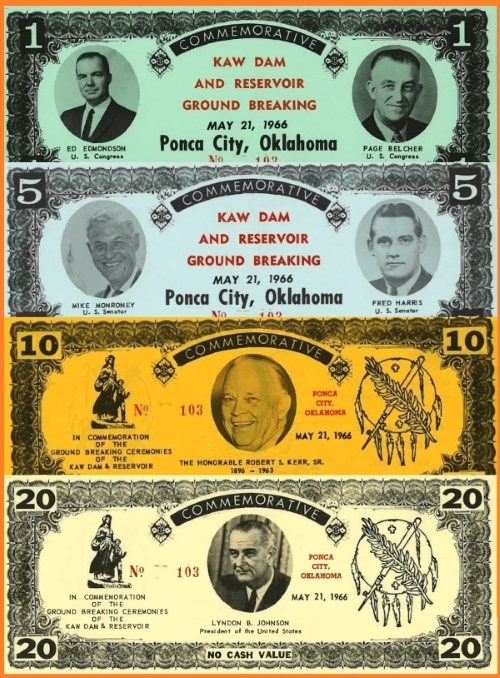
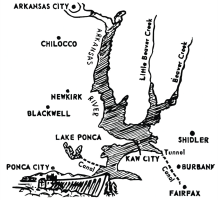
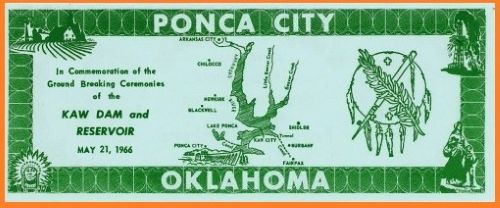
ABOVE: The fronts of the four souvenir notes that commemorated the groundbreaking for the Kaw Dam and Reservoir, which took place on May 21, 1966. It's not known if these novelty items were sold or simply given away for the occasion. BELOW: The back common to each note. Interestingly, the schematic map depicted includes two canals--one to Lake Ponca, the other to Fairfax, Oklahoma--that do not exist. (Image source: author's collection).
Origins of the Kaw Dam Project
The initial idea for what became the Kaw Dam project may have originated with Kerr himself, who showed interest in developing the Arkansas River Valley during his years as governor. The first formal proposal for the project was made in 1957 when, in the wake of floods that Spring along the banks of the Arkansas River, the mayor of Ponca City and other Kay County leaders requested that the U.S. Army Corp of Engineers undertake a feasibility study for the construction of a dam and reservoir that would contribute to flood control, watershed development and irrigation needs; assure adequate public water supplies; and enhance boating and other recreational opportunities. That year a local lobby group, the Kaw Dam and Reservoir Association (KDRA) sprung into existence, backed by civic and business leaders in Ponca City and Newkirk, the County seat. In particular, the Continental Oil Company, at the time headquartered in Ponca City and the largest employer in the area, threw its weight behind the proposal.
Any plan to construct a dam in this area entailed one inconvenience, which was that the resulting reservoir would inundate Kaw City, a community of about 800 people located on the oxbow bend of the Arkansas River. It would also displace members of the Kaw Nation, a Native American tribe centered in Kay County. In 1959, Kaw City residents and some local farmers facing the loss of their acreage formed the Anti-Kaw Dam Association to oppose the project. Given the overwhelming local support for building the dam, their defeat was a foregone conclusion; once the project became realistic, the prospect of being submerged under forty feet of water effectively killed real estate values and the economy of Kaw City. Over the years its residents put most of their energy into negotiating the best terms they could get for financial assistance in relocating the community to a new site.
Initially, the project made little headway as the Eisenhower Administration was not enthusiastic about pork barrel spending (ironically, during these years Kay County consistently voted Republican, denying even Kerr, patron of the Kaw Dam project, their support). As a presidential candidate, Kennedy was much more sympathetic, promising his support for Kaw Dam during the 1960 campaign. Meanwhile, Kerr had become chair of the Senate Select Committee on National Water Resources; the Democrats’ election victory in 1960 assured that, once the Army Corps of Engineers signed on, Senator Kerr could leverage his influence to get the project authorized and funded. The Corps published its survey in December 1961 and gave its stamp of approval the following February. This gave a green light to the project, although a debate percolated for some years thereafter as to whether a wildlife refuge should be included (the KDRA was against this as it would've restricted recreational access to the shoreline; the refuge never came to be). Kerr was able to get authorization and initial funding for the project tucked into the Flood Control Act passed in October 1962 (Public Law 87-874).
Senator Kerr passed away on New Year’s Day 1963, and Oklahoma’s other (Democratic) Senator, Mike Monroney, assumed the initiative for shepherding the project along. A very young Fred Harris, also a Democrat, won a special election to fill Kerr’s seat in 1964; Senator Harris then assumed a seat on the Public Works Committee and pushed for continued appropriations for the Kaw Dam.
Groundbreaking Day
The official groundbreaking ceremony for the Kaw Dam and Reservoir project took place on May 21, 1966, a Saturday morning, at a site on the west bank of the Arkansas River some seven miles from Ponca City. Businesses in downtown Ponca City closed for the occasion, and an exuberant parade began on its streets at 9am, followed by the ceremony at 11am, to which Ponca Citians streamed in an automobile caravan hundreds of vehicles long. Oklahoma’s Governor Henry Bellmon was in attendance, as well as both its Senators—Monroney and Harris—and the two Congressmen representing the districts adjacent to the project, Ed Edmondson and Page Belcher. Belcher, whose district included Kay County was a Republican, whereas Edmondson, whose district reached deep into the area of Oklahoma known as “Little Dixie”, was a traditional Democrat. Yet as Edmondson declared at the ceremony, “there are no party lines among the Oklahoma congressional delegation when it comes to water development in this state" --especially when it came to unlocking the federal spending that made projects like Kaw Dam possible.
The opening invocation at the ceremony was delivered by Francis Pipestem, chief of the Otoe-Missouria tribe. Resplendent in his traditional regalia, Pipestem led a contingent made up of one hundred members the four Indian nations living in the vicinity of the project (including the Kaws). Most of the dedicatory remarks sang praises of the late Senator Kerr for the role he played in making the project possible; the first spade of dirt was turned over by Senator Monroney using a silver shovel, which he then dedicated to the memory of his departed colleague. While the entire Oklahoma congressional delegation supported the project, Kerr’s importance reflected the basic differences between the Senate and the House when it came to lawmaking. A single senator with enough motivation and seniority could accumulate the committee power to single-handedly make things happen. In contrast, figures like Edmondson and Belcher, even if they did serve on the relevant House committees, were relative cogs in the legislative process. As for what benefits the Kaw Dam and Reservoir would bring to the community, it was left to Brigadier General R. H. Free of the Army Corps of Engineers to explain to the 1500 people in attendance.
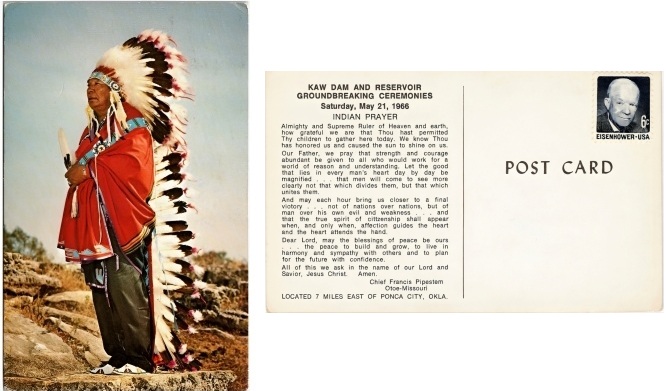
Chief Francis Felix Pipestem (1907-1971) of the Ote-Missouria tribe delivered the invocation for the Kaw Dam groundbreaking ceremony, reprinted on this postcard as the "Indian Prayer." (Image source: Ebay).
The Notes’ Portraits
More than anyone else, Oklahoma’s Robert Samuel Kerr, could take credit for making Kaw Lake possi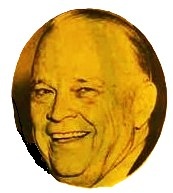 ble. Unlike the younger Oklahoma politicians appearing on these notes, Kerr had a lucrative career in the oil business before entering Oklahoma politics, serving as govenor before entering the Senate in 1949. After an abortive run for the Presidency in 1952, Senator Kerr focused his legislative energies to his state’s benefit, becoming a virtuoso of pork barrel politics. In particular, Kerr’s chairmanship of the Rivers and Harbors Subcommittee of the Public Work Committee in the Senate gave him considerable influence over how public works spending involving water would be allocated. Having a fellow Democrat in the White House after 1960 made Kerr's agenda easier, especially as President Kennedy relied upon Kerr to marshall support for his broader agenda, which assured executive cooperation when it came to public works.
A Republican from an otherwise solidly Democratic state, Page Belcher’s career overlapped consid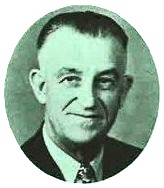 erably with Ed Edmondson’s. He began as a representative of the 8th District which was then merged with the 1st District in a 1952 reapportionment. Thereafter Belcher easily won re-election in this heavily Republican area for the next twenty years, moving his residence when necessary in order to stay within the shifting boundaries of the district. For years Belcher was the lone Republican in Oklahoma's congressional delegation. During an era when Republicans languished as the minority party in the House, the best that Belcher could hope for was that his increasing seniority would allow him to move up the committee ranks. Given the rural plains economy of northern Oklahoma, it was inevitable that Belcher would serve on the Agriculture Committee and specifically its Wheat Subcommittee. Belcher retired in 1972, before the Kaw Dam's completion.
A long-time representative of Oklahoma’s 2nd District, Edmond Augustus Edmondson came from a 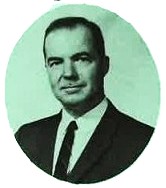 distinguished political family in Muskogee, Oklahoma. After early career forays into law enforcement and journalism, Edmondson earned a law degree and practiced law in Muskogee. His brother, J. Howard Edmondson, served a term as governor and briefly occupied Senator Kerr's seat before losing a special election to Fred Harris in 1964. Two of Ed Edmondson’s sons later served on the Oklahoma Supreme Court and as the state’s Attorney General. As a member of the majority party in the House, Edmondson's senior positions on committees relevant for Indian affairs, mining (important for his district) water resources and public works gave him significant influence over legislation that impacted Oklahoma, especially the McClellan-Kerr project. Edmondson left office at about the same time Belcher did, later running unsuccessfully three times for a Senate seat before retiring to private practice in Muskogee.
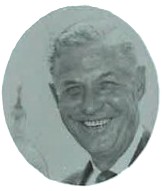 Almer Stillwell ("Mike") Monroney’s Senate career focused on different issues than Kerr's, notably space and aeronautical policy. In particular, Monroney drafted and sponsored the 1958 legislation that created the Federal Aviation Agency (the FAA's Aeronautical Center in Oklahoma City is named after him). Monroney first served a dozen years in the House, where he was crucial in passing the Legislative Reorganization Act of 1946 which, paired with the Administrative Procedures Act of that year, created the structure of the modern Congress and defined the powers of the modern administrative state. In 1950, Monroney bested Oklahoma's venerable Senator Elmer Thomas in a primary contest, then coasted to victory in the general election. More so than Kerr, Mike Monroney left his mark on American foreign policy, both in his House and Senate careers. Monroney retained his Senate seat until 1969, when he was ousted by former Governor Henry Bellmon.
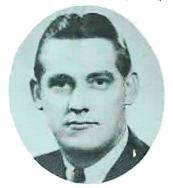 Fred Harris, Oklahoma’s junior senator, had been in office barely two years, having beaten Ed Edmondson’s brother in a primary contest, and then Republican Bud Wilkinson in the general election held in 1964 to fill the last two years of Kerr’s term. Although all the Democrats in the Oklahoma congressional contingent were more moderate than their counterparts in the deep south (none of the Oklahomans signed on to the anti-civil rights “Southern Manifesto”, for example), Harris carved out a distinctive political niche as a left-wing populist, a stance that put him at increasing odds with a more conservative Oklahoma electorate. Harris left the Senate in 1972 and, after a brief and rather quixotic run for the Presidency, exited electoral politics by the time the Kaw Dam was completed in 1976.
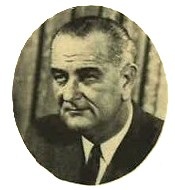 President Lyndon Johnson appears on these notes only because he happened to occupy that office at the time of the groundbreaking ceremony. Other than signing the necessary appropriations bills in which Kaw Dam funding was embedded, and serving atop the executive branch, which includes the Army Corp of Engineers, Johnson had no direct connection to what was a minor public works project. Invited to the ceremony, the President did not attend, spending the day of May 21, 1966 instead in private rest, at the Camp David compound in Catoctin, Maryland.
Kaw Lake Today
After the groundbreaking ceremony, two years passed before dam construction began in earnest. Assisted financially through a benevolent intervention by a local oilman named David Morgan, Kaw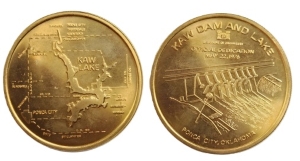 City was relocated a couple miles to the west of its original location, losing about half of its 1960 population in the process. For the rest of the decade, local authorities squabbled with the Army Corps of Engineers about how many bridges would be thrown across the future waterway. By the time President Nixon dedicated the McClellan-Kerr Navigation System in 1971, Kaw Dam was only twenty percent complete. Impoundment of water behind the dam began in 1975. Some twenty years after the project was first formally proposed, President Ford signed a bill that appropriated the last slug of money for the project. Estimated to cost about $87 million in 1966, the project topped out at $110 million, an overrun which was not egregious, mostly reflecting the quickening pace of price inflation during these years. Ultimately, the Kaw Dam and Reservoir project cost about a tenth as much as the McClellan-Kerr System, Kerr’s legacy achievement.
Kaw Dam and the reservoir filling behind it were completed in May 1976, a decade almost to the day after the groundbreaking ceremony. A commemorative token, just as obscure as the souvenir notes illustrated above, was issued to mark that occasion. In 1989 the Oklahoma Municipal Power Authority acquired the substructure to the dam and installed hydroelectric capacity that now furnishes power to local utilities. Otherwise, Kaw Dam and what is now Kaw Lake do exactly what they were designed to do, in terms of flood control and water management. In addition, Kaw Lake supports Oklahomans' quasi-constitutional right to recreational boating, as well as offering locals a congenial place to camp, fish, and swim.
REFERENCES
Daily Oklahoman, May 18, 1966; May 22, 1966 (Edmondson quote).
Encyclopedia of Oklahoma History and Culture, Oklahoma Historical Society, for basic biographical information about Page Belcher, Ed Edmondson, Fred Harris, Robert S. Kerr, and Mike Monroney.
https://www.okhistory.org/publications/encyclopedia
Lowitt, Richard, “Forty Feet Under: Kaw City and the Kaw Dam Project on the Arkansas River, 1957-1966” Chronicles of Oklahoma (Winter 2006), pp. 388-425.
Tulsa World, May 22, 1966.