Sattler Scrip of Buffalo, New York
IN THE SHIFTING LANDSCAPES of American retailing, department stores occupied a commanding position from the late 19th to the mid-20th century. Their importance also reflected the centrality of urban downtowns to American commercial life. In city after city, department stores like Macy’s in New York, Filene's in Boston, or Marshall Field’s in Chicago represented pinnacles of retail experience and reigned as symbols of those cities’ cosmopolitan vitality.
For Buffalo, NY, a mid-tier city whose population peaked at just over half a million by 1950, that iconic institution was Sattler’s Department Store. Founded in 1889 as a shoe business by John G. Sattler, after 1926 the store began expanding into clothes and then into many other merchandising lines over the years, including food and home furnishings. Its location at 998 Broadway placed it in a Polish neighborhood on Buffalo’s east side, about two miles from the city’s downtown.
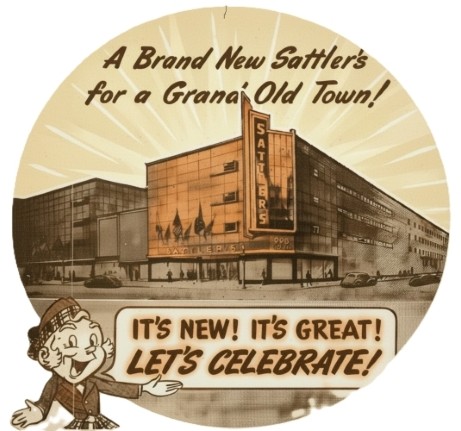
In 1927, John G. Sattler’s son-in-law, Charles Hahn Jr., took over running the business. Hahn in turn hired a young newspaperman named Robert S. Cornelius to manage the store’s promotional strategies and advertising campaigns. It was Bob Cornelius who masterminded Sattler’s distinctively manic merchandising style. A scrappy discount retailer located at some distance from downtown pedestrian traffic, Sattler’s under Cornelius resorted to over-the-top spectacles to draw crowds to its premises. The store brought in elephants and tightrope walkers; hosted a live wedding in its display windows; sponsored visits by television and radio celebrities; and held a guessing contest for the correct weight of the world’s largest hunk of bologna. Sattler’s was a constant and heavy user of advertising space in local newspapers. Beginning in 1937 it also inundated the local airwaves with its “9-9-8 Broadway” radio jingle, various versions of which became earworms for Buffalonians over the next twenty-five years. The year 1947 inaugurated the peak period for Sattler's as it opened its renovated and expanded store at the 998 address.
At around this time, Sattler’s also introduced a distinctive form of store credit, Sattler Scrip, which circulated across its counters in one form or another for nearly thirty years.
The Origins of Sattler Scrip
Frequently mistaken for depression-era local currency, Sattler Scrip was, in fact, anything but that. Whereas the various kinds of emergency monies and clearinghouse notes issued during the 1930s served to address some aspect of the economic crisis of those years, Sattler’s merchandise certificates were actually a reflection of post-World War II consumer abundance. Introduced in late 1946, Sattler Scrip functioned as a flexible form of consumer credit before store charge cards and credit cards came into widespread use. More than a premium plan (earned by purchases) or even a gift certificate service, Sattler Scrip represented a form of local money that not only passed across the counters of Sattler’s department store but also circulated within the wider Buffalo community.
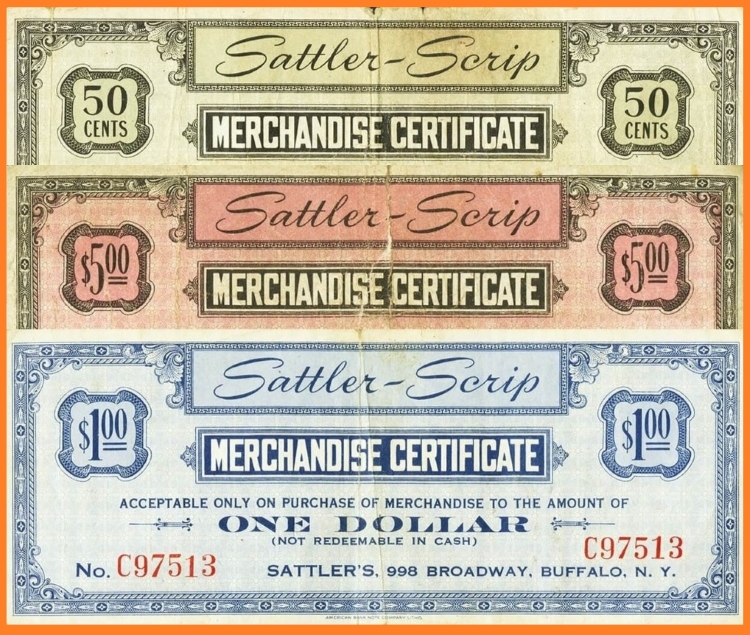
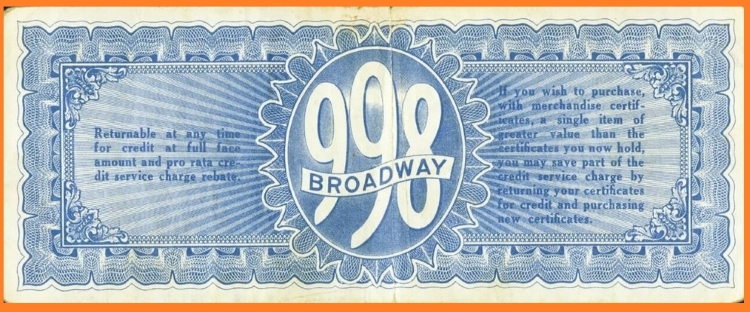
ABOVE: The three known denominations of Statler Scrip first issued in late 1946, printed by the American Banknote Company, each differing from the other only in their values and colors. BELOW: The reverse of the $1.00 certificate, which features some description of how Sattler Scrip operated (Image source: Heritage Auctions).
As the store’s tutorial advertisements in 1946 instructed the public, shoppers interested in purchasing goods now but desiring to make payment later could do so using Sattler Scrip. Customers wanting supplies of the store’s certificates visited the store’s budget office where, after providing suitable identification, they set up what amounted to charge accounts. For a one dollar “service fee”, paid upfront in cash, a customer received twenty dollars’ worth of Sattler Scrip merchandise certificates. These certificates could then be used anywhere in the store the same as regular money. By acquiring Sattler Scrip, the customer committed to a plan whereby that twenty dollar balance (or multiples thereof) would be paid off, on terms as long as six months. If the customer paid the balance owed within thirty days, Sattler’s would offer to refund the one-dollar fee.
Sattler Scrip was, in effect, a form of store credit that allowed customers to purchase on time. The terms, as described, seem to have been generous. Sattler’s advertising never mentioned any interest 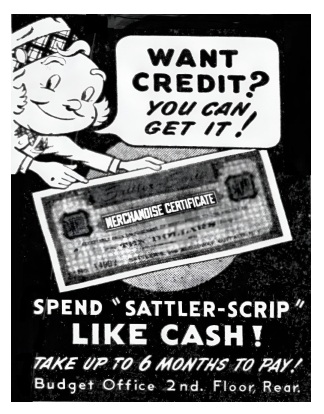 charges owed on customer balances other than the initial fee. Thus, for customer purchasing, say, $100 worth of certificates with a five-dollar fee and paying off the balance over six months, that fee represented a 10% annual interest rate (assuming they did not pay off the balance within thirty days). The plan was easy for the company to manage, since it did not need to calculate interest on variable balances in order to bill its customers. At the same time, Sattler Scrip was flexible enough to resemble a revolving credit line. The language printed on the back of each note explained how that would work. Anybody with a Sattler Scrip account could return their remaining certificates (rather than using them to buy anything) for full credit against their balance due, even receiving back a prorated portion of their original service fee. Conversely, anyone needing more certificates than they currently possessed in order to purchase some expensive item could roll their outstanding certificate balance into a new, larger issue, and receive a discount on the new service fee by applying the prorated refund on their previous fee.
From the newspaper advertisements appearing in late 1946, it was not clear what Sattler’s would have charged on those scrip accounts which, after six months, might still have unpaid balances.
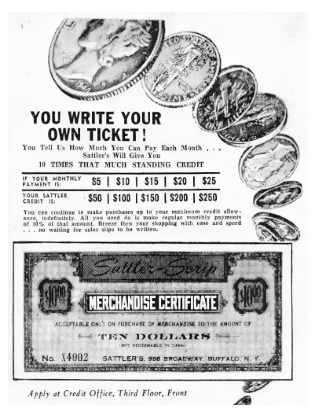
Nonetheless, it seems apparent that the department store did not intend to charge interest to customers simply for the convenience of having Sattler Scrip in their pockets. Advertisements from 1954 stressed that its merchandise certificates came with no interest or carrying charges. In another explanation of the company’s terms from early 1958, a scrip customer needed only to specify how much of a monthly payment they could afford to make; Sattler’s would then issue merchandise certificates to ten times that amount. No mention was made of service fees. In sum, Sattler Scrip served as a convenient form of store credit or layaway plan, granted on easy terms, that was meant to stimulate consumer sales.
For at least thirty years after its introduction, Sattler Scrip not only enabled customers to buy now and pay later but figured in a number of the store’s incessant marketing gambits. Typically, merchandise certificates were handed out as prizes in some offbeat or oddball contest. For example, in 1959, the store gave out Sattler Scrip to selected owners of cars, identified by their license plates, sitting in the store’s parking lot. Other promotions involving Sattler Scrip appealed to juvenile audiences. In 1961, Sattler’s put on a “Search for Dondi” contest that awarded certificates to that youngster who most resembled the child actor David Kory, who starred as the Italian war orphan “Dondi” in a highly sentimental (and rather forgettable) 1961 film of that same name. That same year, certificates were up for grabs in a paint-by-numbers scheme held on the store’s premises. Other kids-oriented events that involved scrip payouts included “Mother of the Month” 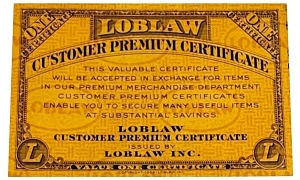 (1962) and “Draw Your Mother” (1966). During the 1963 Christmas season, Sattler’s offered customers who saved money through their banks’ Christmas plans the opportunity to cash their holiday checks at the store, giving them a 5% bonus if they accepted Sattler Scrip. In 1964, Sattler’s cross-marketed its certificates with the premium coupon of another Buffalo retailer, the Loblaw grocery chain, by offering to redeem every dollar’s worth of Loblaw’s coupons with $1.25 worth of Sattler Scrip. The store's merchandise certificates were such a familiar feature of Buffalo's retail scene that they even put to use outside of the store. For example, Lovejoy Motors of Buffalo regularly advertised that it would give away $50 in Sattler Scrip to anyone buying a used car.
The End of Sattler’s Department Store and its Scrip
Implemented at the high point of the company’s history, Sattler Scrip persisted in one form or another for at least thirty years. Advertising references to its use appear in Buffalo newspapers as late as 1976, just a few years before the store closed for good. The decline of Sattler’s Department Store over this period was mirrored in the waning fortunes of Buffalo as a city. Beset by the hollowing out of its industrial economy and the growth of suburbs, Buffalo’s urban core hemorrhaged people. From its peak population of over half a million at mid-century, over the next fifty years Buffalo shrank by half. In response to these challenges, Sattler’s struggled to adapt. Charles Hahn, Jr., John Sattler’s son-in-law who ran the store during its best years, sold his interest in 1953 to Associated Investors, a Buffalo group. The new owners turned Sattler’s into a chain, opening suburban locations in an attempt to chase customers to where they had relocated. The company further diversified by establishing a separate chain of drugstores and sought to expand outside of Buffalo by acquiring Kern’s in Detroit-- a brief and unhappy experience.
As detailed above, Sattler Scrip appears to have been a regular feature of the store’s marketing campaigns during the 1960s. However, it is likely that the way its merchandise certificates were used had changed by then. Like other retail establishments, Sattler’s had to adapt to the changing payments habits of its clientele. Beginning in 1960, Sattler’s made available to its customers a charge card administered by the Midland Shoppers Credit Service, an affiliate of the Marine Midland Company. Doing so seemed to render the original purpose of Sattler Scrip, which was to facilitate layaway purchases, obsolete. That its use persisted suggests that, by this time, Sattler Scrip was issued mostly in conjunction with the store’s various promotional efforts and had become nothing more than a gift certificate.
Related to questions about its changing use was how its appearance may have changed over time. When introduced in 1946, Sattler Scrip came in 50 cent, 1 Dollar, and 5 Dollar denominations (newspaper advertisements like the one reproduced above featured a 10 Dollar denomination, however this author has never actually seen one). While this denominational range might have been appropriate for 1946 prices, it seems odd that the certificates’ face values would never have been adjusted to account for the considerable price inflation that took place over the next thirty years. Prizes offered in various contests sometimes amounted to $50 or $100 in merchandise certificates; however it's not known if these prizes were simply paid out in multiples of the original denominations. Unfortunately, aside from their serial numbers, there are no other characteristics of these notes that give any hint as to when they were printed and issued. Indeed, it seems strange that, for a feature of the store’s shopping experience as enduring as this, more effort wasn’t put into embellishing or freshening up the look of Sattler Scrip over the years, given the creative energy that Sattler’s put into so many of its other promotional stunts. Unless there are as-yet unknown denominations and varieties to be discovered, these aspects of Sattler Scrip will remain obscure.
Despite its efforts to expand and diversify beyond its original location, Sattler’s financial situation grew dire. In 1976 the chain was purchased by Firstmark Corporation, a Buffalo-era holding concern, which failed to turn it around. Three years later Sattler’s was acquired by United Department Stores, whose own bankruptcy forced Sattler’s into liquidation in 1982. A tragedy for Buffalo, this experience was not peculiar to it. Sattler's demise was reprised in the disappearance of department stores in other, comparable cities-- Tiedtke’s in Akron (closed 1973), Shillito’s in Cincinnati (1986), or Himelhoch’s in Detroit (1979) --and in urban retailing markets across the country.
Sattler’s landmark store at 998 Broadway, vintage 1947, was then demolished forty years later and replaced by a K-Mart, which in turn went under in 2002. The latest commercial enterprise to occupy that storied address is an Aldi’s grocery store—also a discount retailer, but operating with far less fanfare than its predecessor.
..........
REFERENCES
Buffalo Courier-Express, November 19, 1961; November 8, 1962.
Buffalo Evening News, October 30, 1946; November 29, 1946; November 25, 1953; March 23, 24, 1954; August 21, 1956; January 24, 1958; May 1, 1959; March 23, 1961; November 16, 1963; March 26, 1964; March 26, 1965; April 2, 1965; May 4, 1955; August 27, 1976.
Cornelius, Robert S. “A Merchant Looks at ‘Greatest Show’” Box Office, April 19, 1952, pp. 4-5.
New York Times, February 8, 1960 (Sattler’s introduced charge cards).
Rizzo, Michael F., Nine Nine Eight. The Glory Days of Buffalo Shopping (Lulu, Inc., 2007), pp. 135-149.
Spitzer, Harry, “The Jingle is Old, But So is That Sound in the Cashbox” Broadcasting, February 20, 1961, p. 22.
Wall Street Journal, June 30, 1953; July 27, 1976; August 6, 1979 (purchase and sale of Sattler’s by Firstmark).