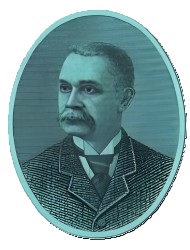
William F. Airey, Writer of Checks
AS MRS. FRANKLIN P. CATOR, head of the Baltimore YWCA, recalled of their initial meeting one day in early 1918, the elderly man had been waiting in the lobby of its headquarters for nearly two hours before Cator was able to see him. The patient stranger explained his story. Because of heart trouble he felt he had not long to live and endeavored to draw up his will. A bachelor, the man had learned of the YWCA’s good work through the praises of his young housekeeper and wondered if the YWCA accepted legacies. The stranger then proposed to Mrs. Cator: “What would you think of $200,000 as an endowment?”
Although the man later met with Cator only twice more before his death in 1920, to the astonishment and consternation of his family, who later sought to break the will, William F. Airey bequeathed almost his entire estate to the Baltimore YWCA. A fixture of Republican Party politics in late nineteenth century Baltimore, Airey had gained a reputation as a reliable dispenser of cash and favors in the partisan struggle for power. By the standards of the time, Airey was no idealist. He was a dutiful machine politician, disdaining mugwumpery and any fashion for civil service reform. He operated in a political world defined by ambition and patronage. Yet at the end of his life he made an extravagant gesture that seemed so out of character with the calculative and self-interested political world in which he had dwelled.
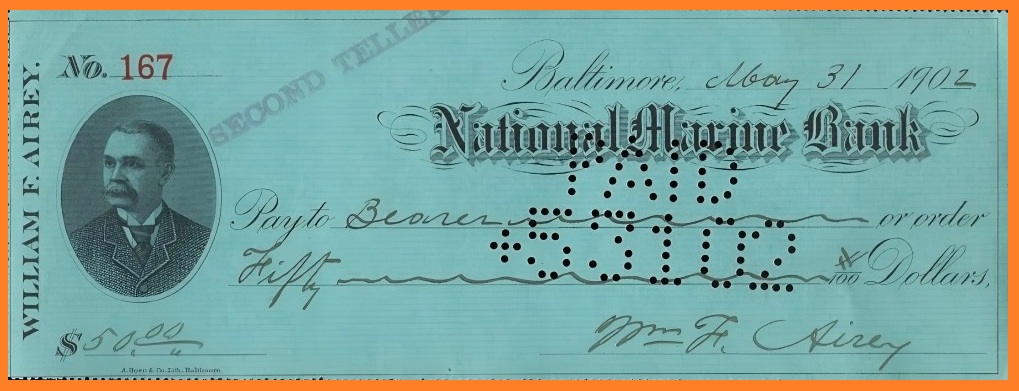
Like many other surviving examples of Airey's checks, this one is made out to "bearer" and in a round amount, suggesting that Airey used them as routine tools of political influence or to provide financial support to political allies (Image source: author's collection).
Baltimore Politics of the Late 19th Century
To be a Republican in late 19th century Maryland politics was a prolonged exercise in frustration. A border state during the Civil War, public sentiment in Maryland was sharply divided in its allegiances (one of the few personal facts known about Airey was that his father supported the Confederacy, while the son was a Union man). While the state’s Democratic Party was suppressed during that conflict, it quickly regained control of the legislature by 1867 and pushed through a new state constitution that same year which restored voting rights to white Confederate loyalists.
For the next half century, the Democrats generally remained in control of both the Maryland state government and the City of Baltimore. During this era, the core arrangement assuring Democratic dominance was a political machine run by Arthur P. Gorman and Isaac Freeman (“Free”) Rasin. Gorman, a prominent “Bourbon” Democrat who served as a U.S. Senator for Maryland, ran the machine at the state level, while Rasin was boss of the Democratic organization in Baltimore. The Democratic reign was punctuated only by Republican victories that ushered in the Governorship of Lloyd Lowndes (1896-1900) and, in Baltimore City, the Mayoralties of Alcaeus Hooper (1895-97) and William T. Malster (1897-99).
As with machine politics elsewhere in late 19th century America, allegiances and factions were built upon a sturdy foundation of patronage. According to Frank R. Kent, a contemporary journalist and close student of Maryland politics, money was the lubricant of Maryland elections to an uncommon degree. As a border state with a large free black population in Baltimore that existed before the Civil War, Maryland was never able to institute a Jim Crow regime in the way that states in the deep South did. As a result, blacks remained a factor in state and municipal elections. While election fraud and voter intimidation were certainly parts of the Democratic toolkit, the Gorman-Rasin combination relied more on financial incentives to assert its control. Whites were paid to vote; blacks were paid not to vote; and, in Kent’s opinion, “in no State in the Union anywhere near the size of Maryland has as much money been spent in elections as here.” The Democrats had the money advantage thanks to their connections with New York City politicians. In contrast, Republican coffers swelled only after 1896, when the party’s national organization created a fundraising machine. The Baltimore & Ohio railroad, a player in Maryland politics for its own reasons, helped at this time by throwing its weight behind Republican candidates.
Kent identified the low point in Republicans’ fortunes as the years 1867-82, when their party had difficulties even finding suitable candidates at all to run for office. Only after the “Potato Bug” campaign of 1875, which exposed fissures in Democratic ranks, did Republicans find opportunities for “fusion” candidates: either independent Democrats willing to break away from the Gorman-Rasin machine, thus earning Republican support, or Republicans who were electorally palatable to those same independents. Even then, the political genius of Rasin inhered in recognizing when to tolerate and promote independent candidates on the Democratic ticket so as to channel those reformist sentiments to the machine’s benefit, a tactic Rasin called “perfuming” the ticket.
Throughout this era of Democratic hegemony, the one, countervailing advantage for Maryland Republicans flowed from their party’s relative dominance in national politics and in particular the office of the U.S. Presidency which, apart from Grover Cleveland’s two terms, remained in their control, thus assuring a stream of federal patronage appointments. Indeed, with dim prospects for controlling either Baltimore City or the Maryland statehouse, Republicans devoted much energy to squabbling among themselves over their access to federal patronage, dividing into factions— “Post Office” versus “Customshouse” Republicans—that reflected the types of federal jobs to which they aspired.
The Life and Career of William F. Airey
It was in this unpromising environment that William Francis Airey charted his political career.
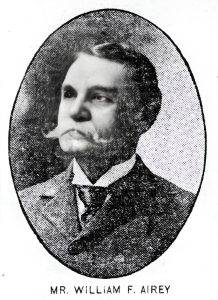
Personal details about his life are scanty. Born in Baltimore in 1838, Airey got his education, including some college, locally. He never married. Later in life he lived with an aunt and, after she passed, resided at the same house with Beulah Redmond, his housekeeper who at the time of Airey’s death was in her mid-twenties. It is unclear what line of work or profession Airey followed outside of the roles and offices that defined his decades as a Republican party stalwart. The considerable wealth that he possessed at the time of his death came not from any business or professional activity distinct from his political career. Rather, over the years Airey patiently accumulated various holdings in Baltimore real estate, using his close knowledge of the city to guide his investments.
William Airey engaged in city politics from his perch at the top of the Baltimore Third Ward Republican organization, a leadership role which he buttressed by serving for over thirty years as President of the Handsome Young Men’s Club (usually referred to as the H.Y.M. Club), an east Baltimore social group. Airey was also President of the Baltimore Eastern Free Dispensary, a charitable organization that provided free medical services and prescriptions to local residents. During the 1880s Airey chaired the Republican City Committee and was a member of the party’s State Central Committee, where he represented the First Legislative District (which included Ward Three).
Frank Kent describes the years between 1883 and 1887 as the height of Airey’s influence within the Republican ranks, when “he was practically the city boss” for his party. Elected chairman of the Republican City Committee in 1879 and re-elected unanimously in 1883, Airey took advantage of Democrat disunity to keep the Republicans electorally relevant. In 1882, Airey threw the Republicans behind the “New Judge” movement, an independent rebellion against the Democrats’ machine candidates for judgeships that succeeded in kicking out the regular Democratic ticket. Airey himself scored an outstanding electoral success in 1883, when he won as a fusion candidate in the contest for Sheriff of Baltimore City, a two-year term. This was Airey’s one stint in elective office his entire career.
By 1888, Airey’s attempts to climb in the ranks of the state Republican organization were stymied by rivals within the party. As a consolation, Airey was selected as a delegate to the Republican national convention of 1888, which chose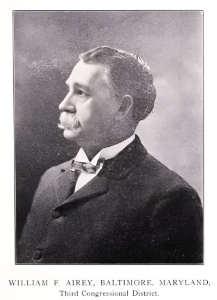 Benjamin Harrison. In exchange for his support at the convention, Harrison bestowed upon Airey the plum political appointment as U.S. Marshal for the District of Maryland, a position whose responsibilities were not unlike Airey’s experience as Baltimore Sheriff, and which brought with it a budget enabling him to make his own patronage hires of subordinates. Grover Cleveland’s victory in 1892 lost him this office, but Airey served again as a delegate to the 1896 national convention. McKinley’s triumph that November returned the Republicans to the White House and resulted in Airey’s reappointment as Marshal in 1898. Upon regaining that office, Marshal Airey earned plaudits from regular Republicans for his willingness to fire all the deputies employed by his Democratic predecessor and hire Republican replacements, even though civil service norms emerging at that time sought to prevent this from happening.
Airey’s tenure as Marshal was cut short when his reappointment in 1902 was challenged by Republican Representative Frank Wachter, who had won Maryland’s Third Congressional District and backed his own candidate for Marshal. Third District Republicans were solidly for Airey and the animosity between the Airey and Wachter forces welled up in the Republican City Committee, spilling over into the various Republican club meetings. This was a purely intramural spat between two party factions, a rather ordinary event in Baltimore’s politics (indeed, a year later Wachter and Airey patched up their differences, and the political game went on). Nonetheless, the dispute while it lasted occasioned remarks by Levi A. Thompson, the head of one such club who spoke before a group of Airey supporters. Thompson’s defense of Airey, reprinted by the Baltimore Sun, gave an extended characterization of what Airey meant for the Republican Party during that era of Baltimore politics:
What Mr. Airey has Done
Mr. Wachter asks the question, what has William F. Airey done for the party? I will tell you what William F. Airey has done for the party. From 1873 to 1883, during the darkest days in the history of our party, he carried its banner; he was at the head of its organization; he went down into his own pockets and furnished money for years for hall rent, stationery, stamps and everything else when there was not enough money anywhere else in the party to buy a stamp. This is what William F. Airey has done for the party.
Moreover when Louis E. McComas, now United States Senator, was a candidate for Congress in the Sixth District, Marshal Airey sat down in this room at this very desk and wrote out a check, which he sent to McComas to aid him in winning his district.
Last fall, when we needed every dollar we could get and were laboring hard to prevent the return of the Hon. Arthur P. Gorman to the Senate, after giving money in every one of these lower wards and sending money into different parts of the State, Mr. Airey sat at his desk right here and wrote out a check to the order of Phillips Lee Goldsborough, chairman of the Republican State Central Committee, ‘to help you, Mr. Goldsborough, in carrying Dorchester county, where things seem uncertain.’ This is one of the things William F. Airey has done for the party.
When William McKinley was a candidate for Governor years ago in the State of Ohio, Mr. Airey sat at this desk and wrote a check, which was sent to him, to aid in carrying his state.
These are the kinds of things he has done, and yet Mr. Wachter asks what has William F. Airey done for the Republican Party.
What has he not done? When he was appointed United States Marshall he left not a Democrat in his office, in spite of the appeals of the most powerful sort which were made to him. In 1888 [sic - 1883], when it was difficult to get a Republican to become a candidate, he was nominated for Sheriff and ran 9,000 votes ahead of his ticket …
But two things on earth prevented him from being reappointed United States Marshal. One of these things was the assassin’s bullet and the other thing was the ingratitude of Frank Wachter to the Republicans of this district.
Thompson’s tribute to Airey appeared in a newspaper from August 1902. It is impossible to know for sure, but the check illustrated below, dated September 18, 1901 and made out to “P. L. Goldsborough, Chairman” may actually represent the very same payment mentioned in the passage above. In the light of Thompson’s remarks, Airey’s surviving checks appear not merely to be the private residues of a man’s personal finances but mark the very trail of his political career. Each one of these checks, featuring a portrait of the man and for the most part made out to “bearer” in some round dollar amount, served both as Airey’s calling card and a recorder of the particular monetary favor which Airey, the political operative, was dispensing for the occasion.
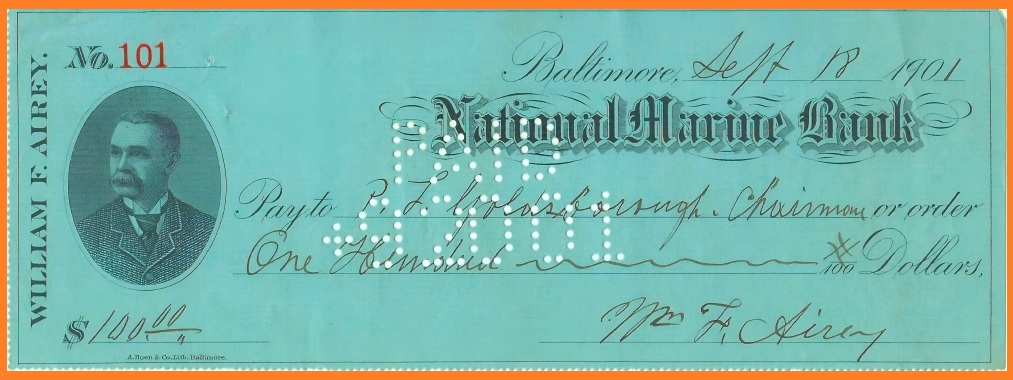
This particular payment, made to Phillips Lee Goldsborough, Chairman of the Republican State Central Committee, may be the very same check referenced in the newspaper extract above (Image source: author's collection).
Airey’s Later Years and the Controversy Over his Will
William F. Airey’s second term as federal Marshal ending in 1902 was the last public office he held. A brief boom for his candidacy as Mayor of Baltimore soon fizzled out and Airey returned to being a factional leader in Republican city politics, typically supporting “regular” candidates over those with a more progressive bent. From the relative paucity of mentions of his name in the Baltimore Sun after the early 1900s, it seemed that Airey had stepped back, if not retired, from active involvement in politics; most references to him in newspapers concerned various real estate investments he was making. Arthur Gorman died in 1906 and “Free” Rasin in 1907; the Democratic machine that had dominated Baltimore in the late 19th century gave way to a more variegated politics of a new generation. In early 1907 Airey’s aunt, Talitha A. Jack, passed away, and Airey continued living at their residence along with Beulah Redmond, his housekeeper.
With his death in 1920 at the age of 82, the revelation of Airey’s will and his intention to leave his estate to the YWCA shocked his immediate family. The estate was officially valued at $195, 075.82, two thirds of which consisted of promissory notes and cash in the bank, while a third represented less liquid real estate investments. As the Baltimore Sun observed, Airey’s conservative investments disdained stocks and bonds entirely: “not even a Liberty Bond is listed among his effects.” By the terms of Airey’s will, dated August 5, 1918, $1,000 would go to the Caroline Street Episcopal Church, where his aunt had worshipped. Beulah Redmond would be provided $400 annuity for the rest of her life, while the bulk of his estate would go to the YWCA to be invested until it reached the sum of $200,000, at which point it would be designated the “William F. Airey Endowment Fund”, the interest from which would fund the YWCA’s various activities. Airey’s will also stipulated that the YWCA place a picture of him in its building and hold a brief ceremony each year in his memory, on January 28, his birthday. Finally, to Airey’s family, which by then consisted of a sister, a number of nephews and nieces and some distant cousins, were bequeathed sundry personal effects of little monetary value.
Airey concluded his will by quoting verse from the poet George Gordon Byron:
Here’s a sigh to those who love me,
And a smile to those who hate;
And whatever sky’s above me,
Here’s a heart for every fate.
For their part, Airey’s relations did not appreciate the generous sentiment of that poetic flourish. Astonished at being cut out of his estate, Airey’s sister, joined by three nephews, brought legal action to break the will, alleging that her brother had not been of sound mind and that Beulah Redmond had somehow turned her brother against the family. This was an awkward argument to make, as the housekeeper herself wasn’t given a particularly extravagant legacy under the will. If she had indeed exercised undue influence, it wasn’t to her own personal benefit. Evidence adduced from Airey’s diary and from relatives’ testimony that he had meant to leave his estate to his family—he had paid his sister’s rent, for example, and had handled a niece’s college expenses—also suggested that he was overall simply a generous person. Other details introduced from his personal papers, such as the small record book in which he meticulously recorded the number of mice caught in his house over the years (the last entry, dated May 14, 1916, brought the total to 1,000) or the poem he wrote to eulogize the passing of his pet canary, were less evidence of an unsound mind than of a bachelor’s harmless eccentricities.
Ultimately, the presiding judge held that, without a wife or children to consider, Airey could do with his money what he wished, and that his relatives’ disappointment alone did not give sufficient grounds to invalidate the will. Throughout his career as a political operative, Airey had written checks to support the causes and campaigns in which he believed. As an extension of this, Airey’s final gesture on behalf of the YWCA simply represented the last, and largest, check he would ever write for the sake of a cause that he likewise deemed good.
Airey’s will was finally probated in April 1921. The YWCA took its time in fulfilling one of Airey’s requests. A full twenty-five years passed before a likeness of Airey was finally unveiled and installed in a second-floor lobby of the building at 128 West Franklin Street, the premises he had originally visited. The portrait was executed by a young painter named Ranulph Bye, whose long career would otherwise focus on watercolor landscapes. Over the years, occasional newspaper accounts noted the annual wreath laying ceremony commemorating Airey’s generosity, the last recorded visit to his gravesite duly taking place on his birthday, January 28, 1960. After that the ritual seems to have lapsed. In 2010, as part of a restructuring of its operations, the Baltimore YWCA sold its old headquarters to the Baltimore Leadership School for Young Women. Where that painting of the YWCA’s forgotten benefactor now resides is not known. However, the name and likeness of William F. Airey persist on the flimsy checks that he once wrote and circulated.
REFERENCES
Baltimore Sun, October 10, 1898; April 23, 1890; June 15, 1902; August 22, 1902 ( “What Mr. Airey Has Done” excerpt); February 22, June 25, August 1, 1903; January 8, 1907; January 6 (obituary), January 6, 1920 (obituary); January 8, 1920 (quote from George Gordon Byron); April 4, 6, 8, 1920; April 5, May 3, 1921; March 5, 1920; April 4, 6, 1920; May 24, 1946; January 28, 1960 (Airey's meeting with Mrs. Cator).
Crenson, Matthew A., Baltimore, A Political History (Johns Hopkins University Press, 2017), ch. 23.
Kent, Frank Richardson, The Story of Maryland Politics (Hatboro, PA: Traditions Press, 1968; originally published 1911), p. 22 (quote about money); pp. 212-13 ("practically the city boss").