Please sign up as a member or login to view and search this journal.
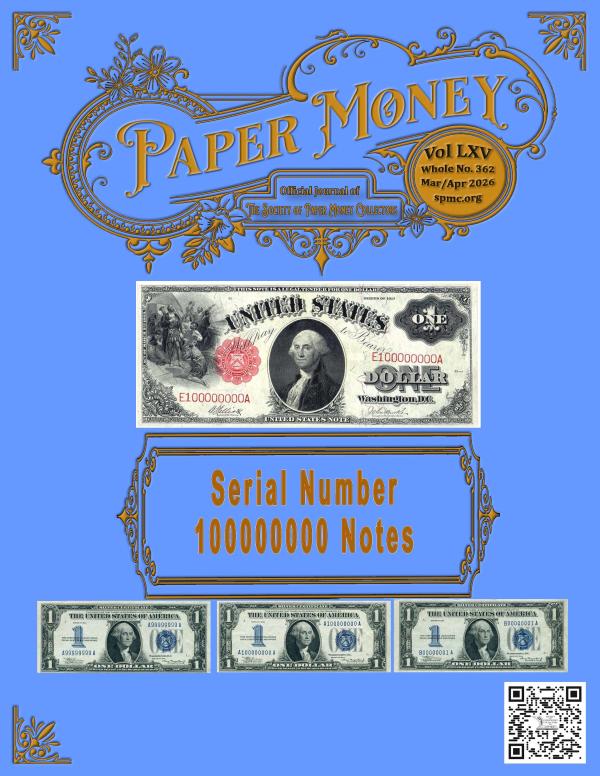
Table of Contents
U. S. Serial Number 100,000,000 Notes--Peter Huntoon
Treasury Vault Robbed--Lee Lofthus
Verandah House Scrip--Charles Derby
Notes of the Jutlandia--Roberto Menchaca
How Congress Nationalized Paper Currency--Lee Eilers
bilingual Improvement and Banking Company Notes--Rick Melamed
Cherokee National Bank--Dave Grant
1883-1884 Postal Notes--Where Ample Rarities Abound--Bob Laub
Ofϐicial Journal of
Serial Number
100000000 Notes
Stack’s Bowers Galleries Presents the
Manhattan Beach Collection
Featured in the Spring 2026 Showcase Auction
March 9-13, 2026 • Costa Mesa, CA
The Official Auction of the Whitman Expos
America’s Oldest and Most Accomplished
Rare Coin AuctioneerCalifornia • New York • Boston • Miami • Philadelphia • New Hampshire • Oklahoma
Hong Kong • Copenhagen • Paris • Vancouver
1550 Scenic Avenue, Suite. 150, Costa Mesa, CA 92626
949.253.0916 • Info@StacksBowers.com
470 Park Avenue, New York, NY 10022
212.582.2580 • NYC@stacksbowers.com
Visit Us Online at StacksBowers.com
SBG PM Spring2026 HLs 260301
Fr. 1609H. 1935A $1 Silver Certificate
Star Note. (R) Experimental.
PMG Gem Uncirculated 66 EPQ.
Fr. 2152-DlgsH. 1934 Light Green Seal
$100 Federal Reserve Star Note. Cleveland.
PMG Gem Uncirculated 66 EPQ.
Serial Number 1.
Fr. 2305H. 1934A $20
Hawaii Emergency Star Note.
PMG Choice Uncirculated 64 EPQ.
Fr. 1700. 1933 $10 Silver Certificate.
PMG Gem Uncirculated 66 EPQ.
Fr. 2211-CdgsmH. 1934 Dark Green Seal
$1000 Federal Reserve Star Note.
Mule. Philadelphia.
PMG Gem Uncirculated 66 EPQ.
Fr. 2011-B. 1950A $10 Federal Reserve Note.
New York. PMG Choice Uncirculated 64 EPQ.
Doubled Print Error.
Fr. 2302. 1934A $5 Hawaii Emergency Note.
PMG Gem Uncirculated 65 EPQ.
Inverted Overprint Error.
Peter A. Treglia
Vice President & Managing Director
of Currency
PTreglia@StacksBowers.com
Tel: 949.748.4828
Michael Moczalla
Currency Specialist
MMoczalla@StacksBowers.com
Tel: 949.503.6244
Fr. 2405H. 1928 $100 Gold Certificate
Star Note. PMG Choice Uncirculated 63 EPQ.
Fr. 2407. 1928 $500 Gold Certificate.
PMG Gem Uncirculated 65 EPQ.
For More Information
800.458.4646 CA • 800.566.2580 NY
Info@StacksBowers.com
LEGENDARY COLLECTIONS | LEGENDARY RESULTS | A LEGENDARY AUCTION FIRM
71 U. S. Serial Number 100,000,000 Notes--Peter Huntoon
78 Treasury Vault Robbed--Lee Lofthus
86 Verandah House Scrip--Charles Derby
91 Notes of the Jutlandia--Roberto Menchaca
102 How Congress Nationalized Paper Currency--Lee Eilers
106 bilingual Improvement and Banking Company Notes--Rick Melamed
94 Cherokee National Bank--Dave Grant
122 1883-1884 Postal Notes--Where Ample Rarities Abound--Bob Laub
SPMC.org * Paper Money * Mar/Apr 2026 * Whole Number 362
65
Columns
From Your President Robert Calderman 67
Editor Sez Benny Bolin 68
New Members Frank Clark 69
Uncoupled Joe Boling & Fred Schwan 111
Cherry Pickers Corner Robert Calderman 116
Dennis Hengeveld 120
124
Foreign Affairs
Chump Change
Small Notes
Quartermaster
Wrong Country
Loren Gatch
Jamie Yakes 125
Michael McNeil 126
Roland Rollins 129
Advertisers
IFC
65
85
89
90
93
Stacks Bowers Galleries
Pierre Fricke
Executive Currency
Greysheet
Whitman Publishing
Dennis Schafluetzel
Higgins Museum 101
109
110
115
123
132
133
FCCB
PCGS-C
William Litt
Bob Laub
SCCS
PCDA
Heritage Auctions OBC
SPMC Hall of Fame
The SPMC Hall of Fame recognizes and honors those individuals who
have made a lasting contribution to the society over the span of many years.
Charles Affleck
Walter Allan
Mark Anderson
Doug Ball
Aubrey &
Adeline Bebee
Hank Bieciuk
Joseph Boling
Q.David Bowers
F.C.C. Boyd
Michael Crabb
Forrest Daniel
Martin Delger
William Donlon
Roger Durand
C. John Ferreri
Milt Friedberg
Robert Friedberg
Len Glazer
Nathan Gold
Nathan Goldstein
Albert Grinnell
James Haxby
John Herzog
Gene Hessler
John Hickman
William Higgins
Ruth Hill
Peter Huntoon
Brent Hughes
Glenn Jackson
Glen Jorde
Don Kelly
Lyn Knight
Chet Krause
Robert Medlar
Allen Mincho
Clifford Mishler
Barbara Mueller
Judith Murphy
Dean Oakes
Chuck O'Donnell
Roy Pennell
Albert Pick
Fred Reed
Matt Rothert
John Rowe III
Fred Schwan
Neil Shafer
Herb& Martha Schingoethe
Austin Sheheen, Jr.
Hugh Shull
Glenn Smedley
Raphael Thian
Daniel Valentine
Louis Van Belkum
George Wait
John & Nancy Wilson
D.C. Wismer
SPMC.org * Paper Money * Mar/Apr 2026 * Whole Number 362
66
Officers & Appointees
ELECTED OFFICERS
PRESIDENT Robert Calderman
gacoins@earthlink.net
VICE-PRES William Litt
TREASURER Robert Moon
robertmoon@aol.com
BOARD OF GOVERNORS
APPOINTEES
PUBLISHER-EDITOR-ADVERTISING MANAGER
Benny Bolin smcbb@sbcglobal.net
Megan Reginnitter mreginnitter@iowafirm.com
LIBRARIAN
Jeff Bruggeman jeff@actioncurrency.com
MEMBERSHIP DIRECTOR
Frank Clark
IMMEDIATE PAST PRESIDENT
Robert Vandevendert
WISMER BOOK PROJECT COORDINATOR
Pierre Fricke
From Your President
Robert CaldermanFrom Your President
Shawn Hewitt
We’re excited to announce the details of our second annual
Florida United Numismatists (FUN) Speakers Forum. In the fashion of our
inaugural seminar last year, we’ll again have a total of five speakers making
presentations, and close out the forum with our SPMC membership meeting on
Saturday morning.
The dates of the FUN convention are January 9-12, 2020 at the Orange
County Convention Center, West Building WA1 & WA2, in Orlando, Florida. The
first four talks are on Friday, January 10 in Room 304F (same as last year).
Here is the lineup… - "The Current
Status of the U. S. Small Size Paper Money Market". – Mr. Calderman, a
specialist and dealer in U. S. small-size type notes will discuss the current
trends in small size notes and the future of this paper money specialty.
- "A Behind the Scenes Look at the Paper
Money Auction Process"–Mr. Johnston, the Vice- President and Managing
Director of the Currency Division at Heritage Auctions will discuss the nuts-
and-bolts of conducting a major Paper Money auction.
"An Overview of the
Confederate Paper Money Market" .
Mr. Fricke has been a long-time dealer in Confederate Paper Money and is the
author of the standard reference on Confederate Paper Money "Collecting
Confederate Paper Money: The Standard Guide to Confederate Money".
"The good, the bad, and the ugly of
antebellum bank note fraud" – Various types of pre-Civil War bank note fraud
will be explored and illustrated.
In addition, at the SPMC Membership Meeting (open to all) on
Saturday at 8:30am in Room 303B we have: - "Overview
of the SPMC Bank Note History Project" - This project is focused on two of
the primary historical aspects of the "Hometown" National Bank Notes - the
Banks who issued them and the bankers who signed them.
I think we’re onto a good thing in making FUN another major venue for
the face of SPMC. Our table will be 867 in the club section of the bourse floor,
so please stop by. Again, this year, we are participating in the ANA Treasure
Trivia Program, which is a great outreach to the youth of our hobby. We have
some very nice world notes to hand out (to young numismatists) as souvenirs
for visiting our table.
Before I go, I should mention that we have a new Membership Secretary.
Robert Calderman, one of our board members, has stepped up to fill the position
recently vacated by Jeff Brueggeman. If you frequent the major shows, you
may have seen Robert at one of our club tables. Robert is great resource for the
Society, and we very much appreciate the work he does for us.
Paper Money * July/August 2020
6
LEGAL COUNSEL
Robert Calderman gacoins@earthlink.com
Matt Drais stockpicker12@aol.com
Mark Drengson markd@step1software.com
Loren Gatch lgatch@uco.edu
Shawn Hewitt Shawn@north-trek.com
Derek Higgins derekhiggins219@gmail.com
Raiden Honaker raidenhonaker8@gmail.com
William Litt
Cody Regennitt
billitt@aol.com
rman andrew.timmerman@aol.comAndrew Timme
Wendell Wolka purduenut@aol.com
frank_clark@yahoo.com
derekhiggins219@gmail.com
SECRETARY Derek Higgins
billitt@aol.com
er cody.regenitter@gmail.com
Up in Punxsutawney, PA… Phil the groundhog officially saw his shadow back on
Monday February 2nd. He was definitely on to something, because even down here
in the warm southern state of Georgia we recently had six inches of snow on the
ground! If you can believe it, down at the Charleston, South Carolina coin show in
the “Low Country” we had three inches of snow fall. Even the sheer thought of this
incoming onslaught quickly created panic into the hearts of the locals.. I genuinely
think some of t ese folks would have actually started running for the hills, if there
were any to be found.. the area is known for having very flat terra . As for the
rest of us, counting in at less than a dozen dealers that remained calm, tayed fo
the final day of the show, and knew deep in our hearts that it was going to be okay,
we thoroughly enjoyed our moments in Charleston’s winter wonderlan for the
very brief time that it last d. To our surprise, th re was a great dive bar s eakhouse
that despite the s ow falling was actually open on Saturd y night! The gre t food
and excellent service made for a very enjoyable evening. It was strange having six
waitresses for a table of only eight of us, but when you have the entire place to
yourself these things can happen! Were you fortunate enough to attend the Winter
FUN Show back in January? While I do not have the exact numbers, the word on
the street was attendance officially broke a new record of over 14,000 people!
Supposedly this volume of dealers and collectors significantly crushed last year’s
total that was closer to 10,000. Any of the naysayers that say the hobby is in decline
need an attitude adjustment. Our hobby, at least in the state of Florida, sure
appears to be alive and thriving! Our SPMC Breakfast went very well and hosted
another sell out crowd of happy members and guests. The Tom Bain Raffle is
always lots of fun and while I did not take home a huge pile of prizes this year, I
was happy to see many smiling faces take home goodies they won! At one point
there was even a rubber chicken floating around the room!?! Now that we are into
the month of March it is time for you to make plans to be at next year’s FUN Show!
Regardless of the potential irritation of the travel logistics, it is always well worth
the effort to be there. There is some very unfortunate news to share with you.
Collector & Dealer John Parker passed away on Saturday February 7t . There is not
much information to share at this point, but from what I was briefly t ld, it sounds
like he had an aggr ssive form of cancer th t he w s not aware of. John has been a
joyous paper money ambassador for many decades within our obby, yet he and I
met just a very sho t twelve years ago at a Dalt n, GA coi show. At he time, he
lived not to far from me here in metro Atlanta and made it a point to tell me
about the local monthly one-day show that still takes place on Sunday in Marietta,
GA. As time went by and we got to know each other better, he was the person who
encouraged me to dip my toes in the water and consider setting up as a dealer at
our small monthly show. I am very grateful to have known John and owe him a
debt of gratitude for giving me that initial push that has now become a huge
blessing in my life! I will miss seeing John’s smiling face and happy personality at
the shows.
SPMC.org * Paper Money * Mar/Apr 2026 * Whole Number 362
67
Terms and Conditions
The Society of Paper Money Collectors (SPMC) P.O. Box 7055,
Gainesville, GA 30504, publishes PAPER MONEY (USPS 00‐
3162) every other month beginning in January. Periodical
postage is paid at Hanover, PA. Postmaster send address
changes to Secretary Robert Calderman, Box 7055, Gainesville,
GA 30504. ©Society of Paper Money Collectors, Inc. 2020. All
rights reserved. Reproduction of any article in whole or part
without written approval is prohibited. Individual copies of this
issue of PAPER MONEY are available from the secretary for $8
postpaid. Send changes of address, inquiries concerning non ‐
delivery and requests for additional copies of this issue to
the secretary.
MANUSCRIPTS
Manuscripts not under consideration elsewhere and
publications for review should be sent to the editor. Accepted
manuscripts will be published as soon as possible, however
publication in a specific issue cannot be guaranteed. Opinions
expressed by authors do not necessarily reflect those of the
SPMC. Manuscripts should be submitted in WORD format via
email (smcbb@sbcglobal.net) or by sending memory stick/disk
to the editor. Scans should be grayscale or color JPEGs at
300 dpi. Color illustrations may be changed to grayscale at the
discretion of the editor. Do not send items of value.
Manuscripts are submitted with copyright release of the author
to the editor for duplication and printing as needed.
ADVERTISING
All advertising on space available basis. Copy/correspondence
should be sent to editor.
All advertising is pay in advance. Ads are on a “good faith”
basis. Terms are “Until Forbid.”
Ads are Run of Press (ROP) unless accepted on a premium
contract basis. Limited premium space/rates available.
To keep rates to a minimum, all advertising must be prepaid
according to the schedule below. In exceptional cases where
special artwork or additional production is required, the
advertiser will be notified and billed accordingly. Rates are
not commissionable; proofs are not supplied. SPMC does not
endorse any company, dealer, or auction house. Advertising
Deadline: Subject to space availability, copy must be received
by the editor no later than the first day of the month
preceding the cover date of the issue (i.e. Feb. 1 for the
March/April issue). Camera‐ready art or electronic ads in pdf
format are required.
ADVERTISING RATES
Editor Sez
Benny Bolin
Required file submission format is composite PDF v1.3
(Acrobat 4.0 compatible). If possible, submitted files should
conform to ISO 15930‐1: 2001 PDF/X‐1a file format standard.
Non‐ standard, application, or native file formats are not
acceptable. Page size: must conform to specified publication
trim size. Page bleed: must extend minimum 1/8” beyond
trim for page head, foot, and front. Safety margin: type and
other non‐bleed content must clear trim by minimum 1/2”.
Advertising c o p y shall be restricted to paper currency, allied
numismatic material, publications, and related accessories.
The SPMC does not guarantee advertisements, but accepts
copy in good faith, reserving the right to reject objectionable
or inappropriate material or edit copy. The SPMC
assumes no financial responsibility for typographical
errors in ads but agrees to reprint that portion of an ad in
which a typographical error occurs.
Benny (aka goompa)
Space
Full color covers
1 Time
$1500
3 Times
$2600
6 Times
$4900
B&W covers 500 1400 2500
Full page color 500 1500 3000
Full page B&W 360 1000 1800
Half‐page B&W 180 500 900
Quarter‐page B&W 90 250 450
Eighth‐page B&W 45 125 225
My little nurse! She is following her goompa in getting into that
profession. And, her first patient, besides her dog--Ellie, will be--
ME! Yes, on March 10, I will have my right knee replaced
(something I should have done a looooong time ago). Then, my left
one about 4-6 months later. But I know I will be taken good care of
by my RN and will have a lot of computer time! Since it is my right
one, I won't be able to drive for 4 weeks!
In my last column I lamented about how winter had not come to
Texas yet. Well, in January it came and with a vengence. We were
essentially shut down for 4 days, schools and stores closed and
staying indoors. Some say it was the usual Texas overreaction to a
little snow but those of us True Texans know it was due to all you
yankees who have moved down here and think you can drive on
snow but don't seem to realize we get a LOT of ice under that snow.
But I digress. No more dissing those wonderful people from the
north and invaded Texas (we let ya'll win) and on to bigger and
better things paper wise.
Speaking of bigger and better--FUN. FUN '26 was the biggest I
have ever seen. Lines for the general public to get in were incredibly
long. Aisles packed and people buying not just tire kicking. And
then there were the exhibits, especially the 30 case one by our own
treasurer, Bob Moon with >100 serial number 1 New York
Nationals. Wow is all I can say. It was magnificent. I placed two
exhibits and won a second (round silver disks) and third in paper
money (portraits on fractional). Our annual SPMC breakfast and
Tom Bain raffle were full and overall, it was an exciting and fun
time at FUN!
We inducted four people into the SPMC hall of fame. Aubrey and
Adeline Bebee, Glen Jorde and Q. David Bowers. Well deserved
honor for these paper greats. At the SPMC table, we gave away a lot
of information on the society, recruited new members and were
participants in the kids treasure hunt. A lot of kids came by to the
point of having to go buy more notes. They were a real hit,
especially the Venezulaen alligator note.
On a sad note, we have to report the death of three of the greats
in our hobby, Hugh Shull, Larry Falater and John Parker.
Hugh was my all-time favorite paper money dealer. He is the
reason I moved from collecting coins and into paper. He taught me
many things and inspired my like no other. It was always a treat to
see him, Don Fisher and Tom Denly side-by-side tables on the side
wall at Memphis. You could make a day out of just listening to them
tell tales (many very tall) and just a lot of good natured bantering.
I did not know Larry well, only from some of the shows he
attended. John Parker, now he was truly a gem. He was always
talking and did not seem to meet a stranger. I did business with him
at FUN '26, buying a number of vignettes from him. The hobby will
miss all three of them.
Till next time! Look out for those school zones and don't drive and text!
68
The Society of Paper Money
Collectors was organized in 1961 and
incorporated in 1964 as a non-profit
organization under the laws of the
District of Columbia. It is
affiliated with the ANA. The
Annual Meeting of the SPMC is
held in June at the International
Paper Money Show. Information
about the SPMC, including the
by-laws and activities can be
found at our website--
www.spmc.org. The SPMC does
not does not endorse any dealer,
company or auction house.
MEMBERSHIP—REGULAR and
LIFE. Applicants must be at least 18
years of age and of good moral
character. Members of the ANA or
other recognized numismatic
societies are eligible for membership.
Other applicants should be sponsored
by an SPMC member or provide
suitable references.
MEMBERSHIP—JUNIOR.
Applicants for Junior membership
must be from 12 to 17 years of age
and of good moral character. A parent
or guardian must sign their
application. Junior membership
numbers will be preceded by the letter
“j” which will be removed upon
notification to the secretary that the
member has reached 18 years of age.
Junior members are not eligible to
hold office or vote.
DUES—Annual dues are $39. Dues
for members in Canada and Mexico
are $45. Dues for members in all
other countries are $60. Life
membership—payable in installments
within one year is $800 for U.S.; $900
for Canada and Mexico and $1000
for all other countries. The Society
no longer issues annual membership
cards but paid up members may
request one from the membership
director with an SASE.
Memberships for all members who
joined the Society prior to January
2010 are on a calendar year basis
with renewals due each December.
Memberships for those who joined
since January 2010 are on an annual
basis beginning and ending the
month joined. All renewals are due
before the expiration date, which can
be found on the label of Paper
Money. Renewals may be done via
the Society website www.spmc.org
or by check/money order sent to the
secretary.
WELCOME TO OUR
NEW MEMBERS!
BY FRANK CLARK
SPMC MEMBERSHIP DIRECTOR
NEW MEMBERS 01/05/2026
Dues
Remittal
Process
Send dues
directly to
Robert
Moon--SPMC Treasurer
403 Gatewood Dr. Greenwood, SC 29646
You may also pay your dues online at www.spmc.org.
15958 Royce Benson Tuttle,
15959 David Klopp, ChatGPT
15960 Bob Sandeen, Shawn Hewitt
15961 William Halsne, John Patrick
15962 Michael Rothstein, Whitman Pubs
15963 Scott McNatt, John Patrick
15964 Paul Fedirka, Website
15965J John Isaac, Website
15966 Jeff Euto, Website
15967 Fred Glueckstein, Website
15968 Katrina Hernandez,
15969J Website
15970 Steve Kreps, Website
15971J Eleanor Higgins, Derek Higgins
15972 Philip Block, Frank Clark
15973 David Frohman, Website
15974 Johnny Ostendorf, Don Kelly
15975 James Audette, Caleb Audette
15976 Andy M. Shaw, Robert Calderman
15977 Dayton Johnson, Website
15978 Joshua Nickles, Chi. World Coin Fair
15979 Thomas Shaw, Website
REINSTATEMENTS--None
LIFE MEMBERSHIPS
LM476 David Helfman, formerly 15253
LM477 Cord Polen, formerly 13748
LM478 Matt Draiss, formerly 14097
LM479 David Kranz, formerly 15400
LM480 Donald Scarinci, formerly 15182
LM481 Dale Lukanich, formerly 13407
NEW MEMBERS 02/05/2026
15980 Dan Dunn, Rbt Vandevender
15981 John Andrews, Website
15982 John J. Sideris, Rbt Vandevender
15983 Floyd Murdoch, John A. Parker
15984 Eldridge J. Gendron Jr., Website
15985 John B. Kern, Fred Bart
15986 Stan Bajic, BNR
15987 Will Crouch Jr, Frank Clark
15988 Mark Dowgiert, Frank Clark
15989 David Kayser, You Tube
15990 Cody Falcon, Frank Clark
15991 Greg Morken, Derek Higgins
15592 Tom M. - Website
15993 Peter Rousso, You Tube
15994 Vacant
15995 Michiko Yoshinaga, Website
15996 Jonathan Brookfield, Website
15997 Mathew Miller, Website
15998 Dennis Schafluetzel, Website
15999 Ed Nelson, Fred Bart
16000 Ronald Hedglin, James A. Simek
16001 Blake Hamilton, Facebook
16002 Joe Forsythe, Website
16003 Robert Yantz, Frank Clark
16004 Martin Yeung, Benny Bolin
REINSTATEMENTS
09999 Mike Abramson, Website
LIFE MEMBERSHIPS
LM482 Robin Hill, IBNS
LM483 Derrick Cloud, Facebook
LM484 Bud Melton
SPMC.org * Paper Money * Mar/Apr 2026 * Whole Number 362
69
We have lost a GIANT in the hobby!
Cothran “Hugh” Shull, Jr.
Notable currency dealer and author Hugh Shull passed away in Lexington, SC on December
19, 2025. Hugh specialized in obsoletes and confederate notes. He was Life Member #6 in the
SPMC and was inducted into the Hall of Fame in 2018. He authored “A Guide Book of Southern
States Currency” in 2007. A life member of the ANA, FUN and charter member of PCDA, he
was named a numismatic Ambassador in 1992.
Personal Reflections
Hugh was the first paper money dealer I had extensive dealings with and he was my favorite. I
got my first catalog from him in 1982 when I transitioned from a 20+ year coin collection (because I hated the way coins
were going to TPG) and began a long collecting career of South Carolina Obsoletes. He was always very nice and went
out of his way to teach me about the notes. I always enjoyed going to Memphis and just standing around listening to the
good-natured banter between him, Don Fisher and Tom Denly, who were always on the sidewall next to each other laugh,
tell stories and have fun.
Raiden Honaker of Heritage says “Describing the legacy of Hugh Shull and his incredible influence on paper money
is difficult to put into words, as his involvement of over half a century undoubtedly changed and impacted our hobby for
the better. Hugh was the definition of a Southern gentleman, and I consider myself very fortunate to have known him
and called him my friend. We all owe Hugh our sincere thanks for his dedication to our wonderful hobby and for
educating countless collectors throughout his many years. His passion and admiration for paper money is difficult to
match, and he will certainly be remembered as a true legend. Thank you, Hugh. We miss you deeply.”
From Pierre and Joyce Fricke We were distraught upon hearing Hugh Shull’s passing on Saturday morning
(December 20). We both saw this as a huge loss for the hobby as well as a great friend.
I met Hugh Shull at the 2002 ANA World’s Fair of Money in New York City. My first impression of Hugh was
that he was the consummate southern gentleman with the most charming personality. I had already ordered
from his catalog and was amazed at the breadth and depth of his inventory. We talked for a while about how
to collect CSA paper money, and I traded a couple of things with him. I was a new collector in paper money,
having started in 2001, and I sought his advice eagerly.
After discussing the new book for CSA paper money, I volunteered to take it on. Hugh was instrumental,
helping make the 2005 and subsequent 2008 and 2014 books better than they would have been otherwise.
We always looked forward to seeing him at the Dalton, Greenville and Franklin TN shows and a group of us
would meet on one of the nights at these shows to visit over dinner.
Hugh made paper money collecting more fun and interesting. His photographic memory was amazing. His
fascinating stories drew a crowd at all the coin and currency shows. His depth of knowledge was unsurpassed
so much that when he came up for consideration in 2018 to be inducted into the Society of Paper Money
Collectors Hall of Fame, I supported it enthusiastically.
Robert Gill says My first dealing with Hugh was many years ago. At that time, I had just recently discovered
Obsoletes and had made up my mind to concentrate on collecting them in sheet form. At that time, Hugh took
phone orders only by recording, but for some reason, that day he answered the phone. I told him I was
interested in the sheets, and would get payment out in that day’s mail. But then, for some reason, he said to
me, “ Now you’re sending the payment today… correct? I told him yes. Then he said, “I’m going to trust you
and mail them today.” From that point on, with trust and respect for each other, he and I set out on a venture
of building an Obsolete sheet collection that he said many times would not be achieved again. And it was
during the past year he found the rarest sheet that he ever did for me. And even more prideful for him, it was
a South Carolina sheet!
SPMC.org * Paper Money * Mar/Apr 2026 * Whole Number 362
70
Documentation for
United States Serial Number
100,000,000 Notes
Purpose and Overview
The purpose of this article is to provide all the documentation that we have found in Federal records
that pertains to the production of serial number 100,000,000 notes.
Serial number 100,000,000 notes represent the pinnacle in fancy serial numbers. They haven’t been
made since 1936 so the supply is limited to three dozen or so in collector’s hands and an unknown
population that hasn’t reached the numismatic market yet.
Table 1 is the current census of 100,000,000 notes. This compilation was made with the enthusiastic
help of serial number aficionados coupled with a thorough scouring of auction catalogs dating back to the
famous Grinnell sales of 1946. Especially helpful contributors to this census were Martin Gengerke, Mike
Abramson and Doug Murray.
The earliest that has been recorded is a $1 Series of 1899 silver certificate printed in 1902 from the
first Lyons-Roberts serial number block that had no prefix or suffix letters. The last reported is a $1 Series
of 1934 bearing serial F100000000A that was the last 9-digit serial printed in the 1934 series. It was
numbered on February 24, 1936.
The use of 100,000,000 serials was restricted mostly to the highly visible $1 silver certificates with
a few showings among the $1 Series of 1917 legal tenders of 1915-1920 vintage. Two deuces have been
recorded; specifically, one each of an 1899 silver certificate and 1917 legal tender note. Only one Federal
Reserve example is reported, a $5 Series of 1914 note from Chicago, which also is the highest denomination
recorded.
The census data reveal that printings of 100,000,000 serials appear to have been sporadic in the
large size series from about 1923 through 1928. No small size examples were printed until the beginning
of 1933. Then their production lasted only through 1936.
The 100,000,000 notes were not printed on conventional numbering presses because the numbering
heads on those presses could not accommodate a 9th numbering wheel. Instead the notes were make up
notes that were numbered on paging machines. Paging machines are hand operated devices that apply serial
Figure 1. $1 1917 Legal Tender D100000000A delivered to the Treasury on
January 30, 1928 is the youngest reported large size 100000000 note that was
printed.
The Paper
Column
Jamie Yakes &
Peter Huntoon
SPMC.org * Paper Money * Mar/Apr 2026 * Whole Number 362
71
numbers one at a time from the same numbering head. The fact is applying serial numbers on those
machines was a productivity-killing labour-intensive pain in the neck.
Paging machines were routinely used to number large size type notes with low serial numbers
during the era of the 100,000,000 notes. They also were used to number both large and small size high
denomination replacement type notes as well as large and small size replacement national bank notes.
There is ironclad physical evidence that the 100,000,000 notes were numbered on paging machines.
The two numbers on a given specimen exhibit identically formed serial numbers; that is, the relative
alignments and spaces between the characters within each are identical and the internal flaws within the
individual characters are identical. This demonstrates that both numbers were printed from the same
numbering head. Great care was used to print the numbers but even so some exhibit slightly tilted numbers
identical to those observed on make-up replacement notes.
Data from rollover
sequences comprising 99999999,
100000000 and 00000001 notes
reveal that the 100,000,000 notes
were printed on separate sheets.
Great care was taken to place the
100,000,000 serials on the correct
plate positions on those sheets:
however, the plate numbers usually
differ from those found on the
99999999 note, which theoretically
should have appeared directly above
it on the same sheet. The following
three rollovers from the Series of
1934 $1 silver certificate series
nicely illustrate this point.
$1 1934
B99999999A I194 2573
B100000000A J111 2542
C00000001A A36 2786
$1 1934
E99999999A I399 2725
E100000000A J397 3017
F00000001A A397 3017
$1 1934
F99999999A I752 2861
F100000000A J337 2741
G00000001A A750 2862
Figure 2. Rollover serial numbers
between the AA and BA block in the
$1 Series of 1934 silver certificates
where each note came from a different
sheet. A100000000A is a make-up note
that was numbered on a paging
machine. These came from the sale of
the Albert A. Grinnell collection in
1946.
SPMC.org * Paper Money * Mar/Apr 2026 * Whole Number 362
72
The preference on the part of the management at the Bureau of Engraving and Printing was, of
course, to avoid printing any 100,000,000 notes because they represented a bottleneck to productivity by
having to be handmade. The 100,000,000 serials print as 00000000 in the normal course of machine
production today. That note is rejected as mutilated and replaced with a star note. Only one legitimate
00000000 note is known to have escaped the Bureau, a $1 Series of 1969A Federal Reserve note bearing
serial A00000000A complete with a red crayon reject line scrawled across its face.
BEP Director Alvin W. Hall, who served from 1924 to 1954, was not the type of administrator who
wanted his Bureau to be bothered with such things. His management style was to drive continually for
efficiencies and cost-reducing innovations. It is easy to infer from the census of reported specimens that he
quietly let production of the 100,000,000 notes lapse as much as possible during the end of the large note
era and hoped to continue to avoid them during the small note era.
A great testament to this came in the form of a complaint from the cashier of the Cleveland Federal
Reserve Bank dated December 12, 1929, inquiring why $1 Series of 1928 silver certificate D100000000A
was missing from the 25,000th brick that happened to be received at the bank.
Production of 100,000,000 notes resumed in 1933 when the following was written in the BEP
Numbering Division log book: “In place of a substitute star note the one hundred million figure was printed
for the first time January 20, 1933 $1 Silver Certificate Series 1928 A100,000,000B.”
Resumption may reflect the fact that high officials in Hoover’s Treasury and certainly those of
Roosevelt who followed had a collecting bent as did philatelist-in-chief Roosevelt himself. Probably Hall
was requested to resume the practice, which he did at least for the high profile $1 silvers.
An internal mimeographed BEP explanation of serial numbering written September 22, 1933
explained the practice. “To have all notes numbered in even millions, a note is numbered 100,000,000 by
hand at the proper time.”
Production of the notes finally became history with the close of Series of 1934 $1s in 1936. None
appeared on the new Series of 1935 notes.
The issue rattled around again in the Treasury Department in 1941. An inquiry was made by
someone in the department that reached Mr. Duncan, Chief of the BEP Numbering Division. He advised
that the note following 99,999,999 was a star note. William S. Broughton, Commissioner of the Public
Debt, confirmed the practice in a memo dated February 13th. Broughton’s memo was taken as an official
directive and was very formally entered into the Numbering Division log book on February 18th.
Those of us who routinely work with Treasury records including Lee Lofthus have copied every
useful document found pertaining to 100,000,000 notes. That record is, of course, sparse. In the interests of
historical accuracy, we are reproducing herewith a transcript of those documents in the chronological order
in which they were written.
Figure 3. Notice the tilt of the right serial number, the drop of both 1s and identical
thin character of the leftmost zero in both. The two numbers were printed from the
same numbering head on a paging machine.
SPMC.org * Paper Money * Mar/Apr 2026 * Whole Number 362
73
Undoubtedly additional gems will be discovered that can be used to build on this story. The
information presented here certainly builds on the pioneering sleuthing into the 100,000,000 notes by Jack
Fischer published in Coin World in the December 2, 1987 and March 2, 1988 issues.
It is easy to understand heightened numismatic interest in 100,000,000 notes. They are visual
knockouts. They eclipse all other fancy serial numbers in rarity, a reality exacerbated because they no long
are being made. Yes, serial number 1 large size notes, 00000001 small size notes, as well as solids and
other neat serial numbered notes on any size notes are prizes, but those serials are many many times more
common and new ones are being printed every month.
Table 1. Reported United States notes bearing serial number 100,000,000.
Plate
Letter Public Sale
Large Size Notes:
Legal Tender Notes
$1 1917 Teehee-Burke A100000000A D
Elliott-Burke D100000000A D
Elliott-Burke E100000000A D
Elliott-Burke K100000000A D
$2 1917 Elliott-Burke A100000000A D
Silver Certificates
$1 1899 Lyons-Roberts 100000000 D
Vernon-McClung V100000000 D
Napier-McClung Z100000000 D
Napier-McClung E100000000E D Abramson 2/16
Parker-Burke K100000000K D Abramson 10/16
Parker-Burke M100000000M D Grinnell lot 967
Parker-Burke N100000000N D
Teehee-Burke R100000000R D Grinnell lot 966
Teehee-Burke U100000000U D reported by Knight
Teehee-Burke V100000000V D Abramson report 1/16
Teehee-Burke B100000000A H Abramson 2/16
Elliott-White H100000000A D
Elliott-White K100000000A Stacks 6/2005
Speelman-White M100000000A D
Speelman-White N100000000A D
Speelman-White R100000000A H
Speelman-White V100000000A D
$1 1923 Speelman-White Z100000000B D
Speelman-White N100000000D H Grinnell lot 968
$2 1899 Teehee-Burke M100000000 D Abramson 12/98
Federal Reserve Note
$5 1914 White-Mellon G100000000A H
Small Size Notes:
Silver Certificates
$1 1928A C99999999B, C100000000B Grinnell lot 5735
$1 1928B G99999999B, G100000000B Grinnell lot 5737
I99999999B, I100000000B, J00000001B
$1 1934 A99999999A, A100000000A, B00000001A Grinnell lot 5733
B99999999A, B100000000A, C00000001A Grinnell lot 5734
C100000000A
E99999999A, E100000000A, F00000001A
F99999999A, F100000000A, G00000001A Grinnell lot 5736
SPMC.org * Paper Money * Mar/Apr 2026 * Whole Number 362
74
Appendix
The following are verbatim transcripts of every useful document or relevant part of a document we
have found to date pertaining to the production of notes bearing serial number 100,000,000. The source for
each is cited in brackets.
______________________________________________________________________________
December 12, 1929
Mr. W. E. Broughton
Commissioner of the Public Debt
Treasury Department
Washington, DC
Dear Mr. Broughton:
It is the writer’s recollection that you have expressed some interest in the work of the expert who has been developing
the Treasury currency collection and, therefore, are not unsympathetic with the interest in the numismatic field. It is
for that reason that we are taking the liberty of bringing the subject of this letter to your attention.
The transition in the size of the currency has broadened the interest in preserving currency specimens of the old and
new series and this bank has added to its collection and accommodated bankers and private collectors by providing
interesting specimens. As you are doubtlessly aware distinctive and unusual combinations of serial numbers are items
of particular interest, and in the arrangement of matched sets in all denominations of our own new series notes we are
very much disappointed that certain desirable low numbers were eliminated and “star” numbers bills substituted that
precluded the possibility of making matched sets in the numbers desired. The scanning of other lots of United States
currency that have come to us from time to time also reveals the fact that the numbers sought are missing and substitute
numbers of the “star” series introduced.
It is recognized that inspection and elimination of imperfect bills naturally break sequences, but from our observation
it is hard for us to believe that the elimination and substitution in all cases is merely the result of causal printing errors,
and we would inquire if it is the practice, with Treasury approval, to permit operators to eliminate desirable numbers
at the original source rather than to permit their release to the general public in the natural course.
The enclosures of a label and a currency strap are sent as an illustration of the pertinent case in that the final number
of the series, D100,000,000A, was missing and a substitute bill was in its place. The other six numbers that were
exchanged were scattered throughout the package rather remotely located from this terminal number. This subject is,
of course, of no vital importance and we report the matter for whatever consideration it merits.
Very truly yours,
C. L. Bickford
Assistant Cashier
Figure 4. This is the only reported Federal Reserve note with a 100000000 serial and
also the only such note that has a face value greater than $2.
SPMC.org * Paper Money * Mar/Apr 2026 * Whole Number 362
75
(Bureau of the Public Debt, various dates)
________________________________________________________________________________________
December 20, 1929
To Mr. Hall:
Regarding the attached letter from Mr. Brickford, I presume the answer is that the numbering blocks for currency run
to eight places only, with a prefix letter and a suffix letter, and so when 100,000,000 is reached it is necessary to
substitute a star number, for this number contains nine places or one place more than the numbering blocks used for
the small currency.
Am I right?
W. S. B. (William S. Broughton, Commissioner of the Public Debt)
(Bureau of the Public Debt, various dates)
_________________________________________________________________________________________
December 21, 1929
Treasury Department
Bureau of Engraving and Printing
Office of the Director
Memorandum
For Mr. Broughton:
Relative to the memorandum of Mr. C. L. Brickford, Assistant Cashier, Federal Reserve Bank of Cleveland, regarding
the numbering of currency:
The numbering blocks used on currency have only eight wheels and consequently the highest number of any series
would be 99,999,999, hence the necessity to place a star note in place of 100,000,000.
The inference that operators are permitted to take out certain numbers is absurd. When an examiner begins operations
she draws 100 star notes and when she has made 100 substitutions she returns the imperfect notes and they are checked
and accounted for until cancelled and macerated.
A. W. Hall (Director of the Bureau of Engraving and Printing)
(Bureau of Public Debt, various dates)
________________________________________________________________________________________________________
January 20, 1933
In place of a substitute star note the one hundred million figure was printed for the first time Jan 20, 1933 $1 Silver
Certificate Series 1928 A100,000,000B
(Bureau of Engraving and Printing, undated)
_____________________________________________________________________________________________
Figure 5. End label from the brick
with the missing D100000000A
note that was submitted by
Assistant Cashier Bickford in his
letter to Mr. Broughton.
SPMC.org * Paper Money * Mar/Apr 2026 * Whole Number 362
76
September 22, 1933
In a memorandum dated September 22, 1933, entitled: “System of numbering United States Paper Currency in the
Bureau of Engraving and Printing” it is explained that: “To have all notes numbered in even millions, a note is
numbered 100,00,000 by hand at the proper time”
(Bureau of Public Debt, various dates)
________________________________________________________________________________________________________
February 13, 1941
Mr. Emerson
Treasurer’s Office (Room 132)
Mr. Duncan advises me that in numbering paper currency a “Star” note is used for the next note following 99,999,999.
The statement in the Bureau mimeograph that “A note is numbered 100,000,000 by hand at the proper time” is not
correct according to that advice.
W. S. B. (William S. Broughton, Commissioner of the Public Debt)
Copy for Mr. Hall
(Bureau of Public Debt, various dates)
________________________________________________________________________________________________________
February 18, 1941
Decided that hereafter all packages of all Denominations when in their numerical order reach the number 100,000,000
(that owing to difficulty in printing this number) that number shall be substituted by a number preceding or followed
by a star as the kind requires. This order was given by Mr. Duncan in the presence of Mr. Kessler & Miss Harper and
Mr. Lourd.
(Bureau of Engraving and Printing, undated)
________________________________________________________________________________________________________
Sources Cited
Bureau of the Public Debt, various dates, file containing a letter of inquiry and internal memos pertaining to the lack of use of a
serial 100,000,000 note in a package of $1 1928 silver certificates received at the Federal Reserve Bank of Cleveland in
1929 as well as other documents relating to numbering currency at the Bureau of Engraving and Printing: Bureau of the
Public Debt, Entry UD Acc # 53-88-14 (53/450/82/4/1 box 1, file: Numbering plans), U. S. National Archives, College
Park, MD.
Bureau of Engraving and Printing, undated, Log book maintained within the Numbering Division: Bureau of Engraving and
Printing Historical Resource Center, Washington, DC.
Figure 6. Heritage
Auction Archives.
photo.
SPMC.org * Paper Money * Mar/Apr 2026 * Whole Number 362
77
National Bank Note Sheets Stolen
from the Comptroller of the
Currency Vault
Lee Lofthus
The U.S. Treasury Department went to great lengths to protect the unissued currency in its
vaults during the national bank note era. Nonetheless, between 1912 and 1916, three hundred and
ten unsigned sheets of large size nationals printed for four national banks were stolen from the
Comptroller of the Currency vaults in the Treasury building in Washington, D.C.
We know of one theft because of newspaper coverage in 1916. We know of the other three
thefts only through the discovery of an unusual note pinned to a page in the Comptroller’s National
Currency and Bond ledgers at the National Archives. But thanks to the Currency and Bond ledgers,
numismatists have been left with fabulous insight into how the thieves exploited idiosyncratic
national bank note issue protocols to help cover their tracks.
The Sheffield National Bank
The theft that made the newspapers was the smallest of the four. In October 1916, several
newspapers reported a Treasury employee had been arrested for stealing 10 sheets of unsigned
national bank notes worth $500. The sheets were stolen from the vault stock for The Sheffield
SPMC.org * Paper Money * Mar/Apr 2026 * Whole Number 362
78
National Bank in Alabama, charter 6759. At the time of the theft, the bank was receiving Series
1902 date backs in 10/10/10/20 sheets.
National bank note circulation was the responsibility of the Office of the Comptroller of
the Currency, specifically the Issue Division. In the fall of 1916, the Comptroller’s office became
aware of a shortage of $500 in the stock count for The Sheffield National Bank.
A 12-year Treasury employee confessed to stealing 10 sheets of incomplete currency.
“Incomplete” currency was Treasury’s term for unsigned sheets of national bank notes. Nationals
were not considered monetized until delivered to the banks and duly signed by the bank officers.
Figure 1. The vault theft of The Sheffield National Bank sheets involved Series
1902 date back notes like this one. Ironically, while the authentic bank
signatures faded from this note, it was forged signatures on the stolen notes that
alerted the National Bank Redemption Agency sorters that something was
amiss and led to catching the perpetrator in October 1916. Heritage Auction
archives photo.
According to the Raleigh, North Carolina News and Observer, October 15, 1916, the
accused employee, originally from North Carolina, was a clerk in the office of the Auditor of the
Post Office Department (then part of Treasury). He was detailed to the Comptroller of the
Currency’s Issue Division and worked as a vault clerk. The theft was discovered earlier in October
when several notes from The Sheffield National Bank showed up at the National Bank Redemption
Agency (NBRA) with forged signatures. Prior to 1921, NBRA redemption clerks were assigned to
“sort groups” responsible for certain towns arranged alphabetically. Immense credit goes to the
eagle-eyed NBRA redemption clerk assigned to southern “S” towns who noticed the signatures
were different than those she was used to seeing on Sheffield National Bank notes (Figure 1).
Subsequent investigation by the Secret Service led to a search of the home of a vault clerk,
where two unsigned $10 bills from Sheffield National were on top of the employee’s furnace. The
clerk admitted taking the 10 unsigned sheets and said he had spent all but the two $10 bills. He
was held in custody when he could not post the $10,000 bail.
A $500 theft may not sound large, but the annual salary of a Treasury clerk at the time
ranged from $800 to $1,800 depending on the person’s assignment and seniority (Comptroller of
SPMC.org * Paper Money * Mar/Apr 2026 * Whole Number 362
79
the Currency, 1916, p.21-23). The clerk involved was earning $1,800 a year (Official Register, p.
522).
It was reported in the press as the first theft of its kind. National bank notes had been robbed
from banks before, and incomplete sheets had been robbed while in-transit to banks, but never
before had Treasury found unsigned sheets stolen directly from the Issue Division vaults (Morning
Chronicle, Oct. 31, 1916; River Press, November 1, 1916). The news report did not reveal how the
sheets were smuggled out of the Comptroller’s vault and the Treasury building. (Figure 2).
In a peculiar twist, multiple press accounts said the clerk had signed the stolen notes using
the names of some of his fellow Treasury clerks (Morning Chronicle, Oct. 31, 1916; River Press,
November 1, 1916). Perhaps it was karma that the unusual signatures led to his capture.
Revelations from the Sheffield Ledgers
A review of the Currency and Bond Ledgers for Sheffield was disappointing in that there
is no reference to the theft. Nonetheless, upon examination, it was apparent what made the
Sheffield bank sheet stock susceptible and how the culprit engineered his theft.
The Currency and Bond ledgers for charter 6759 show that the bank had maintained a
$50,000 circulation backed by 2 percent Consol bonds prior to the outbreak of war in Europe in
Figure 2. This 1914 photograph shows one of the enclosed corridors inside the Treasury building
where fiscal operations took place. One vault is at left, and a watchman is on duty. Anyone removing
national bank note sheets from the Comptroller’s vaults had to surmount other clerks ordinarily
being in the vault rooms, then go past watchmen in halls like this, with armed guards at the exits.
Library of Congress photograph LCN 2016862691.
SPMC.org * Paper Money * Mar/Apr 2026 * Whole Number 362
80
the summer of 1914. That August, The Sheffield National Bank, like more than 1,300 other
national banks, sought to avoid a potential national monetary panic that some feared the war would
bring upon the U.S. The Sheffield bankers joined a National Currency Association and through it
obtained $55,000 in emergency currency backed by “other securities,” i.e. securities other than
Treasury bonds. Given Sheffield’s location in Colbert County, a major cotton producing area in
northern Alabama, the bank’s “other securities” may have been cotton warehouse receipts.
As events would transpire, the bankers never circulated all their emergency currency, so
when it came time to redeem it, they returned much of it in uncut sheet form. In February 1915,
they returned 500 uncut, unsigned sheets worth $25,000 to the Treasurer’s redemption agency to
partially redeem their emergency currency. Those sheets were redeposited for reissue in the
Comptroller’s inventory. This was a new procedure, authorized by Treasury as a waste prevention
measure.
On March 9, 1915, the Comptroller’s Issue Division clerks began sending the redeposited
sheets back to the Sheffield bank as replacements for worn notes. Because they were reissuing
sheets whose serial numbers had already been recorded as issued, the protocol used by the
bookkeepers was to record the date and dollar amount of the reissues but not serial numbers.
The ledgers reveal that although the bankers returned the 500 sheets, only 490 were
reissued. The Bookkeeping Division maintained a stock entry on the ledgers for the last 10 sheets
until 1928 that represented the stolen sheets.
The thief exploited the hectic environment and the emergency currency redeposit
procedure to embezzle 10 sheets that were no longer accounted for by serial number. There was
no evidence of the ledgers being tampered, so the Issue Division’s own vault counts should have
eventually disclosed the theft if the NBRA had not noticed the forged notes first.
The clerk who stole the sheets lost his job at Treasury and was indicted in December 1916.
Secret Service records indicate he pleaded guilty and received probation and time served (Secret
Service, 1916-7).
Three Bigger Thefts
The big money was in the next three thefts. I came across these incidents while working
on another project in the National Currency and Bond Ledgers. Turning pages, I stopped short
upon finding the following lengthy typed note pinned to a ledger page for The Greensboro National
Bank (5031), Greensboro, North Carolina.
“Note: This account was altered at some time between Dec. 9, 1914 and
February 28, 1916, and it was thus falsely made to appear that $5,000 less in the
currency of the 10/20 denomination of the Greensboro National Bank,
Greensboro, N.C. was on deposit in the vaults of the Issue Division than was
actually there or ought to have been there.
The notes numbered from 8701 to 8800 were wrongfully withdrawn
from the vaults presumably at the time this account was altered as above set forth,
they were embezzled and placed in circulation by the individual and the shipment
schedules under date of August 5, 1916 were falsified and the record thus made
to appear that $15,000 less than the true amount was chargeable to the vault. The
ledgers which carry the accounts of the First National Bank of Fremont, Nebraska,
between February 8. 1911 and April 5, 1912, and the First National Bank of
Yankton, South Dakota, between January 17, 1911, and January 6, 1913, were
similarly falsified by $5,000 each and the funds were similarly embezzled. * * *
The foregoing corrections have been made on the books by authority of
J.W. McIntosh, Comptroller of the Currency, under date of April 14, 1925.
Copies of the note were attached to the Fremont and Yankton pages as well. The theft of
100 sheets each from three different banks, totaling $15,000, was a stunning development.
SPMC.org * Paper Money * Mar/Apr 2026 * Whole Number 362
81
No information was provided as to how 100 sheets of significant size and weight were
smuggled from the vault during each theft.
Puzzling is the fact that the explanatory note was dated April 1925. Whether the
thefts weren’t discovered for a long time, or it took until 1925 to get approval to adjust the
vault balance and bank ledgers, is unexplained. Also unexplained was whether the thief
was ever caught.
Cooking the Books
The way the thief covered his tracks was readily apparent upon close examination
of The Greensboro National Bank ledger.
On December 17, 1914, the Comptroller’s vault had received 800 sheets of Series
1882 date back notes, $40,000 total, from the Bureau of Engraving and Printing (BEP).
The entry is clear that sheet serials 8001 to 8800 were logged into the vault.
By October 1915, that ledger page had been filled and a new page begun in another
volume. Sheets 8001 to 8800 were still in the vault stock, and their serials were recorded
as carryover balances on the new page. But sometime after January 12, 1916, the thief
altered the ledger entry with an erasure to make it appear the delivery consisted only of
serials 8001 through 8700 (Figure 3). The same technique was used to alter the books in
the Fremont and Yankton cases.
But there was more sophistication to these cases than the Sheffield theft.
Figure 3. Entries from successive ledger pages for The Greensboro National Bank. Top:
ledger entry for December 17, 1914, recording the receipt of the last 800 Series of 1882
date back 10-10-10-20 sheets printed for the bank. Bottom: carry forward entry on the
new page begun in October 1915 with ending serial 8800 altered to 8700. Currency and
Bond Ledgers, National Archives, College Park, MD.
SPMC.org * Paper Money * Mar/Apr 2026 * Whole Number 362
82
Figure 4. Bureau of Engraving and Printing proof of a Series of 1882
10-10-10-20 date back sheet for The Greensboro National Bank. The thief
smuggled 100 sheets like this worth $5,000 out of an Issue Division vault,
and took similar sheets from the stocks of the Fremont and Yankton
banks. National Numismatic Collection photo.
SPMC.org * Paper Money * Mar/Apr 2026 * Whole Number 362
83
A Devilishly Clever Plan
The three banks all had something important in common: they each had their charters
extended shortly before the thefts. The thief in these cases would exploit the fact that, per the
National Bank Act, upon extension the bank would receive notes from a new series and the
leftovers from the previous series would be withdrawn from the vault and destroyed.
If the thief watched for charter extensions, he could await the arrival from BEP of the
notes of the new series, then steal from the unissued residuals in the old series.
There was no one to focus on the notes sent for destruction as long as the sheet serials
being destroyed matched the vault balance on the ledgers. Consequently, he falsified the bank
ledgers as well as the receipts ledgers by altering the final serial numbers in those printings.
The Greensboro National Bank was originally chartered in January 1896. The bank was
extended on January 8, 1916. On January 12, 1916, the BEP delivered the first 1000 sheets,
serials 1 to 1000, of new Series 1902 plain backs. The old Series 1882 date back stock that was
sent for destruction in February 1916 consisted of remnant sheet serials 8296 to 8700, matching
the ledger where serial 8700 had been altered down from 8800. (Figure 3).
Fremont and Yankton
The thefts from the Fremont (1974) and Yankton (2068) banks followed the exact same
scenario. Like the Greensboro case, the stolen sheets from Fremont and Yankton were also Series
1882 date backs. See Table 1.
Table 1. Sheet Serial Falsified Approximate Sheets
Bank Nos. Delivered Ledger Entries Timeframe of Theft Stolen
FNB of Fremont 2001-3000 2001-2900 March/April 1912 100
FNB of Yankton 2001-2400 2001-2300 Nov 1912/Jan 1913 100
Greensboro NB 8001-8800 8001-8700 January/Feb 1916 100
Conclusion
The thefts were a loss for the Treasury, not the four national banks whose incomplete
currency was stolen. All four cases involved the theft and passing of nationals with forged
signatures. The original National Bank Act provided no protection to individuals or banks that
accepted a forged note. If a forged note was identified, it was seized and the holder lost his or her
money without compensation. The basic unfairness of placing the burden to validate signatures
upon citizens and banks caused years of resentment. Congress finally solved the problem with the
Act of July 28, 1892, allowing for the redemption of stolen nationals with missing or forged
signatures. As such, if a note holder unknowingly ended up with a forged note from the thefts in
this article, Treasury would have made good on it. Any loss to Treasury for redeeming such notes
was made up many times over by other nationals permanently lost and those that never came in
for redemption.
The National Currency Foundation Census does not currently report surviving notes from
any of the stolen serial numbers for the affected Greensboro, Freemont, or Yankton banks.
Acknowledgements
Jamie Yakes provided several newspaper accounts of the Sheffield theft. The proof sheet
image is courtesy of the Society of Paper Money Collectors National Bank Lookup Website
(spmc.org) that links to the BEP proof sheets in the Smithsonian National Numismatic Collection.
The Sheffield National Bank note image is from Heritage Auctions. The National Currency
Foundation’s National Bank Note Census continues to be an invaluable resource.
SPMC.org * Paper Money * Mar/Apr 2026 * Whole Number 362
84
Sources
Comptroller of the Currency, 1863-1935, Division of Issues, National Currency and Bond Ledgers: Record Group 101, Entry UD-
14, National Archives, College Park, MD.
Comptroller of the Currency, 1919, Annual Report, December 4, 1916, Volume 2. Government Printing Office, Washington, DC.
1038 p. Via fraser.stlouisfed.org
Comptroller of the Currency, The National Bank Act (with Amendments and Additional Acts), Treasury Department Document
1382, Government Printing Office, Washington, DC. 1890. 126 p.
Department of Commerce, Bureau of the Census, Office Register of the United States, Persons in the Civil, Military, and Naval
Service, 1915: Government Printing Office, Washington, DC. 916 p.
Evening Star, Washington, D.C., October 25, 1916, Says Treasury Clerk Stole Unsigned Money; December 29, 1916, Grand Jury
Returns Forty-Five Indictments.
Kelly, Don, 2004, National Bank Notes, A Guide with Prices, 4th Edition: The Paper Money Institute, Oxford, OH, 592 p.
Lofthus, Lee, May-June 2024, Protocols for Handling the Issuance and Redemption of Aldrich-Vreeland Emergency Currency:
Paper Money, Vol. 53, p. 158-194.
Morning Chronicle, Manhattan, Kansas, October 31, 1916, Stole by Wholesale, Clerk Accused of Taking Sheets of Unsigned
Money from Treasury.
New York Times, New York, October 15, 1916, U.S. Treasury Robbed. Timesmachine.nytimes.com
Raleigh News and Observer, Raleigh, North Carolina, October 15, 1916, Money Vaults of Uncle Sam Robbed.
Society of Paper Money Collectors, National Bank Lookup website, spmc.org
The River Press, Fort Benton, Montana, November 1, 1916, Alleged Theft from Treasury.
U.S. Treasury Department, Secret Service Division, Docket Ledger of arrests, July 1, 1916 to June 30, 1917: Record Group 87,
Entry 34, 87/450/66/7/2 Box 6, National Archives, College Park, MD.
Winners 2025 Wismer
Award for Best Book
for 2025. United States
Paper Money Errors
SPMC.org * Paper Money * Mar/Apr 2026 * Whole Number 362
85
Stephen G. Wells’ Verandah House Scrip: Good for Boarding and
Merchandise in Antebellum and Civil War Rome, Georgia
By: Charles Derby
One of the joys and headaches of collecting scrip is knowing exactly what you have. Take this
“Verandah” note as an example – a 25-cent note printed in Rome, Georgia, on August 15, 1862, with some
vignettes and a faded signature. It presents a challenge to the collector, but a combination of clues on the
note itself and some research using a variety of sources yields an answer. First, a search of the Heritage
Auctions database reveals two other denominations of these Verandah notes, a 10 cent and 50 cent note.
Collectively, these three notes yield more clues. Each has a central vignette of a large building and four
smaller vignettes of chairs, tables, bales, barrels, and sacks. Few were issued, based on the serial numbers
being in the range of 100-200. The issuer’s signature is collectively discernable as “S. G. Wells.” There is
no imprint, but its appearance is consistent with being printed by David Mason’s Job Office, the principal
printer in Rome at the time, who also printed hundreds of other types of scrip in Georgia, Alabama, and
Tennessee1. Historical research then yields the answer: these notes were issued by Stephen G. Wells, who
during the 1850s and 1860s was the proprietor of a boarding house and general store known as Verandah
House, located near the Rome Railroad depot in downtown in Rome, Georgia.
Stephen G. Wells was born on June 22, 1795, to Joshua and Sarah (“Sally”) Ladd Wells in Mount
Vernon, Kennebec County, Maine, the eldest of 11 children.2 In 1822, at age 27, he married Pamela Prescott
1800–1834) in Kennebec. They had a daughter, Martha A. Wells (1834-1880), the year Pamela died,
suggesting that Pamela died in childbirth. By 1838, Stephen made a major move – to Columbus, Georgia.3
He established himself there as a successful merchant, businessman, and citizen over the next decade. He
and his business partner, Reuben R. Hudgins, formed Wells & Hudgins, a successful dry goods, grocery,
and provision store that operated in the late 1830s and early 1840s.4 Stephen became a town leader, serving
as Alderman in the Columbus government.4 He married Martha Evans (b. 1809, father Terry Evans), but
SPMC.org * Paper Money * Mar/Apr 2026 * Whole Number 362
86
she died in January 1842 “after a painful illness of more than two months” at age 33 years.5 In 1845, at age
50, he married Nancy “Ann” Perryman, 25 years his junior, and they began a family with the birth of their
first child, Stephen, in 1846. He bought and lived in a house that survives today: the Wells-Bagley House.
Originally located at the corner of Front Avenue and Eighth
Street overlooking the Chattahoochee River, it was moved to
22 Sixth Street due to downtown commercial development.
Since 1969, it has been on the National Register of Historic
Places.
Interestingly, while a businessman in Columbus, Stephen
and others warned of the expansion of paper money in the late
1830s and early 1840. They wrote: “We, the undersigned,
merchants and citizens of Columbus, looking upon the great
amount and variety of Change Bills now in circulation as a
great and growing evil, do mutually agree and pledge
ourselves that, on and after the first day of December next, we
will not receive, or pay out, any other than bill of the City
Council of Columbus.”6 Such was a typical problem in this
time, and indeed Columbus then had notes from several banks,
insurance companies, and individuals, making the note like
that shown here to be much safer for exchange by businessmen
like Stephen.
But financially, events unraveled for him. In 1842, a fire severely damaged his store with Hudgins,
and they had no insurance.7 By 1846, things had gotten so bad that a legal settlement against Stephen forced
him to give up his properties including land and buildings.8 Stephen
decided to seek new opportunities: he moved to the other end of the
state, from Columbus in the south to the up and-coming city of Rome
in the northern mountains of Georgia. Formed in 1834 after the forced
removal of the Cherokee Nation, Rome became the government seat of
Floyd County, rich in agriculture, especially cotton, and in railroads and
rivers for moving the products to market. At the time Wells moved
there, Rome got its first railroad, and soon it had both the Rome Railroad
with connections to the east and the Western & Atlantic Railroad with
connections to the north and south. Also, in downtown Rome, where the
Rome Railroad Depot and The Verandah were located, the Oostanaula
and Etowah rivers joined to form the Coosa River. By 1850, Wells had
bought and was proprietor of the Verandah House9 (spelled both
“Verandah” and “Veranda” by Wells himself). Newspaper
advertisements reveal the location of The Verandah: on Broad Street,
within sight of and on the same side of the street as the Depot, and three
stores north of Rome Bank. Indeed, Wells’ advertisement that the
Verandah “covers the lot in the most desirable part of the city” is not an
understatement.
When Wells purchased The Verandah, it was more a general store
than a boarding house, which he advertised as a “Provision Store” and
told the public, “A few young men can be accommodated with
Boarding.”13 Other advertisements listed available provisions including
bacon and drugs such as “James’ Neuralgic Liquid” and “Nunnally’s
SPMC.org * Paper Money * Mar/Apr 2026 * Whole Number 362
87
Chemical Patent Soap.” Wells soon expanded the boarding house business of the Verandah. By 1855, Wells
described The Verandah as having three store rooms on the first floor, a basement for merchant and dry
goods, and for guests, “six upper rooms, two rooms below, dining room and kitchen - stables and consign
houses, and a first rate never failing well of water.”14 As Wells’ business was growing, so was his family.15
By 1860, the 65 year old Stephen and third wife Ann had five children: Stephen aged 14, Henry aged 11,
Edward C. aged 10, Gustave Augustus aged 616, and Frank C. aged 2.15 Stephen was also an Alderman in
Rome.
The two images below are a photograph10 and a map11 of Rome in the fall of 1864, viewed from the
same aspect. In these images, the Etowah River flows from right to left into the Oostanaula River, forming
the Coosa. The bridge to left is the 2nd (or Howard) Avenue bridge, and a pontoon bridge in the foreground
center is near what is today the Broad Street bridge, leading into the Depot area, with Broad Street running
perpendicular to 2nd Avenue. The American House, a two-story hotel with a wide veranda, is located on the
corner of Second Avenue and Broad Street. A firsthand account of downtown Rome during the Civil War
by H. W. Johnson helps to place the Verandah in this picture.12 Johnson described the “Wells Hotel” (aka
the Verandah) as toward the Etowah from the American House and on the same side of the street. “Farther
down Broad Street [from the Wells Hotel] were other business houses…Thence it was low and swampy to
the Oostanula and Etowah Rivers.”
The Civil War brought new financial challenges to Wells and his Verandah. In 1861, he was running
a grammar school at the Verandah, charging $2 per month tuition with him as both teacher and proprietor.17
By late 1863 and early 1864, the fighting was heating up in southeast Tennessee and northern Georgia,
especially as Sherman began his march toward Atlanta. So, Wells began marketing the Verandah for the
military, offering “ROOMS TO RENT Furnished for Officers or Soldiers, when their friends call to see
them.”18 But Rome was occupied by Union forces in May 1864, and they remained there until November
1864. Upon their departure, parts of Rome were burned, and the local townspeople set up a small patrol
that included the few remaining men in Rome, old as they were, for protection of their houses, and Wells
was among them.4
By the end of the war in 1865, 70-year-old Wells decided to sell The Verandah to younger merchants,
Claiborne & Guthrie.19 By 1867, still in business on The Verandah block though not in the Verandah itself,20
the Maine-born Stephen Wells took the oath of allegiance to the Union.
In 1869, at age 74, Stephen, Ann, and their children left Rome after living there for 20 years and
returned to Columbus, where he and Ann had met and married. Two years later, Stephen died suddenly,
from the effects of injuries that he received by falling from his steps a few weeks before.21 He was buried
in Columbus’ Linwood Cemetery, in a grave that today is unmarked. At least we have his Verandah scrip
with his name as a reminder of his life.
SPMC.org * Paper Money * Mar/Apr 2026 * Whole Number 362
88
References and Footnotes
1 Derby, Charles. “Mason’s Job Office of Rome, Georgia: David Hastings Mason Jr. and his Tri-State Obsolete Currency.” Paper
Money (Nov-Dec 2020), pp. 426-436.
2 Ancestry.com and U.S. Censuses.
3 Columbus Sentinel and Herald, April 19, 1838.
4 Martin, John H. 1874. Columbus, Geo. From Its Selection as a ‘Trading Town’ in 1827 to Its Partial Destruction by Wilson’s
Raid in 1865. Thos. Gilbert Book Printer and Binder, Columbus.
5 Columbus Enquirer, February 2, 1842.
6 Columbus Enquirer, November 24, 1841.
7 Columbus Argus, March 16, 1842.
8 Columbus Times, October 7, 1846.
9 Rome Courier, April 25, 1850.
10 Photograph of Rome by Union photographer George M Barnard, in fall 1864 when Sherman left Rome for Atlanta.
https://commons.wikimedia.org/wiki/File:Rome,_Georgia,_in_1864.jpg
11 Map of Rome by Asbury L. Stephens of the Union army, drawn on October 8, 1864, showing the locations of fortifications, a
steam boat landing, and troop positions. Gilder Lehrman Collection #: GLC04498.04.
12 H.W. Johnstone, “A Pen Picture of Rome,” from the Rome Tribune, January 26, 1907.
13 Rome Courier, May 16, 1851.
14 Rome Courier. May 22, 1855.
15 In 1855, at age 21, Martha A. Wells (Stephen’s daughter from his first marriage) married Peter A. Omberg in Rome. They had
one child (Niles Ernest Omberg) before Peter died in 1860. Martha continued to live in Rome, where she died in 1880. In 1864,
Stephen and his third wife, Ann had a sixth child, Mary O. Wells.
16 In 1866, Augustus, at age 11, accidentally injured himself with a shotgun blast, and newspaper editors who reported the incident
lamented, “When will parents learn to keep such dangerous weapons out of the hands of children?” Rome Tri-Weekly Courier,
May 3, 1866.
17 Rome Tri-Weekly Courier, May to Oct 1861.
18 Rome Tri-Weekly Courier, April 1863 to March 1864.
19 Rome Courier, January 1866.
20 Rome Weekly Courier, July 5, 1867.
21 Columbus Enquirer, August 3, 1871.
SPMC.org * Paper Money * Mar/Apr 2026 * Whole Number 362
89
@greysheet_redbook
800 546 2995
whitman.com
The 9th edition of “United States Paper Money” is the essential colector’s price
guide and comprehensive history of 160+ years of U.S. paper currency. Featuring
650+ ful-color, high-resolution images, the complete Friedberg numbering
system, updated 2026 values, and 20,000+ market prices, it covers everything
from $10,000 notes to $1 bils, plus Fractional Currency, error notes, encased
postage, and more!
ORDER
TODAY
RETAIL: $29.95
ALL-NEW
9TH EDITION
AVAILABLE
NOW!
1
THE CURRENCY OF THE JUTLANDIA
By: Roberto Menchaca García
The “MS Jutlandia” was built in Denmark in 1934, as a combined passenger and cargo ship. She initially
operated the route between Copenhagen and Bangkok. Nothing at that time suggested that the ship would write
a beautiful page in the history of humanitarian aid.
On June 25, 1950, North Korean communist forces attacked South Korea. Denmark agreed to provide
humanitarian support to the allied forces in South Korea within the framework of the United Nations. The
“Jutlandia” was readily converted into a hospital ship by the Danish government and sent to the war zone in
January 1951. She was equipped with four operation theatres, 365 hospital beds, X-ray, eye and dental clinics,
among other specialised services. The crew of 97 members was initially completed with 91 well-trained doctors
and nurses. To avoid conflicts, the ship was given a neutral, civilian status and put under the direction of the
Danish Red Cross. She sailed under three flags: the Danish, the Red Cross and the UN flag. The “MS Jutlandia”
carried out her humanitarian mission from March 1951 till August 1953
During her time in the war zone, the Red Cross devised a curious form of currency in the form of banknotes
for exclusive use on board the vessel. The notes were used by the medical personnel and the ship’s crew to pay
for some of the services offered on board (shops, canteen, etc.). However, some sources suggest that they may
have also been used by external visitors. The banknotes were produced in Denmark and issued on behalf of the
Danish Red Cross in the nominal values of 5-, 10- and 25-øre, 1-, 5-, 10- and 50 kroner. They were all printed in
both sides with the same legends and features.
The MS Jutlandia during
the Korean War
Five-, 10- and 25-øre notes issued on board the
Jutlandia
SPMC.org * Paper Money * Mar/Apr 2026 * Whole Number 362
91
2
Except for the nominal value, the colour and serial number, all types of notes were basically identical. With
a rectangular shape (88x56 mm), they displayed in red the legends “DANSK RØDE KORS” (Danish Red Cross)
and “JUTLANDIASEDDEL” (Jutlandia banknote”), in addition to the nominal value. These were inserted in a
rectangle with four red crosses in the vertices. The acronym of the issuing authority, “DRK”, was repeatedly
inserted in the background of the rectangle. A bilingual statement in Danish and English was also engraved on
both sides of the notes. It reads “FOR USE ONLY AS A MEANS OF PAYMENT ON BOARD THE HOSPITAL
SHIP JUTLANDIA IN ACCORDANCE WITH GIVEN REGULATIONS”. The notes were further stamped, only
on one side, with a serial number of between two and five digits in black located on their right side.
The 5- and 25-øre and 5-kroner banknotes were printed using a light blue colour. Red and brown were used
for the 10-øre, 1- and 10-kroner banknotes. The coloration used for the highest denomination notes, the 50-kroner,
was green. The Danish/English bilingual statement referred to above was engraved on the lower part of the notes
framed within a rectangle in all notes with face value of 1 kroner or lower. The notes of 5-kroner and higher
denominations displayed said statement framed in two different rectangles placed on the lower part of the notes.
The 10-øre and 10-kroner banknotes are very scarce and mostly exist as proof exemplars.
An extremely rare complete set of proof notes with serial number 0000 and a rare (issued) specimen of the
10-øre banknote were auctioned on November 7, 2017, by the Danish firm Bruun Rasmussen (Auction nr. 874,
lots numbers. 364 and 365).
One-, 5- and 50-kroner notes issued on board the Jutlandia
A 10 -kroner note issued on board the Jutlandia (proof-note)
SPMC.org * Paper Money * Mar/Apr 2026 * Whole Number 362
92
3
Reproduction of the catalogue page
displaying lot nr. 364
SPMC.org * Paper Money * Mar/Apr 2026 * Whole Number 362
93
The Organization, Life and Unhappy Demise of the
Cherokee National Bank of St Louis
By: Dave Grant
INTRODUCTION
Like many NBN collectors, I actively pursue associated national bank ephemera. It’s always fun to find a savings
bank, letterhead, advertisement or other contemporary item. And having a fairly narrow geographic focus (primarily
the St Louis MO-IL metro and Evansville IN), looking for such items gives me something to look for between notes,
especially as a placeholder for missing charters.
While national banks were originally required to acquire a certain amount of U S Bonds to secure circulation,
there was no explicit requirement to subscribe for circulation. Of the 10,471 national banks organized during or
before 1913 only 61 did not issue currency. The Federal Reserve Act of 1913 removed the bond requirement and
45% of the over 3800 banks organized afterward chose to not ask for circulation. Peter Huntoon’s recent Paper
Money article (2025) “National Banks That Did Not Issue” discusses the earlier, the pre-1913 era in detail.
While not being able to collect a note from a non-issuer is disappointing, ephemera, souvenirs or other chatskis
does help to round out a collection. The wonderfully titled Cherokee National Bank of St Louis is represented in my
collection by an attractive faux leather book bank. These savings banks were a
promotional item given to new or prospective depositors. The bank was made by
the Bankers Utilities Company of San Francisco and carries a 1923 patent date.
On the front is the bank’s logo, a spread eagle atop a shield with the bank’s title.
Below is the legend “National Bank Protection in Your Community Friendly
Service Always.” On the back is the legend “Member Federal Reserve System.”
The bank dates to the decade following WWI which was generally prosperous
with a growing and more urban middle class. Autos, appliances and a variety of
new consumer goods were made more accessible by relatively small installment
loans increasingly available to individuals. “Retail banking” was a departure for
many national banks which typically focused on business customers. With
growing consumer affluence banks heavily promoted savings accounts. Safety
was still an issue, of course, and the legend on the front of the bank mentions
“national bank protection,” a combination of what was perceived to be stricter
regulation and the double liability associated with national bank stock. If the bank ran into trouble, shareholders
could lose not only their investment but could also be assessed up to an additional 100% of the stock’s par value.
That should have given shareholders reason to closely monitor the soundness of their bank investment.
CHEROKEE NATIONAL BANK
Despite the name, the bank did not have a tie to native Americans but simply was named for its location in the
Cherokee neighborhood, a few miles south and west of downtown St Louis and stretching east to west along Cherokee
Street. Settled in the early 1850s with a strong German immigrant influence, by the end of WWI the area was
considered one of the most rapidly developing districts of the city. It had become a “Streetcar Suburb” with excellent
streetcar access to other parts of the city. It was also an important shopping destination of its own, “with jewelers,
saloons, theaters, confectionaries, tailors, shoe shops, an ice rink, 6 dry goods stores” and a variety of other retail and
service establishments.
The Cherokee Business Men’s Association (CBA) had been organized to promote the area’s interest as well
which included the establishment of a bank within the area. A short ‘blurb in the August 19, 1924 newspapers may
be the first public announcement of the efforts to organize a bank. The bank was to be located on Cherokee Street
and initial capital would be funded by 2,000 shares at $125 per share. The Association not only endorsed the project
but was even taking subscriptions for the shares. They were so confident in the opportunity that 120 of its members
were already subscribers and most of the stock was held in small lots by the membership. Perhaps to reassure skeptics
that everything was legitimate, “statements accompanying stock subscription blanks announce no money or stock is
to be given anyone for promotion or organization of the bank.”
SPMC.org * Paper Money * Mar/Apr 2026 * Whole Number 362
94
In early November 1924, the Controller of the Currency had approved the application to organize a national
bank. On a parallel track work was underway to renovate a building at the southwest corner of Jefferson Avenue and
Cherokee Street. Key officers were to be Henry P Mueller, President and Henry Freiert, Cashier.
Henry Mueller had previously been president of the Henry P Mueller Brass Foundry Company was born in the
area in 1883. After the death of his father the 14-year-old Mueller left school to support his family becoming a $4
per week helper in a brass foundry. About ten years later he set up his own company which was so successful that it
was sold for $150,000 in the early 1920s. Although he later admitted that he was “no banker” and had no experience
in banking, he decided that was field he wanted to enter and invest in.
Deeply involved in community affairs, Mueller was a moving force in the CBA and president of the South Side
Kiwanis Club in 1932. He was chairman of St Louis City’s Industrial Committee charged with investigating
unemployment in the city but was especially noted for his interest in youths and related community enterprises. An
organizer of the local Boy’s Club, perhaps his greatest commitment was with the St Louis Council of the Boy Scouts
of which he was chairman of the South District. He not only provided his time but at the end of 1930 he renovated
and donated his summer home on the Meramec River to the Scouts to be used as an ongoing training facility for
Scout leaders to support scouts’ pursuit of merit badges.
Cashier Harry Freiert was the correspondent to the Comptrollers during organization. He had been with the
Lafayette South Side Bank and had been elected director of the Bank Clerks Association in 1921 and in 1925.
On February 26, 1925 Charter 12643 was awarded to the bank which opened “for inspection” by the community
on Saturday February 28. A full-page ad was run in the German language Westliche Post highlighting the contractors,
largely Cherokee businesses, that had participated in the building’s renovation. For example, William Clodius was a
bank director and his name-sake company was cited as the builder and main contractor for
the bank.
The open house was reported to be a success with several thousand visitors touring
the bank which was reported to have been “remodeled and equipped with every modern
convenience.” Mueller received many congratulations and “numerous floral tributes from
friends of the bank…were placed about the bank quarters.”
The bank operated without much public notice during the next few years. In 1926,
the bank received positive press by demonstrating newly installed anti-theft equipment
with a sham robbery. The equipment used tear gas guns covering the lobby from strategic
locations. The gas was released when the faux “robbers” attempted to make their move. Admittedly it was a mixed
success. While having the desired effect on the robbers, the gas also drove observers located at the rear of the bank
out of the building and even affected some outside. Nevertheless, R J Anderson, representative of the manufacturer
Federal Laboratories of Pittsburg was most positive, reassuring that the gas was harmless, non-toxic and the effect
was only temporary. Two jewelry stores had installed the equipment but Cherokee was the first St Louis financial
institution to do so. The St Louis chief of detectives along with observers from other attending depositories all
predicted that every bank in St Louis would eventually install similar equipment.
THE FALL
Growth over the next few years was modest. By the end of 1929 deposits had maxed out at less than $2 million.
As the Depression took hold, deposits declined by a third over the next three years and loans decreased by about 20%.
But, as examiners later discovered, the quality of the remaining loans turned out to be questionable. It was an ugly
cycle. Bank failures seemed to be increasing, usually with no guarantee of the repayment of any of the customers’
money and any generally any repayment stretched out over several years. Fueling declining confidence, any hint of
trouble led customers to make even further withdrawals in the hope of getting their money out before their bank failed
too.
By the time of the inauguration of Franklin Roosevelt in early March 1933, some 17 of the St Louis’ banks had
been closed or in some stage of resolution and many followed the same path. Precipitated by the failure of the nearby
but unaffiliated Hodiamont Bank on January 5, heavy withdrawals forced the closure of the Hamilton State Bank two
days later. In his statement, the cashier of Hamilton indicated that while the directors felt that their bank was solvent,
the failure of Hodiamont had alarmed depositors leading to unusually large withdrawals which, in turn, had depleted
the bank’s cash reserves. In order to protect their remaining depositors, it was felt prudent to close and turn the bank
SPMC.org * Paper Money * Mar/Apr 2026 * Whole Number 362
95
over to Missouri’s Finance Commissioner. On just the next day, January 8, it was announced that Hamilton would
remain closed and liquidated.
Other banks suffered runs and followed suit over the next few weeks. By January 13, 3 St Louis County and 5
St Louis City banks had closed during just the prior 10 days. These were generally small, but included the Savings
Trust Company. Savings Trust promoted thrift savings accounts for 22,000 school children with $85,000 of the
deposits from 28 schools. It also supported similar efforts of 11 other banks; 65,000 total accounts with $280,000 of
deposits.
During February the crisis continued, with bank holidays in many states, most recently including 8 days in
Michigan and 3 days in Maryland. Dealing with the situation was hampered since each state had its own set of
regulations which were generally different than those for national banks as well. In February the Comptroller was
provided permission to apply state regulations if they provided more options than available under Federal law.
Following reports of several large Kansas City banks limiting withdrawals and new bank holidays in New York,
Kansas and Nebraska, Missouri’s Governor Park announced an immediate 2-day bank holiday at 1:30 am on Saturday,
March 4. This temporarily closed 750 state and 85 national banks and trust companies in Missouri and brought to 43
states with some sort of banking restriction. Because of the late notification, there was some confusion about the
holiday until further details followed, especially for national banks who were not under state control. Two of the
national banks in suburban Clayton opened briefly until it was clear that the moratorium applied to them as well and
a suburban state-chartered institution simply did not get the word and was open until later on Saturday morning.
As a stopgap to provide liquidity, the use of clearing house scrip was proposed. It was further proposed that
the current bank holiday be extended until passage of the necessary
legislation. The precedent was the use of Cashier’s Checks during
the Panic of ’07. The scrip would be collateralized by assets of
each issuing bank which were being held at the local clearing
house. In turn, the scrip could be issued to depositors wishing to
withdraw funds and used until more normal economic conditions
returned.
However, this proposal was unnecessary and dropped before
any final legislation passed. The re-introduction of Federal
Reserve Banknotes and other liquidity measures on a national level
had already begun to provide some necessary liquidity. The
printing of FRBNs was rushed: production began on the 9th and the
first deliveries began the next day albeit with a bias toward eastern
money centers. The St Louis Fed’s weekly report on March 24th
indicated that while it had issued just a modest $31,000 there was
the promise of more to come soon.
The bankers in St Louis “unitedly declared” that the move by the governor was unnecessary and the St. Louis
banks in particular were in good shape. Bryon Moser of the Security National may have best summed up their
position: “As far as we were concerned there was no reason for a moratorium, but under present conditions, there
was nothing to do but to close” adding that “It is up to Governor Park whether the banks reopen Tuesday.” He also
expressed the frustration and uncertainty of several others: “Everyone expects some sort of announcement to be made
from Washington not later than Monday with reference to relief efforts, but it is not known what the nature of the
announcement will be.”
Any uncertainty about the Federal response was short lived. After his inauguration on March 4, the new
president, Franklin Roosevelt declared a national bank holiday for all of the country’s financial institutions. On the
March 9 the Emergency Banking Relief Act was passed which extended the holiday indefinitely to give state and
federal examiners the time to inspect all financial institutions, triaging them into those that were sound and could be
licensed to open immediately, those that could reasonably be reorganized, perhaps with some assistance from either
the government’s Reconstruction Finance Corporation (RFC) or new privately raised capital, and those that needed
to be closed/liquidated.
The Act also took steps to prevent hoarding and export of gold. For currency collectors, it also authorized a new
issue of federal reserve bank notes, backed by a variety of securities to add much needed liquidity to the economy.
SPMC.org * Paper Money * Mar/Apr 2026 * Whole Number 362
96
The first fireside chat was aired during this period to explain to the nation these actions in order to reassure public
confidence, reduce hoarding and limit runs on banks. At least for the moment Roosevelt’s efforts seemed to have had
the desired effect.
On the April 13 the national bank holiday began to lift, in some cases with financial assistance from the RFC for
both national banks and state-chartered institutions. In St Louis 20 banks and trust companies were deemed to be
sufficiently sound to be licensed and immediately reopened. license Cherokee was not among
the 20. It joined the three other national banks that had been placed in conservatorship – Grand
National, American Exchange National and South Side National. A statement was issued that
not being licensed with the first tranche of reopened banks did not necessarily indicate a
problem, an explanation that seemed to be validated when other banks received licenses and
opened for business during the next few days.
President Mueller was named as conservator of Cherokee. Under the new Emergency
Banking Relief Act, his role was similar to that of a receiver, but rather than liquidation, he was to “conserve assets
with the aim of early reopening of an institution rather than liquidation when this can be done.” Mueller indicated
that “the purpose is to raise some additional capital. This must be done as the result of the depreciation of some
bonds caused by the depression. In the meantime, we are not permitting withdrawals or accepting deposits but are
carrying on a few limited operations such as making change or serving safe deposit customers.” On just the next day,
the Globe Democrat reported that Cherokee was in fact being permitted to open new accounts and operate on a
restricted basis. New accounts were segregated from the $1.1 million of existing accounts which remained
“temporarily inactive” and inaccessible while the bank was being reorganized. To address the loss of bond value,
subscription for a new capital issue was underway which eventually reached a total of $300,000. Many of the
subscribers were existing shareholders, members of the CBA and even depositors.
During his conservatorship, Mueller had continued to go his own way however. As an example, during
Roosevelt’s bank holiday he had approved and the bank cashed a draft for the Laclede Power and Light Company.
He supported Laclede’s position that it only involved newly segregated funds and wasn’t bound by the rules of the
bank holiday. The receiver sued Laclede and in due course the court found that the entire transaction was illegal and
was declared void. Laclede returned the funds.
Mueller continued his active campaign to become one of four members of the St Louis Board of Education
Department. He had been unsuccessful in the past but now was strongly favored and even had received the
endorsement of the St. Louis School Patrons Alliance.
The March 17 headlines had pushed aside the bank crisis, at least temporarily, heralding the passage by the US
Senate of a bill legalizing 3.05% beer by a vote of 43 to 30. This deed had been achieved by reducing the maximum
alcohol content from 3.20%. It looked like Prohibition was on the way to be repealed and during the next two weeks,
publicly it appeared that everything was working out for Cherokee too.
But all was not well for the Cherokee National Bank.
On April 1, the front-page headline of the St. Louis Post Dispatch screamed: “4 ACCUSED OF
EMBEZZLEMENT AT CHEROKEE BANK.” with a $50,000 shortage alleged due to abstraction and misapplication
of funds. An unnamed source suggested the loss might be much higher.
On the previous day, Mueller had been replaced as conservator by bank examiner Vance Sailor who was
subsequently replaced on April 22 by a permanent receiver Jack Bernhardt. Sailor discontinued accepting any new
deposits and any other activities by the bank. Mueller had been told of the shortage by examiners a few days before
but he denied any knowledge of it. According to his wife, after being informed of the shortage, Mueller had spent
some time, unsuccessfully, trying to locate Freiert before having a complete nervous breakdown and confined to bed
rest on the order of his physician.
SPMC.org * Paper Money * Mar/Apr 2026 * Whole Number 362
97
With so much public distrust in banks after 4 years of Depression, an example had to
be made. Emphasizing the seriousness of the charges, a “special accountant” from the
Department of Justice had been flown in to assist the Assistant U S District Attorney in St
Louis to aggressively pursue the case. Warrants for the immediate arrest were issued for
President Mueller, Cashier Freiert, Assistant Cashier Rudolph Provaznik and Bookkeeper
Edward Remmert. Bond was set at $25,000, $15,000, $10,000 and $5,000 respectively.
Mueller withdrew his candidacy from the school board election. It was too late to redo the
ballot and he still received over 13,000 votes. Given this development, the status of
subscriptions for new capital to cover the bond depreciation was clearly in question despite
$300,000 having already been pledged by the bank’s shareholders and depositors.
In fact, bank examiners had found evidence that there was a potential shortage of at no
less than $114,000 in customer deposit accounts. And at least $92,000 of loans/notes appeared to carry forged
signatures of prominent area businessmen. Even the signature of Mrs. Mueller, the president’s wife, appeared on
some notes of which she denied any knowledge. Clearly the value, if any, of those assets was questionable although
disputed by Freiert who claimed that the actual loss associated with forged signatures was no more than $5000,
perhaps not the best line of defense.
Due his health it was not until April 7 that Mueller surrendered to the US Marshall, posted bond supplied by
several friends and pled not guilty to the charges. By then the other 3 accused had made bond, and all initially claimed
that they had no knowledge of any wrongdoing. Freiert had been working with the examiners in sorting through the
bank’s books. Provaznik, a 23-year banking veteran who had been with Cherokee from the start, claimed that despite
his title he had only been following the orders of Mueller and Freiert. Remmert claimed he knew nothing of the
activities being alleged.
Nevertheless, there was hope that the bank could be reorganized with no loss to depositors. Much faith was
placed on two indemnity bonds protecting the bank from any embezzlement, fraud or other misdeeds by employees
including the bank’s officers. The Hartford Accident and Indemnity Co issued bonds in 1925 and 1930 totaling
$100,000. If the shortage was in that range or less, the hope was that that the bank might still be successfully
reorganized. After further investigation it was determined that a portion of the loss occurred prior to 1930 and would
not be fully covered by the second bond. After much negotiation, in January, 1935 a settlement was approved by the
court for a $70,302 payment by Hartford to the receiver.
Statements by Freiert also revealed that he and Mueller had partnership in several real estate deals, collateralized
by Cherokee stock, through the Jefferson Realty Company which they controlled. As the investigation continued it
was found that a few years before they had also formed the B & M Investment Company expressly to borrow money
from the bank to speculate in stocks. Along with the shortage in customer accounts, funds from the loans had been
used to fund their speculation. The enterprise was unsuccessful as real estate and equity values declined into the early
1930s. Like a losing gambler, Mueller and Freiert had continued to double down even as their losses mounted.
Lightening stuck again on May 18, 1933 when 6 indictments with a total of 35 counts of embezzlement,
misapplication of funds and conspiracy were handed down by a federal grand jury against Mueller, Freiert and
Provaznik. It was alleged that fraudulent withdrawals from customers’ checking and savings accounts had indeed
been made in order to pay their checks from their own accounts holding insufficient funds. In one case cited, Freiert
was alleged to have tapped customer accounts to cover his $15,000 check to close what was probably a brokerage
margin account. The check was paid at the bank although it contained less than a dollar at the time.
Originally arrested with the others in early April, Edward Remmert, the bank’s 28-year-old bookkeeper, was not
included in the indictments and would not be prosecuted. Remmert had always maintained his innocence. At the
beginning of the 1933, he began to suspect he was being used unwittingly to help carry out transactions he felt were
“shady.” He recorded these into a “little blue memorandum book.” The book was presented to the grand jury and
helped to inform the investigation and support the prosecution.
On June 3, the St Louis Star and Times reported that the estimate of loss at the bank was $460,000 including
$250,000 of bond depreciation and $185,000 of shortages in accounts. Cornered by the evidence, the 3 indicted
bankers had finally been forced to admit their guilt. There was now no question that the bank would reopen and a
few weeks later receiver Barnhardt was given permission by a federal judge to sell the furniture and fixtures of the
bank.
SPMC.org * Paper Money * Mar/Apr 2026 * Whole Number 362
98
With no access to the money in their accounts and no indication when their money might be available, the
situation faced by depositors was bad, but the plight of many shareholders of the bank, many of whom also had
deposits now frozen in the bank, was even worse. Perhaps not fully appreciated by some investors, the “National
Bank Protection” proudly displayed on the book bank was supported by a “double liability of their national bank
stock. The reality was brutally demonstrated in Barnhardt’s announcement on July 28 1933. The Comptroller of the
Currency had levied a 100% assessment on the 250 shareholders of the bank, $100 for each share they owned. Notices
had been sent out to shareholders the previous day with a notice that the assessments were payable by the end of
August. Perhaps to soften the blow, receiver Bernhardt was able to offer an extended payment plan. If a shareholder
paid 25% of the total owed by August 31, AND provided a satisfactory guarantee in writing to make similar 25%
payments for the next three months, they would be permitted to do so without accruing any interest. Otherwise,
Barnhardt had no choice but to bring suit in Federal court. Interest would start on any unpaid balance. Since the
assessment was owed to the Comptroller of the Currency to fund liquidation efforts, it could not be offset by any
claims for deposits or other debts the shareholder had against the bank. Payment of those claims took a separate track
and payment, if any, would have to await the bank’s liquidation.
The vast majority of the shareholders were of relatively modest means, lived in St Louis and typically had
holding of just 2 to 4 shares. No doubt this probably included members of the CBA, many of whom had purchased
shares in 1924 at $125 to show their support for Mueller and the bank. That investment was gone, liquid funds in the
bank’s accounts were frozen and now they had an unexpected debt with the threat of legal action to enforce
compliance.
Proceeds from the assessment came in slowly. By the end of 1934 over $123,000 was still outstanding and a
final accounting 5 years later indicated that $51,579 of the original $200,000 remained uncollected.
Finally at trial on November 15, the 3 pled guilty of falsification of bank records and embezzlement. Mueller
and Freiert received 10 years and Provaznik 5 years in Leavenworth. Provaznik received a lesser sentence because
while he did not directly benefit from the crimes he had assisted in their commission and done nothing to stop them.
Freiert had protested that he had only been involved in the schemes because of threats from Mueller who denied the
accusation.
Only the charges to which the bankers had admitted guilt were prosecuted however. Five of the six original
indictments and most of the counts were dismissed and would not be pursued any further resulting in relatively light
sentences. The rationale was that none had any prior convictions and after their actions had been exposed, they had
admitted guilt and assisted the receiver in “straightening out the affairs of the bank.”
Remarkably. the convicted bankers expressed surprise by how severe they considered the sentences to be,
expecting outright dismissal or, at worst, probation.
By contrast, dismissal of indictments and resulting light sentences enraged many in the community. A letter to
the editor a few days after the officers had been taken to prison condemned how “lax” the prosecution and judge had
been. On the 5th of December, the directors of the now 85 member Cherokee Business Association unanimously
passed and published a resolution strongly opposing any consideration at any time of parole or pardon for the bankers.
The minimum time any of those convicted was a third of their sentence and no one, except perhaps those convicted,
was even considering such. But CBA wanted to get their position on the record “in the interest of simple justice and
in behalf of the depositors of the bank.“ The Association and its members had strongly supported the bank and its
officers since its organization in 1924. When the bank did not immediately emerge from the bank holiday, many had
even supported the raising of additional capital to cover the depreciation of the bank’s bonds and other assets which
had originally been blamed for most of the bank’s problem.
Many no doubt felt personally embarrassed and betrayed. Cherokee’s collapse had “worked an untold hardship
on thousands of its depositors in South St Louis” including many CBA members depositors, borrowers and even
shareholders of the bank. The directors that passed the resolution represented a cross section of the community
including a jeweler, owners of shoe and clothing stores, a milliner, a draper, a dry goods merchant and a physician.
The CBA resolution also encouraged the thousands of depositors in the community to begin a personal letter
writing campaign to the Federal Parole Board to tell their story and express their vehement opposition to any leniency
for the culprits.
On Nov 18 the three convicted bankers were escorted to Leavenworth to begin serving their sentences. They
may not have appreciated the irony that they were accompanied by a car thief also en route to prison. As a final bit
SPMC.org * Paper Money * Mar/Apr 2026 * Whole Number 362
99
of drama, Mueller apparently had an argument with his colleagues, refused to pose with them for the obligatory “perp
walk” photos and chose to ride to prison with the car thief instead. It wasn’t recorded what the car thief thought of
the proceedings.
After the trial and convictions, the reports on Cherokee became much more prosaic. There was no longer any
mention of the bank reopening, but the newspapers focused on tracking of the liquidation and the several dividends
to return to depositors and other unsecured creditors as much of their money as possible
Secured creditors had already been made whole, receiving $504,491, but there was no promise of how much, if
any, of depositor’s money would be returned. At the end of 1933, depositors with balances when the bank closed had
received nothing. In order to be eligible, they had to file claims with documentation to the receiver. Then they would
wait until the liquidation freed funds which then could be distributed as “dividends,” essentially installment payments
which stretched over several years.
On January 6, 1934 the first dividend of $250,000 or 20% was announced and would be available on two days
later for the 5,000 depositors and other creditors with approved claims. Approximately $1.1 million of deposits frozen
at the time of the bank’s closing represented the vast majority of the claims. The payment was in part funded by a
$120,000 loan from the Reconstruction Finance Corporation that was repaid first as the bank’s remaining assets were
sold. In addition to the dividend, each claimant also received a receiver’s certificate acknowledging the balance of
the bank’s indebtedness based on his or her proved claim. However, there was still no promise that the whole amount
of the remaining indebtedness, or in fact that any further dividend would be paid at all.
In addition to the potential of loss of the rest of their deposits, the process to establish the claims and collect the
first dividend had to be done in person. National bank regulations prohibited the mailing of dividend checks to city
residents. Ninety-nine percent of the depositors and other creditors were St Louisans. In response, many Cherokee
neighborhood merchants, perhaps themselves a victim of the bank, offered to cash the dividend checks of those not
wishing to make an additional trip to cash their checks at banks downtown.
A second dividend of 25%, totaling $288,000, was approved for distribution on August 29, 1934 on the
presentation of the receiver’s certificate which had accompanied the January dividend. With this payment,
Cherokee’s depositors had recovered just 45% of their money almost a year and a half after the bank’s closure.
Depositors and shareholders had suffered over the last year and a half and now it was the turn of the bank’s
directors. On July 6, 1935, federal judge Davis approved the settlement against the bank’s directors that had been
negotiated by receiver Barnhardt and approved by the Comptroller of the Currency. The settlement was in addition
to the Comptroller’s $100 per share assessment. The directors’ combined liability was $37,479 to be paid almost
entirely in cash. Most of this amount was assigned to the directors individually, ranging from $10,435 for Gustav
Schoenberg, president of F E Schoenberg Manufacturing, a window and door screen company, to $115 against
William Clodius, a building contractor.
Both had been directors of the bank since its formation, and Clodius’ company was cited as the builder and main
contractor in the Westliche Post prior to the bank’s open house. Unfortunately, in 1933 Clodius still owned 44 shares
of Cherokee stock. The Comptroller’s assessment of $4,400 along with separate loans also secured by his now
worthless Cherokee stock had been cited in his bankruptcy filing in October 1933.
Negligence of the directors in overseeing the management of the bank cited as the reason for the settlement. In
addition to the obvious - preventing the embezzlement of nearly $200,000 - the directors had failed to enforce the
bank’s loan limitations and had permitted dividends to be paid when the bank’s capital was impaired to the point of
being wiped out.
A third, dividend to depositors was announced over a year later in mid-December 1935. It was for 12.5% and
brought the total recovery paid to depositors of just 57.5%. The bank’s building was sold in January 1937 and a
fourth dividend was available in July 1937. At 5% the total payment to depositors of 62.5% they owned when the
bank began liquidation four years before.
Interestingly, in March 1938, the receiver reported having difficulty with depositors following up on their claims.
Despite his frustration and attempts at outreach, this should have not been surprising since most of the 3,000 accounts
involved were very small representing just $8,000 in deposits and a few other unsecured debts. After 5 years of
Depression, some had died, left the area or had otherwise disappeared. Or perhaps many simply did not see spending
the time and effort for a such small return.
SPMC.org * Paper Money * Mar/Apr 2026 * Whole Number 362
100
The drawn-out nature of the resolution of the bank was a source of continued anger in the community. This was
well expressed in a letter to the Post Dispatch’s editor at the end of February 1938, signed simply as “Victim.” The
author decried the how long resolutions had taken not only for the Cherokee bank but the 17 others that also hadn’t
reopened after the national bank holiday. It was a plea that the affairs be ended up so (he) “could finally receive what
little was coming to (him) without the deduction of any more fees and expenses.”
Things were slowly winding down and it evident that the liquidation was nearing completion. In April, 1938
the last of the Cherokee’s assets were sold at auction for just $1,130. These had been carried on the bank’s books for
$253,237 and included obligations of defunct/bankrupt companies, dead borrowers, and forged notes presumably
made by the convicted officers of the bank.
It took a few more months before the final dividend of 4.3% was announced in July. This time a depositor could
send in their certificate of proved claims and would receive their check. With the final dividend, depositors would
have received a total of just about two-thirds of the deposits that they owned when the bank was closed nearly 5 years
before. Total expenses related to the liquidation were a bit over 6%.
Thus ends the sad tale of the Cherokee National Bank of St. Louis, charter 12643. A story with a hopeful and
promising start but a very unfortunate ending for many.
ONE MORE THING
Huntoon’s intriguing article on national banks that did not issue currency prompted me to learn something about
the Cherokee National, a bank in my area that I knew nothing about beyond having produced a nifty looking book
bank. While perhaps suffering from lax management and directors, many banks that did not emerge from Roosevelt’s
1933 bank holiday were mostly just overwhelmed by events and not prepared to face the challenges brought on by
the Depression. Cherokee was not one of those, but a particularly egregious example of management’s conscious
illegal activities. It’s also a nice example of how resolution of failed banks was dealt with by the Comptroller of the
Currency.
SOURCES
Huntoon, Peter, Paper Money whole number 359 (2025), National Banks That Did Not Issue.
Huntoon, Peter, presentation: Emergency Money of the Great Depression, ANA World’s Fair of Money (2009)
Russell, Stefene, St Louis Magazine, Portrait of a Neighborhood – The People and Places of Cherokee Street
(Oct 2011).
St Louis Globe Democrat 8/2/21, 8/19/1924, 11/9/24, 2/25/33, 3/1-4/25, 6/5/25,12/9/30, 4/2/33, 6/13/33,
7/29/33,1/7/34,10/13/34, 1/12/35, 12/13/35, 4/12/36, 1/3/37, 7/10/37, 4/9/38, 7/26/38.
St Louis Post Dispatch 8/18/1924, 12/14/24, 1/8/33, 2/18/33, 2/25/33, 3/31/33, 3/16/33, 3/31/33, 12/5/33, 4/2/33,
4/23/33, 1/7/34, 8/27/34, 7/6/35, 1/11/35, 2/27/38, 8/21/38.
St Louis Star and Times, 5/25/20, 2/28/25, 10/27/26, 1/24/33, 3/4/33, 3/16/33, 4/1/33, 4/3/33, 6/3/33, 11/15/33,
1/6/34, 8/3/34, 1/11/35, 3/25/38.
Westliche Post 2/27/25
SPMC.org * Paper Money * Mar/Apr 2026 * Whole Number 362
101
How Congress Nationalized Paper Currency
By Lee Eilers
I. Introduction
The dollar, as we know it today, is a fiat instrument — untethered to gold, silver, or any physical asset. It is the
most widely used and traded currency in the world, the bedrock of global commerce, and the primary tool of
American economic policy. But its existence as fiat legal tender is not the result of constitutional amendment or
public mandate. Instead, it emerged through a combination of wartime necessity, judicial flexibility, and political
power consolidation.
Between 1789 and the Civil War, paper money in the United States circulated in the form of bank-issued
private notes, not federal currency. These notes, while often unstable and hyperlocal, operated in a legal gray zone
— outside direct state issuance but under state charters. Eventually, Congress not only displaced that system but
also assumed for itself the power it once denied to others, becoming, in effect, the new monetary robber barons.
What began as an improvised wartime measure evolved into a permanent transformation of America’s
monetary structure—one that operates outside the original constitutional design and remains unratified by the
people it governs.
II. The Constitutional Monetary Framework
The U.S. Constitution, ratified in 1789, was crafted to create a federal government of limited, enumerated
powers. Article I, Section 8, Clause 5 granted Congress the authority:
“To coin Money, regulate the Value thereof, and of foreign Coin, and fix the Standard of Weights and
Measures.”
This clause, by its plain meaning, empowered Congress to mint metallic coinage, not to print or declare paper
as money. At the time, “coining money” meant exactly that — turning metal into legal tender. There is no mention
in the Constitution of printing currency, issuing bills of credit, or using any medium of exchange not backed by
physical commodity. The silence of the Constitution on paper money was not an oversight—it was a deliberate
omission born of hard-learned lessons.
In contrast, Article I, Section 10, Clause 1 directly prohibits the states from:
“…coin[ing] Money; emit[ting] Bills of Credit; [or] mak[ing] any Thing but gold and silver Coin a Tender in
Payment of Debts.”
This clause reveals the framers' deep distrust of paper money. It was a direct response to the inflationary chaos
caused by “Continentals” and other colonial-era bills of credit. The clause forbids states from issuing paper money
or designating anything other than gold and silver as legal tender — emphasizing a preference for sound money
across the federalist structure.
Notably, the Constitution does not explicitly grant Congress the power to issue paper money or to make any
form of money legal tender beyond coinage. It likewise does not contain any clause that permits emergency
exceptions or crisis suspensions of constitutional limits.
III. The Necessary and Proper Clause: Limits of Flexibility
Often cited to justify federal paper currency is Article I, Section 8, Clause 18 — the Necessary and Proper
Clause:
“To make all Laws which shall be necessary and proper for carrying into Execution the foregoing Powers…”
This clause allows Congress to pass laws that support the execution of its enumerated powers — including
coining money. However, under strict constitutional interpretation, this clause does not authorize new powers. It
only enables Congress to build out tools to facilitate powers it already has.
Thus, Congress might reasonably:
Establish mints,
Regulate coin composition,
Enforce anti-counterfeiting laws,
Or even issue gold- or silver-backed certificates as redeemable proxies for coin.
SPMC.org * Paper Money * Mar/Apr 2026 * Whole Number 362
102
But issuing fiat money — paper currency that is:
Not redeemable in any commodity,
Forced on the public as legal tender,
And used to fund spending not tied to taxation or borrowing,
…is a categorical overreach. It is not “carrying into execution” the coinage power. It is inventing an alternative
to it.
IV. The Era of Private Banknotes: A Constitutional Workaround
Between 1790 and 1863, most paper currency in the U.S. came not from the federal government, but from
state-chartered private banks. These institutions issued promissory notes redeemable in coin. Known today as
obsolete banknotes, these paper instruments were:
Not legal tender under law,
Accepted voluntarily by merchants and citizens,
And issued by thousands of banks, often without reliable reserves.
This system arose because, while Article I, Section 10 prohibited states from issuing bills of credit, it did not
prohibit private banks from doing so. States skirted constitutional limits by chartering banks, who then acted as
surrogate money issuers.
In effect, this created a shadow monetary system:
Paper currency proliferated,
State banks profited immensely,
And the federal government remained largely uninvolved in day-to-day monetary circulation.
This was a classic constitutional end run — the letter of the law was followed, but the spirit of the Constitution
(which sought to prevent widespread paper money) was clearly subverted. In effect, states obeyed the letter of
constitutional law while private banks performed the very monetary alchemy the Constitution sought to prevent.
Congress, at the time, stood silently aside—until it later seized that power for itself.
V. The Civil War and the Seizure of Monetary Power
The crisis that changed everything came with the Civil War. The Union needed vast sums to finance its war
effort. Gold and silver were scarce. State banknotes were unstable and geographically limited. Congress faced an
existential decision: create money or lose the war.
In 1862, Congress passed the Legal Tender Act, which:
Authorized the issuance of greenbacks (non-redeemable paper money),
Declared them legal tender for all debts (except import duties and interest on federal debt),
And funded the Union’s military effort without raising corresponding taxes.
This act went beyond issuing certificates redeemable in coin. It was a fiat mandate — for the first time in U.S.
history, people were legally compelled to accept paper that was not tied to any commodity.
Initially intended as a temporary wartime measure, it became a permanent precedent.
In 1870, the Supreme Court in Hepburn v. Griswold ruled that the Legal Tender Act was unconstitutional.
Chief Justice Salmon P. Chase, writing for the majority, argued that Congress lacked the authority to declare
unbacked paper notes as legal tender for private debts. While the Constitution granted Congress the power to coin
money, it gave no such power to issue paper money and force its acceptance. Chase invoked the Tenth Amendment
to reinforce this point: if a power is not delegated to the federal government by the Constitution, it is reserved to the
states or the people. By making paper money legal tender — especially retroactively — Congress had usurped a
power it was never granted, violating not only the letter but the structure of constitutional federalism. Notably,
Chase had once served as Lincoln’s Treasury Secretary and had helped implement the Legal Tender Act during the
war. Yet as Chief Justice, he reversed course, asserting that wartime necessity did not justify permanent
constitutional overreach. That Chase later deemed the Legal Tender Act unconstitutional was not a repudiation of its
wartime utility, but a warning against making emergency power a permanent norm.
But that decision was immediately reversed in Knox v. Lee (1871) after President Grant appointed two new
justices. The Court now held, by a 5–4 margin, that Congress had implied powers in emergencies.
The Constitution had not changed. The justices had. What began as a legal workaround became a judicially
sanctified overreach.
SPMC.org * Paper Money * Mar/Apr 2026 * Whole Number 362
103
VI. From Competitor to Monopoly: Congress Becomes the Bank
Once Congress had successfully issued fiat currency, it did not stop there. It moved to eliminate competition.
Through the National Bank Acts of 1863 and 1864, it:
Created a system of federally chartered banks,
Required those banks to buy U.S. debt as a condition for issuing notes,
And in 1865, imposed a 10% annual tax on state banknotes — effectively killing them.
The result was a federal monopoly on money creation. The very behavior that was forbidden to states and
outsourced to private banks for decades had now been consolidated under Congress.
Congress looked at the decentralized, profitable private system of note issuance and said: “We’ll take that.”
Thus, the U.S. government did not just assume control of currency for stability — it absorbed the financial
privileges once enjoyed by thousands of private banks, centralizing them in Washington. Congress became the new
monetary baron, issuing paper backed by its own debt, benefiting from seigniorage, and controlling the legal tender
status of every dollar in the country. By nationalizing currency issuance, Congress did not just centralize monetary
control—it absorbed the financial benefits and seigniorage that had once made private banks so powerful. It
replaced a thousand local profiteers with one federal master.
VII. Why No Constitutional Amendment?
Given this transformation, why has there never been a constitutional amendment to legitimize fiat currency?
The reasons are plain and revealing:
1. Judicial Cover
The Supreme Court validated the Legal Tender Act. Once Congress had precedent, there was no incentive to
open the can of worms that a formal amendment process would entail.
2. Amendments Are Hard
They require a two-thirds vote in both chambers and ratification by three-fourths of states — an
insurmountable obstacle when political and financial institutions already operate under fiat norms.
3. Avoiding Public Scrutiny
A constitutional debate would prompt dangerous questions:
Why wasn’t this authorized in the first place?
Who controls the money supply?
What backs our currency?
What happens if confidence collapses?
4. Avoiding Retrospective Accountability (and Global Shock)
To attempt, or even discuss, amending the Constitution now would be to publicly acknowledge that:
The issuance of fiat currency during the Civil War was never constitutionally authorized,
And that the current monetary system has operated for over 150 years on tenuous legal ground,
sanctioned more by precedent than by text.
But this isn’t just a historical embarrassment — it’s a live geopolitical liability.
The U.S. dollar is the world’s reserve currency, used in:
Global trade settlements,
Central bank reserves,
Sovereign debt instruments,
And as a benchmark of economic stability.
To formally reopen the legal foundation of the dollar in a public constitutional forum would raise dangerous
questions in global markets:
Is the dollar’s legal status uncertain?
Could the amendment process fail?
Is the system vulnerable to challenge or collapse?
Such doubt — even if temporary — could:
Destabilize exchange rates,
Trigger capital flight,
Raise interest rates on U.S. debt,
SPMC.org * Paper Money * Mar/Apr 2026 * Whole Number 362
104
And erode international trust in the American financial system.
In a financial system built on perception and trust, even a whisper of foundational uncertainty could trigger
cascading effects in markets, trade, and sovereign finance worldwide.
For Congress or the Treasury, the political calculus is simple:
Better to preserve ambiguity and let historical overreach be quietly maintained than to risk a global financial
disruption by airing it out through a constitutional correction.
This fear — of both domestic backlash and international fallout — ensures that no serious attempt will likely
ever be made to reconcile the fiat system with the Constitution’s original design. The cost of truth has become too
high.
5. Preserving Flexibility
Fiat currency is essential to modern monetary policy:
It allows rapid economic response
It supports deficit spending
It empowers central banks to smooth out cycles
Tying such powers to rigid constitutional text would hamstring federal action. Thus, political and financial
elites prefer ambiguity to transparency.
VIII. Conclusion: A System Without Consent
The modern monetary system of the United States — based on fiat currency, central banking, and legal tender
mandates — does not rest on a constitutional amendment. It exists because:
Congress found it politically necessary,
The courts found it judicially tolerable,
And the public, over time, found it normal.
But it was never lawfully authorized through the constitutional process. The transition from coin-based money
to fiat was not debated openly, nor ratified by the states. It was built through crisis, solidified through precedent,
and protected through inertia.
What began as a workaround to limit state power became a federal seizure of monetary authority, transforming
Congress from a monetary regulator into a monetary monopolist — the very role once played by the private banks
it displaced.
The founding generation feared paper money not out of superstition, but experience. The collapse of
Continental Currency during the Revolutionary War taught them that unbacked paper tender can destroy economies
and dissolve trust. They responded by writing deliberate constraints into the Constitution, forbidding states from
issuing such currency and carefully avoiding any grant of that power to Congress. Over time, those constraints were
not repealed, but quietly eroded—by political necessity, legal reinterpretation, and institutional convenience. What
we live with today is a monetary system that functions, but was never constitutionally authorized. It was
improvised, preserved by precedent, and shielded from public scrutiny. In place of democratic consent, it rests on
inertia and geopolitical necessity. It works—but it does not conform. And it endures not because it is lawful, but
because to expose its illegitimacy would be too dangerous.
SPMC.org * Paper Money * Mar/Apr 2026 * Whole Number 362
105
BILINGUAL (FRENCH/ENGLISH) NEW ORLEANS
IMPROVEMENT AND BANKING COMPANY NOTES
By: Rick Melamed
While walking through the FUN show in early January 2025, I came across a New Orleans based financial
institution that printed their notes in French and English. Most Obsolete collectors are aware of the Citizens Bank of
Louisiana, with many remainder notes extant. The famed “Dixie” note being highly sought after (“Dix” is French for
Ten).
With the heavy French influence that pervades New Orleans, finding a second financial institution printing
bilingual notes was not unexpected. The second institution printing notes in French and English is the New Orleans
Improvement and Banking Company (NOIBC). On their notes they also display their name in French: Banque des
Amèliorations. But unlike the Citizen’s Bank with its large population of remainder notes (unsigned and undated
notes), NOIBC has no remainders. All existing notes in collector’s hands are well worn, dated with full signatures.
They were a major financial player in 19th century New Orleans; chartered by the Louisiana Legislature to undertake
public improvements in exchange for the right to issue money. Their charters required them to fund public
improvements like canals, railroads, and gas lighting. It was one of several such banks in New Orleans during the
antebellum period, alongside entities like the Canal and Banking Company, the New Orleans Gas Light and Banking
Company, and the Exchange and Banking Company. NOIBC was a bank (they issued their own currency) as well as
an investment company. The New Orleans Improvement and Banking Company built the Hotel Royal, the St.
Charles Hotel, and the infamous St. Louis Hotel (more on them below).
Louisiana’s first banks—the Bank of Louisiana and a branch of the First Bank of the United States—opened on
Royal Street in 1805. By 1830 New Orleans boasted five banks, and by 1836, the number of banks had grown to
twelve. New state-chartered banks - such as the Bank of Orleans, Citizens’ Bank, Mechanics and Traders Bank, Union
Bank, and Consolidated Association of Planters, competed to underwrite expanding markets in land, cotton, sugar,
and enslaved people.
The construction of these hotels was partly fueled by the rivalry between the Vieux Carré (Creole-dominated)
and Faubourg Ste. Marie (American-dominated) areas of the city. The French and American communities were
competitive with each other to establish a foothold in the city’s growth. However, with so many banks in competition
the solvency of the financial sector began to collapse. Their banknotes held their value as long as the public had
confidence in their creditworthiness. Banks could print and circulate paper currency supposedly backed by precious
metals in their vaults. During the Panic of 1837, one of the worst financial crises in US history, banks suspended
specie payments, and creditors ranging from state governments to individual property owners defaulted on their
debts.
SPMC.org * Paper Money * Mar/Apr 2026 * Whole Number 362
106
NEW ORLEANS IMPROVEMENT AND BANKING NOTES
The $5 example dated June 1, 1836, is from the
NOIBC. The central vignette is an early railroad train
stacked high with bales of cotton traveling near the
Mississippi River. A steamship, smoke billowing,
makes its way upriver. Right below the vignette we see
the name of the bank in French and English. In the left
margin the value is stated in English: “FIVE
DOLLARS”, on the right, is the stated value in French:
“CINQ PIASTRES”. Cinq is the French word for five.
The $10 example is dated May 8, 1840. The value
on the margins is in English (left) and French (right).
“DIX” is the French word for Ten. The central vignette
is the St. Louis Hotel. The hotel’s image is found on
all the bank’s notes from $10 to $1000. NOIBC was
obviously proud of its participation in building the
luxurious hotel. All NOIBC notes have blank backs.
The $20 example is dated September 18, 1839. In
four locations in round medallions is the French word
for Twenty – “VINGT”. The St. Louis Hotel vignette
with a multitude of people and horses takes its place in
the top center.
The $50 note above is too worn to decipher the
date. It was the only example found in the Heritage
archives. As with all denominations, the name of the
bank is printed in French and English. The French
word for Fifty (CINQUANTE) is not present; replaced
with the Roman numeral for 50: “L”. A cotton ball is in
the left margin, and in the right margin a slave is
shown, hoe in hand, tilling the fields. The St. Louis
Hotel is in its usual spot. As with all the denominations,
the name of the bank in French, Banque des
Amèliorations is placed on top of the English bank
name, New Orleans Improvement and Banking
Company.
The $100 note, dated May 8, 1840, has the return
of the French word for the denomination. In the
medallion in the upper right is the French words for
one hundred dollars: “CENT PIASTRES”. On the
right is Minerva, the Roman goddess for wisdom,
justice, law, victory, and warfare.
SPMC.org * Paper Money * Mar/Apr 2026 * Whole Number 362
107
The $500 example of the note, dated March 6,
1838, is a rare note. This well-worn example sold for
$1,762.50 in a 2015 Heritage auction. In the bottom left,
in French, is “500 PIASTRES”. On the bottom right,
“500 DOLLARS”. Liberty stands with a pelican shield
in the far right, on the far left an allegorical image of a
seated woman sporting a crown is holding a staff and
leaning on a shield. In the center bottom is a rowing
man in a canoe.
The $1,000 note is dated September 1, 1837. This
is the only example found in recent public auctions.
Only graded Fine-15, it still sold for $2,820 in a 2015
Heritage auction. In the bottom left, in French, is
“1.000 PIASTRES”. In the bottom right, “1.000
DOLLARS”. A standing Justice holding a scale is
flanked with an eagle atop a globe. A masted ship is on
the right.
THE INFAMOUS ST. LOUIS HOTEL – NEW ORLEANS
All but the $5 NOIBC notes have the central vignette
featuring the St. Louis Hotel. We want to take the
opportunity to prepare our readers for some harsh
realities. Our goal is to tell the unfiltered story of the
St. Louis Hotel which was a main hub for the active
New Orleans slave trade. Yes, the image of all the
notes showing the hotel where slaves were bought
and sold is uncomfortable, but it is part of our
history, and its story needs to be told. It is a reminder
that some of the American past is glorious and some
is shameful.
The St. Louis Hotel was built in 1838 at the
corner of St. Louis and Chartres Street in New
Orleans. Originally it was referred to as the City
Exchange Hotel. It was designed by Jacques Nicolas
Bussière de Pouilly, one of New Orleans’s most celebrated antebellum architects.
de Pouilly moved from France to New Orleans in 1833. His design for the St. Louis Hotel was the result of a
competition to build a luxurious hotel in the heart of the city’s French community. This was an effort to refurbish the
French Quarter so it would not be upstaged by the rapidly developing American sector across Canal Street. The hotel
featured a domed, fifty-foot-tall rotunda, supported by marble columns and embellished with decorative ceiling
paintings and stained glass. From its opening in 1838 the arcaded structure impressed the public and fellow architects
labeling it as “an outstanding achievement of American architecture.” The hotel’s massive marble portico on St. Louis
Street opened onto the Passage de la Bourse (Exchange Alley), an elegant pedestrian alley that bisected three city
blocks. In 1841, the hotel experienced a huge fire that swept through the four-story building, destroying it completely.
However, the hotel was quickly rebuilt with the help of funding from the Citizens Bank at a cost of $600,000. The
new building was a central location for 'French New Orleans', hosting many lavish banquets and balls until 1862 when
New Orleans was captured by Union forces during the Civil War. The hotel became a military hospital for Union
soldiers having lost its grandeur. During the Reconstruction Era (1865-1877), it was sold to the state of Louisiana and
became the state capitol. From that period forward, the hotel went into a gradual decline. A hurricane in 1915 caused
massive damage which led to its demolition in 1916.
SPMC.org * Paper Money * Mar/Apr 2026 * Whole Number 362
108
While the St. Louis Hotel was a glamorous and magnificent structure, it had the ominous distinction as the place
where slaves were bought and sold.
Left: Ad for slave auction at the St. Louis. Center: Painting entitled "Sale of Estates, Pictures and Slaves in the
Rotunda at New Orleans" by William Henry Brooke. It shows a slave auction at the St. Louis Hotel rotunda. The
slave trade took place under the building's rotunda six days a week. Right: While the hotel was demolished in 1916,
a marker was placed in 2018 at the location of the hotel.
We hope none of our readers are offended by the sensitive theme of this article. Our aim was to present an
accurate history. Thanks to Heritage for the images of the notes. Also, thanks to Robert Ticknor, Outreach Historian,
from the nonprofit Historic New Orleans organization.
SPMC.org * Paper Money * Mar/Apr 2026 * Whole Number 362
109
You Collect. We Protect.
Learn more at: www.PCGS.com/Banknote
PCGS.COM | THE STANDARD FOR THE RARE COIN INDUSTRY | FOLLOW @PCGSCOIN | ©2021 PROFESSIONAL COIN GRADING SERVICE | A DIVISION OF COLLECTORS UNIVERSE, INC.
PCGS Banknote
is the premier
third-party
certification
service for
paper currency.
All banknotes graded and encapsulated
by PCGS feature revolutionary
Near-Field Communication (NFC)
Anti-Counterfeiting Technology that
enables collectors and dealers to
instantly verify every holder and
banknote within.
VERIFY YOUR BANKNOTE
WITH THE PCGS CERT
VERIFICATION APP
U N C O U P L E D :
PAPER MONEY’S
ODD COUPLE
Joseph E. Boling Fred Schwan
Expanding on Fred
Read Fred’s side first this month, because I will be
expanding on part of his column.
Where to start. We had remarkably similar
introductions to collecting MPC. I had already used
three series of MPC before I got to Viet Nam. In
Morocco 1953-55 we used series 481 and 521. When I
got to Japan in 1957 series 521 was still in use,
converting to 541 while I was there. But my collecting
field was stamps. I did not swing over to paper until I
was in Germany 1964-67 and discovered the post-WWI
inflation notes selling at DM1 per five pieces. By the
time I got to VN I was a serious paper money collector.
Nevertheless when we converted from series 641 to
661, I laid aside only the notes through $1. Five dollars
and up was too much money to take from my wallet.
Two posts after VN I was in Kansas, at Fort Riley.
At a weekend coin show I came across a $10 MPC from
one of the early series in decent collectable condition.
I knew it had no value in commerce, and did not want
to pay the $11 asking price. I don’t recall what I ended
up paying, but it was a hard decision to make. Now I
was committed. I could buy new issues from Ed
Hoffman and others with the last two numerals in the
serial numbers matching across the series. I did not see
the point, but I could appreciate that those retailers
were buying complete straps intact in order to build the
matching-number sets. That impressed me.
Came the day I won several lots in a Money
Company auction of Japanese coins. I had another
tough decision to make. My MPC set was complete
save for one piece—the same one Fred wrote about this
month, the series 541 $5. I already had the series 471
$5, the supposed key to the MPC set. But I did not see
a 541 $5 on the horizon, and I had to pay that auction
invoice. I called Fred and said, “Send $250 to my bank
and I will send you my collection of MPC— we’ll settle
up later.” I was out of the MPC business. It was 1980.
See Boling page
Getting Started
Last issue I said I would start discussing some of
my favorite notes. Here is another.
I began collecting coins in 1959 in a sibling rivalry
with my brother. I moved to paper money in 1972 when
I started collecting–no surprise–military payment
certificates. I had just returned from Viet Nam, where I
used MPC on a regular basis. In Viet Nam I ordered
coins in the mail. Did I bring home any MPC? No, zero
pieces. Joe at least brought home notes through the $1
denomination!
After Viet Nam, the Army sent me to Fort Sill in
Lawton, Oklahoma. Within a few months I met Lloyd
Walker at a coin show. Soon we were attending area
shows on nearly a weekly basis. Lloyd was a great
numismatist. He was a former coin shop owner (in
Lawton) and at the time of our meeting was a bourse
dealer. Lloyd had a specialty that would be unusual
even today. He specialized in world minors!
At some small show in Oklahoma, Kansas, or
Texas, I found a few military payment certificates.
When we got home, we unloaded and chatted about the
weekend. Lloyd said that he too had some MPC around
there somewhere. I pushed and he found the notes. Of
course I bought what he had and wondered out loud
about how many series there might be.
Lloyd responded “Well, there is a book on MPC.”
Wow! I was excited but a bit skeptical. He went into
his back room (much like my garage today) and within
a few minutes found Ray Toy’s third edition! You
know that I was excited then. I went to the Internet of
the day–long distance information–and within a few
minutes I was talking to the great one in Tucson.
In the 1980s Lloyd’s interests migrated to
Oklahoma trade tokens. He published a nice catalog of
the tokens. I believe collectors still use his book. I just
looked. Two copies are available on eBay. Tragically
Lloyd was murdered in that decade.
SPMC.org * Paper Money * Mar/Apr 2026 * Whole Number 362
111
After Ray Toy I met and bought MPC from Ed
Hoffman, Paul Garland (more later), and others. I could
hardly think (or talk) about anything else. That is a
condition not much changed today. All of the area coin
shops knew of my new quest. Heck, all area collectors
and coin clubs knew.
Out of the blue I received a call from a local shop
dealer. I am sorry, I do not remember his name.
Eventually he ran for sheriff and was defeated soundly.
He had some rare (he said) MPC that I would want and
that I should hurry down to his shop. He did not need
to suggest that I hurry. With little fanfare, the fellow
laid out a group of Series 521 $10 MPC. I was stunned.
I had never seen a 521 $10 nor had I ever seen such a
group of MPC. I only remember being shocked at the
price, but of course I bought the group. Then what?
That was a good question. I placed a classified
advertisement in Coin World and my life changed. I
received two calls from the ad. I answered the first call.
Without so much as a hello, the caller said exactly “I
called to chisel you down on one of those 521 $10s.”
Remember, this was in the days when long distance
calls were charged by the minute. The caller did not
want to waste any time talking. We made a deal. The
caller was Joe Boling. Here we are sharing a column
fifty years later.
The other caller was Freeman Craig, Sr. He was a
long-time numismatist, specializing in Latin American
coinage. On the phone Craig was (slightly) more polite
than Joe had been, but still did not engage in much
small talk–at first. Of courses, he wanted one of the
notes and we agreed on a deal. I do not remember if he
negotiated or just agreed to pay my asking price (as he
should have), but we made the deal. Only then he said,
“by the way I have a Series 541 $5.” That really got my
attention. It was another note that I had never even seen.
I do not remember exactly how he phrased it, but
after I caught my breath, I blurted out, “I can give you
$750 for it.” At that point it was Freeman who was
caught off guard. You must realize that the above-
mentioned Toy catalog listed the 541 $5 in uncirculated
at $7.50 and it is altogether possible that no single MPC
had ever traded for as much as $100, maybe $50!
He said that he would have to call me back the next
day. I told him that I would await his call, which of
course was the only thing that I could do. The call came
in as promised. Mr. Craig said that I could have it for
the offered $750. Then in keeping with my excitement
I said something a bit crazy. I said that I would see him
on Saturday when we could make the exchange and
settle up.
He lived in San Antonio which was (still is) 432
miles from Lawton. As crazy as that offer was, I am
happy that I made it (the offer) and the trip because I
do not think that he would have told me the “rest of the
story” if we had used the mails.
After all of our business was finished, Freeman
told me the following story. When he had returned from
Korea a few years before, he brought home some of the
MPC from circulation. Specifically he brought back
several of each fractional and one-dollar
denominations. He brought back exactly three $5 and
one $10 certificates. Obviously the high face value was
the hindrance to bringing back more tens. The one
complete set that he brought back would stay in his
collection. The others were available for sale or trade
as we have seen. Ultimately, all of the notes were sold,
some of them several times. Of particular interest are
the fives. We have the serial numbers for those notes:
F03829401F, …402F, and…403F.
Freeman told me that one of the fives (…401) was
sold to “a woman in St. Louis” for the catalog value of
$7.50. As crazy as that sounds today, that was a 50%
premium over face value at a time when we have seen
that the face value was an important factor. Of course
the woman from St. Louis was the great collector Ruth
Hill. The third note was the one that I had just
purchased (…403) and still have.
The summer before, Freeman had been at the
SPMC meeting at the American Numismatic
Association convention. By chance he was seated next
to Paul Garland and MPC talk broke out. At that time
Freeman was missing only one piece to complete his
regular issue MPC collection. I do not recall if Freeman
had the extra $5 piece with him to show Paul or only
told him about it, but Paul, of course, wanted it.
Freeman told Garland that he would trade the $5 for a
521 $10 if Paul could come up with one in a year.
Fortunately for me, the year had just expired.
The notes from the Craig group (hoard?) have
moved around quite a bit over the years and now
decades. Fortunately, we have the serial numbers of the
$5 denomination. Ruth Hill’s note was illustrated in
SPMC.org * Paper Money * Mar/Apr 2026 * Whole Number 362
112
Shafer’s catalog of US paper money. Ruth sold it to a
collector whose name I have forgotten. Selling notes
was not Ruth’s style.
She told me what happened. A woman inherited
her husband’s collection and contacted Ruth about
disposing of it. I do not know how big the collection
was, but it included an uncirculated 541 $5. Ruth told
me that she “played the widow card” in obtaining the
541 $5, which was her second example. She
emphasized to the widow that she, Ruth, wanted the
note for her own collection and would not sell it. To
keep her word, Ruth sold the Freeman Craig piece
(…401) to the collector whose name I have also
forgotten. I later bought the entire collection from
mister forgotten name and resold the 541 $5 to Larry
Smuczenski, in whose collection it remains. In addition
to being illustrated above, it is the plate note in the
current MPC catalog.
Freeman Craig, Sr. was a collector who was ahead
of his time. He invested more than $30 to bring home
some high-denomination MPC and thanks to his coin
background he maintained them in original
uncirculated condition.
The unstated matter at hand is replacements.
Freeman did not have any replacements. I am quite
sure that while he was in Korea, he did not know what
replacements were. If he had, he certainly would have
brought some home–I believe that they would have
been relatively available for a knowledgeable collector
to find. I was so naive that I do not think I even asked
Freeman anything about replacements. At the time that
I visited him, I probably did not own any.
Freeman Craig died in the late 1970s (or early
1980s). His collection was offered at auction at a
Memphis paper money show. It was quite an exciting
event, but I do not remember many (any) details. That
means that I do not remember what happened to the
…402 certificate. It would be great if you know its
whereabouts and can let me know:
fredschwan@yahoo.com.
Recapitulation of distribution of Freeman Craig
MPC Series 541 $5 certificates
F03829…
…401F Freeman Craig, Sr. ➔ Ruth Hill ➔
Mr. Forgotten ➔ Schwan ➔ Larry Smulczenski
…402F Freeman Craig, Sr. collection ➔
current location not known
…403F Freeman Craig, Sr. ➔ Fred Schwan
collection
Boling cont.
Twenty years later I did not go to the inaugural
MPCFest in the Y2K year. I was invited, but I was no
longer collecting them and did not see the point. I was
retired from the Army in Seattle, and Port Clinton was
a long way away. The after-action reports were good,
and I had some regrets. I did not go to Fests II and III
because both conflicted with the ANA spring
convention, and I was chief judge—I had other
responsibilities. But I let Fred know he was making a
mistake by ignoring the ANA calendar.
Finally for Fest IV he stopped doing that, and I
have been to every Fest since. I still was not “formally”
collecting MPC, but I had discovered position
collecting. Every piece of MPC has a number printed
on it showing where it was located on the sheet before
the notes were separated—we call it the position
number. Some weird collectors were chasing MPC
bearing only favorite numbers. I was encouraged to
collect position 8 notes—nobody had claimed 8 yet. I
resisted. Through 1998 and 1999 I had been receiving
position 8 notes with invoices discounted 100% (and
one with discounts of 50%). Eventually, the hook was
set—I started searching for position 8 notes.
Position collecting is not at all like “normal”
collecting. One has to completely ignore condition—
when you see a note with the desired position number,
you had better buy it, because it might be the only one
you will ever see. MPC fractionals were printed 84 to a
sheet—only 1.2% of the notes printed bear the number
you are seeking. Among higher denomination notes the
percentage is better (2.0%), but the available
population is tiny—MPC were intentionally withdrawn
and destroyed periodically, and very few GIs set aside
notes above $1 in redemption value to keep as
souvenirs. I am proud to say that I am the first (and so
far, only) person to complete the basic 92-note MPC set
from a single position (8, of course). Two or three other
collectors are one note away from completion—it is
pure chance that has let me be the first, and you can see
that some of my finds are real dogs (while others , being
nicer notes, cost me a lot more than I wanted to pay for
a simple position number).
Fortunately, among the unissued series (691 and
701) no position 8 notes have ever appeared. We have
only the limited handfuls grabbed by the individual
who was supposed to be destroying them, and there was
apparently no carton of 8s within reach for any of the
notes that were diverted into the market.
Below are some of the 8s I have bought. Of special
interest to me, no counterfeit MPC 8s have appeared.
SPMC.org * Paper Money * Mar/Apr 2026 * Whole Number 362
113
SPMC.org * Paper Money * Mar/Apr 2026 * Whole Number 362
114
SPMC.org * Paper Money * Mar/Apr 2026 * Whole Number 362
115
Federally issued small size two dollar
bills are by far the most misunderstood of all
United States Paper Money! Virtually every
show I take a dealer table at, someone attending
the show asks me about grandpa’s two dollar
bills! They are always so happy to show me
their treasures. You would almost expect these
bills carry some sort of magically properties
based on the wonder and nervous excitement in
the person’s eyes! As they carefully retrieve the
small stash from their bag and hold them ever
so carefully, I am always hoping for the best
and expecting the worst. What are then
presented to me, on virtually every single
occurrence, are three to twelve two dollar bills
that vary from series of 1963 to 2017A!!! As
the current president of our phenomenal Society
of Paper Money Collectors I have a duty to treat
each of these customers with the utmost respect
and loving care… regardless of how they
choose to respond when I gently inform them
that their coveted treasures are either worth face
value and can be spent or, in the case of the red
seals, worth slightly over face value at an
almost insulting premium based on their
unfortunate condition. There are so many
grumpy curmudgeons behind the tables of coin
shows across America! if you ever take a table
at a show, decide for yourself to be the
exception to the rule and be an ambassador for
our hobby! With a little practice, it actually
does not take that much effort to be nice to the
general public.
Taking a table at shows is not for the faint
of heart. It creates an entirely different
perspective and overall show experience vs.
casually walking the bourse floor shopping, or
even vest pocket wheeling and dealing. I
wholeheartedly recommend you give it a try
sometime and see for yourself how it can be
extremely enjoyable and intensely challenging
at the same time. Just yesterday I had a
gentleman badgering me because he did not like
the price of a gorgeous coin I had in the case. A
Carson City Trade Dollar in a funky NGC grade
of MS61 that looked Proof Like! The coin is
absolutely gorgeous and the customer was
by Robert Calderman
Two Be or Not to “B”!
SPMC.org * Paper Money * Mar/Apr 2026 * Whole Number 362
116
mesmerized by its beauty. However, the cost of
admission to take home this vintage round
metal disk was not going to work for him.
Instead of moving on he decided to give me an
earful, and provide me with an awkwardly
delivered educational lecture as to why no one
would every buy this coin. Ugh, what a joy to
fill my time on Super Bowl Sunday afternoon!
Yes, I know what you are thinking… that this is
exactly what I deserve for having a coin in my
case in the first place!!! 😂
Okay, so what exactly am I hoping to see
when a stranger walks up to my table and says,
“Can you take a look at these two dollar bills
and let me know what they are worth?” In the
back of my mind it is always the same set of
things in random order that I hope to see: a
specialized small size plate serial number
variety, an error note, any early series 1928 star
note, a 1928B series note in XF+, or even a
fancy serial number will do! Strangely, I never
think of large size notes, and on rare occasion
someone will actually pull out a raggedy 1917
$2 legal tender note and proudly place it on my
table. So now that you are fully in tune with my
frame of mind when these occurrences present
themselves, what is the best thing on a two
dollar bill that I have seen over the years?
Nadda, zip, zilch, nothing of note that has
knocked my socks off! Now if you grew up in
the 1980’s… or were at least paying attention
during that decade, you know that, “Goonies
never say die!” So of course I am not giving up
hope that I will have something outrageously
incredible walk up to the table one day. Time is
on my side as they say and anything can happen
on a given day at a coin show.
For now, while I wait impatiently for
something magical to happen at an upcoming
show in the not so distant future, let us look at
“Two” of these specific show stoppers that I
would love to see appear. The first is a tough
note you may already “Be” aware of. Series of
1928B two dollar legal tender notes are the key
series of all regular issue small size deuces
issued to date. Featuring the signature
combination of United States Treasurer Walter
Orr Woods and Secretary of the Treasury Ogden
Livingston Mills, they are very special notes in
all levels of preservation. Scarce in problem
free original extremely fine grades, and rare in
original uncirculated condition! What are we
referring to when specifying “Original
condition?” This refers to notes that qualify for
the third party grading services PPQ Premium
Paper Quality or EPQ Exceptional Paper
Quality modifiers. Collectible paper money is
extensively cleaned, pressed, processed, or
referred to as so called “Improved”, in an effort
to squeeze a higher numerical Sheldon grade on
a slabbed TPG holder for financial gain. Out of
the many notes that qualify for PPQ/EPQ there
are unfortunately plenty of notes that have still
had work done to them! Although regardless of
this fact, you are still at a much higher
percentage chance of getting an original high
quality example when having this additional
modifier attached to the grade. As we once
again “Impatiently wait”.. this time for a PCGS-
Banknote Population Report, yes I said it again!
Our quick reference research can only rely on
PMG’s data to take a peek at a rough tally of
surviving examples.
For PMG graded examples of Friedberg
catalog number Fr.1503 there are 457 notes
listed in all grades broken down into their two
respective Blocks: A-A and B-A. At first glance
you would think that maybe the 1928A series
notes are even tougher with just 370 notes in all
grades!?! However, when looking at XF-Q or
better examples, there is absolutely no contest
between the two series counting in at 225x
1928A notes vs. just 138x 1928B notes! Now
that you can see things clearly through the fog,
we will focus here in this installment on the
1928B’s. Any nice quality extremely fine or
better 1928B $2 LT example should be highly
prized for your collection! An astute collector
will absolutely desire adding both an A-A and
B-A note to their collection. This next nugget
may shock your collecting psyche and once you
have learned this factoid there is no going
back… so proceed with caution! For the A-A
block 1928B’s graded 64Q or better there are a
minuscule 8 examples in total graded by
PMG!!! Compare this to the B-B block that
counts in at a hefty 88 notes! Unfortunately,
now you will realize without a doubt, buying
both blocks in CU condition is not a challenge
that all collectors will be willing to take on.
This becomes a frustrating occurrence where
lucky 8’s definitely do not feel quite so lucky!
Count yourself as an official small size
collecting super hero if you happen to have both
of these 1928B $2 LT blocks in 65Q or better in
your paper money collection! What you may be
asking yourself now is, what exactly is the cost
of admission for the easier of these two blocks?
Finding a B-A 1928B $2 LT example in 65Q
will run you roughly $1,500 and if you can
somehow locate a 66Q, expect to pay closer to
$3,000. The glorious 1928B $2 LT image
featured here with SN: B02470587A is in fact
graded PMG 66EPQ.
SPMC.org * Paper Money * Mar/Apr 2026 * Whole Number 362
117
For another amazing two dollar bill that
turns heads and makes collectors cheer for joy
when they are fortunate enough to acquire an
example is a note that can both be called
underrated and overrated at the same time
depending on your perspective and collecting
taste! The coveted $2 Legal Tender 1928D B-A
block Non-Mule is a tough beast of a note that
is often overlooked by casual collectors! This is
another very tough catalog variety that is
extremely important in virtually any grade you
can find for your collection. When you hear,
“Beauty is in the eye of the beholder", this is
what we are talking about. If you are lucky
enough to find an example in VG with four
missing corners you should buy it and be
ecstatic! If the thought of this makes your
stomach turn because you only collect Gem
65Q notes… get over it and meet the "New
you”. You are now gaining a deeper knowledge
of the hobby and are on the path to becoming a
seasoned “Advanced” collector! Embrace the
new normal of allowing a numerical grade on a
holder to become secondary in your list of
priorities and almost allowing condition to be a
compete afterthought in your mind! I know, I
get it, this is not easy to potentially put a VG or
Fine note in your binder, on display with all of
your other pack fresh notes that almost shine
like diamonds. Now on page 17 of your album,
are we really going to slide a note in the page
that looks like it was just pulled out of a mud
puddle? Yes, yes you are… if you want to
follow the path, finish the set, and complete the
mission, the rarest most coveted notes that exist
often cannot be acquired in uncirculated
condition! The sooner you accept this fact, the
sooner you can fully enjoy this hobby. Waiting
for an ultra rare variety to appear in 65Q or
higher condition could require waiting for
decades, and even then it may still not exist, so
stop waiting! Buy the rarities in any possible
grade that you can. Only then should you hope
to potentially upgrade later if the opportunity
presents itself down the line.
Why am I wearing you out, underscoring
this point to such an extreme? This variety is a
perfect example of taking what you can get for
your collection. The Fr.1505 1928D $2 LT B-A
block non-mule is one of these very tough
varieties that deserve love in any state of
preservation you can acquire. The vast majority
of B-A block examples for this series are mules
that feature a macro size faceplate number 182 -
401 and micro size back plate number 288 or
lower. These B-A mule notes are reasonably
tough to locate with PMG alone grading a total
of 81 examples in all grades including 28 of
these in uncirculated condition. For our featured
variety, the B-A non-mule that features macro
size back plate numbers 289 and higher, there
are only 28 PMG examples in all grades with
just TWO of these reaching uncirculated
grades, a single 65EPQ and a 63 noQ. Here is a
huge caveat that you need to highlight and
memorize immediately… the 65EPQ note does
not exist!!! It is actually the more common
mule note that was mislabeled by PMG and it is
“Fake News!” Lol. Just because the internet
says it, does not make it true! If you think you
can prove me wrong please by all means this is
your opportunity. Maybe you will be lucky
enough to add the sole finest “ONE KNOWN”
CU example in 63 noQ to your collection.
However, for everyone else, myself included
SPMC.org * Paper Money * Mar/Apr 2026 * Whole Number 362
118
the 26 other examples in the PMG population
report will just have to do! In fact, 22 of these
are graded VF35 or lower!!! The exampled
pictured here featuring SN: B99146289A is
graded PMG 25 without negative comments on
the holder, despite the obvious and moderate
soiling. This now allows you to peek behind the
curtain and see why you should be overjoyed
and count yourself very fortunate to find an
example of this variety in any condition. Why
were we saying this variety is both overrated
and underrated? What an odd description? In
the ancient specialized guide of generations
past, the 1928D $2 LT B-A non-mule was
priced in VF condition at $1,000. Currently
with patience, you can pick up a VF example of
this rarity for well under $500!!! Take
advantage of this buyers market while you
can… with total overall population numbers
(Including raw notes) that may remain in the
realm of just a few dozen, now is the time for
you to buy one for your collection! If you want
to be a hero and try to cherry pick an example,
look for serial numbers on these 1928D B-A
notes that are above the current lowest observed
on record which is: B97269954A. Thanks to the
efforts of amazing researchers like Peter
Huntoon and dedicated collectors like Larry
Thomas and others that have been hunting these
varieties avidly for decades, we thankfully have
a roadmap to help us on our hunting journeys!
Maybe the note you turn up will be a new
lowest observed serial number! If you do,
please make sure to let me know!
Do you have a great Cherry Pick story that
you would like to share? Your note might be
featured here in a future article, and you can remain
anonymous if desired! Email scans of your exciting
treasure with a brief description of what you paid
and how it was uncovered to: gacoins@earthlink.net
1928D $2 Legal Tender Mule with “Micro” size back plate number 278
1928D $2 Legal Tender Non-Mule with “Macro” size back plate number 304
SPMC.org * Paper Money * Mar/Apr 2026 * Whole Number 362
119
This column is called Foreign Affairs –
Paper Money Edition, and I thought it was time
that we talk a little bit about the part of this hobby
that I consider to be one of the most enjoyable:
trade shows. In particular, I will share with you
the one major show that every collector of
(world) paper money should attend at least once:
today known as the Maastricht International
Money Fair (MIF), held in Maastricht, the
Netherlands, twice a year (usually April/May and
September). For the protection of all people
involved, I will keep the names anonymous, for
reasons that will soon become clear.
What is today commonly known as the
MIF has a lengthy history with its roots in the
mid-1980s, when a small banknote show was
organized in the southern Netherlands, minutes
from both the Belgian and the German border.
One of the main organizers was the late Jos
Eijsermans, a Dutch banknote dealer and past
president of the IBNS. The 1980s could have
been the Stone Age of world paper money
collecting. While there was a dedicated group of
collectors, the field was small, and having a
dedicated banknote show was almost unheard of.
From these humble beginnings evolved what
became commonly known as the ‘Mecca’ of
world paper money collecting.
Around 1997, the show moved from
Maastricht to the neighboring town of
Valkenburg, a quaint and quiet town about 15
minutes away. It remained here until 2019 at a
local sports venue called the Polfermolen, and it
was in Valkenburg that the show further grew
from a small happening to a major international
event. It was also in Valkenburg where I attended
the show for the first time, first as a day visitor
and then later as a dealer.
Valkenburg is a lovely historic town where I made many fond
memories when the show was held there.
Image Courtesy of the Author
Even though it was now held in
Valkenburg, the show continued to be known as
‘Maastricht.’ The show itself consisted of two
parts, a structure that has largely endured until
today: a pre-show, where dealers gathered a few
days prior to the main show to trade amongst
themselves, and the actual show, open to the
public on the weekend. Today, most of this has
remained the same, although after the pandemic,
what was once a competing show took over as the
major Maastricht show, held again in the city
whose name it kept all those year. The MIF today
is organized by Dimitri Waltmans and his wife
Claudia, along with a large team that supports the
six-day banknote extravaganza. The show is held
at the MECC, a large convention center on the
edge of the city, easily accessible by both rail and
car from all corners of Europe. It is not just a trade
fair; local school groups often visit, and in the
past, presentations on a wide variety of topics
have been given. There is also an auction
organized by Stack’s Bowers that is one of the
SPMC.org * Paper Money * Mar/Apr 2026 * Whole Number 362
120
premier world paper money auctions of the year,
held in conjunction with the show.
As with any coin or banknote show, the
social aspect is often more important than the
trading that takes place. Sure, I have made some
great deals at the show over the years, both for
business and for my personal collection.
However, when I think back on the 20+ times I
have attended (so far), there are many memories
that have taken place outside of the show,
including many great dinners and after-dinner
events (bringing my wife to the very last show in
Valkenburg is a clear highlight). Some of these
stories are better not put in writing, but I’ll share
one that happened about a decade ago. One
evening after the show a small group of four of us
attempted to (accidentally) burn down the most
historic hotel in Valkenburg, by placing a plastic
doorframe directly under one of those terrace
heaters. The smell was actually quite pleasant
(although probably not healthy), but when we
looked up at the doorframe, smoldering, a very
slight panic set in. But, in a stroke of genius, we
figured that a few of the overpriced beers would
make excellent fire retardant (my initial
suggestion to try my Scotch was thankfully struck
down by the group). I still have the picture to
prove it. After we skillfully averted the crisis and
put out the fire using a few glasses of Dutch beer,
we told the barkeeper. He was a friendly fellow
we had gotten quite close with over the years,
who then proceeded to look at us, look at the
doorframe, shrug his shoulders, and mumble,
‘well, it’s not my hotel,’ and promptly walked
away. We figured we could at least get a few free
beers out of it for our heroic act, but that never
happened.
If you collect paper money, which, if you
are reading this, you probably do, a visit to
Maastricht at least once should be high near the
top of your calendar. I have heard American
collectors who made the trip for the first time be
amazed by the venue, the people, and the
banknotes available, and for many, it becomes an
annual pilgrimage. Speaking of that, U.S. paper
money does show up (the United States is part of
the world, after all), so don’t think that as a U.S
collector, there is nothing for you there. In fact, it
wouldn’t surprise me if Robert Calderman would
be able to find several notes for his
‘cherrypickers’ column. Of course, we all know
that in recent years trade shows have seen drastic
changes, and they have become more and more a
wholesale affair, but the Maastricht show is one
of those events that is still there. It is where
friends from around the world see each other
twice a year, do business during the day, and
socialize over a good meal and drinks during the
night.
A small section of the bourse floor this past year.
Image Courtesy of Don Ludwig
While organizers and locations have
changed and dealers have come and gone, the
Maastricht show remains as strong and important
as ever. With the Memphis show long gone, the
MIF is clearly the largest paper money show in
the world. As I said above, for anybody seriously
collecting paper money, no matter what kind, a
visit to Maastricht, at least once, should be at the
top of your ‘must-do’ list. And when you are
there, maybe take a side trip to Valkenburg and
get the ribs at the Valkenhof. You won’t regret it.
About the Author: Dennis Hengeveld is
Director of Consignments & Senior Numismatist
at Stack’s Bowers Galleries. He can be reached at
dennis@stacksbowers.com.
SPMC.org * Paper Money * Mar/Apr 2026 * Whole Number 362
121
1883-1894 Postal Notes, Where Ample Rarities Exist.
(how rare Is rare?)
By Bob Laub/formatting by Skye
Postal notes from West Virginia are exceedingly rare with only six currently known. I discovered a fascinating
example from the small town of Barboursville, and will start with a short history before I precede into the postal
note details.
BARBOURSVILLE HISTORY: The Village of
Barboursville is located in the central western most portion of West
Virginia, and was founded in 1813 by an Act of the Virginia
Assembly. As the Cabell County Seat, the town flourished as an
industrial and political center. Barboursville had factories for:
furniture, fan mill, hats, wagons and buggies, two or three harness
shops, and a large exporting tannery. Its largest company was a
sawmill built by Miller & Moore, which cut large quantities of
lumber for steamships. With oak plentiful, the town prospered
sending it cargo by the Guyandotte River (a 166-mile tributary of
the Ohio River), to the Midwest.
Immigration began to come in about 1780 and land was easy to
get, at the small price of $1.60 per 100 acres. In 1880 the population of this rural community was 361, and by 1900
had only increased to 429. Almost no census information is available for 1890 due a fire in the Commerce
Department Building in Washington, D.C., in January 1921.The 1880-1890 decades are a crucial source of census
information as they correspond to ones encompassed during the Postal Note series. Today there is about 3,200
residents.
CIVIL WAR DIVISION: In 1861, as the United States became massively divided over slavery, the western
regions of Virginia split politically with the eastern portion, and the two were never reconciled as a single state
again. Upon the ratification of the 13th Amendment (Abolition of Slavery) to the U.S. Constitution, West Virginia
became the 35th state to join the Union on June 20, 1863. There were several skirmishes during the Civil War in
and around the village. The most devastating was the destruction of the town’s sawmill, which had a tremendous
financial impact to their commercial interests. To exacerbate the town’s troubles - after the war, the County Seat
was moved to nearby Huntington. The city ceased as a manufacturing town and became a quiet, residential place.
West Virginia Postal Note Stats: Postal Notes were one-time usage documents issued by the U.S.
Government through the Postal Service. During the lifetime of the series, September 3rd, 1883, through June
30th,1894, three different printing firms produced over 70 million notes. Of that lofty number West Virginia issued
468,662 postal notes.
In a privately maintained census, compiled in 1996 by Jim Noll, (sixth edition) his records show only two
recorded survivors from the entire state of West Virginia. Those numbers were also reflected in an in-depth article
by Peter Martin in the Congress Book 1997, Pacific 97 Hand Book, of the American Philatelic Congress. In that
article it was also stated only two postal notes had survived from West Virginia.
In June 2004 Jim Noll released the seventh, and final edition of his census. According to that report, the
number of West Virginia Postal Notes had increased to five. The Barboursville note is the first new West Virginia
Postal Note to be recorded in more than 19 years.
SPMC.org * Paper Money * Mar/Apr 2026 * Whole Number 362
122
John W. Church, Postmaster: A Postmasters signature is an integral part of all issued notes and appears on
the lower half of a note’s obverse. On this note the Postmaster is John W. Church. He assumed his postal position
on May 14th,1889, and remained in that capacity until May 24th,1893, receiving an annual compensation of
$228.84. A postmasters’ annual compensation varied from year to year and was based on the overall amount of
business conducted at their individual post office.
Five Previously Recorded West Virginia Survivors: Two notes were issued from Wheeling: A Type- I,
(yellow paper) produced by Homer Lee Bank Note Company of N.Y.
(Aug. 15th,1883 - Aug 14th,1887) and a Type- V, (grey paper) printed by the Philadelphia firm of Dunlap, and
Clarke. (Aug. 15th,1891-June 30th,1894).
A Type- III from Webster, printed by Homer Lee (grey paper), and represents the rarest of all the types.
Additionally, two single Type- V’s from both Hendricks, and the capital city of Charleston survive. Each of
the previous five notes were issued in souvenir amounts of either one-cent, or two-cents, with all issued postal notes
encompassing a three-cent administrative fee. Why would anyone wish to spend four-cents in securing a one-cent
postal note? The likely response would be being maintained as a keepsake or souvenir. This logic happens to be
what most postal note collectors generally agree on, and is probably why most surviving notes are valued at less
than five-cents.
(1,743 of the remaining 2,304 recorded postal notes were issued for five-cents or less)
The Barboursville Postal Note, at $2.40, on the other hand, is the highest recorded amount for the state, and in
retrospect, the only surviving note likely purchased with commercial intensions. Also, the only postal note which
has survived from the four-year printing contract of the American Bank Note Company. (Aug 15th,1887- Aug
14th,1891). During their time producing these notes the engraved plates were reworked under the direction of
Thomas F. Morris. His name may be more recognized as the engraver who worked on the 1896 Educational Series
of Silver Certificates
In conclusion: The facts presented, speak for themselves, and should more clearly encompass the article title.
1883-1894 Postal Notes, Where Ample Rarities Exist (how rare is rare?)
At this time, I would like to thank my long-time friend, and fellow researcher/writer Rick Melamed for his
keen eye and creative approach.
My goal with this article is to provide enlightenment, and entertainment in an area I have been collecting for
20-years. Comments are always welcomed at briveadus2012@yahoo.com. I’m also interested in hearing about any
Postal Notes you may have as well. Many thanks.
SPMC.org * Paper Money * Mar/Apr 2026 * Whole Number 362
123
In a previous life I had a job trading currencies in
New York City, working for a boutique firm in midtown
Manhattan that catered to a clientele of what were then
euphemistically called “high net worth individuals” who
devoted some of their spare change to playing the
interbank forward market. In that pre-internet world, I
became very skilled at cradling a phone receiver in the
crook of my neck as our telex printer clattered off trade
confirmations. To celebrate that gig, an uncle of mine
once gifted me a necktie emblazoned with the various
symbols of the currencies I traded.
Looking at that necktie now leaves me feeling
wistful for the specific reason that many of the currency
symbols appearing on it no longer exist. Sure, the
Japanese yen, the Swiss franc, and “cable” are still alive
and kicking. On the other hand, the mainstays of my brief
trading career—the German mark, the French franc, the
Spanish peseta, among others—have long since been
swallowed up by the capstone of the European integration
project, the euro common currency. Since 1999, twenty-
one of the twenty-seven countries that make up the
European Union have merged their national currencies
into the eurozone. The latest country to do so, Bulgaria,
took the final plunge on New Year’s Day 2026; by the
end of this January, about three-quarters of the paper
circulation of Bulgarian leva have been retired and the
rest declared no longer legal tender.
This change was Bulgaria’s choice to make, but
there is nonetheless something regrettable about the
disappearance of yet another currency, much as a linguist
might rue the loss of meaning when a language goes
extinct. Despite the convenience and efficiency gains that
come from monetary and linguistic standardization,
something is lost by the decrease in banknote diversity—
fewer opportunities for artistry in design and engraving,
fewer celebrations of national heroes or cultural
heritages. While future euro banknotes will feature
actual, historical personages, the current series is
notorious for its abstract mélange of architectural styles
that carefully avoid any symbolism relating to national
identity. As paper money, the euro works well enough; as
portable expressions of group belonging, it’s an utter
failure.
How well does the eurozone function and how much
further could it expand? There is no short and easy
answer to the first question. Economists have long used
the notion of the “optimal currency area” to gauge
whether a monetary union is a good idea to begin with.
Such an area has integrated and flexible markets in labor,
goods, and capital, along with a “fiscal union” (common
budgetary resources) that allows public authority to
stimulate areas of the economy where needed. While that
describes the United States, even after nearly seventy-five
years, the EU only approximates that optimal currency
ideal. Instead, from its very beginnings there was a kind
of build-it-and-they-will-come attitude towards the new
currency: once the euro was established and countries
joined, its very use would draw their economies closer
together. A common currency would be a cause, not a
consequence, of economic integration.
The eurozone did set economic and fiscal standards
that countries had to meet to join, but politics corrupted
their enforcement. Arguably, Italy didn’t qualify as a
charter member in 1999 and definitely not Greece, which
nearly fell out of the eurozone a decade after joining. The
downside of a less-than-optimal currency area comes
from what countries give up to belong. Without their own
currencies, countries can no longer have their own
monetary policies. As a result, interest rates and monetary
conditions that might be right for one part of the eurozone
(Germany, say) might be too tight or too loose for
another part (France).
How might the eurozone expand? Currently, six EU
member countries remain outside the common currency
(two other nonmember nations, Kosovo and Montenegro,
use the euro anyway). Denmark, an EU member since
1973, long ago chose to opt out and keep its national unit,
the krone. Late joiners—Sweden (1995), Czech Republic
(2004), Poland (2004), Hungary (2004), and Romania
(2007)—legally do not enjoy Denmark’s discretion.
However, the obligation of an EU member country to
adopt the euro only kicks in once the country officially
starts the process of adoption, thus allowing these
laggards to postpone making any hard choices. Sweden
would easily qualify but its people are against it. Poland’s
government is likewise skeptical about trying. Czechia
and Romania don’t yet meet the economic criteria to join,
while Hungary’s populist government under Viktor
Orban has grown allergic to all things European.
Thus, as obsolete as it is, my currency cravat won’t
likely get any more outdated. That little fashion accessory
to my wardrobe still hangs in my closet, forlornly waiting
for the day that fat neckties finally come back into
fashion.
Chump Change
Loren Gatch
The State of the Euro,
2026
SPMC.org * Paper Money * Mar/Apr 2026 * Whole Number 362
124
$MALL NOTE$
Surprise Scarcity of 1928B Atlanta $20s
By Jamie Yakes
he Treasury’s destruction in 1946 of unused Series of 1928 Federal Reserve notes disposed of over a quarter of
the total value of them printed. This affected the survival of many types, depending on the district and denomi-
nation. In my article about the destruction,1 I mentioned one type in particular that is scarcer than expected: Se-
ries of 1928B Atlanta $20s. Here, I estimate that over two million were serial numbered, but only twenty percent of
those got into circulation.
The BEP printed 7,416,000 twenty-dollar notes for Atlanta with a 1928 series date, from a mix of 1928, 1928A,
and 1928B plates. They delivered 5,580,000 to the agent at the Atlanta Federal Reserve Bank. Atlanta was the only
bank to not have unissued 1928s on hand when the order to stop issuing the notes came down from the Federal Re-
serve Board in January 1936. Suffice to say, serials F00000001A to F05580000A were placed into circulation. The
BEP had the other 1,836,000 notes, with serials from F05580001A to F07416000A, and those were destroyed in
1946.
The use of faces from each series was separate with no commingling. Series of 1928A faces were used in two
overlapping four-plate press from January to May 1929. Series of 1928A faces were used during one press run in
July and August 1929, and for another in March and April 1930. Series of 1928B faces were used in continual press
runs from August 1930 to August 1933.
By August 1930, the BEP had num-
bered 5,136,000 notes on a mix of 1928
and 1928A sheets. The next numbering
run occurred in October, beginning with
serial number F05136001A. Sheets of
1928Bs were available for that number-
ing run, as too were sheets of 1928s and
1928As. Serial F05136001A, therefore,
was the lowest possible number that
could have appeared on a 1928B note.
Observations of 1928 and 1928A notes2
show none with serials greater than 5.4
million, indicating those sheets were consumed by November.
Series of 1928B sheets served until the end of production of Atlanta twenties in October 1935. The final serial
printed was F07416000A, so the BEP numbered 2.3 million notes after 1928B faces went to press. A small percent-
age of those were 1928s and 1928As, so odds are more than two million 1928B notes got numbered. Nearly eighty
percent of those were destroyed,3 which leaves an estimated four hundred thousand 1928Bs that got issued into cir-
culation. That’s few notes, many of which have been culled from circulation over the past ninety years.
Sources Cited
1. Yakes, J. “‘Special Procedure for Destruction:’ The Fate of Unused 1928 Federal Reserve Notes.” Paper Money, Whole No. 358
(2025, Jul/Aug): 238.
2. Heritage Auctions. “Currency: Auctions: Past Sale Prices.” Searches for “Fr. 2050-F,” “Fr. 2051-F,” and “Fr. 2052-F,” sold and
unsold as of February 10, 2026. Accessed at https://currency.ha.com/c/search/results.zx?ic4=Breadcrumb-071515.
3. It’s probable that all Atlanta $20s destroyed were Series of 1928Bs. This includes 372,000 yellow-green seals.
Other Sources
Container 146. Entry P1: “Ledgers Pertaining to Plates, Rolls, and Dies, 1870s-1960s.” Record Group 318-Records of the Bureau of
Engraving and Printing. National Archives and Records Administration, Archives II, College Park, Maryland.
T
A nice 1928B $20. (Heritage Auctions.)
SPMC.org * Paper Money * Mar/Apr 2026 * Whole Number 362
125
The front of the Type-40 Treasury note endorsed by Richard M. Cuyler, Major, Artillery & Ordnance.
Image: Randall Smith
Richard Matthaei Cuyler
Major, Artillery & Ordnance
Commander, Macon Arsenal, Georgia
ome endorsements on Confederate treasury
notes open a window on history. Some of them
are rare, and the endorsement by Richard
Matthaei Cuyler is Rarity 11 with fifteen known
examples. The illustrated endorsement is shown with
the full reverse of the treasury note, which boasts two
post-Civil War advertisements, one from a Georgia
railroad in red font, and another from a dealer of
cigars in Windsor, Ontario, Canada. Windsor is
directly adjacent to Detroit, Michigan. The
endorsement by Cuyler reads:
“November 4th 1862
Rich M Cuyler
Maj Art(iller)y & Ord(nance)”
Richard Matthaei Cuyler
The Cuyler family was prominent in the state of
Georgia, and the record can be confusing, as the
name “Richard” is fairly common in the Cuyler
family, and the commander of the Macon Arsenal,
Richard M. Cuyler, can be confused with other
Cuylers having different middle names.
Richard Matthaei Cuyler was born on April 26th,
1825, to Richard Randolph Cuyler and Mississippi
M. Gordon. Cuyler began his career at age 14 with
the U. S. Navy as a midshipman on April 28th, 1839,
and he became a part of the U. S. Coast Survey on
June 20th, 1845.1 In the 1850s he was a Lt.
Commander for the U.S. Coast Survey on the Pacific
coast.
Roger Adamek discovered the link between
Cuyler and the Macon Arsenal which he would
eventually command.
“Christopher DeSwan Findlay of Macon,
Georgia...a partner in the Findlay Foundry, leased the
family foundry to the Confederacy in May, 1862. The
Foundry was under the direction of Richard Matthaei
Cuyler.
“Cuyler was an officer in the US Navy for two
decades before resigning in a dispute with a senior
officer in 1859, and a distinguished artilleryman of
the Mexican War. R. M. Cuyler rose from private to
captain in the Confederate army from his experience
around ordnance. He recognized the value of
Macon’s railroads and foundries in meeting the
South’s needs for weapons and munitions. R. M.
Cuyler converted the Findlay iron works into the
Confederate Macon Arsenal’s Cannon Factory.
Cuyler hired Christopher and his brother Robert
[Findlay] from the Army to help operate their former
S
The Quartermaster Column No. 47
by Michael McNeil
SPMC.org * Paper Money * Mar/Apr 2026 * Whole Number 362
126
foundry for the Ordnance Bureau. At its peak, the
Macon Arsenal produced 10,000 rounds of small
arms ammunition and 125 artillery shells per day, and
is famous for producing the 12 pound, bronze-
barreled Napoleons and 10- to 30-pound iron barreled
parrot guns.”2
Cuyler married Emily Charlotte Potter on April
25th, 1861, and they had five children, one dying in
infancy.3
Cuyler’s military record in the National
Archives is voluminous with 379 documents.
Confusion of Cuyler with others of the same last
name is also noted in the National Archives in the file
heading for “R. W. Cuyler,” which directs the
researcher to the correct file for R. M. Cuyler.
Many endorsements are found from officers who
worked at the Macon Arsenal or were supplied by it.
Among them were the Military Store Keepers John
Urquhart Ansley, Richard Lambert, and William
Henry McMain, and the Quartermaster J. G.
Michaeloffsky. Readers will find more information
on the Macon Arsenal in the author’s book.4
On July 23rd, 1863, Cuyler was appointed to the
temporary rank of Lt. Colonel, commanding the
arsenal, and reporting to Col. Gorgas in Richmond.
Cuyler held this “temporary” rank until end of the
war.
After the fall of Atlanta in early September,
1864, Cuyler became convinced that the Macon
Arsenal would become a prime target for Gen’l
Sherman and that the arsenal would have to move to
Savannah, Georgia. Ironically, Sherman bypassed
Macon and marched to Savannah, where the city
leaders presented the keys of the city to Sherman to
prevent its destruction.
By April 1865 it was clear that the end of the
war was imminent, and in a letter of April 14th Cuyler
wrote that he “had been ordered to report at his
earliest convenience the number of men in the
Ordnance establishment that were organized and
armed for the local defense.” Cuyler appeared on a
report of Confederates captured a week later at
Macon, Georgia.
In 1867 Cuyler appeared as a Savannah, Georgia
partner in an advertisement for Brown & Cuyler, a
“General Commission Merchant” in New York.5 An
announcement of a pardon for Cuyler, noting his
record as an “ex-United States Naval officer,”
appeared on January 15th, 1867.6 Richard Matthaei
Cuyler died in Savannah, Georgia, on May 18th,
1879, at age 54.7
Reflections from history’s distant mirror
The author attended the University of California
at Santa Barbara. The university is built on a rise of
land surrounded by the Pacific ocean to the south and
a wide, shallow slough to the north between the The endorsement of R. M. Cuyler at top, with
advertising from Atlanta, Georgia and Windsor,
Ontario, Canada. Image: Randall Smith
SPMC.org * Paper Money * Mar/Apr 2026 * Whole Number 362
127
Napoleon guns used in the defense of Atlanta, Georgia.
Image in the public domain.
university and the town of Goleta, which is nestled
against the coastal mountains. The water in this
shallow slough would rise to about a foot after a big
rain, but local legend recalled that the slough was
deep enough for ships to navigate it in the 1850s.
Coastal survey ships took extensive navigational
data, noting water temperatures and currents. The
Santa Barbara Gazette of July 3rd, 1856 reported,
“The U. S. surveying schooner Ewing, R. M.
Cuyler, Lieutenant Commander, arrived in our
harbor on the 2nd instant, from a cruise in the Santa
Barbara Channel. Currents were observed at five
stations, namely: off Santa Barbara; in the channel
between Santa Barbara and Point Conception; ...and
off San Miguel Island.” [take note of this island]
Local legends of ships in the Goleta Slough are
correct. 102 inches of rain fell between November
11th, 1861 and January 31st, 1862. “Sediment quickly
filled tidal estuaries and lagoons which had been
navigable to ships for centuries.”8
Local legend also recalls that Santa Barbara and
Goleta set a heat record on the North American
continent at 133 degrees on June 17th, 1859.9 Many
online sources are skeptical of this record, claiming
that thermometers in Santa Barbara would not have
measured temperatures higher than 120 degrees, and
they further doubted reports that this temperature
could have existed offshore. These online sources are
excellent examples of faulty deductions from real
data [AI will accelerate this]. These sources have
ignored the role played by the ships of the U. S.
Coast Survey and the scientific instrumentation they
carried. Referring to this record-shattering event, the
U. S. Coast Survey reported that “No human being
could withstand such heat.”10 The record also notes
that the scorching wind came the northwest. The
coast at Santa Barbara runs east-west, and a
northwest wind would have blown from the shore
over the coastal waters of Santa Barbara and Goleta,
a geographical fact ignored by online sources. This
heat record stood until 1934 when Death Valley
recorded 134 degrees.
If you dive deeply into a Google map, you will
find that the harbor at the uninhabited San Miguel
Island in the Santa Barbara Channel is named for
Richard M. Cuyler. His endorsement is one of the
treasures in my collection.
Carpe diem
“Those who do not remember the past are
condemned to repeat it.” ― George Santayana, 1906
References
1. www.fortwiki.com/Macon_Arsenal
2. Robert S. Davis, Jr. Cotton, Fire & Dreams – The Robert
Findlay Iron Works and Heavy Industry in Macon Georgia
1839-1912.
3. www.islapedia.com/index.php?title=CUYLER,_Richard_M.
4. Michael McNeil. Confederate Quartermasters,
Commissaries, and Agents, published by Pierre Fricke, 2016. See
pages 207 to 210.
5. The Daily News and Herald, Savannah, Georgia, January 3rd,
1867.
6. Ibid. January 15st, 1867.
7. www.islapedia.com/
8. Walker A. Tompkins, Goleta, the Good Land, published by
Goleta Amvets Post No. 55, Goleta, California, 1966, page 62. I
extend my deep gratitude to my brother-in-law, Scott Hathaway,
a retired librarian at the University of California, Santa Barbara,
who loaned me this book for the research on Cuyler.
9. Ibid. Pages 57-58.
10. Ibid. Page 58.
SPMC.org * Paper Money * Mar/Apr 2026 * Whole Number 362
128
Wrong Country!
The DT-54 tractor on Albania and North Vietnam
By: Roland Rollins
This series continues to draw attention to world banknotes with vignettes of items that are not from the country of
issue. Understanding the connection of such an image to the country of issue often relates to other factors worth exploring
on the banknote.
Several of the prior “wrong country” examples in this series were easily explained as convenient, with a cost savings
using a stock image or a simple mistake. In this case the image was very deliberate, in two countries who were at the time
behind the iron curtain. Most currency collectors are of an age to well remember this. The “iron curtain” was popularized
by Winston Churchill in a 1946 speech and represented the huge military, political, and cultural differences between the
ideological and physical boundary that separated communist Eastern Europe from democratic Western Europe during the
Cold War.
The banknotes for discussion are the Albania 25 lekë banknote dated 1964 (P37/B222a) and 1976 (P44/B222b) and
the North Vietnam 20 Dồng dated 1969 (P74A/B306). The both notes were printed by China Banknote Printing and
Minting, Shanghai. The theme for the notes is agriculture. The entire seven note series of Albania acts as propaganda,
extolling the virtues of the socialist society. The front of the Albania banknote depicts a happy woman field worker holding
a wheat sheaf with the background showing the modern harvesting of a wheat field with a combine and truck. The reverse
continues this modern take with a tractor pulling a man on a plow in a wheat field. The North Vietnam 1 Hào (two versions),
2 Hào, and 20 Dồng of the 1964-75 series depict hog, rice, and wheat farming. The reverse shows a very similar note as the
Albania note with the same brand tractor also pulling a plow in a wheat field.
Both the Bank Note Book and Pick only mention a tractor, not the exact model - the DT-54. The diesel-powered tractor
was produced from 1949 to 1979 at three different plants in the Soviet Union! The plants, located in Stalingrad, Kharkov,
and Altai U.S.S.R., produced nearly a million varieties of this model. This author only wonders why the Russian printer
Goznak was not pressed into service as the printer for one or both of these notes.
So why was this particular tractor displayed? One could easily infer the tractor was not generic, but displayed in an
exact manner to purposely convey the helping hands of the fellow socialist big brother country of Russia providing the
modernization of agriculture – with most viewers expecting Russia to aid all Communist countries including those satellite
nations behind the iron curtain.
The whole Albania series is reasonably priced and would easily fit in a collection of Albanian, propaganda, and
agricultural and industry theme banknotes. The North Vietnam note was never issued and should be considered at least
scarce to rare. The Bank Note Book assigns a value of $400 in uncirculated condition. There is currently one online for sale
in uncirculated condition for sale for $1,600 while another has a current bid of $370 (without buyer’s fee) closing in mid
February.
SPMC.org * Paper Money * Mar/Apr 2026 * Whole Number 362
129
SPMC FUN at the Awards Breakfast and Tom Bain Raffle!
Once again the SPMC held our annual awards breakfast and Tom Bain raffle at FUN ’26. This year was a
sellout leading us to hope that we may have to have a larger room next year!
Tom Bain Raffle
The SPMC table set up and manned.
A scrumptious but artery clogging
breakfast was waiting for all.
HoF member, Cliff Mishler patiently
awaiting his turn for food.
Tearing apart 100 tickets is time
consuming and a lot of work!
Auction lots awaiting new owners.
Wendell awaiting divine inspiration as to
the winner of the next lot.
SPMC.org * Paper Money * Mar/Apr 2026 * Whole Number 362
130
SPMC Awards
Award Winners
Hall of Fame—Audrey and Adeline Bebee, Glen
Jorde, Q. David Bowers
Nathan Gold—Robert Vandevender
Founders Award—Derek Higgins
President’s Award—Nancy Purington
Nathan Goldstein Award—Robert Calderman
Forrest Daniel Award—Steve Feller
Education, Research Award—Peter Huntoon
Best in Show—Jaime Halvpka
Wismer Award—Fred and Bianca Bart
Article Winners (first place, second place)
Colonial—Steve Feller
Confederate—Mark Coughlan, Steve Feller
Nationals—Honaker & Lofthus, Bob Sandeen
Obsoletes—Bernhard Wilde, Terry Bryan (tie for 1st)
World—Robert Menchaca (won 1st & 2nd)
Miscellaneous—Lofthus. Hansen, Lofthus, Huntoon
Column—Calderman, McNeil & Yakes (tie for 2nd)
Sometimes mystery boxes contain $100 red seal and sometimes rubber chickens
Vnndevender--Gold Higgins—Founders Purington—president’s Bart--Wismer
SPMC.org * Paper Money * Mar/Apr 2026 * Whole Number 362
131
EXPLORE
the hobby of
Souvenir Cards at
SouvenirCards.org
Official website of the
Souvenir Card Collectors Society
Free comprehensive online catalog with
more than 2,700 reference images
Each year, Society members receive:
• The quarterly Souvenir Card Journal,
with 40 years of back issues
• Access to exclusive SCCS auctions
• Excel flles of the latest catalog data
• Annual engraved souvenir card
One-year memberships start at $25
For more information, visit the About page on
our website or email SCCS1981@yahoo.com.
OUR MEMBERS SPECIALIZE IN
LARGE SIZE TYPE NOTES
They also specialize in National Currency, Small Size Currency,
Obsolete Currency, Colonial and Continental Currency, Fractionals,
Error Notes, MPCs, Confederate Currency, Encased Postage,
Stocks and Bonds, Autographs and Documents, World Paper Money . . .
and numerous other areas.
THE PROFESSIONAL CURRENCY DEALERS ASSOCIATION
is the leading organization of Dealers in Currency,
Stocks and Bonds, Fiscal Documents and related paper items.
PCDA
To be assured of knowledgeable, professional, and ethical dealings
when buying or selling currency, look for dealers who
proudly display the PCDA emblem.
For further information, please contact:
The Professional Currency Dealers Association
PCDA
• Holds its annual National Currency Convention in conjunction with the Central States Numis-
matic Society’s Anniversary Convention. Please visit our Web Site pcda.com for dates and location.
• Encourages public awareness and education regarding the hobby of Paper Money Collecting.
• Sponsors the John Hickman National Currency Exhibit Award each year, as well as Paper Money
classes and scholarships at the A.N.A.’s Summer Seminar series.
• Publishes several “How to Collect” booklets regarding currency and related paper items. Availability
of these booklets can be found on our Web Site.
• Is a proud supporter of the Society of Paper Money Collectors.
Or Visit Our Web Site At: www.pcda.com
Susan Bremer – Secretary
16 Regents Park • Bedford, TX 76022
(214) 409-1830 • email: susanb@ha.com
U.S. CURRENCY
SIGNATURE® AUCTION
CSNS - Dallas | April 29 – May 1
For a free appraisal, or to consign to an upcoming auction, contact a Heritage Expert today.
214.409.1001, Currency@HA.com or HA.com/Currency.
Dustin Johnston #18229. BP 22%, see HA.com 90163
DALLAS | NEW YORK | BEVERLY HILLS | CHICAGO | PALM BEACH
LONDON | HONG KONG | MUNICH | TOKYO | PARIS | AMSTERDAM | BRUSSELS | GENEVA
Always Accepting Quality Consignments in 50+ Categories
Immediate Cash Advances Available
2 Million+ Online Bidder-Members
Now Accepting Consignments to Our Official CSNS Auction
Deadline: March 9
Serial Number 1 Pensacola, FL - $10 1882 Brown Back
Fr. 485 The Citizens National Bank Ch. # 4837
PMG Choice Very Fine 35 EPQ
Serial Number 1 San Diego, CA - $10 1902 Red Seal
Fr. 613 The National Bank of Commerce Ch. # 6869
PMG Choice Very Fine 35
Serial Number 1 Denver, CO (Territory) - $20 Original
Fr. 426 The First National Bank Ch. # 1016
PMG Very Fine 25
Pittsburgh, PA - $50 1875
Fr. 446 The Union National Bank Ch. # 705
PMG Choice Extremely Fine 45
Gainesville, TX - $50 1902 Red Seal
Fr. 664 The Lindsay National Bank Ch. # 6292
PMG Very Fine 25
Sioux Falls, SD - $5 1882 Brown Back
Fr. 472 The Union National Bank Ch. # 4629
PMG Choice Very Fine 35