Please sign up as a member or login to view and search this journal.
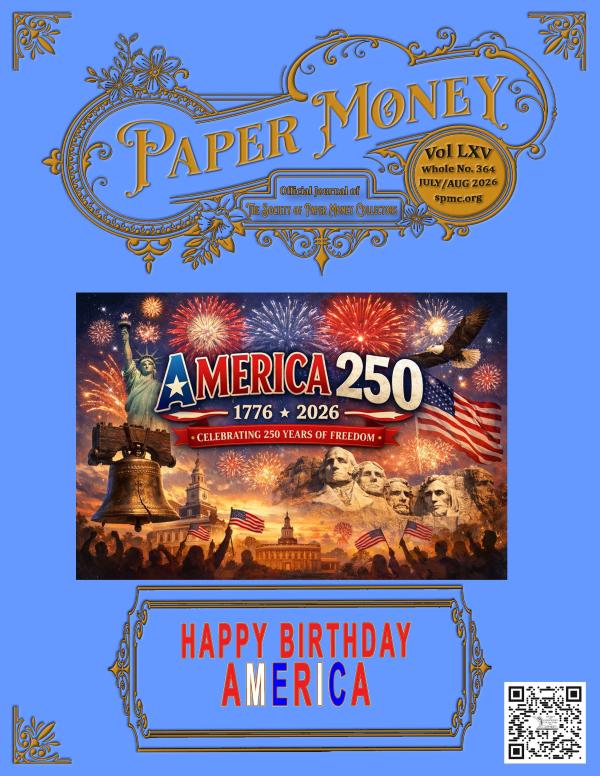
Table of Contents
Census Update T-64 Confederate Notes--Mark Coughlan
Wyoming Series of 1929 National Bank Notes--Peter Huntoon
Reassessment of T-39/T-40 Confederate Notes--Enrico Aidala
Internal Approvements--Bill Gunther
Free Postal Notes--Bob Laub
Ofϐicial Journal of
HAPPY BIRTHDAY
AMERICA
LEGENDARY COLLECTIONS | LEGENDARY RESULTS | A LEGENDARY AUCTION FIRM
America’s Oldest and Most Accomplished
Rare Coin AuctioneerCalifornia • New York • Boston • Miami • Philadelphia • New Hampshire
Oklahoma • Hong Kong • Copenhagen • Paris • Vancouver
1550 Scenic Avenue, Suite. 150, Costa Mesa, CA 92626
949.253.0916 • Info@StacksBowers.com
470 Park Avenue, New York, NY 10022
212.582.2580 • NYC@StacksBowers.com
Visit Us Online at StacksBowers.com
SBG PM SumGlobal26 HLs 260701
NOW ACCEPTING CONSIGNMENTS
The Stack’s Bowers Galleries
Summer 2026 Global Showcase Auction
Auction Dates: August 31–September 5 & 8–11, 2026 • Costa Mesa, CA
U.S. Currency Consignment Deadline: July 13, 2026
Highlights already consigned include:
Peter A. Treglia
Vice President & Managing
Director of Currency
PTreglia@
StacksBowers.com
Tel: 949.748.4828
Michael Moczalla
Currency Specialist
MMoczalla@
StacksBowers.com
Tel: 949.503.6244
Contact Us For More Information:
800.458.4646 California • 800.566.2580 New York • Consign@StacksBowers.com
Vienna, Illinois. Narragansett Bank. 18xx $3.
PMG Gem Uncirculated 66 EPQ. Proof.
From the Caine Collection.
Fr. 151. 1869 $50 Legal Tender Note.
PMG Very Fine 25.
Fr. 187k. 1880 $1,000 Legal Tender Note.
PCGS Banknote Very Fine 25.
Fr. 192b. 1864 $50 Compound Interest Treasury Note.
PMG Very Fine 30.
Fr. 341. 1880 $100 Silver Certificate.
PMG Very Fine 30.
Fr. 1166b-I. 1863 $20 Gold Certificate.
PMG Very Fine 25
Fairbanks, District of Alaska. $5 1902 Red Seal.
Fr. 587. First NB. Charter #7718.
PMG About Uncirculated 50 EPQ.
Fr. 2014-G. 1950D $10 Federal Reserve Note.
Chicago. PMG Gem Uncirculated 65 EPQ.
Solid Serial Number 7's.
Fr. 2220-G. 1928 $5,000 Federal Reserve Note.
Chicago. PMG Choice Uncirculated 64.
An Event
Auctioneer
Partner of the
ANA World’s
Fair of Money®
Falfurrias, Texas. $20 1902 Plain Back.
Fr. 659. The First NB. Charter #11792.
PCGS Banknote Very Fine 30.
From the Jack Copeland Collection.
Davenport, Iowa. $50 1902 Red Seal.
Fr. 664. First NB. Charter #2695.
PMG Choice Uncirculated 63.
210 Census Update T-64 Confederate Notes--Mark Coughlan
218 Wyoming Series of 1929 National Bank Notes--Peter Huntoon
232 A Reassessment of T-39/T-40 Confederate Notes--Enrico Aidala
254 Internal Approvements--Bill Gunther
275 Free Postal Notes--Bob Laub
SPMC.org * Paper Money * Jul/Aug 2026 * Whole Number 364
205
217 Those We Have Lost
Columns
From Your President Robert Calderman 207
Editor Sez Benny Bolin 208
New Members Frank Clark 209
Chump Change Loren Gatch 263
Uncoupled Joe Boling & Fred Schwan 264
Foreign Affairs Dennis Hengeveld 270
Cherry Pickers Corner Robert Calderman 272
Quartermaster Michael McNeil 278
Small Notes Jamie Yakes 280
Advertisers
Stacks Bowers Galleries IFC
Pierre Fricke 205
PCGS-B 231
Executive Currency 262
FCCB 282
William Litt 282
Higgins Museum 282
LFKnight 283
SCCS 284
PCDA IBC
Heritage Auctions OBC
SPMC Hall of Fame
The SPMC Hall of Fame recognizes and honors those individuals who
have made a lasting contribution to the society over the span of many years.
Charles Affleck
Walter Allan
Mark Anderson
Doug Ball
Aubrey &
Adeline Bebee
Hank Bieciuk
Joseph Boling
Q.David Bowers
F.C.C. Boyd
Michael Crabb
Forrest Daniel
Martin Delger
William Donlon
Roger Durand
C. John Ferreri
Milt Friedberg
Robert Friedberg
Len Glazer
Nathan Gold
Nathan Goldstein
Albert Grinnell
James Haxby
John Herzog
Gene Hessler
John Hickman
William Higgins
Ruth Hill
Peter Huntoon
Brent Hughes
Glenn Jackson
Glen Jorde
Don Kelly
Lyn Knight
Chet Krause
Robert Medlar
Allen Mincho
Clifford Mishler
Barbara Mueller
Judith Murphy
Dean Oakes
Chuck O'Donnell
Roy Pennell
Albert Pick
Fred Reed
Matt Rothert
John Rowe III
Fred Schwan
Neil Shafer
Herb& Martha Schingoethe
Austin Sheheen, Jr.
Hugh Shull
Glenn Smedley
Raphael Thian
Daniel Valentine
Louis Van Belkum
George Wait
John & Nancy Wilson
D.C. Wismer
SPMC.org * Paper Money * Jul/Aug 2026 * Whole Number 364
206
Officers & Appointees
ELECTED OFFICERS
PRESIDENT Robert Calderman
gacoins@earthlink.net
VICE-PRES William Litt
TREASURER Robert Moon
robertmoon@aol.com
BOARD OF GOVERNORS
APPOINTEES
PUBLISHER-EDITOR-ADVERTISING MANAGER
Benny Bolin smcbb@sbcglobal.net
Megan Reginnitter mreginnitter@iowafirm.com
LIBRARIAN
Jeff Bruggeman jeff@actioncurrency.com
MEMBERSHIP DIRECTOR
Frank Clark
IMMEDIATE PAST PRESIDENT
Robert Vandevendert
WISMER BOOK PROJECT COORDINATOR
Pierre Fricke
From Your President
Robert CaldermanFrom Your President
Shawn Hewitt
We’re excited to announce the details of our second annual
Florida United Numismatists (FUN) Speakers Forum. In the fashion of our
inaugural seminar last year, we’ll again have a total of five speakers making
presentations, and close out the forum with our SPMC membership meeting on
Saturday morning.
The dates of the FUN convention are January 9-12, 2020 at the Orange
County Convention Center, West Building WA1 & WA2, in Orlando, Florida. The
first four talks are on Friday, January 10 in Room 304F (same as last year).
Here is the lineup… - "The Current
Status of the U. S. Small Size Paper Money Market". – Mr. Calderman, a
specialist and dealer in U. S. small-size type notes will discuss the current
trends in small size notes and the future of this paper money specialty.
- "A Behind the Scenes Look at the Paper
Money Auction Process"–Mr. Johnston, the Vice- President and Managing
Director of the Currency Division at Heritage Auctions will discuss the nuts-
and-bolts of conducting a major Paper Money auction.
"An Overview of the
Confederate Paper Money Market" .
Mr. Fricke has been a long-time dealer in Confederate Paper Money and is the
author of the standard reference on Confederate Paper Money "Collecting
Confederate Paper Money: The Standard Guide to Confederate Money".
"The good, the bad, and the ugly of
antebellum bank note fraud" – Various types of pre-Civil War bank note fraud
will be explored and illustrated.
In addition, at the SPMC Membership Meeting (open to all) on
Saturday at 8:30am in Room 303B we have: - "Overview
of the SPMC Bank Note History Project" - This project is focused on two of
the primary historical aspects of the "Hometown" National Bank Notes - the
Banks who issued them and the bankers who signed them.
I think we’re onto a good thing in making FUN another major venue for
the face of SPMC. Our table will be 867 in the club section of the bourse floor,
so please stop by. Again, this year, we are participating in the ANA Treasure
Trivia Program, which is a great outreach to the youth of our hobby. We have
some very nice world notes to hand out (to young numismatists) as souvenirs
for visiting our table.
Before I go, I should mention that we have a new Membership Secretary.
Robert Calderman, one of our board members, has stepped up to fill the position
recently vacated by Jeff Brueggeman. If you frequent the major shows, you
may have seen Robert at one of our club tables. Robert is great resource for the
Society, and we very much appreciate the work he does for us.
Paper Money * July/August 2020
6
LEGAL COUNSEL
Robert Calderman gacoins@earthlink.com
Matt Drais stockpicker12@aol.com
Mark Drengson markd@step1software.com
Loren Gatch lgatch@uco.edu
Shawn Hewitt Shawn@north-trek.com
Derek Higgins derekhiggins219@gmail.com
Raiden Honaker raidenhonaker8@gmail.com
William Litt
Cody Regennitt
billitt@aol.com
Andrew Timme
Wendell Wolka
frank_clark@yahoo.com
derekhiggins219@gmail.com
SECRETARY Derek Higgins
billitt@aol.com
er cody.regenitter@gmail.com
rman andrew.timmerman@aol.com
purduenut@aol.com
As you are now reading this copy of Paper Money, or at least while it sits in your
mailbox waiting for you to open, it is now officially Summertime! Do you have big
plans in the works? Are you reading this July/August edition while in Orlando,
Florida for the Summer FUN Show? If so, I hope you will stop by and say hello
while you are at theshow! As I write these words to you it is still Spring and I am
enjoying what little time isleft in my favorite season of the year.
During the month of May I had an amazing opportunity to take a short sabbatical
and spend nearly the entire month on the road! Sounds like a regular working
schedule of go-go-go, but this time it was much different from my typical routine.
I was very fortunate to have the time to visit with Peter Huntoon in Nevada! It
was my third visit since 2022 and it is always a great joy to spend time with a
friend. Catching up with someone for 90 seconds at a busy coin show is nothing
in comparison to tangible quality time with a f iend off the clock. While Peter
may very well be considered alegend in our hobby versus just another common
ragpicker, he is in fa just a regular guy t at loves the paper mon y hobby!
Spending time with him talking otes and having some laughs was e l worth the
4,000+ mile round trip journey that I spent in the truck to make it happen. While
this sounds absurd, airlines do still exist and taking a flight was a travel option
that was readily available. I instead chose the adventure route that gave me more
flexibility to also see family in New Mexico and make a quick stop at emphis,
Tennessee to reminisce on some of the great times I had on Beale Street with
fellow paper money collectors at IPMS Paper Money Shows over the years.
2017 was the last show in Memphis and even though this is quickly approaching a
decade in the past, it still feels like it was just yesterday!
While in New Mexico I finally had a small window of time to head up to Taos,
Red River, Cimarron, Raton, and Clayton! I used to live in Albuquerque, NM for a
short time back in 1996 and for the past thirty years I have wanted to check
additional NM locations off my list that I had yet to travel to, many related to
areas that had National Banks! The extra detours adventuring did not disappoint.
My favorites were visiting Dawson, NM an old coal mining ghost town that now
only has an old cemetery left. Located many miles down a dirt road well far
removed from civilization, not only did I lose cell service completely, I did not see
another human the entire time I had journeyed off the state highway! The
cemetery was in very rough shape and my main goal while exploring there was to
not roll an ankle or step on a rattlesnake!!! My second favorite spot was Capulin
Volcano, a national park where y u get to drive conic l road all the way to the
top of the volcano and take i an incredible 360’ view of vast landscape seemingly
void of human contact. The surrounding ar a is so undeveloped that Capulin is
listed as a Gold Tier Int rnational Dark Sky Park since the area is so far rem ved
from man-made light pollution. Unfortunately, t forecaste cloud cover the
evening I was there did not cooperate with seeing the stars this time, so I am
already planning to schedule a return visit! Hopefully this short stint of rambling
encourages you to visit a friend in person and to travel somewhere new! I am
quickly noticing how quickly time goes by and how much fun can be had by doing
things that are far removed from your regular day to day schedule. If you make it
to the Summer FUN show, stop by my table and say hello!
SPMC.org * Paper Money * Jul/Aug 2026 * Whole Number 364
207
Terms and Conditions
The Society of Paper Money Collectors (SPMC) P.O. Box 7055,
Gainesville, GA 30504, publishes PAPER MONEY (USPS 00‐
3162) every other month beginning in January. Periodical
postage is paid at Hanover, PA. Postmaster send address
changes to Secretary Robert Calderman, Box 7055, Gainesville,
GA 30504. ©Society of Paper Money Collectors, Inc. 2020. All
rights reserved. Reproduction of any article in whole or part
without written approval is prohibited. Individual copies of this
issue of PAPER MONEY are available from the secretary for $8
postpaid. Send changes of address, inquiries concerning non ‐
delivery and requests for additional copies of this issue to
the secretary.
MANUSCRIPTS
Manuscripts not under consideration elsewhere and
publications for review should be sent to the editor. Accepted
manuscripts will be published as soon as possible, however
publication in a specific issue cannot be guaranteed. Opinions
expressed by authors do not necessarily reflect those of the
SPMC. Manuscripts should be submitted in WORD format via
email (smcbb@sbcglobal.net) or by sending memory stick/disk
to the editor. Scans should be grayscale or color JPEGs at
300 dpi. Color illustrations may be changed to grayscale at the
discretion of the editor. Do not send items of value.
Manuscripts are submitted with copyright release of the author
to the editor for duplication and printing as needed.
ADVERTISING
All advertising on space available basis. Copy/correspondence
should be sent to editor.
All advertising is pay in advance. Ads are on a “good faith”
basis. Terms are “Until Forbid.”
Ads are Run of Press (ROP) unless accepted on a premium
contract basis. Limited premium space/rates available.
To keep rates to a minimum, all advertising must be prepaid
according to the schedule below. In exceptional cases where
special artwork or additional production is required, the
advertiser will be notified and billed accordingly. Rates are
not commissionable; proofs are not supplied. SPMC does not
endorse any company, dealer, or auction house. Advertising
Deadline: Subject to space availability, copy must be received
by the editor no later than the first day of the month
preceding the cover date of the issue (i.e. Feb. 1 for the
March/April issue). Camera‐ready art or electronic ads in pdf
format are required.
ADVERTISING RATES
Editor Sez
Benny Bolin
Required file submission format is composite PDF v1.3
(Acrobat 4.0 compatible). If possible, submitted files should
conform to ISO 15930‐1: 2001 PDF/X‐1a file format standard.
Non‐ standard, application, or native file formats are not
acceptable. Page size: must conform to specified publication
trim size. Page bleed: must extend minimum 1/8” beyond
trim for page head, foot, and front. Safety margin: type and
other non‐bleed content must clear trim by minimum 1/2”.
Advertising c o p y shall be restricted to paper currency, allied
numismatic material, publications, and related accessories.
The SPMC does not guarantee advertisements, but accepts
copy in good faith, reserving the right to reject objectionable
or inappropriate material or edit copy. The SPMC
assumes no financial responsibility for typographical
errors in ads but agrees to reprint that portion of an ad in
which a typographical error occurs. Benny (aka goompa)
Space
Full color covers
1 Time
$1500
3 Times
$2600
6 Times
$4900
B&W covers 500 1400 2500
Full page color 500 1500 3000
Full page B&W 360 1000 1800
Half‐page B&W 180 500 900
Quarter‐page B&W 90 250 450
Eighth‐page B&W 45 125 225
We are now in the summer doldrums here in Texas. People are
complaining about the heat, but it has not hit 100 yet! Buckle up
cause "Here comes the sun!" Wasn't that a great song? Not a whole
lot happening paper-wise for me right now so a column about ME.
My son was in SanDiego doing his company's national meeting so
his wife (my DIL) and daughter (my granddaughter shown above)
went to join him and spent 8 days in California. The trip started on a
wary note(s). First on the way over to pick my DIL and GD up to go
to the airport, my A/C on my car died and that is not what you want
in summer in Texas. Then we got on the plane and all went well. We
went to baggage claim and we made it to CA but our bags decided to
stay in Dallas. Finally got them all at 1:30am! A day at the San
Diego Zoo, two days at Disneyland, a day at Universal and 101,365
steps later, I am tired and my feet hurt! But it was all worth it seeing
her face and awe seeing Mickey, Elsa and the others. Besides the
auspicious trip beginning, the only downside were the prices. Wow,
California is eXpensive!!! Chicken nuggest and fries for four will
run you over $80. I kept thinking how many notes I could have
bought for what I spent on chicken alone! Now that I am home, I
have to go spend even more $$ to get my car's 100,000 mile service
done and A/C work done. If you have any loose fractionals sitting
around, just send them to me. Gives a whole new meaning to the
title to my new coin exhibit, "Brother, can you spare a dime."
Back to paper--in this issue we have two articles on Confederate
notes. One finishing up Steve Fellers' work on T-64 notes (although
the census will continue to be updated). The other is an attempt to
clarify and correct errors in Raphael Thian's Register, specifically
related to T-39 and T-40 notes. Besides those two ground-breaking
articles, Peter Huntoon talks about Wyoming nationals and our usual
columnists fill the pages with information related to MPCs, small-
size notes, world currency and a tribute to USA 250.
Speaking of USA 250, I used a graphic to denote the upcoming
celebration. Plans are underway all over the country for this time of
celebration of the greatest country in the world and all the freedoms
and opportunities we have. I just hope and pray this is not politicized
& the country ends up being degraded although I am unsure of that!
We also have a small section about yet the passing of two of our
hobby's greats--Mike Bean and Patrick McBride (Mr. Ben Franklin).
We are sad to see them go and extend our thoughts and prayers to
their families.
As always, I am asking for articles. I would love to have an article
or two about the revolutionary war and our independence and how it
is immortalized in currency.
Forgot to mention--my sone gave me a great gift for Father's Day--
he took me to a Dodger's game while we were there. Not a big
Dodger fan but got to see Otani hit a homerun in Dodger stadium!!
Till next time! Look out for those school zones and don't drive and text!
SPMC.org * Paper Money * Jul/Aug 2026 * Whole Number 364
208
The Society of Paper Money
Collectors was organized in 1961 and
incorporated in 1964 as a non-profit
organization under the laws of the
District of Columbia. It is
affiliated with the ANA. The
Annual Meeting of the SPMC is
held in June at the International
Paper Money Show. Information
about the SPMC, including the
by-laws and activities can be
found at our website--
www.spmc.org. The SPMC does
not does not endorse any dealer,
company or auction house.
MEMBERSHIP—REGULAR and
LIFE. Applicants must be at least 18
years of age and of good moral
character. Members of the ANA or
other recognized numismatic
societies are eligible for membership.
Other applicants should be sponsored
by an SPMC member or provide
suitable references.
MEMBERSHIP—JUNIOR.
Applicants for Junior membership
must be from 12 to 17 years of age
and of good moral character. A parent
or guardian must sign their
application. Junior membership
numbers will be preceded by the letter
“j” which will be removed upon
notification to the secretary that the
member has reached 18 years of age.
Junior members are not eligible to
hold office or vote.
DUES—Annual dues are $39. Dues
for members in Canada and Mexico
are $45. Dues for members in all
other countries are $60. Life
membership—payable in installments
within one year is $800 for U.S.; $900
for Canada and Mexico and $1000
for all other countries. The Society
no longer issues annual membership
cards but paid up members may
request one from the membership
director with an SASE.
Memberships for all members who
joined the Society prior to January
2010 are on a calendar year basis
with renewals due each December.
Memberships for those who joined
since January 2010 are on an annual
basis beginning and ending the
month joined. All renewals are due
before the expiration date, which can
be found on the label of Paper
Money. Renewals may be done via
the Society website www.spmc.org
or by check/money order sent to the
secretary.
WELCOME TO OUR
NEW MEMBERS!
BY FRANK CLARK
SPMC MEMBERSHIP DIRECTOR
NEW MEMBERS 05/05/2026
Dues Remittal
R
obert Moon --SPMC Treasurer
Process
Send dues
directly to
403 Gatewood Dr. Greenwood, SC 29646
You may also pay your dues online at www.spmc.org.
16053 Zach Coplea, Robert Calderman
16054 Susan Bremer, Website
16055
16056 Jeremy Whaley, John Patrick
16057 Chad Beckett, John Patrick
16058 Mark Weston, Website
16059 Ryan Tidwell, Frank Clark
16060 Herbie Gregg, John Patrick
REINSTATEMENTS
None
LIFE MEMBERSHIPS
None
NEW MEMBERS 06/05/2026
116061 David Horne, YouTube
16062 Jason Kuschner, Website
16063 Dave Walker, Website
16064 Benjamin McCormick, John Patrick
16065 Steve Craig, Website
16066J Bob Schmidt, Frank Clark
16067 Matt Davidson, Seth Wilson
16068 Harold Kroll, Website
16069 Jared Goldfarb, Website
16070 Mike Andrews, Website
16071 Joe Peruski, Website
16072 Donald Bremner, Paper Money Forum
16073 Steve Shupe, Frank Clark
16074 Kevin Roy, John Patrick
16075 Alejandro Serra, Website
16076 Austin Cook, Website
16077 Jennifer Fryhoff, Website
REINSTATEMENTS
None
LIFE MEMBERSHIPS
None
SPMC.org * Paper Money * Jul/Aug 2026 * Whole Number 364
209
Foreword
This is the twelfth update from an ongoing project which strives to maintain a census of surviving $500 T64
notes issued by the Confederate States Treasury as part of the Seventh Issue, dated February 17th, 1864. This
update provides census data as of June 4th, 2026.
As the readers of Paper Money will be aware, this ‘T64 Census’ project has
for almost twenty-five years been nurtured by Dr. Steven (Steve) Feller; last
November, Steve sadly passed away after a sudden illness. Steve was a highly-
respected and much-loved Professor of Physics at Coe College, in Cedar Rapids,
Iowa, having served at this institution for forty-six years, whilst publishing
numerous research papers and several books on the physics and chemistry of glass
(borates), an area in which he specialised. In his leisure time, Steve was an
enthusiastic and highly-respected numismatist, contributing numerous articles in
multiple publications; his area of particular expertise was that of the money and
tokens used within Prisoner-of-War camps, Internment camps, and Concentration
camps, an interest that he shared with his youngest daughter, Ray. Steve also had
a strong interest in Confederate and Southern states paper money, and this brought
the two of us into contact in mid-2024 as I undertook research work for my current
project, namely, to create an updated Register of Confederate Treasury notes in
digital form. I was aware of Steve’s articles on the $500 T64 in Paper Money and
had used his research to help finalise my estimate for the total quantity issued of these iconic T64 notes. From the
earliest days of his research, Steve’s census had reported the highest T64 serial number as being 38386, and this
assertion remained unchanged until, in May 2024, I discovered a note bearing a higher serial number, 38390. I
had stumbled across this note - or to be precise an image of it - in the depths of the Heritage Auctions online
archives, where it had sat since November 2018. Somehow Steve must have missed it in his search for new notes.
Although this new serial number was only four more than the previously known highest, it was the first such
discovery in almost twenty-five years, and after getting some expert opinions to confirm that the note appeared
genuine, I excitedly contacted Steve and informed him of the good news, and we arranged a Zoom video call for
the following week. Within seconds of our call beginning, I realized that Steve was not a native Midwesterner -
his accent quickly confirmed him as a New Yorker. Steve was happy to learn that I had lived and worked in New
York myself for many years, although my affection for the N.Y. Mets baseball team, rather than his beloved
Yankees, led to some painful discussions (at least for me) about the undoubted superiority of the Bronx bombers
over the upstarts from Queens!
Figure 1 - Dr. Steven A. Feller -
Image courtesy of Coe College
Figure 2 -The reigning
champion - T64 highest
serial number of 38390
with plate letter B (PF-3)
SPMC.org * Paper Money * Jul/Aug 2026 * Whole Number 364
210
Steve and I co-authored the next (eleventh) update of the T64 census, which appeared in Paper Money in
November 2024, and we remained in regular contact thereafter. We had just begun collaborating on some research
around the $20 T67 denomination of the Seventh Issue when I received the sad news of his passing - a great loss to his
family and to the educational community which he served so well. It was also a great loss to Confederate numismatics,
and on extending my condolences to his daughter Ray, I mentioned that it would be a shame if Steve’s remarkable
research project into the T64 ended. His dedication to this project - scanning numerous auction sites, dealer inventories,
and other sources every day for more than twenty years to check for previously undocumented notes - deserved to
continue. I asked Ray if the Feller family would be supportive of me carrying forward Steve’s T64 research as best I
could, and I was delighted to receive her approval. Hopefully, Steve himself would also have approved.
In that regard, I present this next update of the $500 T64 census, the twelfth. Unfortunately, I do not possess all
of Steve’s mathematical skills, and some of his detailed statistical analysis and insight of serial numbers is beyond my
abilities. However, I will endeavour to incorporate the standard set of charts, and supplement this with other
information about the T64 which I hope readers will find interesting. Rest in peace Steve - your legacy will continue.
Recap of the Project objectives
Steve Feller began his T64 census project sometime in early 2003. The first article on the subject was published
in the International Bank Note Society’s IBNS Journal in the third quarter of 2003 (Volume 42, Number 3) - Steve was
the Journal’s Editor at that time. In opening the article Steve explained his affection for this particular note: “It is a
favourite for a number of reasons including the striking vignettes, the high denomination, and the fact that it is
beautifully and historically composed.”
The note was the artistic work of Edward Keatinge, a highly skilled engraver from Ireland who had learned his
trade in Dublin and London before emigrating to the United States in 1848. Keatinge worked for various publishing
concerns creating lithographic illustrations before moving to the American Bank Note Company in New York where
he engaged in the serious trade of bank note engraving upon steel plates. In the summer of 1861, shortly after the
outbreak of the Civil War, Keatinge was enticed by Confederate agents to defect to Richmond, Virginia, where he
would establish a new company in partnership with a Virginian businessman, Thomas Ball, to produce paper money
for the Confederate Treasury. This led to the formation of Keatinge & Ball who were the most important of the various
engraving and printing concerns that had a role in producing Confederate paper money.
The $500 T64 note contained two distinctive vignettes - the most famous, which gave the note its lasting identity,
was the bust of Confederate General Thomas J. “Stonewall” Jackson, positioned in the lower right corner. Steve
provided the following commentary on this vignette: “General Jackson, a devoutly religious man, was known for his
valour on the battlefield and his relentless defence, hence his nickname. General Jackson was wounded by his own
men on May 2nd, 1863, and died eight days later after losing an arm in surgery. In a letter to Jackson’s physician,
General Robert E. Lee said: ‘Give General Jackson my affectionate regards and say to him: he has lost his left arm,
but I my right.”
The second vignette, flanking the left edge of the note, featured a collage of patriotic Confederate images with a
military theme, described by Steve as follows: “The composite vignette consists of the Confederate flag, much in the
news these days, the great seal of the Confederate States of America, a trumpet, cannon balls and a cannon, a sword,
a drum, and maybe more.”
Like other Seventh Issue notes, the $500 T64 exhibited notable variations in the colour of the underprint from
light red, to a dusty pink, to a dramatic dark red, the likely result of disruption to the supply of materials used to mix
the ink. This led to the classification of three variations of the T64, and these are comprehensively described by Pierre
Fricke in his 2014 book, “Collecting Confederate Paper Money”, on pages 471 – 475.
Regardless of the aesthetic appeal of the note, Steve’s objective in initiating his project was grounded in
numismatic research, and this related to the incomplete records for the Seventh Issue of Confederate Treasury notes:
“I have done this research so as to get some closure on the 1864 Issue. No one knows the end serials for any of the
denominations since the Confederate record-keeping fell apart as the end of the War approached. It was my hope that
the $500 denomination offered the best chance since it was a more limited issue than the others.”
Steve was correct that the record keeping for the 1864 Seventh Issue was incomplete - the details of series, serial
number runs, and signers for more than eleven million notes were missing from the surviving records. However, this
was probably not down to sloppy book-keeping by the Treasury department, but rather the impact of the War. In April
1864, as the Federal Army of the Potomac tightened its stranglehold across Virginia, the Treasury Note Bureau was
prudently relocated from Richmond to Columbia, South Carolina. Communications between the two cities were
frequently disrupted by Federal cavalry raids, and perhaps a consignment of operational records from Columbia was
captured and destroyed on its way to Treasury headquarters in Richmond? There is no doubt though, that General
Sherman’s invasion of the Carolinas in early 1865, leading to the capture and wide-spread burning of Columbia on
February 17th, resulted in the destruction of all Treasury-related premises in the city, and the loss of any documents
stored within them. This explains the loss of many of the later Seventh Issue records.
SPMC.org * Paper Money * Jul/Aug 2026 * Whole Number 364
211
Summary of the Project to date
Steve set about his search for any $500 T64 notes, carefully recording the serial number and plate letter of every
surviving note that he had observed. Steve cast a wide net in his search for T64 notes. The advancement of technology,
and in particular the internet made such a project much more viable than it would have been fifty, or even twenty years
earlier. The Internet provided easy access to any Confederate paper money items which were sold through the leading
auction houses such as Heritage, Stacks, Spink, as well as more public outlets such as eBay. Many dealers created their
own websites to display their inventories, and museums and universities began to digitize their treasured collections to
make them more accessible. And there were the numerous numismatic conventions, and money shows, where notes
would be exhibited and traded. Steve covered all the bases.
By the time of his first article, published in September 2003, Steve reported that he had observed a total of 108
T64 notes as at mid-July 2003, with serial numbers ranging from 183 to 38386. Steve then applied his analytical skills
- perhaps with help from his eldest daughter Heidi, a professor of mathematics - to unlock various statistical insights
into this growing set of data, specifically:
- Projecting the highest serial number for the $500 T64 denomination
- Modelling the relative progression of serial numbers observed across the known spectrum
- Modelling the distribution of surviving notes across the three colour-based varieties defined by
Fricke/Criswell: PF-1/CR-489A (light red), PF-2/CR-489 (pink), PF-3/CR-489B (dark red)
- Modelling the distribution of surviving notes against the four plate letters A, B, C, D
As Steve continued his search for new notes - undertaking daily checks of his multiple sources - he steadily built
up the total quantity of notes observed and periodically provided updates on his progress and latest analysis. In total
he contributed eleven articles on the subject, eight of which have appeared in Paper Money since 2007, and three of
which appeared in the IBNS Journal prior to this. The table below provides a schedule of these reports, along with the
growing quantity of notes observed, and the rate of discovery of new notes during the period concerned.
Figure 3 - Summary of published reports on T64 Census project.
Steve’s earliest analysis indicated that serial number 38386 was likely to be close to the highest, and this
assertion has remained valid ever since; the discovery of serial number 38390 in 2024 has only served to bolster
his original assumption.
SPMC.org * Paper Money * Jul/Aug 2026 * Whole Number 364
212
Over the years Steve’s analysis repeatedly showed that the observation of surviving notes across the low to
high serial number range (1 - 38386) was remarkably even. Similarly, distribution across the plate letters A, C,
and D was remarkably even, although there was a higher representation (about 10%) of notes with plate letter B.
As regards the three colour-based varieties, the light red and pink types were evenly represented (as a percentage
of the total quantity of notes for that variety), but the dark red variety (PF-3/CR-489B) had a noticeably higher
representation.
As shown in the table above, the current total of notes observed is 4,145, an increase of 338 since the previous
update in November 2024. The charts below provide the latest update on these themes, showing that the trends
have generally remained consistent. The charts show that there is a higher-representation of notes in the higher
serial numbers, 31200 to 38400 (the dark red notes), which may not be surprising as these notes were the last to
be issued, between November 1864 and February 1865.
Figure 4 - Updated charts for T64 Census project.
How many T64 notes were there?
Since the project was initiated more than twenty years ago, more than four thousand T64 notes have now
been observed. One parameter which provides important context for the number of notes observed, is the total
quantity of T64 notes that were actually issued by the Confederate Treasury.
The Author has studied Treasury Note Bureau records covering the period of the Seventh Issue and extracted
all relevant production reports. These reports, produced by Mr. Sanders G. Jamison, Chief of the Treasury Note
Bureau, were compiled every two weeks to record the amount of currency (by denomination) which had been
produced by his department, and duly handed over to the Assistant Treasurer, Mr. W. Y. Leitch, for issue through
the various Depositories located across the Confederate states. These reports were sent to the Secretary of the
Treasury - namely Christopher G. Memminger until his resignation in July 1864, and thereafter to the new
Secretary, George A. Trenholm. The reports are invaluable because they provide an accurate record of the dates
and quantities of $500 T64 notes that were ready for issue.
SPMC.org * Paper Money * Jul/Aug 2026 * Whole Number 364
213
The initial batch of 20,000 notes, comprising serial numbers 1 - 5000 (No Series, plate letters A to D) was
processed in Richmond between March 31st and April 11th, 1864; these notes were all signed by Mr. William
Miller for the Register, and Mr. James Joplin for the Treasurer. The next tranche of 60,000 notes comprising serial
numbers 5001 - 20000 were processed in Columbia between July 23rd and September 15th, 1864, following the
relocation of the Treasury note Bureau to that city. These notes were also signed by Mr. William Miller for the
Register, and Mr. James Joplin for the Treasurer, and were in fact the only Confederate Treasury notes to have
been signed by male clerks in Columbia; the two were amongst a small group of men to relocate, undertaking
specialist roles. All subsequent $500 T64 notes, and those of all other denominations, were signed by female
clerks.
Figure 5 - Signatures of Mr. William Miller and Mr. James Joplin on an early T64 note.
Figure 6 - Signatures of Miss Esther Barnwell and Miss Eugenia Baker on a late T64 note.
Records confirm that by the end of November 1864 some 131,600 T64 notes (serial numbers 1 -32900, plate
letters A -D) had been manufactured and handed over to the Treasury department for issue. Details of the signers
of these notes were included in Thian’s Register of the Confederate Debt, but records after this date are missing;
Seventh Issue notes from late November onwards have been lost. Based on observation of surviving notes and
from reviewing surviving Treasury correspondence, the Author believes that the last serial number run of T64
notes was probably 38001 -38400, signed by Miss Esther H. Barnwell and Miss Eugenia A. Baker, indicating a
total quantity of 153,600 notes.
In the table below, the entries up to the end of November 1864 are all based on actual Treasury reports. Based
on the financial amounts of $500 notes specified in these Treasury reports the Author has modelled the
corresponding serial number runs, and in turn these have been correlated to Thian’s Register of the Confederate
Debt which provides details of the signers up to serial number 32900 which aligns with the reporting period of
November 30th, 1864.
The entries between December 1st, 1864, and mid-February 1865 have been projected by the Author based
on two things:
i) the observation of surviving notes with serial numbers between 32901 and 38400
ii) a similar production rate as had been in place for the November reporting periods
As can be seen, the final entry in the table is February 15th, 1865, which coincides with the capture by Federal
forces of Columbia, on February 17th, 1864. The capture and subsequent conflagration which engulfed Columbia
effectively ended the Confederate Treasury’s ability to manufacture paper money due to the destruction of the
engraving and printing factories of its suppliers, and the abandonment of the Treasury Note Bureau offices.
A limited number of Treasury staff, and a modest amount of equipment and supplies were evacuated by train,
eventually ending up in Anderson, South Carolina, but there is no evidence this was sufficient to enable a
resumption in the production, or issuance of Treasury notes or bonds, however briefly. Furthermore, a letter from
Treasury Note Bureau Chief, Sanders Jamison to Secretary Trenholm (Dated March 20th, 1865) reported that
rampaging Union soldiers had been seen clutching handfuls of blank $500, $100, and $50 Treasury notes
following the capture of Columbia. Trenholm’s response, unsurprisingly, was that no further notes of these
denominations should be produced or issued. The coup de grace occurred in early May 1865, when Federal forces
caught up with the escapees in Anderson, and all remaining equipment and supplies were destroyed, and Treasury
staff detained.
SPMC.org * Paper Money * Jul/Aug 2026 * Whole Number 364
214
Figure 7 - Table summarising production of T64 notes between February 1864 and February 1865.
Interestingly, Dr. Douglas Ball (1939-2003), the highly-respected Confederate numismatist, estimated a
higher total quantity of T64 notes, a figure of 164,800, implying that the highest serial number was 42100. This
estimate may have been based on Dr. Ball’s examination of the so-called Richmond Hoard - the large collection
of Confederate Treasury documents and paper money which were retrieved after the capture of the Confederate
capital city, in April 1865, and which now reside in the National Archives in Washington D.C.
Unfortunately, there is no tangible information currently available to substantiate Dr. Ball’s higher estimate,
although this may well be buried somewhere in the many complex volumes of his research into Confederate paper
money; these are now in the possession of Pierre Fricke, arguably the leading authority and dealer in Confederate
currency at the current time.
Furthermore, no $500 T64 notes with serial numbers 38401 - 41200 have been witnessed during the last
twenty-five years of focused research by this project. In summary, the Author believes it is appropriate to estimate
the total quantity of $500 T64 notes at 153,600 - a figure which can be fully substantiated. Should new information
become known, then this estimate can be reviewed.
How many T64 notes have survived?
As shown by the table above, at an average rate of discovery of 3 to 4 new notes per week, it has taken
around twenty-three years to reach the current total of 4,085 surviving T64 notes, some 2.67% of the total issued.
This rate of progress has remained steady over the years and shows no sign of abating.
As explained earlier, based on both observation and research of Confederate Treasury records, Steve Feller
and the Author came to the same conclusion that the highest serial number was probably 38400, thereby giving a
total quantity of 153,600 T64 notes having been issued by the Confederate Treasury before its note producing
capability ceased to function after the capture of Columbia in February 1865. Thus, the obvious question is how
many more surviving T64 notes are still out there, waiting to be discovered?
Unfortunately, there is no easy answer to this question. There are no available comparisons for the other
1864 Seventh Issue denominations, and no advanced mathematical formulae that can be applied to give us the
answer. The only accurate census data which exists for Confederate Treasury notes relates to the extremely rare
types from 1861, known as the “Big Six”, covering the four ‘Montgomery’ notes (T1, T2, T3 and T4), the ‘Liberty
seated with Shield and Eagle’ note (T27), and the ‘Indian Princess’ note (T35). These notes were all printed in
extremely small quantities, and in addition the T27 and T28 notes were printed on very poor-quality paper. The
census data on these notes, now in the care of Pierre Fricke, has been maintained by successive, dedicated,
numismatists for almost a century.
If we look at census data for the $500 T2 Montgomery note from the First Issue in April/May 1861, the
survival rate is just over 23% from a total of 607 notes issued. This was a high denomination interest-bearing
note, designed for holding rather than circulating, but there are parallels with the 1864 T64 note, which although
not interest-bearing, and despite the raging inflation by that stage of the War, would probably have been retained
rather than circulated widely.
SPMC.org * Paper Money * Jul/Aug 2026 * Whole Number 364
215
It is probable that many T64 notes were destroyed as Treasury depositories and commercial banks across the
South were seized and dismantled by Federal forces as the War
drew to a close. Indeed, there were illustrations of this in
contemporary magazines, such as Harper’s Weekly, showing
Federal soldiers burning piles of Confederate Treasury notes and
bonds whilst despondent Southerners looked on. However, given
the general eye-appeal of the T64 note, and the patriotic
Confederate images which adorned its face, any Southern citizens
in possession of this high denomination note would probably have
held on to it after the collapse of the Confederacy, despite its
complete loss of monetary value.
In discussions on this subject with other Confederate
numismatic experts, including Pierre Fricke and Mike McNeil,
there is a belief that around 20% of T64 notes are likely to have
survived, representing about 30,000 notes. On this basis, the T64
Census project has so far only unearthed around 14% of the
estimated surviving population. The next question is why, after all
this time, is this figure so low, and where are all the undiscovered notes? This is another question which is not
easy to answer.
One possible explanation considered by the Author is that many of the missing T64 notes are locked away
at the Smithsonian Institute in Washington D.C. At the end of the War a substantial quantity of official documents
and correspondence was salvaged from the Confederate Treasury offices in Richmond and transported to the
offices of the War Department in Washington D.C. for examination. Amongst the haul were over a hundred boxes
containing an estimated 500,000 Confederate bank notes, which became known as the Richmond Hoard. These
boxes were later removed to the Smithsonian where they reside today. Could many of the unseen surviving T64
notes be located amongst this hoard?
Unfortunately, it seems that the answer to this question is ‘No.’ Examinations of the hoard by Douglas Ball
during the 1960s, and later by Richard Doty and others in 1998, revealed that the contents were mostly redeemed
Sixth Issue notes, and an odd mixture of cancelled notes from earlier issues. There was no mention of any Seventh
Issue specimens, which is probably not surprising, as the Confederate Treasury wasted no time in getting all
available notes into circulation as quickly as possible due to the appalling state of the economy.
The more likely scenario is that these missing T64 notes are resting quietly in many thousands of collections
- both large and small in size - dotted across the United States. Some of these collections may have been held as
treasured family heirlooms for generations past and will remain so for generations to come. Naturally, changes in
family circumstances will result in some collections being offered for sale, and these are the ones that appear at
auction or on eBay, or can be found in local coin stores, and even in yard sales. Sadly though, some smaller
collections of notes may well end up in the trash when their owners pass away, as family members fail to
appreciate their value or historical importance.
The T64 is one of the most attractive and desired of Confederate notes, and is certainly affordable, with many
Fine/Very Fine examples readily available for under $1,000 at auction or from dealers. Having acquired a decent
T64 note, there is no reason for a new owner to rush to sell it - the Author has been in possession of his T64 note
for over thirty years! This would explain the fact that notes do not appear for sale as frequently as our Census
project would like. Knowing this, is there anything that can be done about this?
Crowdsourcing approach
One approach which the Author is considering is to launch a broad appeal across the Confederate paper
money collecting community to identify as many surviving T64 notes as possible. This concept has been applied
before on various numismatic topics. The Author would be happy to publish the current list of serial numbers /
plate letters which have been observed to date, so that collectors could check whether or not their note(s) are
included. If not, readers will be invited to send a snapshot of their note to a designated email address for the
Author’s review. Anonymity will be assured, as this can sometimes be a concern for collectors. The Author will
look into the feasibility of this approach, but in the meantime will continue with the daily checks instigated by
Steve all those years ago.
The Author would welcome any additional thoughts or insights into thisT64 project and can be contacted at
the following email address: treasurynotescsa@gmail.com
Figure 8 - Burning Confederate money - sketch
from Harper’s Weekly.
SPMC.org * Paper Money * Jul/Aug 2026 * Whole Number 364
216
Two more have left us.
Two more of our very visible members have left us. The SPMC extends our thoughts and sympathies to their families.
Michael “Mike” George Bean passed away on May 26, 2026. Mike was best known for
taking his spider press to conventions and printing souvenir cards. He was a regular at FUN
and the noon and 4p drawings were greatly anticipated. Quite often you would see recently
departed member John Parker eagerly awaiting the chance to buy the cards from the lucky
winners.
Mike was SPMC member #9702. He greatly supported the SPMC by printing many of our
awards, breakfast tickets and other cards for us including a special intaglio printed card that
was inserted into the 40th anniversary commemorative issue of Paper Money in January
2001.
Mike was a plate printer by trade and began his career at the Bureau of Engraving and
Printing in 1971, retiring in 2005.
Pat McBride, aka Benjamin Franklin.
Pat was SPMC member #15528. He portrayed Benjamin Franklin at numismatic events
and passed out colonial paper money reproductions with SPMC info on them. He as
Secretary/Treasurer of the Pennsylvania Association of Numismatists. He received the
ANA Presidential Award, Glenn Smedley Memorial Award and the Goodfellow Award for
the Pittsburgh National Money Show in 2019. In 2025 he received an ANA Medal of
Merit.Pat was an accomplished collector. He was an award-winning exhibitor, including
his first-place awards in 1989 at the National Money Show for his Military Payment
Certificates and in 2019 at the National Money Show for his Byzantine coin display.
SPMC.org * Paper Money * Jul/Aug 2026 * Whole Number 364
217
Wyoming
Series of 1929 National Bank Notes
Introduction and Purpose
The Wyoming national banks had a total circulation of $1,355,310 on December 31, 1934, just
months before the issuance of national bank notes ceased. Most of the circulation consisted of Series of
1929 small-size notes. Twenty-three modest to small Wyoming national banks had issued a total of 406,335
small-size notes having a face value of $4,480,470 over the previous five and a half years, most of which
already had worn out and been replaced. Only 15.6 percent of them were type 2s.
The purpose of this piece is to provide an overview of the Wyoming Series of 1929 issues using
key statistics along with a detailed inventory of all the varieties that were issued. At this writing in 2021, I
have logged in 1,030 small Wyoming notes into my Wyoming national bank note census. That number is
sufficient to definitively reveal the relative rarities of the notes by bank and by variety.
Issuing Towns
There were eighteen towns that hosted Series of 1929-issuing banks. Many were built along the
Union Pacific Railroad as the tracks were being laid across Wyoming between 1867 and 1869, including
from east to west, Cheyenne, Laramie, Rawlins, Rock Springs, Green River and Evanston.
Native American heritage and lore is captured in the names of several Wyoming towns. Of course,
Cheyenne owes its name to the Cheyenne tribe, Greybull to an albino buffalo discovered by Native
Americans along the Bighorn River that flows through town, Rock Springs for a spring discovered by a
Pony Express rider in 1861 as he detoured to avoid some Indians. Cody is named after William F. “Buffalo
Bill” Cody, a principal in the slaughter of buffalo herds in the campaign to exterminate the Native
Americans and later of wild west roadshow fame. Probably Meeteetse is the most unusual name on the list,
a Shoshone word meaning meeting place or place of rest.
Explorers, pioneers and entrepreneurs also left their names on the towns. Powell was named for
Colorado River explorer John Wesley Powell; Green River after the tributary upon which Powell started
his first voyage down the Colorado River system in 1869. The 1869 date is significant because that was the
year the Union Pacific Railroad reached Green River, so Powell took immediate advantage of that fact to
ship his boats there from the east. Evanston owes its name to James A. Evans, a Union Pacific surveyor.
Henry T. Lovell, a rancher who settled in the northeastern part of the Bighorn Basin in 1880 gave his name
Figure 1. President father and cashier son are signers. Powell in the midst of a
large irrigation district supplied by the Shoshone River was named for
Colorado River Explorer John Wesley Powell who was a proponent of the
collective public approach to the development of western waters.
The Paper
Column
Peter Huntoon
SPMC.org * Paper Money * Jul/Aug 2026 * Whole Number 364
218
to that town. Kemmerer stands for M. S.
Kemmerer, president of the Kemmerer Coal
Company that dominated the economy of his
town. Incidentally, J. C. Penney opened his first
store in Kemmerer.
Military generals were honored by people
looking for town names. Included was F.W.
Lander, surveyor and improver of the Oregon trail in 1857. John A. Rawlins served as protector of the
Union Pacific railroad surveyors in 1868. Philip Sheridan was responsible for killing many Native
Americans, but was remembered fondly by one of his Civil War troopers who platted the town of Sheridan.
Always a good way to get a place named after you was to be murdered near a future town site.
Laramie was named after the Laramie River which flows through that place. The river, in turn, was named
after Jacques LaRamie, a French-Canadian trapper killed in 1818 or 1819 by some Arapahos who caught
him and shoved him under its ice. Casper was named after Lt. Casper Collins, killed by Indians in 1865
when he went to the aid of some travelers near the town site.
Politicos got their due. Douglas honors Stephen A. Douglas, U.S. Senator from Illinois, an
Abraham Lincoln opponent.
Thermopolis is a tourist mecca that is the site of world-famous hot springs.
Certainly, as a town name, Buffalo conjures up images of the old wild west but unfortunately that
mystique is a mirage. The reality is that the place was named after Buffalo, New York!
The origins of the Wyoming town names is from Urbanek (1974).
Issuances
Of the 406,335 Series of 1929 Wyoming notes issued, Table 2 reveals that 16.2 percent were type
2s. The most widely used Series of 1929 denomination was the $10, accounting for 68 percent of the notes
pressed into circulation.
Figure 2. Map showing the locations of the towns in
Wyoming that hosted Series of 1929 note-issuing
national banks.
Figure 3. Buffalo, east of the
Bighorn Mountains on the west
edge of the Powder River Basin
with its great sounding western
name, in fact, was named after
Buffalo, New York. This type 2
$5 from an issue of only 324
notes created a sensation when
discovered in 2004.
Table 1. Populations of the Wyoming towns
in 1930 that hosted Series of 1929-issuing
banks.
Town Population Town Population
Buffalo 1,749 Lander 1,826
Casper 16,619 Laramie 8,609
Cheyenne 17,361 Lovell 1,857
Cody 1,800 Meeteetse 296
Douglas 1,917 Powell 1,156
Evanston 3,075 Rawlins 4,868
Green River 2,589 Rock Springs 8,440
Greybull 1,806 Sheridan 8,536
Kemmerer 1,884 Thermopolis 2,129
SPMC.org * Paper Money * Jul/Aug 2026 * Whole Number 364
219
Token quantities of $50s and $100s
were issued by one bank, The First National
Bank of Lovell (10844), and those only of the
type 1 variety. Believe it or not, they were
ordered by the bank in order to make a few
bucks off a strange paper money collector who
had a fetish for number 1 sheets.
The smallest issuing bank was The
First National Bank of Meeteetse (6340),
which served a town with a population of 296
people in 1930. The bank had the minimum
capitalization allowed by national banking law; specifically, $25,000 and thus a circulation of only $6,250.
Series of 1929 notes from this bank are correspondingly rare, and eagerly sought by Wyoming collectors.
One each of its three denominations have been reported to date.
Overprinting Plate
Varieties
Three entities
manufactured the plates
used by the Bureau of
Engraving and Printing
to overprint the bank
information on Series of
1929 national bank
notes. The information
was overprinted on half
sheets consisting of six
notes. The same plate or
sets of plates made for a
given bank was used for
all the denominations.
Barnhart
Bothers & Spindler was
awarded the contract for
all the plates. Theirs
were called logotypes
and they came in sets of
six identical 1-subject
plates that were mounted
Table 2. Numbers of issued Wyoming Series of 1929
notes by type and denomination.
Den Type 1 Type 2 Total Face Value
$5 46,764 13,226 59,990 $299,950
$10 233,496 41,610 275,106 $2,751,060
$20 60,186 10,957 71,143 $1,422,860
$50 60 60 $3,000
$100 36 36 $3,600
totals 340,542 65,793 406,335 $4,480,470
83.8% 16.2%
Figure 4. A Meeteetse note from
the smallest 1929-issuing bank
in Wyoming is the key to any
state set of small notes.
Figure 5. The First National Bank of Meeteetse building now serves as a museum.
Cattle king Harry Cheeseman was one of the bank’s founders in 1902.
SPMC.org * Paper Money * Jul/Aug 2026 * Whole Number 364
220
together on the press. BBS experienced difficulty in meeting the deadlines for supplying their plates in 1929
so, as a stopgap measure, the Bureau of Engraving and Printing contracted with the Government Printing
Office to supply conventional 6-subject electrotype plates. Later in the series, when the Bureau received
rush orders or even later when American Type Founders Company—the parent firm of BBS—went into
bankruptcy, the Bureau of Engraving and Printing made its own plates. The BEP plates consisted of sets of
six identical 1-subject plates similar to the BBS plates.
The plates made by the respective manufacturers are herein labeled BBS, GPO and BEP. No BEP
plates were made for the Wyoming banks.
Figure 6. Green River pair illustrating a classic looking stopgap GPO overprint (top) used only for the first
printing and BBS overprint (bottom). Notice that the bank signatures are the same.
Figure 7. This trio from Kemmerer illustrates a succession of three bank presidents during the 1929 era.
SPMC.org * Paper Money * Jul/Aug 2026 * Whole Number 364
221
A new set of plates was made each time anything changed on the bank overprint.
In the case of the stopgap GPO plates, the signatures were identical to those on the backordered
BBS plates. Only the first Series of 1929 printing was made from the GPO plate in the cases where they
were used. They were employed for Powell (10265), Casper (10533), Green River (10698), Greybull
(10810), Cheyenne (11380), and Thermopolis (12638).
Every different overprint variety that is found on the Series of 1929 notes issued by Wyoming
banks is listed on Table 3. The table contains a wealth of useful information including the issued serial
numbers, manufacturer of the overprinting plate(s), bank signers, and the inclusive dates during which the
notes were shipped to the banks from the Comptroller of the Currency’s office in Washington, DC.
The type 1 notes were printed in sheets of six with identical serial number but different prefix
letters, whereas the type 2 notes were consecutively numbered. You can read the type 1 sheet or type 2 note
changeover serial numbers between the different varieties for each affected denomination from Table 3.
Table 3 also lists the numbers of reported notes for every variety used in Wyoming. You will find
some zeros in the listing.
The bankers in two operating banks in Wyoming didn’t take out circulation during the Series of
1929 era: The Stockgrowers National Bank of Cheyenne (2652) and The Citizens National Bank of
Torrington (11132).
Table 3. Series of 1929 overprinting plate varieties used to print Wyoming national bank notes with dates when the notes were sent
from the Comptroller of the Currency's office to the banks and numbers of each reported as of 2021.
Ch No Town Serial Range No Notes Mfc President Cashier Inclusive Dates Shipped Rep't
3299 Buffalo
The First National Bank of
Series of 1929 type 1
10-10-10-10-10-10 1 - 1178 7,068 BBS H. P. Rothwell W. R. Holt Sep 4, 1929 - Sep 18, 1933 8
20-20-20-20-20-20 1 - 338 2,028 BBS H. P. Rothwell W. R. Holt Sep 11, 1929 - Sep 18, 1933 14
Series of 1929 type 2
5 1 - 324 324 BBS H. P. Rothwell W. R. Holt Mar 30, 1934 - Sep 20, 1934 1
10 1 - 2112 2,112 BBS H. P. Rothwell W. R. Holt Sep 25, 1933 - Mar 27, 1935 2
20 1 - 398 398 BBS H. P. Rothwell W. R. Holt Oct 9, 1933 - Apr 4, 1935 1
Total 11,930 Total 26
3615 Laramie
The Albany National Bank
Series of 1929 type 1
10-10-10-10-10-10 1 - 2786 16,716 BBS C. D. Spalding R. G. Fitch Aug 31, 1929 - Apr 5, 1934 47
20-20-20-20-20-20 1 - 698 4,188 BBS C. D. Spalding R. G. Fitch Sep 19, 1929 - Mar 27, 1934 29
Series of 1929 type 2
10 1 - 489 489 BBS C. D. Spalding R. G. Fitch Apr 5, 1934 - May 24, 1934 3
20 1 - 89 89 BBS C. D. Spalding R. G. Fitch Apr 13, 1934 - May 4, 1934 1
Total 21,482 Total 80
4320 Rawlins
The First National Bank of
Series of 1929 type 1
5-5-5-5-5-5 1 - 3512 21,072 BBS J. E. Cosgriff Geo. A. Bible Sep 11, 1929 - Dec 16, 1933 23
10-10-10-10-10-10 1 - 1982 11,892 BBS J. E. Cosgriff Geo. A. Bible Sep 19, 1929 - Dec 8, 1933 19
20-20-20-20-20-20 1 - 528 3,168 BBS J. E. Cosgriff Geo. A. Bible Sep 26, 1929 - Dec 8, 1933 13
Series of 1929 type 2
5 1 - 5294 5,294 BBS J. E. Cosgriff Geo. A. Bible Dec 16, 1933 - May 23, 1935 5
10 1 - 2847 2,847 BBS J. E. Cosgriff Geo. A. Bible Dec 22, 1933 - May 3, 1935 5
20 1 - 772 772 BBS J. E. Cosgriff Geo. A. Bible Jan 3, 1934 - May 17, 1935 2
Total 45,045 Total 67
4604 Sheridan
The First National Bank of
Series of 1929 type 1
10-10-10-10-10-10 1 - 1400 8,400 BBS R. H. Walsh W. C. Henderson Sep 17, 1929 - Jul 16, 1931 13
20-20-20-20-20-20 1 - 472 2,832 BBS R. H. Walsh W. C. Henderson Oct 7, 1929 - Jan 7, 1932 22
10-10-10-10-10-10 1401 - 2562 6,972 BBS R. H. Walsh W. C. Henderson Jul 16, 1931 - Jun 7, 1934 26
20-20-20-20-20-20 473 - 684 1,272 BBS R. H. Walsh W. C. Henderson Jan 7, 1932 - Apr 30, 1934 8
Series of 1929 type 2
10 1 - 2189 2,189 BBS R. H. Walsh D. C. Meyer Jun 7, 1934 - May 24, 1935 2
20 1 - 615 615 BBS R. H. Walsh D. C. Meyer Jun 15, 1934 - May 15, 1935 23
Total 22,280 Total 94
4720 Lander
The First National Bank of
Series of 1929 type 1
10-10-10-10-10-10 1 - 1148 6,888 BBS S. C. Parks E. W. Frankenfeld Sep 14, 1929 - Jan 22, 1934 10
20-20-20-20-20-20 1 - 328 1,968 BBS S. C. Parks E. W. Frankenfeld Oct 3, 1929 - Dec 27, 1933 8
Series of 1929 type 2
10 1 - 1613 1,613 BBS S. C. Parks E. W. Frankenfeld Jan 22, 1934 - May 29, 1935 4
20 1 - 535 535 BBS S. C. Parks E. W. Frankenfeld Feb 26, 1934 - May 17, 1935 3
Total 11,004 Total 25
SPMC.org * Paper Money * Jul/Aug 2026 * Whole Number 364
222
Table 3. Continued.
Ch No Town Serial Range No Notes Mfc President Cashier Inclusive Dates Shipped Rep't
4755 Rock Springs
The Rock Springs National Bank
Series of 1929 type 1
10-10-10-10-10-10 1 - 2602 15,612 BBS J. W. Hay C. Elias Sep 25, 1929 - Oct 13, 1933 31
20-20-20-20-20-20 1 - 602 3,612 BBS J. W. Hay C. Elias Oct 3, 1929 - Sep 12, 1933 16
Series of 1929 type 2
10 1 - 3634 3,634 BBS J. W. Hay C. Elias Oct 13, 1933 - May 29, 1935 13
20 1 - 1272 1,272 BBS J. W. Hay C. Elias Oct 25, 1933 - May 17, 1935 10
Total 24,130 Total 70
4989 Laramie
The First National Bank of
Series of 1929 type 1
10-10-10-10-10-10 1 - 2536 15,216 BBS J. A. Guthrie H. R. Butler Nov 5, 1929 - Mar 19, 1934 36
20-20-20-20-20-20 1 - 788 4,728 BBS J. A. Guthrie H. R. Butler Nov 13, 1929 - Mar 9, 1934 32
Series of 1929 type 2
10 1 - 2016 2,016 BBS J. A. Guthrie H. R. Butler Mar 27, 1934 - Mar 27, 1935 9
20 1 - 765 765 BBS J. A. Guthrie H. R. Butler Apr 5, 1934 - Mar 18, 1935 4
Total 22,725 Total 81
5413 Rawlins
The Rawlins National Bank
Series of 1929 type 1
10-10-10-10-10-10 1 - 3568 21,408 BBS N. R. Greenfield H. A. France Oct 4, 1929 - Jan 3, 1934 45
20-20-20-20-20-20 1 - 954 5,724 BBS N. R. Greenfield H. A. France Oct 12, 1929 - Dec 8, 1933 30
Series of 1929 type 2
10 1 - 2056 2,056 BBS N. R. Greenfield H. A. France Jan 3, 1934 - May 13, 1935 5
20 1 - 680 680 BBS N. R. Greenfield H. A. France Jan 13, 1934 - May 24, 1935 2
Total 29,868 Total 82
5480 Kemmerer
The First National Bank of
Series of 1929 type 1
10-10-10-10-10-10 1 - 1580 9,480 BBS P. J. Quealy J. W. Biggane Oct 4, 1929 - Sep 23, 1931 6
20-20-20-20-20-20 1 - 450 2,700 BBS P. J. Quealy J. W. Biggane Dec 4, 1929 - Oct 23, 1931 14
10-10-10-10-10-10 1581 - 2178 3,588 BBS J. L. Kemmerer J. W. Biggane Sep 23, 1931 - Dec 22, 1932 7
20-20-20-20-20-20 451 - 606 936 BBS J. L. Kemmerer J. W. Biggane Oct 23, 1931 - Apr 24, 1933 10
10-10-10-10-10-10 2179 - 2556 2,268 BBS J. A. Reed J. W. Biggane Dec 22, 1932 - Nov 17, 1933 7
20-20-20-20-20-20 607 - 680 444 BBS J. A. Reed J. W. Biggane Apr 24, 1933 - Nov 6, 1933 2
Series of 1929 type 2
10 1 - 1913 1,913 BBS J. A. Reed J. W. Biggane Nov 17, 1933 - Jun 19, 1934 6
20 1 - 323 323 BBS J. A. Reed J. W. Biggane Nov 25, 1933 - Jun 8, 1934 13
Total 21,652 Total 65
6340 Meeteetse
The First National Bank of
Series of 1929 type 1
5-5-5-5-5-5 1 - 266 1,596 BBS A. A. Linton A. E. Linton Oct 28, 1929 - Jan 11, 1935 1
10-10-10-10-10-10 1 - 138 828 BBS A. A. Linton A. E. Linton Dec 5, 1929 - Apr 10, 1935 2
20-20-20-20-20-20 1 - 41 246 BBS A. A. Linton A. E. Linton Dec 12, 1929 - May 1, 1935 1
Total 2,670 Total 4
6850 Casper
The Casper National Bank
Series of 1929 type 1
10-10-10-10-10-10 1 - 2540 15,240 BBS P. C. Nicolaysen C. H. McFarland Oct 17, 1929 - Feb 23, 1934 26
20-20-20-20-20-20 1 - 674 4,044 BBS P. C. Nicolaysen C. H. McFarland Nov 26, 1929 - Feb 6, 1934 22
Series of 1929 type 2
10 1 - 1764 1,764 BBS P. C. Nicolaysen C. H. McFarland Feb 23, 1934 - Sep 18, 1934 4
20 1 - 504 504 BBS P. C. Nicolaysen C. H. McFarland Mar 6, 1934 - Jan 11, 1935 0
10 1765 - 3241 1,477 BBS J. W. Ouderkirk R. E. Barton Sep 18, 1934 - May 14, 1935 0
20 505 - 899 395 BBS J. W. Ouderkirk R. E. Barton Jan 11, 1935 - May 27, 1935 1
Total 23,424 Total 53
7319 Cody
The First National Bank of
Series of 1929 type 1
10-10-10-10-10-10 1 - 230 1,380 BBS P. E. Markham C. E. Parker Oct 21, 1929 - Dec 2, 1931 4
20-20-20-20-20-20 1 - 42 252 BBS P. E. Markham C. E. Parker Nov 19, 1929 - Dec 16, 1931 1
10-10-10-10-10-10 315 - 616 1,812 BBS P. E. Markham R. H. Smith Jan 6, 1932 - Jul 25, 1934 6
20-20-20-20-20-20 105 - 198 564 BBS P. E. Markham R. H. Smith Feb 29, 1932 - Jul 10, 1934 5
Series of 1929 type 2
10 1 - 416 416 BBS P. E. Markham R. H. Smith Jul 25, 1934 - Mar 23, 1935 1
20 1 - 130 130 BBS P. E. Markham R. H. Smith Aug 11, 1934 - Mar 9, 1935 0
Total 4,554 Total 17
8020 Cody
The Shoshone National Bank of
Series of 1929 type 1
10-10-10-10-10-10 1 - 630 3,780 BBS S. C. Parks, Jr. R. W. Allen Nov 1, 1929 - Apr 27, 1934 8
20-20-20-20-20-20 1 - 182 1,092 BBS S. C. Parks, Jr. R. W. Allen Dec 7, 1929 - Apr 2, 1934 7
Series of 1929 type 2
10 1 - 735 735 BBS S. C. Parks, Jr. R. W. Allen Apr 27, 1934 - May 38, 1935 2
20 1 - 170 170 BBS S. C. Parks, Jr. R. W. Allen Jun 4, 1934 - Apr 30, 1935 0
Total 5,777 Total 17
SPMC.org * Paper Money * Jul/Aug 2026 * Whole Number 364
223
Table 3. Continued.
Ch No Town Serial Range No Notes Mfc President Cashier Inclusive Dates Shipped Rep't
8087 Douglas
The Douglas National Bank
Series of 1929 type 1
10-10-10-10-10-10 1 - 1142 6,852 BBS M. R. Collins R. L. Swan Oct 29, 1929 - Oct 18, 1933 5
20-20-20-20-20-20 1 - 358 2,148 BBS M. R. Collins R. L. Swan Dec 7, 1929 - Sep 29, 1933 14
Series of 1929 type 2
10 1 - 1932 1,932 BBS M. R. Collins R. L. Swan Oct 18, 1933 - May 15, 1935 5
20 1 - 528 528 BBS M. R. Collins R. L. Swan Nov 3, 1933 - May 15, 1935 3
Total 11,460 Total 27
8534 Evanston
The First National Bank of
Series of 1929 type 1
10-10-10-10-10-10 1 - 1338 8,028 BBS G. E. Pexton O. E. Bradbury Nov 2, 1929 - Mar 6, 1934 13
20-20-20-20-20-20 1 - 360 2,160 BBS G. E. Pexton O. E. Bradbury Dec 10, 1929 - Feb 2, 1934 10
Series of 1929 type 2
5 1 - 312 312 BBS G. E. Pexton O. E. Bradbury Apr 2, 1934 - Aug 12, 1934 0
10 1 - 1511 1,511 BBS G. E. Pexton O. E. Bradbury Mar 6, 1934 - Apr 20, 1935 4
20 1 - 435 435 BBS G. E. Pexton O. E. Bradbury Mar 20, 1934 - May 31, 1935 2
Total 12,446 Total 29
8612 Evanston
The Evanston National Bank
Series of 1929 type 1
10-10-10-10-10-10 1 - 1366 8,196 BBS T. Painter A. Coutts Nov 5, 1929 - Mar 20, 1934 19
20-20-20-20-20-20 1 - 370 2,220 BBS T. Painter A. Coutts Nov 19, 1929 - Mar 20, 1934 11
Series of 1929 type 2
10 1 - 888 888 BBS T. Painter A. Coutts Mar 20, 1934 - Nov 15, 1934 2
20 1 - 252 252 BBS T. Painter A. Coutts Apr 3, 1934 - Jan 22, 1935 1
10 889 - 1520 632 BBS J. W. R. Rennie A. Coutts Nov 15, 1934 - May 20, 1935 1
20 253 - 404 152 BBS J. W. R. Rennie A. Coutts Jan 22, 1935 - May 31, 1935 0
Total 12,340 Total 34
10265 Powell
The First National Bank of
Series of 1929 type 1
10-10-10-10-10-10 1 - 618 3,708 GPO S. A. Nelson H. Barrows Oct 12, 1929 - Oct 18, 1933 6
20-20-20-20-20-20 1 - 204 1,224 GPO S. A. Nelson H. Barrows Oct 21, 1929 - Oct 3, 1933 5
10-10-10-10-10-10 619 - 744 756 BBS S. A. Nelson H. Barrows Oct 12, 1929 - Oct 18, 1933 1
20-20-20-20-20-20 205 - 246 252 BBS S. A. Nelson H. Barrows Oct 21, 1929 - Oct 3, 1933 0
Series of 1929 type 2
10 1 - 1152 1,152 BBS S. A. Nelson R. A. Nelson Oct 18, 1933 - Jan 15, 1935 4
20 1 - 213 213 BBS S. A. Nelson R. A. Nelson Nov 15, 1933 - Dec 13, 1934 1
Total 7,305 Total 17
10533 Casper
The Wyoming National Bank of
Series of 1929 type 1
10-10-10-10-10-10 1 - 1220 7,320 GPO B. B. Brooks C. F. Shumaker Oct 5, 1929 - Sep 7, 1933 12
20-20-20-20-20-20 1 - 416 2,496 GPO B. B. Brooks C. F. Shumaker Oct 18, 1929 - Aug 26, 1933 11
10-10-10-10-10-10 1221 - 2734 9,084 BBS B. B. Brooks C. F. Shumaker Oct 5, 1929 - Sep 7, 1933 12
20-20-20-20-20-20 417 - 596 1,080 BBS B. B. Brooks C. F. Shumaker Oct 18, 1929 - Aug 26, 1933 4
Series of 1929 type 2
10 1 - 4179 4,179 BBS B. B. Brooks C. F. Shumaker Sep 7, 1933 - May 27, 1935 11
20 1 - 1311 1,311 BBS B. B. Brooks C. F. Shumaker Sep 14, 1933 - May 14, 1935 7
Total 25,470 Total 57
10698 Green River
The First National Bank of
Series of 1929 type 1
10-10-10-10-10-10 1 - 622 3,732 GPO T. S. Taliaferro, Jr. J. A. Chrisman Oct 5, 1929 - Nov 21, 1933 4
20-20-20-20-20-20 1 - 212 1,272 GPO T. S. Taliaferro, Jr. J. A. Chrisman Oct 12, 1929 - Nov 13, 1933 5
10-10-10-10-10-10 623 - 2360 10,428 BBS T. S. Taliaferro, Jr. J. A. Chrisman Oct 5, 1929 - Nov 21, 1933 21
20-20-20-20-20-20 213 - 604 2,352 BBS T. S. Taliaferro, Jr. J. A. Chrisman Oct 12, 1929 - Nov 13, 1933 16
Series of 1929 type 2
10 1 - 1095 1,095 BBS T. S. Taliaferro, Jr. J. A. Chrisman Nov 21, 1933 - Apr 30, 1935 3
20 1 - 190 190 BBS T. S. Taliaferro, Jr. J. A. Chrisman Dec 1, 1933 - Apr 16, 1935 0
Total 19,069 Total 49
10810 Greybull
The First National Bank of
Series of 1929 type 1
10-10-10-10-10-10 1 - 492 2,952 GPO C. J. Williams G. A. Hinman Oct 18, 1929 - Sep 11, 1933 2
10-10-10-10-10-10 493 - 1084 3,552 BBS C. J. Williams G. A. Hinman Oct 18, 1929 - Sep 11, 1933 8
Series of 1929 type 2
10 1 - 2159 2,159 BBS C. J. Williams G. A. Hinman Sep 27, 1933 - May 29, 1935 7
Total 8,663 Total 17
10844 Lovell
The First National Bank of
Series of 1929 type 1
5-5-5-5-5-5 1 - 622 3,732 BBS H. Hansen W. E. Pearson Mar 24, 1932 - Sep 27, 1933 8
10-10-10-10-10-10 1 - 210 1,260 BBS H. Hansen W. E. Pearson Mar 24, 1932 - Aug 3, 1933 4
20-20-20-20-20-20 1 - 64 384 BBS H. Hansen W. E. Pearson Mar 24, 1932 - Jun 15, 1933 1
50-50-50-50-50-50 1 - 10 60 BBS H. Hansen W. E. Pearson May 2, 1932 - Feb 17, 1933 4
100-100-100-100-100-100 1 - 6 36 BBS H. Hansen W. E. Pearson May 14, 1932 - Feb 2, 1933 0
Series of 1929 type 2
5 1 - 2298 2,298 BBS H. Hansen W. E. Pearson Sep 27, 1933 - Mar 18, 1935 3
10 1 - 1030 1,030 BBS H. Hansen W. E. Pearson Oct 18, 1933 - Apr 16, 1935 2
20 1 - 135 135 BBS H. Hansen W. E. Pearson Dec 4, 1933 - Mar 26, 1935 0
Total 8,935 Total 22
SPMC.org * Paper Money * Jul/Aug 2026 * Whole Number 364
224
$50 and $100 Lovell Type 1 Issues
Lovell is a small community in the northern part of the Bighorn Basin in north central Wyoming.
The First National Bank (10844) there had a small circulation of $30,000 between 1932 and 1935. Although
the bank was chartered in 1916, it got a late start in issuing currency because its officers didn’t subscribe
for any until 1932. The bank held the distinction of being the only bank in Wyoming to issue $50 and $100
notes. Those emission were tiny, totaling 60 and 36 notes respectively.
I visited the bank in 1982 to determine if anyone there had knowledge of these issues. This quest
was a long shot but it paid off. I met with owner Jack Pearson who recalled cutting sheets and also the
reason for the high denominations.
Some eastern fellow—Pearson thought the man was from Pennsylvania—offered to buy the
number 1 sheets from the bank. Why not cash in and order all five denominations for the gentleman!
This sounded suspiciously like the work of George H. Blake who purchased number 1 Series of
1929 sheets on a commission basis for renowned collector, Col. Edward H. R. Green. Blake was from New
Jersey, not Pennsylvania, but certainly he was a fellow from the east.
Thanks to Green, the $5 type 1 Lovell number 1 sheet did get saved, first appearing publicly as lot
5427 in the Grinnell sales of 1946. It represented one of only two Wyoming sheets in that landmark sale. It
was purchased for $76 and next appeared in the collection of William P. Donlon as the Wyoming example
in his 48-state set. Donlon sold the set to Johnny O. Bass in the late 1967. Bass in turn sold the set to Dave
Levitt a couple of years later and it now resides in his estate.
The big question is, of course, were the $50 and $100 number 1 sheets saved? The fact is that Green
didn’t want to tie up that much face so he rarely purchased them. Consequently, Blake didn’t offer to buy
them from the bankers.
It is almost certain that Green also got the number 1 type 1 $10 and $20 Lovell sheets as well, but
neither sheet nor cut number one notes from them have appeared on the numismatic market.
Green died in 1936. Some of his sheets were sold to collectors for a nominal premium as occurred
with the $5 Lovell sheet, possibly purchased directly from Green’s by Albert A. Grinnell himself. Most
were deposited in the Chase National Bank of New York in 1948 by the Green estate and immediately
turned in to the Federal Reserve Bank of New York for redemption. The cashier of the New York Fed
Table 3. Continued.
Ch No Town Serial Range No Notes Mfc President Cashier Inclusive Dates Shipped Rep't
11380 Cheyenne
The American National Bank of
Series of 1929 type 1
5-5-5-5-5-5 1 - 1530 9,180 GPO J. W. Hay D. H. Wageman Oct 4, 1929 - Dec 27, 1933 11
10-10-10-10-10-10 1 - 774 4,644 GPO J. W. Hay D. H. Wageman Oct 16, 1929 - Dec 27, 1933 5
20-20-20-20-20-20 1 - 258 1,548 GPO J. W. Hay D. H. Wageman Oct 30, 1929 - Sep 18, 1933 6
5-5-5-5-5-5 1531 - 3394 11,184 BBS J. W. Hay D. H. Wageman Oct 4, 1929 - Dec 27, 1933 7
10-10-10-10-10-10 775 - 2034 7,560 BBS J. W. Hay D. H. Wageman Oct 16, 1929 - Dec 27, 1933 17
20-20-20-20-20-20 259 - 458 1,200 BBS J. W. Hay D. H. Wageman Oct 30, 1929 - Sep 18, 1933 9
Series of 1929 type 2
5 1 - 4686 4,686 BBS J. W. Hay D. H. Wageman Dec 27, 1933 - Mar 5, 1935 4
10 1 - 2340 2,340 BBS J. W. Hay D. H. Wageman Jan 14, 1934 - Apr 9, 1935 0
20 1 - 734 734 BBS J. W. Hay D. H. Wageman Feb 12, 1934 - Apr 22, 1935 4
Total 43,076 Total 63
12638 Thermopolis
The First National Bank of
Series of 1929 type 1
10-10-10-10-10-10 1 - 616 3,696 GPO R. J. Ireland W. T. Bivin Sep 26, 1929 - Jan 16, 1934 5
20-20-20-20-20-20 1 - 202 1,212 GPO R. J. Ireland W. T. Bivin Oct 14, 1929 - Dec 27, 1933 8
10-10-10-10-10-10 617 - 1146 3,180 BBS R. J. Ireland W. T. Bivin Sep 26, 1929 - Jan 16, 1934 6
20-20-20-20-20-20 203 - 342 840 BBS R. J. Ireland W. T. Bivin Oct 14, 1929 - Dec 27, 1933 7
Series of 1929 type 2
10 1 - 768 768 BBS R. J. Ireland W. T. Bivin Jan 16, 1934 - Nov 14, 1934 2
20 1 324 324 BBS R. J. Ireland W. T. Bivin Feb 14, 1934 May 15, 1935 3
5 1 - 312 312 BBS H. L. Davis W. T. Bivin Jul 30, 1934 - Jan 29, 1935 2
10 769 - 1431 663 BBS H. L. Davis W. T. Bivin Nov 14, 1934 - May 29, 1935 1
20 325 359 35 BBS H. L. Davis W. T. Bivin May 15, 1935 May 15, 1935 0
Total 11,030 Total 34
Grand Total 406,335 Grand Total 1030
SPMC.org * Paper Money * Jul/Aug 2026 * Whole Number 364
225
offered them to the cashiers in the other districts with the suggestion they be offered to the banks of issue.
I doubt the $10 and $20 sheets survived this process.
The Lovell bankers put their $50s and $100s into circulation. The National Currency and Bond
Ledgers reveal that the Lovell high denominations began to dribble in one or two at a time before such
record keeping ceased in 1935. By June 28, 1935, twelve $50s and five $100s already had been redeemed.
What is miraculous is that four of the $50s are known to have survived; specifically, B000002A
au, D000004A vg, C000005A xf, and E000008A f-vf. As these things can go, D000004A was deposited in
a bank in Pennsylvania in the 1980s and offered to the Lovell bankers at face if they wanted it. A $100 is
the premier Wyoming small note yet to be discovered.
$20 Type 2 Issue from Laramie (3615)
There were two national banks in Laramie during the Series of 1929 era, The Albany National Bank
(3615) and The First National Bank (4989), both with circulations of $100,000. The number of $20 type 2
notes sent to The Albany National Bank totaled a mere 89 notes. Here is that story.
Currency circulations were backed by bonds purchased by the banks and deposited with the U.S.
Treasurer. From 1900 forward, notes equal to the face value of the bonds were issued to the banks by the
Comptroller of the Currency. Periodic shipments of new notes were sent as worn notes were redeemed by
the U. S. Treasurer.
In cases where bonds were sold, no new shipments could take place until after the outstanding
circulation was reduced to the value of bonds still held on deposit. A $50,000 bond sale by The Albany
National Bank on May 28, 1934, followed by another $50,000 sale on January 3, 1935, created the $20 type
2 rarity as those bankers elected to get out of the currency-issuing business.
The Albany National Bank had maintained a $100,000 circulation of $10 and $20 notes since the
teens. Periodic shipments of new notes were sent by the Comptroller as worn notes were redeemed. We
collectors commonly underestimate the importance of such redemptions, but a significant percentage of a
bank’s notes were redeemed each year. In the case of The Albany National Bank, redemptions averaged
$4,500 per month, or about 54 percent of the circulation each year. There was a complete dollar turnover
every 22 months!
The bank had just begun to receive its type 2 issues when the first half of its bonds were sold in
May 1934. Specifically, there had been seven shipments of type 2 $10s between April 5 and May 24,
totaling 489 notes, and two shipments of $20s. The first of the $20s was sent on April 13 (serials 1 through
30) and the second on May 4 (31 through 89). The $20 shipments spanned only three weeks.
Figure 8. $50 and $100 nationals were issued in Wyoming only by this Lovell bank and in
minute quantities, 60 and 36 respectively of these Series of 1929 type 2 notes.
SPMC.org * Paper Money * Jul/Aug 2026 * Whole Number 364
226
Redemptions never exceeded the value of the remaining bonds. The last bonds were sold in January
1935. Consequently, no additional shipments were sent to the bank after May 24, 1934. The result was the
creation of a great rarity, the type 2 $20 issue of only 89 notes.
One of the $20s miraculously turned up in a Joe Flynn (Kansas City) ad in 1973, while I was living
in Nebraska. I knew its significance but I missed out on buying it and from that time on wondered who got
it. I really got interested in its whereabouts when I moved to Laramie in 1974. Shortly thereafter, I looked
up veteran Wyoming collector, Tom Mason (Frontier Mint) of Cheyenne. In what would be our first heart-
stopping meeting, we showed each other our accumulations. I was thrilled to find Flynn’s type 2 $20 among
Tom’s notes. It bore serial number A000025 and graded vg-f. Of course, it would be there, Tom was the
Wyoming vacuum in those days and made all the shows. There the note stayed no matter what deal I
proposed to pry it loose. I bought Tom’s holdings after he died in 1979, and brought A000025 home. The
fact is, I would have preferred never to have gotten his note had he lived.
Three of the Albany National type 2 $10s also have turned up in circulated grades, namely
A000124, A000137 and A000255.
Sheets
Wyoming Series of 1929 sheets remain rare. So far, I have documented only the $5 type 1 Lovell
sheet.
A second Wyoming sheet, a $10 type 1 American National Bank of Cheyenne (11380), serial 842,
was offered as lot 5838 in the Grinnell sales (Bluestone, 1944-6), and sold for $125. In 1965 I saw an ad
placed by Haas Coin Company of New York in Paper Money, volume 4, number 3, offering a CU $10 type
1 from Cheyenne for $45. I responded quickly and received A000842A! I have always wondered if they
were cutting notes off the sheet as orders came in! The big question is, would I have purchased the whole
thing for $270 at the time! Probably not.
Sheets were saved by the Kemmerer bankers because the CU $20 type 1 number 1 notes have
appeared, as have notes from the second and third $20 type 2 sheets. In fact, at last report, one uncut pair
remains from the third $20 type 2 sheet, A000014 and A000015. I suspect that some sheets still survive in
that bank.
Rarity
The key factors that dictate rarity are the antiquity of the issues, the number of notes that were
issued, and the duration of the issues. Antiquity generally is not considered to be a big factor for Series of
1929 notes because they were the last national issued. However, census data reveals that even the early
Series of 1929 issues tend to be scarce owing to turnover.
As for numbers issued, Table 3 provides the statistics you need to assess the Wyoming 1929 issues
in whatever way you wish. Additional insight is provided by observing the circulation data on Table 4.
Scarcity in the Series of 1929 issues was greatly enhanced if a bank failed or was liquidated. This
resulted because the National Bank Redemption Agency in the Treasurer’s office redeemed the notes from
non-current banks even if they were fit for use, whereas fit circulated notes were returned to the operating
banks for reuse. However, none of the Wyoming note-issuing banks failed or liquidated during the small-
Figure 9. Only 89 type 2 $20
notes were issued by this
Laramie bank, the smallest
type 2 issuance in the state.
SPMC.org * Paper Money * Jul/Aug 2026 * Whole Number 364
227
size note era. All the weak Wyoming national banks got wiped out in the post-World War I agricultural
depression of the early 1920s.
The rarity question can be dramatically upset by a hoard. It turns out that several Wyoming bankers
saved their notes. The biggest bank hoard was stashed away in The First National Bank of Sheridan (4604)
and involved mostly high grade $20 type 1 and uncirculated $20 type 2 notes. The total number of notes
reported in Table 3 for this bank appears only to scratch the surface of what may be out there. Other bankers
who saved unusual numbers of notes included those in Kemmerer (5480) and Rawlins (5413).
One significant hoard found in Rock River, Wyoming, in 1978, contained at least $6,700 in small-
size nationals including about 60 Wyoming notes from 12 banks. The prize was one of three reported
Meeteetse (6340) notes, $5 F000112A in vg. The hoard contained a lode of Laramie notes numbering 37
or so, with the split between the two banks weighted toward The Albany National Bank, and with more
$10s than $20s. This hoard alone propelled the two Laramie banks into the common category by Wyoming
standards.
Another hoard containing both large- and small-size Wyoming notes emerged in Green River or
Rock Springs in the late 1970s which contained a number of Rock Springs, Green River and Rawlins small-
size notes. It was scattered to the four winds years before I learned of it. Tom Mason recorded the few
serials that we have from the hoard as the notes went by.
Closing
I arrived in Wyoming as an assistant professor of hydrology in the Department of Geology and
Geophysics at the University of Wyoming in 1974. It was a dream job in what was still a sparsely populated
frontier state, population 50,000, with big uncluttered horizons. I already came with an abiding interest in
Wyoming national bank notes which I had been accumulating in a modest way before I arrived. My pursuit
of Wyoming notes went into high gear and my position offered the opportunity to get out in the state and
sample its small and short but rich and colorful banking history. It was readily accessible by welcoming
bankers and state officials. The libraries at the university and state archives were loaded with previously
unmined banking information. Best of all was a diverse cadre of fine welcoming collectors who were easily
found and who enjoyed networking, horse trading and compiling a state census of observed notes.
Table 4. Circulations on December 31 for the Wyoming Series of 1929 note-issuing banks.
Town Ch. No. 1929 1930 1931 1932 1933 1934
Buffalo 3299 $49,995 $49,995 $49,995 $49,995 $49,995 $50,000
Laramie 3615 $100,000 $100,000 $100,000 $100,000 $100,000 $50,000
Rawlins 4320 $100,000 $100,000 $100,000 $100,000 $100,000 $100,000
Sheridan 4604 $100,000 $100,000 $100,000 $100,000 $99,340 $100,000
Lander 4720 $50,000 $50,000 $50,000 $50,000 $50,000 $50,000
Rock Springs 4755 $89,998 $90,000 $90,000 $90,000 $88,650 $90,000
Laramie 4989 $100,000 $100,000 $97,900 $100,000 $100,000 $99,460
Rawlins 5413 $111,400 $114,460 $116,200 $148,200 $148,200 $100,000
Kemmerer 5480 $100,000 $100,000 $100,000 $100,000 $100,000 $30,000
Meeteetse 6340 $6,250 $6,250 $6,250 $6,250 $6,250 $6,250
Casper 6850 $100,000 $100,000 $100,000 $100,000 $100,000 $100,000
Cody 7319 $12,500 $12,500 $12,500 $25,000 $25,000 $25,000
Cody 8020 $25,000 $25,000 $25,000 $25,000 $25,000 $25,000
Douglas 8087 $50,000 $50,000 $50,000 $50,000 $50,000 $50,000
Evanston 8534 $50,000 $50,000 $50,000 $50,000 $50,000 $50,000
Evanston 8612 $50,000 $50,000 $50,000 $50,000 $50,000 $50,000
Powell 10265 $35,000 $35,000 $35,000 $35,000 $35,000 $34,600
Casper 10533 $100,000 $100,000 $100,000 $100,000 $100,000 $100,000
Green River 10698 $80,000 $80,000 $80,000 $80,000 $80,000 $40,000
Greybull 10810 $25,000 $25,000 $25,000 $24,460 $25,000 $25,000
Lovell 10844 $30,000 $30,000 $30,000
Cheyenne 11380 $100,000 $100,000 $100,000 $100,000 $100,000 $100,000
Thermopolis 12638 $50,000 $50,000 $50,000 $50,000 $50,000 $50,000
Totals $1,485,143 $1,488,205 $1,487,845 $1,563,905 $1,562,435 $1,355,310
SPMC.org * Paper Money * Jul/Aug 2026 * Whole Number 364
228
Foremost among them
was Tom Mason, the dean of
Wyoming nationals, who
formerly operated the Wyoming
Mint Coin Shop in Cheyenne,
but was semi-retired when I
arrived. He had collected for
decades and was steeped in the
historical lore of the state. He
made for an enthusiastic
colleague but also an ardent
competitor. Another notable was
Jim Hoskovec, originally from
Douglas, who lived in Golden, Colorado and had an advanced collection of Wyoming notes. In short order,
George Warner from Sheridan joined the fray and began to amass what became the most comprehensive
collection of 1929 notes from the state. There were several others—the Wyoming national bank note market
was always hot—so duplicates didn’t linger among anyone’s holdings.
Series of 1929 notes occupied a prominent spot in everyone’s collections. These fellows were not
large-size only snobs. It was celebrated when a new Series of 1929 signature combination or new
denomination appeared for one of the banks. Wyoming nationals, not the least being the 1929 notes, were
the glue that bound us together. This piece is a culmination of the collective effort of these friends.
Figure 10. Cheyenne, the state
capital along the route of the
Union Pacific Railroad, hosted
only one Series of 1929-issuing
bank.
Figure 11. Cheyenne is home to
the only surviving operational
Big Boy locomotive of 24 built to
handle the grades over the
Laramie range west of Cheyenne
and the Echo Canyon climb from
Ogden, UT, to Evanston, WY.
They were the largest steam
locomotives built and operated
between 1941 and 1959. The
tender carried 28 tons of coal and
24,000 gallons of water. The
distance from Cheyenne to
Laramie was 57 miles and they
ran out of both pulling a typical
freight before getting there.
James L. Ehenberger photo.
SPMC.org * Paper Money * Jul/Aug 2026 * Whole Number 364
229
References Cited and Sources of Data
Bluestone, Barney, 1944-6, Catalogue of the original celebrated Albert A. Grinnell collection of United States paper money:
Syracuse, NY [7 catalogs reprinted by William T. Anton and Morey Perlmutter, 1971, in one volume, privately printed,
651 p. plus prices realized].
Bureau of Engraving and Printing, 1929-1935, Series of 1929 national bank note billing ledger for overprinting plates in charter
number order: Record Group 318, U.S National Archives, Collect Park, MD.
Comptroller of the Currency, 1863-1935, Annual reports of the Comptroller of the Currency: U. S. Government Printing Office.
Comptroller of the Currency, 1863-1935, National currency and bond ledgers: Record Group 101, U.S. National Archives,
Washington, DC.
Donlon, William P. Nov. 15, 1974, Mail bid sale of the Thomas F. Morris collection and additional consignments: William P.
Donlon, Utica, New York, 104 p.
Philpott, W.A., Nov. 10, 1970, Why No. 1 sheets, Series 1929, are not too rare: Numismatic News, p. 14, 27.
Urbanek, M., 1974, Wyoming place names: Johnson Publishing Company, Boulder, Colorado, 236 p.
Figure 12. Greybull in the
Bighorn Basin where U. S. 20
crosses the Bighorn River was
served by this small bank with a
circulation of $25,000,
Figure 13. Thermopolis, named for a large
scenic hot spring on the east side of the
Bighorn River with travertine falls into the
river, was served by this bank that received
notes printed from a GPO plate (top), a set
of backordered BBS plates with the same
bank signatures (middle), and lastly a second
set of BBS plates with a new president’s
signature (bottom). The $5 is a prize from a
printing of only 312 notes.
Figure 14.
Tom Mason
at the May
1975
Colorado-
Wyoming
Show in
Denver.
SPMC.org * Paper Money * Jul/Aug 2026 * Whole Number 364
230
You Collect. We Protect.
Learn more at: www.PCGS.com/Banknote
PCGS.COM | THE STANDARD FOR THE RARE COIN INDUSTRY | FOLLOW @PCGSCOIN | ©2021 PROFESSIONAL COIN GRADING SERVICE | A DIVISION OF COLLECTORS UNIVERSE, INC.
PCGS Banknote
is the premier
third-party
certification
service for
paper currency.
All banknotes graded and encapsulated
by PCGS feature revolutionary
Near-Field Communication (NFC)
Anti-Counterfeiting Technology that
enables collectors and dealers to
instantly verify every holder and
banknote within.
VERIFY YOUR BANKNOTE
WITH THE PCGS CERT
VERIFICATION APP
The Type 39 and Type 40 Confederate treasury
notes were the second interest-bearing $100 notes
issued in quantity by the Confederate Treasury
Department. They were issued from May 5th, 1862
to January 16th, 1863, and they paid annual interest
of 7.30% (2 cents per day). These notes show the
vignette of a train with easily visible straight steam
(all white) flowing from the train’s safety valve for
T-39 notes and a diffused steam (clear) for T-40
notes, together with a milkmaid on the left.
Collectors often label these notes as “Trains” or
“Seven-thirty” notes.
As advanced collectors know, the listings of
the issue dates, signers, serial numbers and plate
letters of these notes can be found in the Register of
the Confederate Debt by Raphael Prosper Thian,
who worked for more than a decade as Chief Clerk
of the U.S. Army Adjutant General’s Office and,
during that period, established a group of clerks to
organize and transcribe the documents of the
Confederate Treasury Department. He compiled,
and Congress published, his Register of Issues of
Confederate States Treasury Notes, Together With
Tabular Exhibits of the Debt, Funded and
Unfunded, of the Confederate States of America,
1861-1865, 190 pages, which appeared in 1880. At
the present time six original volumes of the Register
are known and one of them was used by Dr.
Douglas B. Ball for a reprint in 1972 by Quarterman
Publications, Lincoln, Massachusetts, with the title
of Register of the Confederate Debt1. Dr. Ball was
also known to have some microfilms inherited from
Philip Chase, with images of the first three issues of
the original, hand-written registers of the Treasury-
note Bureau found in the National Archives.
T-39 as well as T-40 notes were printed on
sheets of eight notes, with plate positions from A to
Ah for the the first printer, Hoyer & Ludwig, and
Aa to Ah for J. T. Paterson (later J. T. Paterson &
Co) who printed all the subsequent notes. Issue
dates began on May 5th, 1862 and ceased on January
16th, 1863. A serial number run is defined as a block
of 100 sheets of 100 unique serial numbers, all
notes on a sheet having the same serial number but
a different plate position letter. All of the 800 notes
from a run were hand-cut from the sheets and sorted
by plate position letters into eight groups of 100
notes each and put into circulation.
Thian’s Register lists the issued notes by
chronological date, typically in multiple blocks of
100 numbers (a run). The lists indicate position
letters, dates of issue, serial numbers, and the name
of the signers for Register and for Treasurer. T-39
and T-40 $100 notes are found on pages 35 to 38 in
Thian’s Register.
We have also to remember that all of these
notes were singularly hand signed for date, serial
number and signatures. Secretary of the Treasury,
Charlestonian Christopher G. Memminger,
repeatedly requested and was denied permission to
engrave the signatures.
Errors in the Register are known, and some of
them could have occurred with the original clerks of
the Treasury-note Bureau, but most of them
probably occurred in their later transcriptions by
Thian’s clerks.
In order to properly assess possible errors in
these T-39 and T-40 notes, the author first ordered
the data from Thian’s Register by consecutive serial
number runs. These serial number runs appear
individually and in sets of multiple runs. These
were matched to the dates of issue and the two
signers (for Treasurer and for Register) as they
appear in the Register. After completing this list,
307 sets of note runs were found. Each set may
contain from 1 to 20 serial number blocks of 100
serials each, representing from 100 sheets up to
2,000 sheets of notes.
With the evidence from other collectors and
previous personal validations of errors in Thian’s
Register, the goal of this paper was to find all of the
errors in every single run inside each of the 307 sets
of runs shown in Table 1. The analysis of only one
note for each set of runs as listed in the Register,
potentially including up to 20 runs, is not sufficient
to verify the accuracy of all the data (serial number,
date of issue, and signers), but a deeper research on
every run of 100 serials inside a set is considered
indispensable if we want to find all of the errors.
Over the last ten years the author researched
the databases of Heritage Auctions, Stack’s-
Bowers, the websites of many online currency
A Reassessment of Type-39 and Type-40
Confederate Treasury Notes
Part 1, by Enrico Aidala
SPMC.org * Paper Money * Jul/Aug 2026 * Whole Number 364
232
dealers, and daily eBay auctions. With this data set
the author was able to confirm 98.3% of the runs
(683 of Thian’s 695 listed runs). In order to
minimize errors in reading and allocating a note,
every run was usually double or triple-checked, or
even more in a few cases where notes were very
worn or damaged.
The work is not complete, since, even after
checking many thousands of notes, 12 runs have not
been observed, particularly in the higher serial
numbers: #43101-43200, #55801-55900, #66001-
66100, #66201-66300, #66801-66900, #66901-
67000, #67301-67400, #68901-69000, #69101-
69200, #69301-69400, #69501-69600 and #69701-
69800.
At the end of this long and extensive research,
the author was able to define and to estabilish 53
runs with errors and 5 runs with peculiarities in
Thians’s Register. The majority of the errors, 92.5%
(49 out of a total of 53 errors), are related to a
wrong or absent date of issue.
Here follows the known errors, some in single
runs and some in one of the sets of runs, organized
by serial numbers:
Set of notes #1501-1900 (4 runs) signed by R.M. Payne for Treasurer and R. Hill, Jr for Register.
In Thian’s Register the date of issue is listed as May 9th, 1862, but all four runs were actually dated May
7th, 1862 (Fig.1).
Figure 1. T-39 #1593 Ae, #1691 A, #1742 Ae, #1806 Ae all dated May 7th, 1862
Run of notes #2101-2200 signed by H. Kepler for Treasurer and R.J. Delony for Register.
In Thian’s Register the set #2101-2500 (4 runs) is listed as May 9th, 1862, but the run #2101-2200 was
actually dated on May 7th, 1862. The other three runs match Thian’s listing (Fig.2).
Figure 2. T-39 #2131 Ae dated May 7th, 1862
SPMC.org * Paper Money * Jul/Aug 2026 * Whole Number 364
233
The first #2500 serial numbers of Type-39
Treasury notes were printed, in Richmond, Virginia,
by Hoyer & Ludwig in the first five days of issue
(May 5th - May 9th, 1862). Moving later to
Columbia, South Carlolina, the printer of the Type-
39 note was J. T. Paterson (with his imprint at the
lower left) from the next day of issue, June 4th, 1862
until August 1st, 1862. A new imprint, J. T. Paterson
& Co, was written at the lower right from the end of
July 1862 to the end of the issuance of the Type-40
interest bearing note. Notably, the two Paterson
designs, as well as the two types of notes, show a
period of overlapping, as evidenced by the serial
numbers.
The first study of the design and the
conformity of the Hoyer & Ludwig T-39 notes was
performed by W. Crutchfield Williams, II, one of
the collectors and probably the leading authority on
Confederate Train notes; the two errors described
above were part of his previous and detailed work.
Set of notes #5201-5300 (single run) signed by T.O. Keesee for Treasurer and T. Ellet for Register.
In Thian’s Register the date of issue is listed as June 16th, 1862, but the run was actually dated on June
17th, 1862 (Fig.3).
Figure 3. T-39 #5205 Aa dated June 17th, 1862
Set of notes #6901-7000 (single run) signed by W.H. White for Treasurer and R.J. Dorsey for Register.
In Thian’s Register the date of issue is listed as June 17th, 1862, but the run was actually dated on June
16th, 1862 (Fig.4).
Figure 4. T-39 #6927 Ae dated June 16th, 1862
Set of notes #8801-9000 (2 runs) signed by H. Kepler for Treasurer and R.J. Delony for Register.
In Thian’s Register the date of issue is listed as June 19th, 1862, but the two runs were actually dated on
June 18th, 1862 (Fig.5).
Figure 5. T-39 #8855 Ad and #8958 Ad, both dated June 18th, 1862
SPMC.org * Paper Money * Jul/Aug 2026 * Whole Number 364
234
Set of notes #11101-11200 (single run) signed by A.S. Watts for Treasurer and W.T. Snead for Register.
In Thian’s Register the date of issue is listed as June 17th, 1862, but the run was actually dated on June
21st, 1862 (Fig.6).
Figure 6. T-39 #11151 Ag dated June 21st, 1862
Set of notes #15301-15600 (3 runs) signed by W.H. White for Treasurer and R.J. Dorsey for Register.
In Thian’s Register the date of issue is listed as June 30th, 1862, but all three runs were actually dated on
June 28th, 1862 (Fig.7).
Figure 7. T-39 #15308 Af, #15478 Ae and #15590 Af, all dated June 28th, 1862
Set of notes # 16801-16874 (single run) signed by W.H. White for Treasurer and R.J. Dorsey for Register
and Set of notes #16875-17100 (3 runs) signed by W.H. White for Treasurer and R.J. Dorsey for Register.
Figure 8. T-39 #16859 Ac is dated June 29th 1862 and #16876 Af is dated June 30th, 1862. #16941 Aa and
#17047 Ad are both dated June 30th, 1862.
SPMC.org * Paper Money * Jul/Aug 2026 * Whole Number 364
235
Figure 9. Report of the number of Treasury notes signed for Treasurer and for Register from Monday
June 23rd to Saturday June 28th, 1862.
In this work of the revision of Thian’s Register
there are a few groups of notes I believe that need to
be pointed out for peculiarities. Fig. 8 shows the
first two sets.
In Thian’s Register at the end of June 1862,
there is an unusual sequence in the date of issue of
notes signed by W.H. White and R.J. Dorsey and
dated June 29th for #16801-16874 and June 30th for
#16875-17100. The issue (registration) date
changed at serials #74/75 and not at the end of a
100 serial number run, as normally was done. This
is the only known instance for all the runs within all
of the Types-39, 40 and 41 interest-bearing notes.
It is interesting to confirm if the date change is
correct and eventually to try to understand why this
happened. The author dealt with this topic more
than ten years ago (unpublished data), finding some
notes over the date change and in the runs detailed
by Thian (Fig.8).
The notes shown above demonstrate the
unusual change of date in the issue (registration)
date. Even though the notes presented are #16859
and #16876 do not perfectly match the exact change
point 16874/16875, we could presume that Thian’s
data are correct.
Why this has happened is an interesting and
curious question, with no evident answer according
to my knowledge.
June 29th 1862 was a Sunday. Not many notes
were issued on a Sunday. We observe Sunday issue
dates on: June 29th Type-39 #15601-15700 (signers:
Watts/Snead), #16001-16100 (signers:
Walford/Grayson), #16801-16874 (signers:
White/Dorsey); on August 24th Type-40 #38301-
38700 (signers: Williams/Kinney), #38701-39100
(signers: Bell/Walston). No Type-41 notes were
issued on a Sunday.
During a day in the Treasury-note Bureau, men
were required to sign 4,000 notes in an eight-hour
workday in Richmond, Virginia. When the Bureau
moved and started production in Columbia, South
Carolina, women were required to sign 3,200 notes
in a six-hour workday, six days per week.2
On the Fold3 website the author found the
records of Major S.G. Jamison, Chief of the
Treasury Bureau at Columbia, relating to the
“Report of work done on Treasury Notes, for the
week ending June 28th 1862” as shown in Fig.9. For
all of the signers working that week there are no
entries for Sunday June 29th.
SPMC.org * Paper Money * Jul/Aug 2026 * Whole Number 364
236
At the moment this unusual change of date in
the middle of a serial number run at 16874/16875 is
confirmed, but further study is needed to explain
why it happened.
Run of notes #19401-19500 signed by A.S. Watts for Treasurer and W.T. Snead for Register.
In Thian’s Register the set #19301-19500 (2 runs) is listed as July 9th, 1862, but the run #19401-19500
was actually dated on July 8th, 1862. The other run matches Thian’s listed date (Fig.10).
Figure 10. T-39 #19490 Ah dated July 8th, 1862
Set of notes #22301-22400 (single run) signed by A.S. Watts for Treasurer and W.T. Snead for Register.
Figure 11. T-39 #22365 Ab dated July 25th, 1862
In Thian’s Register the date of issue is listed as
July 11th, 1862 but the run was actually dated on
July 25th, 1862 (Fig.11).
The solution of Thian’s typographical error
was found by Michael McNeil and described in his
interesting paper.3 Pierre Fricke loaned him
microfilms with images of the original, hand-
written, registers of the Treasury-note Bureau.
These microfilms were made by the National
Archives for Philip Chase in the early 1950s. They
were given to Dr. Douglas Ball, whose entire work
was inherited by Fricke. McNeil found the origin of
this error as a ditto mark under “July 25th” in the
date column which was transcribed by Thian’s
clerks as the number “11.”
Set of notes #22701-22800 (single run) signed by H.C. Williams for Treasurer and J.M. Kinney for
Register.
In Thian’s Register the date of issue is listed as July 21st, 1862 but the run was actually dated on July
22nd, 1862 (Fig.12).
Figure 12. T-39 #22741 Ab dated July 22nd, 1862
SPMC.org * Paper Money * Jul/Aug 2026 * Whole Number 364
237
Run of notes #29101-29200 signed by by H.C. Williams for Treasurer and J.M. Kinney for
Register.
In Thian’s Register the set #28901-29200 (3 runs) is listed as July 9th, 1862, but the run #29101-29200
was actually dated on July 12th, 1862. The other two runs match Thian’s listed date (Fig.13).
Figure 13. T-39 #29163 Ac dated August 12th, 1862
Set of notes #32201-32300 (single run) signed by W.G. Allen for Treasurer and C.S. Taylor for Register.
In Thian’s Register the date of issue is listed as August 13th, 1862, but the run was actually dated on
August 14th, 1862 (Fig.14).
Figure 14. T-39 #32278 Ab dated August 14th, 1862
Run of notes #33901-34000 signed by A.S. Watts for Treasurer and W.T. Snead for Register.
In Thian’s Register the set #33801-34000 (2 runs) is listed as August 14th, 1862, but the run #33901-
34000 was actually dated on July 15th, 1862. The other run matches Thian’s date (Fig.15).
Figure 15. T-40 #33995 Ac dated August 15th, 1862
Run of notes #37901-38000 signed by T.W. Bell for Treasurer and W.B. Walston for Register.
This is the third run with peculiarities to be noted for collectors.
Figure 16. T-39 #37933 Ag dated August 23rd, 1862 – Replacement Note
SPMC.org * Paper Money * Jul/Aug 2026 * Whole Number 364
238
In Thian’s Register the set #37901-38300 (4
runs) is correctly dated August 23th, 1862 and
correctly signed, but the run #37901-38000
contains, at present, only one known note #37933
Ag that is considered to be a Replacement Note
(Fig.16). The detailed description and comment
about this and the following runs containing
Replacement Notes is beyond the scope of this
paper, but it can be read in detail in “Replacement
Notes among Type-39 and Type-40 Confederate
Currency”, Paper Money, N° 340 January/February
2023.4 To summarize, the note #37933 Ag matches
Thian’s date and signers, but it has a T-39 printing
design in a period of time after August 15th, 1862,
when this design was not regularly printed and
used. Furthermore it shows the J. T. Paterson,
Columbia S.C. imprint written at the lower left,
again when this imprint was not regularly used after
August 1st, 1862. From the previous study, this note
was presumably used to replace a note with an error
during the printing or issuing processes.
Inside the run #37901-38000, the majority of
the notes are of the regular Type-40 design
matching Thian’s date and signers, with #37921 as
the nearest note, verified by the author, preceding
the Replacement Note, and #37957 the nearest one
following it. Inside this range, there is a possibility
of finding other Replacement Notes in this run.
Set of notes #40001-40100 (single run) signed by T.D. Walford for Treasurer and T.F. Grayson for
Register.
In Thian’s Register the date of issue is listed as September 2nd, 1862, but the run was actually dated on
September 1st, 1862 (Fig.17).
Figure 17. T-40 #40061 Ah dated September 1st, 1862
Run of notes #40301-40400 signed by M.M. Young for Treasurer and M.C. Riggs for Register.
This is the fourth run with peculiarities to be noted for collectors.
Figure 18. T-39 #40373 Ab and #40378 Aa dated September 1st, 1862 – Replacement Notes
In Thian’s Register the set #40101-40500 (4 runs) is
correctly dated September 1st, 1862 and correctly signed,
but in the run #40301-40400 there are, at present, two
known Replacement Notes (Fig.18).4 Again, the notes
match Thian’s date and signers, but they have a T-39
printing design and the J. T. Paterson, Columbia S.C.
imprint is written at the lower left.
In the run #40101-40200, the majority of the notes
show a normal Type-40 design matching Thian’s date
and signers, with #40356 as the nearest note, verified by
the author, preceding the Replacement Notes and
#40389, the nearest one following them. In this range,
some other Replacement Notes may be eventually found.
SPMC.org * Paper Money * Jul/Aug 2026 * Whole Number 364
239
Set of notes 41201-41600 (Aa-Af) (4 runs) signed by T.D. Walford for Treasurer and T.F. Grayson for
Register.
In Thian’s Register this set was split into two dates.
The date of issue of the notes with plate positions from
Aa to Af is listed as September 2nd, 1862, while the last
two plate positions Ag and Ah, were listed as September
6th, 1862. The author believes that all of the four runs and
all of the plate positions were actually dated on
September 6th, 1862. The verification would include the
observation of 32 notes. With the 8 plate positions and
the 4 runs the author verified 19 different notes, with at
least two notes per run and at least one note for every
plate position. All were dated September 6th. Fig 19
shows one note per run as examples.
Figure 19. T-40 #41290 Af, #41344 Ac, #41416 Ae, #41527 Ab, all dated September 6th, 1862
Run of notes #44401-44500 signed by H.C. Williams for Treasurer and J.M. Kinney for Register.
This is the fifth and last run with peculiarities. In
Thian’s Register the set #44301-44700 (4 runs) is
correctly dated September 12th, 1862 and correctly
signed, but in the run #44401-44500 there are at present
six known Replacement Notes (Fig.20).4 These notes
match Thian’s date and signers and they have a T-39
design with the J. T. Paterson, Columbia S.C. imprint
written at the lower left. In the run #44401-44500, note
#44436 is the nearest note, verified by the author,
preceding the Replacement Notes, with the Type-40
design matching Thian data, and #44455 the nearest one
following them. Other Replacement Notes may be found.
Figure 20. T-39 #44439 Aa, #44442 Aa, #44444 Aa, #44449 Aa, #44452 Aa and #44452 Af dated September 12th,
1862 - Replacement Notes
SPMC.org * Paper Money * Jul/Aug 2026 * Whole Number 364
240
Set of notes 52001-52300 (3 runs) signed by T.D. Walford for Treasurer and T.F. Grayson for Register,
Set of notes 52301-52700 (4 runs) signed by W.L. Harvey for Treasurer and G. Johnson for Register and
Set of notes 52701-53200 (5 runs) signed by T.D. Walford for Treasurer and T.F. Grayson for Register
The author treats these three consecutive
sets, 12 runs, 1200 notes, as one set because in
Thian’s Register the date of issue is not specified
for all of the runs. All the runs nicely match with
their signers, but in Thian’s Register on page 36,
these runs are not given a date. After completing a
check of all the runs, the author confirms that they
were actually all dated on September 23rd, 1862.
Fig. 21 shows examples of two notes per set.
Figure 21. T-40 #52080 Ah, #52196 Ac, #52336 Ae, #52663 Ag, #52929 Ag and #53165 Ag, all dated
September 23rd, 1862
Set of notes #54401-54500 (single run) signed by T.D. Walford for Treasurer and T.F. Grayson for
Register.
In Thian’s Register the date of issue is listed as October 1st, 1862, but the run was actually dated on
October 2nd, 1862 (Fig.22).
Figure 22. T-40 #54445 Ae dated October 2nd, 1862
SPMC.org * Paper Money * Jul/Aug 2026 * Whole Number 364
241
Runs of notes #61101-61900 (8 runs) signed by W.L. Harvey for Treasurer and G. Johnson for Register
In Thian’s Register the set #59901-61900
(20 runs) is listed as October 11th, 1862. This is the
largest set among T-39 and T-40 treasury notes
accounting for 2,000 serial numbers and 16,000
notes. The first 12 runs, #59901-61100 perfectly
match Thian’s date, but the last 8 runs were actually
all dated on October 15th, 1862. Fig.23 shows four
of the eight runs as examples.
Figure 23. T-40 #61142 Ah, #61292 Ab, #61524 Ac and #61838 Aa, all dated October 15th, 1862
Run of notes #62601-62700 signed by W.L. Harvey for Treasurer and G. Johnson for Register.
In Thian’s Register the set #62601-63000 (4 runs) is dated October 18th, 1862, but the run #62601-62700
was actually dated on October 15th, 1862. The other runs match Thian’s date (Fig.24).
Figure 24. T-40 #62617 Ae, dated October 15th, 1862
Runs of notes #64101-64300 signed by P.B. Hooe for Treasurer and Tho. J. Miller for Register.
In Thian’s Register, the set #63901-64300 (4 runs) is dated October 18th, 1862, but the runs #64101-
64300 were actually dated on October 22nd, 1862. The first two runs in the set match Thian’s date (Fig.25).
Figure 25. T-40 #64103 Af and #64212 Af, dated October 22nd, 1862.
SPMC.org * Paper Money * Jul/Aug 2026 * Whole Number 364
242
Set of notes #64301-64700 (4 runs) dated October 22nd, 1862.
This is the only error in Thian’s Register
not related to the date but to the signers of the
treasury notes. Indeed, the set #64301-64700 (4
runs) is correctly dated on October 22nd, 1862. The
listed signers are P.B. Hooe for Treasurer and Tho.
J. Miller for Register, but all four runs were actually
signed by E.C. Goddin for Treasurer and E. Nulty
for Register (Fig.26).
Figure 26. T-40 #64360 Ad, #64408 Ac, #64580 Ag and #64681 Ag, all signed by E.C. Goddin for
Treasurer and E. Nulty for Register.
Run of notes #69401-69500 signed by A.W. Gray for Treasurer and W. Hancock for Register.
In Thian’s Register the set #69001-69500 (5
runs) is dated January 8th, 1863. Within this set the
run #69401-69500 is a well-known run of treasury
notes because it includes notes dated on January
16th, 1863, the last date of Type-40 Confederate
Currency. These notes and this set are thoroughly
described by the author in an article in Paper
Money, N° 340 July/August 2022.5 In this article
the question regarding their post-dating has been
addressed through a description of the issue process
of the Treasury notes. At the time when the article
was written, 13 notes dated January 16th, 1863, were
recorded by the author. In the last three years, five
more notes have been observed for a total of 18
notes. Since the lowest serial number is #69403 and
the highest is #69486, we can rationally infer that
the whole run has been post-dated. What about the
other four runs of this set? Two of the runs
(#69001-69100 and #69201-69300) match Thian’s
date, while the other two, at present, have not been
observed, as stated at the beginning of this paper.
Fig.27 shows a full image of one of these rare and
intriguing notes.
Figure 27. T-40 #69404 Ag, dated January 16th, 1863.
SPMC.org * Paper Money * Jul/Aug 2026 * Whole Number 364
243
This study has attempted to discover in the
most exhaustive and definitive way the correct list
of Type-39 and Type-40 Confederate Notes as they
were issued by the Confederate Treasury
Department. In Part 2 we will see tables which will
help the collector identify both genuine and
counterfeit notes with more accurate listings of
dates and signers. Table 1 will list all of the serial
number runs in consecutive order, showing where
the errors occur and their corrections. Table 2 will
list only the errors in a more condensed form.
98.3% of the runs (683 out of a total of 695)
were checked for errors, with only 12 remaining
runs to be verified. It is therefore possible that some
new errors will be found in these unverified runs.
Furthermore, new data on Replacement Notes could
be found.
The greater hope of the author is that high
resolution digital copies of the original Registers in
the National Archives can be made available to
collectors. Some future researcher, and perhaps the
author in retirement, will have the time and
resources to work together with the National
Archives to achieve this goal.
Acknowledgments:
Great appreciation goes to Michael McNeil for reviewing this article and providing editorial advice. A
special thanks goes to W. Crutchfield Williams, II, for providing the data of his work of revision of Hoyer &
Ludwig Type-39 Notes.
References:
1. Thian, Raphael P. Register of the Confederate Debt, Quarterman Publications, Lincoln, MA, 1972, 190 pages.
2. Derby, Charles, and McNeil, Michael. Confederate Treasury Notes, The Signers and Their Stories, CC&A, Mead, CO, 2023.
3. McNeil, Michael. A Confederate Train Note Date Set, Paper Money, N°321 May/June 2019, pages 186 to 189.
4. Aidala, Enrico. Replacement Notes among Type-39 and Type-40 Confederate Currency, Paper Money, N° 343
January/February 2023, pages 38 to 47.
5. Aidala, Enrico. The last date of Type-40 Confederate Currency: the intriguing date of January 16th, 1863, Paper Money, N° 340
July/August 2022, pages 278 to 285.
The Virginia State Capitol, used as the Confederate
Capitol, is seen at center. The Customs House is to
the left, used by the Confederate Treasury
Department and the offices of the President and Vice
President. image: Berean Hunter, The Photographic
History of the Civil War in Ten Volumes, volume 5,
The Review of Reviews Co., New York, 1911.
Wikipedia.org, in the Public Domain.
SPMC.org * Paper Money * Jul/Aug 2026 * Whole Number 364
244
In Part 1 we explored the many errors of
Type-39 and Type-40 Confederate Treasury notes
found in the 1972 reprint of Raphael Thian’s well-
known Register of the Confederate Debt. In this
final installment, Part 2, we will see descriptions of
these errors in tables which are more easily used by
the numismatist. In Table 1 we see all of the serial
number runs listed in consecutive order. The notes
were signed and issued in runs of 100 sheets with
eight notes printed to a sheet for a total of 800
notes. All notes on a sheet share the same serial
number but are made unique with a plate position
letter, which is described in detail in Part 1. The
listings of these notes in Thian’s Register consist of
sets containing various numbers of runs all having
the same date of issue. The author breaks down
these multiple runs within a set when errors are
found that violate the listed date or the listed
signers. These errors are shown in red font in the
tables. Other runs may have notes with a peculiarty,
and these are shown in green font in Table 1. The
first two examples have an unusual date change and
the last three have Replacement Notes; these
peculiarities are described in detail in Part 1.
These tables provide a means to quickly check
a note for the validity of its serial number, date of
issue, and its signers. This is important because
when these features do not match it suggests the
possibility of a counterfeit note, and these are
common. With these tables the data can be verified
easily and quickly. Here is Table 1:
TABLE 1:
Set (runs) Date Sheets Treasurer Register
1 1-200 May 5th 200 RM Payne R Hill, Jr
2 201-400 May 6th 200 RM Payne R Hill, Jr
3 401-500 May 5th 100 JC Tennent M Winston
4 501-600 May 7th 100 H Kepler RJ Delony
5 601-700 May 6th 100 H Kepler RJ Delony
6 701-800 May 5th 100 CS Maurice Tho J Miller
7 801-900 May 8th 100 CS Maurice Tho J Miller
8 901-1000 May 7th 100 CS Maurice Tho J Miller
9 1001-1100 May 8th 100 H Kepler RJ Delony
10 1101-1200 May 6th 100 JC Tennent M Winston
11 1201-1300 May 7th 100 JC Tennent M Winston
12 1301-1400 May 9th 100 JC Tennent M Winston
13 1401-1500 May 8th 100 JC Tennent M Winston
14 1501-1900
May 7th
(Thian: May 9th)
400 RM Payne R Hill, Jr
15 1901-2000 May 8th 100 CS Maurice Tho J Miller
16 2001-2100 May 9th 100 CS Maurice Tho J Miller
17
only 2101-2200
2201-2500
May 7th
May 9th
100
300
H Kepler RJ Delony
18 2501-2700 June 7th 200 H Kepler RJ Delony
19 2701-2900 June 5th 200 AS Watts WT Snead
20 2901-3000 June 6th 100 AS Watts WT Snead
21 3001-3500 June 7th 500 AS Watts WT Snead
22 3501-3900 June 4th 400 TO Keesee T Ellet
A Reassessment of Type-39 and Type-40
Confederate Treasury Notes
Part 2, by Enrico Aidala
SPMC.org * Paper Money * Jul/Aug 2026 * Whole Number 364
245
23 3901-4300 June 5th 400 TO Keesee T Ellet
24 4301-4400 June 6th 100 H Kepler RJ Delony
25 4401-4700 June 9th 300 H Kepler RJ Delony
26 4701-5000 June 17th 300 AS Watts WT Snead
27 5001-5100 June 26th 100 TD Walford TF Grayson
28 5101-5200 July 4th 100 TD Walford TF Grayson
29 5201-5300
June 17th
(Thian: June 16th)
100 TO Keesee T Ellet
30 5301-5500 June 14th 200 TO Keesee T Ellet
31 5501-5800 June 13th 300 WH White RJ Dorsey
32 5801-5900 June 17th 100 TO Keesee T Ellet
33 5901-6100 June 17th 200 AS Watts WT Snead
34 6101-6200 June 17th 100 WH White RJ Dorsey
35 6201-6300 July 4th 100 TD Walford TF Grayson
36 6301-6500 June 25th 200 TD Walford TF Grayson
37 6501-6600 June 26th 100 TD Walford TF Grayson
38 6601-6700 June 17th 100 WH White RJ Dorsey
39 6701-6900 June 14th 200 WH White RJ Dorsey
40 6901-7000
June 16th
(Thian: June 17th)
100 WH White RJ Dorsey
41 7001-7300 June 17th 300 AS Watts WT Snead
42 7301-7400 June 19th 100 AS Watts WT Snead
43 7401-7500 June 17th 100 H Kepler RJ Delony
44 7501-7700 June 18th 200 H Kepler RJ Delony
45 7701-7800 June 16th 100 H Kepler RJ Delony
46 7801-7900 June 16th 100 WH White RJ Dorsey
47 7901-8200 June 18th 300 WH White RJ Dorsey
48 8201-8300 June 19th 100 AS Watts WT Snead
49 8301-8600 June 24th 300 AS Watts WT Snead
50 8601-8800 June 16th 200 H Kepler RJ Delony
51 8801-9000
June 18th
(Thian: June 19th)
200 H Kepler RJ Delony
52 9001-9300 June 18th 300 WH White RJ Dorsey
53 9301-9400 June 19th 100 WH White RJ Dorsey
54 9401-9600 June 24th 200 WH White RJ Dorsey
55 9601-9800 June 21st 200 WH White RJ Dorsey
56 9801-10000 June 18th 200 H Kepler RJ Delony
57 10001-10100 June 19th 100 H Kepler RJ Delony
58 10101-10200 June 21st 100 H Kepler RJ Delony
59 10201-10300 June 24th 100 H Kepler RJ Delony
60 10301-10500 June 19th 200 H Kepler RJ Delony
61 10501-10600 June 27th 100 AS Watts WT Snead
62 10601-10700 June 20th 100 AS Watts WT Snead
63 10701-10800 June 21st 100 AS Watts WT Snead
64 10801-10900 June 20th 100 AS Watts WT Snead
65 10901-11000 June 24th 100 AS Watts WT Snead
66 11001-11100 June 20th 100 AS Watts WT Snead
67 11101-11200
June 21st
(Thian: June 17th)
100 AS Watts WT Snead
68 11201-11300 June 26th 100 TO Keesee T Ellet
SPMC.org * Paper Money * Jul/Aug 2026 * Whole Number 364
246
69 11301-11400 June 19th 100 H Kepler RJ Delony
70 11401-11500 June 20th 100 H Kepler RJ Delony
71 11501-11800 June 21st 300 H Kepler RJ Delony
72 11801-12100 June 20th 300 H Kepler RJ Delony
73 12101-12200 June 26th 100 WH White RJ Dorsey
74 12201-12400 June 20th 200 WH White RJ Dorsey
75 12401-12500 June 24th 100 WH White RJ Dorsey
76 12501-12600 June 20th 100 TO Keesee T Ellet
77 12601-12800 June 24th 200 TO Keesee T Ellet
78 12801-12900 June 21st 100 TO Keesee T Ellet
79 12901-13000 June 20th 100 H Kepler RJ Delony
80 13001-13100 June 24th 100 H Kepler RJ Delony
81 13101-13200 June 26th 100 H Kepler RJ Delony
82 13201-13300 June 24th 100 H Kepler RJ Delony
83 13301-13400 June 23rd 100 AS Watts WT Snead
84 13401-13700 June 25th 300 AS Watts WT Snead
85 13701-13800 June 25th 100 TO Keesee T Ellet
86 13801-13900 June 27th 100 TO Keesee T Ellet
87 13901-14000 June 21st 100 TO Keesee T Ellet
88 14001-14100 June 27th 100 TO Keesee T Ellet
89 14101-14200 June 23rd 100 WH White RJ Dorsey
90 14201-14300 June 25th 100 WH White RJ Dorsey
91 14301-14400 June 27th 100 WH White RJ Dorsey
92 14401-14500 June 25th 100 WH White RJ Dorsey
93 14501-14600 June 23rd 100 AS Watts WT Snead
94 14601-14700 June 27th 100 AS Watts WT Snead
95 14701-14800 June 26th 100 AS Watts WT Snead
96 14801-15100 June 27th 300 AS Watts WT Snead
97 15101-15200 June 28th 100 AS Watts WT Snead
98 15201-15300 June 28th 100 WH White RJ Dorsey
99 15301-15600
June 28th
(Thian: June 30th)
300 WH White RJ Dorsey
100 15601-15700 June 29th 100 AS Watts WT Snead
101 15701-15800 June 30th 100 AS Watts WT Snead
102 15801-15900 July 2nd 100 AS Watts WT Snead
103 15901-16000 July 3rd 100 AS Watts WT Snead
104 16001-16100 June 29th 100 TD Walford TF Grayson
105 16101-16400 June 30th 300 TD Walford TF Grayson
106 16401-16500 July 3rd 100 HC Williams JM Kinney
107 16501-16600 July 4th 100 HC Williams JM Kinney
108 16601-16700 July 2nd 100 HC Williams JM Kinney
109 16701-16800 July 5th 100 HC Williams JM Kinney
110 16801-16874 June 29th 74 WH White RJ Dorsey
111 16875-17100 June 30th 226 WH White RJ Dorsey
112 17101-17200 July 2nd 100 WH White RJ Dorsey
113 17201-17600 June 30th 400 AS Watts WT Snead
114 17601-17900 June 30th 300 TD Walford TF Grayson
115 17901-18000 July 24th 100 TD Walford TF Grayson
116 18001-18100 July 5th 100 HC Williams JM Kinney
117 18101-18200 July 2nd 100 HC Williams JM Kinney
SPMC.org * Paper Money * Jul/Aug 2026 * Whole Number 364
247
118 18201-18300 July 5h 100 HC Williams JM Kinney
119 18301-18400 July 10th 100 HC Williams JM Kinney
120 18401-18500 July 3rd 100 HC Williams JM Kinney
121 18501-18600 July 9th 100 HC Williams JM Kinney
122 18601-18700 July 10th 100 HC Williams JM Kinney
123 18701-18900 July 5th 200 WH White RJ Dorsey
124 18901-19100 July 14th 200 WH White RJ Dorsey
125 19101-19200 July 7th 100 AS Watts WT Snead
126 19201-19300 July 10th 100 AS Watts WT Snead
127
19301-19400
only 19401-19500
July 9th
July 8th
200 AS Watts WT Snead
128 19501-19600 July 9th 100 WF Hoge CW Keim
129 19601-19700 July 10th 100 WF Hoge CW Keim
130 19701-19800 July 8th 100 WF Hoge CW Keim
131 19801-19900 July 9th 100 WF Hoge CW Keim
132 19901-20300 July 14th 400 WH White RJ Dorsey
133 20301-20400 July 10th 100 HC Williams JM Kinney
134 20401-20600 July 14th 200 HC Williams JM Kinney
135 20601-20700 July 28th 100 HC Williams JM Kinney
136 20701-20800 July 28th 100 AS Watts WT Snead
137 20801-20900 July 24th 100 AS Watts WT Snead
138 20901-21000 July 14th 100 AS Watts WT Snead
139 21001-21100 July 25th 100 AS Watts WT Snead
140 21101-21200 July 22nd 100 HC Williams JM Kinney
141 21201-21300 July 25th 100 HC Williams JM Kinney
142 21301-21500 July 21st 200 HC Williams JM Kinney
143 21501-21600 July 24th 100 HC Williams JM Kinney
144 21601-21700 July 21st 100 PB Hooe CH Johnson
145 21701-21900 July 22nd 200 PB Hooe CH Johnson
146 21901-22000 July 28th 100 PB Hooe CH Johnson
147 22001-22100 August 1st 100 AS Watts WT Snead
148 22101-22200 July 25th 100 AS Watts WT Snead
149 22201-22300 July 28th 100 AS Watts WT Snead
150 22301-22400
July 25th
(Thian: July 11th)
100 AS Watts WT Snead
151 22401-22500 July 28th 100 AS Watts WT Snead
152 22501-22700 August 1st 200 HC Williams JM Kinney
153 22701-22800
July 22nd
(Thian: July 21st)
100 HC Williams JM Kinney
154 22801-22900 July 28th 100 AS Watts WT Snead
155 22901-23000 July 25th 100 AS Watts WT Snead
156 23001-23200 August 1st 200 WG Allen CS Taylor
157 23201-23300 July 21st 100 WG Allen CS Taylor
158 23301-23400 July 24th 100 HC Williams JM Kinney
159 23401-23600 August 1st 200 R Bain JH Harris
160 23601-23900 August 1st 300 AS Watts WT Snead
161 23901-24000 July 24th 100 AS Watts WT Snead
162 24001-24200 August 1st 200 HC Williams JM Kinney
163 24201-24700 August 8th 500 RM Payne M Winston
164 24701-24900 July 21st 200 WG Allen CS Taylor
SPMC.org * Paper Money * Jul/Aug 2026 * Whole Number 364
248
165 24901-25100 August 1st 200 R Bain JH Harris
166 25101-25400 July 21st 300 R Bain JH Harris
167 25401-25600 July 24th 200 WG Allen CS Taylor
168 25601-25700 July 28th 100 WG Allen CS Taylor
169 25701-25800 July 22nd 100 HC Williams JM Kinney
170 25801-26000 July 25th 200 HC Williams JM Kinney
171 26001-26100 July 24th 100 HC Williams JM Kinney
172 26101-26200 July 21st 100 R Bain JH Harris
173 26201-26300 July 28th 100 R Bain JH Harris
174 26301-26400 July 25th 100 HC Williams JM Kinney
175 26401-26500 July 28th 100 HC Williams JM Kinney
176 26501-26600 July 25th 100 HC Williams JM Kinney
177 26601-26700 July 25th 100 AS Watts WT Snead
178 26701-26900 July 24th 200 AS Watts WT Snead
179 26901-27200 July 28th 300 HC Williams JM Kinney
180 27201-27400 August 2nd 200 EC Goddin E Nulty
181 27401-27600 August 5th 200 EC Goddin E Nulty
182 27601-28000 August 2nd 400 PB Hooe CH Johnson
183 28001-28300 August 4th 300 TC Gale EH Smith
184 28301-28400 August 2nd 100 TC Gale EH Smith
185 28401-28500 August 4th 100 TD Walford TF Grayson
186 28501-28600 August 2nd 100 TD Walford TF Grayson
187 28601-28800 August 8th 200 TC Gale EH Smith
188 28801-28900 August 8th 100 HC Williams JM Kinney
189
28901-29100
only 29101-29200
August 9th
August 12th
300 HC Williams JM Kinney
190 29201-29600 August 4th 400 AS Watts WT Snead
191 29601-29900 August 12th 300 HC Williams JM Kinney
192 29901-30000 August 13th 100 HC Williams JM Kinney
193 30001-30400 August 9th 400 AS Watts WT Snead
194 30401-30700 August 12th 300 AS Watts WT Snead
195 30701-30800 August 13th 100 AS Watts WT Snead
196 30801-30900 August 12th 100 AW Gray WS Gilman
197 30901-31200 August 13th 300 AW Gray WS Gilman
198 31201-31300 August 13th 100 WG Allen CS Taylor
199 31301-31400 August 12th 100 WG Allen CS Taylor
200 31401-31600 August 13th 200 WG Allen CS Taylor
201 31601-31800 August 13th 200 AW Gray WS Gilman
202 31801-32000 August 12th 200 AS Watts WT Snead
203 32001-32100 August 13th 100 AS Watts WT Snead
204 32101-32200 August 12th 100 AS Watts WT Snead
205 32201-32300
August 14th
(Thian: August 13th)
100 WG Allen CS Taylor
206 32301-32400 August 14th 100 WG Allen CS Taylor
207 32401-32500 August 15th 100 WG Allen CS Taylor
208 32501-32600 August 14th 100 WG Allen CS Taylor
209 32601-32900 August 14th 300 JW Jones JO Snyder
210 32901-33000 August 15th 100 WF Hoge CW Keim
211 33001-33300 August 14th 300 WF Hoge CW Keim
212 33301-33500 August 15th 200 HC Williams JM Kinney
SPMC.org * Paper Money * Jul/Aug 2026 * Whole Number 364
249
213 33501-33700 August 14th 200 HC Williams JM Kinney
214 33701-33800 August 15th 100 AS Watts WT Snead
215 33801-33900
only 33901-34000
August 14th
August 15th
200 AS Watts WT Snead
216 34001-34400 August 16th 400 HC Williams JM Kinney
217 34401-34800 August 16th 400 TW Bell WB Walston
218 34801-35200 August 18th 400 AW Gray WS Gilman
219 35201-35600 August 18th 400 AS Watts WT Snead
220 35601-35900 August 19th 300 TW Bell WB Walston
221 35901-36000 August 20th 100 TW Bell WB Walston
222 36001-36400 August 19th 400 HC Williams JM Kinney
223 36401-37200 August 20th 800 TW Bell WB Walston
224 37201-37500 August 20th 300 TD Walford TF Grayson
225 37501-37900 August 23rd 400 TD Walford TF Grayson
226
only 37901-38000
38001-38300
August 23rd 400 TW Bell WB Walston
227 38301-38700 August 24th 400 HC Williams JM Kinney
228 38701-39100 August 24th 400 TW Bell WB Walston
229 39101-39500 August 28th 400 TD Walford TF Grayson
230 39501-39700 September 1st 200 TW Bell WB Walston
231 39701-40000 September 1st 300 TD Walford TF Grayson
232 40001-40100
September 1st
(Thian: September 2nd)
100 TD Walford TF Grayson
233
40101-40300
only 40301-40400
40401-40500
September 1st 400 MM Young MC Riggs
234 40501-40900 September 1st 400 AS Watts WT Snead
235 40901-41000 September 1st 100 TD Walford TF Grayson
236 41001-41200 September 2nd 200 TD Walford TF Grayson
237 41201-41600 (Aa-Af)
September 6th
(Thian: September 2nd)
TD Walford TF Grayson
238 41201-41600 (Ag-Ah) September 6th
400
TD Walford TF Grayson
239 41601-42300 September 8th 700 TW Bell WB Walston
240 42301-42700 September 8th 400 TD Walford TF Grayson
241 42701-43100 September 11th 400 TW Bell WB Walston
242 43101-43700 September 11th 600 TD Walford TF Grayson
243 43701-43800 September 12th 100 TD Walford TF Grayson
244 43801-43901 September 11th 100 TD Walford TF Grayson
245 43901-44300 September 11th 400 TW Bell WB Walston
246
44301-44400
only 44401-44500
44501-44700
September 12th 400 HC Williams JM Kinney
247 44701-45500 September 12th 800 TD Walford TF Grayson
248 45501-45900 September 12th 400 HC Williams JM Kinney
249 45901-46300 September 12th 400 TW Bell WB Walston
250 46301-46700 September 15th 400 TW Bell WB Walston
251 46701-47100 September 15th 400 HC Williams JM Kinney
252 47101-47500 September 15th 400 TD Walford TF Grayson
253 47501-47900 September 18th 400 TD Walford TF Grayson
254 47901-48300 September 18th 400 TW Bell WB Walston
255 48301-48700 September 18th 400 HC Williams JM Kinney
SPMC.org * Paper Money * Jul/Aug 2026 * Whole Number 364
250
256 48701-49100 September 18th 400 TW Bell WB Walston
257 49101-49300 September 18th 200 TD Walford TF Grayson
258 49301-49700 September 20th 400 TD Walford TF Grayson
259 49701-50100 September 20th 400 TW Bell WB Walston
260 50101-50500 September 23rd 400 TW Bell WB Walston
261 50501-50900 September 20th 400 TD Walford TF Grayson
262 50901-51100 October 1st 200 HC Williams JM Kinney
263 51101-51500 September 25th 400 TW Bell WB Walston
264 51501-51600 September 23rd 100 TD Walford TF Grayson
265 51601-51700 September 25th 100 TD Walford TF Grayson
266 51701-51800 September 23rd 100 TD Walford TF Grayson
267 51801-51900 October 1st 100 HC Williams JM Kinney
268 51901-52000 September 23rd 100 TD Walford TF Grayson
269 52001-52300
September 23rd
(Thian: missing date) 300 TD Walford TF Grayson
270 52301-52700
September 23rd
(Thian: missing date) 400 WL Harvey G Johnson
271 52701-53200
September 23rd
(Thian: missing date) 500 TD Walford TF Grayson
272 53201-53500 October 1st 300 TD Walford TF Grayson
273 53501-53600 October 2nd 100 TD Walford TF Grayson
274 53601-54000 October 1st 400 TW Bell WB Walston
275 54001-54400 October 2nd 400 HC Williams JM Kinney
276 54401-54500
October 2nd
(Thian: October 1st)
100 TD Walford TF Grayson
277 54501-54800 October 2nd 300 TD Walford TF Grayson
278 54801-55100 October 2nd 300 D Lyon JT Dickson
279 55101-55500 October 2nd 400 WL Harvey G Johnson
280 55501-55900 October 2nd 400 TW Bell WB Walston
281 55901-56300 October 2nd 400 HC Williams JM Kinney
282 56301-56700 October 2nd 400 WL Harvey G Johnson
283 56701-57100 October 2nd 400 HC Shook C Walthall
284 57101-57500 October 2nd 400 EC Goddin E Nulty
285 57501-59100 October 2nd 1600 WL Harvey G Johnson
286 59101-59900 October 6th 800 WL Harvey G Johnson
287
59901-61100
only 61101-61900
October 11th
October 15th
2000 WL Harvey G Johnson
288 61901-62600 October 15th 700 WL Harvey G Johnson
289
only 62601-62700
62701-63000
October 15th
October 18th
400 WL Harvey G Johnson
290 63001-63400 October 22th 400 WL Harvey G Johnson
291 63401-63500 October 25th 100 WL Harvey G Johnson
292 63501-63900 October 18th 400 EC Goddin E Nulty
293
63901-64100
only 64101-64300
October 18th
October 22nd
400 PB Hooe Tho J Miller
294 64301-64700 October 22th 400
EC Goddin
(Thian: PB Hooe)
E Nulty
(Thian: Tho J Miller)
295 64701-65000 October 22th 300 AS Watts WT Snead
296 65001-65300 January 6th 300 AW Gray W Hancock
297 65301-65700 January 6th 400 OM Marshall WB Walston
298 65701-66100 January 8th 400 AS Watts WT Snead
SPMC.org * Paper Money * Jul/Aug 2026 * Whole Number 364
251
299 66101-66500 January 6th 400 TO Keesee JT Dickson
300 66501-66900 January 6th 400 TD Walford TF Grayson
301 66901-67300 January 6th 400 AW Gray W Hancock
302 67301-67400 January 8th 100 AW Gray W Hancock
303 67401-67800 January 6th 400 WG Allen CS Taylor
304 68201-68600 January 8th 400 TD Walford TF Grayson
305 68601-69000 January 8th 400 TO Keesee JT Dickson
306
69001-69400
only 69401-69500
January 8th
January 16th
500 AW Gray W Hancock
307 69501-69900 January 8th 400 WG Allen CS Taylor
set #67801-68200 were destroyed January 24, 1863, as indicated on Thian’s Register
Table 2 provides a summary of all of the errors found the listings for Type-39 and Type-40 notes. The
errors are shown in red font. Replacement notes are not included in this table.
TABLE 2:
Set (runs) Date Sheets Treasurer Register
1501-1900
May 7th
(Thian: May 9th)
400 RM Payne R Hill, Jr
only 2101-2200
2201-2500
May 7th
May 9th
400 H Kepler RJ Delony
5201-5300
June 17th
(Thian: June 16th)
100 TO Keesee T Ellet
6901-7000
June 16th
(Thian: June 17th)
100 WH White RJ Dorsey
8801-9000
June 18th
(Thian: June 19th)
200 H Kepler RJ Delony
11101-11200
June 21st
(Thian: June 17th)
100 AS Watts WT Snead
15301-15600
June 28th
(Thian: June 30th)
300 WH White RJ Dorsey
19301-19400
only 19401-19500
July 9th
July 8th
200 AS Watts WT Snead
22301-22400
July 25th
(Thian: July 11th)
100 AS Watts WT Snead
22701-22800
July 22nd
(Thian: July 21st)
100 HC Williams JM Kinney
28901-29100
only 29101-29200
August 9th
August 12th
300 HC Williams JM Kinney
32201-32300
August 14th
(Thian: August 13th)
100 WG Allen CS Taylor
33801-33900
only 33901-34000
August 14th
August 15th
200 AS Watts WT Snead
40001-40100
September 1st
(Thian: September 2nd)
100 TD Walford TF Grayson
41201-41600 (Aa-Af)
September 6th
(Thian: September 2nd)
TD Walford TF Grayson
41201-41600 (Ag-Ah) September 6th
400
TD Walford TF Grayson
52001-52300
September 23rd
(Thian: missing date) 300 TD Walford TF Grayson
SPMC.org * Paper Money * Jul/Aug 2026 * Whole Number 364
252
52301-52700
September 23rd
(Thian: missing date) 400 WL Harvey G Johnson
52701-53200
September 23rd
(Thian: missing date) 500 TD Walford TF Grayson
54401-54500
October 2nd
(Thian: October 1st)
100 TD Walford TF Grayson
59901-61100
only 61101-61900
October 11th
October 15th
2000 WL Harvey G Johnson
only 62601-62700
62701-63000
October 15th
October 18th
400 WL Harvey G Johnson
63901-64100
only 64101-64300
October 18th
October 22nd
400 PB Hooe Tho J Miller
64301-64700 October 22th 400
EC Goddin
(Thian: PB Hooe)
E Nulty
(Thian: Tho J Miller)
69001-69400
only 69401-69500
January 8th
January 16th
500 AW Gray W Hancock
Comments from the editor, M. McNeil:
Dr. Enrico Aidala is a physician living in
Torino, Italy. His dedication to the understanding of
the Type-39 and Type-40 Confederate Treasury
notes has produced valuable research and many
articles in Paper Money. As a member of the
Trainmen, a group dedicated to the understanding of
Type-39, 40, and 41 notes, Dr. Aidala has worked
closely with the founder of the Trainmen group, W.
Crutchfield Williams, II. Building on Williams’
extensive work, Aidala has given us a new and rich
understanding of these notes and their historical
context.
Numismatists of Confederate treasury notes
may have noticed the depth in the research by
Aidala and his colleague in London, Mark
Coughlan. Interest in Confederate notes is
international, and we might wonder why it has such
a strong appeal. There is no doubt that the
Confederacy went to war to preserve its economic
engine of slavery. But its success depended on the
cooperation of a large segment of its population,
and we find that cooperative spirit in the
Confederate Treasury Department and many of its
employees. Half of the net worth of the
Confederacy was bound up in its slaves, who of
course cooperated through the threat of deadly
force. But we tend to see heroism in cooperative
ventures with long odds of success, and that perhaps
is much of its appeal.
Dr. Aidala, grazie mille.
This is a view of Columbia, South Carolina, from the State Capitol after fires had burned through the city in February 1865. The
Treasury-note Bureau was located in the city at this time and was also burned. Accounts vary as to the source of the fire, some
claiming it was started by Sherman’s drunken troops. Other sources claim it spread from fires which were set to bales of cotton to
prevent them from falling into Union hands, and this was the source of the fires that destroyed much of Richmond. Sherman vowed to
“make Georgia howl,” and he did indeed burn much of Atlanta, but when presented with the keys to Savannah and its bales of cotton in
December 1864, Sherman left the city intact.
SPMC.org * Paper Money * Jul/Aug 2026 * Whole Number 364
253
“Internal Improvements”: How Support for the Alabama & Chattanooga
Railroad Bankrupted the State of Alabama
By Bill Gunther
In the early 1800s, states and local communities eagerly involved themselves in “internal improvements,” such as
investments in canals (Eire Canal), roads (Cumberland Road), Libraries, universities and rivers and harbors. That
involvement was both direct, such as when New York State built the Eire Canal, and indirect such as when states and
local communities sponsored lotteries. It was not unusual for governmental involvement to be the result of promotional
efforts of private citizen for less than noble reasons. This generosity with the public purse was largely approved by
citizens and was, in fact, often constitutionally encouraged. However, governmental involvement was often met with
widespread losses, which created a “revulsion against internal improvements” among states and cities beginning in the
1840s. This revulsion occurred at a time when railroads were first emerging and in need of large amounts of capital for
construction.
Greed, more often than not, was the primary object of many early railroad promoters. This story is about a man
who could be called the king of railroad plunderers, how he overcame the revulsion against state aid, issued “meal
tickets” for wages, and the subsequent bankruptcy of the State of Alabama. A little Alabama railroad history will be
helpful in putting the story of the Alabama & Chattanooga Railroad in context.
State sponsored lottery for road construction (1825)
City sponsored lottery for construction of a canal (ca. 1796).
SPMC.org * Paper Money * Jul/Aug 2026 * Whole Number 364
254
Alabama’s Railroad History
The first railroad to appear in Alabama occurred in 1830 when a group of local “planters” (the term usually
refers to cotton planters of the period) were successful in obtaining a charter from the Alabama Legislature to build a
railroad. This railroad was needed to bypass the “shoals” on the Tennessee River in North Alabama. Riverboats, with
their precious cargo of North Alabama cotton, were forced to offload their cargo at the shoals, haul the cotton by wagon
around these shoals, and reload the cotton for the trip to markets in New Orleans. An enterprising man proposed building
something new called a “railroad”, which would haul cotton up from Tuscumbia Landing on the Tennessee River to the
nearby town Tuscumbia where it would be transferred to wagons for a trip to
Florence where it would then be reloaded on a boat bound for markets in New Orleans. A charter for this project was
granted by the State on January 16, 1830. This railroad (called the Tuscumbia Railway) was totally completed with
private investments by June 12, 1832. The “power” for this railroad was horses and mules who pulled wagons up the
incline along wooden rails.
Even without a locomotive, the project was a financial success from the start. Because of this success, a new charter
was issued to extend this road east to Decatur on January 13, 1832. This new road was called the Tuscumbia, Courtland
and Decatur Railroad. This time a locomotive was ordered and arrived in 1834. Mechanical problems were frequent and
caused long shipping delays. Eventually, the financial panic of 1837 resulted in the failure of the company.
The Limits of Private Capital
While the government was quick to grant charters for new railroads, obtaining financial support from the
government was impossible for several reasons. First, the general public was opposed to any support that was perceived
to benefit a select group, such as rich planters. Second, the state was still dealing with the collapse of the government-
owned and operated Bank of the State of Alabama (1824-1845). The pubic saw no reason to expect the government to
be any more successful in operating railroads. The revulsion to public funding was so strong that one railroad’s charter
contained a clause stating that if the company even requested federal aid, their charter would be forfeited. Still, Alabama
granted 25 railroad charters in the 1830s, most of which did not get beyond the planning stage.
Opposition to public funding of private ventures continued, although a growing interest in bringing railroads to
Alabama was beginning to question that posture. It was increasingly apparent to many people that the high cost of
railroad construction required State financing. The impasse was broken in 1840 when state financial aid was granted to
Alabama’s First Railroad.
Source: Wayne Cline, Alabama Railroads (Tuscaloosa: University of Alabama Press, 1997), p.13.
SPMC.org * Paper Money * Jul/Aug 2026 * Whole Number 364
255
the Montgomery and West Point Railroad. Despite the aid, the railroad was not completed until 1851 largely due to the
lingering effects of the Panic of 1837.
In 1860 a law was passed which would allow state aid to railroads that would support the development of the state’s
natural resources (coal, iron). However, aid to railroads became moot in 1861 with the start of the Civil War. At that
point, the Confederate Government took an active role in supporting strategic railroad building.
The State Finally Embraces Railroads
After the war ended, the attitude toward state aid for railroads was much more liberal and in 1867 the General
Assembly passed “An Act to Establish a System of Internal Improvements”. The Act provided for railroads to use the
“good faith and credit” of the State in the issuance of their bonds. These “endorsed” bonds were to be issued only on
the completion of a predetermined number of miles of roadbed and at a fixed financial rate per mile. This plan resembles
a program begun in Tennessee in 1853. When the State received evidence of the completion of this required number of
miles, the Governor was then authorized to sign and release the bonds to the railroads. They in turn would sell the bonds
in the financial markets, using the proceeds to further the construction of more miles of roadbed. Interest rates on the
bonds were attractive (8%) to the buyer and the “faith and credit” of the state implied reduced default risk to the bond
holders. With such safeguards against fraud, how could anything go wrong?
J. C. Stanton and the Creation of the Alabama and Chattanooga Railroad
John Clark Stanton was born on October 14, 1820 in the small town of Bartlett, Coos County, New Hampshire to
Obed Hall Stanton (1792-1851) and Jane Nute Stanton (1804-1836). In 1851, Stanton married Catherine Johnson Young
(1823-1918) in Plymouth, New Hampshire. They had five children, with two born in New Hampshire, one in
Connecticut, one in Massachusetts and one in Illinois. In 1850 he was listed as living in Vermont with an occupation as
a railroad overseer. The various locations of his children’s birthplaces reflect his choice of career as a railroad contractor
which required him to travel to various sites across the country. As an example of his mobility, he was living in
Massachusetts in 1858 and then listed in Illinois in 1859 By 1865, he had returned to Massachusetts. His 1870 residence
is listed in Massachusetts (although he was living in Alabama at the same time) with an occupation of railroad contractor.
Back in Alabama, Robert Jemison, a prominent merchant and investor, was having
financial difficulty completing his railroad, the North East and South West. In 1867, after
finding no local financial support, Jemison turned to friend and former Governor, Robert M.
Patton and a Captain Bozeman (who cannot be further identified), and asked them to travel
North to seek financial support for his railroad. Stanton become aware of their presence in
his area and promoted himself as a person of means as well as a man with considerable
experience in railroad construction. Stanton was aware of Alabama’s legislative support in
the form of the Internal Improvements Act of 1867, and was convinced that he could rescue
the North East and South West railroad for Robert Jamison and make a handsome profit for
himself.
Stanton arrived in Alabama in 1867 with his younger brother, Daniel Nute Stanton
(1828-1908). After assessing the situation, Stanton rented the struggling Wills Valley
Railroad (it connected Chattanooga to Trenton, Georgia). He then convinced Robert
Jamison to liquidate his North East & South West Railroad and merge the Wills Valley
and North East & South West railroads to create the Alabama Chattanooga Railroad. From this position, he began his
quest for financial support from the Alabama Legislature.
The Internal Improvements Act initially provided for payment (in endorsed bonds) in the amount of $12,000 for
each mile of track opened for traffic in the State of Alabama. Payments were to be issued only after the first 20 miles of
track were completed. Stanton viewed these conditions only as “opening” offers and began to immediately negotiate a
better deal. He was able, through questionable activities such as financial bribes of legislators, to secure funding that
applied to the already completed (and out-of-state!) Wills Valley Railroad. Moreover, he had the law changed from
reimbursements eligible after 20 miles of roadbed completed to 5 miles and had the support increased from $12,000
per mile to $16,000 per mile.
John C. Stanton, date unknown.
https://collections.chattlibrary.org/s/l
ocalhistory/item/25509#lg=1&slide=0
SPMC.org * Paper Money * Jul/Aug 2026 * Whole Number 364
256
An Endorsed Alabama Bond in Support of the Alabama & Chattanooga Rail Road, 1870,
Signed by Governor W. H. Smith and Treasurer Arthur Bingham.
A partial sheet (55/60) of interest coupons representing 8% interest.
Due semi-annually for 30 years.
SPMC.org * Paper Money * Jul/Aug 2026 * Whole Number 364
257
These state-sponsored bonds were to be gradually issued as track was completed and “proof” of such submitted to
the Alabama governor’s office. When the Governor, William H. Smith, found a stack of 1,300 bonds on his desk that
had been signed and dated April 1, 1870 by the Treasurer, Arthur Bingham, he signed them all making them
immediately marketable. Someone mistakenly delivered them all to Stanton. This made the total issue of sponsored
bonds to the Alabama Chattanooga Rail Road some $4,720,000, more than $580,000 in excess of the total allowed by
law and even in excess of the value of the entire railroad ($4,000,000).
There is no question that Stanton must have known that he was not entitled to these bonds, but he immediately sold
them in markets as far away as New York, Paris and London. Technically, this windfall of cash was legally restricted
to building the Alabama & Chattanooga Railroad. Instead, Stanton used most of the money to fund the construction of
a luxury hotel (The Stanton House), a train station and opera house all in his adopted home town of Chattanooga,
Tennessee. When the error was discovered, anger over the scandal resulted in Governor Smith not being reelected in
1871.
The “Stanton House was advertised as the ‘most elegant hotel in the South at five stories tall with 100 guest rooms.”
Included in the hotel were several restaurants, a barber shop, pool rooms and a large dining hall capable of seating 200
guests. Room rates were from $2.50 to $3 per day (considered expensive at the time), and offered restrooms on every
floor! An elevator, propelled by steam, lifted guest’s luggage to every floor. Stanton provided a “horseless carriage” to
transfer guests from his railroad depot to the hotel. (The hotel was demolished in 1906).
Stanton House Hotel, Chattanooga
date unknown.
https://collections.chattlibrary.org/s/l
ocalhistory/item/5601#lg=1&slide=0
Stanton’s Horseless Carriage.
Ward, James A. Ward (Ed.), Southern Railroad Man, p. 63.
SPMC.org * Paper Money * Jul/Aug 2026 * Whole Number 364
258
The State Assesses the Damage
In less than one year, Stanton found himself asset-rich but cash poor. On January 1, 1871, Stanton defaulted in
payment of interest on a total of 4,000 Alabama bonds! It was determined that 1,300 of these bonds were in excess of
what was due based on the miles of road completed and 500 more than would be due when the railroad would be totally
completed. Still, the new Governor (Robert Lindsay, 1870 -72) was authorized to pay interest on the bonds that were
held by innocent purchasers in the amount of $545,000 on February 25, 1871 and another $834,000 on March 8, 1871.
For perspective, interest on the total of all railroad bonds endorsed by the State was estimated to be more than twice the
total annual income of the entire state! By any standard, the State was at this point insolvent.
To add insult, an assessment of the status of the railroad ordered by the governor concluded that as of November
9th, 1871, it would take an additional $507,983.74 to “complete the road”. For perspective, that amount is equal to $13.4
million in 2025 dollars. Some residents and other observers did note that the state was not without a partial railroad and
that the amount spent was not a total loss.
As the state struggled to deal with the crisis, the Panic of 1873 “wreaked havoc on a state already suffering from
earlier reckless railroad development.” A Debt Commission was appointed in 1874 that included Governor George
Houston, (1874-1876) to determine the public debt and recommended a scheme to pay what was determined to be
legitimate claims. As part of this scheme, the State transferred its lien on the Alabama & Chattanooga Rail Road’s
property to holders of 2,000 fraudulent bonds in return for the bonds themselves. The State would still be paying debt
service on the remaining bonds for decades and even by 1902, $9,357,600 of bonded state debt remained. The impact
on the State’s credit was such that some new bonds sold for only 20 cents on the dollar!
Meal tickets As “Money”: A Precursor to Bankruptcy
Before officially declaring bankruptcy but short of cash (late 1869 or early 1870), Stanton began to issue Meal
Tickets as wages to his workers. Although the private issue of notes to act as “money” had been barred by the National
Banking Acts of 1864 and 1865, Stanton claimed that these were issued as “Meal Tickets”. These tickets, it was hoped,
would be spent by workers for meals in various locations along the train route and these merchants in turn would submit
them to the “Local Treasurer” for reimbursement. In what form the reimbursement would take was not disclosed on the
tickets. While this tactic provided Stanton time before having to redeem these tickets, it did not postpone the inevitable.
AO-523-$.20a
Reverse of Non-Receivers tickets
AO-523-$.25a
AO-523-$.333a
SPMC.org * Paper Money * Jul/Aug 2026 * Whole Number 364
259
After the company declared bankruptcy and was in receivership, it continued to issue “Meal Tickets” for wages,
but these tickets clearly stated “Receivers” on the face. The reverse was slightly different on these notes and now stated
that they were redeemable at the Treasurer. It seems likely that local merchants became leery of accepting these tickets
and most likely refused to accept them making them worthless to the holder
Both issues of “Meal Tickets” were signed by Henry E. Waite as Treasurer, but his signature is printed on the
Receivers version, while they were previously hand signed. Also, no 20-cent ticket has surfaced in the Receivers’ issues,
perhaps because inflation had made this note particularly worthless. Both issues of Meal Tickets were printed by the
National Bank Note Company.
Ironically, the Alabama & Chattanooga Railroad issued this $500 bond on April 1, 1871, three months after
declaring bankruptcy and under receivership. It is a 20-year bond “secured” by one million acres of land and the entire
property of the rail road, now under receivership. Briefly, it stated “subject to prior liens.”, many of which of course
would have been filed as a result of bankruptcy. The absence of 10 (5 years) of the 40 coupons suggests that the
semiannual payments of 8 percent interest may have been submitted for payment. It seems doubtful that they would
have actually been paid.
SPMC.org * Paper Money * Jul/Aug 2026 * Whole Number 364
260
It is also interesting to note that the signature of the Treasurer on this bond appears to be “Sam Wheeler”, and not
Henry E. Waite as appears on the “Meal Tickets”. No information on a Sam Wheeler could be located on Ancestry.
The Aftermath
Hundreds, perhaps even thousands, of unpaid workers and contractors littered the financial landscape around the
Alabama & Chattanooga Rail Road. A railroad conductor on the road commented that “A great many of the trackmen
and bridgemen had quit work on the roadway, on account of not being paid off. The Chinese workers, many of whom
were imported to work specifically on the Alabama & Chattanooga Rail Road “were turned loose without being paid
up in full.”
The financial impact on the State of Alabama was felt for many years as they struggled to pay the interest on the
bonds and redeem the bonds as they became due. It has been said that as much as $30 million in railroad
endorsements was assumed by the State. Cities also suffered from their indorsements with Mobile, Selma and Opelika
so deeply far in debt that they lost their charter. Instead, they became “districts under the direct control of the
governor.” Revulsion against state aid to private companies returned and was so strong that the Constitution of 1875
made it illegal for any “subdivision of the state” to engage in internal improvements.”
It was not until 1877 that the State was able to end the financial nightmare associated with the Alabama &
Chattanooga Rail Road by selling the road with all liens attached.
Was John C. Stanton Found Guilty?
Numerous attempts to find Stanton guilty of fraud and “diversion” of funds often failed for lack of proof. After
all, Stanton did not ask for the bonds to be delivered to him and he did not actually sell the bonds himself. Mixing of
funds from multiple sources made it difficult to determine what revenues were used in what activities (Chattanooga
developments or the Rail Road).
Finally, Stanton tired of all the legal harassment and left town a wealthy man. He spent his remaining years in
New York City living in the Sturtevant House. His obituary appearing in the New York Tribune on October 11, 1901
noted:
“He was a pioneer in railroad building in the South at the close of the war,
constructing the Alabama Chattanooga Railroad, now known as the
Alabama Great Southern. He was largely instrumental in developing the
coal and iron interests of the South, and Birmingham, Ala., is said to have
had its origin as a result largely of his foresight and great faith in the South
as a manufacturing centre.”
Contrary to this praise is a much later analysis (2021) which concluded that Stanton “used every resource at his
command to keep it {Birmingham} from being born.” He even ran for Mayor of Chattanooga in 1879 but was soundly
defeated and left town the following year. He was 80 years old when he died.
Sources
“Birmingham’s Founding Full of Drama and Paradox,” Alabama News Center. (https://alabamanewscenter.com/2021/06/11/birmingham-
founding
Goodrich, Carter. “The Revulsion Against Internal Improvements,” Journal of Economic History (Vol. X, No. 2, November 1950), pp. 145
– 169.
Cline, Wayne. Alabama Railroads (Tuscaloosa: University of Alabama Press, 1997).
DuBose, John V., ed by James K. Green, Alabama’s Tragic Decade: Ten Years of Alabama -1865-1874 (Birmingham: Webb Book
Company, 1940).
Fleming, Walter L. Civil War and Reconstruction in Alabama (New York: The Columbia University Press, 1905).
Gunther, Bill. “Alabama’s 8 Percent Gold Bond of 1870 Reveals a Scandalous Past”, 2017. Http://scripophily.org/publications/other-
pulications/alabamas-8-percent-gold-bond-of-1870
_____, and Derby, Charles. A Comprehensive Guide to Alabama Obsolete Notes 1818-1885. Published 2020. Also, see Addendum
“Newly Discovered Notes in 2020 to 2025.”
Inflation index, www.2013dollars.com/us/inflation.
Jenkins, Gary C. “John C. Stanton”. http://tnency.utk.tennessee.edu/entries/john-c-stanton
Lindsay, Robert B. “Special Message in Relation to the Alabama and Chattanooga Rail Road,” February 1, 1872. Montgomery, Alabama.
W. W. Screws, State Printer, 1872.
SPMC.org * Paper Money * Jul/Aug 2026 * Whole Number 364
261
Moore, A.B. “Railroad Building in Alabama During the Reconstruction Period,” The Journal of Southern History, Vol. 1, No. 4 (Nov.,
1835), pp. 421-441.
Patterson, John. “Alabama’s Railroad Network: 1830-1870”, Huntsville Historical Review (Vol. 2, No. 3), Article 5, July 1, 1972.
https://louis.uah.edu/huntsville-historical-review
Report of the Commissioners (Debt Commission).
Report of John H. Gindrat, “Receiver of the Alabama & Chattanooga Railroad, to the Governor”, Montgomery, Alabama. W. W. Screws,
State Printer, 1871.
Report of Messrs. Farrand and Thom, Railroad Commissioners, “Authorized to Examine and Report Upon the Condition of the Alabama
and Chattanooga R. R. Co.”, to the Governor, Montgomery, Alabama, W. W. Screws, State Printer, 1871.
Stanton, John C. Public Family Tree, Ancestry.com.
Stanton House, Wikipedia.org.
Stanton, John C. (Photo). https://collections.chattlibrary.org/s/localhistory/item/25509#lg=1&slide=0
Stanton, John C. Obit, New York Tribune, October 11, 1901.
Summers, Mark W. Railroads, Reconstruction, and the Gospel of Prosperity. (Princeton: Princeton University Press, 1984).
Ward, James A. (editor). Southern Railroad Man: Conductor N. J. Bell’s Recollection of the Civil War Era (DeKalb: Northern Illinois
University Press, 1994.)
SPMC.org * Paper Money * Jul/Aug 2026 * Whole Number 364
262
On July 4, 1976, my teenage self was caught up in a
swirl of humanity around the Washington Monument.
The massive, epic, fireworks display celebrating the
Bicentennial was over, the night was growing late, and it
was sinking in to me that returning to my suburban
Maryland home would be a lot harder than it was getting
downtown—city busses were overwhelmed, and the D.C.
subway barely existed at the time. At that age, planning
ahead was not my forte. I did have the foresight to order
my proof set for that year, the last mint purchase I made
before my interest in coin collecting waned (I blame
puberty for that).
Fifty years later, I’m still around to celebrate the
nation’s Semiquincentennial (I stumble over that word,
just like the Captain of the Axiom in the 2008 movie
WALL-E struggled with “S-E-P-T-U-A centennial”). The
U.S. Mint, active as ever, is pumping out pricey
numismatic products for credulous collectors. In contrast,
there is a glaring absence in 2026 of any comparable
emissions from the Bureau of Engraving and Printing.
Even in 1976, the BEP was at least able to put John
Trumbull’s “Declaration of Independence” on the back of
the $2 bill, which made sense given that Thomas
Jefferson basically wrote the thing. Unfortunately for
Jefferson’s posthumous vanity, nobody really uses the
note in commerce, so the original commemorative
gesture just lingers as an obscure oddity.
Just recently, some of President Trump’s more
enthusiastic supporters have sought to overcome his
inherent modesty by proposing to put his visage on a
$250 bill. There’s a lot to like about the idea, starting
with the denomination itself. But, like the 1976 version of
myself, there’s that planning thing. People should’ve
been thinking years ahead if they really wanted to issue a
commemorative note in time for the 2026 celebration. Of
course, some deep-state operative somewhere will come
up with a “law” that oh-so-conveniently prevents living
persons like Trump from appearing on paper money.
Given Trump’s obvious aesthetic tastes, appearing on a
gold coin might be more his thing, anyway. Back during
the Obama years, there was a brief and hallucinatory
debate about the feasibility of a trillion-dollar coin. My
understanding is that, legally, this remains a theoretical
possibility. Something a bit more, well, modest—a one-
billion-dollar Trump coin—would not only kick off our
SemiQ celebrations but also pay for the East Wing
Ballroom construction that Congress refuses to fund.
Countries around the world not only have high speed
passenger rail, they also rotate their currency designs on a
regular basis. Even if we Americans can never achieve
the first, can we at least aspire to the second? If we only
treated our paper money in the same way that almost
every other decent nation does, we could’ve long had a
schedule in place for altering banknote designs that
anticipates milestones like 2026. I have in mind
something like the Military Payments Certificates
(MPCs) used by our troops between 1946-1973. Of
course, their periodic design variations didn’t reflect
aesthetic choices but sought to prevent MPCs from
percolating into local black markets. Moreover, there
would be no need for fractional denominations (which
law prevents, in any case)—just stick with a range from,
say, $1 to $20. That would provide ample opportunities
to recognize prominent individuals or meaningful themes
beyond the stale repertoire that we’ve been stuck with for
decades. Moreover, once Americans get used to the idea
of variation, each design change will have a smaller
cultural significance so the fights about them will
diminish. If you don’t like, say, Harriet Tubman’s
sourpuss countenance, just wait a few years for someone
more upbeat to replace her.
Any good idea, even mine, can go too far. Given the
U.S. dollar’s status as an international currency, it
wouldn’t be wise to mess with the higher denominations-
-$50s and especially $100s—since these make up over
90% of the currency held internationally. Street traders
the world over already discount older $100 bills because
they lack the security features of the new ones. Also,
there needs to be a manageable process for deciding who
or what gets on our paper money. In particular, the hoi
polloi can’t have too much of a say in the matter. The
British, being a bloody-minded people, are on the verge
of putting Cocky McCockroach on their currency because
the Bank of England allowed too much public input into
the design process.
It is probably too late for my sensible proposal to
affect the Semiglutidecentennial. Fifty years ago, I finally
made it home from the fireworks by walking seven miles,
in the utter dark, along the towpath of the Chesapeake &
Ohio Canal. There’s always 2076 to look forward to. But
people, let’s have a plan
Chump Change
Loren Gatch
Commemorating the Semiquin—
Uh, 250th Anniversary
SPMC.org * Paper Money * Jul/Aug 2026 * Whole Number 364
263
U N C O U P L E D :
PAPER MONEY’S
ODD COUPLE
Joseph E. Boling Fred Schwan
Happy Fakeday MPC
You will see on the other side of this page that
MPC are having a birthday, and Fred is celebrating it.
I realized this week that we have never run a column
about MPC fakes. Since that is my side of the hobby,
here is my contribution to the deficiency.
Counterfeit MPC were not made for GIs to spend.
We are talking here about MPC printed in quantity for
use in commerce, as distinguished from altered notes,
which are usually one-offs. Genuine MPC leaked into
local (off-base) markets as service members spent
them illegally for drinks or cuddles. Despite their
fragility in those markets (MPC were subject to
overnight demonetization whenever a series was
converted to a new issue), once a series was in use for
a few months, substantial quantities of them were
circulating off-post. Since their value in those circles
was far from zero, and printing costs were nominal, it
paid to create counterfeits to use in the same
underground economy. GIs might have been involved
in such circulation (buying the spurious notes at a
discount, like any other purveyor of queer), but it is
not likely that they would have been used for on-base
purchases, where getting caught would mean
prosecution in the military justice system.
A byproduct of their limited circulation, often in
venues of reduced brightness, was that quality did not
need to be very high. When seen in daylight, many
counterfeit MPC seem laughably crude, but daylight
was not their domain. And, of course, some were
well-enough done that they have snuck into third-
party-graders’ slabs.
The oldest pieces I have date back to the second
series of MPC, series 471. This was actually the
easiest series to counterfeit if one was going to include
the only naked-eye security feature, the red and blue
paper discs (planchettes) embedded in the paper. See
Boling page 267
Happy Anniversary MPC!
Eighty years ago, as I prepare this report and as
you read it, secret preparations were underway to
introduce a new money for soldiers, sailors and
airmen stationed overseas—military payment
certificates (MPC). It is difficult to pinpoint the exact
date of conception or even birth of MPC. The
secretary of war approved the production and use of
MPC in June 1946. The earliest firm date that I have
is July 13, 1946. On that date the order for the
production of MPC Series 461 was placed with the
Bureau of Engraving and Printing. Only three days
later, Allied military currency Series 100 A yen was
introduced in Japan as a trial military scrip.
Military payment certificates were introduced to
the world on September 16, 1946 and presumably the
first MPC collectors were also born on that day. Over
the next 80 years, fifteen series were prepared and
thirteen were issued, many more collectors were
created, and discoveries large and small were made.
Today we will review the most important of those
discoveries.
When Series 651 was issued in Korea on April
28, 1969 no fractional denominations were issued. In
1973 I was excited to be able to include a photograph
of a specimen (serial number A00000000A) of one of
the unissued certificates. The photograph had been
provided by the Bureau of Engraving and Printing and
published in the fourth edition of Ray Toy’s World
War II Allied Military Currency.
A few months thereafter I received a photocopy
of an issued and slightly circulated example of a
Series 651 50 cent certificate from a collector in
Japan! That was a stunning discovery that I reported
in the Bank Note Reporter. Over the next few years,
examples of all four fractional certificates found their
way into the collectors’ market. We believe that we
have solved most of the mysteries concerning Series
651. It had in fact not been issued only in Korea, but
not known to collectors at the time, the series—
complete with fractional denominations—had also
been issued in Japan and Libya but for only a few
months. Looking back on the situation today, it seems
SPMC.org * Paper Money * Jul/Aug 2026 * Whole Number 364
264
likely that the first and only circulated example came
from the limited issue in Japan. It is controversial to
say it, but I believe that the other Series 651
fractionals in collections today are remainders that
were liberated from some archive long after the series
was issued and retired. Whatever the source,
collectors today are happy to have full sets of Series
651 in their collections.
In the late 1970s, collector Don Terrill sent me a
photocopy of a note that he described as looking
vaguely like a military payment certificate. I agreed. I
needed something to fill my column in the Bank Note
Reporter, so I ran the image with the same comment
about looking vaguely like MPC. To my amazement, I
MPC coupons looked like MPC
received a letter from a US Army finance officer
explaining the mystery note. It was from a special
issue called MPC coupons. These coupons were
created for use by Korean soldiers in Vietnam.
Furthermore, similar issues were created for Thai
soldiers in Vietnam.
Seven series of coupons were issued. Eventually,
examples of most of the issues were found by
collectors, but many of the coupons are rare and
research remains to be done. At MPCFest 2026,
collector David Marble presented the results of his
research on the vignettes on the backs of Series 4
Korean coupons. This followed his presentation on the
faces of the series at Fest 2025. Even with this recent
research, much remains to be learned about MPC
coupons.
We now know that up to four printings were
produced for various MPC series. The key to this
discovery goes back to about 1970 when Neil Shafer
and Ed Hoffman noticed that the position number for
Series 481 dollars appeared in two different locations.
That discovery was important in its own right, but,
more importantly, it led to research by Larry
Smulczenski. The fruits of that research were reported
at MPCFest #1 in 2000. The complete results were
published in the fourth edition of the Comprehensive
Catalog of Military Payment Certificates. Collectors
now seek certificates from as many as four printings
(regular and replacement) for a single series!
Thirteen series of MPC were issued. The first
time that collectors learned about unissued Series 691
was when Series 692 was issued in Viet Nam. Series
692 would not have existed if Series 691 had not been
printed. We knew that Series 691 existed, but we did
not know what it looked like. The first clue as to the
design of Series 691 came in 1978 when the BEP
mistakenly displayed a sheet of Series 691 $10
certificates at the Houston ANA convention and we
saw it in their display case. Joe was able to
photograph that sheet and we published the exciting
image in the Bank Note Reporter.
A few years later we learned about the designs of
the other denominations of Series 691 and the designs
of Series 701 when a collector whose name escapes
me at the moment was able to photograph some proofs
in a government archive. As exciting as that was, it
was nothing compared to the news in 2000 when sets
of both unissued series (691 and 701) came into the
collectors’ market, having been salvaged from
destruction by an alert collector. The collector who
executed the liberation is known as Mr. 691.
Over the decades a few specimen sets and even
proof sets have found their way into collectors’ hands.
Each case was spectacular and the discovery of which
Series 691 $10 discovered by chance
Series 701 fractionals discovered in auction
SPMC.org * Paper Money * Jul/Aug 2026 * Whole Number 364
265
was exciting and important, but the sale of the
Paymaster Collection in 2016 by Stacks-Bowers tops
them all. This large collection included specimens,
specimen sets, rare regular issues, replacements, and a
book titled Progressive Impressions, Composite
Impressions and Specimen of Military Payment
Certificates, Series 701. Two similar books/sets had
previously been known in private hands (Series 692
and 681). These remarkable sets included partial
sheets of four images of each denomination and color
proofs of each stage of the printing! As would be
expected, the book in the Paymaster Collection
included the fractional denominations, which had not
been issued nor were they included in the sets that had
been liberated by Mr. 691.
Replacements of all paper money issues are
popular with collectors. MPC replacements are not
only no exception, but they are particularly popular. In
the early 1970s, I began a survey of MPC
replacements. The first published report of the survey
had perhaps 200 reported serial numbers. The survey
now has nearly 3000 serial numbers! Most
importantly, of the 90 types of the widely-issued
certificates only one issue remains unreported—the
Series 651 $5. Sometime in the future I will devote an
entire column to this note. The twist is that the Series
651 fractional replacements are also unreported. They
are what I described above as not widely issued. I also
want to point out that the fact that no replacements
have been found tends to confirm the limited nature of
their issue.
This concludes my survey of the important events
of the first 80 years of military payment certificates.
What of the next 80, or even the next 20 years,
completing a century of collecting? What discoveries
remain to be made? I will take a stab at it.
The survey of known replacements will pass the
4000 mark and the “last” replacement, the Series 651
$5, will be found. A replacement of at least one of the
fractionals of Series 651 will be discovered and most
of the replacements from the multiple printings will be
found. You can help with this prediction by reporting
replacements in your collections to
fredschwan@yahoo.com.
In a related issue, the balance of the Series 691
and 701 that are in government hands will be
distributed to collectors. That means that replacements
of all denominations will be reported and probably
available for collectors.
As of this report, only one serial-number-one
certificate in for-issue format is known in collections.
This great note has been mentioned here in the past. It
was recently sold by Stacks-Bowers after being in the
Logan Talks collection for more than fifty years. It too
will likely be the subject of a future report here. I
believe that at least one additional serial number one
will be found, as will some other spectacular serial
numbers.
Of course there will be some sales of significant
collections, but I believe that the most electrifying
discovery will be something entirely unexpected.
What could that be? That is a fascinating question to
ponder. Possibly some unknown original art from the
estate of a BEP artist could be found. Perhaps that art
could be from a proposed issue like Series 662 or 473!
Guy Araby believed that paper varieties exist in
some series and there is evidence that varieties might
exist in the ultraviolet characteristics of Series 681.
The late, great collector Guy Araby deserves
recognition for his passion for collecting MPC. I hope
to be able to develop a report on him in the future.
There you have it, my report on the past eighty
years and a peek into the future. The MPC centennial
is not all that far away. Happy birthday MPC.
Series 651 was mysterious
3000 replacements recorded
Fancy serial numbers wait to be found
SPMC.org * Paper Money * Jul/Aug 2026 * Whole Number 364
266
Boling cont.
The planchettes are a little over a millimeter across, so
they are not very conspicuous, and they appear at
random places on a note, so their absence can easily
be overlooked unless one suspects that the note may
be bad. Many counterfeiters ignored them. But the
series 471 notes are themselves red and blue, so the
planchettes could be included without having to print
those small dots separately. Sometimes they are
visible only when the note is held to a light (as a dark
disc), because they are completely buried in the fabric
of the paper. Look for planchettes IN (not printed ON)
the paper.
We know from CID files (Criminal Investigation
Division, an Army criminal justice office) that series
471 was heavily counterfeited in Italy during its
circulation period (10 March 1947 to 22 March 1948).
By and large, these fakes are at the higher end of the
quality scale. Figure 1 is a genuine $10 note; you can
see a blue planchette just left of the $ sign at lower
right, and pink ones in the upper left margin and in the
right margin just over the edge tear at lower right.
Figure 2 is a counterfeit with very sparse printed
planchettes—you can see two of them easily. It is
lithographed with three colors of tint, the same
technology used face and back for genuine notes. The
tint is often called the underprint—patterns of lines in
different colors designed to make copying the note
difficult. They are usually supplemented by wavy
lines that are part of the main plate, making four
intricate colors that counterfeiters have to replicate.
There is another security feature to all MPC that is
not naked-eye visible—one needs a dark room and a
longwave UV light. Figure 3 shows a genuine note
under UV illumination; you can see that the serial
numbers and series number have turned greenish, all
the text on the right end of the note has turned brown,
and one of the blue tints is bright yellow.
Figure 3
But UV reactivity is not a foolproof method of
identifying a genuine note; figure 4 is the same
genuine note of figure 1, also under UV light, and it
shows almost none of the UV reactivity. That is due to
its having been doctored to “improve” its grade; it has
been washed, pressed, and trimmed, and whatever it
was immersed in destroyed the reactivity of the UV-
sensitive inks.
Moving to series 472, we find a counterfeit
(Figure 5) definitely at the lower end of quality. Its
black plate is letterpress halftone, the technology used
for black and white newspaper illustrations.
Figure 6 shows part of a word in the lower frame of a
genuine note. Figure 7 shows the same word on the
counterfeit; it has been screened (part of the process of
making a halftone plate). Almost always when you see
this kind of pattern on a note, it is a replica. You can
see also that the counterfeit has only one tint color—
another shortcut that the counterfeiters took. The
serial number is part of the black plate—if I find
Figure 1.
Figure 4
Figure 5
SPMC.org * Paper Money * Jul/Aug 2026 * Whole Number 364
267
Figure 6
Figure 7
another, it will have the same serial number (unless
the fakers printed more than one image on a sheet). I
believe this note was printed in Japan; I bought it
(represented as being genuine) from a Japanese dealer
at the 1998 Tokyo International Coin Convention.
Figure 8
Figure 8 shows a genuine example under UV; almost
the entire black face, including the serial number, is
brown, and one of the tints glows. Figure 9 is the
Tokyo counterfeit under UV—dullsville.
Figure 9
Now we enter the Viet Nam era. Series 641 was in
use for over three years, giving entrepreneurs lots of
time to create excellent copies. Given all that time, I
expect that there is more than one counterfeit version
around, but I have seen only one so far—the $10 note.
The only reliable diagnostic I know is to count the
colors of the tints—the genuine has three, orange, pale
blue, and turquoise. The counterfeit has only orange
and turquoise. But the distinction between the blue
and turquoise is very subtle—you have to look at
several places to make it out. UV is not a great help,
because the reactivity (at least on the notes I have) is
fairly mild. You need a fully dark room to see it, and
the conversion of the serials from black to brown is
also subtle. There are a couple of useful places to
look, but you pretty much must have one of each
(genuine and bad) next to each other to see the
differences. The block letters J on the serials are
thicker on the counterfeit, and the numerals are a bit
ragged. The lines of the colored tints are also thicker
than on the originals. You can look at the lady’s eye
under magnification; the genuine is better defined
(you can distinguish the pupil). See figures 10-16.
Figures 11, 13, 15 are the genuine note; figures 10, 12,
14, 16 are the counterfeit.
Figure 10
Figure 11 Figure 12
SPMC.org * Paper Money * Jul/Aug 2026 * Whole Number 364
268
In series 661, the first to have a $20 note, it is again the $10 that has been counterfeited. The distinction is very
plain on the backs. See figures 17-18. There is a vertical column of medallions at the left end of the back. On the
genuine note the top two are orange and the bottom six are red. On the counterfeit, the top two are orange, the next
three are pink, and the bottom three are red. On the note I have there is also a misregistration of the back printing,
with the orange and pink plates printed about a millimeter+ to the right and up compared to the solid red plate. That
makes the hour-glass-shaped device at the left end look very peculiar.
The counterfeits of series 681 are extremely crude. They are the first counterfeit MPC $20 notes to be widely
available. I don’t know where they came into the collector market, and it’s hard to believe they actually circulated,
but they are pretty beat-up and I suppose if one or two of them were inserted into a wad of many other heavily
circulated genuine notes they could pass. See figures 19-24. In addition to being plain ugly, the numeric overprints
are a real mess. Looking at the UV image (figure 23), you can see that the blue starburst on the left of the face is the
primary UV “bright spot” on the note. Going back to figure 20, notice the three white spots. Those are places where
planchettes that were sitting on the surface of the note fell away in heavy circulation, taking the printing ink with
them. That is always a good sign that real planchettes had been present, not simply printed copies of planchettes.
There are more MPC counterfeits than I have shown here. Let me know about yours. Joeboling@aol.com
Figure 13 Figure 14 Figure 15 Figure 16
Figure 17 Figure 18
Figure 19 Figure 20 Figure 21
Figure 22 Figure 23 Figure 24
SPMC.org * Paper Money * Jul/Aug 2026 * Whole Number 364
269
It’s time for me to discuss in this column
one of my favorite banknote-related subjects:
rarity, and in particular the fascinating insight into
why certain notes are rare. I have touched on this
topic in previous columns, and I will gladly bring
it up again: world paper money still offers real
‘bang for your buck.’ The caveat to that is that
because some of this material is so rare, finding it
is the challenging part.
Rarity, in its most simple definition, is a
combination of how many were produced and
how many survived. Many other factors can
impact rarity, such as purchasing power or the
way a country withdrew its outmoded currency.
To illustrate this, we will take one note as an
example, but the discussion that follows is one
that can be repeated for many such notes,
although of course, the exact circumstances of
issuance vary from note to note.
Lot 51575 in the Stack’s Bowers Spring
2026 Maastricht sale was a 1951-dated 5 Pound
from Western Samoa, graded Very Fine 30 by
PMG. The note, the only example in the PMG
population report of this type, was issued between
1920 and 1951 and brought $17,080. Western
Samoa, located in the South Pacific, at the time
was under New Zealand administration as a
League of Nations mandate and later became a
United Nations trust territory, with governance
centered on colonial oversight and gradual
political reform. It had originally been a German
colony, but in 1914, during World War I, the
Samoa Expeditionary Force of New Zealand
occupied the two main islands (Savai’i and
Upolu), taking control without fighting.
Today, the independent nation of Samoa
is not as inaccessible as it was 75 years ago,
although it is hardly easy to get to. For example,
from my location in California to Faleolo
International Airport, located 25 miles west of the
capital Apia, a google search reveals that it is a
relatively easy one or two-stop flight, with a stop
in Honolulu or Auckland (New Zealand),
although because of the layovers and timing, it is
difficult to do it without an overnight stop. The
absolute quickest way is about 16 hours, arriving
at 3.35 AM. If you want to arrive at a reasonable
time, you probably will want to stay overnight in
Hawaii. The way back is even more complicated
and involves at least a 34-hour journey.
Now in late 1951, when our note entered
circulation, Samoa was even less of a tourist
destination as it is today. The airport we would
use today existed only as a military airfield. Right
around the time our note was issued, the first
flying boats started stopping in Samoa while
The Western Samoa 5 Pound, dated December 21, 1951,
discussed in this column.
Images Courtesy of Stack's Bowers Galleries
SPMC.org * Paper Money * Jul/Aug 2026 * Whole Number 364
270
flying on the ‘Coral Route,’ which ran
(with intermediary stops, including overnights)
from New Zealand to Tahiti. Commercial
aviation at the time, however, was mostly for the
rich, as vast sums of money were required to book
a seat on one of the flying boats. A more
economical way would be by boat (the non-flying
kind), which of course would take much longer,
depending on where you started your journey. In
simple words, getting to Samoa was possible, but
unless you worked for the New Zealand
government, or had important business, you were
unlikely to find yourself in Samoa spending 5
Pound notes.
Typical housing near Apia in the late 1940s. It probably
wouldn’t take many of these 5 Pound notes to rent one of these
huts for several months!
Image Courtesy of the Author
The remote location of Samoa is not the
only reason this note is such a rarity, nor is it
relatively high spending power (it was the largest
denomination in circulation at the time). Western
Samoa in 1950 had an estimated population of
approximately 88,000 people. Most of the
working force was employed in the agricultural
industry, cultivating copra, the white flesh from
coconuts primarily used in the production of
coconut oil. There was little industrial
development and wages were low, so day-to-day
use of paper money was limited. 5 Pound notes
such as this were most likely used to facilitate
larger business transactions, including sending
funds to New Zealand, which saw a large increase
of Samoans immigrating in search of better
economic opportunities. It is very likely that more
than a few people carried these 5 Pound notes,
which once redeemed in New Zealand, were
destroyed, as sending them back to Samoa was
not necessary.
There are some dedicated collectors of
Western Samoa who have sought long and hard
for an example of this type, with the signature
title at left as ‘Minister of External Affairs for
New Zealand.’ There are only a few examples
known; I am personally aware of just two,
including the example sold by Stack’s Bowers,
which is an example of the final date believed
issued. The other was in the Amon Carter
collection and has long been off the market. The
5 Pound note was later issued as a slightly
different type, with different signature titles, as
well as overprinted in red and issued by the Bank
of Western Samoa after Samoa achieved its
independence of 1962. These later varieties
remain rare but are a bit easier to acquire.
One interesting story I heard regarding
this type was from an advanced collector who
visited Samoa once and asked elderly locals if
they ever saw a 5 Pound in circulation. Everyone
he talked to said he had never seen or even heard
of one. This is something that I think as collectors
we often don’t realize often enough: just like
many people don’t know that a national bank in
their hometown issued paper money a century
ago, many people of countries such as Samoa are
blissfully unaware of their own nation’s long
numismatic and economic history. But that is a
topic for another column.
About the Author: Dennis Hengeveld is
Director of Consignments & Senior Numismatist
at Stack’s Bowers Galleries. He can be reached at
dennis@stacksbowers.com.
SPMC.org * Paper Money * Jul/Aug 2026 * Whole Number 364
271
Did you know that our 53rd Secretary of
the Treasury Frederick Moore Vinson was born
in prison!?! Yes, he was born January 22, 1890
at the jail in Lawrence County Kentucky!!!
Okay, so technically it was within the living
quarters in the front of the building, not in an
actual jail cell, where Fred was born into this
world. His father James Vinson was the official
jailer for Louisa, Kentucky and the family lived
there at the prison! Located in far eastern
Kentucky, a stones throw away from the West
Virginia border, the original structure, built in
1822 as the cities first jail, is still standing to
this day!!!
Vinson’s signature as Secretary of the
Treasury on small size paper money is featured
on: Red Seal Legal Tender 1928E $2’s and
1928D $5’s, Silver Certificate Blue Seal 1935B
$1’s, 1934B $5’s, and 1934B $10’s, and also on
Federal Reserve Note Green Seal series of
1934B $5/$10/$20/$50/$100 denominations.
His time was very short lived as Secretary from
July 23, 1945 to June 23, 1946. President Harry
S. Truman appointed Vinson to fill the void
after Henry Morgenthau Jr.’s resignation.
Vinson’s short period as Secretary was no
reflection whatsoever on his competency,
Truman needed him elsewhere and appointed
Vinson to serve as the 13th United States
Supreme Court Justice! Fred Vinson would hold
this position for seven years until his death from
a heart attack in his sleep on September 8th,
1953 at the age of 63. Vinson’s short period of
11 months as Secretary of the Treasury made
for some absolutely incredible collectible paper
money treasures!
Here we will take a brief look at what are
arguably two of the most coveted small size
five dollar regular issue notes to have ever been
printed! It is no surprise, that we regularly
feature small size notes in this column since the
varieties are so overwhelmingly abundant in the
category. Typically we are looking at mules,
late finished plate numbers, and star notes.
What makes the two notes in this installment so
amazing are the fact that they are regular issue
notes! Notes that can very well seem
completely innocuous at first glance. This offers
our readers here an incredible Cherry Picking
opportunity! Both of the notes pictured in this
article can potentially be plucked from a
dealer’s junk box for a minuscule fraction of
their actual market values!
Our first Vinson treasure is a brand new
addition to the census, a 1934B $5 Silver
by Robert Calderman
Treasured Vinson Rarities!
SPMC.org * Paper Money * Jul/Aug 2026 * Whole Number 364
272
Certificate M-A block example in raw VF 25
condition. Just a short year ago we covered this
variety in the “Block Party” installment of
Cherry Picker’s Corner in the May/June 2025
edition of Paper Money. This outrageously rare
note should not exist at all. We are ultimately so
very fortunate that when a handful of worn
1934C plates had been removed from use, three
1934B plates were mistakenly put into rotation
and sent to press for an incredibly short four
day period. Take a look at the recommended
reading at the end of this article, Jamie Yakes
has a great article on this subject! It has been
many many years since a new serial number has
been unearthed on this variety! Jim Hodgson
estimates a range of only 50,000 - 100,000 of
these 1934B $5 M-A block Silver Certificates
were printed during that four day press run and
as a result, it comes as no surprise that
including this new VF note, the current tally of
known examples in all grades is just a scant
fifteen notes! If you want to compile a complete
set of regular issue five dollar silver certificates,
this note is an absolute must have! This new to
the census example features serial number
M28575288A and sold in May of 2026 on the
wild world of eBay for $565.28!!! Was this a
good deal? An average run of the mill 1934B $5
SC from another block in this condition would
typically sell for $8-$15… maybe $20 if it
looked a little prettier. My expectation was, this
note would easily fall into the $800 - $1,200
range and at under $600 this trophy note sold at
an absolute gift price! These M-A notes do not
come up very often for collectors to have an
opportunity to acquire. If this note is on your
want list, be sure not to wait around for an
uncirculated example. With only four CU’s to
choose from, you may be waiting much longer
than you would prefer! The finest known PMG
66EPQ example sold via Heritage auctions over
a decade ago and brought $7,637.50 back in
April 2015. A price that now also seems like an
extreme bargain for those who know how rare
and special this M-A block variety is!
The second extreme Vinson treasure we
will look at is a 1934B Federal Reserve Note on
Kansas City graded VF 35 by PMG. This
variety has always been a head scratcher since it
is also a regular issue note and not a mule
variety, late finished plate variety, or a star note.
The print run has been long standing in various
printed references at just 64,000 notes! This is a
very odd number since it is not divisible by 12,
the number of notes printed on a sheet during
this series production era. Additionally, a low
number like this is what you would expect to
see on an ultra tough star note, vs a regular
issued block note!?! The mystery is still hidden
for now and what we collectors can concern
ourselves with for the time being is just how
extremely difficult this note is to lay your hands
on! At the time of this writing, PMG has
incredibly only graded two examples across all
grades, and this VF 35 is the finest that has
come across their desk, WOW!!! There is an
old PCGS-Currency holdered note graded CU
64-Apparent that has a repaired edge tear in the
right margin. While the Uncirculated example is
superior to our note in very fine condition
featured here, it is often the case that diehard
collectors would prefer the lower condition
problem free note over having a note that is
SPMC.org * Paper Money * Jul/Aug 2026 * Whole Number 364
273
damaged or has seen repairs. Regardless, we are
now just splitting hairs unnecessarily since
when notes are so rare that they hardly exist at
all, you take what you can get and should not
concern yourself so much with petty things like
condition! It has been said here in this column
before, when a note is this tough to add to your
collection, take hold of the opportunity
presented to you. Never scoff at an example
that you can add to your holdings. Even if it is
missing pieces and covered in tape… just buy
the note!!! The example we have featured here
sold privately for an undisclosed amount. The
old book value for a VF example is listed at
$1,500 which is rather hilarious by today’s
standards. The damaged CU example sold
recently in May 2025 via Heritage Auctions
where it brought a very reasonable $5,280.00. A
bargain price versus its previous realization of
$7,475.00 back in 2008 also at Heritage. These
notes come up for sale so infrequently that
consistent price realizations are not to be
expected. Rarities like the two Vinson varieties
featured here can bring 3-5 times their last price
at auction.. or find themselves selling for 50%
of historic values. Often lack of knowledge can
be a treasured note’s worst enemy. When trophy
notes like these show themselves, it is up to the
collecting community to actually be paying
attention at the time! They can be in full view
for everyone to see and still on occasion fall
through the cracks. Continue studying and keep
your eyes pee led fo r fu tu re buy ing
opportunities!!!
For those who value rarity over condition
and see the beauty in attempting to add these
seeming ly imposs ib le no tes to your
collections… I applaud you! While large size
type notes will forever be pretty to look at,
these small size rarities reign supreme in both
their minuscule survival rate and incredibly
small print numbers! To find only half of an
example, that has been partially burned in a fire,
leaving it barely identifiable would still be a
banner day for a dedicated collector! If you
have any serial numbers to contribute on either
of these two varieties featured in this article it
would be greatly appreciated! Currently for the
1934B $5 Silver Certificate M-A block, we
mentioned that there are 15 examples recorded.
For the Federal Reserve 1934B Kansas City
notes, there are only 6 examples recorded!!!
Surely there are more out there to be found, and
maybe you will be the next lucky person to find
one of these incredible Vinson treasures!
Do you have a great Cherry Pick story that
you would like to share? Your note might be
featured here in a future article, and you can remain
anonymous if desired! Email scans of your exciting
treasure with a brief description of what you paid
and how it was uncovered to: gacoins@earthlink.net
Recommended Reading:
• “Block Party” Robert Calderman - Paper Money *May/
June 2025* Whole# 357
• “Rare $5 Silver Certificate Series of 1934B M-A Block
Notes” Jamie Yakes - Paper Money *Nov/Dec 2009*
Whole# 264
• “He Was Born in Jail” Jack H. Fisher, NLG - Paper
Money *Jan/Feb 1993* Whole# 163
Image Credit:
• Louisa Kentucky Jail - Jimmy Emerson DVM -
flickr.com
• Fred M. Vinson as Supreme Court Justice - Truman
Library
SPMC.org * Paper Money * Jul/Aug 2026 * Whole Number 364
274
BUY OUR COFFEE or TEA AND GET a ONE
DOLLAR POSTAL NOTE for FREE
By Bob Laub / Formatting by Skye
Early Store Incentive Programs: I am sure at least some of our readers remember the days of S & H Green
Stamps. The company actually began in 1896, and continued through the late 1980s. These were one of the first retail
store loyalty programs. They were early shopping incentives in the form of perforated gummed stamps which were to
be moistened and placed into store provided books. Stamps were assigned three different point values, one, ten, and
fifty, with fifty points being required for each page of a 24-page booklet (1200 points per booklet) Once filled those
books could be turned in for S & H Green Stamps catalog merchandise. They were an early advertising gimmick to
encourage shoppers to remain loyal to their particular stores.
Growing up in small-town rural America I also remember Plaid Stamps, another shopper incentive gimmick
which were produced for A & P Grocery Stores. (The Great Atlantic & Pacific Tea Company). As a child It was fun
(pre-internet, and 140 channels of T.V.) to sit down after dinner, and paste these stamps into their respective books.
That is when the family unit was an important part of life with much fewer distractions, especially considering only
two or three channels on a black and white console T.V. Somehow we all survived and made it work.
A Rare Postal Note Association Item: A number of years ago I came across an interesting item. Not a postal
note, but could easily be an association item to that series. It was a finely printed early customer incentive check.
These checks were included in one-pound packages of coffee, or half-pound purchases of tea. The check measures
8¾ inches in length, by 3¼ inches in width, and were included in packages of coffee, and tea, distributed by the
Howard W. Spurr Company. Established in 1875, and located in Boston, Massachusetts, they were known as one of
the most expansive wholesale grocers in the north-eastern United States. In fine print the obverse reads:
“Preserve these checks till you have 25 of them and then mail them to our address and we will send you a
United States Postal Note for ONE DOLLAR, good for the money anywhere in your town. SEND YOUR
FULL NAME AND POST OFFICE ADDRESS”.
SPMC.org * Paper Money * Jul/Aug 2026 * Whole Number 364
275
The mere mention of an 1883-1894 Postal Note in the same article with S & H Green Stamps, Plaid Stamps, or
in this case a Howard W. Spurr & Co., customer incentive check, might have some collectors thinking the author of
such an article may have been suffering from some form of cranial mishap. Quite honestly if I were to read someone
else’s comparison to that same association, I would probably be thinking the same way.
These Howard W. Spurr checks must have been significantly distributed in and around the Boston area. This
check shows serial number 11028, printed in red, and located on the right side of the obverse. Each check carried a
value of four-cents, but you had to forward 25 of them in order to receive your one-dollar Postal Note. A time we
will never return to, when a dollar actually meant something. Different economic times for sure.
The Postal Note Years of 1883-1894: Postal Notes were a single-use government issued monetary device
payable to the “bearer” and implemented to more safely transmit small amounts (under $5.00) of money more
securely through the mail. The much-needed series, initiated on Monday September 3, 1883 served a successful
continuation until its final day of issue on Saturday June 30, 1894.
On this incentive check, just to the left of Howard W. Spurr’s facsimile signature, is the date March 15, (18)86.
That date clearly transpired mid-way through the first four-year postal note printing contract. During the postal note
12-year series (1883-1894) there were three private companies which secured consecutive four-year printing
contracts. The first such company was the Homer Lee Bank Note Company of New York City. (Aug.15,1883-
Aug.14,1887). The second was the American Bank Note Co., also of New York City. (Aug.15,1887-Aug 14,1891).
With the third contract awarded to the printing firm of Dunlap and Clarke, of Philadelphia, PA. (Aug.15,1891-June
30,1894).
The Dunlap and Clarke contract was actually shortened to 34-months by the government stating the use of
postal notes was no longer needed.
The series experienced a significant degree of success with over 70-million notes issued, and a total value of just
over 126-million dollars having been forwarded.
In Conclusion: As rare as postal notes are, given only 2404 survivors are currently listed (May, 2026) in an
ongoing privately maintained census, this is the only related customer incentive check I have found, or even know of.
(a true miracle of survival).
I hope you enjoyed this postal note ephemera article: Buy Our Coffee or Tea and Get a One Dollar Postal
Note for Free. All comments are appreciated, and can be directed to me at briveadus2012@yahoo.com I am also
interested in hearing about any related ephemera or Postal Notes you may have.
A Howard W. Spurr & Co customer incentive check reads: “Preserve these checks till you have 25 of them
and then mail them to our address and we will send you a United States Postal Note for ONE DOLLAR good for
the money anywhere in your town”.
SPMC.org * Paper Money * Jul/Aug 2026 * Whole Number 364
276
A circa 1880’s photo of Howard W. Spurr’s
retail space located in Boston, MA.
This image shows an
example of a $1.00 Postal
Note. Notice the dollar
coupon on the left.
Before this note was
issued there would have
been three other
attached coupons for
$2.00, $3.00, and $4.00,
and were removed
because they did not
apply in this case.
SPMC.org * Paper Money * Jul/Aug 2026 * Whole Number 364
277
The front of the Type-41 Treasury Note endorsed with Interest Paid by Maj. Richard I. HIll, Quartermaster.
Image: Randy Shipley
Maj. Richard Inge Hill, QM
22nd Regt. Alabama Infantry
ilitary officers issued interest-bearing
Confederate treasury notes to pay for food,
equipment, horses, mules, and many other
supplies, but nothing in the Quartermaster Manual
indicates that paying interest on these notes was one of
their duties. Depositaries paid the interest accrued on
these notes, typically on January 1st of each year, and
they kept detailed records of interest payments,
including the serial number and plen of the note, the
number of days of accrued interest, and the amount of
the paid interest. In Major Richard Inge Hill we have
the only known instance of interest paid by a military
officer. All of the 10 known examples are in red ink,
and 9 of the 10 examples are in superb condition,
ranging from AU 55 to UNC 63. We have no evidence
to explain why Hill paid interest; these rare notes are an
enigma. The illustrated endorsement reads:
“Interest Paid
March 1st 1863
R. I. Hill
AQM C. S. A.”
Charles Derby researched the background on Hill
and corrected a common error in his name. His middle
initial looks very much like a “J”, and his file in the
National Archives reflects this as well. Derby’s research
discovered that Hill’s middle name is “Inge,” and it is
not uncommon for “I” and “J” to be confused in hand-
written script.
M
The Quartermaster Column No. 49
by Michael McNeil
An endorsement of Interest Paid by Maj. Richard I. Hill,
the only military officer known to have paid interest.
Image: Randy Shipley
SPMC.org * Paper Money * Jul/Aug 2026 * Whole Number 364
278
Richard Inge Hill was born in Alabama on April
24th, 1833. The 1860 US Census reported Hill’s
occupation as a merchant. He married Ann Taylor
Randolph on February 6th, 1866 and they had six
children. One of them, Harriet Beverly Hill, survived
until 1979. The December 4th, 1875 Alabama Beacon
noted that Major Hill had grown “the largest and
decidedly the finest turnip we have seen this season.”
The US Census reports that they lived in Greensboro,
Alabama, in 1870 and 1880. Hill described his
occupation as a farmer, but a notice in the December
16th, 1880 Alabama Beacon observed that he also
served as “first clerk on the steamer Bradish Johnson,
which plies on the Bigbee Rivers.” The September
2nd, 1886 Alabama Beacon reported that “Maj. R. I.
Hill made 200 gallons of molasses...last week. ...It is
of very fine quality.” The November 9th edition of
the Alabama Beacon reported that Hill was appointed
as Deputy Internal Revenue Collector. Hill moved to
Sheffield, Alabama in December of 1886 and died
there on January 23rd, 1899. He is buried at Oakwood
Cemetery in Sheffield.
1861
Richard I. Hill was appointed as a Captain in the
Quartermaster Department on November 1st reporting
to the 22nd Regiment Alabama Infantry, approved by
Judah P. Benjamin, Acting Secretary of War, and
confirmed by Congress on December 24th.
1862
Hill was wounded during the Battle of
Pittsburgh Landing, Shiloh, Tennessee, on April 6th
to 7th. No details on the nature of the wound are
known.
1863
Hill was promoted to Brigade Quartermaster on
January 11th. On a report dated February 11th at
Shelbyville, Tennessee, Hill reported as a bonded
AQM to Deas’ Brigade, Withers’ Division, Polk’s
Corps, Army of Tennessee. He was promoted and
confirmed as Major & Quartermaster on April 11th,
and approved by James A. Seddon, Secretary of War.
1864
A report of February 1st at Dalton, Georgia,
noted that Hill reported to Deas’ Brigade, Hindman’s
Division, Hindman’s Corps. A report of August 15th
at Atlanta, Georgia, noted that Hill was assigned to
Anderson’s Division as Quartermaster of Deas’
Brigade, and served as the Acting Chief
Quartermaster of the division. A report at Atlanta
dated July 20th noted in pencil that Hill was 30 years
of age and “stout,” a term used to describe that he
was fit for duty.
The May 20th edition, page 3, of the Alabama
Beacon gives us a window into the declining public
support for the war effort in Alabama:
“Major R. I. Hill ― We had the pleasure of meeting
with this gentleman on our streets last Monday. He is
in remarkably fine health, and has increased some 30
pounds in weight, since he entered the army. His
personal appearance speaks well for the commissariat
in Gen. Johnston’s army, and would operate seriously
against his success were he engaged in impressing
provisions, instead of stock. He has been absent the
army for a month or more, engaging in the unpleasant
duty of impressing horses and mules. Greene
[County] has had to respond to so many drafts of that
sort, that we hope the Major, after taking a survey of
the field of operations, will arrive at the conclusion
that the public good would not be subserved by
drawing any further upon the agricultural labor of the
county.”
1865
A report dated January 22nd stated that Hill was
recommended by the Secretary of War as a Division
Quartermaster for Johnson’s Division, Lee’s Corps,
Army of Tennessee. Hill was paroled at
Montgomery, Alabama, on April 10th. His parole
document noted that he was 5 feet, 11 1/2 inches tall,
with light hair, blue eyes, and a fair complexion.
We will probably never know why Hill felt
obligated to pay interest on Confederate Treasury
notes, but he bequeathed us an historically significant
rarity.
Carpe diem
“Those who do not remember the past are condemned to repeat it.” ― George Santayana, 1906
SPMC.org * Paper Money * Jul/Aug 2026 * Whole Number 364
279
$MALL NOTE$ By Jamie Yakes
Series of 1934A Kansas City $20 Mules
Andy Timmerman, note-slinger extraordinaire from Kearney (Nebraska) Coin Center, recently asked me about a
small-size twenty-dollar Kansas City star (a replacement note) owned by one of his clients. The note was a mule: a
Series of 1934A macro face with a micro back (fig. 1). His searches had revealed scant information about the variety;
mine uncovered only one additional example. So, I turned to the B.E.P.’s plate records, and with the help of a friend,1
reconstructed this variety’s story. The simple cause of the scarcity of Series of 1934A $20 K.C. mules stemmed from
the delayed use of 1934A faces.
What is a mule?
Before we discuss the details about
1934A $20 K.C. mules, what ex-
actly makes a mule? Small-size
mules have mismatched plate serial
numbers on their faces and backs: a
small, or micro, number on one
side and a large, or macro, number
on the other. Mules first appeared
in January 1938, when Series of
1935A $1 macro face plates were
mated with one-dollar micro backs.
For the next fifteen years, mules
would be produced for all classes
and denominations.
Plate serial numbers identify an
individual printing plate and appear
in the lower right quadrant of each side of a note. On the face, the number is adjacent to the plate letter, and on the
backs, it’s usually along the bottom margin, often adjoining the vignette or a counter. From 1928, every small-size
currency plate had been finished with micro numbers consisting of digits that were six hundred microns high.2 The
tiny numbers were difficult to read, which eventually became a nuisance for the Secret Service agents who used them
to discern fake notes from real ones.
Fed up, in August 1937, the agency asked the Treasury Department to increase the size of the plate serials so
they’d be easier to read, especially on soiled and worn notes.3 Their request got to B.E.P. Director Alvin Hall, who
directed his subordinates to meet the service’s demand. Staff in the engraving division nearly doubled the size of digits
to one millimeter high. Now large enough to easily read, the new macro numbers placated Secret Service agents. But
how did collectors get mules out of all this?
The change in size was critical enough that the B.E.P. assigned new series designations to every class. They desig-
nated the first macro face plate for each type (by district and denomination) of Federal Reserve Note as Series of
1934A. (Every Series of 1934 plate, therefore, had micro serial numbers.) For backs, they started using macro plate
numbers at an arbitrary point in the numbering sequence for each denomination.4 The split between micro and macro
backs for twenties was at serials 317 and 318.
Production of micro plates for each type ceased with the first production of macros, but the B.E.P. continued to
comingle both types on the printing presses. Mule sheets would be produced until the last micro face and micro back
of a particular type had been retired.
Figure 1. Series of 1934A $20 K.C. star mule, with macro face plate 25 and mi‐
cro back plate 281. (Source: A. Timmerman.)
SPMC.org * Paper Money * Jul/Aug 2026 * Whole Number 364
280
$20 Macro Plates
The B.E.P. certified for use the first twenty-dollar macro backs, serials
318–321, in January 1938.5 They finished another group in February
1939, and twenty-four more that August. By the end of 1940, fifty
plates were ready for the presses, but none got used until plates 318
and 319 did in February 1941. Another group went to press in late
April, and from then, the use of macros gradually increased through-
out the year. By 1942, they predominated on the presses.
The use of macro backs marked the gradual retirement of micro
backs. Thirty-six micros had been used in 1940, and twenty-eight dur-
ing all of 1941. At the start of 1942, only fifteen were available; by
October, that amount had dwindled to three: plates 311, 313, and 316
(chart 1). Plate 316 was dropped last, on October 27th.
Production of 1934A $20 K.C. faces began later in 1938.6 The
B.E.P. prepared only twelve: eight that November, and four the fol-
lowing April. Like macro backs, the bulk of them wouldn’t be used until 1942; till then, 1934 faces got most service
on the presses. However, for a few weeks in spring 1941, one 1934A face landed on press: the first one, serial 25 (fig.
2).
Kansas City Mules
Thirteen Series of 1934 faces were still in the plate vault at the
start of 1941. Four of them shared a two-week press run in Feb-
ruary. A second run of four plates occurred from March 21st to
April 15th, and began with 1934 faces 13, 14, 15, and 16. A few
days after the run started, 1934A face 25 replaced face 16. A few
weeks later, faces 8 and 17 replaced 14 and 15. Faces 8, 13, 17,
and 25 stayed together until the end of the run. There were addi-
tional press runs during the rest of the year, and all involved 1934
faces. Series of 1934As would go unused until October 1942.
Why 1934A face 25 got chosen in lieu of another 1934 face is
anyone’s guess. Lucky for us collectors that it did. Sheets printed
from face 25 at this time were mostly mules, and many got routed
to a subsequent numbering run of twenty-four thousand sheets
that received serial numbers J00084001 to J00108000. Both
known mule stars—the other is J00096072—have face 25 and
came from that run, which consisted primarily of 1934s.
A second press run of 1934As happened in mid-October 1942,
when the B.E.P. sent all twelve to press alongside 1934s. By
then, the mix of back sheets had changed: most were macros, and
the supply of micros was low. There might have been more mi-
cros available if not for the rushed printings of San Francisco $20
sheets since the summer that had been rapidly consuming $20
backs. Series of 1934A K.C. mules were printed that October,
and a few examples with regular serials are known. The B.E.P.
wouldn’t use any 1934A faces again until September 1945, when
micro backs were long gone and the possibility for1934A mules
had ended.
Figure 2. Plate histories for 1934A $20 KC faces.
The 1941 press run for face 25 is the first pair of
stamped dates in the TO/FROM PRESS columns.
(Source: NARA/BEP.)
SPMC.org * Paper Money * Jul/Aug 2026 * Whole Number 364
281
Few Chances
The rare mules often happened on the “fringes:” situations with an overwhelming majority of one type of face or back
or both. Such was the case with 1934A $20 K.C. mules: In 1941, a lone 1934A face was outnumbered by 1934 faces,
and, in 1942, an abundance of 1934A faces faced a short supply of micro backs. In both cases, the odds of printing a
1934A face on a micro back sheet were low. Series of 1934A $20 K.C. mules, whether stars or regular notes, are
sleepers that often hide in dealers’ cases. Study those twenty-dollar mules, and always flip over those 1934As.⁕
1 Special thanks to Jim Hodgson for his assistance with data and analysis. Additional information about this variety can be
found on the Facebook Group, “Small Size Variety Collectors – U.S. Paper Money.”
2 One thousand microns (or micrometers) equals one millimeter.
3 Huntoon, P., “Origin of Macro Plate Numbers Laid to Secret Service.” Paper Money Whole No. 280 (July/Aug 2012), 295.
4 The idea that micro back plates were designated as Series of 1934 and macros as Series of 1934A is a fallacy.
5 Container 43, Entry P1, “Ledgers Pertaining to Plates, Rolls and Dies, 1870s-1960s.” Record Group 318-Bureau of Engrav-
ing and Printing, National Archives and Records Administration, Archives II, College Park, Maryland (as are all references
to back plate histories).
6 Container 147, Entry P1, “Ledgers Pertaining to Plates, Rolls and Dies, 1870s-1960s.” Record Group 318-Bureau of En-
graving and Printing, National Archives and Records Administration, Archives II, College Park, Maryland (as are all refer-
ences to face plate histories).
The Higgins Museum of National Bank Notes has
mounted a special display of 31 currency issues of the
Revolutionary War era.
This special exhibition is on loan from the collection
of one of the museum board members and includes
issues of Colonies when under British rule, early
Statehood days as well as notes authorized by the
Continental Congress.
Many of the notes feature distinctive designs, such as
an issue of Pennsylvania which features a ring of
thirteen interlocked rings a design attributed to
Benjamin Franklin, and an issue of Massachusetts
featuring a cod fish.
The exhibit will be available during regular operating
hours throughout the summer. Admission is free, but
free-will offerings are encouraged.
SPMC.org * Paper Money * Jul/Aug 2026 * Whole Number 364
282
Lyn Knight Currency Auct ions
If you are buying notes...
You’ll find a spectacular selection of rare and unusual currency offered for
sale in each and every auction presented by Lyn Knight Currency
Auctions. Our auctions are conducted throughout the year on a quarterly
basis and each auction is supported by a beautiful “grand format” catalog,
featuring lavish descriptions and high quality photography of the lots.
Annual Catalog Subscription (4 catalogs) $50
Call today to order your subscription!
800-243-5211
If you are selling notes...
Lyn Knight Currency Auctions has handled virtually every great United
States currency rarity. We can sell all of your notes! Colonial Currency...
Obsolete Currency... Fractional Currency... Encased Postage... Confederate
Currency... United States Large and Small Size Currency... National Bank
Notes... Error Notes... Military Payment Certificates (MPC)... as well as
Canadian Bank Notes and scarce Foreign Bank Notes. We offer:
Great Commission Rates
Cash Advances
Expert Cataloging
Beautiful Catalogs
Call or send your notes today!
If your collection warrants, we will be happy to travel to your
location and review your notes.
800-243-5211
Mail notes to:
Lyn Knight Currency Auctions
P.O. Box 7364, Overland Park, KS 66207-0364
We strongly recommend that you send your material via USPS Registered Mail insured for its
full value. Prior to mailing material, please make a complete listing, including photocopies of
the note(s), for your records. We will acknowledge receipt of your material upon its arrival.
If you have a question about currency, call Lyn Knight.
He looks forward to assisting you.
800-243-5211 - 913-338-3779 - Fax 913-338-4754
Email: lyn@lynknight.com - support@lynknight.c om
Whether you’re buying or selling, visit our website: www.lynknight.com
Fr. 379a $1,000 1890 T.N.
Grand Watermelon
Sold for
$1,092,500
Fr. 183c $500 1863 L.T.
Sold for
$621,000
Fr. 328 $50 1880 S.C.
Sold for
$287,500
Lyn Knight
Currency Auctions
Deal with the
Leading Auction
Company in United
States Currency
SPMC.org * Paper Money * Jul/Aug 2026 * Whole Number 364
284
For further information please contact:
PCDA
Susan Bremer – Secretary
16 Regents Park * Bedford, TX 76022
(214) 409-1830 * email: susanb@ha.com
Or Visit Our Web Site At: www.pcda.com
Dustin Johnston #18229. BP 22%, see HA.com 90165
U.S. CURRENCY
SIGNATURE® AUCTION
GACC – Dallas | October 7 – 9
Fr. 1373a 50¢ Third Issue Justice Uncut Pair
PMG Choice About Uncirculated 58 EPQ
Fr. 1351 Third Issue 50¢ Justice
PCGS Banknote Choice VF 35 PPQ
Double Denomination M#4E10FR.2 Essay
Second Issue 5¢/50¢
PMG Choice About Uncirculated 58 EPQ
Fr. 1328 Third Issue 50¢ Spinner
Uncut Sheet of 12
PCGS Choice About New 55PPQ
Double Denomination M#2S50R.1e Specimen
Second Issue 50¢/10¢ Surcharge
PMG Choice About Uncirculated 58 EPQ
DALLAS | NEW YORK | BEVERLY HILLS | CHICAGO | PALM BEACH
LONDON | HONG KONG | MUNICH | TOKYO | PARIS | AMSTERDAM | BRUSSELS | GENEVA
Always Accepting Quality Consignments in 50+ Categories
Immediate Cash Advances Available
2 Million+ Online Bidder-Members
Highlights from The William S. George Collection
Consign Alongside this Collection by August 17
For a free appraisal, or to consign to an upcoming auction, contact a Heritage Expert today.
214.409.1001, Currency@HA.com, or HA.com/Currency