Please sign up as a member or login to view and search this journal.
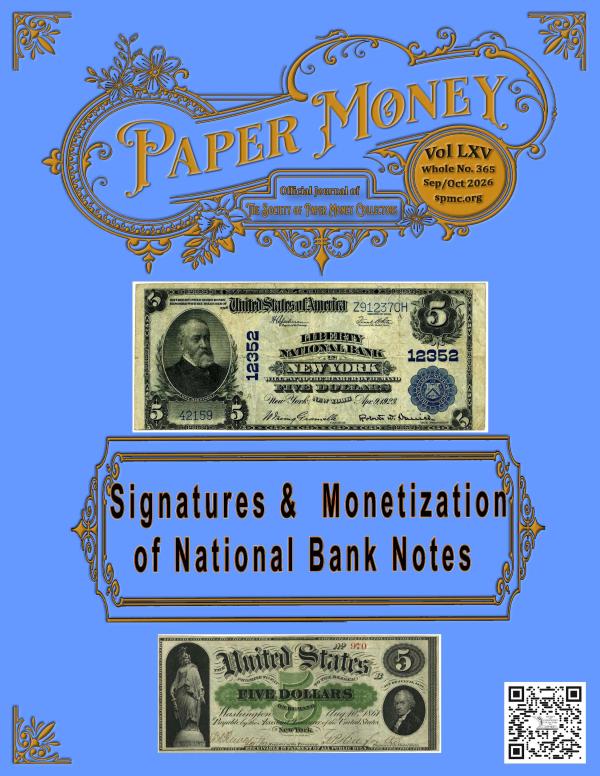
Table of Contents
Bank Signatures & Monetizaton of National Bank Notes--Peter Huntoon
The Durhamville Glass Manufacturing Co. --Michael Reddick
Vignettes & Latin Sayings on S.C. Notes of 1775/76--Benny Bolin
BEPs Vanishing Act--Lee Eilers
Two Banks, One Corner--Marc Shull
Introduction to George Clymer--Bill Gunther
New Jersey Vignette Identified--David Gladfelter
Backtalk--David Gladfelter
Postal Note from Rushmore, MN--Bob Laub
Ofϐicial Journal of
Signatures & Monetization
of National Bank Notes
Costa Mesa • New York • Boston • Miami • Philadelphia • San Francisco • New Hampshire • Oklahoma
Hong Kong • Copenhagen • Paris • Vancouver
America’s Oldest and Most Accomplished Rare Coin Auctioneer
SBG PaperMoney ConsignNov 260901
1550 Scenic Ave., Ste. 150, Costa Mesa, CA 92626
949.253.0916 • Info@StacksBowers.com
470 Park Ave., New York, NY 10022
212.582.2580 • NYC@StacksBowers.com
Visit Us Online at StacksBowers.com
LEGENDARY COLLECTIONS | LEGENDARY RESULTS | A LEGENDARY AUCTION FIRM
November 2026 Showcase Auction
Realize Top Prices for Your U.S. Currency
in the Stack’s Bowers Galleries
Auction Dates: November 16-20, 2026 • Costa Mesa, CA
Visit Us Online at
StacksBowers.com
Peter A. Treglia
949.748.4828
PTreglia@
StacksBowers.com
Michael Moczalla
949.503.6244
MMoczalla@
StacksBowers.com
Contact Our
Experts Today for
More Information!
Official Auction
of the
Whitman Expo.
Consign
U.S. Currency by
October 1, 2026
Fr. 93c. 1862 $10 Legal Tender Note.
PMG Choice Uncirculated 64 EPQ.
Realized $63,000
Fr. 359. 1890 $5 Treasury Note.
PCGS Banknote Gem Uncirculated 65 PPQ.
Realized $31,200
Fr. 348. 1890 $1 Treasury Note.
PCGS Banknote Gem Uncirculated 65 PPQ.
Realized $36,000
Fr. 1700. 1933 $10 Silver Certificate.
PCGS Banknote Superb Gem Uncirculated 67 PPQ.
Low Serial Number.
Realized $99,000
Philipsburg, Montana. $10 1882 Brown Back. Fr. 485.
The First NB. Charter #4658.
PCGS Banknote Choice Very Fine 35. Serial Number 1.
Realized $36,000
Fr. 1179. 1905 $20 Gold Certificate.
PMG Gem Uncirculated 66 EPQ.
Realized $120,000
Fr. 2405. 1928 $100 Gold Certificate.
PMG Gem Uncirculated 66 EPQ.
Realized $192,000
Fr. 2407. 1928 $500 Gold Certificate.
PMG Gem Uncirculated 65 EPQ.
Realized $204,000
290 Bank Signatures & Monetizaton of National Bank Notes--Peter Huntoon
300 The Durhamville Glass Manufacturing Co. --Michael Reddick
312 Vignettes & Latin Sayings on S.C. Notes of 1775/76--Benny Bolin
315 BEPs Vanishing Act--Lee Eilers
318 Two Banks, One Corner--Marc Shull
310 Introduction to George Clymer--Bill Gunther
SPMC.org * Paper Money * Sep/Oct. 2026 * Whole Number 365
285
324 New Jersey Vignette Identified--David Gladfelter
326 Backtalk--David Gladfelter
346 Postal Note from Rushmore, MN--Bob Laub
Columns
From Your President Robert Calderman 287
Editor Sez Benny Bolin 288
New Members Frank Clark 289
Chump Change Loren Gatch 327
Uncoupled Joe Boling & Fred Schwan 328
Foreign Affairs Dennis Hengeveld 336
Cherry Pickers Corner Robert Calderman 332
Quartermaster Michael McNeil 338
Small Notes Jamie Yakes 344
Advertisers
Stacks Bowers Galleries IFC
Pierre Fricke 285
Cuba BN Catalog 299
William Litt 308
SCCS 309
Executive Currency 325
FCCB 345
Bob Laub 348
Higgins Museum 348
PCDA 349
Heritage Auctions OBC
SPMC Hall of Fame
The SPMC Hall of Fame recognizes and honors those individuals who
have made a lasting contribution to the society over the span of many years.
Charles Affleck
Walter Allan
Mark Anderson
Doug Ball
Aubrey &
Adeline Bebee
Hank Bieciuk
Joseph Boling
Q.David Bowers
F.C.C. Boyd
Michael Crabb
Forrest Daniel
Martin Delger
William Donlon
Roger Durand
C. John Ferreri
Milt Friedberg
Robert Friedberg
Len Glazer
Nathan Gold
Nathan Goldstein
Albert Grinnell
James Haxby
John Herzog
Gene Hessler
John Hickman
William Higgins
Ruth Hill
Peter Huntoon
Brent Hughes
Glenn Jackson
Glen Jorde
Don Kelly
Lyn Knight
Chet Krause
Robert Medlar
Allen Mincho
Clifford Mishler
Barbara Mueller
Judith Murphy
Eric Newman
Dean Oakes
Chuck O'Donnell
Roy Pennell
Albert Pick
Fred Reed
Matt Rothert
John Rowe III
Fred Schwan
Neil Shafer
Herb& Martha Schingoethe
Austin Sheheen, Jr.
Hugh Shull
Glenn Smedley
Raphael Thian
Daniel Valentine
Louis Van Belkum
George Wait
John & Nancy Wilson
D.C. Wismer
SPMC.org * Paper Money * Sep/Oct. 2026 * Whole Number 365
286
Officers & Appointees
ELECTED OFFICERS
PRESIDENT Robert Calderman
gacoins@earthlink.net
VICE-PRES William Litt
TREASURER Robert Moon
robertmoon@aol.com
BOARD OF GOVERNORS
APPOINTEES
PUBLISHER-EDITOR-ADVERTISING MANAGER
Benny Bolin smcbb@sbcglobal.net
MEMBERSHIP DIRECTOR
Frank Clark frank_clark@yahoo.com
IMMEDIATE PAST PRESIDENT
Robert Vandevender
WISMER BOOK PROJECT COORDINATOR
Pierre Fricke
From Your President
Robert CaldermanFrom Your President
Shawn Hewitt
We’re excited to announce the details of our second annual
Florida United Numismatists (FUN) Speakers Forum. In the fashion of our
inaugural seminar last year, we’ll again have a total of five speakers making
presentations, and close out the forum with our SPMC membership meeting on
Saturday morning.
The dates of the FUN convention are January 9-12, 2020 at the Orange
County Convention Center, West Building WA1 & WA2, in Orlando, Florida. The
first four talks are on Friday, January 10 in Room 304F (same as last year).
Here is the lineup… - "The Current
Status of the U. S. Small Size Paper Money Market". – Mr. Calderman, a
specialist and dealer in U. S. small-size type notes will discuss the current
trends in small size notes and the future of this paper money specialty.
- "A Behind the Scenes Look at the Paper
Money Auction Process"–Mr. Johnston, the Vice- President and Managing
Director of the Currency Division at Heritage Auctions will discuss the nuts-
and-bolts of conducting a major Paper Money auction.
"An Overview of the
Confederate Paper Money Market" .
Mr. Fricke has been a long-time dealer in Confederate Paper Money and is the
author of the standard reference on Confederate Paper Money "Collecting
Confederate Paper Money: The Standard Guide to Confederate Money".
"The good, the bad, and the ugly of
antebellum bank note fraud" – Various types of pre-Civil War bank note fraud
will be explored and illustrated.
In addition, at the SPMC Membership Meeting (open to all) on
Saturday at 8:30am in Room 303B we have: - "Overview
of the SPMC Bank Note History Project" - This project is focused on two of
the primary historical aspects of the "Hometown" National Bank Notes - the
Banks who issued them and the bankers who signed them.
I think we’re onto a good thing in making FUN another major venue for
the face of SPMC. Our table will be 867 in the club section of the bourse floor,
so please stop by. Again, this year, we are participating in the ANA Treasure
Trivia Program, which is a great outreach to the youth of our hobby. We have
some very nice world notes to hand out (to young numismatists) as souvenirs
for visiting our table.
Before I go, I should mention that we have a new Membership Secretary.
Robert Calderman, one of our board members, has stepped up to fill the position
recently vacated by Jeff Brueggeman. If you frequent the major shows, you
may have seen Robert at one of our club tables. Robert is great resource for the
Society, and we very much appreciate the work he does for us.
Paper Money * July/August 2020
6
Robert Calderman gacoins@earthlink.com
Matt Drais stockpicker12@aol.com
Mark Drengson markd@step1software.com
Loren Gatch lgatch@uco.edu
Shawn Hewitt Shawn@north-trek.com
Derek Higgins derekhiggins219@gmail.com
Raiden Honaker raidenhonaker8@gmail.com
William Litt
Cody Regennitter cody.regenitter@gmail.com
billitt@aol.com
Andrew Timme
Wendell Wolka
derekhiggins219@gmail.com
SECRETARY Derek Higgins
billitt@aol.com
rman andrew.timmerman@aol.com
purduenut@aol.com
It is now September already and for the brief time that is left, I will hold on tightly
to our very last smidge of summer. At least until the first day of fall coming up here
soon on the 22nd. Enjoy the heat and sunshine for as long as you can! This is a fun
time of year here in the southeast where every afternoon we are bombarded by
intense pop-up thunderstorms that really scare the tar out of our little kitty cats!
Have you noticed a ton of changes going n in the paper money world this year?
A lot of shuffling has been going around, some of it for the better and other
changes have been s dly bit ersweet! The Paper Money Collectors of Michigan
PMCM founded in 1966 has now disbanded after nearly 60 years. Thei ren wned
publication “The Rag Picker” is avail ble via the archives on the Newman
Numismatic Portal and I hig ly recommend taking a look if you are not already
familiar with their past newsletters. The S MC was chosen by the P CM to receive
a generous donation from their treasury and we were in turn able to use funds to
provide new SPMC memberships and also renewals to active PMCM members! As
a result, you will notice a number of new SPMC members being added to our roster
via Frank Clark’s membership reports in our Paper Money Journal.
Another big change was the California Long Beach Expo shutting down after over
60 years of shows! PCGS owned the Expo and announced in February 2025 that the
show was being put on pause indefinitely. That was an absolute heartbreaker for me
since I grew up near Long Beach and still have family in Orange County!
Thankfully, StacksBowers Galleries based in nearby Costa Mesa came to the
rescue and acquired the show! Founded in NYC way back in 1933 Stacks Bowers
was the perfect company to swoop in and save the day. Earlier this year in
February, we had the first show under new ownership and a second show is coming
this month Sep. 9-11. While the summer shows will now likely become a thing of
the past… two shows a year are fantastic and much better than zero!
While I do acknowledge that this is old news at this point, it is very fresh on my
mind after hearing new information being released about the Whitman Baltimore
Expos! Next year’s longstanding March Baltimore show has now turned i to a
February show in Washington D.C.!!! Boy-oh-boy, a sho in D.C. during the dead
of winter? This could be an interesting logistical ess for dealers and attende s
traveling to and from the show! Le us just ke p our fingers crossed on that one. If
that wasn’t wild nough for you, how about this… th June Baltimore s ow is now
going to be in R leigh, NC for the next two years! This is a big plus fo me travel
wise, being closer to my home base here in Ge rgia, but much ore importantly
the Baltimore show is the only large show that exists to serve the northeast region!
Sure Raleigh works for a show, but it is an absolutely terrible location for all of the
folks who typically drive in from nearby NY, NJ, DE, and other northeastern
locales. The Whitman Publishing Company was acquired by CDN, publishers of
the Greysheet, back on Halloween 2023. With acquisition comes change.
It will be very interesting to see what the future holds for the Baltimore show, an
iconic location that has been a numismatic staple for over 50 years! What was the
actual catalyst to all of this change you may be asking? It most likely had nothing to
do with the ownership transition. This fall begins a billon dollar redevelopment of
the Baltimore Inner Harbor area. Regardless of how you feel about the changes to
the Whitman Expos, Baltimore was not going to be an option for at least the next
two years. Hope to see you at a future show.
As always, please stop by my table and say hello.
SPMC.org * Paper Money * Sep/Oct. 2026 * Whole Number 365
287
Terms and Conditions
The Society of Paper Money Collectors (SPMC) P.O. Box 7055,
Gainesville, GA 30504, publishes PAPER MONEY (USPS 00‐
3162) every other month beginning in January. Periodical
postage is paid at Hanover, PA. Postmaster send address
changes to Secretary Robert Calderman, Box 7055, Gainesville,
GA 30504. ©Society of Paper Money Collectors, Inc. 2020. All
rights reserved. Reproduction of any article in whole or part
without written approval is prohibited. Individual copies of this
issue of PAPER MONEY are available from the secretary for $8
postpaid. Send changes of address, inquiries concerning non ‐
delivery and requests for additional copies of this issue to
the secretary.
MANUSCRIPTS
Manuscripts not under consideration elsewhere and
publications for review should be sent to the editor. Accepted
manuscripts will be published as soon as possible, however
publication in a specific issue cannot be guaranteed. Opinions
expressed by authors do not necessarily reflect those of the
SPMC. Manuscripts should be submitted in WORD format via
email (smcbb@sbcglobal.net) or by sending memory stick/disk
to the editor. Scans should be grayscale or color JPEGs at
300 dpi. Color illustrations may be changed to grayscale at the
discretion of the editor. Do not send items of value.
Manuscripts are submitted with copyright release of the author
to the editor for duplication and printing as needed.
ADVERTISING
All advertising on space available basis. Copy/correspondence
should be sent to editor.
All advertising is pay in advance. Ads are on a “good faith”
basis. Terms are “Until Forbid.”
Ads are Run of Press (ROP) unless accepted on a premium
contract basis. Limited premium space/rates available.
To keep rates to a minimum, all advertising must be prepaid
according to the schedule below. In exceptional cases where
special artwork or additional production is required, the
advertiser will be notified and billed accordingly. Rates are
not commissionable; proofs are not supplied. SPMC does not
endorse any company, dealer, or auction house. Advertising
Deadline: Subject to space availability, copy must be received
by the editor no later than the first day of the month
preceding the cover date of the issue (i.e. Feb. 1 for the
March/April issue). Camera‐ready art or electronic ads in pdf
format are required.
ADVERTISING RATES
Editor Sez
Benny Bolin
Required file submission format is composite PDF v1.3
(Acrobat 4.0 compatible). If possible, submitted files should
conform to ISO 15930‐1: 2001 PDF/X‐1a file format standard.
Non‐ standard, application, or native file formats are not
acceptable. Page size: must conform to specified publication
trim size. Page bleed: must extend minimum 1/8” beyond
trim for page head, foot, and front. Safety margin: type and
other non‐bleed content must clear trim by minimum 1/2”.
Advertising c o p y shall be restricted to paper currency, allied
numismatic material, publications, and related accessories.
The SPMC does not guarantee advertisements, but accepts
copy in good faith, reserving the right to reject objectionable
or inappropriate material or edit copy. The SPMC
assumes no financial responsibility for typographical
errors in ads but agrees to reprint that portion of an ad in
which a typographical error occurs. Benny (aka goompa) except now PeePaw
Space
Full color covers
1 Time
$1500
3 Times
$2600
6 Times
$4900
B&W covers 500 1400 2500
Full page color 500 1500 3000
Full page B&W 360 1000 1800
Half‐page B&W 180 500 900
Quarter‐page B&W 90 250 450
Eighth‐page B&W 45 125 225
My little princess IS TWO!!! Can you believe it? I cannot. Seems
like yesterday she was born. So much fun, watching her run round
carefree and getting into everything! She is truly the light of my life.
So, we are now in the incessently hot days of summer. Not just in
Texas, but all over the nation it seems. Seems like a good time to go
indoors into the air-conditioning and go to a coin show!!!
From all reports I have been hearing, the hobby is strong and
doing well.
As you read in President Calderman's column, we want to
welcome members from the Paper Money Collectors of Michigan
into our ranks. I hope they all enjoy our group and will become
contributors to Paper Money. I always like their newsletter, The Rag
Picker. I have a number of issues from years ago saved in my
library. I hope some of their authors will continue to keep writing
and send me articles!
Some have asked how do I send you what is needed? Well, any
old paper money related topic will do. Due to having to reformat a
lot of the submissions in order to match formatting, decrease white
space, etc., I ask for articles to be in WORD format with picture
placement noted with a simple note so I put them in the correct
place. I use Time-Roman 11 pt. as the font. I will be happy to do the
rest. Just send them to me.
You will find this issue a bit smaller than usual, but with the same
quality of articles and columns. It seems I had a lot of longer articles
that would have taken me over the 72-80 page limit I have imposed
on myself. But--I still need your articles.
I really, really, really want to ask one of our many exceptional
authors out there to write me an article on Thanksgiving/Christmas
for the November/December issue. Submission deadline is October
10. Write about notes (U.S. or world), stamps, paper, receipts, etc.
I do need to tell you a little change that is happening, but only
temporarily. You probably noticed that the July/August issue was
later than usual and this one to, maybe. My goal is always to have it
in the hands of the USPS the first week of the first month of the
issue--September week one for the September/October issue, etc.
However, when getting the July/August issue ready to be printed,
our printer's main machine went kaput! That put them way behind
schedule but they got it working again and guess what? Their main
binding machine then went kaput! More delay.
So, in order to keep the issues on track as near as possible, I am
going to put the electronic file on the website right after I approve
the printers proofs. This will hopefully allow that if the print copies
are delayed most people will be able to at least read the electronic
copies. Hopefully with the next issue, all this will be a moot point
and our printer will be at full capacity again.
Till next time! Look out for those school zones and don't drive and text!
SPMC.org * Paper Money * Sep/Oct. 2026 * Whole Number 365
288
The Society of Paper Money
Collectors was organized in 1961 and
incorporated in 1964 as a non-profit
organization under the laws of the
District of Columbia. It is
affiliated with the ANA. The
Annual Meeting of the SPMC is
held in June at the International
Paper Money Show. Information
about the SPMC, including the
by-laws and activities can be
found at our website--
www.spmc.org. The SPMC does
not does not endorse any dealer,
company or auction house.
MEMBERSHIP—REGULAR and
LIFE. Applicants must be at least 18
years of age and of good moral
character. Members of the ANA or
other recognized numismatic
societies are eligible for membership.
Other applicants should be sponsored
by an SPMC member or provide
suitable references.
MEMBERSHIP—JUNIOR.
Applicants for Junior membership
must be from 12 to 17 years of age
and of good moral character. A parent
or guardian must sign their
application. Junior membership
numbers will be preceded by the letter
“j” which will be removed upon
notification to the secretary that the
member has reached 18 years of age.
Junior members are not eligible to
hold office or vote.
DUES—Annual dues are $39. Dues
for members in Canada and Mexico
are $45. Dues for members in all
other countries are $60. Life
membership—payable in installments
within one year is $800 for U.S.; $900
for Canada and Mexico and $1000
for all other countries. The Society
no longer issues annual membership
cards but paid up members may
request one from the membership
director with an SASE.
Memberships for all members who
joined the Society prior to January
2010 are on a calendar year basis
with renewals due each December.
Memberships for those who joined
since January 2010 are on an annual
basis beginning and ending the
month joined. All renewals are due
before the expiration date, which can
be found on the label of Paper
Money. Renewals may be done via
the Society website www.spmc.org
or by check/money order sent to the
secretary.
WELCOME TO OUR
NEW MEMBERS!
BY FRANK CLARK
SPMC MEMBERSHIP DIRECTOR
NEW MEMBERS 07/05/2026
Dues Remittal
R
obert Moon --SPMC Treasurer
Process
Send dues
directly to
403 Gatewood Dr. Greenwood, SC 29646
You may also pay your dues online at www.spmc.org.
16078 Tarik Eid, Website
16079 Kathleen Wasiuk, Website
16080 John Heemstra, Website
16081 Eric Shuster, Website
16082J Philip Davis, Website
16083 Nathaniel Mills, Website
16084 Skhye Wix, Website
16085 Donald Shaffer, Website
16086 Kim Weatherford, Website
16087 Alexander Shumskiy, Website
16088 Dennis Boone, Website
16089 William Heim, Website
REINSTATEMENTS
None
LIFE MEMBERSHIPS
None
NEW MEMBERS 08/05/2026
16090 Peter Daskalakis, Jeff Brueggeman
16091 David Haddock, David Sundman
16092 Ernie Nagy, PMCM
16093 Matthew J. Friday, PMCM
16094 Scott Webakken, Robert Calderman
16095 George Schweighofer,
16096 Robert Thomas, Frank Clark
16097 Stephen Cook, Paper Money Forum
16098 James Edgar, PMCM
16099 Mike Shirkey, PMCM
16100 Joseph LeBlanc, PMCM
16101 Bryan Kibiloski, PMCM
16102 Scott Simpson, PMCM
16103 Greg Gilbert, PMCM
16104 Rob Nettles, PMCM
16105 Bill Sauter, PMCM
16106 John A. Verville, PMCM
16107 Ryan Terry, Website
16108 Richard Schimmel. Website
16109 Terome Mitchell, Frank Clark
16110 David Anderson, Website
16111 Jerry Fitzpatrick, PMCM
16112 Floyd April, PMCM
16113 Audrius Moskaliovas, IBNS
REINSTATEMENTS
None
LIFE MEMBERSHIPS
LM488 Gregory Field, Robert Calderman
LM489 Adam Chin, Frank Clark
SPMC.org * Paper Money * Sep/Oct. 2026 * Whole Number 365
289
Bank Signatures and
Monetization
of National Bank Notes
INTRODUCTION
The question is, just what signifies that a piece of paper is monetized? Is it transformed into
money simply because some issuing authority such as a government treasury, bank, corporation or
individual printed the piece of paper saying so? Is it money once the official seal of the issuing entity is
overprinted on it? How about if it is signed by an official associated with the issuing authority?
Monetization of Treasury currency by the U S. Treasury was accomplished by overprinting seals
on the notes, an innovation implemented with the 1862 Legal Tender notes. However, monetization of
national notes, which followed in 1863, required signing the notes by designated officers of the banks.
This article will explain why nationals were treated differently, how sealing was used to monetize
Treasury currency but bank signatures to monetize nationals, and how monetization by signing nationals
eventually became a rather hollow reality.
Sealing is Adopted for Treasury Currency
The paper currency of the country leading up to the Civil War was issued by a plethora of private
banks, some state and local governments, corporations and individuals. Typically, those notes bore at least
one signature—usually penned—of an officer representing the issuing entity to indicate that the note was
monetized. The tradition of signing such notes was the same as followed for other classes of financial
paper representing contract value or indebtedness. Some financial paper of the era also utilized the seal of
the issuing entity or individua, but signatures were ubiquitous.
The 1861 demand notes are generally considered to be the first circulating U.S. currency
underwritten by the U.S. Treasury. They were authorized by a Congressional Act passed August 5, 1861,
Section 2 specified that the demand notes “shall be signed by the Treasurer of the United States, or by
some officer of the Treasury Department, designated by the Secretary of the Treasury, for said Treasurer,
and countersigned by the Register of the Treasury, or by some officer of the Treasury Department,
designated by the Secretary of the Treasury, for said Register, and no Treasury notes, issued under any
Figure 1. The neatly printed signature of cashier Albert Hollander is the smallest I have seen
on a national.
The Paper
Column
Peter Huntoon
SPMC.org * Paper Money * Sep/Oct. 2026 * Whole Number 365
290
act, shall require the seal of the Treasury Department.”
The framers of the legislation were not thinking realistically for a currency issue designed for an
entire nation. Ultimately, the demand note issue consisted of 4,450,000 $5s, 2,003,000 $10s and 910,000
$20s, All 7,363,000 of them had to be signed twice. Not only that, the deputies signing for the Treasurer
and Register initially had to hand write “for the” in front of the engraved titles on each note.
In short order, the bank note companies were instructed to engrave “for the” onto the plates, which
virtually halved the work of the deputy signers. Even so, something had to give.
The following is a revealing verbatim transcript of an account of the signing protocol. This
appeared in the July, 1875, issue of the Banker’s Magazine.
A writer in the Indianapolis Journal says: “The law requires all notes, bonds and interest coupons issued
by the Government to bear the signature of the Treasurer. In former times, before the invention of
greenbacks, and when the bond issues of the Government were comparatively insignificant, the Treasurer
used to affix his personal signatures to them. When General Spinner came into office in 1861 he still
pursued this practice for awhile, and nearly killed himself in the monotonous manual labor of writing his
name. It soon became evident that the work was greater than any man could do, and left him no time
whatever for other more important duties. So when the first issue of Government notes was made in the
summer of 1861, a different arrangement was made. These notes were receivable for customs duties, and
being payable on demand were called demand notes. The whole amount of them issued was $60,000,000.
This is before the Government began to print its own notes. These demand notes were engraved and
printed in New York, and sent to the Treasury Department at Washington to be signed by the Treasurer
and Register. As the theory still prevailed that they must be signed by hand, a force of about eighty clerks
was organized to do the work by deputy, one-half acting as Deputy Treasurers and the other as Deputy
Registers. At first the words ‘for the’ had to be written in, making the signature read, ‘John Jones, for the
Treasurer,’ or for the Register, as the case might be. Afterwards the words “for the” were engraved, and
only the signature had to be written. The signing of the $60,000,000 of demand notes occupied this force
of eighty men about six months—from August, 1861, to February, 1862. Although the Government credit
was good at that time, it was even then sorely pressed for ready money to meet the heavy expenses of
organizing and equipping the Army. Thus the demand notes were called for faster than they could be
Figure 2. Demand notes were monetized by the penned signatures of the Register of the
Treasury and Treasurer of the U.S. or their deputies. Notice the deputies had to write “for
the” in front of the officer titles on this note. 7,363,000 demand notes had to be signed within
a year. Heritage Auction Archives photo.
SPMC.org * Paper Money * Sep/Oct. 2026 * Whole Number 365
291
signed, and it often occurred that the whole force of clerks was kept at work till nearly midnight signing
bills which would be cut and trimmed early the next morning, and in some paymaster’s chest before night.
It happened to the writer to have charge of the work, and he well remembers the high degree of
gratification evidenced by the then Secretary of the Treasury, Mr. Chase, on learning that the last sheet of
demand notes had been signed without the loss of a dollar. These were the last Government notes signed
by hand.
After the last of the demand notes was issued in early 1862, and the legal tender notes were on
their way, the officials in the Treasury Department sprang for a major innovation. The bank note
companies were ordered to overprint facsimiles of the Treasury official’s signatures on the legal tenders.
In due course, as the 1862-3 legal tender series wore on, Treasury had the bank note companies roll
engraved facsimiles of the Treasury signatures onto the plates, which saved one printing step.
Simultaneously, and more significantly, they also decided to have Treasury seals printed on the
notes wherein the seals became the monetizing instrument rather than signatures of Treasury officials.
The American Bank Note Company was commissioned to design and produce seals that were
purchased by the nascent Bureau of Engraving and Printing, then called the National Currency Bureau.
The National Currency Bureau was housed with the Treasury building under the supervision of the
Secretary of the Treasury. The bank note companies delivered uncut sheets complete with Treasury
signatures to the Bureau. Thus, the overprinting of the Treasury seals was undertaken within Treasury as
a security safeguard. Then the Bureau cut the notes from the sheets
The Act of February 12, 1862 authorizing the first issue of legal tender notes carried this pivotal
language: “as evidence of lawful issue, the imprint of a copy of the seal of the Treasury Department, which
imprint shall be made under the direction of the Secretary after the said notes * * * shall be received from
the engravers.”
Thusly, from the outset of the 1862 legal tender series, an overprinted Treasury seal served as the
monetizing device on all Treasury currency rather than Treasury signatures.
Monetization of National Bank Notes
At this point, it is important to distinguish Treasury currency from bank currency. Treasury
currency is Congressionally authorized currency issued by the U.S. Treasury, the redemption of which is
the liability of the United States. Treasury currencies that later came into being after the legal tender notes
included gold and silver certificates, and Treasury Notes of 1890 and 1891.
In contrast, national bank notes are classified as bank currency, also authorized by Congress, but
the liability of the issuing bank.
From the outset, monetization of national bank notes was fundamentally different than Treasury
currency. The Act of February 25, 1863 that first authorized national bank currency clearly stated that the
printing of Treasury signatures and the Treasury seal served only to attest to the legitimacy of the issuance
Figure 3. President Peter White won the distinction for using the largest signature on
nationals. Heritage Auction Archives photo.
SPMC.org * Paper Money * Sep/Oct. 2026 * Whole Number 365
292
of the notes under the authority of the act, but monetization of the notes occurred only after they were
signed by the bank officials whose bank was liable for their redemption.
Specifically, language in Section 18 reads:
* * * notes shall express upon their face that they are secured by United States bonds, deposited with the
treasurer of the United States, and issued under the provisions of this act, which statement shall be attested
by the written or engraved signatures of the treasurer and register, and by the impression of the seal of the
treasury; and shall also express upon their face the promise of the association receiving the same, to pay
on demand, attested by the signatures of the president, or vice-president, and cashier.
This language was carried forward to the revised and reenacted version of the law as Section 22
in the Act of June 3, 1864. The language not only required the signatures of the bank officers but also
specified which officers could sign.
What transpired was that Congress simply adopted the existing tradition of signing to monetizing
nationals as was used for pre-Civil War bank currency. No one gave it a second thought
Another grandfathered tradition was to provide the notes in sheet form for ease in signing. That
practice stayed with nationals for the duration. Thus, the bankers assumed the responsibility for separating
the notes.
One onerous problem was that of sheets that were stolen in transit to the banks. Those notes with
spurious signatures were rejected when they came in for redemption at the Treasury. The procedure was
to send the rejected note back through the banking channel to the person who deposited it so the loss could
be lodged against that person. Of course, such rejected notes were vexing because the note holder had
accepted what clearly was a genuine note complete with signatures, The situation was a public relations
disaster for national currency because it caused the public to be wary of it.
Overprinted Bank Signatures
Comptroller of the Currency John Jay Knox, who served as Comptroller of the Currency between
1872 and 1884, was one of the foremost Treasury monetary thinkers of his era. He could be a stickler in
his interpretation of laws. Imagine receiving this letter from him if you were president of The Fourth
National Bank of New York as you were in the midst of issuing a total of 570,412 Original and 1875 series
notes between 1864 and 1884.
Treasury Department
Office of the Comptroller of the Currency
Washington,
April 10th, 1875
P. C. Calhoun Esq Prest
Figure 4. $1 Original Series note from The Fourth National Bank of the City of New York
printed in 1875 with printed signatures of president P. C. Calhoun and cashier Anthony Lane.
Heritage Archives photo.
SPMC.org * Paper Money * Sep/Oct. 2026 * Whole Number 365
293
Fourth Nat’l Bank
New York City
Sir:
I am informed that circulating notes of your bank have recently been placed in circulation with the
engraved signature of the President and Cashier. Section 22 of the National Bank Act authorizes the
engraving of the signatures of the Treasurer and Register, but not those of the Officers of National Banks.
Sec. 23 of the Act provides that “After any such association shall have caused its promise to pay such
notes on demand to be signed by the president or vice-president and cashier thereof, in such manner as to
make them obligatory promissory notes, payable on demand, at its place of business, such association is
hereby authorized to issue and circulate the same as money.” The construction of this Act is plainly that
no National Bank has a right to issue circulating notes unless “signed” by the President or Vice President
and Cashier thereof. This has been the interpretation of the Act by my predecessors in Office and the
present Secretary of the Treasury concurs in the interpretation. I have therefore requested the Treasurer
of the U.S. to transmit to this Office for destruction all circulating notes of your Bank with engraved
signatures which may be returned to his Office for redemption and your Bank is directed to require that
all circulating notes hereafter issued by your Bank shall receive the written signatures of your President
or Vice President and Cashier. If you have on hand any of your circulating notes with engraved signatures,
you are requested to return them to the Treasurer for redemption.
Very Respectfully
John Jay Knox
Comptroller of Currency
Bank officers certainly had more important concerns than the time-consuming and physically
debilitating job of signing notes. Clearly this was a point that the framers of the National Bank Act had
not thought through.
The reality was that the officers in many large banks had resorted to overprinted signature from
their earliest years, including those in The Fourth National Bank. The fact is, the officers at The Fourth
Figure 5. Note from The First National Bank of Woonsocket printed in 1866 with printed
signature of president Edward Harris and penned signature of cashier Reuben G. Randall. In
addition, the penned signature of vice president Joseph E. Cole was added vertically.
Figure 6. Detail
showing the penned
signature of Jos. E.
Cole over Vice
Pres’t.
SPMC.org * Paper Money * Sep/Oct. 2026 * Whole Number 365
294
National were having their signatures overprinted from the outset in 1864, Consequently, it is a curiosity
that their overprinted signatures were being challenged in 1875. It also is possible that Knox’ letter never
was sent.
In 2014, the PCGS grading service received a very curious looking ace from The First National
Bank of Woonsocket, Rhode Island. The note carries a penned signature of Jos. E. Cole scrawled vertically
across the face. Vice Pres’t is neatly printed under it. The PCGS graders wanted to know what I thought
of it because the printed Vice Pres’t hinted at legitimacy.
The other signatures on the Woonsocket note were Edward Harris, president, and Reuben G.
Randall, cashier. The note was serial numbered in 1866 and those officers were current then.
The big deal, though, is that President Harris’ signature was printed.
Probably the Woonsocket bankers had received a letter of admonishment for using overprinted
signatures or they read about the problem in some Banker’s magazine or Treasury circular. Their solution
was to comply by having both the cashier and vice president hand sign their notes. President Harris could
still maintain his visibility as top dog with his overprinted signature even though he may not have been
actively involved in the day-to-day operations of the bank or even present most of the time.
The use of a printed president’s signature may be problematic, but the note carries two penned
signatures of legally authorized signers so it meets the letter of the law. I consider it to be one of the most
interesting nationals I have seen.
Quelling Frustration
Public and banker frustration revolving around the technicalities associated with bank signatures
on nationals, especially rejected stolen notes with spurious signatures, festered for almost 30 years before
Congress dealt with it. On July 28, 1892, an act entitled “An act to amend the national bank act in providing
for the redemption of national bank notes stolen from or lost by banks of issue” was finally signed into
law as follows.
That the provision * * * providing for the redemption of national bank notes, shall apply to all national
bank notes that have been or may be issued to, or received by, any national bank, notwithstanding such
notes may have been lost by or stolen from the bank and put in circulation without the signature or upon
the forged signature of the president or vice-president and cashier.
The key clause and its linguistic context within the text of the act was “shall apply to all national
bank notes.” The ‘all” was taken to apply well beyond stolen notes. The act served as license by the bankers
Figure 7. $5 Series of 1875 sheets D252111-D252135, 741-765 were stolen while in transit to
the bank, spuriously signed and passed. When presented for redemption, such notes were
rejected by the Treasury and returned through banking channels to the depositor who
sustained the loss. The punch cancels read BAD. Heritage Archives photo
SPMC.org * Paper Money * Sep/Oct. 2026 * Whole Number 365
295
to apply their signatures using any means possible because the notes would be redeemed anyway. From
this point onward we see the use of every conceivable means the bankers could find to apply their
signatures. Rubber-stamped signatures in particular flourished. Also, little attention was paid to the
requirement that the signatories be the president or vice-president and cashier
Bankers occasionally submitted vice president signatures when it came time for the Bureau of
Engraving and Printing to overprint signatures on Series of 1929 notes. Others pushed the envelope by
submitting signatures of assistant cashiers without pushback from the Comptroller of the Currency’s
office.
Implicit in the passage of the 1892 act with respect to the stolen notes was that the loss to the
Treasury would be offset many times over by irretrievably lost notes that never would be submitted for
redemption.
Engraved Bank Signatures
In an amendment to the National Bank Act dated March 3, 1919, Congress provided that the
promise to pay a national bank note could be attested by the “written or engraved signatures of the
president or vice president and cashier.” Through an oversight, this language amended a section of the
National Bank Act that authorized the Comptroller to provide for the preparation of national bank notes,
not the appropriate section dealing with the actual issuance by the banks of such promissory notes. This
was remedied in an amendment passed January 13, 1920, as follows.
Any association receiving circulating notes under this title may, if its promise to pay such notes on demand
is expressed thereon attested by the written or engraved signatures of the president or vice president and
the cashier thereof in such manner as to make them obligatory promissory notes payable on demand at its
place of business, issue and circulate the same as money. Such written or engraved signatures of the
president or vice president and the cashier of such associations may be attached to such notes either before
or after the receipt of such notes by such associations.
The officers of the large banks, and many smaller banks, leapt at the chance to have their signatures
engraved on their plates and were only too happy to pay the nominal extra cost. The signatures were added
to existing plates or affixed to duplicate plates when ordered. Plates for many new banks ordered engraved
signatures from the outset.
Both Series of 1882 and 1902 plates were current when the 1920 act passed but no engraved
signatures were ordered by bankers issuing from the then waning Series of 1882.
Series of 1902 notes with engraved signatures are easily distinguished because there are no lines
under the bank signatures. The lines were omitted from new plates or removed from existing plates at the
Figure 8. Rubber stamp used at
The First National Bank of
Belen, New Mexico, to apply
both bank signatures at once to
their later Series of 1902 blue
seal plain back notes. Robert
Calderman photo.
SPMC.org * Paper Money * Sep/Oct. 2026 * Whole Number 365
296
time engraved signatures were added.
The engraved signatures of vice presidents can be found on some Series of 1902 notes issued by
two banks: The National Bank of Fairmont, West Virginia (9462) and Liberty National Bank in New York,
New York (12352).
Odd Signature Titles
Just about every officer title used in a national bank ended up as a title under some signature on a
national bank note. Consequently, we see everything from Chairman of the Board down to various
assistants and actings. The most unusual of the stand-ins that I have observed is on the illustrated Greybull,
Wyoming, note. Neatly penned under the signature of Louise E. Craig is the word “For” in front of the
engraved CASHIER. She was standing in for cashier G. A. Hinman at the time. This is the only instance
where I have observed “for cashier” let alone “for president” on a national. It harkens back to the “for the”
Register and “for the” Treasurer signatures on the 1861 demand notes.
Perspective
It is only natural that Congress designated bank signatures as the monetizing device for national
bank notes when their authorizing legislation was passed in 1863. That tradition was simply carried
forward from their non-Federal predecessors.
In similar fashion, Congress already had used Treasury signatures to monetize the demand notes
of 1861. That had been a nightmare for the Treasury Department, which ultimately had to employ a
workforce to sign the 7,363,000 that were issued within a year. The next currency legislation authorized
legal tender notes and Congress in concert with the Treasury Department designated the overprinting of
the Treasury seal on them as the monetizing device. From then on, the seal has been used to indicate
monetization of all Treasury currency.
However, national bank notes, the redemption of which were the liability of the issuing banks,
were classified as bank currency and were treated differently. As with the demand notes, the bankers found
themselves burdened with signing their notes. Ironically, nationals also carried Treasury seals but by law
in their case the seals simply certified that their issuance was sanctioned by the Treasury acting on behalf
Figure 9 This bank was one of two in the country to order plates bearing the engraved
signature of the vice president. Notice that there are no lines under the signatures.
SPMC.org * Paper Money * Sep/Oct. 2026 * Whole Number 365
297
of Congress. This schizophrenic fine point certainly was lost on the public.
It did make a different in the handling of the two classes of currency. For most of the period up
through 1910, Treasury currency was delivered to the Treasurer in sheet form without Treasury seals. The
seals were overprinted within the Treasury building under the supervision of the Treasurer as a separate
operation. This was a security measure to prevent the theft of sealed currency by the printers in the bank
note companies and later the Bureau of Engraving and Printing.
In contrast, Treasury seals were printed on national bank notes at the Bureau of Engraving and
Printing from the Series of 1875 forward with the idea being that if stolen, they weren’t money so could
be repudiated.
The Act of July 28, 1892 that required the redemption of all national bank notes regardless of
the legitimacy or condition of the signatures depreciated their authority as monetizing devices, As for
Treasury currency, the sealing of it was turned over to the Bureau of Engraving and Printing in 1910 as
an economy measure.
Sources
Banker’s Magazine, July, 1875, Mr. Spinner’s signature: Third Series, vol. x, no. 1, p. 68.
United States Statutes, laws authorizing currency: Government Office, Washington, DC.
Figure 10. Louise E. Craig For CASHIER.
SPMC.org * Paper Money * Sep/Oct. 2026 * Whole Number 365
298
Author,
Emilio M. Ortiz
CUBA
Specialized Banknote
Catalogue
1857 - 1960
200 Catalogues have been printed.
The sales price is $139.00 including delivery to Europe and USA.
Other destinations will pay additional for shipping.
To order your copy, please e-mail your request to:
cubanbanknotes@gmail.com
The Durhamville Glass Manufacturing Company
Disputed Origins, Titanic Explosions, and the Politics of Scrip
by Michael Reddick
Image by Author
As an introduction, I became an SPMC member in October 2025 after finding the website and recognizing
value in both the tools and information provided. I primarily collect National Bank Notes and obsolete currency from
my home state of Georgia and neighboring South Carolina. At the beginning of this year, I decided to expand my
paper money search to include areas I had not previously considered. One of the first items that caught my attention
was this 6 ¼ cents note from Oneida County, New York, which was listed in a January 2026 auction.1 Researching
this note and learning the stories behind it turned out to be an absolute joy, so I decided to share my journey here with
the collecting community. I hope you find my journey interesting as well.
Let’s take a look at the note. I was not familiar with the Durhamville Glass Manufacturing Company nor had
I seen this denomination before. A description provided by the auction house included sparse details: the company
was started by J. Fox in 1818, this denomination was unknown to someone named ‘Harris’, and it was in some way
related to the Coinage Act of 1857. As a relative newcomer to collecting obsolete paper money, many questions
swirled in my head as I pondered bidding for the note. Why was there a ¼ in this 6 ¼ cents note? What was the
Coinage Act of 1857? Who was Harris and what denominations had he known about? Who was this J. Fox fellow
who started the company? And who was H. W. Fox, the signer of this note, and what was his relation to J. Fox?
As an inquisitive person with a passion for solving mysteries, I was immediately compelled to find answers
to these questions. I successfully bid for the note and upon receiving it, began a deep dive into the past, but the more
research I conducted on the company that issued it, the more confused I became. Was the Durhamville Glass
Manufacturing Company started in 1818 as indicated by the auction house description, or was it actually started in
1841, 1843, 1845, or even 1849 as stated by others?2,3,4 Was the company really founded by a man named J. Fox, or
was it actually founded by Isaac B. Fox5, Samuel H. Fox6, or possibly DeWitt C. Stephens?7 Adding to my
bewilderment, consider the many names used to describe the company over time: Durhamville Glassworks,
Durhamville Glass Works, Durhamville Glass Factory, Durhamville Glass Manufacturing Company, Fox & Fox, Fox
& Son, Fox & Company, Fox, Gregory & Company, DeWitt Stevens Glass Works, and finally the Durhamville
Glassworks, Incorporated. The seemingly contradictory information on dates, founder names, and company names
only fueled my desire8 to dig deeper, figure out who really founded the company, discover the true start date, and
have a better understanding of the obsolete scrip that was issued.
SPMC.org * Paper Money * Sep/Oct 2026 * Whole Number 365
300
Durhamville History
I first wanted to get a general idea of where
the company was located and what existed in the
area just prior to the founding of the glass
company. Durhamville was first settled in 1811 by
Eliphalet Frazee, but was named after Eber
Durham who settled in the area in 1826.
Durhamville’s growth was fueled by the
development of the Erie Canal, which began
construction in 1817 and was completed in 1825.
The canal was an engineering marvel of the time,
serving as the primary connection between the
Atlantic Ocean and the Great Lakes. Today,
Durhamville is a hamlet located within the town of
Verona, in Oneida County, New York. As of April
2026, it has an estimated population of 788.
One of the first names that popped up in
my research on Durhamville was that of DeWitt
Clinton Stephens. Mr. Stephens was born on May
20, 1810, and was a key player in the development
of the local economy. He was a highly respected
contractor and builder and was involved in several
high-profile projects in the area. He helped build the portion of the Erie Canal that passed through the Montezuma
marshes, located 40 miles southwest of present day Durhamville. Stephens was also an active builder and promoter
of the Oswego Midland Railroad, which ran from New York City to Oswego on the shore of Lake Ontario, and passed
just east of Durhamville. Between 1841 and 1843, he began building and operating the first glass factory in
Durhamville.9 A short time later, in 1845, he sold his factory to the owners of a glassworks company located in Sand
Lake, New York. I found one contemporary source25 which indicated Mr. Stephens retained co-ownership of the
factory for a short period after the 1845 transaction, but I was unable to locate any corroborating evidence.
The detailed map in Figure 1 was created by D.G. Beers10 in 1874 as part of a larger effort to produce and
sell detailed maps to local residents. It clearly shows the streets, property boundaries, and property owner’s names
for Durhamville. Below the map title is a list of the prominent businesses operating in Durhamville at the time. It
includes the names of both Samuel H. Fox and Henry W. Fox as proprietors of the Durhamville Glass Works. The
map clearly shows the location of the Durhamville Glass Works, the company store, and the company office located
on the north side of Clinton Street. Between Clinton and Lafayette Streets, you can see the location of Samuel Fox’s
residence. The Durhamville Glass Manufacturing
Company grew and prospered under the leadership of
Samuel H. Fox. The painting shown in Figure 2 depicts the
Durhamville Glassworks11 as it existed in the mid-1800s.
While researching the early history of Durhamville and
Oneida County, I located a couple dozen contemporary
accounts of the history of the area and all accounts agree
that the glassworks were originally built and operated by
DeWitt C. Stephens between 1841 and 1843. If the
founding by Mr. Stephens is such a well-established fact,
why do we see claims that the company was founded by
someone else in 1818? To better understand this
discrepancy, we need to take a look at the history of the
Rensselaer Glassworks, a glass company located 130 miles
east of Durhamville.
Figure 1 - Map showing Durhamville Glass Works, Samuel H. Fox Residence, and
several properƟes owned by Fox & Co., circa 1857.
Figure 2 – Durhamville Glassworks, mid-19th century
SPMC.org * Paper Money * Sep/Oct 2026 * Whole Number 365
301
The Rensselaer Glassworks Connection
The Rensselaer Glassworks were located on the shore of Glass Lake in Rensselaer County, New York. The
land was owned by the Van Rensselaer family, one of the oldest European colonial families in New York. In 1804,
Jeremiah Van Rensselaer, a land agent, merchant, and surveyor, founded12 the Rensselaer Glass Factory in Sand Lake.
Incidentally, Van Rensselaer served as president of the Bank of
Albany from 1789 through 1806. The production of glass at this
location is known to have been started by 1806. For a detailed
explanation of the complicated history of land leases and ownership
of the Rensselaer Glassworks, I’ll defer to Phil Bernnard who
published an excellent article4 in Antique Bottle & Glass Collector
which provides a breakdown of the history and people involved in
the creation and development of the Rensselaer Glassworks. In 1806,
a legislative act was passed that
incorporated the Rensselaer Glass
Factory with an approved
capitalization “…not to exceed 100
shares at $1,000 each.”13 Figure 3
shows a stock certificate from the
1806 incorporation which was sold
at auction14 in 2014. The names on
this particular stock certificate are
interesting, as it was issued to
Francis Bloodgood, who two years
earlier had joined with a group of businessmen to lease the land upon which the
glassworks were built. Bloodgood later served as a state senator representing the
Western District from 1809-1816. The certificate is signed by Elisha Jenkins, a
prominent merchant and politician, who served as President of the newly formed
corporation. Elisha subsequently served as the New York State Comptroller15 from
1801 to 1806, New York Secretary of State from 1806 to 1807, and as the Mayor of
Albany from 1816 to 1819. The stock certificate is also signed by James Kane, who
served as the Registered Agent of the corporation.
In 1818, Isaac Bristol
Fox formed a partnership with Nathan Rockwood Crandall16,17
and Abraham Vander Poel Gregory and purchased the Rensselaer
Glass Factory from the stockholders of the company. The new
partnership was called Crandell, Fox & Co. This transaction marks
the origin of the often-quoted founding year 1818. It is the first
time a member of the Fox family becomes involved in glass
making. The partnership lasted until May 27, 1823, when it was
dissolved18 upon the departure of Abraham Gregory; however, the
business continued to operate under the name Crandell, Fox & Co.
Between 1823 and 1838, Isaac Fox exited his ownership position
and the company changed hands several times, only to be
reacquired by the Fox family as described by Peter Finn, a Trustee
of the Sand Lake Historical Society:
“The glass factory changed hands several times in the
ensuing years and eventually was reacquired by Isaac
Fox and leased (and then subsequently sold) to his sons,
Albert R. and Samuel H…”19
After reacquiring the operations in Sand Lake, the Fox
family was able to develop and improve the manufacturing
processes and finally turn a profit. Innovations introduced by the
Fox brothers include being “…the first in the country to use soda
ash in the making of glass, the first to adopt wheel ovens, and the first to use coal in his furnace.”3 In 1845, the firm
Figure 3 - Rensselaer Glass Factory stock issued 1806
Figure 4 - Elisha Jenkins, President
Figure 5 - Family Tree from FamilySearch.org
SPMC.org * Paper Money * Sep/Oct 2026 * Whole Number 365
302
expanded beyond the Sand Lake operations by purchasing a glass factory in Durhamville, New York, which had been
recently built by the notable contractor DeWitt Clinton Stephens.20 In Figure 5 a graphic showing Isaac B. Fox’s
family makes clear just how much of a family affair Fox & Company was. Originally founded by Isaac B. Fox,
control of the company eventually passed to his children Albert R, Samuel H, I. Williard, and Henry W who held
various positions within the company. Henry Wilson Fox, the youngest of the Fox brothers, joined the company upon
the departure of his brother Isaac Willard Fox.21 Henry, incidentally, served as the company registrar and was the
signer of the 6 ¼ cents note. He worked with the company until his health took a downturn and he decided to retire
in September 1875. Upon retirement, Henry was removed from active ownership and was replaced by Samuel’s son,
Frederick (Fred) Hamilton Fox.
The name of the Fox family business changed several
times over the remainder of its existence as family members
rotated in and out of ownership positions for various reasons.
Manufacturing operations at the Sand Lake location ceased in the
late evening of December 25, 1852, when a titanic explosion of
an unattended furnace showered the town with molten glass. It
was widely reported that residents awoke the next morning to see
molten glass icicles hanging from trees and homes in the area. The
furnace and surrounding buildings in Sand Lake were burned to
the ground, and operations there never restarted. Some of the
glass operations and assets that survived the fire were moved to
Durhamville22 to augment company operations there.
Durhamville Glass Manufacturing Company Scrip
In my previous experience researching National Bank
Notes to determine scarcity and value, I had been spoiled by the
convenience provided by both the National Bank Note Census
and Track and Price. For obsolete note collecting, there is no
similar up-to-date centralized database23, so finding information
is a bit more challenging. Searching auction house databases is
helpful for finding images of obsolete scrip, but if you want to
develop a better idea of the scarcity and value of scrip, you’ll
typically need to find a book published by a state expert.
For the state of New York, I turned to Gordon L. Harris.
In 2001, Harris published his book New York State Scrip and
Private Issues, which covers scrip and private notes from the
colonial era to the Civil War. On page 52, Harris listed the
following description at the beginning of his brief section on
Durham Glass Manufacturing: “The company was formed in
1818 by J. Fox, changing hands a few times and finally bought
back by J. Fox and Sons”24 Eureka! I had found the source that
most auction houses quote when describing scrip issued by this
company. Unfortunately, based on my research, this information
is not quite accurate. The business entity operated by the Fox
family may have been formed in 1818, but the Durhamville
factory was not built until the 1841 to 1843 timeframe. It’s
interesting to note that Harris states that “J. Fox” formed the
company. Several family documents, posted legal notices, court
documents, and contemporary newspaper articles clearly identify
Isaac Bristol Fox (I. Fox) as the actual founder of the company. I wondered for some time why Harris believed the
company was founded by a J. Fox instead of I. Fox. My initial hypothesis was that Harris had simply misinterpreted
the font that was used by printers at the time, and had mistaken an “I” for a “J”. But that explanation didn’t sit well
with me, so I kept digging. Then I found a book published in 1912 which provides an overview of the glass industry
of Oneida county. The author, Cookinham, mentions the founding of the Oneida Glass Factory Company and the
Utica Glass Factory Company, then adds: “Later, a glass factory was organized at Durhamville, which was conducted
Figure 6 - Harris H6. Image by WorthPoint.com
Figure 7 - Harris UNL. Image by coinsgreen, eBay.com
Figure 8 - Harris H8. Image by Heritage AucƟons
SPMC.org * Paper Money * Sep/Oct 2026 * Whole Number 365
303
for many years by Stevens & Fox, afterward, Samuel J. Fox, and Samuel J. Fox & Son. The business had been very
profitable, and for a time the partnership known as Fox & Son was financially very strong…”25
Here again, we see the errant introduction of the
letter “J” when we have incontrovertible evidence that
Samuel Fox’s middle name was Hamilton. This led me to
believe that when Harris was conducting research for his
2001 book, he may have read the 1912 book by
Cookinham and saw the reference to a “Samuel J. Fox.”
Harris may have known that Samuel Fox was the son of
the founder, so maybe he assumed the father’s name was
“J. Fox.” It’s also possible Harris simply dropped the
“Samuel” from “Samuel J. Fox” and just used “J. Fox” in
his 2001 book. Although I can’t be certain, this seems to
be the most plausible explanation.26
In his book, Harris listed seven denominations
from three cents up to two dollars. I scoured the internet
and several printed publications attempting to locate
images of every unique scrip design issued by the
company. I was able to locate twelve unique designs
spread across nine denominations, and I share eleven27 of
them here in Figures 6 through 16. The 6 ¼ cents note I
acquired at auction (Figure 10) was issued on January 1st,
1854, three years prior to the passage of the Coinage Act
of 1857. The Act prohibited the use of foreign money in
general commerce within the United States. Prior to
passage, foreign coins were allowed as legal tender
within the United States because the US Mint didn’t have
sufficient capacity to support the quickly expanding
economy. A common currency basis used in colonial New
York at the time was the “York shilling”, which was
benchmarked to the Spanish dollar. It valued one Spanish
real (or “bit”) at 12 ½ cents, which meant that a “York
shilling” was worth 1/8 of a Spanish dollar. For this
reason, it was not uncommon to see scrip denominations
of 6 ¼, 12 ½, and 37 ½ cents circulating in the United
States in the early 1800s, as the currency was based on the
Spanish dollar and the denominations made it easier for holders of paper money to exchange the notes for specie.
The Politics of Scrip and Company Stores
Economic uncertainty created by the depressions of 1819, 1837, 1857, 1873, and 1893 was the primary driver
for companies to begin paying workers with scrip in lieu of hard currency. These financial crises led to widespread
bank failures, high unemployment, and scarcity of specie. In this environment of fear, people began hoarding specie,
which dried up market liquidity and made daily commerce and business to business transactions nearly impossible.
To help address the liquidity issue, banks, businesses, and on rare occasions even individual citizens, began creating
and issuing their own temporary currency that today we call scrip. The intent was that the scrip would be exchanged
for legal tender once the economy recovered and specie was available again in sufficient quantities to support general
commerce.
The practice of companies creating on-site stores to provide goods to employees became popular during the
development of logging, mining, and railroad camps from the 1850s to the 1930s. These companies were often so
remote, it was impractical for workers to travel to the nearest town for needed goods, so companies would provide a
store at the company location. A company might pay workers using a mixture of company scrip and hard currency
or simply pay workers in 100% scrip. Companies benefited from issuing scrip as they no longer needed to maintain
Figure 9. Harris UNL. Image by myerscollecƟbles, eBay.com
Figure 10. Harris UNL. Image by Author
Figure 11. Harris UNL. Image by Heritage AucƟons
SPMC.org * Paper Money * Sep/Oct 2026 * Whole Number 365
304
a large supply of hard currency and they could print
however much ‘money’ they wanted. The downside was
that scrip was typically only redeemable at the company
store and employees holding large sums of scrip were
incentivized to not leave the company, as their scrip
would be worthless outside the circular economy created
by the company. It’s not hard to imagine how this system
could be rigged in favor of the company. Over time and
influenced by the passage of the Coinage Act of 1857,
some companies stopped issuing scrip and began a
system of keeping ledgers or issuing pass-books which
tracked worker wages. Company store purchases were
simply deducted from the ledger or pass-book, so the
company essentially operated a monopoly by controlling
the entire financial ecosystem. What could possibly go
wrong? The management of the Durhamville Glass
Manufacturing Company, along with several other
glassworks in New England, followed industry trends by
creating company stores and issuing scrip or pass-books
to workers in the mid-1800s.
Samuel Fox’s older brother Albert Fox served as
a New York State Senator from 1848 to 1849. In 1881,
Samuel followed his brother’s lead and stepped into the
political arena to run for a senate seat on the Republican
ticket, but lost to “…that popular Democrat, Robert H.
Roberts, of Boonville...”5 In 1882, “…against his own
better judgement, he was induced to accept a nomination
for Congress against J. Thomas Spriggs.”2 Fox
campaigned as a Republican, and during the 1882
campaign, the use of company scrip and pass-books
became contentious. Figure 15 shows a front-page political
advertisement28 presumably paid for by James Leonard who was
representing the Cigarmakers Union. In the ad, Leonard blasts the
company for paying workers with scrip, stating that a physician named
Joseph P. Davis who lived in Utica was holding a quantity of original
scrip that was available for all to see. Leonard further complains that Mr.
Fox “…paid his men in orders and pass-book accounts payable only at
the store of the Durhamville Glass Co.” At the end of the advertisement,
Leonard commands, “You will not vote for a man who pays in shin
plasters and orders.” On page four of the same newspaper issue, there is
a lengthy political hit piece that may have been typical of the types of
articles Fox faced during his campaign. The article begins by describing
Fox as a monopolist who paid big prices to buy back all company scrip
for political purposes. The author presumably visited the glassworks to
investigate “…odious forms of payment…” and “…unpleasant rumors
circulated concerning the treatment of the men in the employ of Fox &
Co.” The author describes conditions where workers were forced to work
“…with bare feet all day long…” in a 1,200-degree environment “…as
hot as the famous fiery furnace of biblical narrative…”
Although the article was clearly politically motivated, it does provide some interesting tidbits for collectors.
At one point the author states the only reason for the discontinuance of the use of scrip and the attempts to buy back
scrip from workers was the fact that Mr. Fox was reacting to his opposition party’s political platform. If true, the steps
taken by Fox to stop issuing scrip and start buying it back from employees may partially explain the relative scarcity
of Durhamville scrip today. Another interesting tidbit provided is that “…scrip was used in all denominations from
ten cents up to five and ten dollars...”27 In my review of company scrip, I have been able to locate images or
Figure 15 – 1882 PoliƟcal adverƟsement, showing a 10-
cent note, Harris H11.
Figure 12. Harris H13. Image by Heritage AucƟons
Figure 14. Harris H20. Image by Heritage AucƟons
Figure 13. Harris H16. Image by Heritage AucƟons
SPMC.org * Paper Money * Sep/Oct 2026 * Whole Number 365
305
descriptions of notes with denominations ranging from three cents up to two dollars. My search for the five- and ten-
dollar denominations continues.
After bashing the use of scrip, the article goes on to describe the creation of a new system of “pass-books”
where glassblowers were credited with their wages, but they could only use their credits to buy goods at the company
store, which carried groceries, clothing, boots and shoes,
meat from a meat market, and other general merchandise.
According to the author, the policies of the Glass
Manufacturers Association, to which the company
belonged, allowed member companies to only pay
workers in cash every five or six months. The author
claimed that any worker who demanded cash payment
between these intervals, “…would be quickly dispensed
with and be sent adrift with his family…and find himself
a marked man and unable to find employment in any
glass factory…” Fox lost the 1882 election to Mr. Spriggs,
an outcome possibly influenced by the politicization of the use of pass-books and company scrip and certainly
influenced by the fact that Fox was “…not a politician in any sense of the term, though an ardent Republican.”2 The
practice of companies paying workers with company scrip became illegal in 1938 with the passage of the Fair Labor
Standards Act.
Market Forces and Closure
At the pinnacle of its operations, the Durhamville Glass Manufacturing Company was the largest
manufacturer of window glass in New York State, and possibly the entire county. Several manufacturing innovations
introduced by the Fox family helped create a competitive advantage that propelled the company to the forefront of
the glass industry. Fox & Company was financially a very successful business for much of the 1800s, providing an
economic backbone for Durhamville and the surrounding
area. By the late 1800s, technological advancements in
glassmaking and a shifting economic environment led to the
decline and eventual closure of the Durhamville operations.
The Erie Canal branch that had helped Durhamville prosper
was closed as the canal was rerouted, fuel and labor costs
were rising, and the glass industry was shifting to plate-
glass technology. In 1891 the operations in Durhamville
merged with U.S. Plate Glass and the majority of
manufacturing operations in Durhamville were shut down.
There were multiple attempts29 to revive the Durhamville
glassworks between 1891 and 1904. Then, on September
22, 1904, Jerre T. Durham sold the Durhamville Glass
works property30 to a group of investors to settle $5,000 in
notes owed to the Oneida Valley National Bank. The
investors intended to rekindle the fires of glassmaking in
Durhamville. About two weeks later, on October 11, 1904, a newly revived Durhamville Glass Manufacturing
Company was incorporated with an initial capitalization of just $7,00031. The first annual meeting of company
stockholders was held Tuesday, July 11, 190532. Contemporary reports of the activities of the newly formed
corporation are scarce, and it only survived one additional year, permanently closing its doors in 1906. All remaining
assets were sold at public auction in 1907.1
Retrospective
Researching this 6 ¼ cents note was an absolute joy for me. My original intention was to purchase the note,
enhance my collection with the odd 6 ¼ cents denomination, write up a brief social media post, then move on to my
next note. But fate had other plans. As I invested more time in this project, I discovered there were conflicting stories
about the origin of the company, I uncovered some Fox family legal drama which led all the way to the supreme
court, I learned about the legendary 1852 explosion of the furnace in Sand Lake, and read about the travails
experienced by the company as it wound down operations. Humans are story-telling animals, but clearly this 6 ¼
cents note had its own stories to tell.
Figure 17 - AdverƟsement Card. I now know the 1818 date refers to Fox
& Company, not the Durhamville Glass Works
Figure 16. Harris H22. Image by coinsgreen, eBay.com
SPMC.org * Paper Money * Sep/Oct 2026 * Whole Number 365
306
In summary, the Fox family business that we today associate with glass manufacturing was founded by Isaac
Bristol Fox in 1818 when he purchased the glass factory (formerly known as the Renssalaer Glass Works) in Sand
Lake. His son, Samuel Hamilton Fox, with his brothers as co-owners, led the company for much of its existence.
Samuel purchased the glass manufacturing plant in Durhamville in 1845, which had been built between 1841 and
1843 and was initially operated by the noted contractor DeWitt Clinton Stephens. Samuel led the company as it grew
and prospered, becoming the largest window glass manufacturer in New York, and likely the entire nation. In late
1852 and early 1853, Samuel transported company
assets and moved workers from Sand Lake to
Durhamville upon the explosive closure of the
operations in Sand Lake. In addition to his work in the
glass industry, Samuel Fox also held senior positions in
two nationally chartered banks. He served as President
of the National State Bank in Oneida, served on the
Board of Directors for the First National Bank of
Oneida, served as president of the National Association
of Window Glass Manufacturers, and ran for House and
Senate seats in the state of New York. Concerning the
note itself, I found the signature to be that of Henry
Wilson Fox, the youngest brother of Samuel, and
grandson of the founder, Isaac Bristol Fox. Henry was
serving as the company registrar in 1854 when he
signed the 6 ¼ cents note. The existence of fractional paper currency was not unusual in the early 1800s, as it provided
a bridge between the paper money issued in the US and the underlying currency basis which was tied to the Spanish
dollar. The passage of the Coinage Act of 1857 prohibited the use of foreign money in general commerce within the
United States, and initiated a decline in the practice of issuing fractional denominations. Furthermore, the issuance
of company scrip by the Durhamville Glass Manufacturing Company was halted prior to 1882, possibly the result of
political pressure encountered during Samuel Fox’s election campaigns. Issuance of company scrip within the U.S.
finally came to an end when it became illegal in 1938 with the passage of the Fair Labor Standards Act.
This project was both an entertaining endeavor and a fantastic learning experience. Not only did I discover
interesting stories about Fox & Company and its manufacturing operations in Sand Lake and Durhamville, but also,
I had the opportunity to learn the skills I needed to research events that occurred 150 to 200 years ago. I am certainly
no expert in genealogy nor in the rigorous methodologies of academic research, but I learned enough to become
efficient and effective in the research I do. Local coin shows and various online auction houses provide a fertile
hunting ground for interesting notes and I anticipate picking up several more in the near future. I can no longer resist
the siren calls emanating from notes my collection, beckoning for my attention. I’m excited to begin the process of
taking a closer look at them and uncovering the fascinating stories they may be hiding.
References and Endnotes
1 Heritage Auctions, Auction 62425, January 2026. https://www.ha.com
2 Oneida Semi Weekly Democratic Union, p.2. (1888, December 22)
3 Utica Daily Press, p.1. (1888, December 18).
4 Bernnard, Phil. (2021, December) The Rensselaer Glassworks: A multifaceted — and important — piece of New York history.
Antique Bottle & Glass Collector. https://issuu.com/fohbc/docs/12_ab_gc_dec21x/s/16055863
5 The Utica Observer, p.7. (1888, December 20).
6 US Census Bureau. (1880). Volume 2: Report on the Manufactures of the United States. P.94.
https://www2.census.gov/library/publicaƟons/decennial/1880/vol-02-manufactures/1880_v2-23.pdf
7 Durant, S. W. (1878). History of Oneida County, New York: with illustrations and biographical sketches of some of its
prominent men and pioneers. Philadelphia: Everts Fariss. Page 802 (P. 586)
https://babel.hathitrust.org/cgi/pt?id=coo1.ark:/13960/t17m0vs8z&seq=11
8 To my friends, I described this research effort as my passion project. My wife called it an obsession. She’s probably right.
9 Utica Daily Press, p. 4 (1889, October 28)
10 D.G. Beers & Co. (1874). Atlas of Oneida County New York [MAP].
https://www.davidrumsey.com/luna/servlet/detail/RUMSEY~8~1~256359~5520345:Durhamville,-New-York-
11 Anonymous. (Mid-19th Century). Durhamville Glassworks [Painting]. New York State Museum, Albany, NY.
Figure 18 - LeƩer from Fox & Co. to Albert Fox, brother of Samuel Fox
SPMC.org * Paper Money * Sep/Oct 2026 * Whole Number 365
307
12 Sand Lake Historical Society. (2004) Historical Highlights, Official Publication of the Sand Lake Historical Society, 31(1),
p.3. https://sandlakehistory.org/historical-highlights/back-issues/HH31-1.pdf
13 Eggleston, F. (1943) Oswego County Glass. Seventh Publication of the Oswego Historical Society, page 13(p.22).
https://nyheritage.contentdm.oclc.org/digital/collection/p16694coll19/id/14589/rec/11
14 Archives International Auctions, AIA XVII Auction March 11, 2014, Rensselaer Glass Stock, 1906, Historic Early NY Glass
Company Stock Certificate.
15 Roberts, James A. (1897). A Century in the Comptroller’s Office. Albany: James B. Lyon, Printer. Page 17.
16 Sylvester, Nathaniel Bartlett (1880). History of Rensselaer County, New York. Philadelphia: Everts & Peck. Page 527
17 I initially had difficulty identifying the correct Nathan R. Crandall. I found records for several who lived in the area in the
early 1800s. I had to cross-reference data from Endnote 16 with FamilySearch and FindAGrave to identify the correct person.
18 The Troy Sentinel, p. 4. (1823, July 18).
19 Finn, Peter. (2021, November 10). Rensselaer County Industrialist Albert Fox: A Short Bio. New York Almanack.
https://www.newyorkalmanack.com/2021/11/albert-fox/
20 DeWitt Clinton Stephens was a noted contractor in the area, as stated by Durant in his book, History of Oneida County, page
819(p.587) (see note 7). Numerous sources confirm that DeWitt founded the glassworks in Durhamville.
21 Goodwin v. Fox, 129 U.S. 601 (1889) https://supreme.justia.com/cases/federal/us/129/601/
22 Some company assets were moved to the Berkshire Glass Factory where Albert Redmond Fox served as the Superintendent.
23 The Society of Paper Money Collectors (SPMC) has started this effort by creating the SPMC Obsoletes Database Project.
The purpose of the project is to compile a database of U.S. obsolete bank notes and scrip, which includes data on note issuers,
types, and a census of reported notes. SPMC members contribute to the information, and experts in their respective states
correct and maintain the integrity of the data. https://www.spmc.org/obs/
24 Harris, Gordon L. (2001). New York State Scrip and Private Issues, p. 52.
25 Cookinham, Henry J. (1912). History of Oneida County New York from 1700 to the Present Time. The S. J. Clarke Publishing
Company (Chicago). p. 483.
26 Not to beat a dead horse, but this got me wondering if there ever was a “J. Fox” who lived in Oneida county during that era?
I revisited my genealogical research and it turns out, Samuel Fox’s grandfather (Issac B. Fox’s father) was named Jeremiah
Fox. Could this be the mysterious “J. Fox” I’d been looking for? In 1800, Jeremiah Fox (1766 – 1824) moved from Columbia
County, NY to North Nassau, N.Y., about 130 miles east of Durhamville. It was in North Nassau where he settled down and
began farming and running a country store. Jeremiah’s son Isaac B. Fox served as the town clerk in North Nassau before
moving to Sand Lake around 1819 at the age of 29, where he began working in glass-making. After an exhaustive search of
census records and contemporary written accounts, I was unable to find any records indicating Jeremiah engaged in any
business venture other than farming and acting as the proprietor of a country store. I don’t believe Jeremiah Fox had any
association with the glass-making industry.
27 I could not find an image of Harris H5, a 3 cent note identical to Harris H6 (Figure 6), but printed in green print.
28 Utica Daily Press, p.1 & 4. (1882, November 6)
29 There were multiple attempts to revive the Durhamville Glassworks after its merger with U.S. Plate Glass in 1891, based on
several contemporary newspaper articles and announcements published in the Utica Daily Press, the Utica Observer, and the
Cazenovia Republican.
30 Cazenovia Republican, p.1. (1904, September 22)
31 Utica Daily Press, p.4 (1904, October 12)
32 Utica Daily Press, p.8 (1905, June 30)
SPMC.org * Paper Money * Sep/Oct 2026 * Whole Number 365
308
In Celebration of Our 250th Year, An Introduction to
a Founding Father: George Clymer
By Bill Gunther
George Clymer: Businessman and Patriot
In this our 250th year of Independence, an overlooked person deserves recognition for his contribution to our
existence. George Clymer, a “founding father” of the United States, is not a name that many will recall, although he is
only one of six individuals who signed both the Declaration of Independence and the U.S. Constitution.
Personal Background
George Clymer was born on March 16, 1739 in Philadelphia, British America. His father, Christopher Clymer
(1711-1746), was a sea captain and his mother, Deborah Fitzwater (1712-1740) was a disowned Quaker for marrying
outside the faith. A year after his birth, his mother died and when he was six years old his father died leaving him a
young orphan. Goerge’s aunt and her husband, Hannah (1715-1748) and William Coleman (1715-1769), raised George
and provided an informal education while guiding him on the ways of a merchant. By the time he was twenty, George
had opened his own mercantile business in 1759. Hannah and William Coleman had no children and George inherited
a large part of their estate when they died (Hannah in 1748 and William in 1769).
In 1765, at age 26, George married Elizabeth Meredith (b. about 1740-d.1815), the
daughter of a wealthy business partner of William Coleman. It was a move that assisted
Clymer in meeting the social elite in Philadelphia, including George Washington. He
fathered nine children, while four of them died in infancy. A son, John Meredith, was killed
in the Whiskey Rebellion in 1687 at the age of 18.
Public Service
Clymer’s entrance into politics occurred soon after his marriage when he became a City
Councilman, and shortly later a City Alderman. He soon joined a group of 400 Philadelphia
merchants in opposition to the taxation policies of England. He helped organize a boycott of
English imports to force the repeal of the Stamp Act (1765) and the Tea Act (1773). In 1776
he was elected to the Second Continental Congress where, as a member, he signed the
Declaration of Independence. He financially supported the cause for independence by exchanging his specie and British
pounds for paper money issued by the Continental Congress.
His support for the Patriots movement did not go unnoticed by the British and his home was vandalized by British
troops in 1777, forcing his wife and children to hide in the woods He was again elected to Congress in 1780 for a third
time and served until 1782 when he and Edward Rutledge were appointed by Congress to visit the Southern States to
urge their timely financial support for the public Treasury. In 1778, he was asked by Congress to travel to Fort Pitt and
help ease an uprising of the Native American Indians who, directed by the British, had been carrying out raids on the
local population. This he accomplished.
He was reelected in 1784 and represented his state to the Constitutional Convention in 1787 where, as a member,
he signed the U.S. Constitution. He was elected to the first Congress in 1789.
Elizabeth Meredith,
(~1740-1815)
SPMC.org * Paper Money * Sep/Oct. 2026 * Whole Number 365
310
In 1796, he was once again asked to serve the public and was appointed to negotiate a treaty with the Indian tribes
of Georgia. This mission was accomplished and Cymer retired from public service after many years of personal sacrifice.
He died on January 23, 1813 and is buried in New Jersey.
This Six Signers
Here are the six individuals who signed both the Declaration of Independence as well as the U. S. Constitution:
1. George Clymer (Pennsylvania)
2. Benjamin Franklin (Pennsylvania)
3. Robert Morris (Pennsylvania)
4. Reed, George (Delaware)
5. Sherman, Roger (Connecticut)
6. Wilson, James (Pennsylvania)
It is not surprising that 4 of the six signers were from Pennsylvania, since the location of both the Second Continental
Congress and the Constitutional Convention at Philadelphia.
The Clymer Check
This check is a rather large amount for the times (equivalent to about $3,000 in 2026). The check was drawn on
the First Bank of the United States, which was in existence from1791 to 1811. Henry Clymer was born in 1767 when
George was 28 years old. It is not clear what this payment represented. Henry died in 1830 at the age of 63. There are
no endorsements on the reverse.
Conclusion
Is George Clymer a founding father of the United States? There is no hard and fast rule on the definition of a
founding father and the debate has never been resolved. Perhaps one of the undisputed founding fathers, John Adams,
our second president, cautioned Josiah Quiney III, about the term “founding father”, saying he had “…no reason to
believe we were better than you are.” He also noted that the term founding father “belongs to no man, but to the American
people general.”
Sources
Clymer, George. Wikipedia.com
Clymer, George. Public Family Tree, Ancestry.com
Coleman, Hannah Fitzwater. Find-a-grave, Ancestry.com
Clymer, George. National Constitution Center. www.constitutioncenter.org/signers/george-clymer
“Founding Fathers of the United States”, Wikipedia.com
Cross-cut cancel. Feb. 26, 1803.
Payable to his son, Henry
Clymer, for $120. Drawn on
"Bank U States." Signed "Geo
Clymer."
SPMC.org * Paper Money * Sep/Oct. 2026 * Whole Number 365
311
Vignettes and Latin Phrases on South Carolina’s
1775 and 1776 Issues
By Benny Bolin
As a collector of South Carolina obsolete bank notes I started collecting the vignettes on them. After my
collection grew to almost 150, I decided to go further. With this being the 250th anniversary of the country, I started
looking into the S.C. revolutionary war notes and their vignettes.
In June of 1775, South Carolina’s Congress approved the issuance of £1,000,000 worth of paper
currency. England’s policy of limiting access to hard currency, coupled with South Carolina’s recently enacted
import/export ban, led to a severe cash shortage in South Carolina. The state’s Congress knew that if the colony was
to fund an ongoing resistance to the Crown, it would need money and a lot of it.
The money printed had a vignette that reflected the rising tensions with England and bolstered the populaces
support for joining the revolutionary war. Each vignette also had a Latin phrase surrounding it. Why use Latin—it
was the language of the educated elite of the time and was widely used in public seals, legal documents and official
correspondence. And it is in these Latin phrases, we see the colony’s growing shift towards defiance of an
overpowering and absent England and then its pursuit of independence. Thus, printed on each one of these paper
notes were the words that Congress wanted its population to embody.
Note: 50£ June 1775
Vignette: a lady, her head bowed, sitting
beneath a tree. To her right, a brilliant sunrise
rises over a city skyline.
Latin Phrase: Post Tenebras Lux –“After
Darkness, Light.”
Meaning: one of hope in the face of dark
times, much like the times many in South
Carolina faced in 1775.
Higher denomination notes from the June 1775 issue also had an elaborate
design on the back. It had an intricate design made up of ribbons and lines
with the saying, in English, “For The Publick Good.” Providing the
colony with enough money for its expanding needs was seen by the
Provincial Congress as an important “publick good.”
Note: 20£ June 1775
Vignette: two hands grasp one another
with quills in their palms..
Latin Phrase: Fides Publica “credibility
of the government.”
Meaning: faith in the new government
and this paper currency was necessary for
it to function.
SPMC.org * Paper Money * Sep/Oct. 2026 * Whole Number 365
312
Note: 10£ June 1775
Vignette: the image of an armored arm
holding a sword with the date 1775
underneath.
Latin Phrase: Et Deus Omnipotens –
“And God Almighty.”
Meaning: Stating S.C. possesses military
power, but also has God on its side.
Note: 5£ June 1775
Vignette: twelve arrows tied together
Latin Phrase: Auspicium Salutis – “An
auspice of well-being.”
Meaning: a symbol of how the unified
American colonies possessed great
strength.
Note: 3$ November 1775
Vignette: encircled laurel (or oak) leaves
around a large cannon.
Latin Phrase: Ultima Ratio – “The Final
Argument.”
Meaning: South Carolina’s “final
argument” with Great Britain was likely to
be made through the barrel of a cannon.
Note: 2£10s November 1775
Vignette: crescent shape with crossed
swords in the center
Latin Phrase: Pro Libertate – declares
“For Liberty.”
Meaning: For Liberty, For Freedom
Note: 15s November 1775
Vignette: Roman numerals that
correspond with the value of the note.
Meaning: value of the note
SPMC.org * Paper Money * Sep/Oct. 2026 * Whole Number 365
313
Note: 15£ March 1776
Vignette: a fantastic lion-like creature holding a
broken sword. Note the rattlesnake around the lion and
biting its neck.
Latin Phrase: Magnis Interdum Parva Nocent –
“Sometimes small things harm the great”.
Meaning: Even the strongest entities have hidden
weaknesses.
Note: 50£ March 1776
Vignette: a castle-like structure with flags and other
military arms behind it. a symbol exuding military
strength.
Latin Phrase: Animis Opibusque Parati – “Prepared
in Mind and Resources.”
Meaning: Being fully ready both mentally and
physically to face any challenge or danger
Note: 100£ March 1776
Vignette: one heart, ablaze, surrounded by twelve other
linked hearts
Latin Phrase: Quis Separabit - "Who will divide us?"
Meaning: The thirteen hearts represented the 13 united
colonies.
Note: 4$ October 19, 1776
Vignette: an aggressive large bull elephant facing the
viewer
Latin Phrase: Infestus Tantum Infestis - Hostile only
to the Hostile.”
Meaning: Conflict is only matched with conflict.
Note: $10 October 1776
Vignette: circular vignette which includes military
flags and a drum at the base of a growing tree at the
center.
Latin Phrase: Tuta Pedamine Virtus, - “Virtue is
secure with a firm footing.”
Meaning: True goodness does not fall easily when a
built on a solid foundation.
SPMC.org * Paper Money * Sep/Oct. 2026 * Whole Number 365
314
The BEP’s Vanishing Act at Numismatic Shows
By Lee Eilers
For much of the late 20th century, the Bureau of Engraving and Printing (BEP) was not a distant federal agency
to collectors. It was a visible and active participant in the numismatic community. Its presence at major conventions
offered something no catalog, book, or exhibit could replicate. Collectors could see how early United States paper
money was actually made, an experience no other medium could offer.
That experience was deliberate and structured. According to Souvenir Card Journal Society editor Greg
Alexander, BEP exhibits were substantial in scale and execution.
“They would share exhibit space with the US Mint, and it was not just a table. It was a large exhibit area,” he
recalled. “They would bring their spider press for printing demonstrations, and they would raffle off limited-edition
souvenir cards, signed by the plate printer.”
Now, however, that presence has completely disappeared.
There was no formal announcement marking the change. The presses stopped traveling; the souvenir cards
disappeared. Demonstrations ended. For many collectors, the shift was so gradual that it went largely unrecognized
at the time. For those entering the hobby today, the absence is simply the norm.
The Era of Direct Engagement
From the late 1960s through the 1990s, the BEP regularly appeared at major numismatic conventions. Its exhibit
space drew steady traffic, supported by both technical demonstrations and collector-focused material.
At the center of that presence was the demonstration press, commonly referred to as a spider press. This hand-
operated intaglio press allowed BEP staff to show the printing method used for U.S. currency from the 1860s to the
1880s.
“They would ink the plate, wipe it, and run it through the press right in front of people,” Alexander said. “That
was a real draw.”
The BEP also sold engraved souvenir cards. These were small-format intaglio prints derived from actual
currency engravings, portraits, and historical vignettes.
The program began in 1969, initially with a philatelic focus. By the early 1970s, it shifted toward currency
designs, particularly after the release of the Educational Series reproductions.
For many collectors, these cards served as an entry point into paper money.
Peak Production and Structural Decline
The souvenir card program reached its highest output in the early 1990s and again around 2000.
“In 1992, they did twelve cards. In 2000, they did thirteen,” Alexander noted. “Those were peak years.”
Earlier production levels often exceeded demand. Some issues were printed in quantities exceeding 50,000,
leaving unsold inventory.
“By the 1980s, they realized they were overprinting,” he said. “By the 1990s, print runs under 10,000 were more
typical.”
After 2000, output declined steadily. By approximately 2010–2011, the program had been reduced to roughly 3
issues per year, according to BEP card data available on the Souvenir Card Collectors Society website.
At the same time, the program shifted away from direct association with specific shows and was rebranded as
“intaglio prints,” reflecting a broader change in how the BEP approached collector engagement.
The Final Phase and Disappearance
The end of the BEP’s direct engagement with collectors did not occur as a single event. It was the result of a
multi-stage decline followed by an abrupt termination. From the collector's perspective, the program remained active,
though diminished, through the 2010s. A partial revival appeared to be underway by 2018, when complete currency
designs returned to BEP-issued prints after a prolonged absence.
However, the final disruption came in 2020.
“The last card was issued at the February FUN show in 2020,” Alexander said. “Within about six weeks,
everything shut down due to COVID, and that was effectively the end.”
SPMC.org * Paper Money * Sep/Oct. 2026 * Whole Number 365
315
The final BEP souvenir card featured the Mayflower under
sail. There’s no public evidence that the image was meant as a
statement, yet in hindsight, its silent symbolism resonates
powerfully. The ship departing quietly, without announcement,
feels haunting, mirroring the BEP’s own gentle, almost mournful,
exit from the show floor.
The immediate cause was the COVID-19 pandemic.
According to Alexander, BEP operations were limited to essential
personnel, and collector products ceased due to staffing and
logistical constraints.
“Only the plate printers could go into the building,” he noted.
“Collector products came to a dead stop because there was no one
to produce or ship them.”
From that point forward, the program did not resume.
The United States Mint kept its presence throughout the
COVID period, taking additional precautions. The BEP, by
contrast, withdrew from the show circuit and has not returned. This
change coincided with growing interest in banknote collecting.
New collectors have entered the hobby, but the Bureau is absent
from their experience.
Dealers describe the change as significant. One estimates that
interest in the banknote hobby has increased by “an easy 3000%”
over the past seven years. Another recalls that as recently as a decade ago, ungraded notes were often stacked on
tables at shows with little demand. Today, those same notes can command hundreds or even thousands of dollars.
Interpreting the Withdrawal
Beyond COVID, the underlying causes are less clearly documented.
Alexander described the BEP as “a pretty opaque organization,” noting that explanations were limited and often
incomplete.
The available evidence points to a combination of factors, including a long-term decline in production after
2000, earlier restrictions on reproducing currency imagery, and operational constraints related to staffing and
fulfillment. As Alexander noted, “These things don’t usually have a single cause.”
What is clear is that the collector-facing component of BEP operations had already weakened before 2020. The
pandemic acted as a terminal event rather than the sole cause.
What Was Lost
The BEP’s absence created a gap that remains today.
“It wasn’t just the cards,” Alexander said. “It was the entire experience. The exhibits drew people in, igniting
curiosity and passion for banknotes, and the products gave us cherished memories to hold onto.”
Organizations such as the Souvenir Card Collectors Society have attempted to fill part of that role through
independent engraving projects. However, without access to BEP plates or designs, these efforts cannot replicate the
institutional connection.
A Structural Imbalance
At major conventions today, the United States Mint maintains a consistent presence through exhibits, product
offerings, and direct engagement. There is no comparable institutional presence for paper currency.
This creates an imbalance within the hobby. Coinage is actively represented by its issuing authority, while paper
currency is represented primarily by collectors, dealers, and independent organizations.
The contrast may also reflect how each agency is structured and funded. The United States Mint operates a
public enterprise fund and is required to be financially self-sustaining, with numismatic products forming a significant
part of that model. That framework encourages consistent engagement with collectors. The Bureau of Engraving and
Printing operates under a different structure, with its primary customer being the Federal Reserve and its core mission
A ship sets sail on the final BEP card (2020)
Was BEP signaling intent - Goodbye?
SPMC.org * Paper Money * Sep/Oct. 2026 * Whole Number 365
316
focused on producing currency for circulation. While the BEP has historically offered collector products, those
activities are not central to its funding model.
One is structurally incentivized to engage with the collector community and the general public, whereas the
other is not.
Could the BEP Return
A return to show participation would not require modern production equipment or current designs. Historical
demonstrations could be conducted using non-security plates and established engraving methods. These techniques
are already demonstrated in museum settings and were previously used by the BEP itself.
From a collector's standpoint, interest remains.
“Yes, there would absolutely still be demand,” Alexander said. “There’s a lot of material they’ve never
reprinted.”
The primary question is not technical feasibility, but institutional priority.
An Opportunity for Reconnection
The BEP’s responsibilities in currency production and security are central. At the same time, it occupies a unique
position as the steward of American banknote engraving. Historically, it chose to share that role directly with
collectors and the public through a visible presence at shows. The current absence reflects different priorities, but it
also creates an opportunity to reconsider.
At a recent ANA convention in Savannah, overlooking a busy show floor, a senior U.S. Mint official and I
discussed the nature of the hobby itself. Few government agencies can claim a dedicated following that spans
generations, with the structure, continuity, and engagement seen in numismatics. The Mint has maintained that
connection since 1793. The BEP has had a comparable audience since 1862.
Both institutions inspired loyal communities, passionate about studying, collecting, and honoring their histories.
Yet today, only one continues to reach out and nurture those bonds. The Mint’s presence can be felt in every
handshake, every eager glance from collectors, young and old. Meanwhile, the BEP’s silence is all too loud, a painful
absence that weighs on paper money enthusiasts. And yet, the rich story of American paper currency and its deep
cultural meaning deserves the same recognition, pride, and emotional resonance as United States coinage.
This imbalance is neither structural nor inevitable. It is the result of choices. A return to even a limited form of
engagement would reconnect the Bureau with a community that remains active, informed, and interested. It would
also sustain a long-standing tradition of direct connection between the nation’s currency printer and the public, which
continues to value its work.
This imbalance is not destiny. It is a matter of choices, choices that shape both tradition and memory. Even a
modest return by the BEP would breathe new life into a tradition collectors still long for. It would honor the enduring
connection between America’s currency printer and its people, a bond still treasured, still missed, and waiting to be
renewed.
Collectors seeking additional information or wishing to express interest in BEP outreach programs can direct
inquiries through the Bureau of Engraving and Printing’s public contact channels, with additional avenues available
through the U.S. Department of the Treasury or congressional offices with oversight of the Treasury Department.
Social Media: https://www.bep.gov/about-bep/social-media
Email: bep.info@bep.gov (public information inbox)
Phone: (202) 874-2330 (Washington, DC main line)
Author’s Note
Special thanks to Greg Alexander for sharing his firsthand knowledge of BEP souvenir cards, convention history,
and the collector community. His interview and archival guidance greatly assisted this article.
SPMC.org * Paper Money * Sep/Oct. 2026 * Whole Number 365
317
Two Banks, One Corner:
The Financial Heart of Pre-Civil War Columbia, SC
By Marc Shull
South Carolina’s capital Columbia was founded in 1786 when the state legislature voted to establish a
new capital near the geographic center of the state. Located at the confluence of the Saluda and Broad
Rivers, the city was laid out in a 400-block grid with streets wide enough to discourage the spread of fire.
It became one of the first planned cities in South Carolina and was officially incorporated in 1805.
By the early 1800s, Columbia was not just a government seat, it was a bustling trade hub where cotton,
lumber, and agricultural goods flowed from the Upcountry toward the coast. This economic activity helped
Columbia develop into one of South Carolina’s key commercial and financial centers.
During this period, a bank’s primary business was "discounting". Which is essentially buying a
planter’s or merchant’s promise of future payment in exchange for immediate banknotes. This was usually
tied to the cotton harvest in the south.
As the economy grew, the need for a stable local currency became apparent. To fulfill this need, The
Commercial Bank of Columbia was authorized by an act of the SC General Assembly dated December 17,
1831.
The Commercial Bank of Columbia
The first president of the Commercial Bank of Columbia was Abram Blanding (1776-1839). A
Massachusetts native who moved South at the urging of his college roommate (future SC Governor David
R. Williams), Blanding was a visionary. Before stepping into the bank's headquarters at the southwest
corner of Richardson (Main) and Taylor Streets, he had already:
● Organized a public library in nearby Camden SC
● Served in the state legislature from the Kershaw
district, 1806
● Served as a Colonel in the War of 1812
● Presided over the completion of the state road
from Charleston to Saluda Gap in North Carolina while
serving as the Chief Superintendent of Public Works
● Built Columbia’s first steam-powered
waterworks (located near today’s Finlay Park) In 1835 he
would sell (some sources say donated) the water works to the
city of Columbia
It was while serving as bank president that he became a
proponent of the Charleston, Louisville and Cincinnati
Railroad. The South Western Railroad Bank was organized
to finance that project. This is likely why Colonel Blanding
moved to Charleston in 1838 to become the president of the
South Western Railroad Bank. Sadly, he died there in 1839
as a Yellow Fever epidemic swept through Charleston.
Abram Blanding’s legacy in Columbia remains literally
paved in stone as the city would later change the name of Walnut Street to Blanding Street in his honor.
SPMC.org * Paper Money * Sep/Oct. 2026 * Whole Number 365
318
On this $5 note, Ceres and Commerce are seated in the center. Col. Thomas Taylor is on the left
and Thomas Jefferson is on the right. Haxby: Unlisted Sheheen: 132
This $10 note from 1835 features the State Arms flanked by Justice and Liberty. Washington is on
the left and Lafayette is on the right. It also has bank president Abram Blanding’s signature on
the lower right. On the lower left, is the signature of John A. Crawford, cashier at the time. He
would later become the second president of the Commercial Bank of Columbia. It also has a bank
ink stamp from 1841. Haxby: SC-70-G6 Sheheen: 137
SPMC.org * Paper Money * Sep/Oct. 2026 * Whole Number 365
319
This $50 bill features John Rutledge on the left and Pallas with an eagle on the right. State Shields at the
bottom center. Haxby: SC-70-G10 Sheheen: 148
This $20 note features SC Revolutionary Hero's Charles Pickney on the left and William Moutrie on the
right. Liberty and the Goddess of Peace are at the center. Haxby: SC-70-G8 Sheheen: 142
The vignettes on this $100 note are described as the Goddess of Music on the left with Justice on the right.
Liberty and Commerce are featured in the central vignette. Haxby: SC-70-G12 Sheheen: 150
SPMC.org * Paper Money * Sep/Oct. 2026 * Whole Number 365
320
The Exchange Bank of Columbia (Chartered 1852)
By the 1850s, Columbia was booming. To keep up with the demand, a second institution, The
Exchange Bank of Columbia, was chartered on December 16, 1852. It stood as a rival to the Commercial
Bank, located directly across the intersection on the northeast corner of Richardson (Main) and Taylor
Streets.
J.V. Lyles of Newberry served as the Bank's first president. He is described as a prominent banker and
cotton merchant in the city.
For a decade, these two banks sat on opposite corners, the twin engines of Columbia’s economy, their
notes circulating through the pockets of merchants and farmers alike.
A Fiery Conclusion
The story of these two banks ends in a shared tragedy. On the night of February 17, 1865, during
General Sherman’s occupation of Columbia, a fire swept through the city. The wide streets were not enough
to stop the inferno.
Both banks were destroyed that night. While the physical buildings crumbled, the "obsolete" notes
they issued survived to become the historical relics that collectors cherish today.
The Burning of Columbia, SC - From Harper’s Weekly, April 8, 1865
This $5 note features the portrait of recently deceased Senator Franklin Elmore. Woman with
state arms and bust of Calhoun at center. Female portrait on right.
Haxby: Unlisted Sheheen: 154
SPMC.org * Paper Money * Sep/Oct. 2026 * Whole Number 365
321
.
This $10 note has Calhoun on the left, a female portrait on the right and Liberty seated in the center.
Haxby: SC75-G4a Sheheen: 156
This $20 note features Faith, Hope and Love on the left, late SC Congressman and Governor George
McDuffie on the right. Liberty is seated in the center.
Haxby: SC-75-G6 Sheheen: 159
This rarely seen $50 note features a train rounding a curve. An anchor is on the left and an unknown male
on the right. If you know who he is, please drop me a line.
Haxby: SC-75-G8 Sheheen: 160
SPMC.org * Paper Money * Sep/Oct. 2026 * Whole Number 365
322
References:
Clark, W.A., The History of the Banking Institutions Organized in South Carolina prior to 1860, The State Company,
1922
Summer, George L., Newberry County, South Carolina, Historical and Genealogical, Self Published, 1950
Sheeheen, Jr., Austin M., South Carolina Obsolete Notes and Scrip, Midlands Printing, 2003
Bowers, Q. David, Whitman Encyclopedia of Obsolete Paper Money, Whitman Publishing, 2016
Hershman, J.T., The Columbia City Directory, Gibbes Printing, 1859 & 1860
“Abram Blanding Pioneer Road Builder”, The Lancaster News, October 23,1985
New York Public Library: nypl.com
Historical Marker Database: hmdb.org
Appendix: Additional Bank Information
The Commercial Bank of Columbia, SC
Chartered:1831 Capital: $800,000
Presidents:
Col. Abram Blanding 1832-1838?
John A. Crawford 1838?-1865
Cashiers:
J. A. Crawford 1832-1838?
A.Mclauchlin 1838?-184?
B.D. Boyd 184?-1852
Edwin Scott 1852-1865
The Exchange Bank of Columbia, SC
Chartered:1852 Capital: $500,000
Presidents:
J.V. Lyles 1853-1855
James S. Scott 1855-1858
R.M. Johnson 1858-1865
Cashiers:
James S. Scott 1853-1855
Jesse Drafts 1855-1865
Very few of these $100 notes remain. This design features the three graces with cupid at the center. Unknown
females are on the left and right. Haxby: SC-75-G10 Sheheen: 162
SPMC.org * Paper Money * Sep/Oct. 2026 * Whole Number 365
323
NEW JERSEY VIGNETTE IDENTIFIED
ON MISSISSIPPI SCRIP NOTE
David D. Gladfelter
A vignette used on two New Jersey stock certificates in the early 1830s has been identified on a Mississippi
railroad company’s circulating scrip note that appeared at auction earlier this year.
It is the first time that the vignette, depicting the ceremonial first run of the Camden & Amboy Railroad’s
steam locative John Bull, has been discovered on a circulating piece of currency – being a 25 cent note of the
Mississippi & Alabama Rail Road Co. of Brandon, MS., dated January 21, 1837 (fig. 1). This discovery note was
inconspicuously placed in a group lot of 5 notes in a Heritage auction closing February 3, 2026.
The note itself is not rare. L. Candler Leggett, in his 1975 book Mississippi Obsolete Paper Money and Scrip,
estimates that 25 to 50 examples are known. It’s just that its vignette of a “train crossing bridge” had never been
identified as the John Bull, until now.
An example of the vignette appeared in a bulk lot of American Bank Note Company (ABNCo) railroad
vignettes, identified only by ABNCo’s archive number V-46383 (the letter standing for “vignette”). It was used by,
and apparently specially engraved for, joint stock certificates of the Delaware & Raritan Canal Company and the
Camden & Amboy Rail Road and Transportation Company issued in the early 1830s and printed by Charles Toppan
& Co. of Philadelphia. Toppan himself (1796-1894), a master engraver, probably engraved the John Bull scene from
life at Bordentown, New Jersey on or about November 12, 1831, when the ceremonial run took place (fig. 2).
The Mississippi notes were printed by Draper, Toppan, Longacre & Co., a successor firm. Through intermediate
firms, the Toppan firm was absorbed by ABNCo when it formed in 1858.
The John Bull is preserved in the Smithsonian Institution. It is the oldest operable steam engine in the world.
It last ran in a sesquicentennial celebration on September 15, 1981, in a park near the Smithsonian. You can see it in
the National Museum of American History. A replica built by the former Pennsylvania Railroad in the 1930s for the
New York World’s Fair and the Chicago Railroad Fair is in the Pennsylvania Railroad Museum at Strasburg. An
operating scale model built by the late Edward Sholl of Bordentown was displayed at the New York World’s Fair in
1965 and has been acquired by a museum.
Figure 1
SPMC.org * Paper Money * Sep/Oct. 2026 * Whole Number 365
324
Figure 2
SPMC.org * Paper Money * Sep/Oct. 2026 * Whole Number 365
325
“BACK TALK” FROM A STIFFED MORRIS CANAL CONTRACTOR
David D. Gladfelter
Our members may have seen my story about comments found on the back side of New Jersey obsolete bank
and scrip notes that ran in The Numismatist last year. Here’s a note of the Morris Canal & Banking Co. (MCB) that
didn’t make it into that story. On the back is a contractor’s tale of woe about uncompensated work done on the canal.
Beyond doubt, MCB accomplished a great feat of engineering. Although it was rendered insolvent by 1842,
a Jersey City newspaper described the then-completed canal as “a work of almost vital importance to the country
through which it passes, and an important convenience to our state.” However, the economic boom of the thirties was
followed by a contraction. At the same time, the canal required improvements in order to compete with the railroads
for its prime business market, the hauling of anthracite coal from the mines of Pennsylvania to the docks of New
Jersey and New York. Larger boats had to be built and leased, the locks widened and deepened, the inclined planes
mechanized and the channel depth increased.
MCB had received a dual-purpose charter from the New Jersey legislature in 1824, making it in effect a canal
company with banking privileges. As hard times arrived, MCB flooded the financial market with worthless interest-
bearing post notes “receivable for canal tolls” but dishonored from the outset. Enter McFarlan & Cotheal with this
penned comment on back of one of the “shinplasters”:
“This and many more of
the same sort received in
payment for work done on
the canal in 1841 & 1842
by McFarlan & Cotheal”
In October, 1844, the New Jersey Court of Chancery ordered that the canal property be sold to satisfy its
creditors. Three investors placed the winning bid of $1,000,000 and became the new owners. Per opinion of the court,
the new owners were “discharged from all claims by, or liabilities to, the creditors and stockholders of the old
company, and such creditors and stockholders would be deprived of all claims and liens upon the canal or the
chartered privileges of the company.”
The $1-million proceeds of the sale were used to pay the first mortgagee in full, including interest on his
loan, and the balance to pay the second mortgagee.
As for Messrs. McFarlan and Cotheal, a Charles McFarlan was among 20 people who were reported as having
signed a protest against tariffs on imported iron in 1842, per Barbara N. Kalata, who also reported that one Henry
McFarlan was elected a director of the successor company to MCB. What connection, if any, either of these people
had to our contractor is unknown. It is possible that a record of the contractors who submitted claims to the court of
Chancery in the 1844 insolvency proceeding still survives, but attempts to locate it were unsuccessful.
*************
Barbara N. Kalata’s well-documented, well-indexed 711-page history, A Hundred Years, a Hundred Miles:
New Jersey’s Morris Canal (Morristown: Morris County Historical Society, 1983), particularly chapters 13 and 14,
was the main source for this piece. I have omitted discussion of the instances of fraud and self-dealing that contributed
to MCB’s demise, but Dr. Kalata covers this aspect in great detail.
SPMC.org * Paper Money * Sep/Oct. 2026 * Whole Number 365
326
Chump Change
Loren Gatch
The financial and economic crises that periodically
beset the American economy during the 19th and early
20th centuries were also important for the history of
American paper money itself. The emergence of new
forms of American currency often reflected policy
responses to financial panics and their effects on the
wider economy. In addition, those panics also unleashed
a variety of emergency monies and other private scrip
that sought to meet the liquidity needs of the moment.
Thus, making sense of American money also involves
understanding why those crises happened and how they
unfolded.
Liaquat Ahamed’s book gives a very readable
account of the origins of the Panic of 1873 and how it
reverberated globally into the financial and currency
politics of the late 19th century. Described by Ahamed as
a prequel to his 2009 book (Lords of Finance) on early
20th century central banking, 1873 begins by sketching
out the speculative excesses that erupted in the financial
convulsions of that year. Then, alternating between
different financial settings in Europe and the United
States, the book maps out how, in the aftermath of the
panic, large-scale social and political pressures began
building within a rapidly industrializing global
economy. Although it was not a cause of the Panic
itself, the key development for Ahamed was the turn
away from silver as a component of the global monetary
base and the adoption of the gold standard by the major
economies, especially France and the United States. In
Ahamed’s telling, the demotion of silver to subsidiary
status resulted in a quarter century decline in the price
level, a deflation that enriched creditors (bondholders) at
the expense of borrowers (especially in the agricultural
sector) whose debt burdens grew in real terms.
Writing mostly from an international
perspective (although he includes vivid accounts of the
machinations Jay Gould and the collapse of Jay Cooke
and Co. in the United States), Ahamed organizes his
narrative around a history of the Rothschild banking
family and its various European outposts. Although too
prudent to be at the forefront of the speculative excesses
of the time, the House of Rothschilds’ significance for
global finance inhered in its role of defining standards of
financial respectability although, by the end of the
century, the Rothschild’s financial reputation
backstopped lending to two of the most problematic
sovereign borrowers of the late 19th century, Egypt and
the Ottoman Empire.
The best parts of the book offer vivid accounts of
how the Panic of 1873 played out in the overheated
financial and property markets of various European
capitals. Ironically, conditions in Berlin were aggravated
by the five billion gold franc indemnity which France
paid after losing the Franco-Prussian War. While that
vast sum financed a unified Germany’s transition to the
gold standard, it also inflated asset bubbles in various
German markets whose bursting proved particularly
painful. Also fascinating are the book’s lurid sketches of
the eye-popping decadence and financial extravagances
of the Egyptian khedives and the Turkish sultans.
Despite their grotesque excesses, these two borrowers
were deemed too geopolitically important to fail and
thus received special treatment.
Less persuasive is Ahamed’s attempt to link the
Panic’s aftermath to the monetary deflation that set in
after 1873. Ahamed simply assumes that the arguments
in favor of silver money, put forth most vocally by
American Populists, were correct. Ahamed contends
that falling prices dampened economic expansion,
“leaving the global economy suffering from a profound
and simmering underlying malaise.” Perhaps there was a
moment in the late 1860s when the French and the
Americans could have joined forces to stabilize
international bimetallism, preventing the global shift
towards a monometallic gold standard from becoming
unstoppable. However, the book goes too far in holding
monetary deflation accountable for the various ills of the
late 19th century, from resurgent antisemitism to trade
protectionism to the increasing debt burdens in rural
economies.
As Ahamed himself notes, economic growth in the
late 19th century was actually quite robust (his repeated
use of the term “depression” notwithstanding) even in
the face of steadily falling prices. Indeed, he
acknowledges that deflationary pressures also came
from the supply side—increased output of commodities
(including, awkwardly, grain crops) and the
technological innovations that made their production
and marketing ever cheaper. Yes, the Panic of 1893 was
sharper and caused more suffering than 1873. Yet as
defenders of gold orthodoxy insisted, it was the fear of
silver itself that precipitated the liquidity crisis of those
years. Ahamed does see all this but still chooses to
signal his sympathies for the little guy as against the
interests of privileged bondholders. The result is some
interpretive confusion it what is otherwise an excellent
book.
*(Penguin Press, 2026. Pp. 368. $32.00 cloth.)
Book Review
1873: The Rothschilds, the First Great
Depression, and the Making of the Modern
World, by Liaquat Ahamed*
SPMC.org * Paper Money * Sep/Oct. 2026 * Whole Number 365
327
U N C O U P L E D :
PAPER MONEY’S
ODD COUPLE
Joseph E. Boling Fred Schwan
Bet You Have Not Seen
One of These Before
This is the story of a very scarce counterfeit note
(the only one of these I have seen). Anyone who
collects national bank notes very intently has probably
seen several counterfeits of the original series notes
(used by banks chartered between 1862 and 1875). In
many cases the counterfeit notes are all that are
available to collect—the genuine notes were withdrawn
by bankers after the counterfeits were published in the
banknote reporters of the day. In addition, once such a
note was published, the Comptroller of the Currency
(CoC) would not send any more of that note to the bank.
If it was a $5 piece, the bank could order only $10 and
higher notes for the duration of its charter. If the charter
was extended, then the bank would begin to receive
notes of the next series, and the $5 denomination would
again be available.
Beginning with the Series of 1882, counterfeits are
much less prolific. A combination of Secret Service
suppression and the aging-out of the free-lance
engravers who had been creating plates earlier greatly
reduced the number of counterfeit varieties seen, and
after entering the 20th century new production of
counterfeit nationals dwindled to a trickle. After the
small-size notes were introduced, nationals continued
in circulation for only a few years before Treasury
phased them out of existence.
That means that counterfeiters hardly had time to
include small-size nationals in their product lines. Not
surprisingly, such bogus pieces are almost never seen.
But check out the illustrations in this article. Do you see
anything strange about the note in Figures 1-2?
Compare figure 1 to figure 3. Without getting out a
magnifier to read the bank title, one obvious difference
is plain—the note in figure 1 has rubber-stamped
signatures. That would cause any experienced note
handler to do a double take—rubber-stamped
signatures ended when large-size nationals ended.
See Boling page 330
Occupied France and The French State
(Vichy Government)
After the collapse of the French armies in 1940,
World War I hero Marshal Pétain sought an armistice
with Germany, which was signed on 22 June 1940. By
the terms of the armistice the French government was
left in nominal control of the whole of France and its
colonies except Alsace and Lorraine, which were
annexed to Germany. The country actually fell into two
zones; Paris and the major industrial areas of the north
were in German hands. The unoccupied zone was
mainly agricultural and included the Mediterranean
coast, which gave access to the North African colonies.
The whole arrangement was designed to be a stopgap
until Great Britain could be conquered.
The seat of the unoccupied French territory was
established in the resort city of Vichy. The Vichy
government then walked a thin line, attempting to
maintain a neutrality and holding Germany to the terms
of the armistice, but having few assets with which to
accomplish this.
The Vichy government increasingly became a tool
of German policy and collaborators became influential
in government. After the Allied invasion of North
Africa in November 1942, Vichy lost all bargaining
power. The Vichy army was disbanded by the Germans
and the whole of France was occupied.
In September 1944, after the Allied liberation, the
French government was reorganized. It declared
Pétain’s Etat Français (French State) abolished and
announced that legally the republic had never ceased to
exist.
During the time that the Vichy government was in
existence many fiscal policies were introduced that
affected France and the colonies. A new coinage was
introduced but Bank of France notes continued to
circulate in France. The above text is taken directly
from World War II Remembered.
Only two paper money issues under Vichy control
included actual French State imagery.
SPMC.org * Paper Money * Sep/Oct. 2026 * Whole Number 365
328
The double-headed axe, francisque, was the most
distinctive emblem of Pétain’s regime. It represented
Pétain himself and loyalty to his authority, rather than
Vichy France in exactly the same sense that a swastika
represented the Nazi Party. The axe often incorporated
seven stars expressive of Pétain’s status as marshall
from World War I.
Pétain’s portrait does not appear on any paper
money, but it was used on an extensive issue of
souvenir receipts given for donations to the French Red
Cross’s several committees for aiding POWs, refugees,
war wounded, war orphans, and others. The receipts are
known as Bons de Solidarité, and are often called notes.
They are commonly collected and include several
varieties that are listed in Campbell and Remembered.
The francisque appears on only two actual note
issues, both of which are scarce or rare. These two sets
are the subject for today. The most well-known and
abundant, though rare, notes are a set of three small
denominations for the Bank of Reunion. These three
locally printed notes each have two bold francisques on
the face. Count the stars on the axe handle. Just as you
anticipated, there are seven stars. Per information on
the backs, the notes were issued by authority of an act
of 8 October 1942.
These notes represent a collecting tragedy for
me. I remember vividly the day in the 1970s when I
not only saw a set of these notes for the first time,
but also when I missed the chance to buy the set by a
matter of just a few minutes!
In 1944 the notes were replaced with pieces with the
same design except that the axes were replaced with
Crosses of Loraine, which were of course the famous
symbol of the Free French and later Fighting French.
Those Free French notes will be discussed another
time.
The only other issue of notes with the Vichy axe was
a two-denomination set (5 and 25 francs) for the
Banque de la Martinique. The notes have a distinctive
folk-art style and appear to have been printed locally,
but were numbered in the French system by a
sophisticated numbering machine. Count the stars on
the axe handle at left. Ah, not as you expected! Five
instead of seven stars. Is there a reason for this?
This set too reminds me of another sad tale that
extends to today.
The first time that I saw a pair of these notes was in
the 1980s. A dealer offered them to me at a price that I
could not afford but I snapped it up! Then I split the
prize with the late World War II veteran and great
collector Angus Bruce. Jump forward to the 2000s. I
visited Angus Bruce with the hope of getting the note
back. In another close call, a well-known dealer had
visited Angus only a few days earlier and had cherry
picked the Martinique note. Because of this miss, I do
not have an image to show you of the 5-franc note and
the only image that I have of the 25-franc note is in
black and white because the image is left over from
Remembered.
If you have
a spare 5-
franc note at
hand, please
let me know.
Fredschwan@yahoo.com
SPMC.org * Paper Money * Sep/Oct. 2026 * Whole Number 365
329
Boling continued
Figure 1
A bank could have its signatures included in the
printing plate for its large-size nationals—at extra cost.
Bankers were famous for wanting to reduce costs, so
only the banks with tremendous issue quantities sprang
for that option. Bankers could also have signatures
printed on notes by a local job-printer, but that would
also cost money. In almost every case rubber stamps
would be cheaper. But all small-size nationals had
printed signatures, placed on the notes in the same
operation as the bank’s name and location. The person
who chose rubber stamps for this fiver (fig 1) was
channeling what he had been seeing for years—large-
size nationals with rubber stamps.
Well, what else might he have gotten wrong? We
just looked at the signatures—the stamped ones are not
the names of the bank’s officers. One would think that
if the crook was using a genuine note as a model, at
least the names would match. Not here. But there might
be a reason for that. Compare the large black numbers
at the ends of the two notes. Those are the charter
numbers. When a note gets to the condition of figures
1-2, with pieces missing and obvious damage to the
printing on the back, a bank receiving the note is
supposed to send it to its servicing Federal Reserve
Bank for redemption and replacement. Before the Fed
existed, this was done by the CoC. It’s the charter
number that told the clerks in Washington what bank
was responsible for this note, and which bank to credit
when the note was removed from circulation. Having
the wrong number there would mess up the books.
Charter 639 belonged to the Niagara County
National Bank and Trust Company of Lockport, NY.
Did they have officers whose signatures are found on
this note? No—these look like C.P. Strauss and D.J.
Ralson. Nobody with names like that was an officer in
the Lockport bank. A search for those names across the
whole Society of Paper Money Collectors (SPMC)
website did not find them anywhere. The correct names
for the Urbana bank are Core S[erena] Ireland and
E[lmer] E[rwood] Cheney (as seen in figure 3). But it
is also fair to say that a search for those names across
the SPMC website didn’t find them either, so evidently
the officer names in the “bank lookup” portion of the
site are not subject to the sitewide search function.
And why the incorrect charter number? Many
counterfeiters evidently did not understand what those
numbers represented. I know of other examples where
a counterfeiter seems to have thought that they were
similar to serial numbers and had to change with every
note. If we find more examples of the counterfeits on
this bank, they may have something other than 639.
Anything else? The plate numbers for the face and
back of the genuine note are 199 and 274 (figures 6 and
8). But those are not fixed. If more than one printing of
Figure 2
Figure 3
Figure 4
Figure 6 Figure 8
Figure 5 Figure 7
SPMC.org * Paper Money * Sep/Oct. 2026 * Whole Number 365
330
$5 notes was ordered during the bank’s use of this
series, most likely some other plates would have been
used. What did the counterfeiter use? Face plate 107
and back plate—oops. He did not put a plate number on
the back of the note (figures 5 and 7). But what can 107
tell us? As it happens, more than you might think.
Once upon a time there was a prolific counterfeiter
who styled himself as Count Victor Lustig. The FBI
and Secret Service called him Robert V. Miller. The
grand jury indictment of which I have a copy at hand
lists several other aliases under which he passed. He
claimed to have been born in Hostinné, Czechoslovakia
in 1890, but a rigorous search for his roots by another
Hostinné native several years ago was unable to find
any hint of his birth. Maybe that is because he was
actually born in Austria, as reported in a different
source.
Miller/Lustig was the distributor of counterfeits.
His accomplice William Watts was the master
craftsman who created the plates and printed the notes.
Over about ten years in the 1920s-30s they are said to
have put about $2,300,000 in counterfeit notes from
many series into circulation. I don’t know who was
keeping the records, but several sources are cited as
saying that theirs was easily the biggest operation
running.
Included in the indictment is a lengthy list of
materials seized when they were arrested in New York
in May 1935, such as all manner of steel-faced and bare
copper plates (eleven total for faces and backs of
notes), negatives, glass plates, various blocks, cuts,
fonts, and other implements for printing the main
images of notes with their serial numbers, seals, and
fake silk threads. Among them is this very plate,
identified by its position letter, L, and plate number,
107 (thus L-107). That line is followed immediately by
a listing for a $5 back plate without a plate number. The
inventory is over three pages long. When arrested
Lustig had 2523 finished $20 notes and 101 $10 notes,
all on Federal Reserve banks. The team actually
specialized in $100 bills, that they laundered through
bookies at tracks. No 100s were found that day, and no
national currency notes are included in the list of seized
items.
The back plate used for my note shows damage
where the number should be (figure 6). Counterfeit
detectors of the period (published for businesses to use
for checking suspicious notes) used the position letter
and plate number to identify counterfeits. Removing
the number from the plate would hinder a decision
about a note’s authenticity. (There is no position letter
on a back plate.)
What is of greater interest to us is that the face of
my note was printed with at least two “main” plates—
the part showing the frame and portrait, and a different
part showing the bank identification. The first is
intaglio, the second letterpress, just like the BEP
operated. With the bank data being separate, any
number of bank titles and locations could have been
inserted in the press to create notes of scores of
different national banks. The indictment does not
mention the bank title associated with plate L-107
when it was seized (there was also a celluloid negative
of the same plate, again not naming the bank). The L-
107 face plate in the list is specifically identified as
being for “national currency,” as distinct from Federal
Reserve notes.
While Watts was said to be an accomplished
engraver, that would have been for touching up the
plates, which were made using a chemical
photoengraving (etching) process. They were intaglio,
and depending on how long you left a plate in the
etching bath, you could get a plate engraved to the same
depth as a plate created by the Bureau. Mine certainly
is, including the back. No siderography equipment was
mentioned in the inventory of materials, so they would
not have been able to mechanically replicate a master
plate, that would have been made only once.
So 107 and “oops,” together with the inventory of
seized plates, pretty firmly tie this note to a specific
counterfeiter, locale, and period. That’s more than I
would have expected to be able to learn from it.
The Count was sent to Alcatraz in 1936 with a pair
of sentences totaling 20 years. He was moved to a
federal hospital prison in Missouri in late 1946 or early
1947. He died there on 11 March 1947. Watts was
sentenced to ten years, and I have no report of his later
life.
Never mentioned in the articles I have found about
Count Lustig was the gross error of using rubber stamps
for the signatures. Non-collectors just don’t notice
details like that.
References
Maysh, Jeff. “The Man Who Sold the Eiffel Tower. Twice.”
Smithsonian magazine 9 Mar 2016
https://www.smithsonianmag.com/history/man-who-sold-
eiffel-tower-twice-180958370/
National Archives and Records Administration (source of the
indictment cited, provided to me by Jeff Maysh—I don’t have
cataloging data for it)
Roman, Phil. “How the Secret Service Trapped the ‘Count’ of
Counterfeiting..Victor Lustig” Real Detective, March 1936,
p30.
Society of Paper Money Collectors https://banklookup.spmc.org/
This article originally appeared in The Cincinnati
Numismatist, August 2025, p30.
SPMC.org * Paper Money * Sep/Oct. 2026 * Whole Number 365
331
Series of 1900 $10,000 Gold Certificates
are mind blowing notes, especially to the non-
paper money collectors walking past my table
at the recent BRNA Dalton, GA coin show! I
take much personal enjoyment in the many loud
wows and sharply exclaimed expletives that are
involuntarily uttered as folks stop in their tracks
and gawk at a golden piece of paper with a
massive face value that leaves them zombie-
eyed for a brief moment in time. The pseudo
deer in headlights trance is real and it is very
fun to watch from behind the table! Then what
really knocks their socks off is the reality when
I explain that the note is available for them to
purchase at less than face value! The head
scratching immediately ensues and the look of
utter confusion is another hearty second helping
of guilty pleasure to behold!
These great notes are the only U.S.
collectible paper money that I can think of that
you can often purchase for significantly less
than their face value! Why? Because every
single one of them has been canceled and is no
longer redeemable! You may hear, “Oh I have
one that is uncanceled!” …but do not be fooled,
even if there are no punch-out, roulette, or cut
out cancels visible, ALL of the series of 1900
$10,000 gold certificates are 100% not
redeemable! They are uniface (one-sided
printing) and if you look on the back, they are
always endorsed. While the examples without
any type of hole cancellation can often be more
attractive, keeping the entirety of the original
design intact, there is not necessarily a massive
premium just for this anomaly alone. What is
extra special about these gorgeous ultra-high
denomination gold notes is the fact that there
are eight different catalog varieties for them
and, if you can believe it, one is still to this day
unreported!!! The eight Friedberg catalog
numbers all start with 1225 and are broken up
into separate suffix letters in the following
range: Fr.1225a - Fr.1225h. With the unreported
by Robert Calderman
Bargain $10K Gold Certificates!
Fr.1225g Rare “Parker - Burke” variety drawn on the Minneapolis FRB, Chicago Branch
SPMC.org * Paper Money * Sep/Oct. 2026 * Whole Number 365
332
“Napier - Burke” signature combination listed
as Fr.1225f. What is interesting to note for our
purposes here, is the fact that most often these
tougher catalog varieties, with the exception of
the unreported catalog number, can be acquired
for little to no premium vs. their more common
counterpart the Teehee - Burke type note variety
listed as Fr.1225h. There is a subtle price
difference in most reference guides for each
catalog number, although it is very trivial across
all grade ranges. As it has been brought to your
attention in this column on so many occasions
over the years, you now have an opportunity at
your disposal that most collectors would have
very often overlooked lacking the knowledge to
discern the fabulous gift laying out before them.
Purchasing a better, and potentially rare, variety
at roughly the same cost as the most common
type note! When the effort required to study and
learn more information than your competition
can really be this easy, it genuinely pays off in
spades to just pay attention!
So if the price guides virtually lump these
varieties all into one group, what is the point in
trying to acquire a better catalog example?
What difference does it make? The biggest
factor that drives the paper money market is
supply and demand. Every year a few more
collectors enter the category and it does not
surprise me anymore when I hear, “This is the
first coin show I’ve ever been to and all I’m
interested in is paper money!” Add that to the
current advanced technology age where AI is
now creating literal monsters! New collectors in
their 20’s and 30’s are using their phones to
become self proclaimed overnight experts! It is
hilarious when their convictions are so steadfast
and immovable yet their piece meal tidbits of
newly acquired information are often misguided
and way off track. While keeping this in mind,
what is clearly available for cheap right now,
does not always stay cheap forever! Being able
to purchase a tough variety with a dozen or less
examples known, instead of the common type
note with a massive seven hundred or more
examples available is hands down the no
brainer play of the decade for your collectible
paper money holdings!
As we always do here in Cherry Picker’s
Corner, let us take a look at the brass tacks, by
running through the actual numbers and also
referencing an example or two! For all grades
and across all of the seven known catalog
numbers of the series of 1900 $10,000 Gold
Certificates, PMG has slabbed just shy of six
hundred examples. The online census of graded
and raw notes combined, including all varieties,
and across the full grade spectrum, totals in at
nearly eighty-hundred and fifty notes! So here
on both accounts, based solely on available
quantity, this is a note that is not out of reach to
acquire for your collection. Without getting too
sidetracked on the detailed origin story of these
significantly large, both in physical size and
denomination, golden treasures it was
unintentionally a great day in 1935 when a fire
forced all of these great pieces of numismatic
history to be tossed out of the windows of the
Fr.1225g Rare “Parker - Burke” variety endorsed on the reverse by Minnesota Governor Theodore Wold
SPMC.org * Paper Money * Sep/Oct. 2026 * Whole Number 365
333
upper floors of the Washington D.C. Post Office
in the attempt to save the building that was at
that time nearly engulfed in flames! With close
to one thousand of these notes known, what do
they cost in mid-grade condition?
We have already hinted at the price of
admission being less than face value to add one
of these great notes to your collection, and
surprisingly this holds true at virtually all grade
levels that fall under the threshold of
uncirculated condition. From VF25 through AU
grades you can typically find these notes across
all known varieties in the price range of only
$2,500 - $4,500!!! What most often accounts
for price more than catalog variety, at least in
our current market, is the overall eye appeal of
the example. Since so many of these notes have
water damage and often even fire damage from
the calamity of where they were all stored at the
time, it may seem blatantly obvious that the
overall look of a note would account for its
resale value. However, what is absolutely
astonishing are how rare some of the tougher
signature combinations actually are! For the
common Fr.1225h variety there are well over
seven hundred examples recorded. For all other
varieties combined, there are less than one
hundred notes recorded!!! Three of these
catalog numbers have ten or less examples
known in all grades!!! The opportunity to
purchase a downright rarity for little to no
premium is no longer an easy feat to
accomplish in numismatics! This is a path you
should consider taking immediately if you are
smart enough to be reading this column! Do not
always just settle for the basic type note when
acquiring a large size example for your
collection. Instead, buy smarter and reap the
potential rewards when you go to sell your
collection down the road! Remember, there will
always be a fixed supply of collectible widgets
available within the marketplace, but the
collector pool of individuals will always
increase over time. Are there peaks and valleys
within the graph chart? Of course there are, but
time will be on your side when you value rarity
over what is clearly common material.
Featured here are two wildly spectacular
anomalies that are outliers to the typical
realizations of these series of 1900 $10K gold
certificates! The first example Fr.1225g with
serial number M13311 is the best of ten listed in
the census for the variety and it has some very
appealing characteristics that make it extremely
special. First the striking purple rubber canceled
stamp diagonally applied across the center of
the note. Next, the unusual rectangular cutouts
that keep the portrait of Jackson completely
undisturbed. Now take a look at how vivid the
original bold red treasury seal appears! This is
not typical to find such bold red ink remaining
on this series. The blue typewriter printing
featuring the Minneapolis Federal Reserve
Bank is unique for the Fr.# too! Finally the best
part for last is found on the reverse with a hand
signed autograph of Theodore Wold the
governor of Minnesota and the first chief
administrative officer during the inception of
the Minneapolis Federal Reserve Bank! Wold’s
engraved vanity signature can be found on the
Fr.1225d Rare “Vernon - McClung” variety made out to the State Bank of Chicago, Illinois
SPMC.org * Paper Money * Sep/Oct. 2026 * Whole Number 365
334
face of the popular series of 1918 $1 Green
Eagle Fr.734 and $2 Battleship Fr.774
Minneapolis Federal Reserve Bank Notes! All
of the added glitz and glamour makes it no
surprise that this example sold for well far and
above a typical type example. Graded PMG
VF35 without negative comments, this note last
sold in 2016 via Heritage Auctions where it
brought $7,050!!! A steal of a deal for a
stunning catalog variety rarity. To my
knowledge, I am not aware of another example
of a series of 1900 $10,000 gold certificate
f e a t u r i n g Wo l d ’s p e n n e d a u t o g r a p h
endorsement.
Our second featured note Fr.1225d with
serial number K3430 has a great pen annotation
indicating this note was drawn on the State
Bank of Chicago! Not so appealing are the
cutout cancels both in very prominent focal
points of the note, one in the portrait and the
other right in the middle of the $10K counter.
Those blemishes can be discounted since this
otherwise attractive example is one of only four
notes in total on the variety! What is hard to
process within the realm of sanity is the history
of this note. In 2018 in a PCGS-Currency VF30
holder with comments: “Small edge repairs and
minor stains” it sold via Heritage Auctions for
$4,800. That was a good deal to be sure! Now
at this point I hope you are sitting down… and
please make sure you are not operating any
heavy machinery lest you accidentally injure
yourself or others! Just three short years later
this same note sold again in 2021 via Heritage
Auctions now in a PMG VF25 holder with
comment: “Stains” for the incredible sum of
$18,600.00!!!
Do you have a great Cherry Pick story that
you would like to share? Your note might be
featured here in a future article, and you can remain
anonymous if desired! Email scans of your exciting
treasure with a brief description of what you paid
and how it was uncovered to: gacoins@earthlink.net
Recommended Reading:
• “Add a Fr.1225 Gold Certificate to Your Collection” -
Frank Clark *Sept/Oct 2009* • Paper Money, Whole No.
263 •
Image Credits:
• Fr.1225g - (Various Images) Robert Calderman
• Fr.1225d - Courtesy Heritage Auctions
• Theodore Wold - Lee Brothers. Minn. Historical Society.
www.FederalReserveHistory.org
Theodore Wold, Governor of Minnesota and first Chief
Administrative Officer at the Minneapolis Federal Reserve Bank
Theodore Wold endorsement on the back
of the Fr.1225g featured here in this article
SPMC.org * Paper Money * Sep/Oct. 2026 * Whole Number 365
335
This installment of Foreign Affairs is
going to be all about paper money designs.
Animals, people, and scenery, that sort of thing.
We will explore some of those iconic designs
found on world paper money, like the Landseer
paintings that were used for inspiration on some
Canadian and Latin-American banknotes, or that
most famous waterfall of Costa Rica known as
Niagara Falls.
Wait…what did I just say? Edwin
Landseer was a British painter who never seems
to have crossed the Atlantic, and Niagara Falls
has always been in what is now Canada, not Costa
Rica. Yet, in the 1880s, the Republica de Costa
Rica had the American Bank Note Company of
New York print a 25 Pesos that proudly displayed
at its center a vignette of Niagara Falls. If you
have visited, you recognize it as a view from the
American side, with the American Falls in the
foreground and the more famous horseshoe falls
(which are in Canada) in the background. The
same country later proudly displayed the Mona
Lisa, by Leonardo da Vinci, on a 2 Colones note
issued in the 1930s. What is going on here?
Costa Rica Pick-122p, circa 1885. Niagara Falls is prominently
displayed on the center of this note.
All Images Courtesy of Stack’s Bowers Galleries
In today’s day and age, currency design
is a secretive and closely guarded process that can
often take many years to complete. For example,
as I am writing this in early August 2026, the
European Union has released preliminary design
candidates for the new series of Euro notes, which
are scheduled to enter circulation in 2028 or 2029.
It wasn’t always such a complicated
process, however, and printers often tried to make
the design process as easy as possible for their
clients. If you were, for example, a representative
of a South American banking institution visiting
New York with the task of ordering new designs
for their currency, your bosses probably wouldn’t
appreciate it if you spent years on end overseas
trying to get designs produced. In the end, as is
often the case, cost was more important, and
printers such as the American Bank Note
Company offered clients several speedy ways to
finalize designs and keep expenses low (and their
quotes lower than their competitors). One way
that this was done was by using stock vignettes,
which is why some designs of the American Bank
Note Company are similar even when the
countries and banks had nothing to do with each
other. It is also how we presume a view of
Niagara Falls was placed on a Costa Rican
banknote: the vignette was already prepared, it
looked appropriate enough, and overall, it made
for a pleasing design.
The Goddess of Luck is seen on two different notes, both
produced by ABNC: El Salvador (top) and Suriname (bottom).
SPMC.org * Paper Money * Sep/Oct. 2026 * Whole Number 365
336
The American Bank Note Company and
other printers often employed a huge number of
engravers to fulfill the steady demand not just for
currency, but also for stocks, bonds, postage
stamps, and anything else that required the
services of a security printer. The engravers
would sometimes copy works of art. Edwin
Landseer paintings were a favorite, and we see
designs on ABNC-produced paper money that
were clearly copied from Landseer paintings.
Artistic liberties, however, prevailed, and it is rare
to find exact copies of art on paper money. Often,
we can find small changes in the background, or,
in the case of a famous design found on Honduras
paper money, the horns of a bull from Landseer’s
Wild Cattle of Chillingham were altered to better
fit the design. Of course, the Landseer painting
has nothing to do with Honduras, but livestock
has always played an important role in the
economy of Honduras, explaining the choice.
Detail of the Landseer painting and the Honduras note that used
the bull in its design. The engraver made little changes to the
image, except for the horns, which seem to have been inspired
by the Texas Longhorn instead.
Perhaps the most famous (and popular)
of all misplaced designs on paper money is the 2
Colones from Costa Rica (Pick-167, issued from
1931 to 1936) with the Mona Lisa at the center.
In this case, we don’t really know what happened.
This type was printed by the British printer
Waterlow & Sons, but the vignette of the Mona
Lisa is unique to this type only, so it is unlikely to
have been a simple stock vignette. Most likely,
the vignette was specifically requested from
Waterlow & Sons by an employee of the Banco
Internacional de Costa Rica who had perhaps
seen it on display during travels in Europe. The
portrait of Mona Lisa by Leonardo da Vinci saw
a resurgence in popularity in the 1930s, including
two movies released that decade, based on the
1914 theft of the portrait and subsequent
recovery. Still, when it comes to paper money,
this is the only note that ever featured the portrait,
which is now believed to have been Lisa del
Giocondo, an Italian noblewoman born in 1479.
The Mona Lisa by Da Vinci on a Costa Rican banknote from the
1930s.
There are other examples of misplaced
designs on paper money, but these are certainly
some of the more prominent. There are also other
Landseer works that appear on paper money.
Both of these certainly would make for an
interesting specialty in a world paper money
collection!
About the Author: Dennis Hengeveld is
Director of Consignments & Senior Numismatist
at Stack’s Bowers Galleries. He can be reached at
dennis@stacksbowers.com.
SPMC.org * Paper Money * Sep/Oct. 2026 * Whole Number 365
337
The front of the Type-40 Treasury note endorsed by Col. Moses Hannibal Wright, Atlanta Arsenal.
image: Pierre Fricke
Col. Moses Hannibal Wright
Commander, Atlanta Arsenal
have waited for this 50th Quartermaster Column to
feature one of my favorite endorsements, and it is
unique on a Confederate treasury note. While it
modestly exhibits bare initials “MHW” with no rank or
title, it is not endorsed by a civilian—it crucially states a
date of issue. The identity was determined by searching
the listings in Arthur Wyllie’s list of Confederate
Officers, then verifying it with original documents in
the National Archives.1 The stylistic match to known
full signatures and initials is perfect. We find one
thousand three hundred and thirty-five documents for
Moses Hannibal Wright in the files for Officers in the
National Archives. The sheer volume of these
documents attests to his need to save time with initials.
In Moses Hannibal Wright we find the very rare rank
of Colonel. His responsibilities were immense. He was
the top administrator of the Atlanta Arsenal, which was
responsible for the manufacture of munitions for much
of the Confederacy, including the C. S. Navy. A very
informative website describes the operations of the
Macon Arsenal which Wright managed after the fall of
Atlanta: www.csarmory.org
The illustrated Treasury note was endorsed on
November 21st, 1862, after Wright had taken
command of the Atlanta Arsenal. The endorsement
reads:
“Issued Nov. 21. 1862
M(oses) H(annibal) W(right)”
I
The Quartermaster Column No. 50
by Michael McNeil
The R15 endorsement of M(oses) H(annibal) W(right).
image: Pierre Fricke
SPMC.org * Paper Money * Sep/Oct. 2026 * Whole Number 365
338
1861 Moses Hannibal Wright was born in
Tennessee in 1836. He was appointed by Tennessee
Governor Harris on July 17th as a Senior Captain
reporting to the Provisional Army of Tennessee, Corps
of Artillery, taking rank retroactively on March 16th.
According to the Atlanta History Center, “he graduated
seventh in his class from the United States Military
Academy at West Point in 1859. After graduating, he
worked in the United States Ordnance Bureau in New
York City, New York, and St. Louis, Missouri. When
the Civil War began, Wright resigned his position and
joined the Confederate Ordnance Bureau, accepting a
position in the armory in Nashville, Tennessee.”2
A letter dated September 29th located Wright at
Columbus, Kentucky, and on October 21st Wright was
located at the Ordnance Office, Nashville, Tennessee.
1862 Wright moved the Nashville Armory to
Atlanta, Georgia, in February. At some point, probably
when he entered the Confederate service, Wright was
appointed as a 1st Lieutenant Artillery, a rank he used
on documents as late as June 2nd, where he still used the
title “Commanding Nashville Arsenal.”
A letter of February 3rd from Wright to Col. W.
W. Mackall, AAG at Bowling Green, Kentucky, made
reference to Wright’s inability to obtain funds for
payment of claims against the Nashville Arsenal,
“owing to the Treasury Department being very much
in arrears, &c. ...I cannot now pay a cent.” This
problem was also mentioned by Quartermasters in this
time frame. The Secretary of the Treasury, C. G.
Memminger, had to create the Treasury Department
from scratch, and delays in the production of treasury
notes by private sector printers impacted Wright.
Wright signed a travel expense voucher dated
March 28th for a trip to Richmond for “consulting
Chief of Ordnance [Col. Gorgas] getting instructions
having been placed in charge of Atlanta Arsenal Ga.”
Wright was appointed on June 9th as a Captain
Artillery, reporting to Col. Gorgas in the Ordnance
Bureau in Richmond, and taking rank the same day.
Wright was again promoted on October 10th as a Major
Artillery, taking rank retroactively on September 3rd.
Wright’s considerable skills as a manager of the
Atlanta Arsenal are seen in his letter of October 30th to
Col. Gorgas, Chief of the Ordnance Bureau in
Richmond:
“You will please pardon me for these lines,
taxing your time and patience, as well as presuming
to write you on the subject.
“I have sent you a letter from Capt. L. J.
Smith, setting forth certain complaints as regards
the conduct of the Messrs. Noble Brothers. I need
scarcely tell you that there has been a constant
stream of just such letters ever since the Foundry
was placed under my control. I must confess that I
am at a loss to know the course to pursue, for I
really cannot think that in these times we can stop
the operations of such an Establishment to have
them all arrested and courtmartialed as Capt L. J.
Smith seems to think I ought to do. As for myself I
never have and cannot expect our contractors and
even direct Employees to observe the strict rules of
Military Etiquette, nor even the ordinary military
usages, they are not bred to it, everything is new to
them & no doubt many of our best Officers in the
Field can testify to the difficulty in obtaining very
ordinary discipline with volunteers regularly
enlisted in the field. I enclose you a copy of a letter
I wrote to Capt. Smith a few days ago, I may have
erred in my remarks & advise, but I desired to do
the best for the common cause.
“If you are acquainted with Capt. Smith, you
know something of his bearing & manners, & you
can judge how they would be adopted to our
common laboring classes as well as many of the
better Order.
“The object of this communication is
respectfully to request, that, if you can do so you
will relieve Capt. Smith from duty with me, in such
a manner as not to wound his [honor] and give him
a place where he will be satisfied.
“...So far as my personal acquaintance extends,
though very limited, I am satisfied of his high
character & gentlemanly bearing, but I just know
that little good will result from the present state of
things & for the Capt. own comfort I make this
request.”
Signed on October 10th, 1862, at the Atlanta Arsenal,
Georgia, with initials on a postscript to a letter, and a
virtually perfect match to the endorsement on the
Treasury note of November 21st, 1862.
image: Fold3.com
SPMC.org * Paper Money * Sep/Oct. 2026 * Whole Number 365
339
If Wright referred in this letter to Capt. L.
Jaquelin Smith, Ordnance Officer, he was apparently
successful in his request, as Smith was reassigned to the
Ordnance Department in Charleston, South Carolina,
in December.
There are numerous letters from Wright to Col.
H. Oladowski, Chief of Ordnance, dealing with issues
of supply of munitions. One of these letters to
Oladowski on March 20th was especially self-effacing:
“I have the honor to acknowledge the receipt
of your communication of 10th Inst., expressing the
kindly appreciation of my humble efforts in the
discharge of my duties, on the part of the General
Commanding the Army of Tennessee.
“I beg that you will please return to General
Bragg my most sincere thanks for such evidences of
approbation from one holding so high a position in
our Army.
“Conscious of my unworthiness to have such
an honor shown me & feeling more than amply
awarded thanks for all that I may have contributed
towards the advancement of our common cause.”
1863 In a letter of March 13th from Wright at the
Atlanta Arsenal to Maj. J. L. Sehon, QM at Atlanta, a
reference is made to the volume of operations of the
arsenal in which Wright explained the level of needed
transportation:
“I beg to state that as all kinds of Ordnance
Stores & supplies are manufactured and received at
& forwarded to the various armies in the field from
this arsenal, the amount of transportation both local
& RRoad is necessarily very great.
“Artillery, Arms, Equipments & Ammunition
are daily shipped to the army in large quantities, on
an average about fifteen drays per day are necessary
to receive & ship the stores & attend to the local
transportation between the different Establishments
of the Arsenal.
“In arriving at the bulk or amount of daily
shipments, by reference to my books for last month,
February, I find that the average daily shipments
alone amount to from ten to fifteen tons, some days
up to twenty five tons, others not so much, to say
nothing of the transportation of material &
manufactured articles from and to the various
Establishments of the Arsenal. In this connection I
beg to assure you that under your supervision every
demand made for transportation from this Arsenal
has been most promptly complied with. I feel
grateful for the assistance you have rendered me in
supplying the Army in the Field.”
Wright was appointed on July 14th as Col.
Artillery reporting to Col. J. Gorgas in Richmond.
The South’s support of states’ rights promoted
confusion in the duplication of the central Richmond
command and the various state commands. This was
evident in a letter by Wright to S. Cooper, Adj. & Insp.
General at Richmond, on September 6th. Bear in mind
that military wisdom abhors a split chain of command:
“Gov. Brown by proclamation has called out
four thousand men on Mon. & ordered to report to
these headquarters. Will you please order some
officer to take charge of them & organize them, it’s
impossible for me to attend to them properly with
my present duties.”
A letter of September 18th from Wright to S.
Cooper, illustrates the breadth of Wright’s
responsibilities and initiative, and his reliance on
Richmond for control of the situation:
“The Provost Battalion of this city having
been removed by Major Lee by authority granted
him, for the purpose of operating against Deserters,
Tories, &c, in Northern Georgia, the city is at this
time without proper protection in the way of a
military Guard. ...I would respectfully request that
the privilege be granted me...of raising a Battalion
of Five Companies of Non Conscripts, by
volunteering to do the Provost and Guard duty of
this city, with the privilege of electing their own
Field and Company officers. I feel sure that the
Battalion can be easily raised of Boys under 18 years
of age....”
Wright was ultimately successful in his request
for a single chain of command. He signed a voucher on
January 31st, 1864, as “Col. Comdg. Arsenal, Troops
&c.”
An extremely rare stamp of the Atlanta Arsenal.
image: Heritage Auctions, HA.com
SPMC.org * Paper Money * Sep/Oct. 2026 * Whole Number 365
340
On December 31st Wright wrote an impassioned,
ten-page letter to Tennessee Congressman J. D. C.
Atkins in which he explained that current law had fixed
the rate of pay of his mechanics at a point far below
survivability; he was losing good mechanics, and the
ones who remained did half the work. He carefully
calculated the costs of rent, food, and fuel and showed
that rent alone consumed nearly all of the wages he
could pay his men. Writing that it is “...my earnest
desire to do all I can, in my humble capacity, for the
good of our common cause (emphasis added) &
Country,” he asked for Congressional action, and put
the situation in very blunt terms in his closing:
“In good times $3.00 [per day] was paid to
the machinist. Now, currency is so depreciated as to
make one dollar in gold worth twenty in Treasury
notes, & still only $3.00 is allowed. In other words,
the $3.00 of the mechanic of 1860, was worth
$60.00 of the mechanic of ’63, or the mechanic to
day gets 15 cents for his day’s work.”
Wright would recognize similar problems in our
economy today, where one ounce of gold from 1794 to
to 1932 was denominated at $20, and now costs more
than $4,000 on the open market, an inflation of 200
times and far worse than the inflation of Confederate
treasury notes.
1864 It appears that funds were found to improve
wages, and the quality of work improved at the Arsenal.
This was evident in a letter written by Col. Gorgas to
Wright on April 23rd:
“I am much pleased in reading the monthly
report of Inspections of Laboratory products by
Col. Mallett to find that the percussion caps made
at your Arsenal have resumed their ancient
superiority. I however expected no less.”
This letter also demonstrated that one of the
functions of the C. S. Laboratories in the arsenal was
the execution of quality control inspections.
Wright wrote Col. Gorgas on May 5th noting that
in four weeks his supply of sheet copper would be
exhausted and asked for help in obtaining more, “that I
may not be obliged to stop the production of Percuss.
Caps, at a period when they will be so urgently wanted
throughout the Confederacy.” On this same day
Wright received notification that $200,000.00 had
been placed to his credit with the Depositary Jno. W.
Duncan (there are several such requisitions in the file).
And on May 20th Col. Gorgas sent a telegram to
Wright stating “issue ammunition out of any on hand
as needed by Col Oladowski.” The Battle of Atlanta
was soon to begin.
A great many telegrams exist to and from Col.
Gorgas in Richmond. A telegram of July 6th from
Gorgas noted: “Write by Express the result the recent
battles & other news we get nothing.” And on July 7th:
“Send the bulk of machinery & Stores to Augusta & to
Columbia SC. Send workmen in same direction when
it becomes necessary.” Colonel Gorgas wrote on July
16th, “Go yourself to Macon or Augusta, according to
army movements.” A commutation of quarters for
Wright at Atlanta, Georgia, during the period July 1st
to 20th showed that Wright had left Atlanta by that
time; the voucher was signed at Macon, Georgia. By
August 4th Gorgas had written: “My telegram of
yesterday assigning you to take temporary charge of all
the Ordnance establishments of Macon with reference
to supplies for Gen’l Hood’s army will have advised
you of my change of intention as to your position with
all the workmen and resources at Macon at your
Command. You will be more useful there than ever.”
Atlanta fell in first days of September. Col. Wright
appeared on a list of staff officers dated September 26th
connected with the Ordnance Department at
Columbus, Georgia, noting that he was on sick
furlough. A report dated October 5th noted that he had
recently returned from sick leave and was “ably
managing the Ordnance Works.”
1886 Wright died in an accidental warehouse fire on
January 8th, aged 50. He was a West Point graduate,
and his West Point peers and former employees met in
a reunion to eulogize him. The eulogies were recorded
and published.3 Here is the introduction to the eulogies
for Moses H. Wright:
“It was reported that his commission as
Brigadier-General was made out just before the
collapse of the Confederacy, but such commission
was never received by Colonel Wright. Since the
war Colonel Wright has lived most of the time in
Louisville, Kentucky, where he pursued the career
of a successful business man up to the day of his
death. He was in the firm of J. Balmforth & Co.,
cotton factors and produce brokers. His untimely
and awful death was caused by the collapsing and
burning of his warehouse, a four-story building.”
SPMC.org * Paper Money * Sep/Oct. 2026 * Whole Number 365
341
Moses Hannibal Wright
image: The Atlanta History Center, Kenan Research Center.
www.atlantahistorycenter.com
The eulogies for Wright echo the character of the
man seen in the files of the National Archives.
“We, the former attaches of the Ordnance
Department, commanded by the late Colonel
Moses H. Wright, at Atlanta and Columbus,
Georgia, during the late war, have assembled for the
first time since our dispersion on the 16th day of
April, 1865. Our meeting to-day, after a separation
of more than twenty years, is for the purpose of
taking some suitable action in regard to the death of
Colonel Moses H. Wright.
“We who served under him in the Arsenals of
which he had charge, gratefully acknowledge his
many acts of kindness. Few men having so much
power wielded it as he did; for while he was
inflexible as to duty, and was energetic and faithful
in the discharge of every trust, yet he never made
those under him feel that they were his inferiors; he
was a true man, an accomplished gentleman, and
was beloved by his associates. ...He had remarkable
powers of organization and great tact in managing
men, which manifested themselves in an eminent
degree at an early age, as he was only about twenty-
five years old when he assisted and organized to
manage such an important enterprise as the
Confederate States Arsenal at Atlanta, Georgia.....”
And another eulogy from an anonymous source:
“The late General Wright, ...that modest,
unassuming man was a high-grade graduate at West
Point, and was commissioned to a branch of the
military service by the Federal Government second
only to the Engineer – the Department of
Ordnance. The head of that department of the
Confederate Government was General G. Gorgas,
and the second rank in the entire service, was held
by the victim of the lamentable horror of last
Friday, who at the end of the war had attained to
the rank of Brigadier-General. ... General Wright
was in the best sense a scholar and a gentleman, a
man without guile and without reproach, a strong
and sweet nature.”
Colonel Wright’s widow requested the inclusion
of this eulogy:
“Colonel Wright and myself were class-mates
and room-mates at West Point. For five years we
were the closest of friends; for three years we lived
in the same little room in the cadet barracks. No
human being, except the members of his own
immediate family, knew Moses H. Wright more
intimately than myself. Together we conned our
lessons. Together we went through our military
duties from reveille at 5 o’clock A. M. until taps at
10 P. M. Many of our duties were irksome and
trying to one’s patience and temper, yet I never
knew Moses Wright to express in word or action a
sentiment of insubordination. As is well known, the
life of a West Point cadet contains many
temptations. Many of our companions were wild
ribald young men. We were separated from all
home influences, surrounded by many conditions
tending to harden a young man and blunt the
sensibilities to a keen appreciation of honor, and
purity, and morality. Yet through our long and
most intimate intercourse, I never heard Moses
Wright utter a word nor express a thought that
would have been improper in the society of the best
ladies of our land. He was pious without fanaticism,
pure without prudery, strictly conscientious
without bigotry, honorable, upright, just, kind, yet
firm in the discharge of every duty. His West Point
nick-name was ‘Deacon.’ He was known by all
cadets as a devout Christian; yet he was never
considered by any one as one of those so-called
‘goody-goody’ young men, whom some pity, others
despise. ...He was my senior by nearly two years,
SPMC.org * Paper Money * Sep/Oct. 2026 * Whole Number 365
342
and to his influence I owe what little success I
achieved at West Point, nay, to his actual help I
owe my graduation and subsequent military career.
As is, perhaps, known to many of your readers, one
hundred demerits in six months will dismiss a cadet
from the Military Academy. I received ninety-eight
during the first five months of my cadetship. For
the remaining month Moses Wright took all of my
duties that he possibly could upon his own
shoulders – such as guard duty, orderly duty, and
the like – so as to diminish my risks of being
reported for delinquencies, and thus by sacrificing
himself he pulled me through.
“Such was his life as a cadet. As an officer of
the United State army for two years, and as a soldier
of the Lost Cause for four, he had no superior as a
faithful, intelligent, energetic member of one of the
highest scientific corps. He was an ordnance officer
in both armies. It would be impossible for me,
without access to crucial records, to give you even
an outline of Colonel Wright’s services to the
Confederacy. I will briefly say that he was one of
our highest and best ordnance officers, and, next to
General Gorgas, was considered the ablest provider
of munitions of war to the armies of the
Confederate States. He was especially successful in
the manufacture of percussion caps, and, to my
own personal knowledge, his promptness and
energy enabled us to fight some of our greatest
battles, which otherwise would have been disastrous
retreats for want of munitions.
“But I can not do my noble friend justice. Of
all the men I have ever known, he came nearest to
obeying the injunctions of St. Paul when he said:
‘Whatsoever things are true, whatsoever things are
honest, whatsoever things are just, whatsoever
things are pure, whatsoever things are lovely,
whatsoever things that are of good report, if there
be any virtue, if there be any praise, think on these
things.’” Maj. S. H. Lockett
he South had notable leaders who were
cooperative in nature and worked for the
common good of their society. I deeply admire
Wright, and we need more like him in Congress and
our executive suites. But we must also note that Wright
worked for the common good of a wealthy elite who
owned slaves. We see the same problem today in our
Congress and our corporate executives who off-shored
our middle class jobs and then welcomed massive
immigration to undercut the wages of the remaining
service sector jobs. Our politicians and executives only
pretend to care about the common good of Black,
White, and Brown working Americans. We should not
be surprised that our society is in steep decline on the
250th anniversary of our Revolution.
Denmark is the textbook example of a cooperative
and successful society based on a well regulated
capitalism and socialism which works for the common
good. Denmark realized that immigrants undercut the
funding of their social programs and the cohesiveness of
their culture, and they shut down immigration. There
is an uncomfortable similarity in the attitudes of the
wealthy Southern elite who immigrated Black slaves “to
do the work nobody wants” and those today who
support and profit from immigration. The Civil War
still has much to teach us, and we are ignoring its
message to our enduring decline.4
Carpe diem
“Those who do not remember the past are
condemned to repeat it.” ― George Santayana, 1906
References:
1. Arthur Wyllie. Confederate Officers, self published in PDF format, 2007 (now out of print). Primary source: Journal of the Confederate Congress
1861-1865, Senate Document #234, 58th Congress, 2nd Session.
2. Atlanta History Center, atlantahistorycenter.com
3. Sixteenth Annual Reunion of the Association of the Graduates of the United States Military Academy at West Point, New York, June 12th,
1885, Annual Reunion, June 10th, 1886, pp. 71-75.
4. Franklin Delano Roosevelt regulated our economy for the common good. The utterly false notion that everyone has a good inner core is now
used to justify unregulated liberty and freedom. John Stuart Mill famously said that yelling “fire” in a theater is not liberty, it is license. Our
notions of liberty have been corrupted by our wealthy elite to become the license to profit at the expense of our common good. I am a direct
descendant of the Mayflower passenger George Soule, as was FDR. Our first pioneers acutely understood that human nature needs to be
regulated. Different regulations suit different cultures, but the absence of regulation produces wealth inequality, social decline, and revolutions.
T
SPMC.org * Paper Money * Sep/Oct. 2026 * Whole Number 365
343
$MALL NOTE$ By Jamie Yakes
An Update on $10 Back Plate 1597
A few years ago, Pete Huntoon presented information about ten-dollar back plate 1597, an eighteen-subject
plate that had intermediate plate serial numbers, or those that are abnormally sized compared to the size of
plate serials on contemporary plates.1 In this case, the number 1597 on all eighteen subjects of the plate is
noticeably smaller.
How this can happen is simple. The plate serial numbers on eighteen-subject intaglio plates were added
with a pantograph machine. This machine used a series of interconnected bars and the rules of geometry to
allow an operator to reproduce a traced design onto another object at a scale different from that of the tem-
plate. On currency plates, the serial numbers that appeared in the plate were reduced from a larger template.
A crucial operating variable of a pantograph is to properly set the reduction factor. The operator who added
the 1597 to plate 5125—the ten-dollar back plate assigned plate serial 1597—used an incorrect setting that
produced numbers smaller than they should’ve been.
Unfortunately, the plate his-
tory records for eighteen-subject
plates are incomplete, so we
don’t know the exact dates of
when back plate 1597 was in the
press room. We do know that it
was certified for use in August
1954, and canceled eight years
later, in July 1962. The Bureau
of Engraving and Printing used
it during the time they were
printing Series of 1950A,
1950B, and 1950C Federal Re-
serve Notes, as well as Series of
Above: Normal back plate 1596 (left) and intermediate back plate 1597 (right). The difference in size
between both numbers is apparent. Notice, especially, the position of each 1 relative to the curl.
SPMC.org * Paper Money * Sep/Oct. 2026 * Whole Number 365
344
1953, 1953A, and 1953B Silver Certificates.
In his article, Pete showed a pair of 1950As, including a New York star, or replacement, note. This past
June the topic surfaced on the Paper Money Forum message boards and garnered interest from members.2
One member, Derek Higgins, a frequent contributor of small-size varieties for this column, showed his star,
a 1950B Chicago (shown above). He also owns a Series of 1950C Boston note (shown below).
Since news of the variety, a few series of Federal Reserve notes with back plate 1597 remain unreported,
as are numerous districts. Silver certificates with back 1597, whose absence frustrated Pete back then, are
still frustratingly elusive.
1 https://www.numismaticnews.net/paper-money/10-18-subject-intermediate-size-plate-serial-number-1597-backs. Accessed
August 10, 2026.
2 https://www.papermoneyforum.com/post/back-plate-1597-on-1950ac-10-frns-and-maybe-1953-sc-
13843727?pid=1344746777. Accessed August 10, 2026.
SPMC.org * Paper Money * Sep/Oct. 2026 * Whole Number 365
345
A Cashed Postal Note from Rushmore, Minnesota.
(What a Rush!!!)
By Bob Laub / Formatting by Skye
State of Minnesota / Town of Rushmore: Minnesota is the 12th largest state in terms of land mass, and the
32nd state admitted to the Union, May 11, 1858. Shown to the right is a postcard of the town in 1910.
The founding of Rushmore: The city was named after S.M. Rushmore, an early
pioneer, successful merchant, and city planner. The town was founded with the
construction of the Worthington and Sioux Falls Railway, when a New York financier,
George I. Seney, established a town in southwestern Minnesota. When the Worthington
and Sioux Falls Railway was planned, a station house was created. The station house
was named Miller Station, in honor of ex-governor Stephen Miller, and for two years it
had no inhabitants. In 1878, Seney, purchased large plots of railroad land
in Dewald and Olney Townships. Seney colonized the land, bringing out settlers from
New York City and other eastern points.
On May 27, 1878, S. M. Rushmore arrived at Miller Station with his family. He
established a store for the new colonists sent there by Seney. After Rushmore settled,
he oversaw the construction of a railroad depot - and then went to grow the community. In August 1878, in honor
of his efforts, the town was renamed Rushmore. A business directory from the fall of 1879 shows that Rushmore
had a general store, a feed mill, an elevator, a hotel, a hardware store, a grocer, a lumber agent, a tin ware dealer, a
notion store, a jeweler, and two blacksmiths. The town also had a new church and a new school. On March 27,
1900, Rushmore, with a population of 204, was incorporated and showed appreciable growth from the 99 residents
represented in the 1880 census report. The 1910 report stated a population increase to only 237. In 2022, the
population was only 264 residents.
1883-1894 Postal Notes: Postal Notes were a monetary device which allowed the majority of the populous an
affordable means of forwarding small amounts of money more securely over variable distances. The amount
forwarded, set by post office regulations was to be under five dollars. (Postal Notes could legally range from one-
cent to $4.99) and each note encompassed a three-cent administrative fee, a constant throughout the series, in
addition to the issued amount.
SPMC.org * Paper Money * Sep/Oct. 2026 * Whole Number 365
346
Between Monday September 3, 1883, and Saturday June 30, 1894, the postal service issued over 70 million of
these one-time usage documents. Of that number Minnesota’s contribution was 1,787,236. Thanks to a new census
project compiled by two collectors from Texas, as of May, 2026, there are only 2404 known survivors from the
entire series, with only 58 of them owing their geographic boundaries to Minnesota.
Postal Notes were produced by three different private printing companies with each contract to span four-
years. The final contract, awarded to the firm of Dunlap, and Clarke, based in Philadelphia Pennsylvania, however
was cut short to 34 months as the government opted to discontinue further production. This note was one of those
final printing contract notes. With serial #213 dated July 3, 1893, and was issued in the amount of $1.77 by
Postmaster S. B. Bedford (Salathiel Boyd Bedford).
Postmaster Bedford assumed that position three different times during his career with the first employment
beginning July 6, 1880 – June 25, 1894
(His first term began three-years prior to the postal note series, and ended five-days shy of the series
discontinuation).
He was then reappointed June 26, 1908 – December 5, 1910, and finally came back as an Acting Postmaster
February 27, 1925 – March 10, 1926. During Postmaster Bedford’s earlier years his annual salary was $228.84, and
was in direct proportion to the annual revenue generated at that post office.
An Added Allure: This lofty issued amount of $1.77 was obviously intended as some form of commercial
usage, but the intrigue of this postal note does not end there. It has the added distinction of being cashed in
Fairmont, MN., but payment did not transpire until May 3, 1894. (184-days beyond the cashing in allotted time).
Allotted time is referenced as a note needing to be cashed within three-months from the last day of month of issue,
or an application for a new note must be rendered with an additional three-cent administrative fee.
The distance between Rushmore, MN. and Fairmont, MN. Is only 73-miles which does not seem it would have
played a major part in the cashing in tardiness of the note.
Pertinent Cashing in Facts: On the lower obverse one can clearly see the words “Received the above
amount” with a signature of J.A. Smith who was presenting this note for payment. Also on the obverse is the “star”
area, an engraved section incorporated to help prevent cashed notes from being fraudulently resubmitted for
payment. The left side reverse clearly shows a date stamp for the issuing office. While the other circle demonstrates
the paying office of Fairmont, MN.
Postal Note Cashing Regulation: The postal regulation which governs the cashing process of all postal notes
is clearly stated on the reverse side of every note.
“This note once paid by whomsoever presented, will be worthless in the hands of any subsequent holder if
not paid within three months from the last day of the month of issue. The holder, to obtain the amount thereof
less an additional fee of three cents, must deliver it to the postmaster at any money order office, and sign an
application for a duplicate payable to him by such postmaster to be issued by the post office department”
(Speculation): I assume this postal note was spared destruction due to it having been forwarded back to the
pay-out post office, in Fairmont, MN. This would have transpired due to the excessive amount of time between the
initial issue date, and payment. Even though all the other boxes seemed to be checked off properly, an additional
SPMC.org * Paper Money * Sep/Oct. 2026 * Whole Number 365
347
three-cent fee along with an application for a newly issued postal note had to be adhered to. If the Postmaster at
Fairmont neglected to comply with the Auditor Department’s request in Washington, D.C., it would have resulted
in the Postmasters account not being credited the $1.77 amount. A hefty sum and equivalent to more than two-
weeks of a then laborers pay.
In Conclusion: Given the overall scarcity of the series, then compounding it with cashed notes surviving
destruction then returned back into collectors’ hands eventually (less than 40), is nothing shy of AWSOME.
I wish to thank my fellow writer Rick Melamed for helping to bring my article to the next level with
additional images. Well done!
I hope you have found some enjoyment in my latest installment of this rare series in Numismatic Americana.
Comments and questions are always welcomed at: briveadus2012@yahoo.com. I would also be interested in
hearing about any Postal Notes or related material you may have as well. Many thanks.
SPMC.org * Paper Money * Sep/Oct. 2026 * Whole Number 365
348
For further information please contact:
PCDA
Susan Bremer – Secretary
16 Regents Park * Bedford, TX 76022
(214) 409-1830 * email: susanb@ha.com
Or Visit Our Web Site At: www.pcda.com
Dustin Johnston #18229. BP 22%, see HA.com 90166
DALLAS | NEW YORK | BEVERLY HILLS | CHICAGO | PALM BEACH
LONDON | HONG KONG | MUNICH | TOKYO | PARIS | AMSTERDAM | BRUSSELS | GENEVA
Always Accepting Quality Consignments in 50+ Categories
Immediate Cash Advances Available
2 Million+ Online Bidder-Members
U.S. CURRENCY
SIGNATURE® AUCTION
GACC – Dallas | October 7-9
Highlights from Our Official GACC Auction
View All Lots & Bid at HA.com/3602
For a free appraisal, or to consign to an upcoming auction,
contact a Heritage Expert today.
214.409.1001, Currency@HA.com or HA.com/Currency.
Scan to View
All Lots & Bid
Serial Number 1
San Diego, CA - $20 1882 Brown Back
Fr. 494 The Consolidated National Bank Ch. # 3056
PMG Extremely Fine 40
Fr. 1217 $500 1922
Gold Certificate
PCGS Extremely Fine 40
Portland, OR - $50 1902 Red Seal
Fr. 665 The First National Bank Ch. # (P)1553
PMG Very Fine 25
Lafayette, IN - $50 Original Fr. 442a
The National State Bank Ch. # 930
PMG Very Fine 20
Fr. 1219e $1,000 1907
Gold Certificate
PMG Very Fine 20
New York, NY - $100 1875
Fr. 457 The National Broadway Bank Ch. # 687
PMG Very Fine 25