Please sign up as a member or login to view and search this journal.
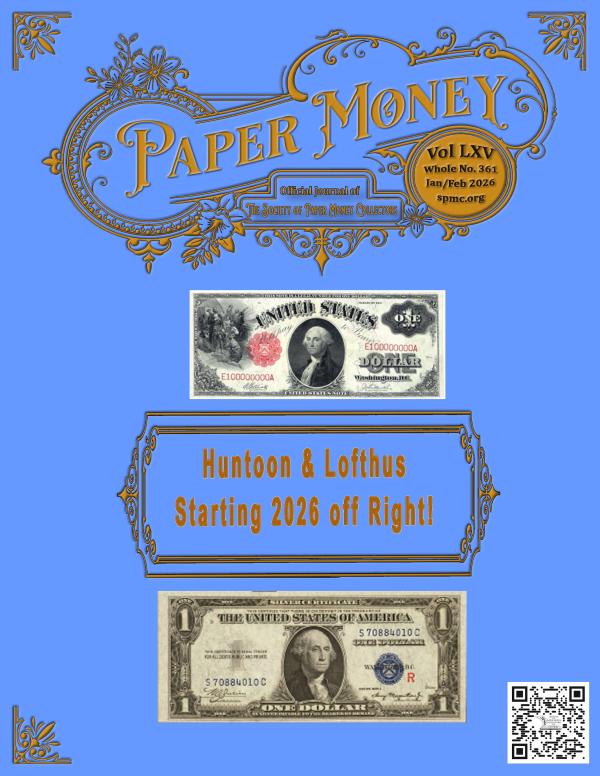
Table of Contents
Serial Number 1,000,000,000 Notes Docmentation--Peter Huntoon
R & S WWII Experimental Silver Certificates--Lee Lofthus
Saint Peter Misprints--Peter Huntoon
Printing on 12-Subject Currency in 1945--James Lemon
Lumbermens Bank of East Warren--Michael Saharian
Fractional Currency Manuscript Notes--Rick Melamed
Assistant Treasurer Thomas C. Ashton--Frank Clark
1893 Chicago's World Fair & Post Office--Bob Laub
Puzzle Notes--David Gladfelter
Ofϐicial Journal of
Huntoon & Lofthus
Starting 2026 off Right!
LEGENDARY COLLECTIONS | LEGENDARY RESULTS | A LEGENDARY AUCTION FIRM
America’s Oldest and Most Accomplished
Rare Coin AuctioneerCalifornia • New York • Boston • Miami • Philadelphia • New Hampshire • Oklahoma
Hong Kong • Copenhagen • Paris • Vancouver
1550 Scenic Avenue, Suite. 150, Costa Mesa, CA 92626
949.253.0916 • Info@StacksBowers.com
470 Park Avenue, New York, NY 10022
212.582.2580 • NYC@stacksbowers.com
Visit Us Online at StacksBowers.com
SBG PM Cons Spring2026 260101
NOW ACCEPTING CONSIGNMENTS
The Stack’s Bowers Galleries
Spring 2026 Showcase Auction
Auction Dates: March 9-13, 2026 • Costa Mesa, CA
Consignment Deadline: January 8, 2026
The Official Auction of the Whitman Expos
Fr. 96. 1869 $10 Legal Tender Note.
PMG Choice Uncirculated 63 EPQ.
Realized: $102,000
San Francisco, California. $5 1870. Fr. 1136.
First National Gold Bank. Charter #1741.
PMG Very Fine 30 EPQ.
From the Shores Collection Part II.
Realized: $ 45,600
Fr. 1194. 1882 $50 Gold Certificate.
PMG Choice About Uncirculated 58 EPQH.
From the Shores Collection Part II.
Realized: $38,400
Fr. 353. 1890 $2 Treasury Note.
PMG Gem Uncirculated 65 EPQ.
From the Shores Collection Part II.
Realized: $66,000
Fr. 1166b. 1863 $20 Gold Certificate.
PCGS Banknote About Uncirculated 50 Details.
From the Shores Collection Part II.
Realized: $516,000
Greeley, Colorado. $5 1882 Brown Back.
Fr. 467. First NB. Charter #3178.
PMG About Uncirculated 50. Serial Number 1.
Realized: $43,200
Fr. 1170. 1907 $10 Gold Certificate.
PMG Choice Uncirculated 64 EPQ.
Serial Number 1.
From the McLaughlin Collection
of Napier - Thompson Notes.
Realized: $120,000
Peter A. Treglia
Vice President & Managing
Director of Currency
PTreglia@
StacksBowers.com
Tel: 949.748.4828
Michael Moczalla
Currency Specialist
MMoczalla@
StacksBowers.com
Tel: 949.503.6244
Fr. 1220. 1922 $1000 Gold Certificate.
PMG Choice About Uncirculated 58 EPQ.
From the Shores Collection Part II.
Realized: $192,000
Contact Us For More Information:
800.458.4646 California • 800.566.2580 New York • Consign@StacksBowers.com
8 Serial Number 1,000,000,000 Notes Docmentation--Peter Huntoon
15 R & S WWII Experimental Silver Certificates--Lee Lofthus
20 Saint Peter Misprints--Peter Huntoon
24 Printing on 12-Subject Currency in 1945--James Lemon
30 Lumbermens Bank of East Warren--Michael Saharian
34 Fractional Currency Manuscript Notes--Rick Melamed
41 Assistant Treasurer Thomas C. Ashton--Frank Clark
SPMC.org * Paper Money * Jan/Feb 2026 * Whole Number 361
1
42 1893 Chicago's World Fair & Post Office--Bob Laub
47 Puzzle Notes--David Gladfelter
Columns
Advertisers
SPMC Hall of Fame
The SPMC Hall of Fame recognizes and honors those individuals who
have made a lasting contribution to the society over the span of many years.
Charles Affleck
Walter Allan
Mark Anderson
Doug Ball
Hank Bieciuk
Joseph Boling
F.C.C. Boyd
Michael Crabb
Forrest Daniel
Martin Delger
William Donlon
Roger Durand
C. John Ferreri
Milt Friedberg
Robert Friedberg
Len Glazer
Nathan Gold
Nathan Goldstein
Albert Grinnell
James Haxby
John Herzog
Gene Hessler
John Hickman
William Higgins
Ruth Hill
Peter Huntoon
Brent Hughes
Glenn Jackson
Don Kelly
Lyn Knight Chet
Krause
Robert Medlar
Allen Mincho
Clifford Mishler
Barbara Mueller
Judith Murphy
Dean Oakes
Chuck O'Donnell
Roy Pennell
Albert Pick
Fred Reed
Matt Rothert
John Rowe III
From Your President
Editor Sez
New Members
Uncoupled
Cherry Picker Corner
Chump Change
Quartermaster
Chump Change
Robert Calderman 3
Benny Bolin 4
Frank Clark 5
Joe Boling & Fred Schwan 48
Robert Calderman 54
Loren Gatch 58
Michael McNeil 59
Loren Gatch 62
Stacks Bowers Galleries IFC
Pierre Fricke 1
Higgins Museum 19
George Anderson 22
Lyn Knight Auctions 23
Dennis Schaflutzel 29
Executive Currency 33
Greysheet 33
Bill Litt 33
FCCB 39
Bob Laub 46
PCDA IBC
Heritage Auctions OBC
Fred Schwan
Neil Shafer
Herb& Martha Schingoethe
Austin Sheheen, Jr.
Hugh Shull
Glenn Smedley
Raphael Thian
Daniel Valentine
Louis Van Belkum
George Wait
John & Nancy Wilson
D.C. Wismer
SPMC.org * Paper Money * Jan/Feb 2026 * Whole Number 361
2
Officers & Appointees
ELECTED OFFICERS
PRESIDENT Robert Calderman
gacoins@earthlink.net
VICE-PRES William Litt
billitt@aol.com
TREASURER Robert Moon
robertmoon@aol.com
BOARD OF GOVERNORS
APPOINTEES
PUBLISHER-EDITOR-ADVERTISING MANAGER
Benny Bolin smcbb@sbcglobal.net
Megan Reginnitter mreginnitter@iowafirm.com
LIBRARIAN
Jeff Bruggeman jeff@actioncurrency.com
MEMBERSHIP DIRECTOR
Frank Clark
IMMEDIATE PAST PRESIDENT
Robert Vandevendert
WISMER BOOK PROJECT COORDINATOR
Pierre Fricke
From Your President
Robert CaldermanFrom Your President
Shawn Hewitt
We’re excited to announce the details of our second annual
Florida United Numismatists (FUN) Speakers Forum. In the fashion of our
inaugural seminar last year, we’ll again have a total of five speakers making
presentations, and close out the forum with our SPMC membership meeting on
Saturday morning.
The dates of the FUN convention are January 9-12, 2020 at the Orange
County Convention Center, West Building WA1 & WA2, in Orlando, Florida. The
first four talks are on Friday, January 10 in Room 304F (same as last year).
Here is the lineup… - "The Current
Status of the U. S. Small Size Paper Money Market". – Mr. Calderman, a
specialist and dealer in U. S. small-size type notes will discuss the current
trends in small size notes and the future of this paper money specialty.
- "A Behind the Scenes Look at the Paper
Money Auction Process"–Mr. Johnston, the Vice- President and Managing
Director of the Currency Division at Heritage Auctions will discuss the nuts-
and-bolts of conducting a major Paper Money auction.
"An Overview of the
Confederate Paper Money Market" .
Mr. Fricke has been a long-time dealer in Confederate Paper Money and is the
author of the standard reference on Confederate Paper Money "Collecting
Confederate Paper Money: The Standard Guide to Confederate Money".
"The good, the bad, and the ugly of
antebellum bank note fraud" – Various types of pre-Civil War bank note fraud
will be explored and illustrated.
In addition, at the SPMC Membership Meeting (open to all) on
Saturday at 8:30am in Room 303B we have: - "Overview
of the SPMC Bank Note History Project" - This project is focused on two of
the primary historical aspects of the "Hometown" National Bank Notes - the
Banks who issued them and the bankers who signed them.
I think we’re onto a good thing in making FUN another major venue for
the face of SPMC. Our table will be 867 in the club section of the bourse floor,
so please stop by. Again, this year, we are participating in the ANA Treasure
Trivia Program, which is a great outreach to the youth of our hobby. We have
some very nice world notes to hand out (to young numismatists) as souvenirs
for visiting our table.
Before I go, I should mention that we have a new Membership Secretary.
Robert Calderman, one of our board members, has stepped up to fill the position
recently vacated by Jeff Brueggeman. If you frequent the major shows, you
may have seen Robert at one of our club tables. Robert is great resource for the
Society, and we very much appreciate the work he does for us.
Paper Money * July/August 2020
6
LEGAL COUNSEL
Robert Calderman gacoins@earthlink.com
Matt Drais stockpicker12@aol.com
Mark Drengson markd@step1software.com
Loren Gatch lgatch@uco.edu
Shawn Hewitt Shawn@north-trek.com
Derek Higgins derekhiggins219@gmail.com
Raiden Honaker raidenhonaker8@gmail.com
William Litt
Cody Regennitter
billitt@aol.com
cody.regenitter@gmail.com
rman andrew.timmerman@aol.comAndrew Timme
Wendell Wolka purduenut@aol.com
frank_clark@yahoo.com
derekhiggins219@gmail.com
SECRETARY Derek Higgins
Fall is now behind us and what a fabulous time it was for paper money
collectors, especially if you were one of the fortunate few dozen diehard
enthusiasts that attended the Dean Oakes Sale at Lyn Knight’s headquarters in
Lenexa, Kansas. I for one was overwhelmingly pleased with the event as it
harkened back to a happier time when auctions were held live at the big shows!
Lyn not only hosted his ever popular charity poker event, he made sure no one that
attended went hungry during the action packed multi-day auction. Eric Knight and
Jim Fitzgerald did an excellent job auctioneering the sale making for a very
enjoyable bidding experience. I was extremely pleased with a few spectacular wins
for my personal collection including a gorgeous $10 San Francisco SN#1 1902
Plain Back on Charter #1741 with a provenance going all the way back to the
famous Grinnell sale! Were you also fortunate enough to win an amazing note for
your collection too? I would love to see your new treasured addition, feel free to
send me an email.
If the Dean Oakes sale wasn’t enough exci ement for you this Fall, something
else happened… s mething truly magical! Stack’s Bowers Galleries announced
that it has now acquired the Lo Beach Expo! After a glorious sixty year history,
last year in February we had what we were told was to be the very last Long Beach
show ever. Disheartening to say the least, the n ws f my favorite show closing its
doors forever left me with that pitiful anguish that can only be compared with the
end of the Memphis International Paper Money Show! I grew up just a thirty
minute drive away from Long Beach in Garden Grove, CA and a chance to go back
home three times a year was like having additional Christmas holidays to
celebrate! Now that the show is officially back in action, I hope you will consider
attending and supporting this epic numismatic event that is taking place February
18th - 20th, 2026.
Depending on when you receive this January/February copy of Paper Money,
we may very well be in the midst of the January FUN show in Orlando Florida!
Can you tell by now that I really enjoy in-person numismatic events? The FUN
show is hands down considered the biggest trade show of the year for our hobby,
and both the SPMC Breakfast and Membership Meeting are cannot miss
opportunities to meet your fellow paper money collectors! If you have not attended
before, I hope you will make plans to attend now or in the near future. Entering the
vast expansive bourse floor at this show is truly an epic experience.
While I write this, metals are at outrageously high historic levels no doubt
stoking the fire and maintaining our current robust hobby market. Will this
continue int 2026? Your guess is as go d as mine. It is definitely a ton of fun
seeing new collectors shing in on gold and buying paper money for the very first
time! We hope to see you soon a sh w near you. When you see SPMC in the
show guide, make sure to stop by the t ble and say hell .
yes, that is his signature.
SPMC.org * Paper Money * Jan/Feb 2026 * Whole Number 361
3
Terms and Conditions
The Society of Paper Money Collectors (SPMC) P.O. Box 7055,
Gainesville, GA 30504, publishes PAPER MONEY (USPS 00‐
3162) every other month beginning in January. Periodical
postage is paid at Hanover, PA. Postmaster send address
changes to Secretary Robert Calderman, Box 7055, Gainesville,
GA 30504. ©Society of Paper Money Collectors, Inc. 2020. All
rights reserved. Reproduction of any article in whole or part
without written approval is prohibited. Individual copies of this
issue of PAPER MONEY are available from the secretary for $8
postpaid. Send changes of address, inquiries concerning non ‐
delivery and requests for additional copies of this issue to
the secretary.
MANUSCRIPTS
Manuscripts not under consideration elsewhere and
publications for review should be sent to the editor. Accepted
manuscripts will be published as soon as possible, however
publication in a specific issue cannot be guaranteed. Opinions
expressed by authors do not necessarily reflect those of the
SPMC. Manuscripts should be submitted in WORD format via
email (smcbb@sbcglobal.net) or by sending memory stick/disk
to the editor. Scans should be grayscale or color JPEGs at
300 dpi. Color illustrations may be changed to grayscale at the
discretion of the editor. Do not send items of value.
Manuscripts are submitted with copyright release of the author
to the editor for duplication and printing as needed.
ADVERTISING
All advertising on space available basis. Copy/correspondence
should be sent to editor.
All advertising is pay in advance. Ads are on a “good faith”
basis. Terms are “Until Forbid.”
Ads are Run of Press (ROP) unless accepted on a premium
contract basis. Limited premium space/rates available.
To keep rates to a minimum, all advertising must be prepaid
according to the schedule below. In exceptional cases where
special artwork or additional production is required, the
advertiser will be notified and billed accordingly. Rates are
not commissionable; proofs are not supplied. SPMC does not
endorse any company, dealer, or auction house. Advertising
Deadline: Subject to space availability, copy must be received
by the editor no later than the first day of the month
preceding the cover date of the issue (i.e. Feb. 1 for the
March/April issue). Camera‐ready art or electronic ads in pdf
format are required.
ADVERTISING RATES
Editor Sez
Benny Bolin
Required file submission format is composite PDF v1.3
(Acrobat 4.0 compatible). If possible, submitted files should
conform to ISO 15930‐1: 2001 PDF/X‐1a file format standard.
Non‐ standard, application, or native file formats are not
acceptable. Page size: must conform to specified publication
trim size. Page bleed: must extend minimum 1/8” beyond
trim for page head, foot, and front. Safety margin: type and
other non‐bleed content must clear trim by minimum 1/2”.
Advertising c o p y shall be restricted to paper currency, allied
numismatic material, publications, and related accessories.
The SPMC does not guarantee advertisements, but accepts
copy in good faith, reserving the right to reject objectionable
or inappropriate material or edit copy. The SPMC
assumes no financial responsibility for typographical
errors in ads but agrees to reprint that portion of an ad in
which a typographical error occurs. Benny (aka goompa)
Space
Full color covers
1 Time
$1500
3 Times
$2600
6 Times
$4900
B&W covers 500 1400 2500
Full page color 500 1500 3000
Full page B&W 360 1000 1800
Half‐page B&W 180 500 900
Quarter‐page B&W 90 250 450
Eighth‐page B&W 45 125 225
My little christmas gift! She is at that age where all my
decorations have to be 3ft high or little hands grab them. It is
so much fun watching those eyes just taking it all in. Christmas
is going to be so much fun and after the year I have had, it is
certainly going to be a wonderful distraction.
I did not think we were going to have a winter in Texas. Up
through Thanksgiving, we still had the A/C on. Then it hit.
Today it is not getting out of the 30s. I hate being cold. So, I
have the perfect solution for that! Join us at FUN '26. January
8-11 in Orlando, FL. The SPMC has made this our annal
convenion place since the IPMS is now defunct. We will be
having a lot of activities. First, join us at our club table (#781)
and say hello and renew long past friendships. The sold out
bourse will be packed with over 1500 dealers and upwards of
10,000 attendees. Come on and find those notes you are
needing for your collection. Then on Friday, Jan. 9th, will be
our SPMC general membership meeting (room #N320E)
capped off with an educational program by Bob Moon. It will
focus on his exhibit and is titled "Collecting New York
Nationals - A Lifelong Journey."
After the meeting, stop by the exhibit area and see Bob's
incredible display of over 100 serial #1 New York National
banknotes. Then on Saturday at 0800 in room #330A/B will be
our annual awards breadfast and Tom Bain Raffle led by the
ever enjoyable Wendell Wolka who it seems could sell ice to
an eskimo. Tickets for the breakfast are still $25 and available
on the website and may even come with a few raffle tickets.
FUN this year has the theme "Paper Money-Portraits of
History." We need to have a strong showing and some good
exhibits showing those FUN people what paper is all about.
I have to apologize to all of our members who receive their
magazine as a hard copy for the Nov/Dec issue being so late. I
had a brilliant idea to get it out early so we could have a good
amount of time to vote for the literary awards. Well, Murphy
struck hard! First, there was problems with the printing
machines, then an illness ran through the shop and finally a
shortage of envelopes. All three at once left the issue getting
out real late. My apologies.
BTW--while you are at FUN, pick up an interesting note and
write me an article about it. I am in need of more (seems I am
always asking you that.
Till next time! Look out for those school zones
and don't drive and text!
SPMC.org * Paper Money * Jan/Feb 2026 * Whole Number 361
4
The Society of Paper Money
Collectors was organized in 1961 and
incorporated in 1964 as a non-profit
organization under the laws of the
District of Columbia. It is
affiliated with the ANA. The
Annual Meeting of the SPMC is
held in June at the International
Paper Money Show. Information
about the SPMC, including the
by-laws and activities can be
found at our website--
www.spmc.org. The SPMC does
not does not endorse any dealer,
company or auction house.
MEMBERSHIP—REGULAR and
LIFE. Applicants must be at least 18
years of age and of good moral
character. Members of the ANA or
other recognized numismatic
societies are eligible for membership.
Other applicants should be sponsored
by an SPMC member or provide
suitable references.
MEMBERSHIP—JUNIOR.
Applicants for Junior membership
must be from 12 to 17 years of age
and of good moral character. A parent
or guardian must sign their
application. Junior membership
numbers will be preceded by the letter
“j” which will be removed upon
notification to the secretary that the
member has reached 18 years of age.
Junior members are not eligible to
hold office or vote.
DUES—Annual dues are $39. Dues
for members in Canada and Mexico
are $45. Dues for members in all
other countries are $60. Life
membership—payable in installments
within one year is $800 for U.S.; $900
for Canada and Mexico and $1000
for all other countries. The Society
no longer issues annual membership
cards but paid up members may
request one from the membership
director with an SASE.
Memberships for all members who
joined the Society prior to January
2010 are on a calendar year basis
with renewals due each December.
Memberships for those who joined
since January 2010 are on an annual
basis beginning and ending the
month joined. All renewals are due
before the expiration date, which can
be found on the label of Paper
Money. Renewals may be done via
the Society website www.spmc.org
or by check/money order sent to the
secretary.
WELCOME TO OUR
NEW MEMBERS!
BY FRANK CLARK
SPMC MEMBERSHIP DIRECTOR
NEW MEMBERS 11/05/2025
Dues Remittal Process
Send dues directly to
Robert Moon
SPMC Treasurer
403 Gatewood Dr.
Greenwood, SC 29646
Refer to your mailing label for when
your dues are due.
You may also pay your dues online at
www.spmc.org.
15933 Mark Etheridge, Website
15934 Nick Reed, Website
15935 David McComb, Polar Currency
15936 David Buckwalter, Website
15937 Steve Lemoine, Website
15938 Darrin Green, Website
15939 Paul Reilly, Robert Calderman
15940 Matthew Gossett, Robert Calderman
15941 Egab Abu-Rummen, Robert Calderman
15942 Thomas Barton, Website
15943J Giovanni Driano, Website
15944 Jim Gosney, Website
15945 Raymond Hugon
15946 Jonathan Testa, Robert Calderman
15947 Steven Shook, Website
15948 Sue-Ann Calhoun, Website
15949 Marissa Panigrosso, Website
15950J Andy Seymour, Website
15951 David Jameson, Website
REINSTATEMENTS--None
LIFE MEMBERSHIPS--None
NEW MEMBERS 12/05/2025
15952 Thomas Cohn, Coin World
15953 Mick Suarez, Website
15954 David P. Barnhard, Website
15955 Dean Bartosch, Cody
Regennitter
15956 Rocco Morritto, Website
15957 Gilmore Sem, Website
REINSTATEMENTS--None
LIFE MEMBERSHIPS--None
SPMC.org * Paper Money * Jan/Feb 2026 * Whole Number 361
5
Steve Feller has passed away
The SPMC is saddened to learn that member Steve Feller
passed away on November 19, 2025 while attending a
Society of Physics Students conference in Denver, CO.
Steve was born on January 12, 1951 in Brooklyn, NY. He
was the director of the physics department at Coe College
in Cedar Rapids, IA.
Steve was member #5494 of the SPMC joining the
society in 1979. He was a researcher and frequent author
with over 30 articles attributed to him. He was best well
known for his research and writing about internment
money in WWII. He also was making a census of T-64
notes that will be continued by Mark Coughlan.
He was the author with his daughter Ray of “Silent
Witnesses: Civilian Camp Money of WWII.”
Steve was awarded many SPMC literary awards for the articles he authored and an ANA Presidents
Award in 2004. He and his daughter Ray were named Numismatic Ambassadors in 2017.
Steve, Clifford Mishler, and daughter Ray Feller at the January 2018 FUN
convention, receiving Numismatic Ambassador awards
SPMC.org * Paper Money * Jan/Feb 2026 * Whole Number 361
6
The SPMC has a lot of fun activities at F.U.N. ’26!
The SPMC is planning many fun activities, award presentations, meetings and educational presentations
at the winter FUN, January 8-11, 2026 in the North Hall of the Orange County Convention Center.
See the SPMC website for a full schedule of events with room #s and ticket ordering.
Friday Jan 9 Saturday Jan 10
0800 SPMC Breakfast and Tom Bain Raffle
Room 330 A/B
0830 Board of Governors mtg
0900 General membership mtg
w/educational program by
Robert Moon
Tom Bain Raffle
Stop by the SPMC table
# 781 and meet other
collectors and talk paper
money
Effervescent and always humorous
Auctioneer—Wendell Wolka
SPMC AWARDS
Educational
talks and paper
money exhibits
Mix ‘em up!
SPMC.org * Paper Money * Jan/Feb 2026 * Whole Number 361
7
Documentation for
United States Serial Number
100,000,000 Notes
Purpose and Overview
The purpose of this article is to provide all the documentation that we have found in Federal records
that pertains to the production of serial number 100,000,000 notes.
Serial number 100,000,000 notes represent the pinnacle in fancy serial numbers. They haven’t been
made since 1936 so the supply is limited to three dozen or so in collector’s hands and an unknown
population that hasn’t reached the numismatic market yet.
Table 1 is the current census of 100,000,000 notes. This compilation was made with the enthusiastic
help of serial number aficionados coupled with a thorough scouring of auction catalogs dating back to the
famous Grinnell sales of 1946. Especially helpful contributors to this census were Martin Gengerke, Mike
Abramson and Doug Murray.
The earliest that has been recorded is a $1 Series of 1899 silver certificate printed in 1902 from the
first Lyons-Roberts serial number block that had no prefix or suffix letters. The last reported is a $1 Series
of 1934 bearing serial F100000000A that was the last 9-digit serial printed in the 1934 series. It was
numbered on February 24, 1936.
The use of 100,000,000 serials was restricted mostly to the highly visible $1 silver certificates with
a few showings among the $1 Series of 1917 legal tenders of 1915-1920 vintage. Two deuces have been
recorded; specifically, one each of an 1899 silver certificate and 1917 legal tender note. Only one Federal
Reserve example is reported, a $5 Series of 1914 note from Chicago, which also is the highest denomination
recorded.
The census data reveal that printings of 100,000,000 serials appear to have been sporadic in the
large size series from about 1923 through 1928. No small size examples were printed until the beginning
of 1933. Then their production lasted only through 1936.
The 100,000,000 notes were not printed on conventional numbering presses because the numbering
heads on those presses could not accommodate a 9th numbering wheel. Instead the notes were make up
notes that were numbered on paging machines. Paging machines are hand operated devices that apply serial
Figure 1. $1 1917 Legal Tender D100000000A delivered to the Treasury on
January 30, 1928 is the youngest reported large size 100000000 note that was
printed.
The Paper
Column
Jamie Yakes &
Peter Huntoon
SPMC.org * Paper Money * Jan/Feb 2026 * Whole Number 361
8
numbers one at a time from the same numbering head. The fact is applying serial numbers on those
machines was a productivity-killing labour-intensive pain in the neck.
Paging machines were routinely used to number large size type notes with low serial numbers
during the era of the 100,000,000 notes. They also were used to number both large and small size high
denomination replacement type notes as well as large and small size replacement national bank notes.
There is ironclad physical evidence that the 100,000,000 notes were numbered on paging machines.
The two numbers on a given specimen exhibit identically formed serial numbers; that is, the relative
alignments and spaces between the characters within each are identical and the internal flaws within the
individual characters are identical. This demonstrates that both numbers were printed from the same
numbering head. Great care was used to print the numbers but even so some exhibit slightly tilted numbers
identical to those observed on make-up replacement notes.
Data from rollover
sequences comprising 99999999,
100000000 and 00000001 notes
reveal that the 100,000,000 notes
were printed on separate sheets.
Great care was taken to place the
100,000,000 serials on the correct
plate positions on those sheets:
however, the plate numbers usually
differ from those found on the
99999999 note, which theoretically
should have appeared directly above
it on the same sheet. The following
three rollovers from the Series of
1934 $1 silver certificate series
nicely illustrate this point.
$1 1934
B99999999A I194 2573
B100000000A J111 2542
C00000001A A36 2786
$1 1934
E99999999A I399 2725
E100000000A J397 3017
F00000001A A397 3017
$1 1934
F99999999A I752 2861
F100000000A J337 2741
G00000001A A750 2862
Figure 2. Rollover serial numbers
between the AA and BA block in the
$1 Series of 1934 silver certificates
where each note came from a different
sheet. A100000000A is a make-up note
that was numbered on a paging
machine. These came from the sale of
the Albert A. Grinnell collection in
1946.
SPMC.org * Paper Money * Jan/Feb 2026 * Whole Number 361
9
The preference on the part of the management at the Bureau of Engraving and Printing was, of
course, to avoid printing any 100,000,000 notes because they represented a bottleneck to productivity by
having to be handmade. The 100,000,000 serials print as 00000000 in the normal course of machine
production today. That note is rejected as mutilated and replaced with a star note. Only one legitimate
00000000 note is known to have escaped the Bureau, a $1 Series of 1969A Federal Reserve note bearing
serial A00000000A complete with a red crayon reject line scrawled across its face.
BEP Director Alvin W. Hall, who served from 1924 to 1954, was not the type of administrator who
wanted his Bureau to be bothered with such things. His management style was to drive continually for
efficiencies and cost-reducing innovations. It is easy to infer from the census of reported specimens that he
quietly let production of the 100,000,000 notes lapse as much as possible during the end of the large note
era and hoped to continue to avoid them during the small note era.
A great testament to this came in the form of a complaint from the cashier of the Cleveland Federal
Reserve Bank dated December 12, 1929, inquiring why $1 Series of 1928 silver certificate D100000000A
was missing from the 25,000th brick that happened to be received at the bank.
Production of 100,000,000 notes resumed in 1933 when the following was written in the BEP
Numbering Division log book: “In place of a substitute star note the one hundred million figure was printed
for the first time January 20, 1933 $1 Silver Certificate Series 1928 A100,000,000B.”
Resumption may reflect the fact that high officials in Hoover’s Treasury and certainly those of
Roosevelt who followed had a collecting bent as did philatelist-in-chief Roosevelt himself. Probably Hall
was requested to resume the practice, which he did at least for the high profile $1 silvers.
An internal mimeographed BEP explanation of serial numbering written September 22, 1933
explained the practice. “To have all notes numbered in even millions, a note is numbered 100,000,000 by
hand at the proper time.”
Production of the notes finally became history with the close of Series of 1934 $1s in 1936. None
appeared on the new Series of 1935 notes.
The issue rattled around again in the Treasury Department in 1941. An inquiry was made by
someone in the department that reached Mr. Duncan, Chief of the BEP Numbering Division. He advised
that the note following 99,999,999 was a star note. William S. Broughton, Commissioner of the Public
Debt, confirmed the practice in a memo dated February 13th. Broughton’s memo was taken as an official
directive and was very formally entered into the Numbering Division log book on February 18th.
Those of us who routinely work with Treasury records including Lee Lofthus have copied every
useful document found pertaining to 100,000,000 notes. That record is, of course, sparse. In the interests of
historical accuracy, we are reproducing herewith a transcript of those documents in the chronological order
in which they were written.
Figure 3. Notice the tilt of the right serial number, the drop of both 1s and identical
thin character of the leftmost zero in both. The two numbers were printed from the
same numbering head on a paging machine.
SPMC.org * Paper Money * Jan/Feb 2026 * Whole Number 361
10
Undoubtedly additional gems will be discovered that can be used to build on this story. The
information presented here certainly builds on the pioneering sleuthing into the 100,000,000 notes by Jack
Fischer published in Coin World in the December 2, 1987 and March 2, 1988 issues.
It is easy to understand heightened numismatic interest in 100,000,000 notes. They are visual
knockouts. They eclipse all other fancy serial numbers in rarity, a reality exacerbated because they no long
are being made. Yes, serial number 1 large size notes, 00000001 small size notes, as well as solids and
other neat serial numbered notes on any size notes are prizes, but those serials are many many times more
common and new ones are being printed every month.
Table 1. Reported United States notes bearing serial number 100,000,000.
Plate
Letter Public Sale
Large Size Notes:
Legal Tender Notes
$1 1917 Teehee-Burke A100000000A D
Elliott-Burke D100000000A D
Elliott-Burke E100000000A D
Elliott-Burke K100000000A D
$2 1917 Elliott-Burke A100000000A D
Silver Certificates
$1 1899 Lyons-Roberts 100000000 D
Vernon-McClung V100000000 D
Napier-McClung Z100000000 D
Napier-McClung E100000000E D Abramson 2/16
Parker-Burke K100000000K D Abramson 10/16
Parker-Burke M100000000M D Grinnell lot 967
Parker-Burke N100000000N D
Teehee-Burke R100000000R D Grinnell lot 966
Teehee-Burke U100000000U D reported by Knight
Teehee-Burke V100000000V D Abramson report 1/16
Teehee-Burke B100000000A H Abramson 2/16
Elliott-White H100000000A D
Elliott-White K100000000A Stacks 6/2005
Speelman-White M100000000A D
Speelman-White N100000000A D
Speelman-White R100000000A H
Speelman-White V100000000A D
$1 1923 Speelman-White Z100000000B D
Speelman-White N100000000D H Grinnell lot 968
$2 1899 Teehee-Burke M100000000 D Abramson 12/98
Federal Reserve Note
$5 1914 White-Mellon G100000000A H
Small Size Notes:
Silver Certificates
$1 1928A C99999999B, C100000000B Grinnell lot 5735
$1 1928B G99999999B, G100000000B Grinnell lot 5737
I99999999B, I100000000B, J00000001B
$1 1934 A99999999A, A100000000A, B00000001A Grinnell lot 5733
B99999999A, B100000000A, C00000001A Grinnell lot 5734
C100000000A
E99999999A, E100000000A, F00000001A
F99999999A, F100000000A, G00000001A Grinnell lot 5736
SPMC.org * Paper Money * Jan/Feb 2026 * Whole Number 361
11
Appendix
The following are verbatim transcripts of every useful document or relevant part of a document we
have found to date pertaining to the production of notes bearing serial number 100,000,000. The source for
each is cited in brackets.
______________________________________________________________________________
December 12, 1929
Mr. W. E. Broughton
Commissioner of the Public Debt
Treasury Department
Washington, DC
Dear Mr. Broughton:
It is the writer’s recollection that you have expressed some interest in the work of the expert who has been developing
the Treasury currency collection and, therefore, are not unsympathetic with the interest in the numismatic field. It is
for that reason that we are taking the liberty of bringing the subject of this letter to your attention.
The transition in the size of the currency has broadened the interest in preserving currency specimens of the old and
new series and this bank has added to its collection and accommodated bankers and private collectors by providing
interesting specimens. As you are doubtlessly aware distinctive and unusual combinations of serial numbers are items
of particular interest, and in the arrangement of matched sets in all denominations of our own new series notes we are
very much disappointed that certain desirable low numbers were eliminated and “star” numbers bills substituted that
precluded the possibility of making matched sets in the numbers desired. The scanning of other lots of United States
currency that have come to us from time to time also reveals the fact that the numbers sought are missing and substitute
numbers of the “star” series introduced.
It is recognized that inspection and elimination of imperfect bills naturally break sequences, but from our observation
it is hard for us to believe that the elimination and substitution in all cases is merely the result of causal printing errors,
and we would inquire if it is the practice, with Treasury approval, to permit operators to eliminate desirable numbers
at the original source rather than to permit their release to the general public in the natural course.
The enclosures of a label and a currency strap are sent as an illustration of the pertinent case in that the final number
of the series, D100,000,000A, was missing and a substitute bill was in its place. The other six numbers that were
exchanged were scattered throughout the package rather remotely located from this terminal number. This subject is,
of course, of no vital importance and we report the matter for whatever consideration it merits.
Very truly yours,
C. L. Bickford
Assistant Cashier
Figure 4. This is the only reported Federal Reserve note with a 100000000 serial and
also the only such note that has a face value greater than $2.
SPMC.org * Paper Money * Jan/Feb 2026 * Whole Number 361
12
(Bureau of the Public Debt, various dates)
________________________________________________________________________________________
December 20, 1929
To Mr. Hall:
Regarding the attached letter from Mr. Brickford, I presume the answer is that the numbering blocks for currency run
to eight places only, with a prefix letter and a suffix letter, and so when 100,000,000 is reached it is necessary to
substitute a star number, for this number contains nine places or one place more than the numbering blocks used for
the small currency.
Am I right?
W. S. B. (William S. Broughton, Commissioner of the Public Debt)
(Bureau of the Public Debt, various dates)
_________________________________________________________________________________________
December 21, 1929
Treasury Department
Bureau of Engraving and Printing
Office of the Director
Memorandum
For Mr. Broughton:
Relative to the memorandum of Mr. C. L. Brickford, Assistant Cashier, Federal Reserve Bank of Cleveland, regarding
the numbering of currency:
The numbering blocks used on currency have only eight wheels and consequently the highest number of any series
would be 99,999,999, hence the necessity to place a star note in place of 100,000,000.
The inference that operators are permitted to take out certain numbers is absurd. When an examiner begins operations
she draws 100 star notes and when she has made 100 substitutions she returns the imperfect notes and they are checked
and accounted for until cancelled and macerated.
A. W. Hall (Director of the Bureau of Engraving and Printing)
(Bureau of Public Debt, various dates)
________________________________________________________________________________________________________
January 20, 1933
In place of a substitute star note the one hundred million figure was printed for the first time Jan 20, 1933 $1 Silver
Certificate Series 1928 A100,000,000B
(Bureau of Engraving and Printing, undated)
_____________________________________________________________________________________________
Figure 5. End label from the brick
with the missing D100000000A
note that was submitted by
Assistant Cashier Bickford in his
letter to Mr. Broughton.
SPMC.org * Paper Money * Jan/Feb 2026 * Whole Number 361
13
September 22, 1933
In a memorandum dated September 22, 1933, entitled: “System of numbering United States Paper Currency in the
Bureau of Engraving and Printing” it is explained that: “To have all notes numbered in even millions, a note is
numbered 100,00,000 by hand at the proper time”
(Bureau of Public Debt, various dates)
________________________________________________________________________________________________________
February 13, 1941
Mr. Emerson
Treasurer’s Office (Room 132)
Mr. Duncan advises me that in numbering paper currency a “Star” note is used for the next note following 99,999,999.
The statement in the Bureau mimeograph that “A note is numbered 100,000,000 by hand at the proper time” is not
correct according to that advice.
W. S. B. (William S. Broughton, Commissioner of the Public Debt)
Copy for Mr. Hall
(Bureau of Public Debt, various dates)
________________________________________________________________________________________________________
February 18, 1941
Decided that hereafter all packages of all Denominations when in their numerical order reach the number 100,000,000
(that owing to difficulty in printing this number) that number shall be substituted by a number preceding or followed
by a star as the kind requires. This order was given by Mr. Duncan in the presence of Mr. Kessler & Miss Harper and
Mr. Lourd.
(Bureau of Engraving and Printing, undated)
________________________________________________________________________________________________________
Sources Cited
Bureau of the Public Debt, various dates, file containing a letter of inquiry and internal memos pertaining to the lack of use of a
serial 100,000,000 note in a package of $1 1928 silver certificates received at the Federal Reserve Bank of Cleveland in
1929 as well as other documents relating to numbering currency at the Bureau of Engraving and Printing: Bureau of the
Public Debt, Entry UD Acc # 53-88-14 (53/450/82/4/1 box 1, file: Numbering plans), U. S. National Archives, College
Park, MD.
Bureau of Engraving and Printing, undated, Log book maintained within the Numbering Division: Bureau of Engraving and
Printing Historical Resource Center, Washington, DC.
Figure 6. Heritage
Auction Archives.
photo.
SPMC.org * Paper Money * Jan/Feb 2026 * Whole Number 361
14
R&S
WWII Experimental
Silver Certificates
Drew Immediate Public Attention
Lee Lofthus
The wartime 1935A $1 silver certificates marked with red “R” and “S” letters were
intended to be an under-the-radar paper durability experiment by the Bureau of Engraving and
Printing (BEP) in the summer of 1944. Instead, the noticeable but unexplained red letters generated
intense curiosity from the start, spawning public inquiries to the Treasury Department that lasted
for years.
The full story of the R&S experiment was told by Jamie Yakes in his article “R & S $1
1935A Experimentals” (Yakes, Paper Money, 2018). Peter Huntoon’s earlier article “Release of
the $1 Series of 1935A R&S Experimentals” chronicled the issue of the notes by the Federal
Reserve Bank of Chicago and provided their historical WWII context (Huntoon, Paper Money,
2012). This article focuses on the public interest in the notes, highlighting one inquiry in particular.
The Experiment
The BEP undertook an experiment in early 1944 to test the wear qualities of a new currency
paper composition it was considering using. A side-by-side real world test was devised whereby
regular silver certificates would be marked with a red “R” for regular paper and marked with an
Figures 1 & 2. Top, the 10th “R” note numbered. Bottom, the 23rd “S” note numbered.
Author’s collection top, Heritage Auctions bottom.
SPMC.org * Paper Money * Jan/Feb 2026 * Whole Number 361
15
“S” for specially treated experimental paper. The idea was to circulate an equal number of each
type, and when the notes came in for redemption, the sorting operation at the Federal Reserve bank
(FRB) of Chicago would use the distinctive red letters to pull the notes and return them to the BEP
where they would be tested for their respective durability. The BEP delivered the notes to the
Treasurer’s office on June 20, 1944, and from there they were delivered to the Chicago FRB. The
FRB did its part, putting 1,184,000 notes of each type into circulation by June 29th.
Despite good intentions, the experiment was a bust, with Yakes noting a myriad of
problems. Sorting in Washington in the Division of Loans and Currency became bogged down.
Treasury arranged for the Chicago FRB to do the separating, but the FRB found that pulling the
R&S notes slowed down its other sorting responsibilities. William S. Broughton, the
Commissioner of the Public Debt, trying to reach some détente, agreed to limit the days the FRB
would perform the R&S sorts. But this contributed to too few notes being recovered in the desired
timeframe to have sufficient sample populations of each type for any valid conclusions to be drawn
from the BEP tests.
Public Commotion
The experiment did produce one inarguable finding: despite some governmental
expectations to the contrary, the American public did, in fact, pay attention to its money in
circulation. Shortly after the notes appeared in Chicago banks and cash registers, people began
speculating what the red letters meant and who put them there. The crescendo was enough that on
July 4, 1944, the Treasury Department in Washington issued the following press release:
The Secretary of the Treasury stated today that in order to test certain technical
aspects of the distinctive currency paper, two lots of $1 silver certificates,
marked with red letters R or S, are being issued in the regular course. The red
letters will facilitate identification of the bills following their redemption as
unfit.
Obvious from the 4th of July holiday timing of the press release is that Treasury wanted to put the
commotion quickly to rest. That hope went nowhere.
The public curiosity manifested itself in dozens, perhaps hundreds, of inquiries to the
Treasury Department as to the meaning of the red letters. The interest was significant enough, and
long lasting enough, that the episode with the R&S letters was cited in 1962 when Treasury
published a book celebrating the BEP’s 100th anniversary. The book noted that R&S inquiries
were still being received 18 years after the initial release of the notes (Treasury, 1962, pp. 149-
150).
Treasury Department records at the National Archives today are replete with evidence of
the public’s interest in the R&S notes. The BEP correspondence files have numerous such letters
sprinkled over years of files (BEP, Record Group 318). Inquiries forwarded to the Bureau of the
Public Debt (BPD) to answer were so numerous that they were given an entire file of their own
(BPD, Record Group 53).
The letters came from all sources. Unsurprisingly, many came from bank tellers, cashiers,
and bank executives. Business owners and ordinary citizens were also curious and didn’t hesitate
to write Treasury.
Letter from Cadillac
In perusing the correspondence files of the BEP late in 2024 at the National Archives in
College Park, Maryland, I came across another little group of R&S letters. The letter in Figure 3
stood out because it came on the letterhead of the Cadillac Motor Car Division of General Motors.
The letter was forwarded to the BEP, and Associate Director Clark R. Long promptly
replied.
SPMC.org * Paper Money * Jan/Feb 2026 * Whole Number 361
16
Figure 3. A 1935A “R” $1 silver certificate was intriguing enough to move Cadillac executive D. P.
Shellabarger to write the Bureau of Engraving and Printing to ask what the R meant. National
Archives, College Park, MD.
SPMC.org * Paper Money * Jan/Feb 2026 * Whole Number 361
17
January 3, 1945
Mr. D.P. Shellabarger
Cadillac Motor Car Division
General Motors Corporation
Detroit, Michigan
Dear Sir:
I have for acknowledgment your letter of December 28, 1944, regarding a one
dollar silver certificate which has a letter “R” engraved in red at the lower right side of
the seal on the face of the bill. You are informed that a small quantity of $1 bills with
the letter “R” overprinted in red adjacent to the seal and an equal quantity of with the
letter “S” in red similarly located were released by the Treasury Department in July
1944 for the purpose of testing certain technical aspects of currency paper. The letter
markings were for purposes of identifying the notes at the time of their redemption.
Very truly yours,
C. R. Long
Associate Director [BEP]
The Cadillac letter is interesting.
We don’t know what prompted Mr.
Shellabarger’s letter. It is safe to infer that
after their release in Chicago, the R&S
notes made their way quickly to nearby
Detroit. Perhaps Cadillac workers were
asking about curious notes received in
their pay envelopes, or perhaps it was
Shellabarger’s personal query, we just
don’t know.
Early Numismatic Attention
Predictably, all the public
attention meant numismatists were
quick to pick up on the notes as well.
R&S notes were a hot topic at the
Chicago Coin Club’s July 5th meeting,
barely two weeks after their first
release. Noted collector James Wade
exhibited his R&S pair at the July 13th
meeting of the New Jersey
Numismatic Society, and F.C.C.
Boyd discussed his notes at the
New York Numismatic Club on
July 14th (The Numismatist, August
1944).
Outcome
Public fascination naturally led to
people saving the notes, which in turn
contributed to low redemption retrieval
rates, which hampered the BEP’s ability
to conduct its comparison durability
testing. 114,000 R notes and 95,000
S notes were ultimately delivered to
the
Figure 4. Cadillac pivoted from cars to war production during
WWII, making engines and drive trains for light tanks and
motorized howitzers as well as parts for the GM Allison
aircraft engine used in P-38 Lightnings, P-51 Mustangs, and
other models. usautoindustryworldwartwo.com image.
SPMC.org * Paper Money * Jan/Feb 2026 * Whole Number 361
18
BEP for testing, but that was a
smaller sample than officials had
desired. After more than two years
and inconclusive test work,
Treasury and the BEP abandoned
the effort and moved on.
Eighty-plus years later, the
R&S notes still have an enduring
numismatic following.
Sources
American Numismatic Association,
Reports of Club Meetings, The
Numismatist, August 1944, v.
LVII, No. 8, pp. 715-6.
Huntoon, Peter, “Release of the $1 Series
of 1935A R&S Experimentals,”
Paper Money, July/Aug 2012, Whole No. 280, pp. 312-315. Spmc.org
Justusson, Gustav A., Assistant Chief, Bureau of Public Debt, Division of Loans and Currency, memorandum for the
files, December 10. 1947. Memorandum documenting discussion with Henry Holtzclaw, Chief of the
Research and Development Engineering Department, Bureau of Engraving and Printing re R&S experiment
and Holtzclaw’s recommendation that the experiment be considered closed. Bureau of the Public Debt, RG53,
Entry UD-UP 13, Series K Currency, 53/450/51/1/4 Box 7, file K332.21 Inquiries (R&S). National Archives,
College Park, MD.
Long, Clark R., Bureau of Engraving and Printing, Associate Director, to D. P. Shellabarger, January 3, 1945. Reply
letter to regarding $1 “R” silver certificate inquiry. Records of the Bureau of Engraving and Printing, Central
Correspondence files, 1881-1949, Record Group (RG) 318, Entry A1-12, 318/450/79/16/3-4, Box 306, file
U. S. Sec: Information. National Archives, College Park, MD.
Shellabarger, D. P., Cadillac Motor Car Division, General Motors, to the Bureau of Engraving and Printing, December
28, 1944. Letter inquiring as to significance of “R” on $1 silver certificate. Records of the Bureau of
Engraving and Printing, Central Correspondence files, 1881-1949, RG 318, Entry A1-12, 318/450/79/16/3-
4, Box 306, file U. S. Sec: Information. National Archives, College Park, MD.
Treasury Department Press Release No. 42-55, July 4, 1944, discussing R&S experimental $1 silver certificates.
Records of the Bureau of Engraving and Printing, Central Correspondence files, 1881-1949, RG 318, Entry
A1-12, 318/450/79/16/3-4, Box 289, file Orders: Silvers. National Archives, College Park, MD.
United States Treasury Department, History of the Bureau of Engraving and Printing 1862-1962. (U.S. Government
Printing Office, 1962), 197 p.
Yakes, Jamie, “R & S Experimentals,” Paper Money, Nov/Dec 2018, Whole No. 318, pp. 431-435. Spmc.org
* * * * * * * *
Figure 5. Not until the 1948 model year, pictured above, would
Cadillac be able to re-tool from its war efforts and offer
customers a truly post-war car design. Image by bat.com
SPMC.org * Paper Money * Jan/Feb 2026 * Whole Number 361
19
Saint Peter Misprints
Prevented a Smooth
1902/1929 Series Changeover
Purpose and Overview
This article documents how the misprinted first order of Series of 1929 notes for The First National
Bank of Saint Peter, Minnesota, charter 1794, caused the Comptroller of the Currency to continue sending
Series of 1902 notes to the bank after the bankers had received their first shipment of 1929 notes and
rejected them.
This tale is documented nicely through the Bureau of Engraving and Printing Series of 1929
overprinting plate billing ledger and the Comptroller's National Currency and Bond Ledger entries for the
bank. The latter lists receipts of printings from the Bureau of Engraving and Printing, issuances to the bank,
and redemptions of the bank's worn notes.
This is the first instance of a reversion to issuing 1902 notes that we have found although we suspect
there are similar occurrences yet to be uncovered.
Finding the Story
Louis Van Belkum's listing for the Series of 1929 type 1 issues to the bank is as follows.
Combination Sheets
10-10-10-10-10-10 1-B4
10-10-10-10-10-10 315-628
20-20-20-20-20-20 1-C3
20-20-20-20-20-20 105-203
At the start of the 1929 series, the Comptroller's clerks used to cut sheets to match the dollar amounts of
redemptions that the shipments covered, hence the part-sheet notations for the first entries for the two
denominations where B4 stands for part sheet A000004A-B000004A.
Clearly something was wrong with the first printing so the part of it not sent to the bank had been
canceled.
A look at the billing ledger for the overprinting plates revealed that the order for the first set of
logotype plates from Barnhart Brothers & Spindler was placed in August 1929 as expected. This entry was
followed immediately by a second order with the notation after it that read "new cashier and president no
charge."
The "no charge" is telling because it reveals that there was a problem with the first set of logotypes,
so the BEP or BBS swallowed the cost of the second. However, there was a disconnect. The notation
addressed new signatures. However, long-serving president C.A, Benson and casher C.D. Moll presided for
The Paper
Column
Peter Huntoon
Lee Lofthus
SPMC.org * Paper Money * Jan/Feb 2026 * Whole Number 361
20
the entire 1929 era as well as before. The fact that signatures were flagged in the notation hints that the
problem involved signatures. Maybe they had been switched or from another bank. We'll guess with you.
We simply don't know what the problem was.
The Story told by the Ledgers
Everything pertaining to this tale is recorded on the first National Currency and Bond Ledger page
that carries information for the Series of 1929 type 1 notes made for the Saint Peter bank. Table 1 lists the
crucial entries.
The misprinted sheets arrived at the Comptroller's office on August 14, 1929. The notes from it that
were sent to the bank went out in shipments dated August 24 and September 3. They totaled 20 $10 and 15
Table 1. Consecutive ledger entries for Saint Peter currency received
and sent to the bank by the Comptroller of the Currency during the
period impacted by the misprinted Series of 1929 printing.
Date Series Sheet Combination Sh Serials Notations
Received from the Bureau of Engraving and Printing
Jul 1, 1929 1902 10-10-10-20 1832-1895 carried forward
Aug 14, 1929 1929 10-10-10-10-10-10 1-314 misprints - to be destoyed
20-20-20-20-20-20 1-104
Oct 14, 1929 1929 10-10-10-10-10-10 315-628
20-20-20-20-20-20 105-210
Jan 15, 1930 1902 10-10-10-20 1879-1895 canceled
Jan 23, 1930 1929 10-10-10-10-10-10 C4-F314 canceled
20-20-20-20-20-20 D3-F104 canceled
Sent to the Bank
Aug 12. 1929 1902 10-10-10-20 1844-1848
Aug 24, 1929 1929 20-20-20-20-20-20 A1-C3 $300
Sep 3, 1929 1929 10-10-10-10-10-10 A1-B4 $200
Sep 16, 1929 1902 10-10-10-20 1849-1855
Sep 16 & 17. 1929
Series of 1929 notes returned by the bankers
$300 in $20s & $200 in $10s redeemed
Sep 18, 1929 1902 10-10-10-20 1856-1865 $500
Oct 1, 1929 1902 10-10-10-20 1866-1870
Oct 18, 1929 1902 10-10-10-20 1871-1874
Nov 8, 1929 1902 10-10-10-20 1875-1878
Nov 22, 1929 1929 10-10-10-10-10-10 315-317
Dec 3, 1929 1929 10-10-10-10-10-10 318-325
Dec 9, 1929 1929 10-10-10-10-10-10 326-330
Dec 14, 1929 1929 10-10-10-10-10-10 331-333
Dec 21, 1929 1929 10-10-10-10-10-10 334-336
20-20-20-20-20-20 105
SPMC.org * Paper Money * Jan/Feb 2026 * Whole Number 361
21
$20 notes with a face value of $500.
The bankers rejected the notes and returned them post-haste. The National Bank Note Redemption
Agency in the U. S. Treasurer's office treated the returned notes as redemptions and they were logged in as
such in the Comptroller's ledger on September 16 and 17.
A record of three actions was recorded. Most importantly, the Comptroller's office shipped the $500
due the bank for the redemption the next day, September 18, using what were leftover Series of 1902 sheets.
A clerk went into the ledger and in pencil wrote "misprints to be destroyed" next to the August 14th receipts
entry. A new set of logotype overprinting plates was ordered from Barnhart Brothers & Spindler.
It took until October 14th for the new set of plates to arrive at the Bureau of Engraving and Printing
and for Bureau personnel to deliver another printing for the bank to the Comptroller.
In the meantime, as well as for a few deliveries after the arrival of the printing, the Comptroller's
clerks continued to use Series of 1902 notes in shipments to offset redemptions of worn notes that were
logged through the system. Finally, ten-dollar sheets from the new printing began to be shipped November
22nd, and the first $20 sheet on December 21st.
A Miraculous Numismatic Survivor
The bankers now had notes that correctly reflected their bank and them personally, so like officers
across the country they saved at least the first of those sheets that they received. This was $10 sheet 315,
which was cut and the notes passed around.
The $10 B000315A note survived and came into regional dealer Glen Jorde's possession. Through
serendipity, co-author Peter Huntoon purchased it July 21, 1989, for his Peter-town collection.
Both Jorde and Huntoon had Van Belkum's issuance data so knew the note was from the first sheet
of $10s from the second printing. In due course, Huntoon also found the notation in the Bureau's billing
ledger revealing that the first printing had some sort of misprint. Consequently, ever since he watched for a
note from the first printing to see the error.
It was only after past SPMC president and Minnesota collector Shawn Hewitt inquired about the
situation that we decided to go after the National Currency and Bond Ledgers to see if that source would
shed additional light on what happened. To that end, co-author Lofthus did that digging at the National
Archives in November 2025 and was ecstatic to report what is presented here on Table 1.
Sources
Bureau of Engraving and Printing, 1929-1935, Series of 1929 overprinting plate billing ledger: Record Group 318,
(318:450/79/18/4 container 133), U.S. National Archives, College Park, MD.
Comptroller of the Currency, 1863-1935, National Currency and Bond Ledgers: Record Group 101, (101:550/901/16/3 vol. 338),
U.S. National Archives, College Park, MD.
Van Belkum, Louis, NBN issues by bank title, National bank & national bank note summary data: Society of Paper Money
Collectors, https://www.spmc.org/nb-nbn-summary-data
SPMC.org * Paper Money * Jan/Feb 2026 * Whole Number 361
22
Lyn Knight Currency Auct ions
If you are buying notes...
You’ll find a spectacular selection of rare and unusual currency offered for
sale in each and every auction presented by Lyn Knight Currency
Auctions. Our auctions are conducted throughout the year on a quarterly
basis and each auction is supported by a beautiful “grand format” catalog,
featuring lavish descriptions and high quality photography of the lots.
Call today to order your catalog
913-338-3779
If you are selling notes...
Lyn Knight Currency Auctions has handled virtually every great United
States currency rarity. We can sell all of your notes! Colonial Currency...
Obsolete Currency... Fractional Currency... Encased Postage... Confederate
Currency... United States Large and Small Size Currency... National Bank
Notes... Error Notes... Military Payment Certificates (MPC)... as well as
Canadian Bank Notes and scarce Foreign Bank Notes. We offer:
Great Commission Rates
Cash Advances
Expert Cataloging
Beautiful Catalogs
Call or send your notes today!
If your collection warrants, we will be happy to travel to your
location and review your notes.
913-338-3779
Mail notes to:
Lyn Knight Currency Auctions
P.O. Box 7364, Overland Park, KS 66207-0364
We strongly recommend that you send your material via USPS Registered Mail insured for its
full value. Prior to mailing material, please make a complete listing, including photocopies of
the note(s), for your records. We will acknowledge receipt of your material upon its arrival.
If you have a question about currency, call Lyn Knight.
He looks forward to assisting you.
913-338-3779 - Fax 913-338-4754
Email: lyn@lynknight.com - support@lynknight.c om
Whether you’re buying or selling, visit our website: www.lynknight.com
Fr. 379a $1,000 1890 T.N.
Grand Watermelon
Sold for
$1,092,500
Fr. 183c $500 1863 L.T.
Sold for
$621,000
Fr. 328 $50 1880 S.C.
Sold for
$287,500
Lyn Knight
Currency Auctions
Deal with the
Leading Auction
Company in United
States Currency
23
The Printing of 12-Subject Currency in 1945
as Described by BEP Director Alvin W. Hall
by
James T. Lemon
Introduction and Purpose
I obtained a copy of a 24-page in-house guide prepared in 1945 under the name of Alvin W. Hall,
Director of the Bureau of Bureau of Engraving and Printing, that was distributed to guides who led public
tours at the facility. The guide came up on eBay by chance as I was searching for a copy of the Bureau’s
100th anniversary volume published in 1962. The guide is simply entitled “The Guides Manual.”
The purpose of this article is to present all the material in the guide that pertains to the
production of currency. I found it to be an invaluable snapshot of currency production from that period
when currency was being printed from 12-subject plates.
Alvin W. Hall was assigned in 1922 to a special committee charged with examining the operation
and efficiency of the BEP by Secretary of the Treasury Andrew Mellon. Hall had a Bachelor’s degree in
Law from National University in Washington, DC, and was employed by the BEP as an accountant at the
time. His success on the committee helped lead to his appointment as Director of the Bureau in 1924. He
was 36, the youngest director to hold the position. He served for a record 30 years until 1954.
He presided during the transition to small size currency in 1928-9, which of course involved
major retooling. He also oversaw the change from 12- to 18-subject currency plates beginning at the end
of his career. His management was characterized by a relentless search for efficiency and cost savings
coupled with exploiting opportunities for automation.
With the construction of the Bureau and Engraving’s Annex, completed in 1938, mezzanines for
accommodation of tourists were also incorporated in the main plant to allow the public to view key parts
of that facility. The tours became a major attraction. Hall realized that the guides required accurate
information so had the Guides Manual prepared. It was not intended for public distribution.
Everything that follows is a verbatim transcript of the parts of the manual that pertain to currency
production. Pay attention to the number of times each sheet and notes cut from them were handled by
humans, let alone by machinery. This perspective may alter your view of the collector concept of
uncirculated!
Preface
This Manual has been prepared for the purpose of
acquainting the guides, whether regular or substitute, with the
major activities of the bureau. Guides should familiarize
themselves with every detail covered in this manual in order
that they may give an accurate description of the processes and
intelligent answers to questions, when escorting visitors through
the work rooms.
It is impossible for each group of visitors to be given all
the information in this manual. It is believed, however, that
sufficient data have been included in the pages which follow to
cover any type of tour to which a guide may be assigned. The
guide, of course, must exercise discretion in explaining the
various processes, confining her remarks to operations included
in the authorized itinerary. In the event questions are asked
which cannot be answered from material in the manual, the
person making the inquiry should be referred to my office.
Guides shall not discuss with visitors any matters
relating to methods, processes, personnel, or wages not referred
Figure 1. Alvin W. Hall, Director of the
Bureau of Engraving and Printing from
1924 to 1954. Wikipedia photo.
SPMC.org * Paper Money * Jan/Feb 2026 * Whole Number 361
24
to in this manual.
A.W. Hall
Director
Facts That Can Be Told at the Exhibit Frames Before Starting a Special Trip
One of the safeguards against counterfeiting paper money is the printing of it on a distinctive
paper. The paper used is specially manufactured solely for the use of the Government, at mills under strict
governmental protection. The paper has short red and blue fibers imbedded in it. It is manufactured at
Dalton, Massachusetts, and contains 50% cotton and 50% linen.
The paper is delivered by the contractor to the Division of Paper Custody, Treasury Department,
in sealed packages of one thousand sheets each. Employees of the Division of Paper Custody break the
seal, count the paper, rewrap it and again seal it, in which condition it is kept until requisitioned by the
bureau.
When received by the bureau the paper is all alike and blank, but each lot is valued according to
the denomination to be printed thereon. Each sheet of blank paper takes the value for which it is intended.
For example, there are 12 notes printed on each sheet, a sheet of $1 Silver Certificates is valued at $12, a
sheet of $10 Federal Reserve Notes is valued at $120, and so on. The bureau is charged with each sheet at
its face value until completed notes leave the plant. Any sheet which becomes lost must be accounted for
by the employees who handled it, regardless of the stage of manufacture at the time it is loss.
There are a number of processes performed on each sheet, and these processes are accomplished
in different divisions. Each division receives a quantity of sheets each day for the day’s work and must
account for every sheet at close of day before employees can be dismissed. Numerous checks are used as
the sheets pass from one operation to another, and they are counted each time. The name of the person or
persons working on currency is recorded so any error can be traced to the person responsible. There is a
system of accounting whereby the movement of all sheets of securities from one division to another is
recorded each day and the responsibility for securities is fixed.
The following are the counts given each note:
1. Blank paper is counted when received from the Division of Paper Custody.
2. Blank paper is counted after it has been processed by wetting machines for back printing.
3. Blank paper is counted by the printer’s assistant who receives it for back printing.
4. A mechanical count is made by a register on the plate printing press as each sheet is printed.
5. Newly printed sheets of backs are counted when received in the Examining Division and placed in
dry boxes.
6. Tissues are removed, sheets examined and counted in the Examining Division after being taken
from the dry boxes.
7. Sheets with printed backs are returned to the Wetting Section and counted before being processed.
8. After being processed they are counted.
9. Sheets with printed backs are counted by the printer’s assistant who receives them for face
printing.
10. A mechanical count is made by a register on the plate printing press as each sheet is printed.
11. Sheets of backs with newly printed faces are counted in the Examining Division, and placed in dry
boxes.
12. Tissues are removed, sheets examined and counted in the Examining Division after being taken
from the dry boxes.
13. Sheets are sized, pressed in plater presses, and counted.
14. Sheets are trimmed and counted.
15. Sheets are received in the Numbering Section and counted before going to the press to be
numbered.
16. Sheets are divided into single notes when numbered and sealed, and the notes are mechanically
counted by the register on the press.
17. The notes are examined and counted and put up in sealed packages of 4000 each.*
SPMC.org * Paper Money * Jan/Feb 2026 * Whole Number 361
25
* In the case of notes in denominations of $500 or higher there are two witness counts given in the
Numbering Section on account of the great value of the notes.
So careful is the check and count of securities that there are few actual losses, notwithstanding the
millions of sheets that are handled in the various stages of manufacture.
Plate Printing Division
Wetting
Paper is wet twice, first when blank, in preparation for the back printing, and second, after the
backs have been printed, in preparation for the face printing.
The counters count the blank paper which has been received from the Division of Paper Custody,
Treasury Department, packed a thousand sheets to a package. This is the first count given the paper in the
bureau and is called a spread count. The counters count off the sheets in fours. If the counter finds the
package contains the thousand sheets it should contain, she places her name on a tag which she inserts in
the package, signifying it contains 1,000 sheets. If she finds the amount to be incorrect, she reports it to
the Supervisor. Or___
The counters are counting the sheets with backs printing on them, which have been returned to
the Wetting Section for the second wetting preparatory for the face printing. (Story is the same as the
foregoing paragraph.)
After the paper is counted, it is delivered to the Wetting machines. The sheets are placed in a pile
at the receiving or far end of the machine and are automatically fed, one at a time between two felt
blankets from which the required moisture is transferred to each sheet of paper before delivery at the end
of the machine, shake them up evenly, and counted off in hundreds.
The machines are under the constant inspection of supervisors who by a system of weighing the
wet paper determine that the proper percentage of moisture has been added to the paper to ensure good
printing qualities.
These damp sheets are stacked in piles on trucks, wrapped with moist cloths and weighted down
with heavy iron weights. These trucks are removed to another room and allowed to remain 48 hours for
the moisture to penetrate evenly to every part of the sheets. They will then be properly seasoned for
printing.
There are 27 wetting
machines which process a total of
approximately 800,000 sheets a
day.
Plate Printing
All classes of currency
and all denominations cannot be
seen in the process of printing, but
they are all printed on presses of
the same type and in the same
manner. As stated before, the
backs are printed first and after
they have been counted, dried,
examined, counted and wet again,
the faces are printed on the other
side. Backs and faces are printed
in the same manner with the
exception that it is necessary to
register the back to the face plate.
The paper stacked in the
issue room is that which has been
wet and is now ready for printing.
Each morning the printers’
Figure 2. Four-plate intaglio printing press of 1945 vintage. Bureau of
Engraving and Printing photo.
SPMC.org * Paper Money * Jan/Feb 2026 * Whole Number 361
26
assistants receive at the issue room the amount of paper the printer requests, and the clerk within the issue
room keeps a record of the paper issued. The printers are held responsible for the amounts given them.
Before printing begins, the assistants count the sheets received and if the amount is correct, they stack the
sheets on the corner of the press under plastic covers. If the amount is not correct, they return the paper to
the issue room for an adjustment.
There are one printer and two assistants to each press. One assistant feeds the sheets to the plate
while the other takes them off, examines and stacks them, inserting a sheet of manila paper, called a tissue
between every two sheets to prevent offsetting of the ink.
Each press has four engraved plates fastened on a moveable plank. From each plate 12 notes are
printed at a time. The printer sets the press in motion by pressing a button. The plates move in a
quadrangle, as follows:
First: The plate passes under a rubber roller which presses the ink, fed from a fountain above the
roller, into the delicate lines of engraving on the plate.
Second: The plate passes under the wiper which removes the greater part of the ink from the plate
leaving but a very thin scum over the face of the plate but not removing the ink from the lines of the
engraving.
Third: When the plate reaches the printer with his bare hands he carefully and skillfully removes
the scum and polishes the plate. He must be very careful to get all the ink from the surface of the plate or
the printed sheet will be smeared. This smearing is called sly-wiping. He must use just the right pressure
with his hands, or he will remove some of the ink from the engraved lines and the printed sheet will show
signs of what is called breaking. The skill of the printer is necessary to supplement the skill of the
engraver to produce the high standard of the notes.
Fourth: The plate passes before the first assistant who places one of the sheets from the stack of
paper accurately on the plate. (In the case of faces, the small mark on the margin of the sheet must be
placed on a similar mark on the plate in order that the face is printed in the proper position to the back
printing.)
Fifth: The plate passes under the impression roller and an impression is transferred to the sheet.
Sixth: The plate then passes before the second assistant who removes the sheet from the plate and
examines it to see that it is properly printed. She notifies the printer if she detects anything wrong.
Assistants become so adept in this examining that they can tell at a glance if the sheet is properly printed.
The ink is wet so the assistant must handle the sheet carefully. One sheet she lays, printed side down, on a
“tissue”. The next she places, printed side up, and puts another tissue on top of it. All the printed sheets
are stacked this way to prevent the wet ink from offsetting on another sheet.
When 200 sheets have been printed, they are collected and carried to tables where they are
counted. A clerk records the amount printed by each printer throughout the day, and this record serves as
a basis in determining the monthly wages of the plate printer, who is paid on a piece-rate basis.
Each press is equipped with a register which records each sheet as it is printed. The amount
shown on the register at the close of work must agree with the amount recorded by the clerk against the
printer operating the press and must also check with the amounts charged to the printer by the clerk in the
issuing room as haven been given to his assistant for printing. These amounts must agree before the
section can be dismissed. If there is a disagreement which cannot be finally rectified, all the employees
handling that particular work during the day must contribute to a fund to pay the face value of the sheet.
Such occurrences are very rare.
There are more than 300 of these presses in operation each day in the bureau and either 3,100
sheets of backs (37,200 notes), or 2,600 sheets of faces (31,200 notes) are printed on a press daily. On
account of registering, the printing of faces is somewhat more exacting, and a printer cannot produce as
many sheets.
Examining Division
Drying and Tissue Separating
After the sheets have been printed and counted, they are taken with the tissues, which were put
between them by the printers’ assistants, to a heated room known as the “drying room” where they are
SPMC.org * Paper Money * Jan/Feb 2026 * Whole Number 361
27
spread on racks and allowed to remain overnight. The next day these sheets with tissues are brought out
of the drying room and the tissues separated from the sheets of currency.
Back and Face Examining
After removal of the sheets from the tissues they are examined and counted. All imperfectly
printed sheets are separated from the perfect ones and the perfect sheets are put into packages of 1,000
each, marked off in hundreds by straps. These packages are placed in the vaults where they remain until
taken out for the next operation.
A printer is allowed to spoil 2 or 3 sheets in every hundred, according to the kind of work he is
printing, and any excess in that amount must be paid for by him. It is very seldom, however, that a printer
has to pay for spoiled work.
Sizing
The sizing of the sheets is done in another wing of the building and not accessible to visitors. The
sheets are automatically fed into machines which give them a coating of a solution of glue, water and a
small quantity of alum, and then are dried as they pass through drying boxes on the machines. This
solution is put on the sheets to strengthen the paper and make notes more resistant to dirt and wear.
After sizing, they are ready for the next operation, platering or pressing.
Platering
The sheets are placed between heavy cardboards and these are made up what are known as
“forms”. Each form contains 500 sheets, 50 cardboards and 5 thin steel plates, one at the top, one at the
bottom, and 3 in the form. The sheets in this form are run through the plater press between rollers having
65 or 70 tons of pressure. This operation restores to the notes the smoothness which they lost in the
wetting, printing, sizing and drying operations.
After the sheets are pressed, they are removed from the cardboards, counted again and placed in
the vaults ready for the next operation.
Trimming
Up to this point the margins on the sheets have been wider than necessary on the finished notes.
They are now trimmed to uniform margins.
There are 50 trimming machines. The sheets are stacked on one end of the machine, picked up
one at a time by suction and
automatically fed to an operative
who registers a small mark on the
sheets to a guide on the machine
as the sheets pass before her. The
machine trims all four margins of
the sheet at the same time and
delivers it into a tray from which
accumulations are removed by
another operative. She examines
the sheets and discards those
having uneven margins, counting
the good sheets into thousands
with a small strap between every
hundred. Sheets with uneven
margins are exchanged for good
sheets at the stock desk. The
sheets with uneven margins are
assembled and assorted, all of the
same width put together, and as
many of these sheets as possible
are salvaged. Each trimming
machine has two operatives, who
Figure 3. Twelve-subject serial numbering, cutting and collating
machine of 1945 vintage. Bureau of Engraving and Printing photo.
SPMC.org * Paper Money * Jan/Feb 2026 * Whole Number 361
28
change positions after each thousand sheets. A machine trims 8,000 sheets a day, or about 24 a minute.
The packages of trimmed sheets are put in the vault ready for the final operations. From the vault
they are delivered to another division to be numbered, sealed and cut apart.
Surface Printing Division
Numbering
The notes are finished in this section. In other divisions the sheets are carefully counted, checked
and guarded, but in this section even greater safeguards are thrown around the money for the reason that it
is finished and negotiable.
The section is divided into a number of enclosures, each containing a pressman and a compliment
of operatives. These presses print the numbers and seals on the notes, cut the sheets into single notes and
collate them into packages of 100 notes each, after which they are delivered to the operatives who count
and examine the work for imperfect notes and for any error of duplication which may have occurred in
the numbering. The numbers run consecutively and change automatically for each note. Should a note be
removed by the examiners from its package for any reason, it is replaced by what is known as a Star note.
These notes are exactly like the other notes, but they have a different series of numbers which are always
preceded or followed by a star. The number of the imperfect note which was removed is never used.
A paper strap is placed around each 100 notes and 40 of these 100-note packs are put up into a
package containing 4,000 notes. Steel bands are electrically welded around each 4000-note package,
which is then wrapped in heavy wrapping paper and properly labeled as to content. Paper seals are placed
on the seams of each package so that the package cannot be subsequently opened without detection. The
packages are then placed in metal trucks and delivered to appropriate vaults.
United States Notes and Silver Certificates are delivered to the Treasurer of the United States and
stored in vaults in the Treasury Department until shipped to Federal Reserve Banks and their branches.
Federal Reserve Notes are stored in the vaults of the Bureau and shipped direct to Federal Reserve
Banks.
Source
Hall, Alvin W., Director Bureau of Engraving and Printing, July 1945, The Guides Manual: Bureau of
Engraving and Printing, Washington, DC, 24 p.
SPMC.org * Paper Money * Jan/Feb 2026 * Whole Number 361
29
The Lumbermens Bank at Warren
By Michael Saharian
The Lumbermens Bank at Warren was incorporated by an act of the State Legislature in February of 1834. The
bank’s name, “Lumbermens,” is a nod to the importance of the lumber industry in the first half of the nineteenth
century. Warren, located in the northwest portion of Pennsylvania, had a plentiful resource in lumber. It is strategically
located, with the Allegheny River flowing through town, allowing the lumber to be floated 140 miles downstream to
Pittsburgh.
Born in Banffshire, Scotland in 1780, Robert Falconer was the president and one of the founders of the
Lumbermens Bank. He came to America in 1800, and first settled in Charleston, South Carolina
where he was involved in the cotton industry. When the War of 1812 broke out, Mr. Falconer
moved to Long Island, as the cotton trade was significantly disrupted due to the British
blockades. During the war he occasionally visited Warren and had a friend, David Brown,
purchase land in the area for him. In 1813, he had moved to the town of Sugar Grove, which is
just outside of Warren in Warren County. By 1814 he was settled on his farm and focused on
developing the area. An article, “The Year There Was No Summer” appeared in the Warren
Times-Mirror and Observer newspaper on December 26, 1970. The article focused on Robert
Falconer’s caring and compassionate nature during the year of 1816. The information was
gathered from letters and the many diaries which residents in the Sugar Grove area kept and
now reside in the archives of the Warren County Historical Society. One account stated, “There
were no crops, the leaves that came out in the spring all fell with the great cold. In many parts
of New York State and other places people actually starved for lack of food.” His neighbors in
Sugar Grove summoned Robert Falconer, who had been in his southern office at the time, for help. He had sent up
enough food from New Orleans by boat to take care of the desperate people of Sugar Grove and the surrounding
areas. “Falconer literally saved the lives of those people at Sugar Grove. He helped everyone, and they all loved him.”
Losing a complete summer seems inconceivable, but research uncovers a trove of different articles documenting
this worldwide phenomenon. Mount Tambora, on the northern coast of Sunbawa Island, exploded on April 10, 1815,
in the largest volcanic eruption in recorded history. The blast reduced the height of the mountain by over four thousand
feet, killing at least ten thousand islanders. The eruption expelled roughly 36 miles of ash, pumice, and aerosols into
the atmosphere. All this material mixed with the atmospheric gases, preventing large amounts of sunlight from
reaching the Earth’s surface. Per the Britannica, “Some eighty thousand people perished from disease and famine,
since crops could not grow. In 1816, parts of the world as far as western Europe and eastern North America
experienced sporadic periods of heavy snow and killing frost through June, July, and August. Such weather events
led to crop failures and starvation in these regions, and the year 1816 was called the “year without a summer.’” Putting
the scope of this volcano into context, the eruption of Mount Tambora was ten times more powerful than Krakatoa in
1883.
It is widely documented that the “Tamboran Gloom” contributed to the creation of one of the most enduring
fictional characters. Mary Wollstonecraft Godwin traveled to Geneva in April 1816, accompanied by others, including
Lord Byron and Percy Shelley. Confined to their house for most of the summer, because of the incessant rain and
gloom, Lord Byron suggested they have a competition to see who could write the best horror story. Frankenstein was
fittingly devised during the storms that had blotted out the summer Sun. Mary Godwin married Percy Shelley in
December of 1816, and Frankenstein was anonymously published on January 01, 1818.
In 1834, Robert Falconer established the Lumbermens Bank, which was the first financial institution in Warren
County. He purchased a building to house the bank, and a reinforced closet served as the vault. Sadly, the bank was
a victim of the Panic of 1837, a financial crisis that began a major depression which lasted until the mid 1840s. Over
40 percent of banks failed across the country, businesses closed, prices declined, and there was mass unemployment.
The article, “The Year There Was No Summer,” mentioned that Mr. Falconer had made all his customers whole after
Figure 1 - Robert
Falconer, founder
and president of the
Lumbermens Bank
SPMC.org * Paper Money * Jan/Feb 2026 * Whole Number 361
30
the collapse of the bank. The bank building remains today and is known as the “Mansion House,” serving as
apartments.
In the1840s, Robert Falconer, and his sons Patrick and William, purchased most of the properties and land in the
town of Worksburg. Located 20 miles north of Warren, in the state of New York, this
early settlement was named after Edward Works, a lawyer, businessman and property
owner. During the 1870s the Dunkirk Allegheny Valley and Pittsburg Railroad
started a line through the area. Patrick Falconer had donated a generous amount of
land to ensure its passage through Worksburg. Over time the town became known as
the Village of Falconer in Chautauqua County and was incorporated in 1891. Per the
2020 United States Census, Falconer has a population of 2,240.
Born in Southbury, Connecticut, Fitch Shepard (1802-1881), was the cashier of
the short lived Lumbermens Bank at Warren. Early in his life
he learned the art of engraving but became interested in the
banking business. Subsequently, he returned to his profession,
and became associated with the engraving firm of Danforth,
Wright and Company, as an active partner. Per his obituary,
which appeared in The New York Times on August 24, 1881,
“In 1859 the organization of the National Bank Note
Company was projected and carried into successful execution by Mr. Shepard and the few
energetic associates whose names appear in the original list of incorporators.” With a good
foundation of marketable artistic talent, the partners solicited business from banks wanting
engraved bank notes. National Bank Note Company (NBNCo) received its first order in early
1860, but a historic event the following year would prove beneficial to the company.
In March of 1861, Abraham Lincoln took office as the sixteenth president of the United
States. One month later, on April 12, 1861, Confederate troops opened fire on Fort Sumter in
South Carolina’s Charleston Harbor, thus beginning the American Civil War. Federal officials feared that southern
states would sell their stamp stocks to Northerners to raise money for weapons. Montgomery Blair, Lincoln’s new
postmaster general, decided to issue a new series of postage stamps, and put the new stamp production out for bid.
NBNCo won the contract, and the new stamps were in use across the Union by mid-August of 1861. NBNCo’s offer
was the most attractive, but they were also recognized for its advanced printing techniques to produce high quality,
secure stamps. Features were designed in the stamps making them more difficult to reuse, helping to prevent fraud,
which was important during a time of national security. All stamps issued before the Civil War were demonetized by
the government, making the 1861-1862 issues the oldest stamps in the United States still valid for postage. NBNCo
held the contract to print all United States postage stamps through 1872, but the business was later consolidated with
that of the rival concern, the American Bank Note Company. Although, retired from day-to-day business operations
years before the consolidation, Fitch Shepard remained with the corporation until the alliance.
Fitch Shepard’s son, Augustus Shepard (1836-1913), was born in Warren. His obituary appeared in the New
York Tribune on September 30, 1913, stating: “For forty years he was connected with the American Bank Note
Company, of New York, having served as its president and vice-president and also as a member of the board of
directors.” He retired from the company in 1905.
Elliott Shepard (1833-1893) was the middle son of Fitch Shepard, and he too was involved in the banking
industry. Elliott was born in Jamestown, New York, and served in the American Civil War with the rank of Colonel.
Responsible for recruiting and organizing the 51st Regiment, New York Volunteers. He was offered a promotion to
brigadier general by President Abraham Lincoln but declined in deference to officers who had seen field service. In
1868 Elliott married Margaret Louisa Vanderbilt, who was the granddaughter of the shipping and railroad tycoon
Cornelius Vanderbilt. During the 1880s he helped found the Bank of the Metropolis, the American Savings Bank, and
the Colombian National Bank, where he served as their attorney. He was a founder of the New York State Bar
Association in 1876 and became its fifth president in 1884. In 1888, Elliott Shepard purchased the Mail and Express
newspaper from Cyrus W. Field for $425,000, serving as its president until his death in 1893. Margaret’s father died
in 1885, leaving her $12 million.
Figure 2 – Building that housed the
Lumbermens Bank in 1834 still
stands today.
Figure 3 - Fitch
Shepard, cashier of
the Lumbermens
Bank
SPMC.org * Paper Money * Jan/Feb 2026 * Whole Number 361
31
Beginning in the 1820s, immigrants began arriving in Warren from different German states and parts of France.
In 1828 there were 80 German and French immigrants living in Warren. Most of these immigrants did not speak
English when they arrived. Many of them found skilled jobs, worked in the lumber industry and operated businesses.
The first volunteer fire department in the city of Warren was organized by a group of German immigrants. To cater
to these immigrants, bank notes were printed with German text for $5 and $10 denominations. On the front, left edge
of the five dollar note, pictured, is the cameo-like portrait of Joseph Haydn (1732-1809). He was an Austrian
composer of the Classical period, who earned the nickname “Father of the Symphony.” On the right edge of the note
is the portrait of Christoph Willibald Gluck (1714-1787). He was a German composer of Italian and French opera in
the early Classical period. The Lumbermens Bank at Warren also printed and issued various denominations with
English text.
The town of Warren is named after Joseph
Warren (1741-1775), who was one of the original
members of the patriotic organization, the Sons
of Liberty. On April 18, 1775, Warren summoned
Paul Revere, giving him orders to ride to
Lexington, Massachusetts, with the news that the
British soldiers were coming. He died later that
year leading a militia at the Battle of Bunker Hill.
The lumber industry played a critical role in
the first half of the nineteenth century, but by the
middle of that century, the discovery of oil had
led to great wealth in the area. Warren was once
home to more millionaires per capita than any
other city in the state. Many of their mansions
still stand today. The city’s historic district is 28 blocks long and contains nearly 600 historic buildings, both
commercial and residential.
Established in 1923, the Allegheny National Forest (ANF) covers just over 500 thousand acres of land, and the
administrative offices are headquartered in Warren. This large region of Pennsylvania remains one of the least densely
populated areas east of the Mississippi River. Although, the federal government purchased the land in the ANF, they
didn’t buy the subsurface rights because of financial issues. Currently, 93 percent of the subsurface land in the ANF
is privately owned, including mineral rights like oil and gas. With the creation of the Allegheny Reservoir, when the
Kenzie Dam was completed in 1965, the area saw a boom in recreational tourism. The Allegheny Reservoir is the
largest reservoir in Pennsylvania, spanning 12 thousand acres. Located on the northern side, Warren is widely known
as the “Gateway” to the ANF.
Today, the largest industries in Warren are manufacturing, retail trade, healthcare, tourism, and oil remains
significant in the area. Per the 2020 United States Census, the population of the city of Warren was 9,400.
Although, not associated with the Lumbermens Bank, two other institutions in Warren County issued paper
money during the era. The Warren County Bank was chartered by an act of the State Legislature passed at the end of
1852. The bank opened its doors for business during the last days of November 1854, with Joseph Young James
(1803-1896) of Warren serving as president. He was a farmer, attorney, and was elected to the Pennsylvania House
of Representatives as a Democrat for the 1843 and 1852 terms. Herman Leonard of New York City was the banks
cashier.
On July 30, 1859, it was mentioned in the columns of the Mail, “At the last term of court the Warren County
Bank was changed to the North Western Bank, and under that name it re-opened last Monday.” The president of the
newly named bank was Rasselas Brown (1812-1895). Rasselas was a lawyer, judge, and elected as a Democrat to the
Pennsylvania House of Representatives for the 1845 term. An article about the North Western Bank appeared in the
Warren Times-Mirror on November 27, 1918, stating, “After an honorable, but brief career it failed in May 1862,
owing to mismanagement of its interest in New York.”
In 1864, Rasselas Brown was involved in the organization and served as a director of the First National
Bank of Warren (NB charter 520). Thus, ushering in the National Banking Era.
Figure 4 – Note issued by the Lumbermens Bank was printed with German text
SPMC.org * Paper Money * Jan/Feb 2026 * Whole Number 361
32
SPMC.org * Paper Money * Jan/Feb 2026 * Whole Number 361
33
Fractional Manuscript Notes
By: Rick Melamed
When someone personally hand-wrote an inscription on a Fractional note (they were in circulation from 1862-76),
it then became a Fractional Manuscript note. Most examples contain an anonymous person’s name and usually a date;
it’s an added bonus if it includes a short message. With open spaces on the note reverses, it invited one to take to pen.
Our best guess that there are about 300 examples out there today. Those that survived the last 150 years inadvertently
created an interesting legacy. In the article we will showcase a nice array of Manuscript Fractionals. You will observe
almost all were written in cursive script.
Left: A manuscript note that
was signed by “Hefissy Morris
Wells” – a Google search found
someone in Texas with that name.
The 25¢ postage note is dated
“January 6, 1915”. Right: A fully
perforated no-monogram 1st issue
50¢ note (Fr. 1311) with an
inscription on the back that dates to the week 1st issue of postage currency was released. On the reverse is written:
"September 10, 1862 - This is the first of this currency taken by N.H. Gleason." No doubt a souvenir when silver coins
became scarce and were replaced with
paper coins.
Top Left: Written on the back of the
5th issue 10¢ fractional (Fr. 1265)
is: "Sherman Foster Oct. 14, 1881." Top
Right: On the back of this 1st issue 10¢
perforation note (Fr. 1241) is inscribed,
“Oct 16, 1862 John Arms.” An attractive,
boldly written example. Lower Left: On
this 2nd issue 50¢ fractional the name “Bill
Tilden” is inscribed. Lower Right: Here
is another anonymous person
memorializing an early released piece of
postage currency. The Fr. 1312 has
marked on the back, "Minnie's from her
Papa. July 31, '63."
Left: On the back of the 4th issue 15¢ fractional (Fr. 1267)
is “August 1869. Courtney.” The 4th issue was released in July
1869, a souvenir piece saved by Courtney just after it was
officially issued. The 15¢ denomination was an odd amount; the
first time the Treasury released any money to the public in the
15¢ denomination. Reason enough to be saved for posterity.
Right: The 2nd note is a 5th issue 50¢ note (Fr. 1381). While
it is quite worn, it still retains a bold inscription: "January 1st,
1880. Good luck to W.R. Thompson".
SPMC.org * Paper Money * Jan/Feb 2026 * Whole Number 361
34
The anonymous “J.C. Tremont” signed the back of this Fractional strip (3) Fr. 1232 – 5¢ 2nd issue.
Left: On the reverse of the rare Fr. 1248 with the
“0-63” corner surcharge is lightly written the
following inscription: “To Belle From Uncle
Orville July 1st 1865". The inscription was so
faint, that we had to enhance the image to read it.
Right: On back of this Fr. 1256 is written: “Fred
Nultow – Jan. 14, 1901.” A rather late date; 25
years after Fractionals ended.
Left: “J.T. Bowman 1931 & 93” is
signed on the Fr. 1265 – 5th issue 10¢
Fractional. It’s rather a cryptic date. Right:
The Fr. 1226 3¢ note is inscribed: “Mother
gave Me, May 1, (18)72 Irwan Williams".
“Charles J. Bates” signed these three notes in 1869: Fr. 1283, Fr. 1244 and FR. 1267. 2 are signed with just
“Chas.” And the 3rd has the full “Charles.”
SPMC.org * Paper Money * Jan/Feb 2026 * Whole Number 361
35
Left: On the reverse of the
4th issue 50¢ Lincoln the
following is written across the
top margin: “Oct 21, 1869
W.H. Robinson”. The 4th issue
was first released in July 1869.
Robinson likely saved this
example since it was newly
released and was the first piece of U.S. issued currency to carry the
portrait of the recently assassinated President Abraham Lincoln.
Right: On the 2nd issue 5¢ Fractional (Fr. 1232) is written:
"Humphrey Pike Jr 37 Broad Street Boston Glass July 23, 1869."
We were able to find a Humphrey Pike, Sr. (1811-1880) and
Humphrey Pike, Jr. (1848-1911) residing in Massachusetts. On the
findagrave.com website is a photo of the Pike family.
In this example the Fractional has personalized by “Harry L Rand” dated
“November 26, 1875”. The further inscription that “This is private property” is
a dichotomy because a piece of circulating currency is anything but private
property. Perhaps this note came into possession by a young boy. While 25¢
had considerable purchasing power in 1875, even then it was a modest amount.
But to a young boy, 25¢ was a fairly sizable sum.
A pair of 1st issue 10¢
Postage Currency notes: Left
(Fr. 1241): Just the name
“Frank Gregory” Right (Fr.
1242): Top – “From B.R.
Clements April 1870” –
Bottom “Henry Gardner”.
SPMC.org * Paper Money * Jan/Feb 2026 * Whole Number 361
36
Left: The Clark note
(Fr. 1238) is personalized
with “B. L. Allen – April 26,
1866”. Right: A 1st issue
10¢ postage note is signed
by “Corporal Myers 1863.”
Myers was likely a Union
soldier during the Civil War.
We know that Union
soldiers were paid with
Fractional currency. A Frank Leslie newspaper of that era has a drawing showing soldiers being paid with Fractionals.
Left: On the face of
this Fr. 1230 uncut
postage currency pair is
written: “From John
Gruhan PM Columbus
Dec 24, 1862”. Right:
Written upside down on
the reverse of the 5¢ 3rd
issue Clark note (Fr.
1238) is written: “Ada
from Papa – June 11,
1866.” 5¢ in 1866 was a
nice present for a child - in the mid 1860’s it would buy 2 slices of pie.
However, to daughter Ada it was something more sentimental.
Three name only Manuscript Fractionals.
Left: 3¢ 3rd issue note (Fr. 1226) has “Sergt. Rose Feb 1865” handwritten upside down. Center: a 2nd 3¢ note (Fr. 1226)
is written “Frank Leaf - Feb. 5 ‘65”. Right: 2nd issue 10¢ Fractional (Fr. 1246) is personalized by “Tomas March”.
SPMC.org * Paper Money * Jan/Feb 2026 * Whole Number 361
37
A nice trio. Left:
On the back of the 4th
issue 50¢ Stanton (Fr.
1376) is written
“Taken from Kate 11
ock am June 1773”.
Many manuscript
Fractionals are dated,
but this one is time specific – 11 AM. Center: On this 4th issue 15¢
note (Fr. 1267) is written “W.P. McCauley – November 6, 1869”.
Right: On the reverse of the red back 3rd issue 25¢ Fessenden (Fr.
1291) is an unusual personalization. Instead of being handwritten, the
name “M.W. Stowell Claremont, N.H.” is personalized with a hand
stamp. A check on Google did not find Stowell mentioned.
This extraordinary pair of 5th issue 25¢ Fractionals
(Fr. 1308) contain a short but provocative story. Written
on each of the notes is: “Dr. J. P. Sholl had this note in his
pocket to and from California. Distance traveled - 10,000
miles. Returned Nov. 30, 1865.” Quite the journey!
This pair of undated Fractional notes, a 4th issue
25¢ (Fr. 1301) and a 3rd issue 10¢ (Fr. 1255) are simply
signed by “J. F. Burnham”.
SPMC.org * Paper Money * Jan/Feb 2026 * Whole Number 361
38
The last note, a rare fiber Fessenden (Fr. 1300), is inscribed “presented to Dr. Gwinn March 20, 1865”. This is not
an anonymous signature. Dr. Gwinn was a chemist hired by Spencer Clark (who was head of the National Currency
Bureau – which would eventually become the Bureau of Engraving and Printing) to develop anti-counterfeiting paper –
which what this note is printed on. Dr. Gwinn created this thick fiber paper – but it was not a success. The fiber
Fessendens’ were too brittle to be a viable solution. This choice AU note was sold at the Martin Gengerke sale from
January 1995 for $3,740.
Final note is a 3¢ Fractional (Fr. 1226) with a “”1939 Happy
Birthday inscription”. Most manuscripts were made in the 19th
century; 1939 is quite a late date…a rare occurrence.
A great deal of thanks to Benny Bolin for supplying so many of
the images and to Heritage for the use of the auction archives – a
valuable resource for all researchers.
SPMC.org * Paper Money * Jan/Feb 2026 * Whole Number 361
39
You Collect. We Protect.
Learn more at: www.PCGS.com/Banknote
PCGS.COM | THE STANDARD FOR THE RARE COIN INDUSTRY | FOLLOW @PCGSCOIN | 021 PROFESSIONAL COIN GRADING SERVICE | A DIVISION OF COLLECTORS UNIVERSE, INC.
PCGS Banknote
is the premier
third-party
certification
service for
paper currency.
All banknotes graded and encapsulated
by PCGS feature revolutionary
Near-Field Communication (NFC)
Anti-Counterfeiting Technology that
enables collectors and dealers to
instantly verify every holder and
banknote within.
VERIFY YOUR BANKNOTE
WITH THE PCGS CERT
VERIFICATION APP
Assistant Treasurer Thomas C. Acton
By Frank Clark
Series of 1882 Gold Certificate Friedberg numbers 1175 and 1175a for the $20 denomination, 1189 and 1189a for
the $50 denomination, 1202 and 1202a for the $100 denomination, 1215b for the $500 denomination, 1218a for the
$1,000 denomination, 1221a for the $5,000 denomination, and 1223a for the $10,000 denomination all have the
signature of Assistant Treasurer Thomas C. Acton. The notes are either autograph countersigned or engraved
countersigned by Mr. Acton.
Who was Thomas Coxon Acton Sr?
Acton was born on February 23, 1823 in Manhattan. He was from a poor family and obtained the usual schooling
of the times. He held a couple of municipal jobs at the beginning of his adulthood. His first job of importance was
when he was appointed the commissioner of the New York Metropolitan police district by Governor Edwin D.
Morgan, along with two other men, John G. Bergen and Superintendent John A. Kennedy.
Acton became president of the Board of Police Commissioners when New York County was formed in 1860. Acton
held this position until the Civil War started a year later. Acton temporarily re-assumed command during the New
York Draft Riots of July 13–16, 1863. John G. Bergen also stepped into the fray as the two were needed by the police
force once again as Superintendent Kennedy was incapacitated during the first hours of the riot. Kennedy was
protecting the office of the provost-marshal at 46th Street and 3rd Avenue on July 14, 1863. He was attacked by an
angry mob and critically wounded. Physicians at the hospital counted over 70 knife wounds, and it was hard to
believe that he was still alive. Needless to say, Kennedy never fully recovered.
Acton took command of police forces in Manhattan, while Bergen directed actions in Staten Island and Brooklyn.
Acton's organizational skills, working with the military, and tireless energy helped bring the rioting under control. It
is said that Acton did not get any sleep during the rioting and it took him five years to recover.
Acton's next government post was as Superintendent of the New York Assay Office. He served in that capacity
until 1875. He was later nominated by President Chester A. Arthur to serve as Assistant Treasurer of the United States
in New York City and this is the position that is listed in the Friedberg reference, Paper Money of the United States.
He held this office from 1882-86. He at first autographed countersigned every Gold Certificate issued by the
department. This required manually signing over 100,000 notes with face values between $20 and $10,000 each. He
maintained a signing speed of about three certificates per minute for many weeks. Finally, it was decided that his
engraved countersignature was all that was needed.
Acton helped organize the Bank of New Amsterdam, and then he served as president of the bank. He went on to
hold several government positions during his later political career as well as becoming a leading social activist and
reformer. Acton was a founding member of the Society for the Prevention of Cruelty to Animals and the Society for
the Prevention of Cruelty to Children. Acton was also a founder of the modern New York City Fire Department,
which replaced the old volunteer firefighter service.
He moved permanently to his summer home in Saybrook, Connecticut in 1896. He died there on May 1, 1898.
A Fr. 1175a with Acton's engraved signature auctioned by Heritage in November 2020.
Thomas Coxon Acton, Sr.
SPMC.org * Paper Money * Jan/Feb 2026 * Whole Number 361
41
The 1893 Chicago World’s Fair and Station Post Office
By Bob Laub/Formatting by Skye
Introduction: The 1893 Chicago World’s Fair, also known as the World’s Columbian Exposition marked the 400th
anniversary of Columbus discovering the New World. The dedication ceremony took place October 21st,1892 which
coincided with the 1492 discovery date, even though the fair did not officially open until May 1st,1893.
The green area represents the Government Building location.
The area constructed to celebrate this historic milestone was a massive undertaking incorporating the use of 40,000
skilled laborers while encompassing 690 acres, equivalent to just over a square mile. Within the construction area were
200 buildings, with forty-six nations represented along with forty-four states all having their own Pavilions. In 1893 the
United States contained only forty-four states. There were also four Territories: Arizona, New Mexico, Oklahoma, and
Utah which had not yet become states, and these were all located within one building.
The Fair opened on Monday May 1st, 1893, and remained so until October 30th. During that time the Exposition was
open seven-days a week and recorded over 27-million visitors. Initially entry was open from 8 a.m. until 7 p.m. but
eventually those hours were extended to 7:30 a.m. until 11 p.m.
SPMC.org * Paper Money * Jan/Feb 2026 * Whole Number 361
42
The admission price for adults was 50-cents, children got in for 25-cents, while youngsters six and under got in for
free. From October 10th through October 21st children between the ages of 6 and 18 were admitted for 10-cents. One day
designated as Chicago Day October 9th, achieved a record attendance of 751,026. It is not surprising the citizens of
Chicago would lean in heavy support of their own fair city.
The Fair was comprised of two main areas with the first devoted
to displaying more than 65,000 educational, cultural, and scientific
exhibits from the many states and countries.
A second area contained the Midway which was more of a
Carnival environment. That section contained numerous attractions,
side shows, various food venders, and of course the rides. As for the
rides, one which stands out the most would have to be the world’s first
Ferris Wheel. At 264 feet in height this was the Fair’s tallest
attraction.
The ride contained 36 massive passenger cars, each fitted with 40
revolving chairs capable of accommodating 60 people per car, totaling
2,160 passengers. The “Chicago Wheel”, as it was sometimes called,
cost each rider 50-cents, ($17.45 in 2024 dollars). The ride took 20-
minutes to complete two revolutions with the first stopping six times
to allow passengers to disembark.
During the six-months the fair was in operation the wheel
accommodated 1,400,000 riders. It was constructed at a cost of
$385,000, and was later demolished in 1906 using 200 pounds of
Dynamite.
The Government Building: Often referred to as one of the “Great Buildings” and was represented by 14 such
structures throughout the Fair. Not the largest building on site by far, just the one chosen to be represented in this article.
When historians refer to the term “Great”, the scale of such structures was absolutely mind boggling. The dimensions of
this one building was 415-feet by 345-feet, or over 3 &1/2 acres under one roof and at a completed cost of $325,000.
The central dome was 125 feet in diameter and 150 feet in height, which is the equivalent of a 15 story building.
SPMC.org * Paper Money * Jan/Feb 2026 * Whole Number 361
43
The green area represents the Post Office location within the Government Building.
The Postal Service: The Post Office was involved in producing the first picture postcards, and Columbian issue
commemorative stamps. Their area within the Government Building, encompassed 9,000 square-feet of exhibit space as
well as a fully functioning post office.
SPMC.org * Paper Money * Jan/Feb 2026 * Whole Number 361
44
When the words station or branch office are referenced in a post office designation these were implemented with
two distinct functions in mind. First and foremost, these were strategically laid out to bring a functioning post office into
more geographic neighborhoods as a matter of convenience. This “World’s Fair Station Post Office” was well suited
to the postal needs of the more than 27-million visitors. The office opened on February 6th, 1893, and remained in
operation until December 31st of that year. Even though the dates of the Expo differed, that office was operational 12-
weeks prior to the Fair opening, and continued for two additional months after the Fair closed. This was to facilitate
postal needs for the more than 40,000 construction workers.
A second function of a station office was to alleviate as much of the patron postal congestion normally occurring at
a main office.
One of the many responsibilities of this branch office was to issue and cash postal notes. During the station’s
months of operation, 1,825 postal notes were issued averaging 10 notes per day while collectively forwarding
$3,817.53.
(Postal Notes were only issued during days the Fair was open, from May 1st, 1893-October 30th, 1893).
My primary deduction was the vast majority of these notes presented themselves in the form of inexpensive
souvenirs, especially given their current surroundings. Modern day collectors believe postal notes issued for five-cents
or less would fall into such a category. Each issued note encompassed a three-cent administrative fee so the question
now is why would anyone pay that required fee to procure such a low denomination postal note? A logical assumption
might be as a souvenir.
Take the collective amount forwarded, divided by the number of notes issued, and the average purchased note
becomes $2.09, a far cry from a would be “souvenir hunter”.
SPMC.org * Paper Money * Jan/Feb 2026 * Whole Number 361
45
So What Are Postal Notes? These were “pay to bearer” single usage documents issued through the U.S. Postal
Service. The series began in early September 1883 and culminated in late June of 1894. During those 12-years over 70-
millions of these were purchased with over $126-million successfully forwarded.
Initially 6,316 post offices were designated as Money Order Offices, a far cry from the 48,049 post offices nation-
wide. The reason for such a discrepancy was each office, in order to qualify as a Money Order Office, must have a
capability of generating $250 or more in annual revenue. Without that minimum requirement the Government decided
an office would be too inexperienced in paying-out these newly released notes.
This World’s Fair Post Office only has five postal note survivors, four of which were issued for one-cent each,
while the fifth was issued for a dime. Needless to say a miniscule number of notes to be appreciated by an ever
increasing collector base. Given the year of the Fair, these postal notes were all accomplished during the final private
printing contract which was awarded to the Philadelphia firm of Dunlap and Clarke. Their contract was in effect from
August 15th, 1891 until June 30th, 1894.
In Conclusion: This article is presented with two distinct approaches. First showing the grandioso scale of this
magnificent World’s Fair. Mere words cannot describe the sights which delighted the more than 27 million attendees,
and also realizing this entire endeavor only had a total longevity of six-months.
My second approach is a bird’s-eye view of a fully working post office. Between the two approaches the article title
hopefully pulls the reader into a more intertwined journey. “The 1893 Chicago World’s Fair and Station Post Office”
If there was ever a time I would wish to escape back to; this would certainly be one of my top choices.
I wish to thank my fellow collector/writer Kent Halland for his continued sources of presentable information. Also
interested in any Postal Notes you may have as well. Questions are always welcomed at: briveadus2012@yahoo.com
Many thanks.
SPMC.org * Paper Money * Jan/Feb 2026 * Whole Number 361
46
A PUZZLE NOTE, WITH ERRORS FOUND AND MISSED
By David D. Gladfelter
Samuel Guron Hufty (1801-1874) was an important obsolete bank note engraver, a named partner at various
times in three major Philadelphia engraving firms.1 Yet he left virtually no signed body of work.2 So it was a treat to
acquire the note illustrated here, with the imprint “Engraved by S. Hufty Philada.” at its bottom center. I had never
seen that imprint before.
The note is listed by David C. Wismer as an issue of the Bank of North America.3 It is also listed thus by
Richard T. Hoober, who credits Wismer with the description.4 However, the note was not issued by BNA, as the
obligation calls for payment not by the bank but by an unspecified entity represented by persons signing on its behalf
at the bottom, or on their own authority. The form of payment called for is “In Specie, or Paper of the Bank of North
America” (emphasis added). Such a note would be a form of scrip, drawn by the maker on an account maintained by
it in that bank.
But the term “scrip” may not be correct here, either. Scrip is usually signed by an authorized official, such as
president, clerk, manager, secretary, treasurer, proprietor, or the like, and is sometimes countersigned as well. This
note has two signature lines, with the accompanying abbreviations “Print.” and “Ck”. What could those abbreviations
stand for? The actual signatures on the lines are too illegible to provide a clue, perhaps, to a locally well-known
business of the time (i.e., circa 1829). So we are left with a puzzle.
At the very least, we can agree that the note serves as a rare sample of Mr. Hufty’s engraving skill. The
workmanship is simple yet elegant. But the note has errors.
Mr. Hufty caught one of them – the value term in the center, the most prominent of eight such terms appearing
on the note. He squeezed a small “S” after and slightly above the word DOLLAR. But he missed another error. So
did Messrs. Wismer and Hoober.
Can you find it?
(The answer is PENNSYVANIA.)
1 Draper, Underwood, Bald, Spencer & Hufty, 1837-1839; Bald, Spencer, Hufty & Danforth, 1843-1850; and Danforth, Hufty & Co., 1850.
Gene Hessler, The Engraver’s Line (Port Clinton, OH: BNR Press, 1993), 176.
2 I checked six potential sources without result: David McNeely Stauffer, American Engravers upon Copper and Steel (New York: The Grolier
Club, 1907, reprinted 1994); Mark Tomasko, The Feel of Steel: The Art and History of Bank Note Engraving in the United States (Newtown,
Pa.: Bird & Bull Press, 2009); W. S. Baker, American Engravers and Their Works (Philadelphia: Gebbie & Barrie Publishers, 1875); Barbara
R. Mueller, “Directory of Major Significant Articles & Studies that have Appeared in 50 Years of the Essay-Proof Journal,” The Essay-Proof
Society, The Essay-Proof Journal 50:10 (1993); George C. Groce and David H. Wallace, The New-York Historical Society’s Dictionary of
Artists in America, 1564-1860 (New Haven and London: Yale University Press, 1957), and Hessler, op. cit.
3 “Descriptive List of Obsolete Paper Money: Pennsylvania (Continued).” The Numismatist 45:602 (October 1932), catalog number 614. The
Hufty imprint is not mentioned. The date Sept. 15, 1829 is given; no illustration is provided. That date is handwritten, except for engraved
digits 18, on the example shown here.
4 Pennsylvania Obsolete Notes and Scrip (Society of Paper Money Collectors, 1985), 201, catalog number 305-46. Hoober mentions the imprint,
and the date as “part ink,” so he probably saw an example.
SPMC.org * Paper Money * Jan/Feb 2026 * Whole Number 361
47
U N C O U P L E D :
PAPER MONEY’S
ODD COUPLE
Joseph E. Boling Fred Schwan
A New Set of BAFSV Proofs
Many years go a group of proofs for the fourth
and sixth series of British armed forces special
vouchers (the British equivalent of US military
payment certificates) appeared in the collector market.
They were especially interesting because they
illustrated secret marks inserted into each design for
identifying counterfeits of the vouchers (as far as I
know no counterfeits have ever appeared for these
notes in any series). The fourth and sixth series proofs
were acquired by an advanced collector of military
currencies. Independently, isolated examples of
similar proofs for part of the second series have also
appeared. This month a set of proofs for the third
series of BASFVs was sold by Heritage Auctions.
Of interest is that there is no £5 note for the third
series. When the first three series were created, no £5
piece was included. It was added while the second
series was in use, and is the only intaglio note in the
entire run of these restricted-issue notes. The newly-
discovered third series proofs include a £5 of the
second series, with the same anti-counterfeit markings
that we had already seen for that denomination. Also,
the recently-sold group contains no proof of the low-
denomination three pence note—possibly because no
secret marks were prepared for it.
Illustrated below are all of the proofs available for
the third series notes, including the carried-over £5
second-series note. Also included are enlarged images
of all the secret marks. You probably will not see the
secret marks as printed in Paper Money’s
illustrations—significant magnification is needed, and
since I don’t collect these notes, I do not have any at
hand for using a 20x tool to show them. But if you
collect them, the proofs will show you the shape and
location of each secret mark, and you should be able
to easily find them with the notes in hand.
See Boling page 50 for secret mark illustrations.
Steve Gone
My previous column started with a short
discussion describing how Steve Feller and I had
collaborated thereon. Before that issue had reached
many or most of you, Steve unexpectedly and
tragically died.
He had led a group of his college physics students
to a conference in Denver but was hospitalized there
and never returned home. I knew Steve and his family
well for over forty years.
Steve and I talked on the phone frequently and on
a variety of topics. Among Steve’s favorites were (of
course) physics and numismatics but also included
baseball and history. We collaborated on projects from
time to time and met in person at least a few times a
year including at MPCFest and frequently the ANA
convention. During those years we excitedly met at
the Memphis paper money show. Steve and that show
are missed.
Too often I have told you about the difficulty of
deciding on a topic for this column. Deciding has
often been more testing than writing. As we were
heading into the new year, I pondered taking a new
approach to topic picking. Instead of trying for an in-
depth report on something important to our hobby, I
decided that instead I would pick out a favorite note
and tell you about it. That would be easy since I have
many favorite notes and most of them in addition to
being favorites have stories.
A few weeks ago I decided on my first favorite:
the Free French 1000 franc note with vignette of a
phoenix rising. It is a magnificent note, beautiful,
historic, important. The note was created in England
by well-known French artist Edmund Dulac (1882-
1953) for the Free French government.
SPMC.org * Paper Money * Jan/Feb 2026 * Whole Number 361
48
Unfortunately, we do not have any information
about the creation of the phoenix note. Did the Free
French authorities hire Dulac and supervise the
creations? Perhaps instead the British government
negotiated the deal with a bank note company. It
might be possible to answer this and other questions if
Dulac arhives appear.
Libre
Equatorial
Africa red serial
number
Outre Mer
Equatorial
Africa black
serial number
The basic note does not have a country of issue.
Instead it has two different major legends:
Caisse Centrale de la France Libre (…Free
French) and Caisse Centrale de la France d’Outre-
mer (Central Bank…Overseas).
Notes with either of these legends and without
an overprinted colony name were traditionally
attributed to French Equatorial Africa because they
were known to have been used there in the home of
the Free French under General de Gaulle.
Pioneering work by Kolsky in the 1980s
identified notes by serial number that were shipped to
Reunion and St Pierre and Miquelon. These data
were included in World War II Remembered and
because this source was more available in the United
States collectors here quite astutely started collecting
the phoenix (and lower denominations too) by serial
number.
Notes were overprinted for use in Martinique,
Guadeloupe, and French Guiana in two different
ways--expedient markings (probably done in the
colonies) and elaborate markings done in England.
Overprints have not been seen for Reunion or Saint
Pierre, but they might exist.
Martinique
elaborate
overprint
Martinique
expedient
overprint
Several varieties exist of the above types. These
include serial number differences, specimen issues
and cancellations. One of these specimen varieties is
very important.
Phoenix red
color trial
The notes that we have discussed so far were all
lithographed in England by Thomas de la Rue. A
specimen was sold a few years ago by Lyn Knight
Auctions of an example in bright red!
The specimen has the …Libre legend. Based on
the distinctive serial number style, this specimen was
printed by Bradbury Wilkinson. The existence of this
red color trial indicates that others may have been
produced and still exist.
Tresor
Central
green
SPMC.org * Paper Money * Jan/Feb 2026 * Whole Number 361
49
Tresor
Central
green back
Amazingly, another color of the phoenix does
exist! It is a beautiful version in green with the
legend Republique Française Tresor Central! This
type which was first listed in Remembered seems to
have at least been intended for circulation in
metropolitan France. The one piece that I know of
seems to have circulated. It has serial number
TB342,001. This is a tantalizing number. It certainly
is a for-issue number but the fact that it ends in 001
indicates that it might not have been a random
survival. On the other hand, if this note circulated
generally, more examples should have surfaced.
There is one last little thing. Dulac also designed
Free French postage or use in the same colonies
as the notes and more! Here is a cover from Chad
in 1946 with two Dulac Phoenix stamps. Note that
the stamps have the same phoenix, but it is facing the
left instead of right.
Phoenix rising Chad cover
So, there you have it. My favorite note, but be
prepared for another favorite next time!
Boling continued:
If you have a counterfeit of any of these pieces
(and can’t find the secret marks in it), please let me
know. I will be pleased to acquire a genuine piece to
trade for your fake. (The Warrington Faker’s inkjet
replicas of the Force T overprints for the first series
notes do not qualify for this offer.)
joeboling@aol.com.
(Illustrations courtesy of Heritage Auctions)
SPMC.org * Paper Money * Jan/Feb 2026 * Whole Number 361
50
SPMC.org * Paper Money * Jan/Feb 2026 * Whole Number 361
51
SPMC.org * Paper Money * Jan/Feb 2026 * Whole Number 361
52
SPMC.org * Paper Money * Jan/Feb 2026 * Whole Number 361
53
The year was 1990. It was a Tuesday,
June 19th to be exact. It was the very first day
of a new release! A very special collectibles
drop that was not on my radar at the time. Little
did I know, once the weekend rolled around,
something magical would happen that would
change my collecting life forever. When I rode
my bicycle to the comic book shop on that early
Saturday morning in sunny Garden Grove,
California, it was not very different from most
weekends. Granted it was now Summer and
freedom reigned, school was a distant memory.
The goal on most every Saturday was to arrive
at the comic book shop by opening at 10am.
This always seemed ridiculous since I was up
by 5am to watch Saturday morning cartoons. At
this pace, waiting until 10am felt like an
absolute eternity! The standard drill was to hunt
the 50c, and $1 comic book bins and buy as
much as possible with my $10 funds allotment.
First of course, I always said hello to the
proprietor and then took a moment to stare
dreamily for a while at the top shelf treasures
located way up high and behind the counter.
The early Amazing Spider-Man issues were my
ultimate favorites, as well as the Hulk and X-
Men. I would always catch some sarcastic
remarks from the guy at the shop, “Are you
going to buy yourself a big-boy book today
kid?” At this point in time, a new issue comic
would cost you $1.75 plus sales tax, and the
thought of saving my bucks for weeks or even
months to buy a single top shelf book at $50+
was just bad math for this young kid who
wasn’t even officially a teenager quite yet.
As we all know new collectors, myself
included, want quantity for their collections,
and any money in our pocket burns a hole so
fast we must get rid of the cash as quickly as
humanly possible! Perusing all of the cheap
stock stashed in giant boxes filling the entire
middle of the shop was the most thrilling part of
my week. The treasure hunt was on and
naturally being twelve years old at the time, I
knew without a doubt I was smarter than
anyone and could cherry pick some real
winners that were potentially not previously
there to be found the week before! The
optimism at that age is truly unlimited. My best
find, pulled out of the bargain bins, had taken
place just a few weeks before when I scored a
copy of Astonishing Tales #25 from 1974 in one
of the 50c boxes. This issue had an original
cover price of 25c and features incredibly
striking cover art. To top if off, it was the first
appearance of a brand new character, “Deathlok
the Demolisher”!!! Wow, what a great find! The
Cattywampus Collecting!
by Robert Calderman
SPMC.org * Paper Money * Jan/Feb 2026 * Whole Number 361
54
feeling was pure joy accompanied by a wave of
piercing adrenaline!
When I went over to check out at the
counter with my new stack of goodies in hand,
the proprietor shuffled his feet and started
giving me guff. “Oh this Astonishing Tales
shouldn’t have been in the 50c box. I can’t sell
you this one at that price.” You should have
seen the look on my face… I would expect my
small stature and tiny frame did not look very
menacing at the time. But as one would present
themselves in an unexpected encounter with a
grizzly bear out in the wilderness, I gave it all I
could to present myself larger than life and
roared to my very fullest, haha! Needless to say
and thankfully so, I somehow won the battle
and went home with my new copy of
Astonishing Tales #25 in hand. To this day, I
have no clue what I said in my defense during
that heated verbal sparing match that took
place, but all that mattered was it had been
successful. What was the book worth at the
time? Oh who knows, maybe $5 tops. It was in
horrible condition. However, to me it might as
well have been worth $100. The book was now
not for sale at any price and became hands
down the absolute #1 trophy comic of my
growing collection! As previously mentioned,
this exciting Astonishing Tales #25 cherry pick
adventure actually took place weeks before…
So what could possibly make this
Saturday’s visit more exciting and memorable
than Deathlok? We have definitely set a high
bar up to this point. After gazing at the stunning
monster trophy comics behind the counter that
were insanely out of reach for both my tiny
height and my minuscule spending budget, my
next steps were always to meander over to the
new releases wall. Typically, it was not
common for me to purchase new books. Again,
this was just bad math. I could get so much
more quantity in the bargain bins and vintage
books were so much cooler! Especially with
their wild advertisements for silly gadgets that
were unfortunately no longer available to order
a decade or more after these comics were
originally issued. As a result, my eyes were
usually focused elsewhere and the time I spent
looking over the new releases was often very
brief. That all changed when something stopped
me dead in my tracks. I was instantly caught in
a tractor beam with no hope for escape. What I
had laid my eyes on was a Spider-Man comic
with absolutely incredible artwork with a cover
price of $1.75!!! To make things even more
spectacular, the issue number on the cover was
clearly marked #1, WOW!!! How could this be?
Spider-Man #1 from 1963 costs as much as a
nice used car! What I was looking at was a
brand new series, a reboot of what was to
become my all-time favorite comic book
superhero character to collect!
The artwork in question I was actually
somewhat familiar with. I believe this was why
it hit home with me and impacted my psyche so
profoundly. Up on the top shelf behind the
counter was similar material! The Amazing
Spider-Man issue #300 was one of those
coveted books that was out of my reach. It had
been released only two years prior and was
already untouchable for my budget. Oh man, if
only I had started collecting comics sooner… a
little heavy handed already making this
statement at twelve years old! What these two
comic books had in common other than both of
them featuring Spider-Man, was the artist Todd
SPMC.org * Paper Money * Jan/Feb 2026 * Whole Number 361
55
McFarlane. This relatively new artist that had
his first published work only three years prior
had now officially hit the big-time with his own
dedicated Spider-Man series and I was gazing
upon the very first issue at the bargain price of
just $1.75… that was the moment everything
changed. The comic collecting bug was not just
munching on my ankle. I was now officially
Checkhov in Star Trek II Wrath of Khan. Yes,
that is exactly what I’m saying. The collecting
bug larva had crawled into my ear and was now
quickly crunching its way through to my brain
to set up permanent residence… That day, I
officially became a lost cause within the
magical world of collecting! How severe was
my new found addiction? Sorry, let us instead
use romance, passion, love affair, the term
“Addiction”, while it may very well be brutally
accurate… is just too real to commit to print!
My newfound hunger for McFarlane comics
was so intense that the next week I immediately
went and sought out odd jobs. Anything I could
muster to scrape up a few extra quarters that
could be spent on Spider-Man! To this day over
thirty-five years later, it makes me smile when I
look back on the joy those days brought me as a
new collector. Coins were interesting to me at
the time and I had a nice box of them. Baseball
cards were already stacked in my sock drawer
too. The comics, with their exciting artwork, by
far made so much more of an impression on me
at this age. They transported me to a happy
place far above all of the other magical widgets
that were available within my current collecting
spectrum.
Now at this point, you should all be
actively scratching your heads, wondering how
in the heck do these stories fit into the world of
paper money? How dare I feed you images of
comic books and share something so
disconnected to what should typically appear on
the pages of this hallowed SPMC Journal?
Many of you collect more than just paper
money. Whether it is a stash of goodies you
assembled many years ago, or a side quest, a
path that you are still currently journeying
towards on your collecting adventures. For
myself, comic books had a major impact during
my youth. Consequently shaping my collecting
world so dramatically that when a recent sheet
of nationals appeared at auction, I instantly was
mesmerized like I was a kid all over again!
Irony has its way with us collectors on
occasion, and this moment is nothing short of
pure silliness in actual reality! What I saw on
my laptop one evening was a small size sheet of
Type-1 five dollar nationals featuring serial
number two on none other than McFarland,
California! Notes from this bank are
spectacularly uncommon. There are three large
size notes listed in the census for this one bank
town and two of these are absolute zombies
listed at a pitiful grade of Fair 2. For small size
notes, there were only seven notes listed in the
census… that was until a sheet of serial number
one Ty.1 $5’s was cut up, now supplying the
collecting community with a total of 13 small
size examples. This gorgeous and previously
unknown sheet of #2’s was not only a new
addition to the National Bank Note Census, it
now becomes the only uncut sheet found on the
bank. McFarland, CA is a very small town in
the Central Valley about twenty-five miles north
of Bakersfield. Back when the bank was
chartered in 1913 there were less than three-
hundred residents!
So, now I know exactly what you are
thinking! Is there a connection here to the
SPMC.org * Paper Money * Jan/Feb 2026 * Whole Number 361
56
famous artist Todd McFarlane? Is he from this
town? Is Spider-Man from here? Does Todd
McFarlane own the town of McFarland, CA like
that one time actress Kim Basinger actually
bought the town of Braselton, GA in 1989? The
answer to all of these questions is a resounding
NO. The real McFarland, CA was named after
James Boyd McFarland who moved to the area
from Ohio and bought up fifty acres of
farmland. If you are a movie buff you can check
out McFarland USA. The flick depicts a true
story from the town’s high school featuring
none other than Academy Award Winner Kevin
Costner.
What we are actually experiencing here in
this article is how the distorted disjointed
cattywampus collecting brain functions within
the cranium of a diehard collector. It is the same
reason we purchase old checks, bank bags,
postcards, bank calendars, little souvenir banks,
and vintage stationary to go along with our
coveted national bank note treasures. We do it
for nothing other than the pure joy it brings us.
Way back in the summer of 1990 purchasing
Spider-Man #1 made for a very memorable and
extremely happy day as a child. Now in 2025
while avidly collecting paper money, a hobby
planet light years away from comic books… we
can still find the same glimmer of joy we had as
a child in the most unlikely of places, in a
fabulous SN#2 uncut sheet of $5 national bank
notes from the made up fantasy world of
“McFarlane-Land” California!
Do you have a great Cherry Pick story that
you would like to share? Your note might be
featured here in a future article, and you can remain
anonymous if desired! Email scans of your exciting
treasure with a brief description of what you paid
and how it was uncovered to: gacoins@earthlink.net
SPMC.org * Paper Money * Jan/Feb 2026 * Whole Number 361
57
A highlight of my high school physics class was the
captivating film Powers of Ten, which took its adolescent
viewers on a brief but dizzying tour of existence by orders
of magnitude, from the interior of the atom to the edge of
the universe. While by now I’ve almost forgotten whether
the earth is round or flat (I haven’t fallen off it yet, which
must prove something), the poetry of quantification still
resonates with me. Money and its gradations can be
appreciated in the same logarithmic way, although the
scale and distinctions between monetary units aren’t
properties of the natural world, but reflect their purchasing
power over human needs and desires. As man-made
values, they change constantly and can even become
irrelevant.
Witnessing the recent obsolescence of the U.S. cent
piece left me feeling slightly nostalgic, but mostly
indifferent, about the fate of the nation’s smallest
monetary unit. After all, some 300 billion of the things
remain squirreled away like some inert monetary dark
matter. If one meaning of money lies in what it can buy,
then the American penny has long lost its significance. In
my own life this was always how I made sense of money.
My first weekly allowance was three hundred Kuwaiti fils
which, to a Foreign Service brat in the 1960s, meant
plenty of firecrackers to feed my joy in blowing things up.
Twenty years later as a young man in Germany, I figured
out the Deutschmark by triangulating between the beer,
cigarettes and Imbiss sausages that made up most of my
diet.
Collectors of paper money obviously don’t want to
get to know their treasures better by spending them! But
still, some knowledge of what a given note once upon a
time might have bought adds to their enjoyment as a
collectible. This is particularly the case in those
hyperinflationary episodes when currency denominations
reached levels akin to those depicted in Powers of Ten. In
2009, the recipient of a now-iconic Zimbabwean 100
trillion-dollar bill could briefly buy a few groceries or
maybe a bus fare; shortly thereafter the currency dwindled
into nothingness.
The fate of the Zim dollar (and similarly unfortunate
currencies) underscores a basic difference between orders
of magnitude in the natural and the monetary realms. In
Powers of Ten, the exponential procession from the
smallest subatomic particle to the furthest extent of the
cosmos traced the grandeur of nature. In contrast, the
constant expansion of monetary denominations is an index
of their worthlessness. Indeed, the face value of that 100
trillion dollar note understates the profundity of
Zimbabwe’s debasement. Between 2006 and 2009 the
country’s currency underwent three different
redenominations. Each time, the old version of the Zim
dollar had a certain number of zeros lopped off in order to
rebase it as the new version—three zeros the first time, ten
zeros the second time, and twelve zeros the third time—a
series of amputations which, by early 2009, created the
fourth and final version of Zimbabwe’s phantasmagorical
money.
From a purely collecting perspective, the more
interesting feature of the Zimbabwe experience may not
have been the appearance of a 100 trillion dollar note of
the third type (as impressive as that was), but the entire
sequence of Zim dollars of the second type, i.e. the series
issued between 2006 and 2008. By then, the pace of
hyperinflation was such that the Zimbabwean government
began issuing low-security “bearer cheques” and “agro-
cheques” featuring expiry dates, rather than proper
banknotes which cost too much to order and whose face
values quickly became obsolete in any case. Ironically,
the same inflationary whirlwind that drove currency
denominations ever higher also wrecked the viability of
fractional coinage, whose metallic content became far
more valuable than its absurdly low face values. To
remedy that problem, at the outset of this redenomination
the government initially issued one, five, ten, and 50-cent
paper scrip as replacements for its vanished small change.
Debasement quickly overwhelmed this redenomination as
well; during this period, the array of paper currency issued
by the government occupied an extraordinary range from
1 Zimbabwean cent (10-2) to 100 billion Zimbabwean
dollars (1011).
While astronomers have debated whether the
universe will continue expanding indefinitely or
eventually collapse in on itself, there’s no uncertainty
about monetary hyperinflation quickly coming to an end,
if not with a bang then with a whimper. By the time it was
abandoned in early 2009, one Zim dollar of the fourth type
equaled 1 x 1025 of the first type (i.e., those notes issued
between 1980 and 2006). To put that result into
astronomical perspective, it is commonly estimated that
there are ‘only’ 1 x 1024 stars in the known universe. When
it comes to mismanaging money, the imagination and
folly of mankind can surpass even cosmic proportions.
Chump Change
Loren Gatch
Powers of Ten
SPMC.org * Paper Money * Jan/Feb 2026 * Whole Number 361
58
The front of the Type-40 Treasury note endorsed by Theodrick Carter, Capt. & Assistant Quarter Master.
Image: Robert Calderman
Theodrick Carter, Capt. & AQM
20th Regiment Tennessee Infantry
uartermasters and Commissaries of
Subsistence were commissioned officers, and
nearly all of them came from politically
powerful and wealthy families. Theodrick Carter was
no exception, and his Tennessee family owned many
slaves. Quartermasters and Commissaries rarely
engaged in battle. In fact, the Richmond
Quartermaster Department had to issue a circular
forbidding Quartermasters from engaging in combat,
a decree which resulted from the heroic actions of a
Quartermaster who put the supply of his regiment at
risk. As a consequence, the mortality rate of
Quartermasters and Commissaries was a small
fraction of those officers who engaged in combat. But
there are exceptions, and the tale of Theodrick Carter
is a story of a Quartermaster who lost his life in one
of the last battles of the Civil War.
Theodrick Carter’s endorsement is known on
only two notes, R14, and one of them is a great prize
in the author’s collection. The endorsement reads:
Issued Feby 22 1863
The Carter
AQM 20th Tenn Rgt
Theodrick Carter (March 24th, 1840―December
2nd, 1864)
The life of Carter is very well documented by
one of his descendants, and the following description
is based on his biography.1 Information on his
military career was gleaned from National Archives
Q
The Quartermaster Column No. 46
by Michael McNeil
Image: Robert Calderman
SPMC.org * Paper Money * Jan/Feb 2026 * Whole Number 361
59
files on Confederate officers and Tennessee
regiments, accessed from Fold3.com.
Theodrick Carter, also known as “Tod” Carter in
his biographies, was descended from Giles Carter
(1634-1699), a vestryman in St. John’s Episcopal
Church in Richmond who was believed to have
emigrated from Gloucestershire, England.2 Many
wealthy families fled England during the reign of
Oliver Cromwell, who overthrew the monarchy and
persecuted the wealthy aristocracy.
Rosalie Carter notes that the birth name given
Carter was “Theodrick,” a common name in the
Carter ancestry, and that he often signed his first
name as “The.,” which is what we see in the
endorsement on the treasury note.3 All of the military
documents signed by Carter in the National Archives
are signed “The. Carter” as well. Carter was educated
in the classics and he studied law. His law office was
located on Third Avenue South in Franklin,
Tennessee, and “by 1861 he was already being
referred to as a ‘brilliant young lawyer’.”4
Tennessee was the last state to secede from the
Union. It was a state of diverse sympathies, with
those in the east favoring the Union, and those in the
west favoring secession. The Carter family lived in
the center of the state, just south of Nashville, and
owning many slaves, their sympathies favored the
Confederacy. “Immediately after the War Between
the States began, Mrs. Sallie Ewing Carter [presumed
to be Tod’s sister], whose sympathies always
strongly enlisted for the Confederate cause, made a
Confederate flag and raised it over her house on
Third Avenue North [Franklin], the same day one
was unfurled from the Capitol in Nashville. ...it was
learned that Tod Carter was among the young men
who helped raise this, the first Confederate flag ever
flown in Williamson County.”5
Carter enlisted at Franklin, Tennessee, for a
period of three years as a Private in Capt. J. T.
Carrothers’ Company H, reporting to the 20th
Regiment Tennessee Infantry on May 28th, 1861. One
of the Lt. Colonels in this regiment was Moscow
Branch Carter, Theodrick Carter’s older brother.6 In a
letter of November 6th, 1861, from Carter to Gen’l
Zollicoffer at Cumberland Gap, East Tennessee,
Provost Marshal Carter listed the descriptions of 33
prisoners of war in his control. Many of these
prisoners were listed as citizens of Tennessee,
presumably of Union sympathies. Carter signed a
voucher on January 16th, 1862, as Provost Marshal at
Mill Springs, Kentucky “for the money used in
defraying the expenses of myself, prisoners of war,
and guard from Mill Springs, KY to Nashville, Tenn
in December 1861.” He received $185.05 for his
expenses. On March 26th, 1862, Carter received funds
as a Provost Marshal at Iuka, Mississippi, reporting
to the 2nd Brigade, Crittenden’s Division. The 20th
Tennessee participated in the Battle of Shiloh, a short
distance north of Iuka, Mississippi.7
Carter was appointed as a Captain & Assistant
Quarter Master on October 24th, 1862, taking rank
retroactively on October 14th, and reporting to the
20th Regiment Tennessee Infantry. The commission
was confirmed by Congress on April 30th, 1863.
Carter’s first name is correctly listed in the
National Archives files as “The.” in the records for
the Tennessee 20th Infantry. His file in the listings for
Officers incorrectly lists his first name as
“Theodore.”
A muster roll dated January and February of
1863 noted that Carter was stationed at Tullahoma,
Tennessee. Carter served in Cleburne’s Division at
the end of 1863, and he was captured at Red House
Ford, Missionary Ridge, Tennessee, on November
25th, 1863. He was received on December 4th at the
Federal Military Prison in Louisville, Kentucky, and
then transferred to Johnson’s Island, near Sandusky,
Ohio, on December 5th, 1863.
Carter was scheduled for transfer to Baltimore,
Maryland, on February 9th, 1864. “It was ‘while
crossing the state of Pennsylvania en route to a
northern prison,’ according to family tradition, that,
Tod made his daring escape from a moving train in
the darkness of night. He feigned sleep, with his feet
resting in the train window, and his head in his seat
companion’s lap. When the guard looked the other
way, Tod’s seat companion gave him a shove out the
train window! The train was stopped and a searching
party was sent back to look for him, but Tod had
made his escape. A northern farm couple befriended
him, and in disguise, he made his way back to
Memphis, Tennessee, by way of the Ohio and
Mississippi Rivers. From Memphis, he made his way
to Dalton, Georgia, where the 20th Tennessee
Regiment was still encamped.”8
Carter was dropped from the rolls of officers on
June 10th, 1864 for having failed to execute a bond.
From September 24th Carter served as a Lieutenant
and Aide-de-Camp for Brig. Gen’l Tyler’s Brigade,
reporting to Bates’ Division, Cheatham’s Corps,
Army of Tennessee. A muster roll dated November
20th, 1864, noted that Lt. Carter was “in the field.”
SPMC.org * Paper Money * Jan/Feb 2026 * Whole Number 361
60
Lt. Col. Moscow B. Carter was captured at
Fishing Creek in January of 1862 and later paroled.
He was in the basement of his home, Carter House,
during the Battle of Franklin, Tennessee, on
November 30th, 1864.9 Theodrick Carter obtained a
leave of absence on November 28th to visit his home
in Franklin. The leave read: “The. Carter, Aide-de-
Camp, has permission to go in advance of this
command to Franklin, by order of T. B. Smith, Brig.
Gen’l commanding.” Carter visited his home on the
29th. Federal troops moved into Franklin on the night
of the 29th and officers occupied the Carter House as
a command post on the morning of the 30th. Carter
avoided capture and made his way back to his unit.10
The Battle of Franklin commenced on the 30th.
Biographies of Carter assume that he still held the
rank and title of Captain and Quarter Master, but this
is not the case―he was a Lieutenant and Aide-de-
Camp to his commanding general. On the first charge
towards the Federal lines by Gen’l Smith’s Brigade,
Carter “dashed through the lines on his horse,
“Rosencrantz,” with drawn sword.... His horse was
seen to plunge and those near him knew he had been
struck. Tod was thrown over his horse’s head, and
when he struck the ground he lay very still. The hour
was five o’clock, just as the sun was setting. He had
been mortally wounded only about 525 feet
southwest of his home, Carter House.”11 He died on
December 2nd at the Carter House with his family at
his side.
Reflections from history’s distant mirror
Human behavior is genetic, and the great
evolutionary biologist, E. O. Wilson, has shown that
our behavior is torn between two opposite impulses:
the impulse to cooperate within a group and the
impulse for selfish gain and preservation. Our
economic system rewards selfish gain, and it is an
engine of remarkable efficiency. This economic
engine is, of course, capitalism, and it has no
conscience. Southern capitalism went to war to
preserve its economic engine of slavery.
The impulse to cooperate is powerful, and those
who have power can manipulate our impulse to
cooperate by appealing to our emotions. This is the
source of nationalism, patriotism, and bravery.
Theodrick Carter was a product of his society
and time. He went to war to preserve that society, and
he made the ultimate sacrifice on the field of battle.
Carter was a military hero in every sense of the
word. The lesson, though, is clear. We need a healthy
sense of skepticism when those in power make
emotional appeals to our cooperative genes. This is a
powerful force, and it is often used for financial gain.
Today it is used to fight forever wars for access to the
world’s resources and cheap labor.
Carpe diem
References
1. Rosalie Carter. CAPT. TOD CARTER of the Confederate States Army, A
biographical portrait, 1978, 52 pages, published by the author. This biography is
very well researched and profusely illustrated.
2. Carter, page 1.
3. Ibid. page 5.
4. Ibid. page 7.
5. Ibid. page 8.
6. www.tngenweb.org/civilwar/20th-tennessee-infantry-regiment/
7. Ibid.
8. Carter, page 33.
9. www.tngenweb.org/
10. Carter, pages 34 to 36.
11. Ibid. page 43.
Capt. Theodrick Carter
image licensed by John C. Thompson
“Those who do not remember the past are condemned
to repeat it.” ― George Santayana, 1906
SPMC.org * Paper Money * Jan/Feb 2026 * Whole Number 361
61
$MALL NOTE$
An Unexpected Visit to North East, Maryland
By Jamie Yakes
n December 2015, I embarked on one of my usual trips to Archives II in College Park, Maryland, where I find
material for this column. I expected that day to go as planned; however, what began well quickly worsened
before ending with an unexpected yet wonderful visit to the quaint town of North East, Maryland. It began with a
road trip.
At the time I lived in northern Ocean County, New Jersey, on the northern fringes of the Pine Barrens just
south of Interstate 195, which bisects the state from Trenton to Belmar. I hit the road around 5:30 a.m. to head west
on I-195 to Interstate 295 southbound, and traveled along the western side of south Jersey on my way to the Dela-
ware Memorial Bridge. I crossed the Delaware River as the sun
began to rise and merged onto Interstate 95 south of Wilmington.
Normally, I’d continue cruising I-95, across Delaware’s
neck and along the rolling hills of Maryland’s northern counties.
I’d approach and cross the Susquehanna River, whereafter rural
Maryland soon yields to urban Baltimore County and its suburbs.
Eventually I’d enter the Fort McHenry tunnels bored underneath
the Patapsco River and exit near Whetstone Point. I’d travel an-
other thirty minutes to Interstate 495, and go west towards
Adelphi and to the local roads that get me to College Park. But
not this day.
Every trip I pit stop at the I-95 rest area in Newark, Dela-
ware, to pee and get Starbucks. Conveniently, it’s roughly the
halfway point of my drive, and I can stretch my legs after having
sat for ninety minutes. At seven a.m., I pulled off the interstate, parked, and headed into the concessionary. The
weather was pleasant for early December, with the sun shining through specks of clouds.
Morgan’s
Coffee in hand and lighter, I returned to my truck and settled in for the rest of the trip. Back then I drove a
2003 Ford F-150. I inserted the key into the ignition, turned it, and…nothing. I tried again, still nothing. Checked
fuel. Plenty. Once more, I tried to start the truck but heard only the sounds of other vehicles on the highway. I’d
made numerous prior trips to the archives and never had truck problems. “Ugh,” I murmured, as this was the first
time. Based on the engine’s silence, I knew either the battery or the alternator had died.
By now it was close to 7:30 a.m. My priority was to get my truck repaired so I could return to Jersey. I also
hoped things could be resolved in time to salvage the day for research. I called AAA and reported my situation.
Thirty minutes later, a service truck arrived. The technician evaluated the battery and alternator and determined
both were dead. I needed a tow to a local shop for repairs, so he called dispatch for a truck.
The tow truck arrived by 10:30 a.m., and out hopped a lively fellow. After we exchanged small talk, he posi-
tioned his truck to receive mine, attached the cables, and hoisted my truck up onto his flatbed. My vehicle now
secured, I grabbed two Monster energy drinks for him and another cup of coffee for myself before we left. We
drove just over the state line, into Elkton, Maryland, to Morgan’s Auto Repair located on Route 40. Tow Guy
dropped off my truck and departed. We had a nice chat during the thirty-minute drive, mostly about our kids.
The staff at Morgan’s were saviors. They diagnosed the problem within thirty minutes: indeed, the truck
would need a new battery and a new alternator. They estimated two or three hours to obtain parts and make repairs.
It was almost noon, so I scrapped plans to visit the archives. I also decided to eschew loitering in the dingy waiting
room of a mechanic’s shop. I really wanted a beer.
North East
Mechanic’s shops often aren’t located near bars, restaurants, or retail shopping centers, and Morgan’s was no
exception. Nearby was a WaWa and a Royal Farms,1 a small commercial strip mall, and some service businesses.
I
North East, nestled on the Chesapeake. (Google
Maps).
SPMC.org * Paper Money * Jan/Feb 2026 * Whole Number 361
62
None sold draughts of beer. By now the air temperature had risen into the sixties, and with a few hours of free time
I decided to take a walk.
As a Gen-Xer, I grew up without cell phones and know how to navigate by street signs and when to trust the
intuitive guesswork that says go left or go right. And although I had my cell phone and could’ve used Google Maps,
on that day I let curiosity guide me.
Morgan’s was located near an intersection, but each direction quickly turned out of view and obscured any-
thing down road. I decided to head south over an Amtrak rail line, and walked further to a stop sign at State Route
7, known locally as Cecil Avenue. I avoided the residential neighborhoods to the left and instead went right, past a
middle school building and towards adjacent traffic signals and the glow of the afternoon sun. North East’s Main
Street lay just beyond those traffic signals. Suddenly I’d forgotten about the crappy morning and problems with
my truck.
North East is situated where the North East River feeds into Chesapeake Bay, just east of the bay’s main
source, the Susquehanna. English settlers founded the town in 1658 as the first settlement in Cecil County. It was
incorporated as a village in 1850.2,3,4 Today it’s a residential community of about four thousand people,5 with single-
family homes and condos, schools and churches, recreational activities, and small businesses. A major attraction is
the downtown area.
The downtown section of Main Street is less than a mile long but offers a variety of small businesses: restau-
rants, antique and collectibles stores, artisanal food merchants, and more. Of the restaurants within view, I chose
Woody’s Crab House, and I wasn’t disappointed. Woody’s offered a pleasant staff, an aura of dark wood panels
surrounding a worn bar, and the crunch underfoot of heaps of pistachio shells discarded onto the floor. I enjoyed a
plate of bacon-wrapped scallops and shrimp, and a bowl of crawfish gumbo, along with two with cold beers.
Satisfied, I departed Woody’s and began walking back to Morgan’s. When I arrived, the repairs had been
completed, so I paid the bill, bid the staff a heartfelt “Thank You!,” and began my trek back to New Jersey. It turned
out to be a good day. And, as a bonus, I walked almost two miles back and forth.
The First National Bank
Across from Woody’s on Main Street is a large building covered in red brick accentuated with drab green
shutters, flashing, and columns. It’s oddly proportioned, the obvious result of past renovations: a two-story section
attached to a one-story section attached to a two-lane drive thru. Today a local property management company
occupies the building, but at one time, decades prior to any renovations, the larger half was the home of The First
National Bank of North East.
The First National was organized
and opened in December 1903, under
charter 7064. It was an Act of 1900 bank,
and the bank’s organizers utilized the
act’s provisions to establish a national
bank in an area populated by less than
three thousand residents with a minimum
capital of $25,000.6 It was North East’s
only national bank and survived past the
national bank era. It changed names over
the ensuing decades, and in 2008 was ab-
sorbed by PNC Bank.
The First National maintained a
modest circulation of $6,250 for its first
twenty years, and then $25,000 for the last
ten. Over three decades, the comptroller is-
sued the bank $353,160 in fives, tens, and twenties. Initially, the bank received Series of 1902 Red Seals, and then
got Plain Backs and Date Backs. In the 1930s, they got both types of Series of 1929s.
Current view (as of 2025) of the building that used to house the First National
Bank of North East. The two‐story structure was the original construction. (Au‐
thor’s photo).
SPMC.org * Paper Money * Jan/Feb 2026 * Whole Number 361
63
Today, if you want a type note from this bank, 1902 blue seals and 1929 Type 1s are available. Unsurprisingly,
1902 Red Seals (630 sheets printed vs. 7,265 of blue seals) and 1929 Type 2s (2,243 notes printed vs. 11,328 Type
1s) are more difficult to find.
Good Eats
I often stop in North East
on my trips to College Park.
Someday I’ll make a stop in Bal-
timore, Annapolis, or Wilming-
ton, but North East has appeal. After spending the day filing through fragile mimeographs and dusty ledger books,
and then facing a three-hour drive home, I have no desire to drive miles off the interstate for dinner. North East is
an easy exit off I-95 and a quick drive down State Route 272, which becomes Main Street as it continues south
through Cecil County. The town is also halfway home, and, crucially for me, beyond the rush hour traffic that clogs
the interstates encircling and traversing Baltimore.
Locals I meet during these trips often mention other towns along my route. One evening at Steak & Main,
another restaurant in North East, a gentleman suggested Havre de Grace or Perryville, two towns less than ten miles
back on I-95 on opposite banks of the Susquehanna. During a subsequent trip to Woody’s, a middle-aged couple
told me of Charlestown, a town farther down State Route 7, and highly recommended the Wellwood Restaurant
there. I plan to one day experience those recommendations.
Fortunately, I’ve got more years of making trips to College Park, and time to visit more places. All of them
will have good eats, and most probably had a national bank or two. And hopefully none of those future trips will
require the services of an out-of-state mechanic. ⁕
References
1 Quick-stop convenience stores and gas stations located in Mid-Atlantic states.
2 Town of North East, Maryland. “About North East–Welcome to North East, Maryland.” Accessed May 29, 2025,
at https://www.northeastmd.org/town-information/about-north-east/.
3 Maryland Manual On-Line. “North East, Cecil County, Maryland.” Accessed May 29, 2025, at https://msa.mary-
land.gov/msa/mdmanual/37mun/northeast/html/n.html.
4 In some U.S. states, a village is a municipal body smaller in area and less populated than a town but with similar
civil authority.
5 2010 census: 3,572. Wikipedia.com. Accessed May 29, 2025, at https://en.wikipedia.org/wiki/North_East,_Mary-
land.
6 North East’s population in 1900 was less than one thousand people. The bank’s original capital was $25,000. Popu-
lation data from Wikipedia.com. Accessed May 29, 2025, at https://en.wikipedia.org/wiki/North_East,_Mary-
land. Capital information from Fraser: Federal Reserve Bank of St. Louis, Annual Report of the Comptroller of
the Currency, Volume 1 (Dec. 5, 1904), appendix number 9, p. 79. Accessed May 29, 2025, at https://fraser.stlou-
isfed.org/title/annual-report-comptroller-currency-56/1904-19068?page=77.
Series of 1902
and 1929 from
North East’s
First National.
(Heritage Auc‐
tions photos).
SPMC.org * Paper Money * Jan/Feb 2026 * Whole Number 361
64
OUR MEMBERS SPECIALIZE IN
LARGE SIZE TYPE NOTES
They also specialize in National Currency, Small Size Currency,
Obsolete Currency, Colonial and Continental Currency, Fractionals,
Error Notes, MPCs, Confederate Currency, Encased Postage,
Stocks and Bonds, Autographs and Documents, World Paper Money . . .
and numerous other areas.
THE PROFESSIONAL CURRENCY DEALERS ASSOCIATION
is the leading organization of Dealers in Currency,
Stocks and Bonds, Fiscal Documents and related paper items.
PCDA
To be assured of knowledgeable, professional, and ethical dealings
when buying or selling currency, look for dealers who
proudly display the PCDA emblem.
For further information, please contact:
The Professional Currency Dealers Association
PCDA
• Holds its annual National Currency Convention in conjunction with the Central States Numis-
matic Society’s Anniversary Convention. Please visit our Web Site pcda.com for dates and location.
• Encourages public awareness and education regarding the hobby of Paper Money Collecting.
• Sponsors the John Hickman National Currency Exhibit Award each year, as well as Paper Money
classes and scholarships at the A.N.A.’s Summer Seminar series.
• Publishes several “How to Collect” booklets regarding currency and related paper items. Availability
of these booklets can be found on our Web Site.
• Is a proud supporter of the Society of Paper Money Collectors.
Or Visit Our Web Site At: www.pcda.com
Susan Bremer – Secretary
16 Regents Park • Bedford, TX 76022
(214) 409-1830 • email: susanb@ha.com
Paul R. Minshull #16591. BP 22%; see HA.com 90162
U.S. CURRENCY
SIGNATURE® AUCTION
FUN 2026 | January 14 – 16
For a free appraisal, or to consign to an upcoming auction, contact a Heritage Expert today.
214.409.1001, Currency@HA.com or HA.com/Currency.
DALLAS | NEW YORK | BEVERLY HILLS | CHICAGO | PALM BEACH
LONDON | HONG KONG | MUNICH | TOKYO | PARIS | AMSTERDAM | BRUSSELS | GENEVA
Always Accepting Quality Consignments in 50+ Categories
Immediate Cash Advances Available
2 Million+ Online Bidder-Members
Tallahassee, FL - $100 1882 Brown Back Fr. 524
The First National Bank Ch. # 4132
PMG Very Fine 25
Low Serial Number 29 Fr. 268 $5 1896 Silver Certificate
PCGS Banknote Superb Gem Uncirculated 68 PPQ
Fr. 1190 $50 1882 Gold Certificate
PCGS Extremely Fine 40
Pensacola, FL - $5 1875 Fr. 404
The First National Bank Ch. # 2490
PMG Choice Extremely Fine 45
Fr. 230 $1 1899 Silver Certificate
PCGS Banknote Superb Gem Uncirculated 69 PPQ
Fr. 153 $50 1875 Legal Tender
PMG Choice Fine 15
Highlights from Our Official FUN Auction
View All Lots & Bid at HA.com/3600