Please sign up as a member or login to view and search this journal.
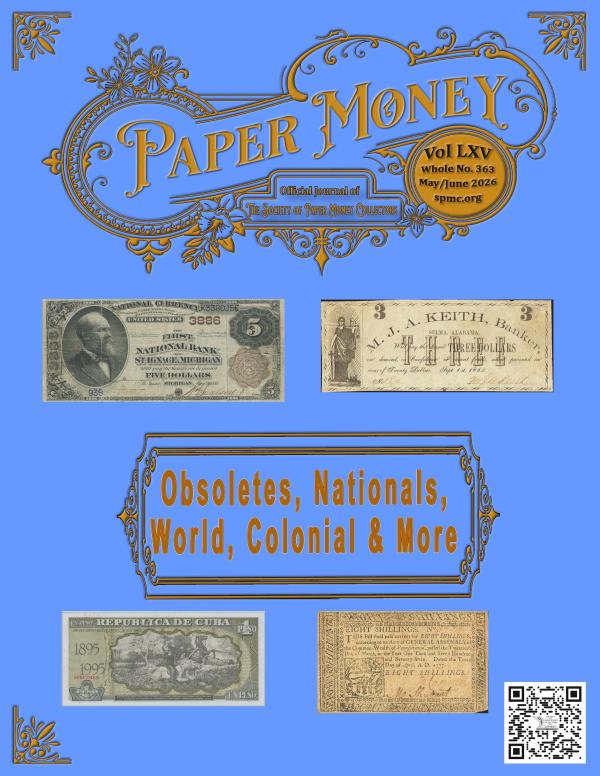
Table of Contents
Early Mackinac Bridge Design--Dave Gelwicks
Labor Banks--Peter Huntoon
A Mobile, AL Grocery Store from the 1860s--Bill Gunther
John Zug--Lee Lofthus
71 Days-Colonial Note to Declaration of Independence--Alexander Georgiades
Hardest Working Banker in Selma, Georgia--Charles Derby
Citizens National Bank of South Bend--Michael Saharian
Two Curious Mistakes in Cuban Banknotes--Roberto Menchaca
Cryptic Civil War Era Manuscript Fractional Note--Rick Melamed
America’s Oldest and Most Accomplished
Rare Coin AuctioneerCalifornia • New York • Boston • Miami • Philadelphia • New Hampshire • Oklahoma
Hong Kong • Copenhagen • Paris • Vancouver
1550 Scenic Avenue, Suite. 150, Costa Mesa, CA 92626
949.253.0916 • Info@StacksBowers.com
470 Park Avenue, New York, NY 10022
212.582.2580 • NYC@stacksbowers.com
Visit Us Online at StacksBowers.com
SBG PM ConsSumGlobal26 260501
LEGENDARY COLLECTIONS | LEGENDARY RESULTS | A LEGENDARY AUCTION FIRM
NOW ACCEPTING CONSIGNMENTS
The Stack’s Bowers Galleries
Summer 2026 Global Showcase Auction
Auction Dates: August 31–September 5 & 8-11, 2026 • Costa Mesa, CA
U.S. Currency Consignment Deadline: July 13, 2026
An Event Auctioneer Partner of the ANA World’s Fair of Money®
Fr. 2407. 1928 $500 Gold Certificate.
PMG Gem Uncirculated 65 EPQ.
From the Mid-Continent Collection.
Realized: $216,000
San Francisco, California. $5 1870. Fr. 1136.
First National Gold Bank. Charter #1741.
PMG Very Fine 30 EPQ.
From the Shores Collection Part II.
Realized: $45,600
Fr. 1194. 1882 $50 Gold Certificate.
PMG Choice About Uncirculated 58 EPQH.
From the Shores Collection Part II.
Realized: $38,400
Fr. 353. 1890 $2 Treasury Note.
PMG Gem Uncirculated 65 EPQ.
From the Shores Collection Part II.
Realized: $66,000
Fr. 1166b. 1863 $20 Gold Certificate.
PCGS Banknote About Uncirculated 50 Details.
From the Shores Collection Part II.
Realized: $516,000
Greeley, Colorado. $5 1882 Brown Back.
Fr. 467. First NB. Charter #3178.
PMG About Uncirculated 50. Serial Number 1.
Realized: $43,200
Fr. 1170. 1907 $10 Gold Certificate.
PMG Choice Uncirculated 64 EPQ.
Serial Number 1.
From the McLaughlin Collection
of Napier - Thompson Notes.
Realized: $120,000
Peter A. Treglia
Vice President & Managing
Director of Currency
PTreglia@
StacksBowers.com
Tel: 949.748.4828
Michael Moczalla
Currency Specialist
MMoczalla@
StacksBowers.com
Tel: 949.503.6244
Fr. 1220. 1922 $1000 Gold Certificate.
PMG Choice About Uncirculated 58 EPQ.
From the Shores Collection Part II.
Realized: $192,000
Contact Us For More Information:
800.458.4646 California • 800.566.2580 New York • Consign@StacksBowers.com
138 Earl Mackinac Bridge Design--Dave Gelwicks
141 Labor Banks--Peter Huntoon
150 A Mobile, Al Grocery Store from the 1860s--Bill Gunther
154 John Zug--Lee Lofthus
164 71 Days-Colonial Note to Declaration of Independence--Alexander Georgiades
169 Hardest Working Banker in Selma, Georgia--Charles Derby
172 Citizens National Bank of South Bend--Michael Saharian
SPMC.org * Paper Money * May/June 2026 * Whole Number 363
133
179 Two Curious Mistakes in Cuban Banknotes--Roberto Menchaca
184 Cryptic Civil War Era Manuscript Fractional Note--Rick Melamed
Columns
From Your President Robert Calderman 67
Editor Sez Benny Bolin 68
New Members Frank Clark 69
Uncoupled Joe Boling & Fred Schwan 111
Cherry Pickers Corner Robert Calderman 116
Dennis Hengeveld 120
124
Foreign Affairs
Chump Change
Small Notes
Quartermaster
Wrong Country
Loren Gatch
Jamie Yakes 125
Michael McNeil 126
Roland Rollins 129
Advertisers
IFC
65
85
89
90
93
Stacks Bowers Galleries
Pierre Fricke
Executive Currency
Greysheet
Whitman Publishing
Dennis Schafluetzel
Higgins Museum 101
109
110
115
123
132
133
FCCB
PCGS-C
William Litt
Bob Laub
SCCS
PCDA
Heritage Auctions OBC
SPMC Hall of Fame
The SPMC Hall of Fame recognizes and honors those individuals who
have made a lasting contribution to the society over the span of many years.
Charles Affleck
Walter Allan
Mark Anderson
Doug Ball
Aubrey &
Adeline Bebee
Hank Bieciuk
Joseph Boling
Q.David Bowers
F.C.C. Boyd
Michael Crabb
Forrest Daniel
Martin Delger
William Donlon
Roger Durand
C. John Ferreri
Milt Friedberg
Robert Friedberg
Len Glazer
Nathan Gold
Nathan Goldstein
Albert Grinnell
James Haxby
John Herzog
Gene Hessler
John Hickman
William Higgins
Ruth Hill
Peter Huntoon
Brent Hughes
Glenn Jackson
Glen Jorde
Don Kelly
Lyn Knight
Chet Krause
Robert Medlar
Allen Mincho
Clifford Mishler
Barbara Mueller
Judith Murphy
Dean Oakes
Chuck O'Donnell
Roy Pennell
Albert Pick
Fred Reed
Matt Rothert
John Rowe III
Fred Schwan
Neil Shafer
Herb& Martha Schingoethe
Austin Sheheen, Jr.
Hugh Shull
Glenn Smedley
Raphael Thian
Daniel Valentine
Louis Van Belkum
George Wait
John & Nancy Wilson
D.C. Wismer
SPMC.org * Paper Money * May/June 2026 * Whole Number 363
134
Officers & Appointees
ELECTED OFFICERS
PRESIDENT Robert Calderman
gacoins@earthlink.net
VICE-PRES William Litt
TREASURER Robert Moon
robertmoon@aol.com
BOARD OF GOVERNORS
APPOINTEES
PUBLISHER-EDITOR-ADVERTISING MANAGER
Benny Bolin smcbb@sbcglobal.net
Megan Reginnitter mreginnitter@iowafirm.com
LIBRARIAN
Jeff Bruggeman jeff@actioncurrency.com
MEMBERSHIP DIRECTOR
Frank Clark
IMMEDIATE PAST PRESIDENT
Robert Vandevendert
WISMER BOOK PROJECT COORDINATOR
Pierre Fricke
From Your President
Robert CaldermanFrom Your President
Shawn Hewitt
We’re excited to announce the details of our second annual
Florida United Numismatists (FUN) Speakers Forum. In the fashion of our
inaugural seminar last year, we’ll again have a total of five speakers making
presentations, and close out the forum with our SPMC membership meeting on
Saturday morning.
The dates of the FUN convention are January 9-12, 2020 at the Orange
County Convention Center, West Building WA1 & WA2, in Orlando, Florida. The
first four talks are on Friday, January 10 in Room 304F (same as last year).
Here is the lineup… - "The Current
Status of the U. S. Small Size Paper Money Market". – Mr. Calderman, a
specialist and dealer in U. S. small-size type notes will discuss the current
trends in small size notes and the future of this paper money specialty.
- "A Behind the Scenes Look at the Paper
Money Auction Process"–Mr. Johnston, the Vice- President and Managing
Director of the Currency Division at Heritage Auctions will discuss the nuts-
and-bolts of conducting a major Paper Money auction.
"An Overview of the
Confederate Paper Money Market" .
Mr. Fricke has been a long-time dealer in Confederate Paper Money and is the
author of the standard reference on Confederate Paper Money "Collecting
Confederate Paper Money: The Standard Guide to Confederate Money".
"The good, the bad, and the ugly of
antebellum bank note fraud" – Various types of pre-Civil War bank note fraud
will be explored and illustrated.
In addition, at the SPMC Membership Meeting (open to all) on
Saturday at 8:30am in Room 303B we have: - "Overview
of the SPMC Bank Note History Project" - This project is focused on two of
the primary historical aspects of the "Hometown" National Bank Notes - the
Banks who issued them and the bankers who signed them.
I think we’re onto a good thing in making FUN another major venue for
the face of SPMC. Our table will be 867 in the club section of the bourse floor,
so please stop by. Again, this year, we are participating in the ANA Treasure
Trivia Program, which is a great outreach to the youth of our hobby. We have
some very nice world notes to hand out (to young numismatists) as souvenirs
for visiting our table.
Before I go, I should mention that we have a new Membership Secretary.
Robert Calderman, one of our board members, has stepped up to fill the position
recently vacated by Jeff Brueggeman. If you frequent the major shows, you
may have seen Robert at one of our club tables. Robert is great resource for the
Society, and we very much appreciate the work he does for us.
Paper Money * July/August 2020
6
LEGAL COUNSEL
Robert Calderman gacoins@earthlink.com
Matt Drais stockpicker12@aol.com
Mark Drengson markd@step1software.com
Loren Gatch lgatch@uco.edu
Shawn Hewitt Shawn@north-trek.com
Derek Higgins derekhiggins219@gmail.com
Raiden Honaker raidenhonaker8@gmail.com
William Litt
Cody Regennitt
billitt@aol.com
Andrew Timme
Wendell Wolka purduenut@aol.com
frank_clark@yahoo.com
derekhiggins219@gmail.com
SECRETARY Derek Higgins
billitt@aol.com
er cody.regenitter@gmail.com
rman andrew.timmerman@aol.com
Earlier this week, I was very fortunate to attend the 5th Annual National Bank
Note Conference at Heritage Auction’s headquarters in Dallas, Texas! While I
had previously atte de the first inaugural event back in 2021, that initial
intimate gathering does not hold a candle to this year’s record breaking crowd!
There were easily fifty diehard collectors in attendance and all of us were
overjoyed to share with each other some of the wild acquisition stories of our
many epic collectible trophies we have assembled over the years. An
abundance of speakers were scheduled over the course of the two days and the
knowledge they shared made the trip well worthwhile! My favorite speakers in
no particular order were: Jamie Yakes, Lee Lofthus, and Allen Mincho. There
were dozens and dozens of exhibit cases with some incredible notes on display!
Jim Simek’s notes stood out to me, featuring wild signature varieties that I
previously had no clue even existed! If you collect national bank notes and
want to meet like minded collectors in a laid back friendly environment, then
next year’s NBN event at HA HQ is the place where you need to be!
In just a couple of short weeks I will be attending and taking a table at the
Central States Numismatic Society’s 87th Annual Convention! How incredible
that we can almost just blink and soon it will be the 100th CSNS show, wow!
This has historically been my favorite show of the year because for a time in
years past it as featured the most important small size auction for the entire
calendar year, and at one time even exc eding the calib r f the FUN sale for
the category! While things have changed a bit over the years, and the live
convention auctions are now just a distant memory, the CSNS show is still very
high on of my list of t p shows for he year. There is a dedicated paper money
section on the bourse at this show and it will likely be v ry hard for you not to
find something great to add to your collection.
I was very saddened to hear of the recent passing of legendary paper money
dealer Dean Oakes! Considered by many to be their all time favorite dealer in
our hobby, Dean spent more years working full time in this business than I
have yetto be alive! I count myself as fortunate to have been able to do
business with Dean over the years. One of my favorite newly acquired national
bank notes in my collection is a 1902 $10 Plain Back on Ch.# 1741 Crocker
First National Bank of San Francisco, California featuring Serial Number One
plate position A, that came out of Dean’s collection that sold last Fall via Lyn
Knight Auctions. Remember when you are looking at your collection that the
notes you hold last longer than the friends you make along the way. Take the
extra time to build friendships in this hobby and enjoy them as much as you
can for as long as youare given the blessing of opportunity to do so!
As always, I hope to see you all at a show in the not so distant future
Terms and Conditions
The Society of Paper Money Collectors (SPMC) P.O. Box 7055,
Gainesville, GA 30504, publishes PAPER MONEY (USPS 00‐
3162) every other month beginning in January. Periodical
postage is paid at Hanover, PA. Postmaster send address
changes to Secretary Robert Calderman, Box 7055, Gainesville,
GA 30504. ©Society of Paper Money Collectors, Inc. 2020. All
rights reserved. Reproduction of any article in whole or part
without written approval is prohibited. Individual copies of this
issue of PAPER MONEY are available from the secretary for $8
postpaid. Send changes of address, inquiries concerning non ‐
delivery and requests for additional copies of this issue to
the secretary.
MANUSCRIPTS
Manuscripts not under consideration elsewhere and
publications for review should be sent to the editor. Accepted
manuscripts will be published as soon as possible, however
publication in a specific issue cannot be guaranteed. Opinions
expressed by authors do not necessarily reflect those of the
SPMC. Manuscripts should be submitted in WORD format via
email (smcbb@sbcglobal.net) or by sending memory stick/disk
to the editor. Scans should be grayscale or color JPEGs at
300 dpi. Color illustrations may be changed to grayscale at the
discretion of the editor. Do not send items of value.
Manuscripts are submitted with copyright release of the author
to the editor for duplication and printing as needed.
ADVERTISING
All advertising on space available basis. Copy/correspondence
should be sent to editor.
All advertising is pay in advance. Ads are on a “good faith”
basis. Terms are “Until Forbid.”
Ads are Run of Press (ROP) unless accepted on a premium
contract basis. Limited premium space/rates available.
To keep rates to a minimum, all advertising must be prepaid
according to the schedule below. In exceptional cases where
special artwork or additional production is required, the
advertiser will be notified and billed accordingly. Rates are
not commissionable; proofs are not supplied. SPMC does not
endorse any company, dealer, or auction house. Advertising
Deadline: Subject to space availability, copy must be received
by the editor no later than the first day of the month
preceding the cover date of the issue (i.e. Feb. 1 for the
March/April issue). Camera‐ready art or electronic ads in pdf
format are required.
ADVERTISING RATES
Editor Sez
Benny Bolin
Required file submission format is composite PDF v1.3
(Acrobat 4.0 compatible). If possible, submitted files should
conform to ISO 15930‐1: 2001 PDF/X‐1a file format standard.
Non‐ standard, application, or native file formats are not
acceptable. Page size: must conform to specified publication
trim size. Page bleed: must extend minimum 1/8” beyond
trim for page head, foot, and front. Safety margin: type and
other non‐bleed content must clear trim by minimum 1/2”.
Advertising c o p y shall be restricted to paper currency, allied
numismatic material, publications, and related accessories.
The SPMC does not guarantee advertisements, but accepts
copy in good faith, reserving the right to reject objectionable
or inappropriate material or edit copy. The SPMC
assumes no financial responsibility for typographical
errors in ads but agrees to reprint that portion of an ad in
which a typographical error occurs.
Benny (aka goompa)
Space
Full color covers
1 Time
$1500
3 Times
$2600
6 Times
$4900
B&W covers 500 1400 2500
Full page color 500 1500 3000
Full page B&W 360 1000 1800
Half‐page B&W 180 500 900
Quarter‐page B&W 90 250 450
Eighth‐page B&W 45 125 225
My how she is grown. 20 months old now and the joy of my life.
As I mentioned in my last column, I had my right knee replaced and
so I have been essentially housebound for the rest of March and the
first week of April (except for twice weekly PT-or sadistic treatment of an old
man--but totally necessary). Hallelujah I am back to driving now. During
my time at home and having to do everything myself (get a drink of
water, get a blanket, etc.) I kept coming back to her and her pics/videos
to maintain my sanity. I am sure I will be glad I had the surgery but I
won't do the other one anytime soon. Enough of the pity party!
During my recovery, I decided to take up a new hobby--model
railroading! I was a big railroader years ago so I decided to build a
new N-scale layout. It is fun, but will not take the place of my paper
money. Oh yeah--I also finished the large doll house I started 30
years ago for my wife and when my lil' bit gets older it is hers!
I have been watching and reading a lot numismatically and it
appears the hobby is still in good shape. As I write this Central
States is kicking off in a few days. I would love to go but just not
able to walk that much now. I hope you will all let me know of your
experiences via an article! In the month of May, the Texas
Numismatic Association is having its' yearly show. I always exhibit
there and want to do so again, but I am having problems deciding
how to put it together. I want to do fractional currency inverts (I
have 55 of them currently. I really don't like slabbing my notes but I
had all my inverts slabbed so when I am gone my son can sell them
easier. Therein lies my conundrum. How can I exhibit so many
notes ensconced in holders, especially those with just the backs
inverted. Oh well, I hope to solve this riddle--if you have any ideas I
would appreciate an email with suggestions.
Once again, it is my sad duty to report the loss of another of our
long-time members. Dean Oakes. Dean was always a fixture at
Memphis and just being around his and John Hickman's table and
listening and learning were great. Dean was always more reserved
than John and when certain collectors walked by the words out of
that table were interesting. Good hearted but interesting. I don't
remember ever buying anything from Dean as at that time about all I
was buying was fractional currency and South Carolina obsoletes
which Dean did not have much of.
This is the report of the demise of four of out major dealer and
collectors in two issues. Sadly our hobby is aging. Now, we need
you younger generation to start writing me so articles I can publish!
If you don't know how, just send me the facts and I will transform
you and your words into a prize winning article!
Well, I gotta go to PT and work on the flexanator--a machine akin
to the rack of medieval times.
Till next time! Look out for those school zones and don't drive and text!
The Society of Paper Money
Collectors was organized in 1961 and
incorporated in 1964 as a non-profit
organization under the laws of the
District of Columbia. It is
affiliated with the ANA. The
Annual Meeting of the SPMC is
held in June at the International
Paper Money Show. Information
about the SPMC, including the
by-laws and activities can be
found at our website--
www.spmc.org. The SPMC does
not does not endorse any dealer,
company or auction house.
MEMBERSHIP—REGULAR and
LIFE. Applicants must be at least 18
years of age and of good moral
character. Members of the ANA or
other recognized numismatic
societies are eligible for membership.
Other applicants should be sponsored
by an SPMC member or provide
suitable references.
MEMBERSHIP—JUNIOR.
Applicants for Junior membership
must be from 12 to 17 years of age
and of good moral character. A parent
or guardian must sign their
application. Junior membership
numbers will be preceded by the letter
“j” which will be removed upon
notification to the secretary that the
member has reached 18 years of age.
Junior members are not eligible to
hold office or vote.
DUES—Annual dues are $39. Dues
for members in Canada and Mexico
are $45. Dues for members in all
other countries are $60. Life
membership—payable in installments
within one year is $800 for U.S.; $900
for Canada and Mexico and $1000
for all other countries. The Society
no longer issues annual membership
cards but paid up members may
request one from the membership
director with an SASE.
Memberships for all members who
joined the Society prior to January
2010 are on a calendar year basis
with renewals due each December.
Memberships for those who joined
since January 2010 are on an annual
basis beginning and ending the
month joined. All renewals are due
before the expiration date, which can
be found on the label of Paper
Money. Renewals may be done via
the Society website www.spmc.org
or by check/money order sent to the
secretary.
WELCOME TO OUR
NEW MEMBERS!
BY FRANK CLARK
SPMC MEMBERSHIP DIRECTOR
NEW MEMBERS 03/05/2026
Dues Remittal
R
obert Moon --SPMC Treasurer
Process
Send dues
directly to
403 Gatewood Dr. Greenwood, SC 29646
You may also pay your dues online at www.spmc.org.
16005 Craig Shields, You Tube
16006 Mike Smith, Will Gragg
16007 Jack Gilbert, R. Calderman
16008 Gary Greenberg, R. Calderman
16009 Vasili Sarantopoulos, Fred Bart
16010 Elliot Glotfelty, Website
16011 Jim Grimm, Frank Clark
16012 Claude-Michael Susin, Fred Bart
16013 Pancho Chacon, John Patrick
16014 Alexander Georgiades, Website
16015 Robert Vergara, Website
16016 Dwayne Westerhausen, Website
16017 James R. Hickey, Fred Bart
16018 Paul H. Giardino, Fred Bart
16019 Jeffrey Cooper, Frank Clark
16020 Eric Prestrud, Website
16021 Daniel Gardner, Mike McNeil
16022 David Everhart, Frank Clark
16023 Ken Mikolaj, Website
16024 Nathaniel Unrath, Frank Clark
16025 Ali Mehilba, Website
16026 Earl Fore, R. Calderman
16027 Brad Kurtzweil, Website
16028 William Norris, Website
16029 Bob Desimone, You Tube
16030 John Hall, R. Calderman
16031 Greg Marks, You Tube
REINSTATEMENTS
None
LIFE MEMBERSHIPS
LM485 Bianca Bart, R. Calderman
LM486 Kim Bart, R. Calderman
NEW MEMBERS 04/05/2026
16032 Paul Mied, Frank Clark
16033 Ray Taylor, ierre Fricke
16034 Brian Miller, Website
16035 David Job, Website
16036 Bruce Breedlove, R. Calderman
16037 Ed Travis, R. Calderman
16038 Derrick Glover, Website
16039 Michael Kodysz, Website
16040 Ken Martin, Website
16041 Brian Monson, Website
16042 Jon Miner, Frank Clark
16043J Brandon Moauro, Website
16044 Terry Reinecker, You Tube
16045 James Robertson, Website
16046 Alfonso Cano, R. Calderman
16047 Jeffery Nunez, Frank Clark
16048 Tom Deutsch, Polar Currency
16049 Rebecca Rush, Website
16050 Bill Burgess
16051 Dean LeFrancois. Polar Currency
16052 Larry Blenn, Website
REINSTATEMENTS
None
LIFE MEMBERSHIPS LM487
Steven Harden, formerly 14565
Brown Back Exhibit Research Leads
To Early Mackinac Bridge Design
by Dave Gelwicks
There were 21 chartered national banks in the Upper Peninsula of Michigan which printed the Series of 1882
national bank notes called “brown backs”. Census data confirms that brown back notes remain from 18 of those 21
banks. While researching Upper Peninsula national bank note varieties this interesting Mackinac Bridge story
developed.
THE FIRST NATIONAL BANK OF ST. IGNACE, MICHIGAN, charter 3886, has 3 brown backs known
of the $5 denomination. Serial number 939 is shown below from the A plate position. The other $5 notes are serial
numbers 960 and 2422 from the B and C plate positions respectfully. All 3 notes were printed from the 1882 brown
back plate dated May 26, 1888. i
During the exhibit process it was determined to describe either an interesting historical point regarding the city
in the bank name or some factual detail pertaining to a bank officer signature from each respective note. The bank
officer signatures are expanded below. The officers were E.H. Hotchkiss, Cashier and Wm. Saulson V., President.
The Society of Paper Money Collector’s web site was used as a reference for the respective bank officers. The
results are listed below from The Huntoon-Shiva Encyclopedia of U.S. National Bank Notes. ii
Charter 3886 Bank Officer Pairs (OCC/Pollock)
Years Cashier President
1888-1889 Edward L. Durgin O. W. Johnson
1890-1921 Edgar Hugh Hotchkiss O. W. Johnson
1922-1924 Edgar Hugh Hotchkiss P. J. Murray
1925-1931 Edgar Hugh Hotchkiss P. J. Murray
1932-1935 H. A. Powers P. M. Brown
1882 Brown Back Charter 3886
Date: May 26, 1888 Size: 7” x 3”
The first observation was that Wm. Saulson V. was not listed in the President column to match with E.H.
Hotchkiss. This was the beginning of a national bank note education lesson for the author. The next act was to contact
national bank note veteran Peter Huntoon with whom I had previous writing experiences. Peter then referred me to
Mark Drengson, the SPMC website data manager.
To this curious novice collector, Drengson explained that the V behind someone’s cursive signature is an
immediate signal identifying the individual as a Vice President of the respective bank, not the President as engraved
on the plate. At various times, and for many reasons, the bank president delegated the note signature process to
another bank officer. This was exactly the case and Drengson then changed the SPMC website by adding Saulson as
a bank office signature during his vice president term of 1891-1892.
William Saulson signed the Charter 3886 brown back note shown on the previous page as the V. President of
The First National Bank of St. Ignace. Saulson’s biography, as detailed in the November, 1963 semi-annual
publication of the JEWISH HISTORICAL SOCIETY OF DETROIT, credits this general store merchant as the first
public ambassador supporting a bridge to span the Straits of Mackinac from Mackinac City in the south to St. Ignace
to the north. iii
This publication reports an 1884 advertisement by Saulson containing his personal rendition of the recently
completed Brooklyn Bridge titled “A Glimpse of the Future” and below the drawing read “The Proposed Bridge
Across The Straits of Mackinac.” These identifiers are shown in very fine print just below Saulson’s portrait and
below the bridge sketch on the advertisement that follows.
In the William Saulson – Michigan Pioneer article, written by Lawrence A. Rubin, Mackinac Bridge Authority
Executive Secretary, stated “…the woods were full of people who wouldn’t have bet a plugged nickel that any
structure could withstand the forces of nature --- wind, ice, currents, water depths --- that prevail at the Straits of
Mackinac…”iv
Saulson immigrated to the United States from Suwalki, Poland about 1877 at age 16. He worked his way west
as a peddler landing in Alpena’s lumber country. As timber thinned out he journeyed toward the flourishing town of
St. Ignace and opened his own store. In 1888 he was elected Mayor of St. Ignace and joined others to establish The
First National Bank of St. Ignace, becoming the vice president by 1890.v
Saulson’s bridge advertisement was his pencil rendering of the single span Brooklyn Bridge that he had seen
following his emigration through Ellis Island and New York City. Lawrence Rubin also states that a copy of the 1884
Saulson drawing was gifted to S.W. Woodfill for his leadership convincing the legislature to establish the Mackinac
Bridge Authority in the late forties.vi
The Mackinac Straights suspension bridge opened to traffic in 1957 eliminating the weekend travelers waiting
hours for the car ferry.
viii
vii
i https://banklookup.spmc.org, This National Bank Lookup website is part of the Bank Note History Projects
sponsored by the Society of Paper Money Collectors
ii Huntoon-Shiva Encyclopedia of U.S. National Bank Notes, The National Currency Foundation owns the copyright
to this encyclopedia, 2023.
iii Michigan Jewish History Volume 4, November, 1863 – Heshvan, 5724, Number 1, Jewish Historical Society of
Detroit, 8801 Woodward Avenue, Detroit, Michigan, Pg 3.
iv Ibid, Pg. 4.
v Ibid, Pg. 7.
vi Ibid, Pg. 7.
viihttps://www.facebook.com/photo.php?fbid=736610303063055&id=217327851657972&set=a.367032996687456,
September 20, 2025
Labor Banks &
the Brotherhood of Locomotive Engineers
Co-operative National Bank of Cleveland
Purpose
The purpose of this piece is to profile labor banks that came on the scene in 1920, flourished for a
decade, then fell into decline by the end of the 1930s. Stockholders and depositors enjoyed special so-called
co-operative profit-sharing provisions such as deposit dividends common to coop enterprises in other
economic spheres that were in vogue at the time.
Cooperatives and Labor Banks
Interest in cooperative enterprises increased substantially after the turn of the 20th century. Coops
were ventures wherein people marshal their resources to carry out an activity of mutual benefit to the
members of group. To classify as a coop, participants bought stock in the enterprise that was used to fund
its operation and house it as their share of its ownership.
To qualify as a coop required certain attributes, some often considered socialistic in contrast to
conventional capitalistic business models. Membership, at least a membership majority, is restricted to the
specific class of owners being served by the coop. Limitations are placed on the size of holdings by any
one individual. Provisions are made for participants to receive periodic stock dividends ideally capped at
10 percent so as not to drain the operation. In order to maintain egalitarian management, owners have one
vote, not multiple votes based on the number of shares they own. Provisions include restrictions on the sale
of shares to others in the special class being served by the coop.
In the case of the banks treated herein, Federal and state banking law required votes to be allocated
by number of shares owned. In contrast, a feature that is considered particularly cooperative is the payment
of dividends to savings depositors in addition to interest, thereby satisfying the cooperative doctrine that
customers should share in profits.
Interest on the part of labor unions in the concept of labor banks began after the turn of the 20th
century but was very slow to take root. The managers of the unions had a bit of a conundrum on their hands.
They had funds that they routinely deposited with commercial banks that drew modest interest but the
bankers often used their profits on that same money to finance activities that were antithetic to the interests
The Paper
Column
by
Peter Huntoon
Figure 1. Note on a presentation sheet signed by President Warren S. Stone who built the
Cleveland Brotherhood bank into the leader of the labor bank movement. Heritage Auction
Archives photo.
of the unions and its members. The question was
could a labor bank turn this around and at the
same time further enrich their membership?
Union hierarchy consists of a large
collection of local and even regional trade
unions that serve specific constituencies. They
belong to national-level federations such as the
American Federation of Labor that promote the
growth of the union movement, lobby for union
goals, coordinate actions between the
individual unions, serve as a liaison with
similar labor-based federations such as the All-
American Farmer-Labor Cooperative
Congress, etc.
Progressive voices in the AFL began to
toy with the concept of labor banks as early as
1904. The movement sputtered but gradually
began to gain traction over the next two
decades, spurred on by the fact that the
treasuries of the member unions had fattened
significantly owing to full employment of their
members during World War I.
The Machinists' Union was the first to
open a labor bank in the United States, an event
that took place May 15, 1920. Theirs was the
Mount Vernon Savings Bank housed in the
Machinists' Building in Washington, D.C. Its
opening drew scant attention.
The next to open was The Brotherhood of Locomotive Engineers Co-operative National Bank of
Cleveland, Ohio, chartered October 26, 1920. This bank immediately took center stage in the growth of
labor bank movement. The following from Princeton (1929, p. 18-22) provides an excellent summary of its
growth.
The Brotherhood of Locomotive Engineers Co-operative National Bank of Cleveland
The inauguration of the Brotherhood of Locomotive Engineers Co-operative National Bank in Cleveland
gave the first real impetus to the labor banking movement. The bank was entirely a labor institution. The
Brotherhood had considered the establishment of a bank in the convention of 1915, so that those active in the
organization were aware and interested in the development even before 1920. In October, 1919, Grand Chief
Stone and First Assistant Grand Chief Prenter had been appointed by the Advisory Board of the Brotherhood
committee to draft a definite plan for the organization of the bank. In June, 1920, the board discussed in detail
the plans for a bank and decided to proceed with the necessary steps. With the help of Dr. Frederick C. Howe
and Dr. Walter F. McCaleb, preparations were made for opening the bank.
In the midsummer of 1920, a circular announcing the prospective opening of the bank was sent to all members
of the Brotherhood of Locomotive Engineers. A charter for a Brotherhood of Locomotive Engineers Co-
operative National Bank had been obtained from the Comptroller of the Currency. Capital stock of $1,000,000
was to be issued and on the advice of the Comptroller the price per share was set at $ 110 so that a paid-in surplus
of $100,000 would be possible. Stock subscriptions were limited to members of the Brotherhood, who in
applying for stock signed an agreement to resell their shares to a purchasing committee of the bank in case
disposal was necessary. To further ensure the exclusive control of the bank by the Brotherhood, the latter
organization purchased fifty-one percent of the stock in its own name. By October 15, 1920, the forty-nine
percent of the capital stock offered to members was oversubscribed by more than $300,000. The loyal and
prosperous members or at least some two thousand of the members had quickly grasped the opportunity to
support the promising experiment.
Figure 2. Warren Stanford Stone (February 1, 1860-
June 25, 1925) built the Cleveland Brotherhood
bank and its chain into the dominant labor bank.
Wikipedia photo.
Within three months after the assembling of capital had begun, the bank was ready for opening. On October
twenty-fifth the rules of the bank were adopted. On November first the bank was formally opened in quarters
which had been made ready in an old building across the street from the Engineers' headquarters. Capital of
$651,000 had been paid in and the remainder was soon forthcoming.
The deposits received during the first day of business by the new bank reached the modest sum of $50,971,
but two months later one million had been reached. A spectacular growth soon set in which can be best shown
by the total deposits listed in the following statements:
December 29, 1920 $ 1,009,880
June 30, 1921 4,754,504
December 31, 1921 7,883,450
June 30, 1922 11,633,267
December 29, 1922 15,480,657
June 30, 1923 19,587,898
December 31, 1923 21,453,324
June 30, 1924 26,016,688
The sources of these large deposits were but in small part the members of the Brotherhood. People of all
classes, but more especially the small-salaried class in Cleveland, were interested in the new bank and supported
it with their deposits. Mail deposits, also, poured in from railroad men throughout the country. The unique
features of the bank set it apart from the run of old-line institutions.
The name of the bank, Brotherhood of Locomotive Engineers Co-operative National Bank, crystallized in
the public mind the two features of the bank which attracted most attention. The Brotherhood was thus forcefully
identified with its offspring. In addition, Co- operative struck a pleasing chord. The repeated announcement that
this meant limitation of stockholders' dividends to ten percent on capital stock, and profit sharing with savings
depositors, proved to be one of the most effective advertising features discovered in recent years of banking. The
payment of a profit-sharing dividend in 1921 and thereafter through the first half of 1925 made good the promise
and provided a repeated stimulus to new business.
The spectacular growth of the Engineers' bank was due in part to two dynamic but conflicting personalities.
With Warren S. Stone as president of the bank and grand chief of the Brotherhood, the respect accorded the
successful labor leader brought support from the railroad labor group. Stone was a man of domineering
temperament who demanded the unflinching support of his constituents. His success in trade union activities
during the War created an atmosphere of optimism about the new financial venture to which he turned his
energies. His lack of knowledge of banking was covered up in the onrush of new business.
In contrast to Stone was McCaleb, the vice-president and executive officer of the bank. McCaleb was
essentially a banking theorist and was partially responsible for the introduction of cooperative features in the
bank's policies. His banking experience had included activity in commercial banking in Texas and service as
Assistant Federal Reserve Agent in the Dallas Federal Reserve Bank. More recently, his theoretical and altruistic
bents had caused him to enter upon a campaign for the extension of credit unions as a protection to working
people.
McCaleb's interest in the Cleveland bank was that of an inventor demonstrating a new machine. His
enthusiasm, energy, and singleness of purpose towards the goal of revolutionizing banking for the benefit of the
working class suggested that emphasis of the end over against the means which marks the reformer. In the urge
towards the new banking, caution became secondary and the energy which otherwise might have been used in
warding off difficulties was spent in sweeping over them.
As long as two such personalities were at one in advancing the cause of the new day in banking, the movement
was bound to attract attention. Stone lent the prestige and support of a large, prosperous, and well-disciplined
labor organization, while McCaleb made this prestige and support effective in a new financial mechanism which
attracted deposits at the rate of a million a month and turned out apparent profits almost immediately at a
corresponding rate. Both Stone and McCaleb were able through their experience as organizers to put the results
of their efforts effectively before the public, and especially, the trade union public.
Stone and McCaleb ardently advocated for the organization of additional labor banks and used the
vast treasury of their Cleveland bank to do so. They worked to establish labor banks for any receptive trade
union or group of unions. They sent organizers to promising markets or better yet to areas where local
unions expressed an interest in a labor bank. The organizers worked to drum up local support, win over
local labor factions, sell stock to union members, and prepare and apply for bank charters in the ventures.
Launching Labor Banks
Although a specific union might sponsor and ultimately own a given bank, any union member
regardless of trade could buy stock in the venture and that stock would count as union stock when it came
to ownership control of the bank.
The labor banks were organized under both state and national charters, whichever the situation
called for.
One particularly effective means to help launch these ventures was to set up a holding company for
the proposed bank that could hold funds gained through the sale of stock in the new venture. In time the
Cleveland bank operated a web of holding companies for this purpose.
The Cleveland bank often lent the holding companies funds and for many maintained at a minimum
a 51 percent ownership. Upon establishment of the bank, this gave Cleveland the majority interest in the
new bank. This mechanism created for the mother bank a chain of Brotherhood banks that operated in
diverse parts of the country under the control of the Cleveland bank.
The heydays for organizing labor banks were during the early 1920s. By 1929 there remained 39
active labor banks in the country (Princeton, 1929, p. 281). You can't always distinguish a labor bank from
a conventional bank by its title because no word in the title is associated with labor.
A recurring problem for the labor banks was staffing. Many simply didn't have officers with
banking experience to assured success. In some cases, the key positions in the institutions were drawn from
the union that owned the bank, often not a good fit.
Henry Edward Cass - Bank Organizer
The two notes illustrated on Figures 5 & 6 carry Henry E. Cass's signature as president. His
signature also appeared as cashier on the early notes from The Brotherhood's Co-operative National Bank
of Spokane issued in 1923. Clearly this man was a major factor in the growth of the Cleveland Brotherhood
empire. As you trace his career below, his crowning achievement was organizing and presiding over The
Brotherhood National Bank of San Francisco. This certainly placed him in the big leagues and earned him
recognition in Financing an Empire, history of banking in California (1927, v. 3, p. 125-126) from which
the following is copied.
Since May, 1918, Cass has been continuously identified with Brotherhood banks in various sections of the
country. At that date he joined the Brotherhood Bank at Cleveland, Ohio, in the capacity of assistant to the
executive vice president, and after a short time was sent to Spokane, Washington, where he organized the
Brotherhood Bank, of which he was elected vice president and cashier and with which he is still associated as
the executive vice president. His labors through the period of his residence on the coast have been far-reaching,
effective and resultant and have been of great benefit to the labor interests thereby represented. On the 1st of
Figure 3. One of several banks in the Cleveland Brotherhood chain whereby the mother bank
invested a 51 percent interest in the bank at the outset to maintain control over it. Mark Sims
photo.
January, 1926, Mr. Cass organized the
Brotherhood National Bank at Portland, Oregon,
of which he is also executive vice president, and
on the 1st of July, 1925, he completed the
organization of the Brotherhood National Bank
of Tacoma, in which institution he is filling the
presidency. His splendid executive powers were
further manifest in tangible manner when on the
1st of August, 1925, he organized the
Brotherhood Bank & Trust Company of Seattle,
of which he was elected president, and on the
16th of March, 1926, the Brotherhood bought the
State Bank of Hillyard, Washington, which Mr.
Cass reorganized under the name of the
Brotherhood State Bank, becoming its executive
vice president. On the 18th of December, 1926,
he organized the Brotherhood National Bank of
San Francisco and was also made its president,
so that he is now concentrating his efforts and
attention upon important financial interests of the
west with results that are highly satisfactory to all
concerned.
In 1923 Mr. Cass received appointment as
Pacific Coast financial representative of the
Brotherhood financial interests and is president
of the Pacific Brotherhood Investment Company;
president of the California Brotherhood
Investment Companies; president of the
Universal Mortgage Corporation of Portland,
Oregon; chairman of the board of the Pacific
Insurance Company of Seattle, Washington;
president of the Pacific Empire Company;
president of the Assured Thrift Agency of
Seattle; president of the Assured Thrift
Corporation of Cleveland, Ohio; president of the
Brotherhood Safe Deposit Company of San Francisco; and president of the Pacific Publications, Inc.
Figure 4. Henry Edward Cass organized numerous
banks for the Cleveland chain and ultimately
served as president of the San Francisco
Brotherhood bank. Coastal Banker (1926).
Figure 5. In the process of organizing banks for the Cleveland chain, Henry E. Cass would serve
temporarily as president or cashier. Mark Sims photo.
Withering
Warren Stone, architect of the phenomenal growth and reach of the Cleveland Brotherhood bank,
died June 25, 1925. The financial prowess and geographic reach of the Cleveland bank and its chain were
at their peaks. The New York Times reported the value of his empire at $150 million, a huge amount at
the time.
Figure 7. The title of the Cleveland Brotherhood bank was shortened in 1928, and the bank
was liquidated in 1930. Heritage auction archives photo.
Figure 6. The organization of the Cleveland Brotherhood bank in San Francisco squarely
placed Henry E. Cass in the big time. Mark Sims photo.
As a minor footnote to his career, Stone was particularly proud of construction of the 14-story
Brotherhood of Locomotive Engineers Union Building on the southeast corner of St. Clair Ave and
Ontario St in Cleveland. It was completed in 1910 as the first union headquarters building owned by a
union. This was fitting because the Locomotive Engineers was lineally descended from the oldest union
in the country.
However, his crowning real-estate achievement was the 21-story Brotherhood Bank Building at
1370 Ontario St completed the year he died. It featured a 1,250-seat auditorium. The union headquarters
was moved into that new building.
Stone's death was an ill omen. A recurring problem with the Cleveland and other labor banks was
union interference in their managements. The two management styles could seriously conflict.
Historically the labor banks couldn't attract qualified management. Union men stepped in regardless of
qualifications. Then there was jockeying for the prestigious president and vice president titles but
directors could not be found.
Loans that should have been denied on fiscal grounds were occasionally approved because they
furthered a union interest or worse some director's interest,
The managers who assumed control after Stone's death embarked on a downward spiral of
downsizing by spinning off links in their chain and otherwise contracting their business. By 1927, the
Cleveland bank was under fire. The president was accused of using the bank as a source of position and
power for himself and his cronies at great cost to the union. The scandal resulted in a cleanup. Limitations
on stock resale were removed as well as loosening of other co-op restrictions.
The name of the bank was shortened to The Engineers National Bank February 15, 1928, a cosmetic
change.
In short order, the Ohio Department of Banking cobbled together a merger between four foundering
banks including The Engineers National Bank, the other three being the Nottingham Savings & Banking
Co., the Guaranty State Savings & Loan Co., and the Commonwealth Savings & Loan Co. They were
reorganized as the Standard Trust Co., on March 11, 1930.
The Cleveland Brotherhood bank was formally liquidated September 12, 1930, as a legal
housecleaning task. It had a total life of only ten years. Its circulation at the time was $800,000.
The Standard Trust continued to hemorrhage cash so was placed in receivership by the Ohio Banking
Department on December 21. 1931. A State Banking Department investigation found that large loans had
been made to friends of bank president, C. Sterling Smith, with inadequate security. Smith was indicted for
embezzlement and sentenced to prison in 1933. By 1941, the liquidators had returned 50% of the $13.2
million in deposits to 22,000 people.
Labor Banks that Issued National Bank Notes
Harry Corrigan (1978) compiled a brief sketch for each of the 15 labor banks that held national
charters. His list is reproduced below.
Unless otherwise stated, dividends to stockholders were limited to 10 percent in this list. Only the
Cleveland and Spokane banks were prosperous enough to pay depositor dividends.
10357 – The First NB in Bakersfield, CA. Although charted in 1913 and the lowest charter
number of any labor bank, it was not a labor bank when organized as the NB of Bakersfield. In 1924 the
bank was failing when speculators bought it and sold it to local railroad union interests. It was renamed on
May 3, 1924, but not to one indicating labor ownership. At its peak, labor owned 70 percent of the stock,
but by 1929 this was down to 20 percent. Proxy voting and repurchase agreements that proved ineffective
were the reason control was lost. The bank never was successful. Its stockholders were assessed a total of
$225 per share over its lifetime. In 1935 it was absorbed by the Anglo California NB. Its circulation was
then $500,000.
12282 – The Transportation Brotherhood NB of Minneapolis, MN. Opened Dec. 18, 1922.
Fifty-one percent owned by a BLE affiliate. Stock ownership limited to members of four transportation
broth- erhoods. Bank had right to repurchase shares. Liquidated Feb 4, 1930. Absorbed by the Marquette
NB of Minneapolis. 1928 circulation was $75,000.
12389 – The Telegraphers NB of St. Louis, MO. Opened Jun 9, 1923. Seventy-two percent owned
by the Order of Railroad Telegraphers. Ownership limited to ORT members with directors qualifying
shares. limit of 10 shares per person. Still in business in 1934 with a circulation of $491,800. Second largest
labor bank with peak assets before 1929 of $7 million.
12418 – The Brotherhood Co-operative NB of Spokane, WA. Opened Aug. 1, 1923. Owned 25
percent by Brotherhood Investment Company, 35 percent by members of the BLE, 25 percent by members
of other unions, and 15 percent by the general public. No restrictions on resale. Depositor dividends paid
until 1927. In 1928, disaffection with the BLE caused other stockholders to kick them out, and decision
was made to go after the business of the general public. Hence the name changed in 1928 to City NB –
much to the disgust of hardline unionists. Although absorbed by the Old NB in 1928, 12418 nonetheless
went into receivership in 1930. In 1928, the circulation was $200,000.
12446 – The Brotherhood of Railway Clerks NB of Cincinnati, OH. Opened Dec. 15, 1923. The
BRC owned 51 percent of the stock, but there were no other ownership limitations. In 1925, their union
convention ruled that no union officers could be officers of the bank. The bank went into receivership in
1930, but was restored to solvency and liquidated later the same year. Its circulation in 1930 was $200,000.
12540 – The Brotherhood of Locomotive Engineers NB of Boston, MA. Opened May 24, 1924.
Controlling interest owned jointly by the BLE national organization and the New England BLE Securities
Corp. Stock restricted to BLE members, officers and directors of the bank. In 1927, bylaws were amended
Figure 8. Labor interests acquired the failing National Bank and reorganized it as a labor
bank with title of First National Bank in Bakersfield without a labor related word. Heritage
Auction Archives photos.
to remove stock restrictions and name changed to Engineers NB. In 1930, changed again to Continental
NB. Liquidated later that year and consolidated with the Boston NB. Circulation in 1929 was $275,000.
12560 – The Labor Co-operative NB of Paterson, NJ. Opened July 26, 1924. Shareholding
limited to 40 for a labor organization, 10 for individuals; limits later raised to 60 and 20, respectively. There
was a resale restriction in the subscription agreement, and management manipulated the stock price to keep
it down. Name changed to Labor NB in 1928, when most co-operative features were dropped. Liquidated
in 1925. Succeeded by N. Union B. Circulation in 1927 was $42,800.
12613 – The Brotherhood Co-operative NB of Portland, OR. Opened Jan 3, 1925. By 1929,
union and union member ownership had fallen under 25 percent. At this time the name was changed first
to Brotherhood NB, then to Columbia NB, hinting an end to co-op features. Liquidated in 1931, absorbed
by the American NB of Portland. Circulation in 1930 $200,000.
12667 – Brotherhood Co-operative NB of Tacoma, WA. Opened July 1, 1925. Title changed to
Washington NB in 1930. Went into receivership Feb 2, 1932. Circulation $191,960 in 1932.
12755 – The Peoples NB of Los Angeles, CA. Opened May 6, 1925. Fifty-one percent owned by
local AFL groups. Repurchase agreements were ineffective, so gradually the union interests lost control.
After an assessment of $24 per share in 1928, labor interests lost control and the name was changed to NB
of Commerce. Bank liquidated in 1932. Circulation in 1929 was $500,000.
12771 – Labor Co-operative NB of Newark, NJ. Opened June 27, 1925. Stock ownership limited
to ten shares for individuals, 50 for unions. Subscription agreement had a repurchase provision and said
that a majority of the new board must be unionists. It is not stated whether there were stock dividend
limitations or provisions for depositor profit sharing, but name change in 1927 to Labor NB and then to
Union NB indicates that there were changes in organization. Still in business in 1934 with a circulation of
$175,000.
12939 – Labor NB of Jersey City, NJ. Opened June 28, 1926. Voting stock limited to trade union
organizations; most other stock not union held. Otherwise, no co-operative features. Liquidated in 1931.
Circulation in 1930 was $100,000.
13016 – Brotherhood NB, San Francisco, CA. Opened Dec. 18, 1926. Owned 51 percent by
Pacific Brotherhood Investment Co. that was related to the Brotherhood Investment Co. that owned the
Spokane bank, 25 percent by union members, the remainder by the general public. In 1929 the unions sold
their interests and the name was changed to City NB. It was liquidated in 1932 and absorbed by the Pacific
NB of San Francisco. The circulation in 1929 was $200,000.
11429 - The Labor NB of Great Falls, MT. Did not issue.
12361 - The Labor NB of Montana of Three Forks, MT. Did not issue.
Sources
Case Western Reserve University, Encyclopedia of Cleveland History.
Corrigan, Harry, 1978, The Brotherhood of Locomotive Engineers Co-operative National Bank of Cleveland, Ohio: Paper Money,
v. 17, p. 133-136.
Cross, Ira B, 1927, Financing an Empire, history of banking in California, vol 3: S. J. Clark Publishing, 448 p.
New York Times, June 13, 1925, Warren S. Stone, labor leader, dies, president of Brotherhood of Locomotive Engineers and its
$150,000,000 interests, p. 1.
Princton University, 1929, The labor banking movement in the United States: Industrial Relations Section, Department of Economic
and Social Institutions, Princeton University, 377 p.
This chapter is from The Encyclopedia of U. S. National Bank Notes published jointly by the National Currency
Foundation (www.nationalcurrencyfoundation.com) and Society of Paper Money Collectors (www.spmc.org).
A Mobile, Alabama Grocery Store from the 1860s
By Bill Gunther
AO-304-$.25a in the Gunther-Derby Reference Book
The above note recently appeared in an online
auction and the cataloger commented that it is
“Presumed to be a merchant concern,” and added that
“the firm of Brooks & Harding does not appear in
newspaper or city directory listings for 1861-1866.”
Nothing more is offered on who or what this note
represented. Those comments presented me with a
challenge as well as an opportunity: find out who and
what this note represented.
The Note
This is the only known note from Brooks &
Harbin that can be identified through an examination
of online archives of auction sales of obsolete notes.
However, it has sold three different times (2001, 2016
and 2025) at the same venue. There is no printer’s
imprint on the note suggesting that it was probably
printed by a local company in Mobile. However, the
vignette of a steamship and two sailing vessels
suggests a more experienced printer. But it is also
possible that this vignette could have been copied from
other note issues of the same period. In fact, this
vignette appears on the 25-cent note issued by Asa
Holt, also of Mobile (above). No printer’s imprint
appears on the Asa Holt notes either. However, the
date of March 1, 1862 that appears on the Asa Holt
note predates the Brooks & Hardin note by six months,
suggesting that the Brooks & Hardin printer may have
appropriated the vignette from an Asa Holt note.
Fractional (less than one dollar) amounts were
necessary since “hard money” (gold, silver and copper
coins) had either been donated to the war effort or were
horded by citizens. The Confederate government did
not provide fractional currency until a 50-cent note
was authorized on April 6, 1863. The State of
Alabama did not offer any currency until they
outlawed the issue of private fractional currency
effective January 1863 and then provided their own
issues of fractional notes. Therefore, in order for
businesses, cities, counties, railroads to operate in
1862, it was necessary for them to issue private
fractional notes.
The redemption clause on this note states that the
bearer could present them in exchange for Confederate
notes provided that they were submitted in multiples
of ten dollars. That meant that the holder would have
to amass a bundle of 40 notes before redemption was
an option! That type of redemption clause was not
unusual for the times and it was designed to discourage
redemption and thereby lengthen the time that the
merchant had an interest free loan from the holder of
the note. If customers likely misplaced or otherwise
failed to present these notes for redemption, the effect
for the merchant was greater profits.
AO-316-$.25d. Asa Holt note, March 1, 1862 showing same
vignette. Source: HA.com.
Who was Brooks?
Augustus William Brooks was born on November
29, 1810 in Albemarle County, Virginia to Robert
Brooks (1785-1863) and Elizabeth Hayes (1789-
1837). Robert Brooks reportedly was a Sargent with
Company B, 61st Regiment, Virginia Military and 5th
Virginia Calvery, and died on January 6, 1863 in
Choctaw County, Mississippi. He was 77 years old
and clearly not required to serve in the Confederate
Army.
It is not clear when Augustus W. Brooks came to
Alabama, but he married a Mary Elizabeth Everett in
Mobile on February 4, 1835. She was 19 years old and
he was 24 years old. They had at least eight children,
four boys and four girls born between 1835 and 1850,
all surviving to adulthood. The girls seemed to live
much longer than the boys with one girl living into her
70s, one into her 80s and one into her 90s.
The 1840 Census record shows Brooks living in
Mobile with his wife and three children. He also
owned a slave at that time, a female age 16. The 1850
Census shows Brooks in Mobile with an occupation of
“merchant” and real estate valued at $10,500. There
are now eight children in the household along with one
female slave, age 26. The 1850s were good for Brooks
with the value of his real estate jumping to $45,000
and a personal estate valued at $17,500. For
comparison purposes, his total wealth would be about
the same as $2.2 million in today’s dollars. The 1860
Census shows Augustus Brooks and his wife, Mary
Elizabeth, along with seven of their children still living
in Mobile. Augustus is listed as a “Merchant” with
seven of their eight children are also living with their
parents.
Civil War records indicate that Augustus Brooks
was a Captain in the Mobile City Troop, no date
shown. In 1861, at the start of the Civil War, Brooks
would have been 50 years old. His participation in
what appears to be the home guard would have been
voluntary. The Confederate government did not
institute a draft until 1862 and at that time the upper
limit on age was 45 years old. In 1864, the upper limit
on draftees was extended to 50 years old.
Brooks died on February 11, 1871 in Mobile and
is buried in the Magnolia Cemetery.
Who was Harding?
The note clearly states that the partner to Brooks
was a man named Harding. However, the Census
records are somewhat confusing because some of them
refer to a man named Hardin in Mobile while some
others cite Harding. But these records consistently
refer to the same man born in Scotland in 1815 who
was a grocer in Mobile. It is possible that Harding
himself decided to drop the “g” after his name was
consistently misspelled. We therefore assume that the
Census records for an Alexander Hardin are in fact
records for Alexander Harding.
Alexander Harding was born in May of 1815 in
Scotland and was about five years younger than
Brooks. It is not clear when he arrived in the United
States, but he reported having a son, George Joseph
Scott Hardin, born in Mobile on June 16, 1846. His
wife was Margaret J. Hardin (born in 1822 in
Liverpool, England) and based on the son’s birthdate,
we infer a marriage date of mid-1845. If that is
correct, Alexander would have been about 30 years old
and Margaret about 23 years old when they married.
They apparently had no other children. (One source
suggests that Alexander Hardin was the stepfather to
George but that could not be verified).
The 1850 Census reports Hardin as a “Shop
Keeper” in Mobile. His wife is shown in the same
household but their son, George, who would have been
four years old is missing. He was not missing long
since the 1860 Census shows 14-year-old George back
in the Hardin household. George would marry in 1876
to Emma F. Smith and they would have seven children,
five girls and 2 boys, all born during Alexander’s
lifetime. George would follow in his father’s footsteps
and become a grocer in Mobile. A record on the Public
Member Tree indicates that George Brooks died in
1896 at the age of fifty.
Alexander Hardin reported that he owned $1,400
in real estate in 1850, but did not report any personal
estate. Just ten years later in 1860, however, Hardin
reported real estate valued at $12,000 and a personal
estate of $15,000 and he reported his occupation as a
“Grocer”. We presume that at this point he was in fact
a partner with Augustus Brooks. Hardin did not serve
in the military during the Civil War. By 1870, his
wealth had taken a small hit with real estate now
valued at $10,000 and his personal estate valued at
$10,00 as well. The 1871 City Directory reports
Hardin as residing on the “SW corner, St. Anthony &
Warren”.
Although Hardin was only 52 years old, he
reports his occupation as a “Ret. Grocery”, a retired
grocer. There is one non-family member living in the
Hardin household, a man named Gus Hickman, age
24. Hickman is reported to be a “city policeman” and
perhaps he was a boarder in the Hardin household.
The 1880 Census records show Hardin still as a
“grocer” at the age of 65, apparently returning to work
after an earlier retirement. His partner, Augustus W.
Brooks, had passed away in 1871, so he is now a single
entrepreneur. Hardin’s wife, Margaret, age 58, is
listed in the household. There is no record for 1890
due to a Census fire and we lastly find Alexander in
the 1900 Census. He is listed as a “Naturalized”
citizen and, strangely, with an occupation of
“architect”. That is very interesting considering his
age at 85!
His wife Margaret passed away in 1889 at age 67
and is buried in Magnolia Cemetery in Mobile.
Alexander passed away on October 4, 1904 in Mobile
at the age of 90 and is also buried in Magnolia
Cemetery with his wife.
Alexander Hardin appears in the Mobile City
Directories from 1869 to 1903 as a “grocer” and at the
address of “Corner of St. Anthony and Warren”. It
also includes the reference “res” indicating that his
residence was, not unusual, at the same address.
As an interesting aside, the 1893 City Directory
occupation listing shows Hardin as a “grocer, liquor”.
It is not clear if also being a liquor dealer was to
continue after 1893, but it is not mentioned again on
the City Directory listings after 1893.
Grocery Prices, 1860
While not directly relevant to the story of Brooks
and Hardin, a brief excursion into the most likely
worklife these two men shared for a period in the mid-
1800s seems justified. Grocery stores (e.g, general
stores) were generally standalone buildings that were
dark with no side windows. The reason? The side
walls were lined with shelving holding a great variety
of goods, while the floors contained barrels of items
such as dill pickles and crackers. Patrons would
produce a list of items desired and our grocers would
retrieve the requested items and bring them to the
counter. Items high on the shelves would be retrieved
with the help of what today we call a “grabber”. After
weighing and wrapping the items they totaled the
purchase and collecting the money, or would write
down the “charge” for customers with good credit.
The grocer would wrap the items in brown
(unbleached) paper and tie the package with brown
string. If the patron was paying with “cash”, it was
likely with some form of private money from another
merchant or bank. Oure grocer would then return the
patrons change with his own private money.
A typical general store of the 1800s. Clerks retrieved items
behind the counters. Self-service was not in vogue at the time
https://ameripics.wordpress.com/wp-content/uploads
/2013/10/1900-grocery.jpg
Prices of items included 3 cents/pound for flour,
2 cents/pound corn meal, 21 cents/pound for coffee, 8
cents/pound sugar, 8 cents/pound for soap, 11
cents/pound for beef or pork, 4 cents/quart for milk
and 20 cents/dozen for eggs. At those prices, it is
obvious that fractional notes were essential for
merchants operating grocery stores!
And now you know the rest of their story. Rest in
Peace Brooks & Hardin.
Sources
Archives International Auctions, www.archivesinternational.com.
Brooks, Augustus William, Public Member Tree, Ancestry.com
__________, Census of 1840, 1850 and 1860
__________, Find-a-Grave, Ancestry
__________, Civil War Soldiers, Ancestry.com
__________, Find-a-Grave, Ancestry.com
“Choosing Voluntary Simplicity.” http://www.choosingvoluntarysimplicity.com/prices-for-1860-1872-1878-and-1882-groceries-provisions-
dry-goods-more/
“Confederate Conscription Acts 1862-1864”, Wikipedia.com.
Gale, Neil. “Explanations of Historical Terms,” http://livinghistoryofIllinois.com.
Gunther, William and Charles Derby, A Comprehensive Guide to Alabama Obsolete Notes, 1818-1885, Privately Published, 2020.
Hardin, Alexander L., Public Member Tree, Ancestry.com
__________, Census of 1850, 1860, 1870, 1880 and 1900, Ancestry.com
__________, Mobile City Directory, 1869-1903, Ancestry.com
__________, Find-a-Grave, Ancestry.com
Heritage Auctions, HA.com.
https://ameripics.wordpress.com/wp-content/uploads/2013/10/1900-grocery.jpg
Shull, Hugh. Southern States Currency. (Atlanta: Whitman Publishing LLC., 2007
Stacks Bowers Auctions, www.stacksbowers.com.
John Zug and the Provenance of the
Series of 1933
Serial Nos. 1 and 2 Notes
Lee Lofthus
The first sheet of the first-ever small size $10 silver certificates, designated the Series of
1933, was delivered uncut by the Bureau of Engraving and Printing (BEP) to the U.S. Treasurer’s
office on January 5, 1934. A week or so later the twelve-subject sheet was cut by hand and the
notes distributed to dignitaries and VIPs. Today, three notes from that first sheet are reported in
numismatic channels, including serial numbers A00000001A and A00000002A. How and when
these two notes came to leave the Treasury Department is a story long obscured by time – until
now.
Figures 1 and 2. The first two notes from the first sheet of Series of 1933 $10 silver
certificates. Top, courtesy of Billy Baeder and USARARE. Bottom, courtesy of
Heritage Auctions.
Setting the Stage
The Series of 1933 $10 silver certificates owe their origin to Title III of the Agricultural
Adjustment Act signed by FDR on May 12, 1933. Section 45, known as the Thomas Amendment
(P.L. 107-006), authorized the issue of silver certificates against silver bullion received from
foreign governments in payment of World War I debts. Senator Elmer Thomas (D) of Oklahoma
had pushed the amendment as a creative means to monetize more silver to increase the money
supply during the Great Depression.
The new certificates were designated the Series of 1933 and issued only in the $10
denomination upon the recommendation of the influential Commissioner of the Public Debt,
William S. Broughton (Broughton, June 17, 1933).
Ironically, within weeks of their first issue, the Roosevelt administration’s fast evolving
silver policies would lead to the demise of the new series (U.S. Treasury Annual Report, 1935, pp.
42-43). Series 1933 notes would be issued only from January to August 1934.
A meager 15,322 Series 1933 $10s remained outstanding as of June 30, 1935 (Lofthus,
2013, note 47). Treasury’s reserve vault stock, comprised of 368,000 Series 1933 and 1933A notes,
was canceled and destroyed in November 1935 (McReynolds, 1935; Kilby 1935). Thus, a classic
numismatic rarity was born.
The First Deliveries and Known Notes
We are fortunate that surviving Treasury Department records in the National Archives
provide the key facts surrounding the receipt and issue of the first notes in January 1934:
January 3 – Series 1933 plate 1 was certified for use by the BEP.
January 5 – first 4,000 notes delivered to the Treasurer’s reserve. First
twelve notes are in uncut sheet form.
January 6 – second 4,000 notes delivered to the Treasurer's reserve.
January 13 – the 8,000 notes above were moved from the reserve vault
to the general fund, i.e., the Cash Room teller working cash.
January 13 – first $120 placed in circulation (see below).
Jan. 14 - 27– start of general circulation.
A memorandum written by Edward Bartelt, Chief Accountant, Office of Accounts and
Deposits, dated April 3, 1934, reveals two important facts: (1) all the Series 1933 notes were
released locally through the Cash Room of the Treasury Department building in Washington; and
(2) the first twelve notes, totaling $120 – the uncut sheet – were recorded as entering circulation
January 13th when they were made available to dignitaries on or around that date. Over the next
two weeks, the Cash Room tellers put 4,000 1933 notes into general circulation (Bartelt, 1934).
There are three notes reported in numismatic hands today from the first sheet –
A00000001A, A00000002A, and A00000005A (hereafter Serial Nos. 1, 2, and 5). Serial No. 1 has
been well known numismatically since William Donlon’s ownership in the 1960’s. Serial No. 2
has left less of a trail. Serial No. 5 was eventually turned over to the National Numismatic
Collection in the Smithsonian Institution as part of the Treasury Department Collection accession.
It is evident from the margins of the notes that they were hand cut from the first sheet.
Per longstanding Treasury custom, senior officials and dignitaries could purchase
examples of the first serial numbers of new issues by paying face value for the notes. No records
have been found showing who purchased notes from the first 1933 sheet.
Exactly how Serial Nos. 1 and 2 left Treasury and entered the numismatic realm is
unreported in modern paper money references.
Enter John Zug
John Zug (1869-1949) was an old-time coin and paper money dealer who was born and
grew up in Washington D.C. He sold coins and currency through the mail from 1920 to the mid-
1940’s from an estate named Tanglewood in Bowie, Maryland. He shared the home with his sister
Marjorie. In those days Bowie was a rural agricultural area, now a dense suburb, about an hour
east of downtown Washington.
Zug earned a civil engineering degree from Johns Hopkins University in Baltimore and
went to work on harbor dredging projects in the state of Washington. He sold stamps on the side,
an outgrowth of his childhood hobby. In 1905 he went to Alaska to work on road projects,
ultimately as district superintendent for the Alaska Road Commission in Fairbanks (Official
Register, 1909, p. 51). In particular, he helped direct the building of what was later named the
Richardson Highway between Valdez and Fairbanks. After military service in World War I, in
1920, he returned to the family home in Bowie. He took up dealing in stamps again but shortly
moved to dealing in coins and currency at the recommendation of a coin dealer friend in
Washington D.C. (Lupia, 2019; Weikert, 1949).
Zug appears to have
been a version of what currency
collectors call a ferret, someone
cultivating contacts and
seeking out coins and currency
from original sources.
Zug is reported to have
obtained a very large number of
uncirculated 1909-S VDB
cents, presumably from the San
Francisco mint, at face value.
One report said Zug had
between 3,750 and 5,000 of
them, another said he acquired
25,000 (George Fuld, in
Kagin’s 1986, lot 5012, p. 175;
also, Fuld to Bowers,
Nov./Dec. 2001, p. 63).
He also obtained a
quantity of uncirculated 1916
Standing Liberty quarters (Bowers, Sept./Oct. 2002, p. 28), perhaps a few dozen, but not on the
scale of the 1909-S VDBs. He clearly had a fondness for acquiring first issues.
Zug was both well-regarded and well-connected (The Numismatist, 1933, p. 466; Bowers,
1997, p. 386), with a reputation for dealing in significant gold rarities, pioneer gold, proof gold,
and rare half dollars.
Zug was a charter member of the Washington D.C. Numismatic Society as well as the
Baltimore Coin Club, and a member of the New York Numismatic Club and American Numismatic
Association. As a frequent exhibitor and speaker at coin club meetings, he sometimes displayed
an Alaskan gold nugget he presumably brought back from his 15 years spent building roads there
(The Numismatist, Dec. 1943, p. 1037). He also exhibited significant paper money rarities. In one
example, he displayed four rare 1861 Demand notes plus the $500 and $1,000 Montgomery
Figure 3. An elderly John Zug, top left, in 1945 at the annual
banquet held by the Baltimore Coin Club. Zug was an active
attendee, exhibitor, and speaker at coin club meetings, no doubt
offering an avenue for purchasing and selling coins and paper
money. He retired as a dealer by 1946. Cropped image from The
Numismatist, June 1945, ExactEditions.com
Confederate notes at a New York
Numismatic Club meeting (The
Numismatist, October 1943, p.
825).
Zug’s proximity to
Washington gave him convenient
access to Treasury’s Cash Room,
and he was willing to go directly
to government sources to obtain
material. His comfort visiting
various government offices no
doubt was helped by his
experience as a youngster visiting
federal agency offices in
Washington with his friends,
seeking discarded mail envelopes
to further their stamp collections.
Zug’s federal connections
attracted the attention of his peers. Famed collector and dealer William Philpott, Jr., described Zug
as someone “who, some way or other, had an entrée to the redemption department of the U.S.
Treasury [in] Washington.” (Philpott, The Numismatist, August 1968, p. 1012).
Zug’s family also had connections in banking and government circles in Washington. His
father was a banker in downtown Washington (Baltimore Sun, 1902), and his sister Marjorie was
a friend of W. Norman Thompson, a senior aide to Secretary of the Treasury Henry Morgenthau
Jr. when the Series 1933 notes were issued. Thompson and Marjorie were on a first-name basis
(Coriell, 2018), but I have seen no other details regarding the friendship. Treasury records show
that Thompson had occasional involvement in currency matters on behalf of the Secretary and
Undersecretary.
Coin Club Reports
I was not thinking of John Zug when I set out to search for contemporary reports from the
1930’s that might mention the first releases of the Series 1933 $10 silver certificates.
My starting point was to search The Numismatist beginning in January 1934 when the
Series 1933 notes were released. I was particularly interested in the various coin club reports. They
seem obscure now but were a recurring feature in The Numismatist in an era when club secretaries
would often submit chatty updates.
The trail warmed quickly upon finding a report for the New York Numismatic Club meeting
of April 13, 1934, where dealer, promoter, and former ANA president Farran Zerbe exhibited an
array of paper currency including a “$1 silver certificate with the name of the new Secretary of
Treasury Henry Morgenthau, Jr., [Series 1928E]” and a “$10 silver certificate, new issue, ‘payable
in silver coin’ [Series 1933]” (The Numismatist, May 1934, p. 328).
The remaining 1934 summer issues came up empty, but upon reaching the November issue,
I saw that John Zug, at the New York Numismatic Club meeting of September 14, 1934, exhibited
his half dollars of 1794 and 1795 as well as a dozen or so pattern and trial piece half dollars. Then,
remarkably, this:
“J. Zug of Bowie, Maryland. . . “$10 Silver Certificate, Series 1933, Nos. 1
and 2; $10 Silver Certificate, Series 1934, Nos. 10 and 11.” (The
Numismatist, Nov. 1934, p. 747).
Figure 4. While primarily remembered as a coin dealer, Zug, as
well advertised on his stationery, also dealt in currency. He often
ran ads for large size legal tender notes, typically uncirculated
examples, in The Numismatist. Author’s collection, ex J. Lupia.
That entry stopped me in my tracks. Zug’s contact in the Treasury Department had to have
been a stellar one for Zug to obtain both the Series 1933 Serial Nos. 1 and 2, not to mention the
Series 1934 Serial Nos. 10 and 11. The Series 1934 Nos. 10 and 11 also came from a sheet delivered
to the Treasurer’s office in uncut form.
Approximately 30 uncirculated low and fancy serials from the first brick of Series 1933
notes are reported today, obtained by collectors via the Cash Room tellers once general circulation
began, but it was Zug who scored the ultimate treasures.
There was no mention of when Zug obtained the 1933 notes, or if he obtained the Series
1933 and Series 1934 notes at the same time. At a minimum we can deduce that Zug obtained the
Series 1934 serials 10 and 11 in the one-month window between the first Treasury release of the
Series of 1934 $10s on or about August 15th (Morgenthau, Aug. 6, 1934) and his appearance at the
New York coin club meeting on September 14th showing off his prizes.
Provenance
With Zug identified as the first numismatic owner of the Serial No. 1 note, the next
identified owner is dealer and collector Willian Donlon. Donlon illustrated the serial No. 1 note on
the cover of the 3rd edition of his small size U.S. paper money catalog (Donlon, 1967).
Renowned collector Dr. Bernard Schaaf bought the No. 1 note from the sale of Donlon’s
collection in 1971 and held it for about 20 years (email from Schaaf to author, Jan. 2013).
Dealer Mike Abramson, a specialist in fancy serial number rarities, purchased the Serial
No. 1 note from Schaaf in 1990 and sold it to collector Willy Baeder of Pennsylvania (email from
Abramson to author, July 2025).
The note is now prominently featured by his son, Billy Baeder, in the USARARE collection
(Philadelphia Inquirer, Associated Press, Oct. 23, 2013; USARARE.com, 2025).
The Undocumented Period
It remains unclear when the Serial No. 1 note moved from Zug to Donlon, or if there was
an intermediate owner (or owners). Donlon had the note at least as early as 1966, probably much
earlier.
Zug died in 1949. Numismatic material in his estate was sold in auctions between 1952
and 1961 (ANA sale, 1952; New Netherlands, 1956; D&W 1961). No 1933 notes appeared in those
sales, suggesting Zug sold Serial Nos. 1 and 2 sometime between their acquisition in 1934 and the
mid-1940’s when he was still actively in business.
Bernie Schaaf asked Donlon how he obtained Serial No. 1. Donlon said it “walked in the
door of a Detroit dealer.” Schaaf inferred that Donlon bought it from that dealer, but no timeframe
was attached to the purchase. Donlon also told Schaff the Detroit seller had only that one note
(Schaaf email to author, Jan. 2013).
Figure 5. Excerpt from the New York Numismatic Club’s report of its September 14, 1934 meeting.
Zug was one of about a dozen exhibitors at that meeting that also included paper money collector
James Wade of New Jersey and coin delear David Bullowa of Philadelphia. Image from The
Numismatist, November 1934, American Numismatic Association, via ExactEditions.com
Donlon and Zug overlapped as collectors and dealers for 15 years or so. In the preface to
the 1971 catalog selling his collection, Donlon reminisced about his first currency purchases,
naming Zug among the early dealers he purchased from starting in 1931. Zug obtained the Nos. 1
and 2 in 1934.
Donlon sold his coins and part of his first currency collection in an Abe Kosoff auction in
November 1956 as he was preparing to retire from his amusement park business. The better small
size material he sold included $10 1933 Serial No. 2000 and multiple $1 and $2 uncut sheets
(Kosoff, 1956). Donlon began part-time currency dealing in 1958, then went full-time in 1961,
adding to his “personal and reference” currency collection along the way.
We have a 32-year gap in the record between Zug obtaining the No. 1 in 1934 and Donlon
in 1966. Who had the note during that gap, and when, remains ambiguous.
I haven’t tracked Serial No. 2 other than noting it was reported to have been owned by
Amon Carter Jr. (Hood letter to Eric P. Newman, 1968), then later listed in the Dean Oakes fixed
price list of March 1988. Serial No. 2 sold to great fanfare as lot 21700 in the Heritage Auctions
sale of May 2, 2025. Donlon, based on his comments in his 3rd Sale catalog, never owned or sold
Serial No. 2 (Donlon, 1973).
The Tantalizing Question
Finding John Zug’s acquisition of the Series 1933 No. 1 and 2 notes in The Numismatist
club reports from 1934 was a significant milestone in reconstructing their travels. Learning that
the Serial Nos. 1 and 2 notes left the Treasury together adds significantly to the mystique of both.
The tantalizing question is how did a local Maryland coin and currency dealer land the
Nos. 1 and 2 notes of an exotic new U.S. currency issue? Senior Treasury officials and other
government dignitaries, sometimes even the President, were normally first in line for such prizes.
Improbably, John Zug acquired the notes. How? We don’t exactly know, but two things may have
worked in his favor. The first is reasonably deduced, the second is necessarily conjecture.
First, the Series 1933 notes carried the Julian-Woodin signature combination. But the
terminally ill William Woodin had resigned as Secretary of the Treasury before the new notes
arrived, and Henry Morgenthau Jr. was now secretary. As a result, when the first sheet was
delivered to the Treasurer’s office, normally a time to celebrate with the secretary, the reaction in
Morgenthau’s office would have been muted.
Morgenthau was sensitive to Woodin’s plight and would not have wanted to distribute the
1933s with any great hoopla or be seen as taking credit for his predecessor’s work. Undersecretary
T. J. Coolidge, Treasury’s No. 2, was not from Woodin’s inner circle. Assistant Secretary Stephen
Gibbons served under Woodin, as did several bureau heads who conceivably could have been
offered notes, but the normal interest at the very top, and therefore for the first two notes, didn’t
exist.
Morgenthau’s lack of interest in the 1933 $10s is further substantiated by the fact that when
the first 1933A $10s arrived on April 2 with his own signature, he didn’t bother to request a sheet.
The only 1933A uncut sheet delivered was the one that Gibbons specially arranged for collector
James Wade (Lofthus and Huntoon, 2024).
When it came to cutting the first Julian-Woodin $10 sheet, Morgenthau likely told one of
his senior aides to make suitable arrangements to distribute the notes, and those arrangements led
to Zug obtaining the first two serials. Rather than worry about the high value $10 notes,
Morgenthau happily contented himself autographing and distributing the new 1928E $1 silver
certificates with his own signature, including inscribing an uncut sheet for his friend FDR.
This is where a second circumstance may have worked in Zug’s favor. We know from
Philpott that Zug had insider access at the redemption division at Treasury. Impressive, but unlikely
to be enough by itself to get him invited to the unveiling of a new currency series.
Did Marjorie Zug let her friend Norman Thompson in the Secretary’s office know of her
brother’s interest in new currency issues? Did that factor into how the aides distributed the
orphaned Julian-Woodin notes? We have no way of knowing, but the idea provides a possible
circumstantial connection that could help explain John Zug’s legitimate but otherwise unexpected
opportunity when the first sheet was cut.
We have yet to see the nine other notes from that first Series of 1933 sheet. One day one
just might drop into your lap.
Sources with selected annotations
10 Dollars, Silver Certificate, United States, 1933 | National Museum of American History [re Serial No. 5 note in Smithsonian collection].
Agricultural Adjustment Act of 1933, P.L. No. 73-10, 48 stat. 31. 73rd U.S. Congress, 1st Session. [Thomas Amendment, Section 45]. 1933.
Abramson, Mike, Special Serial Numbered Notes. Mike Abramson, Duluth, MN. 2023. 271 p.
Abramson, Mike, email to author Lofthus, July 26, 2025. [Purchase, ownership, sale of Serial No. 1 $10 Series 1933 silver certificate].
Bartelt, Edward, Chief Accountant, Office of the Commissioner of Accounts and Deposits, memorandum to Herman Oliphant, General Counsel,
Treasury Department, April 3, 1934, National Archives and Records Administration (hereafter NARA), Record Group (RG) 56, Treasury
Central Files 1933-1956, 450/60/24/6 Box 22, file “Emergency of 1933 Issue of Silver Certificates,” College Park, MD. [Movement
and release of early Series 1933 $10 silver certificates].
ANA Official Convention Sale, 1952, New York (joint sale by Numismatic Fine Arts, Schulman, Grunthal, and New Netherlands). 1952, 226 p.
Baltimore Sun, Barn Burned Near Bowie, January 5, 1902. [Identifying Zug Sr. as a banker].
Bebee, Aubrey E., Mar 1956, The celebrated James M. Wade collection of U.S. paper money (fixed price sale catalog): Bebee’s, Omaha, NE. 43 p.
Botsford, Robert K. “My Declaration of Independence,” The Numismatist, July 1933, pp. 465-466. [Views on John Zug].
Bowers, Q. David, American Coin Treasurers and Hoards. Bowers and Merena Galleries, Wolfeboro, NH. 1997. 456 p. [Commentary on John Zug,
1909-S VDB cent hoard].
Bowers, Q. David, Rare Coin Review, No. 144 Nov/Dec 2001, FPL, p. 63. Bowers and Merena Galleries, Wolfeboro, NH. [George Fuld hearing of
Zug’s hoard of 1909-S VDB cents; also, specific evidence that Zug was one of just two dealers, the other being Henry Chapman, to
“have decent inventory of 1916 SLQ”].
Bowers, Q. David, Rare Coin Review, No. 149 Sept./Oct. 2002, FPL, p. 28. Bowers and Merena Galleries, Wolfeboro, NH. [Henry Chapman, and
separately Zug, having stocks of uncirculated 1916 quarters].
Breen, Walter H. Complete Encyclopedia of U.S. and Colonial Coins. Doubleday, FCI Press, New York, NY. 1988. 754 p. [Zug hoard of 1909-S
VDB cents].
Broughton, William S., Commissioner of the Public Debt, memorandum to Dean Acheson, Undersecretary of the Treasury, Department of the
Treasury, June 17, 1933, NARA, Record Group (RG) 56, Treasury Central Files 1933-1956, 450/60/24/6 Box 22, file “Emergency of
1933 Issue of Silver Certificates,” College Park, MD. [Recommendations for new series of silver certificates].
Broughton, William S., Commissioner of the Public Debt, memorandum to Earle Bailie, Special Fiscal Assistant, Office of the Secretary, January
2, 1934. NARA, RG 56, 450/60/24/6 Box 22, file “Emergency of 1933 Issue of Silver Certificates,” College Park, MD.
[Recommendations re proceeding with Julian-Woodin signatures vs. waiting for Julian-Morgenthau plates].
Coriell, Michael, posting of unmailed letter from Marjorie Zug to W. Norman Thompson, U.S. Treasury Department, 1941. Via Facebook, April
11, 2018.
Department of Commerce and Labor, Bureau of the Census. Official Register of the United States. Government Printing Office, Washington, D.C.
1909. 836 p.
Department of the Treasury, Office of the Secretary, Central Files 1933-1956, file labeled Treasury Dept – Treasurer’s Office: RG 56 Entry A1-193,
(56/450/57/17/2 box 199), U.S. National Archives, College Park, MD.
Donlon, William P., Mail Bid Sale [No. 1] of the Research and Personal Collection, auction catalog May 22, 1971. 121 p.; Mail Bid Sale [No, 3],
April 5, 1973. 69 p. Utica, NY, 1971, 1973.
Donlon, William P., Donlon Catalog of U.S. Small Size Paper Money. Hewitt Bros., Chicago, IL. 2nd and 3rd editions, 1965, 1967. 128 p.
D&W Auction Sales, 14th Catalog of U.S. Coins & Currency, Oct. 27-28, 1961. 66 p.; 5th Annual Convention Sale, Middle Atlantic Numismatic
Association, Oct. 26-27, 1957. 24 p. D&W, Baltimore, MD.
Heritage Auctions, CSNS U.S. Currency Signature Sale, Auction #3598, Lot 21700. May 2, 2025. Dallas, TX. [May 2025 auction sale of Serial
No. 2 $10 Series 1933 silver certificate].
Hood, Richard L., personal correspondence with Eric P. Newman. Hood Correspondence, 1967-8. Newman Numismatic Portal, Washington
University. St. Louis. MO. [Series 1933 $10 silver certificates discussion, limited census information].
Huntoon, Peter, Lee Lofthus, and Jamie Yakes, May-June 2016, Launch of the Series of 1928E $1 Silver Certificates: Paper Money, v. 50, pp. 162-
8.
Kagin’s, The Philip Van Cleave Collection, Jan. 30-Feb.1, 1986, lot description by cataloger George Fuld, lot 5012. Kagin’s Numismatic Auctions,
Inc. San Francisco, CA. 1986. 246 p.
Kilby, Edwin L., Assistant Commissioner of the Public Debt, memorandum to L.C. Spangler, Chief, Division of Supply, Nov. 22, 1935. NARA RG
53, Bureau of the Public Debt, 450/54/1/5 Box 9 File 422.1 [Direction to provide paper cutting machine bisect the reserve stock of Series
of 1933 $10 silver certificates before incineration].
Kosoff, Abe, The William P. Donlon Collection of U.S. Coins and Currency, Nov. 23-25,1956, Encino, CA. 1956. 112 p.
Lofthus, Lee, May-Jun 2013, 1933 $10 silver certificates, the making of a rarity: Paper Money, v. 52, pp. 163-80.
Lofthus, Lee, Sep-Oct 2014, Release and survival of $10 1933 silver certificates: Paper Money, v. 53, pp. 316-21.
Lofthus, Lee, Jan-Feb 2023, 1933 $10 silver certificates, 90th Anniversary and census update: Paper Money, v. 63, pp. 6-14.
Lofthus, Lee, and Peter Huntoon, Mar-April 2024, Evidence for the Issuance of a $10 Series of 1933A Silver Certificate Sheet; Paper Money, v.
63, pp. 80-101.
Lofthus, Lee, Peter Huntoon, and Derek Moffitt, May-June 2024, Evidence for the Issuance of a $10 Series of 1933A Silver Certificate Sheet,
complete with serial numbers; Paper Money, v. 63, pp. 197-201.
Lupia, John, “John Zug 1869-1949,” The E-Sylum, Vol. 22, No. 2, January 13, 2019, article 18. Numismatic Bibliomania Society. 2019. [John Zug
biography].
McReynolds, William H., Administrative Assistant to Secretary of the Treasury Henry Morgenthau Jr., memorandum to the special destruction
committee members, Nov. 19, 1935. NARA RG 53, Bureau of the Public Debt, 450/54/1/5 Box 9 File 422.1 [Direction to destroy reserve
stock of Series of 1933 $10 silver certificates].
Morgenthau, Henry Jr., Annual reports of the Secretary of the Treasury on the state of the finances for fiscal year ended June 30, 1933, 1934, 1935:
Government Printing Office, Washington D.C. 1933, 420 p.; 1934, 435 p.; 1935, 471 p.
Morgenthau, Henry Jr., Secretary of the Treasury, letter to William A. Julian, U.S. Treasurer, August 6, 1934, NARA, Record Group (RG) 56,
Treasury Central Files 1933-1956, NARA RG 56 450/60/24/7 Box 23, file Silver Certificates. [Termination of Series 1933 and issue of
Series 1934 silver certificates].
New Netherlands Coin Company, 20th Anniversary Sale, 48th Catalog, Nov. 24, 1956, New York City. 59 p.
New York Times May 28, 1978, “William Donlon, Dean of U.S. Paper Money Dealer” dies, Numismatics, Russ Mackendrick, p. 119.
Oakes, Dean, 15th Issue, March 1988. FPL, Dean Oakes Currency, Iowa City, IA. 52 p. [Sale of Serial No. 2 $10 1933 silver certificate, p. 28].
Philadelphia Inquirer, “Royersford man [Billy Baeder] has $10 bill worth $500,000?” by Peter Mucha, Philly.com October 23, 2013.
Philpott, William A, Jr., “Fifty Years in numismatics has been a long, rewarding experience,” The Numismatist, August 1968, pp. 1011-1015.
[Reminiscence on dealers and collectors who influenced him].
Russell, Willis, Lee Lofthus, Peter Huntoon, Mar-Apr 2023, $10 1933 silver certificate star note printing: Paper Money, v. 62, p. 110.
Schaaf, Bernard, email to author Lofthus, January 5, 2013. [Ownership of Serial No. 1 $10 Series 1933 silver certificate].
Stack’s-Bowers Galleries, March 4, 2019, Spring 2019, Baltimore Sale: Lot 9386: Stack’s-Bowers Galleries, Costa Mesa, CA.
The Numismatist, “Club Reports,” Washington DC Numismatic Society, meeting of Nov. 1, 1943. December 1943, p. 1037. [Zug’s display of
Alaskan gold nugget].
The Numismatist, “Club Reports,” New York Numismatic Club, meeting of Sept. 10, 1943. October 1943, p. 825. [Zug’s exhibit of 1861 Demand
notes and Confederate $500 and $1,000 Montgomery notes].
The Numismatist, “Club Reports,” New York Numismatic Club, meeting of Apr. 13, 1934. May 1934, p. 328. [Zerbe’s display of $1 1928E and $10
1933 silver certificates].
The Numismatist, “Club Reports,” New York Numismatic Club, meeting of Sept. 14, 1934. Nov. 1934, pp.746-7. [Zug’s display of $10 1933 silver
certificates serial nos. 1 and 2, also $10 1934 silver certificates serial nos. 10 and 11].
Treasurer of the United States, 1929-1934, Office of the Treasurer, U.S., Division of General Accounts, United States Paper Currency Received
from Bureau of Engraving and Printing, July 1, 1929, to June 30, 1934. NARA RG 50, Treasurer of the U.S., entry UD-131 450/41/23/4
vol. 2, College Park, MD.
Weikert, Edward Jr. “John Zug, ANA No. 2123.” The Numismatist, December 1949, pp. 730-1. [Zub obituary].
Woods, Walter O., Treasurer of the U.S., to W. Norman Thompson, Assistant to the Secretary, July 29. 1929. NARA RG 53, Bureau of the Public
Debt, 450/54/1/3 Box 3 File K262. [Memorandum discussion national bank note replacement].
* * * * * * * * * *
In Memoriam
Unfortunately, we have lost four giants in our hobby in the past few months. We memorialized Hugh Shull in the
last issue and now we have three more. The hobby and all of us will truly miss these icons of the hobby.
Dean Gordon Oakes. Dean was born on Christmas Eve, 1936 in Emmet County,
IA. He married Evelyn Fedderson in 1958 (a 67-year marriage) and they had two sons and two
daughters. Dean died on March 21, 2026.
Dean was SPMC member #1322, joining the Society in 1963. He served the society very
faithfully and was President from 1995-1997; Vice-President 1993-1995; Treasurer 18-986-
1995 and Governor 1981-1999. He was inducted to the SPMC Hall-of-Fame in 2021. He was
awarded an Award of Merit in 1982 and a literary award in 1994 for his book Iowa Obsolete
Notes and Scrip one of the first books in the Wismer series of the SPMC Wismer Series that
was published in 1982. He authored, with John Hickman, his long-time business partner The
Standard Catalog of National Bank Notes in 1982 and the co-author of The Standard Guide to Small-Size U.S. Paper
Money 1928 to date.
He began collecting coins in 1949. In 1962 he formed A & A Coins, Inc. with Ben Marlenee and Roger Schnittjer.
By 1965 he had become sole owner and sold the store in lowa City in 1978. He joined partner John Hickman in 1972
to conduct sales of currency under the name of Hickman-Oakes. They conducted 38 auction sales from 1976 through
1989. He was a founder of the Iowa City Coin Club. He has served as president of the Iowa Numismatic Association.
He had one of the finest known collection of Iowa obsolete notes.
Lyn Knight had fond memories of Dean as well. I am deeply saddened to share that Dean Oakes, a giant in the
numismatic community since 1952, has passed away. Dean was a dedicated collector, dealer, and student of currency.
His collecting interests began in Iowa and expanded to U.S. National Bank Notes, Type Notes, and Small Size
currency, and later included Philippine replacements, Panama, and Brazil. Generous with his time and expertise, Dean
contributed to the Small Size Catalog, the National Banknote Project, The Iowa Obsolete Book, and served for many
years with the Higgins Museum and the Iowa Car Museum. We will see his fingerprints on the world for generations
to come.
Derek Higgins remembers Oakes as truly a legend and a giant in the hobby. I was fortunate enough to meet him
and purchase many notes from him over the past few years and he was always a gentleman and fair in his dealings. I
will miss seeing him at the big shows and having that rare opportunity to connect with someone who helped build the
hobby into what it is today. Jessica and I are keeping his family in our thoughts and prayers.
Lawrence B. Falater
Larry was SPMC member
#3641 and LM 35. He was
the author of two articles on
National Bank Notes that
were published in Paper
Money. A collector of
Michigan nationals and
obsoletes he was a fixture for
many years at shows.
See his obituary at https://
www.eaglefuneralhomes.co
m/obituaries/Lawrence-B-
Falater?obId=46586294
John A. Parker
John was always a visible
dealer of just about
everything numismatic at
shows. He was SPMC
member 3641 and LM 128.
A very nice In Memoriam
was published in the 1st
quarter SCCS journal. See
https://
www.souvenircards.org/
html/menu_journals.html
You Collect. We Protect.
Learn more at: www.PCGS.com/Banknote
PCGS.COM | THE STANDARD FOR THE RARE COIN INDUSTRY | FOLLOW @PCGSCOIN | ©2021 PROFESSIONAL COIN GRADING SERVICE | A DIVISION OF COLLECTORS UNIVERSE, INC.
PCGS Banknote
is the premier
third-party
certification
service for
paper currency.
All banknotes graded and encapsulated
by PCGS feature revolutionary
Near-Field Communication (NFC)
Anti-Counterfeiting Technology that
enables collectors and dealers to
instantly verify every holder and
banknote within.
VERIFY YOUR BANKNOTE
WITH THE PCGS CERT
VERIFICATION APP
Seventy-One Days: From Pennsylvania's Last Colonial Note to the
Declaration of Independence
By Alexander H. Georgiades
On April 25, 1776, Pennsylvania printed currency dated "in the 16th Year of the Reign of His Majesty GEO. the
Third." The ornate royal arms dominated the face of each note, with crown, shield, lion, and unicorn rendered in
careful detail by printers Hall and Sellers. Seventy-one days later, counting both April 25 and July 4, Pennsylvania's
delegation would cast a narrow vote for independence from that same George III.
The twenty-shilling note from this emission (Fr#PA-206)
captures this paradox in paper and ink. Serial number 10003 bears
the signatures of colonial trustees and a nature-print leaf
impression on its reverse, the typical botanical security device of
the period. But it's the royal symbolism on the face that makes this
note historically remarkable. The April 25, 1776 emission would
be the last Pennsylvania emission widely issued to carry full
British royal arms and regnal dating, making it a transitional issue
of exceptional numismatic significance. PMG population data
shows this emission comprises twelve denominations with
approximately 312 PMG-certified examples surviving across all
grades (PMG figures only, as of February 19, 2026).¹ The twenty-
shilling note is among the scarcer issues with only 19 examples
recorded.¹ The scarcity reflects both the brief circulation period
before these notes became politically obsolete and the systematic
redemption campaigns that followed independence.
The Pennsylvania Assembly authorized the emission on
April 6, 1776, appropriating £85,000 in bills of credit across
twelve denominations ranging from sixpence to forty shillings.²
Hall and Sellers, who had printed Pennsylvania currency since the
1760s, used their established engraved border elements,
ornamental devices, and printing techniques, making no concession
to the deteriorating relationship with Britain. The notes were printed
on paper containing mica flakes and blue silk threads, a diagnostic
feature for authentication, with nature-print reverses on the higher
denominations. The April 1776 emission shares the same columnar
borders, royal arms block, and crown ornaments as the October 25,
1775 issue, reflecting Hall and Sellers' modular approach to plate
assembly across emissions.³
The series comprised twelve denominations: sixpence, one
shilling, two shillings, four shillings, six shillings, eight shillings, ten
shillings, twelve shillings, fourteen shillings, twenty shillings, thirty
shillings, and forty shillings. British Arms appear on denominations
of one shilling and above, with the three highest denominations
carrying crown devices beneath the main legend, the number of
crowns keyed to denomination.³ The twenty-shilling note shares
border elements and ornamental devices consistent with Hall and
Sellers' modular printing approach across the higher denominations.
The paper is distinctive: rag stock embedded with mica flakes and
blue silk threads. These features are visible under transmitted light
and useful for authentication.
Figure 1– Obverse Fr#PA-206, April 25, 1776.
Author’s collection.
Figure 2 - Fr#PA-191 October 25, 1775. Heritage
Auctions archives.
The royal arms on the face represented traditional Pennsylvania currency design dating back decades. The shield
displays the quartered arms of England, Scotland, France, and Ireland, flanked by the English lion and Scottish
unicorn. For the three highest denominations (20s, 30s, and 40s), crown devices appear below the main text, with the
number of crowns keyed to denomination.³ This iconography had served Pennsylvania well through multiple
emissions and carried the weight of established legitimacy. For Hall and Sellers, changing the plates would have
required significant expense and time. Whether the Assembly's retention of royal symbolism in April 1776 reflected
political caution, economic necessity, or simple administrative continuity, these notes entered circulation carrying
imagery that would become increasingly problematic as the independence movement gained momentum.
The nature-print on the reverse deserves particular attention.
Each note carries a unique impression of an actual leaf, pressed into
the paper during printing. This anti-counterfeiting technique,
developed by Benjamin Franklin and Joseph Breintnall in the
1730s, exploited the biological uniqueness of leaves.⁴ No two
plants produce identical leaf patterns of veins and edges.
Counterfeiters attempting to replicate the design would need to
either obtain genuine leaves or hand-engrave approximations that
expert eyes could detect. Franklin's process involved creating a
plaster mold of the leaf, then casting it in type metal to create a
raised printing block. The technique was effective but labor-
intensive, requiring careful selection of leaves, preparation of the
printing surface, and individual application to each note. By 1776,
Hall and Sellers had refined the process considerably, but each note
still required individual attention during production.
The signatures on these notes show considerable variation,
reflecting the multiple trustees who signed these emissions. The
April 25, 1776 emission employed eighteen different trustees as
signers.² The twenty-shilling denomination required three
signatures. This specimen carries the signatures of Andrew Tybout,
Josiah Hewes, and George Douglass, applied in iron gall ink after
printing. The bold, confident hand of Tybout contrasts with the
signatures of Hewes and Douglass, suggesting different individuals working through stacks of notes at different
speeds. Trustees signed numerous notes per session, with serial numbering often executed in red ink. The variation
in ink color, pressure, and style across surviving examples provides forensic evidence of the signing process and
helps authenticate genuine notes versus later facsimiles. These three men represented Pennsylvania's political and
commercial establishment. George Douglass served as Justice of the Peace for Berks County from 1764 to 1776 and
was a wealthy merchant who owned the White Horse Inn and operated a successful general store.⁵ Andrew Tybout
and Josiah Hewes would continue serving Pennsylvania's revolutionary government after independence, both
appointed to the Council of Safety in December 1776 to collect clothing donations for Washington's Continental
Army during the desperate winter that preceded the victories at Trenton and Princeton.⁶ Douglass would later serve
as a captain in Pennsylvania's Revolutionary forces.⁷
Pennsylvania's conservative Assembly saw no contradiction in fighting British policies while maintaining
allegiance to the crown. The colony had prospered under British rule, and Philadelphia's merchant elite feared both
economic disruption and internal social revolution. The currency design reflected this political stance. While
Massachusetts had been fighting British troops for a year and Virginia was moving toward independence,
Pennsylvania's government was still printing money that acknowledged George III's sovereignty. The notes circulated
through May and June 1776 as Pennsylvania's political crisis deepened, carrying their royalist message into every
commercial transaction.
The Continental Congress increased the pressure on Pennsylvania. On May 10, Congress passed a resolution
recommending that colonies without adequate governments should form new ones "under the authority of the
people."⁸ The resolution was ambiguous, but Pennsylvania radicals saw an opening. On May 15, Congress added a
preamble which declared it "necessary that the exercise of every kind of authority under the said crown should be
Figure 3 - Reverse Fr#PA-206, April 25, 1776.
Author’s collection.
totally suppressed."⁹ This was a direct attack on Pennsylvania's charter government, which derived its authority from
the proprietary grant of Charles II.
Pennsylvania's Congressional delegates remained bound by instructions adopted November 9, 1775, forbidding
them to consent to independence or any measures that would separate from the crown.¹⁰ These instructions reflected
the Assembly's hope for reconciliation even as war raged. John Dickinson articulated Pennsylvania's cautious
position: resistance to parliamentary tyranny, yes, but not separation from the empire. For months this stance held,
but the May 15 preamble triggered a constitutional crisis.
The Assembly's instructions became untenable. Philadelphia's radical Committee of Inspection and Observation,
an extra-legal body that had been enforcing the Continental Association's boycott of British goods, called for a
province-wide conference to meet in mid-June. The call went out to every county committee, bypassing the Assembly
entirely. This was revolutionary politics in action. The radicals were creating a parallel government structure,
appealing directly to "the people" over the heads of their elected representatives. The Provincial Conference, when it
met, would have no legal standing under Pennsylvania's charter. But it would claim legitimacy from popular
sovereignty, the same principle that would soon justify independence itself.
Through late May and early June, Pennsylvania teetered between two competing visions of political authority.
The Assembly, elected under colonial law and meeting in the State House, insisted it spoke for Pennsylvania. The
county committees and the upcoming Provincial Conference, self-organized and extra-legal, claimed they represented
Pennsylvania's true will. Currency continued to circulate bearing the royal arms, even as radical newspapers called
for a complete break with monarchy. The notes issued on April 25 now seemed relics from another era, though barely
ten weeks old.
Facing the reality of shifting public sentiment, the Assembly rescinded its November 1775 instructions on June
8, freeing Pennsylvania's Congressional delegates to vote their conscience.¹¹ The Provincial Conference, meeting
from June 18 to June 25 at Carpenters' Hall with delegates from across Pennsylvania, then pressed the case for a new
government and consolidated popular authority.¹² The Conference declared Pennsylvania's 1701 charter government
inadequate for present circumstances and called for a constitutional convention to draft a new frame of government.
Yet the political crisis continued. The Assembly struggled to maintain quorum in the face of mounting
opposition. By late June, attendance had collapsed and the body effectively ceased to function, adjourning without
providing new guidance to Pennsylvania's delegates. John Dickinson and Robert Morris, the two delegates most
firmly opposed to independence, found themselves in an impossible position. The November instructions that had
bound them were rescinded, but they personally remained unconvinced of independence's wisdom.
The final act played out in early July. On July 1, Congress began debating Richard Henry Lee's resolution for
independence. Pennsylvania's delegation was split. Franklin and Wilson supported independence. Dickinson and
Morris opposed it. When the preliminary vote came on July 1, Pennsylvania's position was unclear. But overnight,
Dickinson and Morris made a fateful decision. Rather than force a confrontation, they absented themselves from
Congress on July 2, allowing Pennsylvania to vote yes when the final vote on independence was taken.¹³ On July 4,
when Congress approved the final text of the Declaration, Pennsylvania's name appeared on a document that would
have been impossible without the political earthquake of the preceding weeks.
The twenty-shilling note issued on April 25 thus marks a precise historical moment. It was the last Pennsylvania
emission widely issued to carry full British royal arms and regnal dating. The transformation that followed is visible
in the contrast between the April 1776 emission and Pennsylvania's next issue, authorized on April 10, 1777. The
1777 notes were printed by John Dunlap and carried Pennsylvania's new coat of arms featuring a ship under sail, a
plow, and three sheaves of wheat.¹⁴ Where the 1776 note derives authority from "the 16th Year of the Reign of His
Majesty GEO. the Third," the 1777 notes invoked "an Act of GENERAL ASSEMBLY of the Common-Wealth of
Pennsylvania." The royal arms and crowns that dominated the April 1776 design had vanished entirely, replaced by
symbols of commerce, agriculture, and prosperity achieved without royal sanction. The transformation in currency
design mirrored the transformation in political authority. Pennsylvania had moved from a proprietary colony under
royal charter to an independent commonwealth with one of the most democratic constitutions of its era, all in less
than a year.
The scarcity of April 1776 notes
reflects multiple factors. First, the brief
circulation period meant fewer notes
entered the economy before becoming
politically problematic. After
independence, notes bearing royal arms
increasingly symbolized a political order
that no longer existed. Second,
Pennsylvania's new government called in
colonial currency and replaced it with
state issues throughout 1777 and 1778.
Notes submitted for redemption were
systematically destroyed. Third, wartime
conditions meant heavy circulation wear
for notes that did remain in use. The
combination of political obsolescence,
redemption campaigns, and circulation damage explains why so few examples survive.
For the twenty-shilling denomination specifically, PMG has recorded only 19 examples across all grades as of
February 19, 2026. The population includes examples in VF (grades 15 to 35), XF (grades 40 to 50), and AU–
Uncirculated (grades 53 to 64), with the distribution fairly even across the spectrum. Examples in Choice AU or
better, like this 58 EPQ specimen from the Richard August Collection,¹⁵ represent the top tier of survivorship. The
"Exceptional Paper Quality" designation indicates the note retains its original crispness and color with no restoration
or pressing. For a note that circulated during the chaotic spring and summer of 1776, this preservation is exceptional.
For collectors seeking to acquire April 25, 1776 notes, patience is essential. When they do appear, provenance
matters significantly. Notes with documented collection history or previous auction appearances command
confidence premiums. Certification by PMG or PCGS Currency provides professional authentication and screening
for restoration or pressing, though raw examples occasionally surface in estate sales or smaller auctions. Buyers
should verify the date carefully, as Pennsylvania issued multiple emissions in 1776 with different political
implications. Only the April 25 emission carries full royal symbolism with regnal dating.
Collectors should examine several diagnostic features for authentication. Look for mica flakes under
magnification and blue silk threads embedded in the paper (not surface-applied). The nature-print impression should
show organic variability in vein patterns and leaf edges. Later photographic or engraved reproductions lack this
randomness. Serial numbers appear in red ink, with signatures in iron-gall ink showing period-appropriate flow and
oxidation. PMG or PCGS certification provides documented authentication history and helps screen for common
problems, with the note's paper, inks, and printing characteristics consistent with period manufacture.
These notes circulated for barely ten weeks before the political order they bore was repudiated. When
Pennsylvania's new government issued its revolutionary currency in 1777, the April 25 notes with their royal
symbolism were being collected and destroyed through official redemption. That so few survived makes each
example precious. They capture the moment before the leap, the instant when Pennsylvania still hoped to remain
British even as events were making that impossible. The transformation from royal colony to independent
commonwealth happened faster than currency could be redesigned, leaving us these remarkable transitional survivors
as evidence of revolution in motion.
Endnotes
1. "PMG Population Report," Paper Money Guaranty, accessed February 19, 2026, https://www.pmgnotes.com/population/
2. Eric P. Newman, The Early Paper Money of America, 6th ed. (Iola, WI: Krause Publications, 2023), 333.
3. "Pennsylvania / 1776 April 25," Newman Numismatic Portal, accessed February 19,
2026, https://nnp.wustl.edu/library/imagecollection/514714
Figure 4 – Obverse Fr#PA-219a, April 10, 1777. Author’s collection.
4. Khachatur Manukyan et al., "Multiscale analysis of Benjamin Franklin's innovations in American paper money," Proceedings of the
National Academy of Sciences 120, no. 29 (2023); Jennifer L. Roberts, "The Veins of Pennsylvania: Benjamin Franklin's Nature-
Print Currency," Grey Room 69 (2017): 66–95.
5. "George Douglass Mansion," Historic Preservation Trust of Berks County, accessed February 19,
2026, https://historicpreservationtrust.org/historic-properties/morlatton-village/george-douglass-mansion/
6. In Council of Safety, December 5, 1776 (Philadelphia: Printed by John Dunlap, 1776), Library of
Congress, https://tile.loc.gov/storage-services/service/rbc/rbpe/rbpe14/rbpe144/14402800/14402800.pdf
7. "George Douglass," Daughters of the American Revolution Patriot Index, Ancestor #A033717.
8. Journals of the Continental Congress, 1774–1789, ed. Worthington C. Ford et al. (Washington, D.C.: Government Printing Office,
1904–1937), 4:342.
9. Journals of the Continental Congress, 4:357–358.
10. John H. Hazelton, The Declaration of Independence: Its History (New York: Dodd, Mead and Company, 1906), 145–146.
11. David Hawke, "Pennsylvania and the Declaration of Independence," Pennsylvania Magazine of History and Biography 96, no. 1
(1972): 61–72.
12. "Pennsylvania: From Colony to State," Carpenters' Company, accessed February 19,
2026, https://www.carpentershall.org/pages/pennsylvania-from-colony-to-state; "Pennsylvania Constitution of 1776," Pennsylvania
Historical & Museum Commission, accessed February 19, 2026,
https://www.phmc.state.pa.us/portal/communities/documents/1776-1865/pennsylvania-constitution-1776.html
13. Journals of the Continental Congress, 5:504–505.
14. "Pennsylvania / 1777 April 10 in Black," Newman Numismatic Portal, accessed February 19,
2026, https://nnp.wustl.edu/library/imagecollection/514710
15. Stack's Bowers Galleries, Spring 2025 Colonial Currency Auction, Lot 20222, "PA-206. Pennsylvania. April 25, 1776. 20
Shillings… PMG Choice About Uncirculated 58 EPQ… (From the Richard August Collection)," accessed February 19,
2026, https://www.biddr.com/auctions/stacksbowers/browse?a=5843&l=7204183
The Hardest Working Banker-Businessman in Selma, Alabama:
M. J. A. Keith and His 1862 Notes
By: Charles Derby
Memory John Allen Keith. A distinctive name, with its two middle names and a first name that is hard to
forget. It is not a household name for most numismatists: he is associated with only several notes, with few
examples of each known today. Even in his own time, who would have guessed that this man born of very humble
means would become a banker, insurance agent, businessman, mayor, and leading citizen of Selma, one of
Alabama’s wealthiest and busiest cities in the middle of the 19th century? This article tells of his life and
achievements, and the money he had printed to facilitate his diverse professional activities.
The Rise of a Businessman
Memory Keith was born in 1809 in Wilkes County, Georgia 1. He certainly was not born with a silver spoon
in his mouth. He moved with his family to Perry County, Alabama, when he was seven years old. He moved to
Selma as a young man. At age 26, he was in eastern Alabama and fighting in the Creek War 2. In response to
Governor Clay’s call for volunteers to join General Jessup’s troops at Tuskegee, Keith became a member of the
Selma Rangers in 1836, as a private in Conley’s Company, Denson’s Alabama Infantry 3. In the 1840s, Keith
lived in Wetumpka and worked as a clerk 4. He married Mary Elizabeth Cowles (b. 1818 in Connecticut) in 1845
in Litchfield, Connecticut. They eventually had four children 1,4. Keith moved back to Selma around 1850 and
there he established himself as a businessman and civic leader of extraordinary range. By 1852, he had a cotton
exchange brokerage office called Butler & Keith. It did well for several years, but outside speculations led to its
failure. But Keith had a diversified portfolio, and he continued to prosper. A Selma directory of 1852 listed “M.
J. A. Keith, insurance agent.” He became a banker during the 1850s. By 1860, he considered banking his major
occupation, when he reported owning $4,000 personal estate and $4,000 real estate and employing two slaves
owned by others 4. He invested in real estate, becoming commissioner of the Broad Street Hotel Company of
Selma in 1860 5,6. Near the end of the Civil War, in January 1865 issues of the Selma Reporter newspaper, he
advertised to buy and was thus speculating in “Gold and Silver, Confederate States Bonds, Four Per Cent
Certificates, and Southern Bank Notes.” Coincident with his rise as a businessman in Selma during the 1850s and
60s, Keith became a civic leader in Selma. From 1857 to 1863, he was elected and served as Selma’s mayor (1858-
1860, 1863), councilman (1857, 1861), and treasurer of the fire department 7.
During the Civil War, he parlayed his business acumen and connections to secure contracts with the
Confederate government in Selma. His work with the Confederate government was as diverse as his other business
ventures. For example, he sold them a “one dray 2-Horse Platform” for $120 in August 1862 (Fig. 1, top). He
was paid $14.67 “For wages of my boy Peter in August 1863” (Fig. 1, bottom) He also rented a vegetable garden
for $30 to the provost marshal for use of Confederate troops stationed in Selma during 1863.
Keith contributed in other ways to the war effort. He was involved in recruiting soldiers for service. Col. S.
G. Spann, a wealthy slaveholder from Dallas County, was forming in 1863 the Choctaw Forces, with Native
Americans as scouts and whites as forces. An advertisement in the Selma Morning Reporter on August 13, 1863,
announced how men could join, with Keith playing a central role: “The time has arrived for every man to buckle
on his armor and enter the ranks as a soldier. Our common and unprincipled foe is making rapid progress into
the very heart of our Confederacy, threatening our very homes and firesides. With this fact staring you in the face,
can you longer remain inactive? An opportunity is now offered to enter the most attractive branch of the service.
My company will be encamped at Selma until organized. M. J. A. Keith, of Selma, Ala., and E. A. Blunt, of Marion,
Ala., are authorized to recruit for this command.” As Union troops threatened invasion of Selma, Keith, like other
citizens, joined the 6th Alabama Cavalry, Company D, at the rank of corporal, on October 6, 1864. During the
Battle of Selma, Keith was captured, taken prisoner of war, and paroled at Centreville, Alabama, on May 13, 1865,
after Selma was lost to Union troops 3.
His Money
Keith produced currency in July and September 1862 to support his banking and business activities7. These
include an eclectic set of designs, dates, and denominations, as shown in Fig. 2. Dates include July 25, September
1, Sept. 16, and Sept. (no day). Denominations include 5₵, 10₵, 25₵, $1, and $3. Based on known serial numbers,
over 1,000 notes of some denominations were
produced. All are rare today. 7 Possibly there
were other denominations in this series, such as
$2 and 50₵ notes.
Keith’s notes do not have an imprint, so the
printer is not self-evident. Nonetheless,
similarities in styles and fonts of lettering and
numbers strongly suggest that these notes were
printed by Madison Jackson Williams 8. He was
editor of the Selma Reporter newspaper and job
printer in Selma who during the War years
produced paper currency for “Charles Lewis &
Co., Banker” of Selma, the Alabama &
Tennessee River Rail Road Co., and for several
merchants in nearby Alabaman towns, using the
imprints of “M. J. Williams” and “Selma
Reporter Print.”
Business as Usual after the War
After the war, Keith continued to maintain
and diversify his business interests, including his
banking interests. In 1865, when Mayor M. J.
Williams ordered and received $25,000 in City of
Selma currency to run city business, the notes
were deposited with three businesses, subject to
be drawn upon by the city, and one of these was
Keith & Co., Bankers 9. In 1866, Keith & Co.
advanced money to the City of Selma to pay for
its steam fire engine 9. His insurance business
advanced as well: he formed with others The
Travellers’ Insurance Company of Alabama in
1866 and the Mutual Insurance Company of
Figure 1. Two receipts for services provided by M. J. A. Keith to the
Confederate government in Selma.
Figure 2. Notes issued by M. J. A. Keith, Banker
Selma in 1867. In 1867, when John Parkman’s 1st National Bank of Selma collapsed 10, the U.S. government
placed the bank’s funds with Keith & Co. to be liquidated 9. He continued to speculate in cotton. His business had
statewide and national reach, with one advertisement reading, “M.J.A. Keith & Co., bankers, insurance, and
collecting agents in Selma…make collection of commercial paper throughout the State, and refer to the Importers
and Traders’ National Bank” 11. His company had as its New York correspondent the Central National Bank 11.
Attesting to his banking activities during this time is a receipt from 1869 for payment from James Boykin to
M. J. A. Keith and Co. 12 (Fig. 3). James was a wealthy plantation owner and businessman in Selma 4. One of his
cousins, Mary Boykin Miller Chesnut, was the famous diarist of Civil War times. Another cousin (and Mary
Chesnut’s sister), Rosalie Miller, signed Alabama State Treasury notes in Montgomery, Alabama, during the war.
By 1870, Memory Keith’s professional and personal life began to change. At age 60, Keith no longer listed
his primary business as “banker” but rather as, “Fire & Life Insurance Agent” 4. His son Edward was working
with him in his insurance company and living with him, along with Edward’s young wife Sarah (called Sadie, b.
1846 in N.Y.) and their 1-year-old son Allen. Memory Keith’s wife, Mary, died in the 1860s, but her younger
sister, Evelina (Eva) Maria Cowles (1836-1893), continued living with the family. Eva moved in with Mary and
Memory in 1849 when she was 13 years old, after Mary’s parents died 4. She was listed as “Music teacher” in
1860, and by 1870 after Mary’s death she was “Housekeeper.”
Memory J. A. Keith died in Selma on September 22, 1878. The Selma Dollar Times wrote of Memory, “He
was an old and much-loved citizen of Selma. A large crowd of sympathizing friends followed him remains to the
grave,” probably at Selma’s renowned Live Oaks Cemetery. Fortunately for us numismatists, a few scraps of “M.
J. A. Keith, Banker” scrip remain to remind us of his life and contributions to Selma.
References
1 www.ancestry.com
2 Alabama Dept. of Archives and History, http://www.archives.alabama.gov/teacher/netres.html
3 The National Archives
4 U.S. Federal Census of 1850, 1860, 1870, 1880; U.S. Slave Schedule of 1860.
5 Sulzby, James Frederick. 1960. Historic Alabama Hotels and Resorts. Univ. of Alabama Press.
6 The Bankers’ Magazine, and Statistical Register, Vol. 20. 1866. Wm. Crosby and Northern Alabama: Historical and Biographical. 1888.
Smith & De Land, Birmingham, Alabama.
7 Gunther, William & Derby, Charles. 2020. A Comprehensive Guide to Alabama Obsolete Notes 1818-1885. 286 pp. ISBN: 978-1-64945-
680-9.
8 Derby, Charles. “Young Selma Entrepreneur Madison Jackson Williams and His Alabama Paper Money.” Paper Money (March-April
2021), pp. 126-133.
9 Hardy, John. 1879. Selma; Her Institutions, Her Men. Times Book and Job Office: Selma, Ala.
10 Derby, Charles. “The Meteoric Rise and Fall of John M. Parkman, President of the First National Bank of Selma.” Paper Money (Sept-
Oct 2016), pp. 365-371.
11 Merchant's and Banker's Almanac. 1870. New York.
12 James Boykin papers, Univ. of Alabama, acumen.lib.ua.edu/legacy/u0003_0000196.xml,
http://www.lib.ua.edu/content/findingaids/pdf/mss_0196.pdf
13 Ross A. Smith's Selma Commercial Directory of 1880-1881; http://focus.nps.gov/pdfhost/docs/NRHP/Text/05000650.pdf
Figure 2. Notes issued by M. J. A. Keith, Banker
Figure 3. A receipt dated 1869 by M. J. A. Keith & Co., Bankers, with James Boykin, prominent citizen and
landowner in Dallas County. From 11.
Citizens National Bank of South Bend (charter #4764)
By Michael Saharian
To most people, a mention of South Bend, Indiana, would conjure up thoughts of college football Saturdays at
Notre Dame Stadium. Located in the northern part of the state, South Bend derives its name from its location on the
St. Joseph River, which takes a significant southern bend in that area. The European settler, Alexis Coquillard,
founded a fur trading post there in 1823 and named the growing settlement “South Bend” to reflect its unique position
on the river.
The Citizens National Bank of South Bend was organized in 1892, largely through the efforts of the late John
Reynolds, who encountered many obstacles in founding it due to the scarcity of money and the impending financial
panic of 1892. Although John Reynolds, who died in 1890, was not alive to see his vision of the new bank come to
life, his nephew, John Foster Reynolds (1858-1896) was able to carry on his legacy and became the first cashier of
the Citizens National Bank.
John F. Reynolds started his banking career in 1884 as an assistant at the 1st National Bank of South Bend,
where his uncle was both a director and a shareholder. In 1889, John F. Reynolds was elected as the inaugural cashier
of the 1st National Bank of Buchanan, Michigan, and his uncle, John Reynolds, was its first president. When the
Citizens National Bank of South Bend opened in 1892, John F. Reynolds became its cashier. He remained in that
position for about a year, but failing health compelled him to give up active business and spend the winter of 1894 in
California. In 1895, he returned to Michigan to serve a second term as cashier of the 1st National Bank of Buchanan.
This time, his father, James Reynolds, served as the president of the bank, rather than his uncle. John F. Reynolds
died the following year at the age of 37.
Albert Listenberger, who helped organize the Citizens National Bank, became
its first president in 1892, and held that position until January 10, 1894. Albert was
born in May 1843, just twelve years after the city of South Bend was first plotted.
On December 13, 1998, an article titled “Adventure Proof” appeared in The South
Bend Tribune, documenting the daring life of Mr. Listenberger. At the age of 14,
Albert became an apprentice tinsmith with the Massey Brothers and headed to Pikes
Peak in the Colorado Territory to ply his trade. In 1860, he hired on as a rider for
the Pony Express, covering over 80 miles a day across the Colorado Plains. The
Pony Express was rendered obsolete by the completion of the Transcontinental
Telegraph less than two years later. Out of work, the experienced horseman enlisted
in the Second Iowa Cavalry fighting for the Union cause. Albert was captured
during a cavalry charge at Boonville, Mississippi, and eventually transferred to the
notorious Libby Prison in Richmond, Virginia. After being paroled and returned to
his old outfit, he was mustered out of service in October 1864. He became
associated with the Oliver Chilled Plow Works in 1871, working as a territory
representative in the United States and abroad. He remained with the South Bend company for 20 years. The 1998
article failed to mention that Mr. listenberger and his wife survived the April 18, 1906, San Francisco earthquake.
The Listenbergers arrived in San Francisco from Los Angeles on April 5, 1906, and were scheduled to depart on April
20. Although their hotel sustained substantial damage, the structure withstood the quake, allowing them to evacuate.
The Listenbergers returned home to South Bend on April 25 and the following day, The South Bend Tribune published
a detailed account of their horrifying experience. Mr Listenberger said, “The devastation and horror in the stricken
city have not been exaggerated by the newspapers nor can they be.” He had “serious doubt that the once great city
will ever be rebuilt anything like it was.” After years of declining health, Albert Listenberger died in November 1922.
Clement Studebaker Jr. and his brother, George M. Studebaker, also held officer positions at the Citizens
National Bank of South Bend. Their father, Clem Studebaker, and uncle, Henry Studebaker, moved to South Bend
from Ohio in 1850 to ply the family trade as blacksmiths, working for others at a going rate of 50 cents per day. In
1852, Clem and Henry founded the firm H & C Studebaker, a blacksmith and wagon-building business, with an initial
capital of $68. The future of the company looked grim, as they lacked the capital to expand. Learning of the company’s
Picture 1: Albert Listenberger, First
president of Citizens National Bank
plight, another brother, John Mohler (JM) Studebaker, returned from California to South Bend flush with cash. In
1858, he invested $8,000 in the company, buying out Henry’s share, who left the business to pursue his passion for
farming.
A steady stream of government contracts kept the shop busy during the Civil War, as the Studebakers churned
out wagons, gun caissons, and ambulances for the Union Army. This significant contribution to the war effort played
a key role in the expansion of the company and established its reputation nationwide.
Another brother, Peter, officially joined the business in 1864 and assumed responsibility for sales and promotion.
He promptly moved to St. Joseph, Missouri, where he established Studebaker’s first retail branch. St. Joseph was an
ideal location, as it was a major “jumping off” point for settlers heading west. These retail branches, or what
Studebaker referred to as repositories, were primarily used for showcasing and selling their wagons and carriages.
Their repositories played a key role in the company’s operations, and by 1885, Studebaker had established a presence
in most major cities across the United States, as well as many locations abroad.
By 1867, H & C Studebaker was turning out 6,000 vehicles each year, including carriages, buggies, and wagons
for passenger, farming, industrial, and municipal use. On March 26, 1868, the Studebaker Brothers Manufacturing
Company was incorporated with a capitalization of $75,000. The factory expanded to four acres, and by 1870, the
company had become the largest employer in South Bend.
When Benjamin Harrison was elected president of the United States in 1888, one of his first acts was to make
sure the White House garage was fully stocked with Studebaker equipment. The Studebaker brothers, firm
Republicans, strongly supported their fellow Hoosier’s presidential campaign. Benjamin Harrison’s presidential
carriage, the “Studebaker Brougham,” is on display at the Studebaker National Museum in South Bend. The museum
houses the world’s largest collection of U.S. presidential carriages, including those used by Abraham Lincoln, William
McKinley, and Ulysses S. Grant. While it is widely reported that President Lincoln’s carriage was built by Studebaker,
in reality, it was manufactured by Wood Brothers of New York in 1864. The carriage transported President Lincoln
to Ford’s Theater in 1865. Clem Studebaker had purchased the carriage in 1889 from a New York physician, who had
bought it from Robert Todd Lincoln shortly after the assassination. By the 1870s, the Studebaker Brothers
Manufacturing Company had become the worlds largest producer of horse-drawn vehicles and harnesses, and by the
end of the century, its annual sales were approaching $4 million.
In a November 1896 board of directors meeting, Frederick Fish, who married J. M. Studebaker’s daughter,
proposed that the company consider entering the fledgling automobile industry. The Studebaker board, especially the
company’s founders, were dead set against it. They believed, “the horse-drawn wagon industry was doing better than
ever, while the auto industry would prove to be a passing fad or a rich man’s toy.” Through Fish’s persistence, $4,000
was appropriated for building and testing a “horseless vehicle.”
The $4,000 investment yielded an electric car that was
one of 20 sold in 1902. The Studebaker Electric was a true
horseless carriage, sporting a body that was of obvious buggy
design. Studebaker’s electric vehicles began rolling out of the
factory, not with a rhythmic clippity-clop sound, but with a
gentle hum. A Studebaker advertisement mentioned ease of
operation as its greatest virtue, proclaiming, “NO EXPERT
CHAUFFEUR NEEDED.” Their electric vehicles had a top
speed of 13 mph and a range of 40 miles between charges.
Ironically, that is about the same top speed as a horse-drawn
buggy. Thomas Edison obtained one of the first Studebaker
Electrics, as he was developing a battery for the electric car
market. Although Studebaker was among the first companies
to use Edison’s new batteries in its earlier models, the design
failed to live up to expectations in practice.
To enter the gasoline powered car market, Studebaker partnered with the Garford Company of Elyria, Ohio, who
was a manufacturer of automobile components and chassis for a few automotive works. Under the agreement, Garford
would assemble each chassis before shipping it to South Bend for completion. Studebaker’s expertise was in body
building and product distribution, not engine building. The finished cars were sold under the Studebaker brand name
Picture 2: 1903 Studebaker electric car advertisement
per the marketing agreement between the two firms. Although collectors today often refer to these cars as
Studebaker/Garfords. The first Studebaker gasoline car sold on July 22, 1904. The Garford relationship was
unhealthy, and they were unable to produce enough chassis to satisfy Studebaker. Production was halted in 1912 after
only 2,481 vehicles had been manufactured over the eight-year period.
On August 4, 1908, the Everett-Metzger-Flanders Company (E-M-F) was formed in Detroit, Michigan. The
name E-M-F was gleaned from the initials of the three company founders: Barney Everitt (a custom auto-body builder
from Detroit), William Metzger (formerly of Cadillac), and Walter Flanders (who had served as Henry Ford’s
production manager).
In April of 1909, a three-year deal was signed for Studebaker to handle sales and distribution for the entire
production capacity of E-M-F. This relationship benefited E-M-F, by allowing them to use Studebaker’s solid
reputation and gain access to their distribution network. E-M-F produced the complete vehicles in their factories, and
the cars were then shipped to Studebaker dealerships. In 1911, E-M-F produced 27,000 cars making them the second
largest manufacturer behind only the Ford Motor Company. Days after signing the agreement, Studebaker began
buying up shares of E-M-F stock. E-M-F cars developed a reputation for unreliability which tarnished Studebaker’s
brand. Unhappy with E-M-F’s poor quality and lack of management, Studebaker bought out the remaining shares and
gained control of their assets and plant facilities in Detroit and Walkerville, Ontario, in 1910. To remedy the damage
done by E-M-F’s inferior quality, Studebaker paid mechanics to visit disgruntled owners and repair their vehicles, at
a total cost of $1 million.
The Studebaker Corporation was organized on February 14, 1911, to merge the assets of the Studebaker Brothers
Manufacturing Company and the E-M-F Company. Previously, approximately 45 Studebaker family members and
heirs maintained a 90% controlling interest in the company’s stock. The subsequent merger opened share availability
to the public.
In 1912, Studebaker began fully producing gasoline-powered cars under its own brand name. The 1912 model
year saw horse-drawn vehicles register a 24% gain over the previous year. It seemed the horse was not dead yet, but
the electric car was. The last Studebaker electric vehicle was built in 1912, with a total of 1,841 electric cars and
trucks manufactured between 1902 and 1912. An official announcement from the Studebaker Corporation read, “The
production of electric automobiles at South Bend has ended… It has been conducted for nine years without much
success, and ultimately the superiority of the gasoline car (is) apparent.”
In 1920, Studebaker ended all production of horse-drawn equipment and became exclusively an automobile
manufacturer, selling that part of the business to the Kentucky Wagon Manufacturing Company of Louisville,
Kentucky. The Studebaker Corporation had completely transitioned from
horses to horsepower, becoming the only horse-drawn carriage builder to
successfully evolve into a top-tier automobile manufacturer.
Studebaker’s massive wagon production facilities on 100 acres in
South Bend were converted to produce car parts at a greater profit to the
corporation. The 1920 “light Six” was the first automobile built entirely in
South Bend. The twenties were great years for the corporation, with profits
consistently exceeding 10% of sales. In 1922 alone, sales totaled $133
million, exceeding the combined value of all horse-drawn equipment ever
produced by Studebaker.
Albert Erskine, the president of the Studebaker Corporation since
1915, had a close relationship with the University of Notre Dame and their
legendary football coach, Knute Rockne. In 1928, Studebaker hired Rockne
as a motivational speaker for $5,000 per year to appear at their automobile
conventions and dealer banquets. That same year, Studebaker acquired
Pierce-Arrow to enter the luxury car market. On March 19, 1931, after
leading his team to a second consecutive National Championship, Rockne
was appointed manager of sales promotion at Studebaker with an annual
salary of $10,000 per year. Twelve days later, Rockne lost his life in a tragic
airplane crash near Bazaar, Kansas. Picture 3 – 1932 “Rockne 65” advertisement
A headline story, “STUDEBAKER MAKES NEW CAR,” appeared in the December 1, 1931, The South Bend
Tribune. It was announced that a new company, the Rockne Motors Corporation, a wholly owned subsidiary of the
Studebaker Corporation, had been formed. The company, of which Rockne was to become president, would produce
the “Rockne Six” and would soon enter the market with a selling price of $585. The article quoted Albert Erskine as
saying, “Plans for the production of the car have been under way for some time and that Mr. Rockne intended to give
up athletics at the close of the 1931 season and devote his time to the business.” Studebaker had high hopes for the
Rockne, an entry-level model in their corporate lineup, believing it would sell well even in a depressed economy.
On December 04, 1931, The New York Times published an article, which read, “Market observers, Friday,
declared in NY, that the response to the new line of Pierce-Arrow cars and the introduction of the Rockne Six,
promised to place the Studebaker Corporation in a strong position for the upturn expected soon in the motor market.”
In 1929, Studebaker reported a profit of $12 million on sales of $145 million and distributed $9.5 million to its
shareholders. In the following years, as sales decreased and employees were laid off, Erskine insisted on paying high
dividends to shareholders, even in the worst years of the depression. While other car companies hoarded cash,
Studebaker burned through it. In 1932, Studebaker lost money for the first time in its history, with sales totaling $45
million and losses approaching $9 million. Astonishingly, Studebaker still paid $1 million in dividends to their
shareholders. It became evident that Erskine and Studebaker’s management had badly misjudged the state of the
nation's economy.
On March 18, 1933, Studebaker filed for bankruptcy and entered receivership, leading to the ousting of Erskine
in favor of more cost-conscious leadership. With his stock worthless and personal debt mounting, Albert Erskine died
by his own hand three months later. The new management got the company back on track by selling Pierce-Arrow
for $1 million, along with other cost-cutting measures. Despite sales of nearly 38,000 Rocknes during the 1932 and
1933 model years, Studebaker’s financial difficulties prompted a reorganization, and the line was discontinued. With
substantial aid from Lehman Brothers, refinancing and reorganization of the new Studebaker Corporation was
achieved on March 9, 1935.
The Studebaker Corporation struggled to turn a profit in the 1930s due to the Great Depression. However,
World War II was a major catalyst for the company’s return to pre-depression success. Before the United States
entered the war, Studebaker was already supplying France with several hundred civilian-style trucks in 1939. Many
of these trucks were used by the German army upon France’s surrender in June 1940. Subsequently, Studebaker
obtained a contract from the U.S. government to produce US6 military trucks in the spring of 1941. After the U.S.
government froze civilian vehicle production in early 1942, Studebaker began manufacturing 4,000 military trucks
per month starting in March of that same year.
In January 1941, Studebaker signed contracts with the U.S. government to produce aeronautical engines. The
company manufactured more than 63,000 Wright Cyclone R-1820 engines for the Boeing B-17 Flying Fortress
bomber. Each aircraft, equipped with four engines, could reach a top speed of 325 mph and a ceiling of 37,000 feet.
Studebaker’s last major contribution to the war effort was the M29 Weasel, an amphibious tracked vehicle
produced at the company’s South Bend facility, which manufactured over 15,000 units between 1943 and 1945. The
Weasel was initially proposed to attack German facilities in the snowy terrain of Norway, but it ultimately served as
a cargo carrier, ambulance, and troop transport vehicle.
The war had been beneficial to Studebaker’s bottom line. The company’s best sales year before the war had
been 1928, with $177 million in sales, but by 1944, revenue had risen to $416 million. Studebaker, having prepared
well in advance for the anticipated postwar market, became the first major U.S. automaker to introduce an entirely
new car design after the war. While the rest of the industry was still producing warmed-over versions of their prewar
models, Studebaker launched their new, stylish “Champion” and “Commander” models with the slogan “First by far
with a post-war car.” By 1949, sales reached $473 million and profits exceeded $27 million.
By the early 1950s, financial pressures and growing competition from the “Big Three” automakers (General
Motors, Chrysler, and Ford), led Studebaker to merge with Packard. With economies of scale on their side, the “Big
Three” could produce cars at a lower cost allowing them to engage in price wars that severely impacted Studebaker
and other independents. The larger rivals also had far greater advertising and marketing resources enabling them to
reach a wider audience. Studebaker’s main plant in South Bend was considered outdated and inefficient, and its
workforce was reportedly the highest paid in the industry.
In 1954, Packard purchased Studebaker, creating the Studebaker-Packard Corporation. While Studebaker was
the larger company, Packard’s balance sheet and executive team were stronger. Packard wanted to gain access to
Studebaker’s larger dealer network, while Studebaker sought to benefit from Packard’s cash reserves. In reality,
neither company was healthy. One industry veteran termed the relationship “Two drunks helping each other cross the
road.” After the purchase, Packard executives determined that Studebaker had been less than honest about its financial
situation, particularly regarding its break even-point, which was much higher than previously disclosed.
Although the last Packard rolled off the assembly line in 1958, the company did not drop “Packard” from its
legal name until the spring of 1962, when it reverted to being the Studebaker Corporation.
In the fall of 1958, Studebaker-Packard introduced the “Lark”
for the 1959 model year in response to the growing popularity of
compact cars. With its compact design and stylish lines, the wildly
successful “Lark” was the major reason for the company’s $28 million
profit that year. The following year, Studebaker’s profit all but dried
up, as the 1960 model year saw each of the “Big Three” introduce a
compact car - GM/Chevrolet (Corvair), Ford (Falcon), and Chrysler
(Valiant) - to rival the “Lark.”
The “Avanti” was Studebaker’s final attempt to revive the
company. With its high-tech and stylish design, the “Avanti” was
marketed as America’s only four-passenger high-performance
personal car. With positive initial reviews and thousands of orders,
Studebaker was unable to deliver a quality product in a timely manner
leading to widespread cancellations. Facing financial difficulties, the
Studebaker Corporation suspended operations at its South Bend
assembly plant in December 1963, followed by the closure of its
Hamilton, Ontario, plant in 1966. With the closure of the Canadian
plant, Studebaker ceased vehicle production after a run of 114
years. Studebaker had been the lifeblood of South Bend for
generations, providing jobs for tens of thousands and shaping the
city’s identity. In 1966, the Studebaker Corporation donated its collection of 33 vehicles to the city of South Bend,
forming the nucleus of the Studebaker National Museum.
The South Bend National Bank merged into the Citizens National Bank of South
Bend in 1919, becoming one of the largest national banks in the state outside
Indianapolis. Clement Studebaker Jr. had been a director of the Citizens National Bank
during the negotiation process but ascended to the presidency after the consolidation.
Young Clement Jr., who was born in South Bend on August 11, 1871, served an
apprenticeship with the Studebaker Brothers Manufacturing Company and later rose
to a position on its board. He played a key role in the formation of the Studebaker
Corporation in 1911 and was elected its vice president at that time. He retired from the
car company in December 1913 and was succeeded by Albert Erskine.
By 1916, Clement Studebaker Jr. had formed the publicly traded North
American Light and Power Company and issued stock, with certificates printed by the
American Banknote Company. The North American Light and Power Company was a
utility holding company formed in South Bend. After retiring as president of the bank
in 1923, Clement moved to Chicago, Illinois, where his utility interests were located.
At various times, he also served as president and chairman of the board of the Illinois
Power and light Company and its subsidiary, the Illinois Traction Company.
Picture 4: Studebaker-Packard 1958 “Lark”
advertisement
Picture 5: Clement Studebaker,
Jr., President of the Citizens
National Bank (1919 – 1923)
Colonel George Milburn Studebaker (1865-1939), the brother of Clement
Jr., was also an officer of the Citizens National Bank. George graduated from the
Pennsylvania Military College in 1885 and was appointed as colonel in the 157th
Regiment of the National Guard of Indiana in 1897. His volunteer infantry unit,
known as the “Studebaker Tigers,” served during the Spanish-American War, but
saw no active duty. At the time, rumors widely circulated in South bend accusing
his father, Clem Studebaker, of using his influence to keep his son's regiment out
of fighting in Cuba. Clem vehemently denied this in letters to the South Bend
papers, stating, “The only path that I could wish the 157th to tread is that where
duty and honor lead the way.” Col. Studebaker served as a secretary and later
became vice president of the Studebaker Brothers Manufacturing Company. In
1911, he was elected vice president of the newly formed Studebaker
Corporation, a position he held until his resignation on November 24, 1913. He
was not directly involved in the Studebaker Corporation’s affairs after 1921.
Col. Studebaker was elected to the Citizens National Bank directorate in
1905 and served as its vice president from 1914 through 1919. By the late 1920s,
he had amassed a fortune estimated at $3.5 million. However, the collapse of the
Insull utility empire, in which his family had a heavy stake, wiped out most of
his wealth. In 1933, he filed for bankruptcy, listing debts of $2.5 million and assets of only $5,000. He had closed his
64-room mansion and lived in a small, rented cottage. The mansion, known as “Tippecanoe Place,” was built by
George’s father in 1889. It remains standing today and functions as an upscale restaurant. Many antiques and
heirlooms in the mansion were left behind to help satisfy creditors’ claims. Ironically, Col. Studebaker was indebted
to the Citizens National Bank of South Bend for $26,000.
An article in the December 2, 1933, issue of The Cambridge Sentinel discussed how the Studebakers had been
closely allied with Samuel Insull and his spectacular rise to fame and power. Col. Studebaker and Clement Jr. were
estimated to have lost a combined $6 million in the Great Depression. Col. Studebaker died August 27, 1939, a
virtually penniless man.
The South Bend Watch Company was another significant business
venture undertaken by the Studebaker brothers. In 1902, George and Clement
Jr., who served as the company’s president, purchased the assets of the
Columbus Watch Company and relocated the business to a state-of-the-art
facility they had built in South Bend. Operations began in March 1903, with
an annual production capacity of 60 thousand watches. The primary focus of
the business was pocket watches for men. The company produced close to a
million watches in its lifetime, including 80 thousand that met the strict
“railroad” standards for accuracy and reliability required for use on the
nation’s railways. Before World War I, pocket watches were the dominant
style for men, while wristwatches were often seen as delicate and primarily
for women. During the war, soldiers in the trenches needed a way to check
the time quickly without fumbling in their pockets. It was common for the
soldiers to strap their pocket watches to their wrists. Veterans returning home
still wearing their “trench watches” helped make them appear rugged,
practical, and a masculine accessory. One of the downfalls of the Studebaker
Watch Company was that it failed to adapt to the growing popularity of
wristwatches, making it unable to compete with the European market. In the
1920s, the company began selling watches on credit with a requirement of
just one dollar down. This backfired with the 1929 stock market crash,
leading to a surge in delinquent accounts which became more than the company could handle. The business, which
had long been an integral part of the South Bend community, closed its doors on Thanksgiving Eve 1929. During its
peak the South Bend Watch Company employed 600 workers and reportedly paid out more than $20 million in wages
over its 26 years of operation.
Picture 6: Colonel George M.
Studebaker, Vice President of the
Citizens National Bank (1914-1919)
Picture 7 – 1914 South Bend Watch
Company catalog
Born in Van Wert, Ohio, in 1890, cashier Harold Phillip Rausch’s signature adorns the $50 note, pictured. He
moved to South Bend from Indianapolis in 1904 and became associated with the Citizens National Bank four years
later. H. P. Rausch began in the collections department and was promoted to the position of assistant cashier in 1920.
On August 28, 1924, he was appointed cashier, a position he would hold for the remainder of the bank’s existence.
Mr. Rausch died in South Bend on November 20, 1947. At the time of his death, he was employed as the secretary-
treasurer of the First Bank and Trust Company.
President Guy Henry McMichael’s signature appears on the $50 note, pictured. At the age of 19, he joined the
Citizens National Bank in 1902 as a bookkeeper. With the resignation of G. W. Harrison, Mr. McMichael assumed
the position of cashier on July 1, 1916. He held that position until June 1922, when he was elected vice president. On
June 26, 1923, Mr. McMichael was elected president of the institution to succeed Clement Studebaker Jr., who had
resigned because of his outside business interests.
On February 22, 1933, the board of directors of the Citizens National Bank announced restrictions upon
withdrawals of deposits because of the heavy drain on cash assets during the previous month. Balances prior to
February 22nd were “frozen” under the authority of the state banking department. New business continued without
restrictions on all deposits made after February 21st.
On March 18, 1933, President Guy McMichael became conservator of the institution under appointment by the
Comptroller of the Currency in Washington. By early 1934, the newly formed City National Bank of South Bend was
granted a charter (13,987) to take over the assets of the Citizens National Bank. The City National Bank conducted
its business in the same banking quarters formerly occupied by the old institution and retained most of its employees.
Operating on a restricted basis for almost a year, the Citizens National Bank of South Bend became a casualty of the
Great Depression when the City National Bank opened on February 5, 1934.
Picture 8: The Citizens National Bank $50 note
TWO CURIOUS MISTAKES IN CUBAN BANKNOTES
By Roberto Menchaca García
From time to time, coins and banknotes
exhibiting new designs are put in circulation. The
path leading from the artistic conception to the
engraving of the final designs in the new currency
is not an easy one. Approval from several
departments is required and many quality control
checks have been implemented to ensure that the
final product meets the desired standards. And yet,
mistakes and errors occur. However, the errors are
sometimes so evident that one can only wonder
how it is possible that they went unnoticed.
Reported here are two of these mistakes that
ended featured in Cuban recent banknotes. Before
getting into the subject, the reader needs to know
some facts about the recent banking system in
Cuba.
The country did not have a centralized bank
until the establishment of the National Bank of
Cuba, that was created by virtue of a Presidential
Law signed on 23 December 1948. The Bank began
operations only on 27 April 1950, on which date its
first banknotes were placed in circulation.
With the advent of Fidel Castro’s revolution in
1959, a wave of nationalisations of private (Cuban
and foreign) companies soon ensued. All banks
operating in the island were nationalised by law in
1960 and their functions were assumed by the state-
owned National Bank of Cuba.
Reverse of a 1961 fifty-peso Cuban note celebrating the nationalisations of foreign companies started the previous year
Despite some structural modifications
implemented over the years, the National Bank
remained in charge of issuing the national currency
until 1997. Then, the Law-Decree number 172,
passed on 28 May of that year, ordered the creation
of the Central Bank of Cuba that would take over
many of the functions of the National Bank,
including the responsibility for issuing the national
currency.
Our first case concerns a commemorative
banknote with nominal value of one peso produced
in 1995. While using different colours, the obverse
reproduced most of the elements that are present in
the corresponding non-commemorative notes,
including the same portrait of Cuba’s national hero,
José Martí. In contrast, the note carried a
differentiated reverse that was devoted to
celebrating the 100th anniversary of Martí’s death
during the war of independence against Spain.
Valderrama’s painting on the topic featured on this
side of the note. These banknotes were originally
meant to circulate alongside the ordinary notes of
identical denomination. However, a notorious
mistake forced to stop the issue.
One-peso (SPECIMEN) commemorative banknote produced in Cuba in 1995
Each side of the notes served to celebrate a
different topic. While the obverse alluded to the
45th anniversary of the centralised bank in Cuba,
the reverse referred to Martí’s death. Strikingly, the
obverse of these notes, bearing the year of 1995,
carried the legend “BANCO CENTRAL DE
CUBA” (i.e. Central Bank of Cuba), even though
they were to be issued two years before its creation
on 28 May 1997! In fact, the logo of the (still
operating!) National Bank of Cuba, consisting of a
five-pointed star with a Cuban coat of arms at its
centre and embedded in a circle, was removed from
the notes and replaced by the country’s national
arms.
The mistake is even more incomprehensible
when account is taken of the fact that ion that same
year 1995 the National Bank of Cuba did issue one-
peso banknotes on its behalf. The correct legend
referring to the issuing authority and its logo are
well visible in the obverse of these notes.
Obverse of a one-peso banknote issued by the National Bank of Cuba in 1995 (ordinary circulation)
The double-commemorative one-peso notes
that were wrongly produced on behalf of the yet-
non-existing Central Bank of Cuba, never
circulated and practically all surviving examples
that are known today are those labelled as
“SPECIMEN” or “MUESTRA” (Sample). Very
few of these notes carrying a serial number have
nonetheless survived, which indicates that the error
was only detected shortly before the entry in
circulation of the first batches.
A 1995 one-peso commemorative banknote issued with serial number
The second case is very recent. It concerns the
new commemorative banknotes issued by the
Central Bank of Cuba on 13 October 2025 with a
face value of one thousand pesos. Like in the
previous case, the notes were meant to circulate
and in fact, they do. The obverse is identical to that
of the analogous notes of the same nominal value.
It displays the portrait of Julio Antonio Mella, who
was co-founder of the first Cuban communist party
back in 1925. The obverse carries a distinctive
anagram formed by the number “65” and a star,
together with the legend “SISTEMA BANCARIO
CUBANO” (Cuba’s banking system). It therefore
alludes to the 65th anniversary of the baking system
in Cuba.
A 2025 one-thousand-peso commemorative Cuban note
However, the official brochure produced by
the Central Bank to explain the issue explicitly says
that the “..special issue of the one-thousand-peso
banknote is made in commemoration of the 65th
anniversary of the nationalization of Cuba’s
banking system made by Commander Ernesto
Guevara...”. This is further confirmed by the
reverse of the commemorative notes. While the
traditional reverse of the ordinary banknotes of
identical denomination features the University of
Havana, that side is dedicated to Commander
Guevara in the commemorative notes.
Brochure produced by the Central Bank of Cuba explaining the commemorative issue
The idea of celebrating in 2025 the 65th
anniversary of the nationalisations started in 1960
is correct. However, the legends actually depicted
in the notes are wrong and confusing. Firstly, they
do not mention the fact allegedly commemorated
(i.e. the nationalisations). Further, as stated at the
beginning of this article, Cuba’s central banking
system dates at least from 1950 and not from 1960.
In summary, either the legends engraved on the
notes should have explicitly referred to the
nationalisations (as clearly stated in the official
brochure issued with the notes) or the issue should
have celebrated the 75th anniversary of Cuba’s
banking system (1950-2025).
In fact, a precedent exists where the Cuban
authorities issued a commemorative banknote to
celebrate in 1975 the 15th anniversary (1960-1975)
of the nationalisation of Cuba’s banking system.
The obverse of the one-peso notes correctly carried
a legend alluding to the 15th anniversary of the
nationalisations and not of the banking system.
One peso banknote issued in 1975 by the national Ban of Cuba to commemorate the 15th anniversary of the banks’
nationalisations
The Bank of England’s recent decision to replace
historical figures on British banknotes with an assortment
of wildlife has unleashed protests from critics alleging
that the change reflects fashionable wokeness and would
“erase history.” Although the actual creatures haven’t yet
been unveiled, the Royal Society for the Prevention of
Cruelty to Animals has created mock-up banknotes with
its own suggestions, including pigeons, rats, and seagulls,
the idea being that British money might well celebrate
not prominent denizens of the animal kingdom, but
humbler species that otherwise go unnoticed in daily life.
These debates about who or what should appear on
paper money happen from time to time. To the extent that
they are ultimately disputes about taste, they involve
people talking past each other. It’s far more productive, I
think, for people to agree on design principles and not
sweat the details. Following the architect Louis Sullivan’s
maxim, form follows function, I’d suggest that whatever
appears on paper money ought to serve its purposes,
which to me are two: First, a piece of currency should
signal its legitimacy and, second, it should be difficult to
counterfeit.
Since modern money is almost always issued by
political authorities, expressing its legitimacy can in turn
be separated into two aspects, the state and the nation. On
the one hand, currency ought to incorporate symbols and
slogans of the state—official seals, escutcheons, shields,
legalese (“payable to bearer” and such) and signatures of
the relevant officials. On the other hand, currency also
needs to invoke some aspect of national belonging and
identity. Like the symbolization of the state, depicting the
nation can be done in all sorts of ways—famous people,
notable landmarks, panoramas of important events.
Although its international reputation isn’t great, I’ve
always thought the Zimbabwean dollar’s use of the
Chiremba Rocks was an effective device for a young
country with little modern history to work with.
Likewise, since the 1990s Ukrainian currency has
featured cultural, artistic, and literary figures who shared
a common commitment to asserting Ukrainian identity
against attempts by Russia to erase it. Throughout the
world, the modern tendency has been to expand the use
of nationalist symbols and representations beyond just
elite political figures (presidents, generals with
epaulettes, etc.) to a more inclusive and diverse
repertoire. Generally, I approve of this tendency and
think the United States has some catching up to do.
That said, the BoE goes overboard. Critics complain
that swapping out Churchill for some piece of roadkill
would be excessively “woke.” Yet the existing array of
personalities on British banknotes had already achieved, I
thought, a fair balance when it comes to diversity. Sure,
Churchill on the £5 note was a privileged white male, but
that bulldog glower of his is iconic. In counterpoint to
him, there’s Jane Austen on the £10 (paragon of Chick
Lit, but smarter about money than most economists); J.
M. W. Turner on the £20 (sensitive artist type); and
finally, Alan Turing on the £50 (tormented gay guy, but
famous not simply for being gay). As an ensemble, these
personalities put forward an inclusive and historically
informed composite of British identity.
One reason the Bank of England gave for ditching
Churchill and the others is that anti-counterfeiting
features would be more effective with animal, rather than
human figures. I don’t buy that. The relationship between
banknote design and fighting counterfeiting has
fundamentally changed since the 19th century. In an
earlier era, it was the art and virtuosity of the engraver
that stood between the integrity of paper money and the
menace of counterfeiting. A well-designed and executed
note was itself a defense against fakery. A banknote’s
aesthetic qualities and its security coincided. In our time
the “engraver’s line” means less, now that technologies
of reproduction are vastly superior to what existed before.
As a result, anti-counterfeiting measures on modern
banknotes have less to do with the aesthetics of banknote
design. Instead, those measures take the form of
additional security threads, foils, holograms, color-
shifting inks, and whatnot. At best, these devices might
be integrated into the design of the banknote. But they
remain separate from what makes a banknote appealing
or meaningful.
Even if historical personages are banished from
British currency, the monarch will always be on the other
side of each note. To the extent that the royals remain
unifying figures across Great Britain, their banknote
portraits will continue to symbolize collective identity.
All the same, there’s something small and unworthy
about a country as storied as Great Britain chucking its
heritage in favor of some petting zoo menagerie. Retiring
the current banknote portraits wouldn’t erase any history,
but it does signal a lack of confidence or belief in the
people and accomplishments that, once upon a time at
least, made the country great.
Chump Change
Loren Gatch
Of Pigeons, Rats, and
Winston Churchill
CRYPTIC CIVIL WAR ERA MANUSCRIPT
FRACTIONAL NOTE
By Rick Melamed
Manuscript Fractionals are notes that have a personalized inscription. What makes them so attractive is they
take the common and elevate it to something more personal. Some are mundane with just a date or a signature. But
sometimes manuscript notes can be something very special. In this case, we have an ordinary 1st issue 10¢ Postage
Currency note (Fr. 1242) in VF condition. On it’s own, it’s worth about $50. But this example, a Civil War era
manuscript note, is greatly elevated by it’s inscription.
The inscription states: Vicksburg, Miss. Jan. 14/64 (January 14, 1864). 8th La. (Louisiana) Unit – A.D.
So, there are a few things to dissect here.
1. We assume the reference to Vicksburg refers to the Siege of Vicksburg.
From Wikipedia: The Siege of Vicksburg (May 18 – July 4, 1863) was the final major military action in
the Vicksburg campaign of the American Civil War. In a series of maneuvers, Union Major General Ulysses
S. Grant and his Army of the Tennessee crossed the Mississippi River and drove the Confederate Army of
Mississippi, led by Lieutenant General John C. Pemberton, into the defensive lines surrounding the fortress
city of Vicksburg, Mississippi, leading to the successful siege and Confederate surrender.
The Confederate surrender on July 4, 1863, is sometimes considered, combined with General Robert E.
Lee's defeat at Gettysburg by Major General George Meade the previous day, the war's turning point. It cut
off the Trans-Mississippi Department (containing the states of Arkansas, Texas and part of Louisiana) from
the rest of the Confederate States, effectively splitting the Confederacy in two for the rest of the war. Lincoln
called Vicksburg "the key to the war".
2. The inscription also refers to the Confederate 8th Louisiana Unit (Infantry). The infantry battalion
was formed at Camp Moore in Tangipahoa, LA on June 15th, 1861, with 889 recruits. Checking Civil War
records, the Louisiana 8th did not fight at Vicksburg. During that battle period, the 8th fought at the Second
Battle of Winchester in Shenandoah Valley, LA (June 13, 1863) and the Battle of Gettysburg in south central,
PA (July 1-3, 1863).
3. Moving on to the year 1864. The note is dated January 14, 1864; a date when the 8th was not in action.
Just prior (November 27 – December 2, 1863), they fought in the Battle of Mine Run, also known as Payne's
Farm. It was conducted in Orange County, Virginia, and was an unsuccessful attempt of the Union Army
Potomac battalion to defeat the Confederate Army of Northern Virginia. It was a low casualty event. The
8th had a 5-month respite and did not see action until the Battle of the Wilderness on May 5, 1864. That battle
pitted Generals U.S. Grant and Robert E. Lee in Spotsylvania, VA. It was a crucial event with a rich history.
Finally, the mysterious initials A.D. The name of that person will likely never be known. Or “A.D.” could
be an abbreviation for “Anno Domini” (Medieval Latin translated means: "In the Year of the Lord").
This fascinating piece has a few things that don’t connect.
• Why was the Confederate Louisiana 8th infantry referenced with Vicksburg when the 8th was not
engaged in the battle?
• What importance is the date referenced, January 14, 1864? There were no battles on that day. Perhaps
the date is only of personal importance to the inscriber.
• Was the Fractional possessed by a Union or Confederate person (or soldier)? If the person was
Confederate soldier, why was he in possession of a note made by the North?
In the end, our best hypothesis is the note was likely a personal item documenting a place and time relating to
the Civil War; their true connection only known by the mysterious “A.D.”
Any reference to the Civil War, even if they do not appear to be connected, does not detract from its desirability.
Thanks to Fractional Currency Collector Board member John Ramsay for bringing this note to light, to Bob
Laub and Fractional Board President, Steve Shupe, for their input. Or perhaps the inscriber, a member of the Louisiana
8th, visited the Vicksburg site on that date. Some mysteries can never be solved.
LEN GLAZER IS APPOINTED THE NEW
FCCB CLUB PRESIDENT
The Fractional Currency Collector’s Board
(“FCCB”) is very pleased to announce that Len
Glazer has assumed the role of club president. Len
was a founding member of the FCCB, which was
formed in 1983. Its quarterly newsletter has been a
great resource for fractional enthusiasts for 43
years. While Len has a long and distinguished
career in paper money, his true love is
fractionals. In 1975, Len formed Fractional
Currency Incorporated and became the country’s
leading dealer of the diminutive currency. In 1990
Len helped start Currency Auctions of America
(”CAA”) with Allen Mincho which quickly became
the most successful currency auction house in the
US. CAA managed the sale of the most important
fractional collections of the era including Martin
Gengerke, Wally Lee, Mike Marchioni and Milton
Friedberg. In 2002, CAA was purchased by
Heritage Auctions and Len managed all currency
auctions until his retirement a couple of years ago.
Len’s mission at the FCCB will be to increase
membership with the focus of bringing young
numismatists into the club.
U N C O U P L E D :
PAPER MONEY’S
ODD COUPLE
Joseph E. Boling Fred Schwan
Mrs. Adolph B. Hill, Jr.—
a Remarkable Woman
Some years ago the ANA’s National Coin Week
theme was “Remarkable Women—Catalysts of
Change.” At that time Fred suggested that I might say
a little about Ruth Waldron Hill (Ruth to her friends—
Mrs. Adolph B. Hill, Jr. whenever her name appeared
in print). I joined the International Bank Note Society
in 1970, and the ANA had its convention in St. Louis
that year. I was stationed at Fort Riley, Kansas, a six-
hour drive west of St. Louis. IBNS was having a
membership meeting on Saturday morning, so I went
straight into that, coming out about noon and expecting
to have all Saturday afternoon and Sunday morning to
“do the show.” I soon learned that the show was closing
at 3:00pm Saturday—leaving me racing around trying
to see everything being offered. I was not pleased.
As a newbie in the IBNS, I knew hardly anyone at
the membership meeting, but Ruth was the Society’s
secretary that year, and St. Louis was her home town,
so she was there. I don’t recall if I was invited to her
See Boling page
Using AI for Humor
I have reported several (many?) times that the
most difficult part of these reports is the decision on the
subject. This time is no exception—with a twist. Today,
March 31, I received the notice from Editor Bolin that
the due date for this column is 10 April. Oh no! That is
the start date for the MPCFest and I have tons of work
to do before the 10th. Now I must squeeze in my SPMC
column. Of course I have been in denial. I knew that
the deadline was looming. Actually, I had an even more
pressing deadline.
Tomorrow is April Fools’ Day. We have a long
history with our military numismatic newsletter
MPCGram of doing jokes for April Fools grams. Some
of these have been really good foolers and most of them
fooled at least a few readers. I suspect that most of them
fooled more readers than the ones who admitted to
being fooled.
I am the founder and editor of MPCGram. We
have had over 2600 issues. My favorite Fools issue was
the year that I quit as editor and collecting altogether
because of the way that people complained about late
delivery and other problems with their FREE
newsletter.
Doug Bell masterminded a great story centered
around a piece of MPC with the serial number that was
the wedding date (not anniversary) of General Douglas
MacArthur. The story was complete with a wedding
picture! The deceit went on for more than a week. Then
there was the time that we sold the rights to World War
II Remembered for BIG bucks. Joe and I were being
sent on a world tour to promote the book.
So, I was a little slow, but the report for this issue
is the story of the April Fools item for tomorrow, April
1, 2026. It will be long past when you receive this, but
it has more relevance to us than normal.
The essence of the joke is that I received a report
via CNN that a new series of MPC had been issued for
Figure 1Mrs. Adolph B. Hill, Jr., November
1988—90th birthday party.
Operation Epic Fury. The main idea of the story was a
great set of fantasy notes that I had created by
coincidence a few days before using artificial
intelligence. I am in way over my head talking to you
about AI, but I can tell you about my experiences.
I am not certain why I decided to try to design the
notes. I have played with the AI app on my phone
enough to know that it is there and that the version I
have is free to use for a limited number of uses per day.
I assume that this app (ChatGBT) was on my phone
when I bought it.
If you are an extreme beginner on AI, you need to
know that the secret is the instructions that you give the
app. The instruction is called the prompt. Universities
now offer degrees (including advanced) in prompting.
The first prompt that I gave was something like this:
create a set of fantasy notes of six denominations with
the theme of United States Naval power in Iran and the
major legend Ship Scrip.
In less than a minute I had the beautiful notes you
see in the top image here.
The next thing that you probably notice is the
rather dreadful addition of the “t” to Scrip. Next notice
that the app made ShipScript one word. I also realized
that I had forgotten to give any instruction regarding
serial numbers.
I was quite pleased with my first try so I sent it
via phone to David Schwan. He is a great artist and
computer geek at the highest levels. He is also my
nephew. He has the full version of ChatGBT or perhaps
some other sort of AI app. I really do not know if there
are more AI apps. I am happy to say that Dave was
impressed with the old man’s first attempt.
I wanted to fix the dreadful legend and add serial
numbers. It was my idea to alter the prompt a bit to fix
those things and send it for revision. Dave told me that
it was cute how naive I was. He said that I could re-
enter the exact same prompt many times and would not
get the same designs back. I kind of knew that, though
I probably do not really understand it.
He said that he could fix my issues with
Photoshop. I said that was wonderful, but that I was
disappointed that I could not fix them with AI.
However, at this point timeliness was important
because I had developed the idea for the joke. He sent
his revised images over. He did a great job and I set off
to complete the text and otherwise prepare the
MPCGram for broadcast at a few minutes after
midnight on Wednesday.
After I finished all of that, I moved on to thinking
about what I could do that was special for this issue of
Paper Money. I decided to try to make an SPMC set of
notes, being more careful with my prompt. This is the
exact prompt that I entered:
create an image of a set of six fantasy bank
notes face and back with naval themes all with
serial number eight and the main legend Society of
Paper Money Collectors.
What do you think? I sent the image off to Dave
and Doug Bell. They both liked the notes and, of
course, I do too. It is interesting to me that the product
is three notes (six sides). The serial numbers are nice,
but I did not specify anything about blocks, so we did
not get any. Did you pick up on my choice of serial
number eight? For the joke I intentionally selected
serial number eight and 39 so as to give clues to the
joke. MPCGram readers know that those numbers are
avidly collected respectively by Joe and Larry
Smulczenski. For the SPMC notes, I am pretty sure that
Joe will appreciate the touch.
From the feedback that I have received, several
people fell for the story and I am equally sure that there
are deniers who also fell for it. For me, this issue had
the added benefit of learning about artificial
intelligence.
Boling continued
home that year (a large apartment on Lindell Blvd.—it
would be a condo today), but Central States had their
1971 convention in the same hotel that ANA had used
in 1970, and I know I did visit her that year. I also
visited in 1976 while driving from Seattle to Bayonne,
New Jersey to send the family car to Germany
(accompanied that year by my five-year-old son
David). On at least one or two other times when I was
driving past St. Louis to get to or from Fort Benjamin
Harrison I also visited. So I had multiple opportunities
to see her magnificent collection, which she was always
eager to share with interested parties.
IBNS was founded in May 1961. Ruth’s
membership number was 202. I have no access to her
admission date; an original handwritten roster is in the
IBNS archives (I don’t recall whether dates were
included on that roster). Bylaws and a membership list
were distributed with the Summer 1963 IBNS Journal,
but my copy does not include them, so I don’t know if
she was already a member in ’63. Her name first
appeared in a Journal in Spring 1964 as a member of
the expert note identification committee. She served on
that committee until it was disbanded many years later.
The earliest membership directory I have is dated
1965. It was compiled by Mrs. Adolph B. Hill, Jr., from
data provided by the secretary, George Broughton. By
summer 1967, Ruth was the secretary, a post she held
through 1970. The directories did not list collecting
interests until 1968. Ruth’s collecting interests then
were shown as “invasion currency, Japanese military
and invasion, military currency, numismatic books,
occupation notes, Palestine, propaganda and surrender,
WWII.” By the end she collected everything except US
paper money (but including US military chits).
Around 1971 or ’72 IBNS received a manuscript of
a massive book by Dr. Arnold Keller titled Paper
Money of the 20th Century. According to Neil Shafer’s
obituary of Ruth, Keller’s tome had been sitting at
Western Publishing Co (which included Whitman) for
quite a while without getting into print. Ruth Hill
bought it and donated it to IBNS to publish country by
country as separate volumes, each to be edited and
updated by a specialist in the country involved. The
general editor of the series was Ruth Hill. Not only was
she the editor, she was also the publisher. Not only was
she the publisher, she was also the compositor and
typesetter. She typed every page in camera-ready copy
on her IBM Selectric typewriter, carefully doping out
EVERY LINE, inserting spaces and hyphens, so that
each line would come out right-justified. She laid in the
illustrations and had the books printed and delivered to
IBNS publications manager Al Hortmann, also in St.
Louis, for sale and distribution. She did this through
four volumes, ending in 1981 when the work was
overtaken by Albert Pick’s books co-published by
Battenberg and Krause Publications. The only credit
she received in those volumes was as the copyright
holder in the name of the IBNS, with her address as the
publication address.
In 1973 Ruth became IBNS vice president, a
position she held for two years. She was then elevated
to the status of Honorary Director for Life, the first to
be so designated (to this day there have been only six,
with three still living). In 1978 she was elected 2nd vice
president, behind Mark Freehill as 1st VP and Don
Carter as president. In March 1979 Carter resigned, and
Freehill, residing in Australia, declined to rise to the
presidency, feeling that the president should be in the
northern hemisphere. The board jumped Ruth around
Mark and named her president. Neil Shafer was
elevated from director to 2nd VP. In the 1980 election
she fell back to immediate past president and Shafer
became president, with Fred Schwan as 2nd VP (he had
been a director since 1977). John Glynn in England was
1st VP following Freehill. I joined the board that year.
Sometime before I was on the board, IBNS had
been broke. Neil’s obituary for Ruth cites 1966. Gene
Hessler’s obituary for Ruth says it happened twice. If it
happened after I joined the board, it was kept very
quiet. Ruth Hill put money into the treasury to keep the
society alive. I don’t know when or how much; it was
never publicized. IBNS was sixty years old in 2021; it
would not have made six without her intervention.
Ruth was not a writer. Except for some secretarial reports and a presidential retrospective in the 30th anniversary
issue, her byline appeared only once on an article in the Journal (with Al Hortmann, on the subject of “Photographic
Records: Fluorescent Markings on Banknotes”). She did write a 40-page pamphlet titled A Trial Listing of Military
Chits in 1969. But her contributions to the Society were innumerable, starting with her gleeful enthusiasm for
collecting.
Ruth died on 14 January 1995, at age 96. She left her collection in trust at a major St. Louis bank with funds to
maintain it in perpetuity—she wanted it to be a reference collection for writers and researchers. Unfortunately, the
bank never did anything to make it available, and eventually claimed to have exhausted the endowment she left for
its maintenance. The collection was broken up and auctioned (to the benefit of a St. Louis hospital) in a series of sales
in 2014. It was a great opportunity lost, and her final gift to her fellow collectors. She was a remarkable woman, a
catalyst of change.
Winners of the Ray Toy award for excellence in Military Numismatics announced at
MPC Fest XXVII!
The Ray Toy award is presented annually at the MPC Fest. It honors a person or persons who have demonstrated
outstanding commitment and service to the military numismatic community. This year the award was presented to a
family who are very well known in that community: the family of Steven Feller of Cedar Rapids, Idaho. Steve was a
noted researcher and writer primarily in the field of Holocaust and internment camp numismatics. He started bringing
his daughter Rachel [“Ray”] along on his research trips when she was only eight. She has become an influential
researcher and writer herself, with several publications individually or jointly with her father. Steve and Ray began
bringing the third generation into the hobby together, a serious numismatic clan. In a great loss to his entire family –
personal and numismatic – Steve Feller died in 2025. This year Ray, Steve’s grandchildren Leonardo and Momo, and
his wife Barbara were all at MPC Fest, and all four, to honor Steve, presented “staff briefings” during Fest. It is a
great honor and pleasure to announce that the Ray Toy award was presented by Chief Fester Fred Schwan to Barbara,
Ray, Leonardo, and Momo at MPCFest XXVII.
Also being announced today are the winners of the Military Numismatics National Tournament Championship,
the Bob Olson Instructor of the Year Award, and the winner of the poker championship bracelet. The new champion
of the National Tournament is Larry “Ski” Smulczenski, a cool-headed competitor and two-time winner. He was a
military pilot flying B-52s, and of course a long-time collector across the field of military numismatics. He is also
the chief auctioneer for the MPCFest Scholarship auction.
The Bob Olson instructor of the year award winner is chosen by vote of the Festers attending the annual
convention. This year’s honoree is David Marble, an Air Force retiree and Korean linguist, as well as military
numismatics collector. His presentation was on images on Korean MPC coupons.
And finally: poker. Any military event would be incomplete without poker, and Fest has a poker championship.
The winner receives a poker bracelet, to be worn proudly through the year and defended in subsequent years. The
winner at Fest XXVII is Ray Feller. Ray won her fourth bracelet, a tribute to her skill and to her friendship with the
gods of fortune.
Watch this publication for the dates of Fest XXVIII/2027. You do not want to miss this unique event. Oorah!
Figure 22026 MPCFest
Challenge Coin
Earlier this week, there was a real actual
threat from our U.S. President claiming an
impending total annihilation of the middle
eastern country of Iran! “A whole civilization
will die tonight!” Thankfully, in reality, this
promise of destruction did not take place, and
for the moment, the War Games pawns on this
high stakes proverbial chess board appear to be
standing still. Today, right this second, as these
words are being written, there are four people
on their way home from a wildly anticipated
trip around the moon! In less than five hours
they are scheduled to splash down off the coast
of San Diego, California! The first time since
1972 that we have sent astronauts on a journey
within the proximity of this glorious glowing
gray orb that many of us, myself included, were
told in our childhood was made entirely of
cheese! As for the rest of us that currently find
ourselves here on the earth, not yet to the
halfway point of our annual trip around the sun,
we can all agree that 2026 is turning out to be
an absolute whopper of a year for unexpected
excitement! Even though I was not around at
the time, it feels like there are striking
similarities to the 1960’s as the space race was
in full force and Nixon was employing his
“Madman Strategy” when he gave the green
light for Operation Giant Lance sending
eighteen B-52’s loaded with nuclear armaments
over northern Alaska headed towards Russia!
As the Bible says, “There is nothing new under
the sun.” It amazes me how history can so often
repeat itself and our collective memories seem
so very short sighted as to not recall our
outrageously bad decisions! Politics aside, we
as collectors are having ourselves an equally
outrageous moment in history as recent prices
by Robert Calderman
Small Size - ☢ Nuclear Detonation! ☢
at auction have rocketed way beyond the moon
and may have even traveled past Alpha
Centauri! If you have not seen this global
thermonuclear event with your own eyes yet…
let us take a look at it together!
United States small size issued notes have
recently seemed to soften up rather dramatically
over the past few years to the point where we
have been seeing an extreme buyer’s market
opportunity! Numeral seal 1928 FRN rarities
and high grade coveted Light Green Seal 1934
varieties have been a particular bargain,
offering incredible value over prices seen when
comparing sales over the past couple of
decades! This never includes every sale, and
there are always going to be outliers that we can
point to and argue over, but it is very clear that
there have been bargains a plenty! If you
missed out, you have no one to blame but
yourself and it is time for you to start paying
closer attention instead of just sitting there on
the sidelines. We know that timing is everything
in this game that we refer to as a hobby. If you
are buying at auction, you are hoping for a steal
of a deal, regardless of what you may actually
be willing to ultimately spend once the gavel
has fallen. If you are selling at auction, there is
always that little itch on the back of your neck
that is hoping to see a new historic sales record
be achieved on each of your consignments as
they hit the auction block. The weird thing is,
you just never know what will happen on a
given day! It only takes one or two dark horses
to either show up or take the day off to
determine the ultimate outcome at auction! This
March we saw so many fireworks that I was
worried I might actually go blind! Yes, it was
that big of a deal to see some of these mind
blowing auction prices that absolutely
destroyed previous records!!!
Let us take a look at a few of these sales
that went absolutely nuclear at the recent Stacks
Bowers sale in March. First we have a cherry
red Fr.1525* 1928 Legal Tender Five Dollar
Star Note in PMG 66EPQ. With 120 examples
graded by PMG at the time of this writing, this
is not considered a rare note. There are twelve
63Q’s, nine 64Q’s, seven 65Q’s, four 66Q’s,
and one lone 67Q. So finding an example in
uncirculated condition is in no way a feat of
strength accomplishment. These pretty notes
find their way to auction on a very regular
basis, to the point of being available virtually
every year in recent history. To put a point on
how common these note can be, in January of
2025 at the Heritage FUN Auction a 65EPQ
example sold for only $1,920. For a five dollar
1928 red seal star in GEM? Yes!!! What a deal!
The most recent 66Q, prior to the note we have
featured here, sold just a few short years ago,
again at an HA Jan. sale for the tune of $7,500.
So what did this example pictured here sell for
in March of 2026 via Stacks Bowers? It brought
more that double the last sale tallying in at a
hefty $15,600 WOW!!! I don’t know about you,
but it seems like the smart play was to buy the
65Q at $1,920 sacrificing one grade point and
in turn pocketing a savings of nearly $14,000!!!
Too bad we don’t have a crystal ball to see into
the future when we are placing our bids.
Next up we have a stunning Fr.1705N* in
65EPQ with the coveted PMG Star Designation
for exceptional eye appeal. Now unlike our
previous Fr.1525*, this $10 Silver Certificate
Star note is a very rare bird. Even the non-star
version of this catalog number variety is a
treasure in uncirculated condition. Why is this
note special? It is the very scarce “Narrow”
back plate variety featuring a plate number of
1390 and above. These are very special notes
that are avidly sought after by collectors. You
can also find narrow back $10’s on the Federal
Reserve Note series of 1950. These are the
transitional back plates that were produced and
modeled after the one dollar silver certificates
establishing a uniform dimension and reducing
plate size to decrease spoilage in production.
This newly “Narrowed” plate size would then
carry on into future series issued notes from this
point forward. PMG has only observed a total
of three examples of this rare star note variety
across their grading desk in all grades
combined! There is one 63Q, and two 65Q
examples, with just one of these gorgeous
GEMS featuring the bonus star designation
modifier! Now when it comes to rarities of any
kind at auction, these trophies will quite often
sell for wildly inconsistent sums, resulting in
many feast or famine realizations over time.
The deeper down the rabbit hole you dig on
esoteric varieties the more inconsistent the sales
results can be. That just means when it is your
chance to acquire an example, you act like the
Nike slogan and “Just Do It” and do not worry
yourself about the final financial outcome…
wouldn’t it be nice if it was just that easy in
reality? Unfortunately, you do actually still
have to stomach the invoice if you decide to go
hog wild! That is what one bidder did this
March when he created history by winning this
note for the absolutely outrageous sum of
$48,000.00!!! Crushing the catalog estimate of
this lot at a mere $15,000 - $25,000. An
absolutely incredible amount of money for this
note! Shattering the previous record sale of this
exact same serial number example when it sold
just three short years ago via Heritage in
January of 2023 where at that time the gavel
fell at $24,000. Yes, double your pleasure and
double your fun while setting your wallet
completely on fire!!! 🔥 … Now like always,
we of course say these things in jest. Kudos to
the winning bidder on acquiring a true small
size star note trophy! Now your mind should
immediately be wondering at this point, what
exactly did the other PMG example of this note,
that is tied for grade in 65EPQ, sell for when it
last appeared at major auction? Back in 2017
the other GEM that just so happens to be a
consecutive serial number to the note we have
pictured here sold for $9,400!!! Can you
imagine if the same collector still owns that
note today!?! I would sure have a grin on my
face so big that my jaw would be starting to
strain from pure giddy excitement! The
difference in their 2017 purchase vs. this one in
2026 is a massive $38,600!!! Boy howdy that
amount of cheddar can sure buy a lot of notes!
What has me now curious is the fact that this
other 2017 note is housed in an extremely early
generation PMG holder and being consecutive
to the 2026 record breaking example, you have
to wonder if resubmitted to PMG, would it also
receive a star designation modifier since that
did not even exist when this example was
originally submitted? We may never know.
Finally, if that last note was not enough to
make your jaw drop, let us look at one more
incredible record breaking auction realization.
Ultra low serial number notes are definitely
thrilling to gaze upon. While they are not for
everyone, the dedicated collectors who truly
love low numbers are always after the lowest
possible serial “Number-One” examples! Add a
star to that number one and you now have the
ultimate combination of beauty and rarity that is
possible to achieve on a low numbered note. If
there was ever possibly a way to make things
even better, now add a vivid light green seal to
the note and you all of a sudden have something
that literally stops people in their tracks creating
the instant deer in headlights reaction! That is
what we have featured here, an incredible rarity
that can be counted on one hand. There are
currently only four known serial number one
1934 star note FRN’s across all series and
denominations. There are two $100’s one on
Cleveland featured here and the other a low
grade San Francisco, one $500 on Kansas City
in PCGS 63PPQ, and a single $20 on Dallas in
63EPQ. That is all she wrote, four glorious
1934 early era notes with this amazing serial
number one that includes a star. So as the theme
of this installment continues, how high into the
stratosphere, far above and beyond our solar
system, did this note ultimately sell for… and
how catastrophically destructive was the
mushroom cloud that detonated the previous
sales realization? On March 17th, 2026 Stacks
Bowers sold this 1934 $100 Cleveland Federal
Reserve LGS star note featuring serial number
one for $180,000.00!!! A new ALL TIME
RECORD at auction for any small size Federal
Reserve Note that is not a $5,000 or $10,000
denomination example!!! This is an absolutely
astounding amount of money for a small size
green seal note that is not an ultra high-denom,
and this incredible record sum will likely hold
for years and may never be repeated or beaten
for potentially decades into the future! Now if
that sum of money does not impress a few of
you then that is just fine. For the rest of us that
need to pick up our jaws from the floor and rub
out the chin impression from the carpet with our
shoe, color us impressed!!! Now as we have
been studiously comparing these incredible
2026 sales realizations to previous historic
results, has this exact $100 Cleveland FRN
example ever sold before? Yes it has, back in
2013 again via Stacks Bowers Auctions. The
hammer price then, thirteen years ago on a
warm summer evening in August… was
$88,125.00!!! Incredibly, in less than a decade
and a half, this note more than doubled in price
giving the previous owner an absolutely nuclear
profit!!!
-(Note Images Courtesy of Stacks Bowers Galleries)-
Do you have a great Cherry Pick story that
you would like to share? Your note might be
featured here in a future article, and you can remain
anonymous if desired! Email scans of your exciting
treasure with a brief description of what you paid
and how it was uncovered to: gacoins@earthlink.net
Matthew Broderick in War Games circa 1983 reacting to the nuclear
sales realization of the 1934 $100 Cleveland LGS SN#1 Star Note!
In world paper money, commemorative
banknotes play an important role. While
collectors in the United States may not be too
familiar with the concept (an argument can be
made that the 1976 $2 is a commemorative for the
bicentennial, but then it subsequently became a
regular issue), elsewhere in the world,
commemorative paper money is regularly issued
for a host of different reasons. In just the past few
years, we have seen commemorative notes for
rugby victories (Fiji), independence celebrations
(Djibouti), currency anniversaries (Mauritania),
and many other occasions deemed worthy of
celebration. Collecting commemorative paper
money is a great way to get started with collecting
world paper money, and many of the issues are
relatively affordable.
Commemorative paper money is not a
new concept. In fact, the earliest commemorative
banknotes were issued by the Leith Banking
Company in Scotland way back in the early
1820s. It commemorated the 1822 visit of King
George IV to Edinburgh, the first visit of a
reigning monarch to Scotland in almost 200
years. For the rest of the 19th century, with paper
money still a fairly novel concept, no
commemorative banknotes were issued until
1894. That year, Nicaragua issued what is now
considered the first government-issued
commemorative banknotes (the Leith Banking
Company was a private institution).
The Nicaragua series issued in 1894
commemorated the 402nd anniversary of
Columbus’ landing in the Americas. No, that is
not a typo; they were actually issued in 1894, and
the Spanish text states that it was ‘402 Years Since
the Discovery of America by the Immortal
Genoese, Cristopher Columbus.’ Locally printed
in limited quantities, this odd commemorative
issue consisted of five denominations, ranging
from 20 Centavos to 10 Pesos. While I have done
some research on this odd series, I have never
quite figured out exactly why the 402nd
anniversary was chosen. It would not be that
strange to still use the 400th anniversary at that
time, or to wait a few years for the 400th
anniversary of Columbus's landing in the region
that is now Nicaragua, in 1502, during his third
voyage.
One story I heard is that the notes were
engraved by the son of a high-ranking official,
who was still in engraving school in Europe in
1892, and that it was his first project after he
returned to Nicaragua in 1894. Whether this is
true or not is unclear, but what is evident is that
this commemorative issue is extremely rare, and
except for the 1 Peos (which is merely very
scarce), examples are seldom offered for sale. I
personally have cataloged a 20 Centavos and a 5
Pesos, both of which were the sole recorded
auction appearances of those denominations in
many years.
The 20 Centavos from the odd 1894 series of Nicaragua,
celebrating the 402nd anniversary of Columbus’s landing in the
Americas.
All images courtesy of Stack's Bowers Galleries
For the first half of the 20th century, most
commemorative notes were issued in lieu of other
denominations, as part of a series of regular notes
(the Nicaragua series discussed here is an
exception, as most denominations were also
regularly issued with other designs). But starting
in about the 1960s, commemoratives became a
political tool, a way to raise funds for a country,
or simply a good way to commemorate certain
events. Odd values are also popular, and in the
last few decades, numerous countries have
released commemorative notes with
denominations such as 88 Cents or 150 Dollars.
While many commemorative notes enter
circulation, these odd values are often only
available for purchase at a premium, similar to
modern ‘Non-Circulating, Legal-Tender’ coins.
Examples include the huge, oversized notes from
countries such as the Philippines and Malaysia,
each of which was once the largest physical
banknote in the world. Still, many
commemorative notes remain relatively
affordable, and building a collection of them is a
great way to get started with a worldwide paper
money collection. Many commemorative issues
are relatively affordable at issue, and quite a few
have shown considerable appreciation in recent
years after they sold out. For collectors wanting
to dip their toes into world paper money
collecting, commemoratives are a great start.
Before you know it, you will become familiar
with notes from countries such as Vanuatu,
Zambia, and Mongolia, all of which have
released attractive commemorative notes in
recent years that can be acquired for less than a
good meal in a decent restaurant, or sometimes
even less than a good cup of coffee!
About the Author: Dennis Hengeveld is
Director of Consignments & Senior Numismatist
at Stack’s Bowers Galleries. He can be reached at
dennis@stacksbowers.com.
An assortment of different commemorative notes from around
the world.
The “Hummel Collection”
By Jack Harwood and Bob Laub/Formatting by Skye
This story was originally presented by Jack Harwood in Postal Order News, a quarterly publication of the Postal
Order Society of Great Brittan. Now being presented to our American audience for the first time in Paper
Money, official Journal of the S.P.M.C.
Introduction: The initial part of this story takes place New Year’s Eve 1996, and a few days into the new
year. I was in New Orleans, Louisiana specifically to attend a college football game. (January 2nd, 1997) Two rival
Florida teams (Florida, and Florida State) facing each other in the 63rd annual Sugar Bowl. This continues to be the
only National Championship game to ever feature two teams from the same state. I felt particularly fortunate as a
Florida resident to be in attendance, and either way a Florida team was going to win. When the game ended Florida
had defeated Florida State by a score of 52 to 20. That game was actually a re-match from a regular season game in
which Florida State defeated Florida by a score of 24 to 21. The game, as exciting as it was, ended up being only
part of the story.
Prior to arriving in New Orleans I had noted a small stamp fair would take place at a hotel near the New
Orleans airport, opening several hours before my return flight to Florida. With no other activities scheduled I
planned enough time for a short visit prior to boarding the aircraft. I was hoping to find a number of small
Louisiana dealers whose stock I had not previously seen. I was quite surprised to find that fully half the 20 or so
dealers were from Florida, and well known to me. Nevertheless, I made the rounds asking each for any postal notes,
or postal orders, and getting only negative responses. At the last table I visited, I finally received an answer which
held out possibilities. The dealer had nothing to offer, but he knew a collector who had a collection of 1883-1894
Postal Notes, and was in the process of selling them. Better yet the dealer gave me the man’s name and partial
address, and told me the collector would be pleased to hear from me. I was able to obtain the exact address from the
American Philatelic Society and before the end of the month the collector and I had exchanged several letters. Yes,
he had some postal notes, and yes he was interested in selling many of them. That was four years ago, (2001) and
now much of the story of the “Hummel Collection” can be told.
“Hummel Collection” Background: Richard Joseph Hummel was an Assistant Postmaster in Baton Rouge,
Louisiana, in 1894. Prior to that stint of gainful employment, he was the Postmaster at Port Hudson, Louisiana from
February 15th,1882, until May 27th,1884.
Postal Notes were discontinued and withdrawn from sale on Saturday June 30th,1894, the last day of the series.
In the months prior to that date, Mr. Hummel evidently decided to try to obtain examples of postal notes from
different post offices throughout the United States. Evidence indicates he sent a nickel to various post offices,
requesting a postal note be returned. Since the commission for a postal note was three-cents, the vast majority of
Obverse Image: A Type V Baton Rouge,
Louisiana (state capital) Postal Note issued
June 26, 1894, just four-days before the
series ended. Two interesting aspects are
the issued amount of six-cents, with only
two or three of that denomination known.
The other is the signature of Asst.
Postmaster R.J. Hummel, which appears
directly below the line for Postmaster J.E.
Blouin.
In busier post offices it was common
practice for other postal employees to sign
for the postmaster. In this case the Asst.
Postmaster was none other than our
articles title subject.
postal notes he received are in the amount of two-cents to fully consume his nickel. We do not know who paid the
postage for this enterprise as none of the return envelopes have survived. We might guess that “official” envelopes
were used, post free, as all post offices were entitled to send “official” Post Office correspondence without postage.
However, we may never know the answer to that question. Basically we know very little about Richard J. Hummel,
except that he had the foresight in 1894 to have formed an exceptional collection of Postal Notes.
What we do know is Mr. Hummel accumulated 249 Postal Notes, including items issued in every state (then
44), plus four territories, (Indian Territory, Oklahoma Territory, Utah Territory, and Arizona Territory) as well as
one from Alaska District, and an example from the District of Columbia (Washington, D.C.). For 100-years the
Hummel collection had been held intact and undisturbed. Mr. Hummel actually sold his collection to Benjamin R.
Mayer
June 11th,1899, for $125, a ten-fold profit over the original cost of the notes. A direct descendant of Mr. Mayer
sold the collection to my correspondent, still intact in its original album. By the time I reached the owner of the
collection, 68 notes had been sold, leaving 181 still in his possession. The majority of the remaining 181 notes have
now been acquired.
This photo-copy image represents the actual receipt
provided to Benjamin R. Mayer. He was the
original purchaser June 11th, 1899 of the “Hummel
Collection” which consisted of 249 Postal Notes
from R.J. Hummel for $125.00. Take particular
notice of R.J. Hummel’s signature as it matches
that present on the Baton Rouge Postal Note
(obverse), located under the line where the
postmasters’ signature would normally go. That
postmasters’ name (J.E. Blouin) was signed in his
absence by Asst. Postmaster R.J. Hummel. That is
evidenced by one signature being below the other, a
more common practice in busier post offices. Most
times the actual signatory would simply place an
initial or two to designate he (or she) signed for the postmaster, but not their entire name. From a historical perspective I am
fortunate that R.J. Hummel opted to sign his full name instead of merely initialing the note, otherwise collectors would have no
evidence as to who R.J.H. might have been.
Hummelstown, PA: Considerable effort has gone into researching Mr. Hummel’s background without a great
deal of success. One of the notes in the collection was from Hummelstown, PA, (Ty.V, #2221) which led me to
believe he might have roots there. Furthermore, that note was signed by Maggie E. Hummel, Assistant Postmaster.
But extensive investigation by the Hummelstown Historical Society concluded that Richard J. Hummel had no
relatives in Hummelstown, and no relationship could be established between him and Maggie E. Hummel. If they
were related, the connection is very distant. The Historical Society also noted that Hummel is a relatively common
name.
Reverse image of the Type V Baton Rouge Postal
Note. Cancel is located in the left circle which is only
faintly applied.
A Known Relative: One direct family connection was established, that of T.M. Hummel, sister of Richard J.
Hummel. Theresa M. Hummel was the Postmistress of Port Hudson, Louisiana, from May 28th,1884, and remained
in that position for more than 17-years until September 15, 1901. (The Hummel Collection actually includes a
postal note signed by her) Just prior to Ms. Hummel’s position at Port Hudson, her brother Richard had been the
Postmaster there from February 15th,1882, (best guess) until May 27th, 1884. Unfortunately, that trail is difficult to
follow, as Port Hudson was a very small Mississippi River Community. First establishing a post office there
February 21st,1833, and was established as a Money Order Office effective July 1st,1879(1). The post office
continued to serve the needs of the community until that office closed April 30th,1954(2). Port Hudson is listed as
being in East Feliciana Parish when it became a Money Order Office, but should be listed in East Baton Rouge
parish. It took almost five-years for that mistake to be corrected in all sections of the Official Postal Guides. A
census report, for Port Hudson, just prior to the onslaught of the Civil War (1860) saw a population of 300
occupants. Port Hudson is now an unincorporated community which is a geographic area having a common social
identity without municipal organization or official political designation.
Ongoing Postal Note Census: Prior to the time the Hummel Collection surfaced, some 964 Postal Notes had
been recorded in the ‘census’ maintained by collector, writer, and researcher Jim Noll. In Jim’s sixth edition of his
census report (1996) only two Louisiana Postal Notes had been recorded. That number changed dramatically with
Jim’s seventh and final census edition (2004) which includes 51 postal notes from the Hummel Collection and
brought the number of known Louisiana Postal Notes to 26. Louisiana’s statewide contribution to the series was
418,706, and by 2023 (19-years later), had only increased to 30 recorded notes. That group of Type V notes were
sold through a series of La Posta auctions in 1995 and 1996. This collection increased the census figure to at least
1162, an increase of more than 20%. With only three exceptions, all the postal notes in the collection are of the
Type V variety which were printed by Dunlap and Clarke, of Philadelphia. (Aug.15th,1891-June 30th,1894).
Obverse Image: A Type IV.1 Postal Note from Port Hudson,
Louisiana printed by the American Bank Note Co. of N.Y.
This type would show the second 8 in the date line (188)
manually crossed out, and a 9 added in its place. An
interesting aspect is the note was issued only 52-days (May
9th, 1894) prior to the series ending. (June 30th, 1894) Most
casual collectors might assume this late-date issue would be
a Type V printed by Dunlap and Clarke of Philadelphia,
PA. It was required of individual postmasters /
postmistresses to fully use their supply of earlier postal
notes before issuing the next chronological type. This is
direct evidence showing how small the town of Port Hudson
was. The smaller a town the longer it would take to exhaust
their current supply of postal notes.
A more significant aspect of this particular postal note
is the signature of Postmistress T.M. Hummel, who was the
sister of Asst. Baton Rouge Postmaster Richard Hummel. A
direct tie-in to our main story character, and a very
historically significant postal note.
At the time a number of ‘firsts’ could be attributed to the Hummel Collection, including the first recorded
issue from Alaska District, (Douglas, AK.) the first from Arizona Territory (Bisbee, AZ) with a date stamp
cancellation, (none of the 26 known Tucson, AZ notes have a postal cancel) as well as the first from several state
capital cities. Also a first from Kentucky, Mississippi, South Carolina, and several other states with less than five
notes recorded. Altogether this is the largest collection to have ever surfaced, and has increased what we know
about this series exponentially.
Assistant Postmaster Hummel was directly connected to the Baton Rouge Post Office which in essence would
have been the epi-center from which all his inquiries would have been generated from. It is probably a safe
assumption that Louisiana would have seen the most significant increase to Jim Noll’s 2004 census, more than any
other state with the addition of the Hummel Collection.
Passing the Baton: Jim Noll’s 30 plus years of census files ended with his seventh-edition which was released
in June-2004. At that time 1,460 postal notes had been recorded from information acquired through multiple
sources. Sadly, Jim passed away in 2014, but two other respected collectors have taken up the census challenge.
Their most recent additions, which are released monthly electronically, brings the current census of known
surviving postal notes, to 2,397 (March 2026). A relatively small number when one considers over 70 million
(70,824,173) of those notes were initially issued, with over 126 million dollars forwarded through the U.S. Mail.
In Conclusion: I have been fortunate over the years to have become friends with a number of fellow
collectors. The late Jim Noll, also Kent Halland who has contributed significant information regarding a number of
my articles, and also Jack Harwood. Jack, over the years, has been instrumental in assisting me in putting my core
collection of postal notes together. Jack is also the original author of this article, and has been gracious enough to
allow me to modify his work by putting my own spin on things.
I hope by sharing this incredible story of the “Hummel Collection” at least some of the readers have come
away with a new-found interest for 1883-1894 Postal Notes.
Any comments or suggestions are welcome at briveadus2012@yahoo.com. I am also interested in hearing
about any Postal Notes you may have as well. Many thanks.
References:
1) List of Money Order Offices, July1st,1879. (page 277) United States Official Postal Guide, Series 1, No. 20, July 1879, published
by Houghton, Osgood, and Company, New York.
2) The Postal Bulletin, Washington, April 6th,1954 – Page 3 says that Port Hudson, East Baton Rouge is discontinued Effective Apr
30th, 1954.
Reverse image of the Port Hudson,
Louisiana Postal Note which clearly shows a
date cancel of 9th of May, 1894. Also at the
bottom center the American Bank Note Co.
logo appears making this particular note an
extremely late issue for the Type.
The Statute of Liberty on Bank Notes from China
By Roland Rollins
I continue my search of foreign vignettes on world paper money. It always draws my attention when I find
objects or people not from the country of the banknote they from which they are present. Most vignettes are carefully
picked by their owner to convey something important about their country or company.
This time I focus on a group of 7 notes, all depicting the iconic Statute of Liberty gracing the entrance to New
York City in the United States. These paper monies include all of 2 series released in 1920 in China. With the printer
being the American Bank Note Company, one could suspect it was yet another case of ABNC pulling a stock vignette
for use for ease, swift utilization, and cost savings to the firm ordering the bank notes. There are reasons this appears
not to be the case.
The currency was printed for the Chinese-American Bank of Commerce. The bank notes are:
SCWPM Catalog Number BANK NOTE BOOK Catalog Number Denomination
PS230 B8101 1 Dollar
PS231 B8102 5 Dollars
PS232 B8103 10 Dollars
PS233 B8104 50 Dollars
PS234 B8105 100 Dollars
PS235 B8106 1 Dollar
PS236 B8107 5 Dollars
The PS230 through PS234 were a complete series with identical motifs produced by Chinese-American Bank
of Commerce. It was the first series produced for the bank after its formation in 1919 as a joint-venture bank with
50% capital from two investment groups, on from the United States and the other from China. Headquartered in
Shanghai, there were branches in Hankou, Harbin, Shandong, and Tianjig. Hankou is now called Wuhan, the capital
of Hubei, China. Notice the bank chose not to offer a 20 Dollar denomination. The second short series were dated the
same as the first series, July 15, 1920. Only a 1 Dollar and 5 Dollar were printed. Neither set of notes had a large
print population, with most released notes being redeemed. All notes – complete, proof, and specimen command 4 to
5 figure sales. All have the same vignette of the Statue of Liberty and the first flag of China, also called the five-color
flag on the front. By 1929, many investors sold their stock and the bank closed soon thereafter.
PS233/B8105 Specimen 100 Dollars
PS235/B8106 Specimen 1 Dollar
There is no documentation of which party picked the Statute of Liberty for the bank’s money. I would lean
towards the bank itself for one additional piece of information. Another bank with dual ownership by investors from
two countries started printing bank notes dated 1921, the Chinese-Italian Banking Corporation. The American Bank
Note Company received part of the printing contract. The entire series ABNC printed for the Chinese-Italian Banking
Corp. featured the same local China scene, an unknown pagoda and bridge. It is still possible ABNC offered vignettes
for both banks, but I suspect both banks had more input on what was to appear on their bank notes. This would hint
that the American investors preferred to overtly display their participation in the bank. The Chinese-Italian Banking
Corporation was formed to maintain the account of the Boxer Indemnity for Italy – part of a ($333 million+) penalty
imposed on China's Qing dynasty by the Eight-Nation Alliance following the 1901 Boxer Rebellion. It appears Italy
had no desire for a high profile in the bank.
The front of the Type-41 Treasury Note issued from San Antonio, Texas, with a serial number in rare red ink.
Image: Roger Adamek
San Antonio, Texas
irtually all of the Type 39, 40 and 41
Confederate treasury notes were issued by
depositaries. Notes issued by military officers
were earlier issued to them by a depositary.
Endorsements and stamps of issue from depositaries
are, for the most part, not rare, but they represent
places of issue, and some of them are quite rare. Roger
Adamek is the leading authority on places of issue of
these interest-bearing notes, and his focus on places has
paid off ― the rarest places of issue have sold for higher
prices at auction than the rarest endorsements of
military officers. Adamek has recently published a book
on the manuscripts and stamps noting interest paid at
all of the locations known to him.1
Statements of issue by the depositaries were
extremely important because they included the date of
issue from which interest would be paid. Without this
statement, interest would have accrued from the date
on the front of the note. Statements of issue take many
forms, and as the depositaries were first issuing these
notes it took the form of a hand-written endorsement
which commonly included the date, the place of issue,
and the signature of the depositary. At San Antonio we
see notes which were originally issued at Jackson,
Mississippi, in manuscript form and re-issued at a later
date in manuscript form at San Antonio. Notes issued
in manuscript form at San Antonio are most common
in brown ink (R9, 51 known). Many of these
manuscripts of issue are dated later than the first
known examples of notes issued at San Antonio with a
date stamp, strongly suggesting that more than one
clerk was involved in the issue of notes at San Antonio.
Notes issued in red and blue ink are known, but
they are very rare (R14, R15, respectively).
V
The Quartermaster Column No. 48
by Michael McNeil
A manuscript statement of issue from San Antonio,
Texas, in rare red ink, on a Type 41 note, Z 76664.
Image: Roger Adamek
As the volume of work increased the depositaries
adopted stamps to issue notes, and some of these
stamps left a space blank to fill in the date by hand.
The vast majority of these stamps are rectangular in
shape, including a statement of issue and the place and
date of issue, but a few of the depositaries adopted
round stamps, and these are correctly called “circle date
stamps.” In the circle date stamps from San Antonio,
Texas, we find that the circle date stamp was actually
borrowed from a post office circle date stamp which
indicated postage “PAID.” This stamp included a place
for a hand-written year but made no mention of issue.
Three rare notes (R13+) are known from the depositary
at San Antonio, George W. Palmer, with this notation
of “PAID.” It was quickly realized that this statement
had no meaning as a statement of issue, and the letters
of “PAID” were crudely damaged on the stamp to
make them illegible. Notes issued after this time show
illegible letters, which on close inspection are the
original letters “PAID.” These modified circle date
stamps are far more easily obtained at a rarity of R9, 76
known at this time.
The San Antonio circle date stamp of issue
contains neither a statement of issue nor the name of
the depositary, but the activity at this location was
immense. San Antonio is the seat of Bexar County and
the former capital of the area as a
territory of Mexico. At the time of the
Civil War it was “the largest city in
Texas and a major cattle, distribution,
mercantile, and military center.”2
Carpe diem
“Those who do not remember the
past are condemned to repeat it.” ―
George Santayana, 1906
References:
1. Roger Adamek. Interest Paid on Type 39, 40 and 41 Confederate Treasury Notes, CC&A, Mead, Colorado, 2024. The appendix in the book
describes the history and processes used to make the orange underprint on Type 41 notes other notes printed by Keatinge & Ball. The differences
in color of these underprints, which range from deep orange to purple are explored, and the conclusion is that these differences are not, for the
most part, due to “oxidation” as most commonly attributed to these darker colors. The evidence points to different inks.
2. George B. Tremmel, Pierre Fricke, John Martin Davis, Jr. Confederate Treasury Certificates, published by the authors, 2010, page 380.
A manuscript statement of issue from San Antonio,
Texas, in rare blue ink, on a Type 41 note, Z 11321.
Image: Roger Adamek
San Antono, Texas. A circle date stamp used by the San Antonio post office on
a letter to denote postage PAID, is seen at the top right. In the inset at bottom,
red arrow, we see its use to issue a Type 41 treasury note, Z 114207 (image
courtesy of the late Robert Ares), and in the inset at the top left, blue arrow, we
see the letters “PAID” crudely obliterated on a Type 40 note, Ag 34445 (image
courtesy of Pierre Fricke).
$MALL NOTE$ By Jamie Yakes
A Nice Series of 1934A $5 Cleveland Star
The Bureau of Engraving and Printing (B.E.P.) printed fewer Series of 1934A $5 Federal Reserve Notes for
Cleveland than any other district. (No 1934A plates were made for Minneapolis, Kansas City, or Dallas). I wrote about
this type in this column in 2024.†
Demand from Cleveland for Federal Reserve notes was never high, and the B.E.P. had an ample supply of Series
of 1934 faces that reduced their need for 1934A faces. Although they did certify twelve 1934A Cleveland face plates,
they used only five to print sheets in late 1942–43, and again in 1945–46. From those plates they produced 134,000
sheets, or just over a million and a half notes. Most of those sheets were finished as regular notes, but some got num-
bered as stars.
Around a half dozen Series of 1934A stars from Cleveland are known. I originally wrote they’d have serial num-
bers in the high 200,000s (corresponding to the earlier press runs) and low 800,000s (the latter runs). Derek Higgins
has expanded the lower range. A few weeks ago on the Facebook group Small Size Variety Collectors-U.S. Paper
Money he showed a Cleveland star with serial D00325181. It seems the other recent small-size addition to his fami-
ly collection certainly hasn’t prevented him from finding good stuff.
Derek’s note has face plate 30 and back plate 1239. The note is beat up and missing a chunk, but, when you con-
sider scarcity like this, you must take what you can get.
Excursus
I recently returned from Heritage’s National Bank Note Conference, an annual event they graciously host at their
gargantuan headquarters in Dallas, Texas. This was the fifth year they’ve held the conference, and my third trip as an
attendee and presenter.
The two-day gathering is national bank note porn: Presenters discuss the history and lore of national bank notes,
collectors talk passionately about the pursuits of their collections, and attendees gawk at fantastic sets of national bank
notes. On display were sets from California, Colorado, Connecticut, Florida, Georgia, Oregon, Texas, Washington,
and Wyoming. (Apologies to those whose sets I can’t remember).
This conference reminds me of my time at the waning years of the I.P.M.S. in Memphis, Tenn., and that show’s
final years in Kansas City, Miss. For a few days collectors escape the world (and maybe even their families and boss-
es) to geek out on bank notes and then share tales as they continue the party at the hotel bar.
Kudos to the folks at Heritage for recognizing how much this hobby means to so many of us, and for being a part
of it by literally opening your doors to make it happen. See you all next year!
†See “Series of 1934A Cleveland FRNs,” in Paper Money Whole No. 34 (2024, Jan/Feb).
For further information please contact:
PCDA
Susan Bremer – Secretary
16 Regents Park * Bedford, TX 76022
(214) 409-1830 * email: susanb@ha.com
Or Visit Our Web Site At: www.pcda.com
Dustin Johnston #18229. BP 22%, see HA.com 90164
DALLAS | NEW YORK | BEVERLY HILLS | CHICAGO | PALM BEACH
LONDON | HONG KONG | MUNICH | TOKYO | PARIS | AMSTERDAM | BRUSSELS | GENEVA
Always Accepting Quality Consignments in 50+ Categories
Immediate Cash Advances Available
2 Million+ Online Bidder-Members
U.S. CURRENCY
SIGNATURE® AUCTION
GACC – Dallas | October 7 – 9
Fr. 2220-G $5,000 1928 Federal Reserve Note
PCGS Banknote Choice Uncirculated 64 PPQ
Realized $360,000
Serial Number 1 Fr. 1083a $100
1914 Red Seal Federal Reserve Note
PMG Choice Uncirculated 64 EPQ
Realized $186,000
Tucson, AZ $5 1875 Fr. 405
The First National Bank Ch. #2639
PMG About Uncirculated 55 EPQ
Realized $192,000
Fr. 2231-A $10,000 1934 Federal Reserve Note
PMG Choice Uncirculated 63
Realized $317,000
Laramie City, Wyoming Territory $5 1875 Fr. 402
The Wyoming National Bank Ch. #2110
PCGS Choice New 63PPQ
Realized $164,700
Fr. 2407 $500 1928 Gold Certificate
PMG Choice Uncirculated 64 EPQ
Realized $93,000
Now Accepting Consignments to Our Official GACC Auction
Consignment Deadline: August 17
For a free appraisal, or to consign to an upcoming auction, contact a Heritage Expert today.
214.409.1001, Currency@HA.com, or HA.com/Currency