Please sign up as a member or login to view and search this journal.
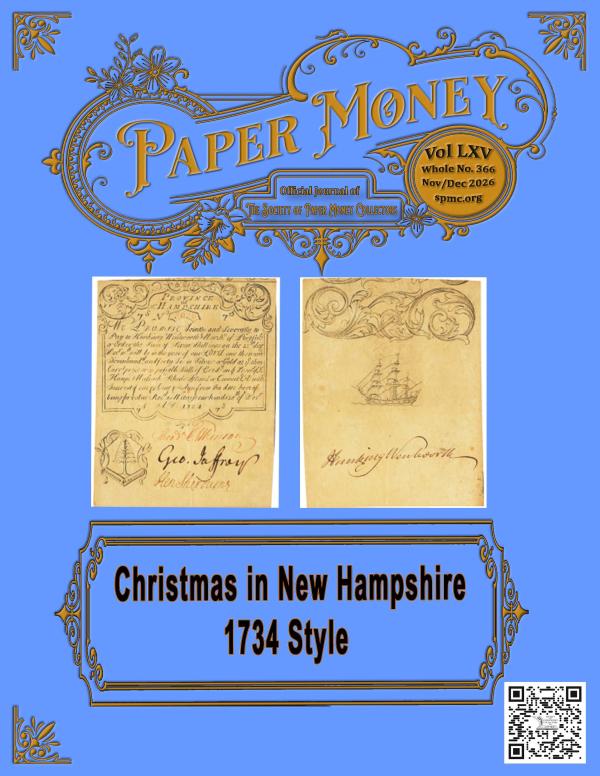
Table of Contents
For the Benefit of Trade--Alexander Georgiades
Provenances of the First Federal Notes--Peter Huntoon
Todays Treasured Collectibles--Jim Simek
Worrel Sisters Ad Notes--Rick Melamed
Series of 1882 $5 NB Replacement Notes--Ken Fritsch
John Reck-Juneau, AK Banker--Frank Clark
R. D. Mann--Charles Derby
National Bank Traveler--Marshall Mallory
P. T. Barnum--David Lewis
Elusive Ohio Obsolete--David Lewis
Nellie Cashman: The Angel of Tombstone--Rick Melamed
Statement of Ownership and Operations
Ofϐicial Journal of
Plan to Participate in Stack’s Bowers Galleries’
NOVEMBER 2026 U.S. CURRENCY
SHOWCASE AUCTION
LEGENDARY COLLECTIONS | LEGENDARY RESULTS | A LEGENDARY AUCTION FIRM
America’s Oldest and Most Accomplished
Rare Coin AuctioneerCosta Mesa • New York • Boston • Miami • Philadelphia • San Francisco
New Hampshire • Oklahoma • Hong Kong • Copenhagen • Paris • Vancouver
1550 Scenic Avenue, Suite. 150, Costa Mesa, CA 92626
949.253.0916 • Info@StacksBowers.com
470 Park Avenue, New York, NY 10022
212.582.2580 • NYC@StacksBowers.com
Visit Us Online at StacksBowers.com
SBG PapMon NovGS26 HLs 261101
Auction Dates:
November 16-20
Costa Mesa, CA
Whitman Expo
Lot Viewing:
November 10-13
Baltimore, MD
Peter A. Treglia
Vice President & Managing
Director of Currency
PTreglia@
StacksBowers.com
Tel: 949.748.4828
Michael Moczalla
Currency Specialist
MMoczalla@
StacksBowers.com
Tel: 949.503.6244
Contact Us For
More Information:
800.458.4646 California
800.566.2580 New York
Info@StacksBowers.com
Fr. 127. 1869 $20 Legal Tender Note.
PMG Gem Uncirculated 65 EPQ.
Fr. 248. 1896 $2 Silver Certificate.
PMG Gem Uncirculated 66 EPQ.
Fr. 378. 1891 $100 Treasury Note.
PMG Very Fine 25.
Fr. 2404*. 1928 $50 Gold Certificate Star Note.
PCGS Banknote Uncirculated 62.
Official
Auctioneer
of the
Whitman
Expos
Memphis, Tennessee. $100 1882 Brown Back.
Fr. 527. The NB of Commerce. Charter #5056.
PMG Choice Very Fine 35.
Breckenridge, Texas. $10 1929 Ty. 2.
Fr. 1801-2. First NB. Charter #14027.
PMG Extremely Fine 40.
Fr. 1960-J. 1934D $5/$10 Federal Reserve Note. Kansas City.
PMG Choice Uncirculated 64. Double Denomination Error.
354 For the Benefit of Trade--Alexander Georgiades
361 Provenances of the First Federal Notes--Peter Huntoon
374 Worrel Sisters Ad Notes--Rick Melamed
386 John Reck-Juneau, AK Banker--Frank Clark
388 R. D. Mann--Charles Derby
373 Todays Treasured Collectibles--Jim Simek
SPMC.org * Paper Money * Nov/Dec 2026 * Whole Number 366
349
396 P. T. Barnum--David Lewis
404 Nellie Cashman: The Angel of Tombstone--Rick Melamed
397 Elusive Ohio Obsolete--David Lewis
392 National Bank Traveler--Marshall Mallory
377 Series of 1882 $5 NB Replacement Notes--Ken Fritsch
416 Statement of Ownership and Operations
Columns
From Your President Robert Calderman 351
Benny Bolin 352
Frank Clark 353
Editor Sez
New Members
Uncoupled Joe Boling & Fred Schwan 398
Chump Change Loren Gatch 402
Cherry Pickers Corner Robert Calderman 405
Small Notes Jamie Yakes 409
Foreign Affairs Dennis Hengeveld 410
Postal Notes Bob Laub 412
Quartermaster Michael McNeil 414
Advertisers
Stacks Bowers Galleries IFC
Pierre Fricke 349
Polar Currency 359
Bill Lorman 360
Executive Currency 371
FCCB 376
Higgins Museum 385
Souvenir Card Soc. 387
PCDA IBC
Heritage Auctions OBC
SPMC Hall of Fame
The SPMC Hall of Fame recognizes and honors those individuals who
have made a lasting contribution to the society over the span of many years.
Charles Affleck
Walter Allan
Mark Anderson
Tom Bain
Doug Ball
Aubrey &
Adeline Bebee
Hank Bieciuk
George Blake
Joseph Boling
Q.David Bowers
F.C.C. Boyd
Wm. Bradbeer
Amon Carter, Jr
Forrest Daniel
C. John Ferreri
Milt Friedberg
Robert Friedberg
Len Glazer
Nathan Gold
Nathan Goldstein
Albert Grinnell
James Haxby
John Herzog
Gene Hessler
John Hickman
William Higgins
Ruth Hill
Peter Huntoon
Brent Hughes
Glenn Jackson
Glen Jorde
Don Kelly
Lyn Knight
Chet Krause
Robert Medlar
Allen Mincho
Clifford Mishler
Barbara Mueller
Judith Murphy
Eric Newman
Dean Oakes
Chuck O'Donnell
Albert Pick
Fred Reed
Matt Rothert
John Rowe III
Fred Schwan
Neil Shafer
Herb& Martha Schingoethe
Austin Sheheen, Jr.
Hugh Shull
Glenn Smedley
Raphael Thian
Daniel Valentine
Louis Van Belkum
George Wait
John & Nancy Wilson
D.C. Wismer
SPMC.org * Paper Money * Nov/Dec 2026 * Whole Number 366
Roy Pennell Michael Crabb
Martin Delger
William Donlon
Roger Durand
Officers & Appointees
ELECTED OFFICERS
PRESIDENT Robert Calderman
gacoins@earthlink.net
VICE-PRES William Litt
TREASURER Robert Moon
robertmoon@aol.com
BOARD OF GOVERNORS
APPOINTEES
PUBLISHER-EDITOR-ADVERTISING MANAGER
Benny Bolin smcbb@sbcglobal.net
MEMBERSHIP DIRECTOR
Frank Clark frank_clark@yahoo.com
IMMEDIATE PAST PRESIDENT
Robert Vandevender
WISMER BOOK PROJECT COORDINATOR
Pierre Fricke
From Your President
Robert CaldermanFrom Your President
Shawn Hewitt
We’re excited to announce the details of our second annual
Florida United Numismatists (FUN) Speakers Forum. In the fashion of our
inaugural seminar last year, we’ll again have a total of five speakers making
presentations, and close out the forum with our SPMC membership meeting on
Saturday morning.
The dates of the FUN convention are January 9-12, 2020 at the Orange
County Convention Center, West Building WA1 & WA2, in Orlando, Florida. The
first four talks are on Friday, January 10 in Room 304F (same as last year).
Here is the lineup… - "The Current
Status of the U. S. Small Size Paper Money Market". – Mr. Calderman, a
specialist and dealer in U. S. small-size type notes will discuss the current
trends in small size notes and the future of this paper money specialty.
- "A Behind the Scenes Look at the Paper
Money Auction Process"–Mr. Johnston, the Vice- President and Managing
Director of the Currency Division at Heritage Auctions will discuss the nuts-
and-bolts of conducting a major Paper Money auction.
"An Overview of the
Confederate Paper Money Market" .
Mr. Fricke has been a long-time dealer in Confederate Paper Money and is the
author of the standard reference on Confederate Paper Money "Collecting
Confederate Paper Money: The Standard Guide to Confederate Money".
"The good, the bad, and the ugly of
antebellum bank note fraud" – Various types of pre-Civil War bank note fraud
will be explored and illustrated.
In addition, at the SPMC Membership Meeting (open to all) on
Saturday at 8:30am in Room 303B we have: - "Overview
of the SPMC Bank Note History Project" - This project is focused on two of
the primary historical aspects of the "Hometown" National Bank Notes - the
Banks who issued them and the bankers who signed them.
I think we’re onto a good thing in making FUN another major venue for
the face of SPMC. Our table will be 867 in the club section of the bourse floor,
so please stop by. Again, this year, we are participating in the ANA Treasure
Trivia Program, which is a great outreach to the youth of our hobby. We have
some very nice world notes to hand out (to young numismatists) as souvenirs
for visiting our table.
Before I go, I should mention that we have a new Membership Secretary.
Robert Calderman, one of our board members, has stepped up to fill the position
recently vacated by Jeff Brueggeman. If you frequent the major shows, you
may have seen Robert at one of our club tables. Robert is great resource for the
Society, and we very much appreciate the work he does for us.
Paper Money * July/August 2020
6
Robert Calderman gacoins@earthlink.com
Matt Drais stockpicker12@aol.com
Mark Drengson markd@step1software.com
Loren Gatch lgatch@uco.edu
Shawn Hewitt Shawn@north-trek.com
Derek Higgins derekhiggins219@gmail.com
Raiden Honaker raidenhonaker8@gmail.com
William Litt
Cody Regennitter
billitt@aol.com
Andrew Timme
Wendell Wolka
derekhiggins219@gmail.com
SECRETARY Derek Higgins
billitt@aol.com
purduenut@aol.com
cody.regenitter@gmail.com
We have now officially surpassed 365 issues of Paper Money Magazine, the
official Journal of the Society of Paper Money Collectors! How exciting is this! In
1961 during the inception of the SPMC and then beginning in 1962 when our
journal was first printed for its inaugural release, I anticipate that the founders of
our society never could have imagined we could come so far as to now be offering
our 366th issue! Very soon 2027 will begin. Will you commit yourself to
downloading the PDF of our very first issue from our SPMC website and reading
one full issue per day for the next 365 days? That would be quite the
accomplishment! Maybe two issues per week would be more practical? That will
only take 3.5 years to complete! Or, how about one issue a week over the next
seven years!!! This only goes to show that the incredible volume of history and
intriguing paper money content available at your disposal is an outstanding bargain
at our current membership rates! Not to mention, the Huntoon-Shiva National Bank
Note Encyclopedia, Bank Note History Project, and so many other benefits too
numerous to mention here. In fact, a brand new benefit has officially been added to
our SPMC educational menagerie. The Paper Money Forum
www.papermoneyforum.com has been very generously donated to our
organization! John Burris established this platform over ten years ago and he has
made the very kind decision to transfer ownership of the website URL, hosting
account, and arc ived content to the SPMC. I wholeheartedly
want to express my sincere appreciation that J hn’s desire to see the PMF thrive
and prosper i to the future by utilizing the SPMC to allow the forum to become
bigger than himself is spectacular! Thank you Mr. Burris! While this transition was
taking place, quietly behind th scenes, a very special SPMC life member David
Helfman made th decision to donate $1,000.00 to the SPMC to provide 1-Year
new online memberships to “Fifty” Paper Money Forum members that have not yet
become SPMC members!
Wow, this is another incredibly generous act of kindness made selflessly with the
only goal being a genuine effort to grow our hobby! As I gently butter you up and
hopefully make you feel even more proud to be a current member of the SPMC
than you already are, let me take a moment to bring something to your attention. It
has been over thirteen years since our SPMC membership rates have changed!
Substantially longer than 13yrs for our advertising rates! It should come as no
surprise to you that both the cost of printing and postage have not stayed anywhere
near the same over this lengthy period of time. While we are not focused as a
money making enterprise, nor do we desire to be, we cannot be a money losing
organization at an unsustainable level! If you are not currently a Life-Member, now
is your opportunity to upgrade your membership before we increase our rates! If
you have the means and generosity and you are willing to make a donation to the
SPMC, this is your call to action. The Society of
Paper Money Collectors promotes the study and appreciation of paper money and
related financial history. Help us to continue this effort far into the future. Your
generous donation large or small will help to ensure both the health and longevity
of our educational organization. Please think of the SPMC when evaluating your
quarterly, annual, and future estate donation planning. Consider consulting both
your financial planner and tax professional and inquire about available: DAF, CRT,
and CLT programs! You are very much appreciated in advance! And as always, if
you make it to an upcoming show, please stop by my table and say hello.
SPMC.org * Paper Money * Nov/Dec 2026 * Whole Number 366
351
Terms and Conditions
The Society of Paper Money Collectors (SPMC) P.O. Box 7055,
Gainesville, GA 30504, publishes PAPER MONEY (USPS 00‐
3162) every other month beginning in January. Periodical
postage is paid at Hanover, PA. Postmaster send address
changes to Secretary Robert Calderman, Box 7055, Gainesville,
GA 30504. ©Society of Paper Money Collectors, Inc. 2020. All
rights reserved. Reproduction of any article in whole or part
without written approval is prohibited. Individual copies of this
issue of PAPER MONEY are available from the secretary for $8
postpaid. Send changes of address, inquiries concerning non ‐
delivery and requests for additional copies of this issue to
the secretary.
MANUSCRIPTS
Manuscripts not under consideration elsewhere and
publications for review should be sent to the editor. Accepted
manuscripts will be published as soon as possible, however
publication in a specific issue cannot be guaranteed. Opinions
expressed by authors do not necessarily reflect those of the
SPMC. Manuscripts should be submitted in WORD format via
email (smcbb@sbcglobal.net) or by sending memory stick/disk
to the editor. Scans should be grayscale or color JPEGs at
300 dpi. Color illustrations may be changed to grayscale at the
discretion of the editor. Do not send items of value.
Manuscripts are submitted with copyright release of the author
to the editor for duplication and printing as needed.
ADVERTISING
All advertising on space available basis. Copy/correspondence
should be sent to editor.
All advertising is pay in advance. Ads are on a “good faith”
basis. Terms are “Until Forbid.”
Ads are Run of Press (ROP) unless accepted on a premium
contract basis. Limited premium space/rates available.
To keep rates to a minimum, all advertising must be prepaid
according to the schedule below. In exceptional cases where
special artwork or additional production is required, the
advertiser will be notified and billed accordingly. Rates are
not commissionable; proofs are not supplied. SPMC does not
endorse any company, dealer, or auction house. Advertising
Deadline: Subject to space availability, copy must be received
by the editor no later than the first day of the month
preceding the cover date of the issue (i.e. Feb. 1 for the
March/April issue). Camera‐ready art or electronic ads in pdf
format are required.
ADVERTISING RATES
Editor Sez
Benny Bolin
Required file submission format is composite PDF v1.3
(Acrobat 4.0 compatible). If possible, submitted files should
conform to ISO 15930‐1: 2001 PDF/X‐1a file format standard.
Non‐ standard, application, or native file formats are not
acceptable. Page size: must conform to specified publication
trim size. Page bleed: must extend minimum 1/8” beyond
trim for page head, foot, and front. Safety margin: type and
other non‐bleed content must clear trim by minimum 1/2”.
Advertising c o p y shall be restricted to paper currency, allied
numismatic material, publications, and related accessories.
The SPMC does not guarantee advertisements, but accepts
copy in good faith, reserving the right to reject objectionable
or inappropriate material or edit copy. The SPMC
assumes no financial responsibility for typographical
errors in ads but agrees to reprint that portion of an ad in
which a typographical error occurs. Benny (aka PeePaw) alias Goompa
Space
Full color covers
1 Time
$1500
3 Times
$2600
6 Times
$4900
B&W covers 500 1400 2500
Full page color 500 1500 3000
Full page B&W 360 1000 1800
Half‐page B&W 180 500 900
Quarter‐page B&W 90 250 450
Eighth‐page B&W 45 125 225
She changed my name! Yes, Goompa is now a thing of the past it
seems and has been replaced with PeePaw. She is really developing
her own personality. She is entering those terrible twos, but not too
bad as yet. For a look into our future, just look at those eyes. Talk
about giving you the stink eye--it is to come!
Till next time! Look out for those school zones and don't drive and text!
It seems that Texas is still breaking records--67 days with no
rain and 52 days above 100! And the Cowboys broke a record
too--first team in 51 years to lose at home to an 0-4 team. Not
sure if we should be proud of any of those.
But, I have had a good summer numismatically. I won two
fractional currency look-a-likes in an auction and then I made a
snap decision to go to Pittsburgh for the ANA. Good choice on
my part except that I opted to go from the airport to the
convention center, but when it was time to go to my hotel, the
staff told me it was a 10-15 minute walk. Well, a short walk to
younger people is a loooooong walk for us more mature
people. 45 mins later I got to my hotel with aching knees, hips
and feet! Uber the rest of the time. The ANA was good--good
crowds and a seemingly high enthusiastic level. I was able to
buy all the dimes I needed for my 2027 exhibit, saw all eleven
1933 $20 Saint Gaudens, talked to a lot of people and had an
overall good time. I did venture into the unknown. I have
always wanted some Swedish plate money and a more mature
dealer there was selling a lot of his inventory including one
piece. He said some people said it was a highly polished
(which it was) fake but others said it was genuine. My go-to
expert, Mark Anderson said it was real and that is good enough
for me. Also at the show, our very own odd couple--Joe Boling
and Fred Schwan won the NLG award for best world paper
money column! Congrats to both!
When I got home, I had the privilege to assist Heritage with
cataloging the William George fractional currency collection.
This collection consisted of over 400 pieces of fractional. It
was heavy in courtesy autographed notes (I got two Clark ones
that I did not have). That was a lot of fun and a great time.
Now it is getting my exhibit ready for FUN. Besides the
fractional invert, I have added two more cases of other
fractional currency errors. Interestingly, the theme this year is
errors & varities.
Please note that around Nov 10 or so, our annual writers
contest will begin. We award prizes for the best book and
articles that appeared in 2026 Paper Money including this one.
SPMC.org * Paper Money * Nov/Dec 2026 * Whole Number 366
352
The Society of Paper Money
Collectors was organized in 1961 and
incorporated in 1964 as a non-profit
organization under the laws of the
District of Columbia. It is
affiliated with the ANA. The
Annual Meeting of the SPMC is
held in June at the International
Paper Money Show. Information
about the SPMC, including the
by-laws and activities can be
found at our website--
www.spmc.org. The SPMC does
not does not endorse any dealer,
company or auction house.
MEMBERSHIP—REGULAR and
LIFE. Applicants must be at least 18
years of age and of good moral
character. Members of the ANA or
other recognized numismatic
societies are eligible for membership.
Other applicants should be sponsored
by an SPMC member or provide
suitable references.
MEMBERSHIP—JUNIOR.
Applicants for Junior membership
must be from 12 to 17 years of age
and of good moral character. A parent
or guardian must sign their
application. Junior membership
numbers will be preceded by the letter
“j” which will be removed upon
notification to the secretary that the
member has reached 18 years of age.
Junior members are not eligible to
hold office or vote.
DUES—Annual dues are $39. Dues
for members in Canada and Mexico
are $45. Dues for members in all
other countries are $60. Life
membership—payable in installments
within one year is $800 for U.S.; $900
for Canada and Mexico and $1000
for all other countries. The Society
no longer issues annual membership
cards but paid up members may
request one from the membership
director with an SASE.
Memberships for all members who
joined the Society prior to January
2010 are on a calendar year basis
with renewals due each December.
Memberships for those who joined
since January 2010 are on an annual
basis beginning and ending the
month joined. All renewals are due
before the expiration date, which can
be found on the label of Paper
Money. Renewals may be done via
the Society website www.spmc.org
or by check/money order sent to the
secretary.
WELCOME TO OUR
NEW MEMBERS!
BY FRANK CLARK
SPMC MEMBERSHIP DIRECTOR
NEW MEMBERS 09/05/2026
Dues Remittal
R
obert Moon --SPMC Treasurer
Process
Send dues
directly to
403 Gatewood Dr. Greenwood, SC 29646
You may also pay your dues online at www.spmc.org.
16114 J Stephen Pitard, Website
16115 Peter Cardone, Frank Clark
16116 Andrew Hill, Website
16117 Michael Vine, Frank Clark
16118 Sam Ackerman, Website
16119 Ali Chaudhry, Rbrt Calderman
16120 Glen Ridgway, Derek Higgins
16121 Jennifer Doesburg, Website
16122 David Hines, Website
16123 Miller Haerr, Derek Higgins
16124 Reuel Schlarb, Polar Currency
16125 Fred Geissler, Mark Anderson
16126 Travis Bolton. Rbrt Calderman
16127 Randy Daniel, Website
REINSTATEMENTS
None
LIFE MEMBERSHIPS
LM490 Al Louis, Frank Clark
LM491 formerly PM15900
NEW MEMBERS 10/05/2026
16128 Steve Peterson, Website
16129 Paul Mole, Website
16130 Steve Blumberg, Website
16131 Jordan Kaplan, Website
16132J Andrew Alexandroff, Rbrt Calderman
16133 Stanislav Schwarzuhr, Website
16134 Douglas Sleep, PMCM
16135 Orton Cowles, PMCM
16136 Scott Barnes, PMCM
16137 Jan Messineo, PMCM
16138 William R. Nettles Jr., PMCM
16139 David Lincoln, Website
16140 George Brooks, Robert Calderman
16141 Joseph Pawluk, Website
16142 Gary Gendreau, Polar Currency
16143J James Angle,Website
16144 Mark Sanford, John Patrick
16145 Jonathan Jenkins, Website
16146 Steven Kirk, Website
16147 David Perkins, Frank Clark
16148 Andrew Newman, John Patrick
16149 Marc Lane, Frank Clark
16150 Peter Aa, Website
16151 Adriane Mercedez, Frank Clark
REINSTATEMENTS
14884 Tommy McDowell, Robert Calderman
LIFE MEMBERSHIPS
LM492 Robert Brown, Website
LM493 Noah Alpert, Robert Calderman
SPMC.org * Paper Money * Nov/Dec 2026 * Whole Number 366
353
For the Benefit of Trade:
New Hampshire's Christmas Day Money of 1734
By Alexander H. Georgiades
December 25, 1734 is not a date one expects to find on colonial American paper money. Yet Christmas Day
appears prominently on one of New England's more unusual monetary experiments, a series of privately sponsored
New Hampshire notes whose surviving examples look unlike most provincial currency of the period. Tall and narrow,
engraved on both sides, and authenticated by multiple handwritten signatures, the notes also bore interest at one
percent per year.1
Christmas appears twice in the obligation. The series is cataloged as December 25, 1734, and the seven-shilling
note illustrated here is executed on that date. Payment was promised twelve years later, on December 25, 1746. A
10-shilling example transcribed by monetary historian Andrew McFarland Davis promises payment to Portsmouth
merchant Hunking Wentworth, or his order, in silver or gold at the price then current or in acceptable bills of credit
from New Hampshire, Massachusetts, Rhode Island, or Connecticut, together with interest of one percent per year.1
Not every documented note was executed on Christmas Day, however. Davis's transcription of that 10-shilling
note records its handwritten attestation as December 26, 1734. The difference is small but important: December 25
was the common date associated with the series and the fixed maturity date, while at least one documented example
was signed the following day.1
That one-day difference is easy to overlook, but it keeps the holiday hook from becoming a scene the evidence
cannot support. We cannot say that the participating merchants gathered on Christmas Day to sign the issue, or that
every note was completed then. What the paper establishes is narrower: December 25 appears on documented
examples and in the redemption promise, while individual execution extended at least into December 26.1
These were not bills of credit issued by the Province of New Hampshire and no act of the legislature made them
legal tender. Contemporary records nevertheless describe them as notes intended to circulate in payment, which is
why Massachusetts moved to prohibit their receipt and why the Board of Trade later discussed their circulation. That
distinction between private obligation and circulating medium sits at the center of their story.
New Hampshire in the early 1730s faced a documented shortage of money. The Board of Trade later described
the province as having "very little Mony" and only a small paper currency authorized by the legislature.1
Massachusetts and New Hampshire were also restrained by royal instructions in their ability to emit bills, while
Figure 1. December 25, 1734, seven-shilling Portsmouth merchants'
note, Fr. NH-38.4, serial no. 3636. The face shows the distinctive
vertical format, engraved contractual obligation, pine-tree device,
BENEFICIO COMMERCI motto, and three handwritten signatures.
Image: Heritage Auctions, HA.com, Eric P. Newman Collection Part
VIII, lot 28052.6
SPMC.org * Paper Money * Nov/Dec 2026 * Whole Number 366
354
Rhode Island retained broader freedom and its paper entered Massachusetts commerce. Boston merchants responded
in 1733 with their own circulating notes; the Portsmouth experiment followed in 1734.8
Portsmouth's riverfront setting is worth keeping in view. Joseph F. W. Des Barres's 1780 view, made forty-six
years after the merchants' notes, shows the town from across the Piscataqua with vessels on the river. It does not
depict Portsmouth in 1734, but it provides useful context for the port community in which the experiment arose.10
The surviving New Hampshire notes state the solution plainly. Their makers promised "jointly and severally" to
pay Hunking Wentworth, a Portsmouth merchant, or his order.1 That phrase was not legal boilerplate of little
consequence. It meant that the credit behind the instrument rested on identifiable individuals who had placed their
names on the obligation.
On surviving examples, three handwritten signatures appear on the face. Eric P. Newman recorded Theodore
Atkinson, John Downing Jr., George Jaffrey, Joshua Peirce, John Rindge, Henry Sherburne, Samuel Smith and
Andrew Wiggin among the men who signed notes in the series. Hunking Wentworth then endorsed the reverse before
circulation.2,3
A 10-shilling note sold by Spink illustrates how those combinations varied. Serial no. 4448 is signed by George
Jaffrey, Henry Sherburne, and Joshua Peirce. Another 10-shilling note, serial no. 1727, bears the names of Samuel
Smith, Andrew Wiggin, and John Downing Jr. Hunking Wentworth signed the backs of both.4
This was therefore not anonymous paper. A person accepting one could read the names of the men standing
behind it. That mattered because there was no provincial treasury promising redemption.
When the controversy eventually reached imperial authorities, the British Board of Trade described the
participants as people of substantial estates and standing in New Hampshire. More importantly, the Board explained
the mechanism with unusual clarity. No person was obliged to receive the notes, it observed. Their acceptance
depended on the credit of the signers. They would, in the Board's formulation, "stand or fall according to the Credit
of the Signers."1
The physical notes reinforced the point. Collectors usually call them "Tall Bills," an apt description of their
vertical proportions. Heritage describes the issue as printed on two sides on laid paper from engraved copper plates.
The contractual text occupies much of the face inside an ornamental frame. Near the bottom is a pine-tree device
carrying the motto BENEFICIO COMMERCI, commonly translated as "for the benefit of trade." The reverse carries
additional ornament and a sailing vessel.5,6
The motifs invite interpretation, but the surviving sources located for this article do not explain why the pine
tree and ship were selected. Their presence can be described with confidence; assigning a more specific political or
commercial symbolism would go beyond the evidence. The motto, by contrast, states the issue's commercial claim
directly: BENEFICIO COMMERCI," for the benefit of trade."
Figure 2. Portsmouth from across the Piscataqua
River, 1780, Joseph F. W. Des Barres. The view
postdates the merchants' notes by forty-six years
and is included for maritime context, not as a
depiction of Portsmouth in 1734. Library of
Congress, Geography and Map Division; no
known restrictions on publication.10
SPMC.org * Paper Money * Nov/Dec 2026 * Whole Number 366
355
The denomination structure looks straightforward until the surviving record is examined closely. Standard
numismatic references have listed 1 shilling, 2 shillings, 5 shillings, 7 shillings and 10 shillings.2,3 The 5-shilling
value, however, is a warning against treating catalog listings as proof of production. Heritage, describing the Eric P.
Newman 2-shilling example, noted that the 5-shilling denomination was unreported in issued form and was
considered possibly never printed.5
That distinction deserves emphasis. A proposed or listed denomination is not the same thing as a documented
circulating note. The surviving record securely establishes other values, including the 1-, 2-, 7- and 10-shilling notes,
but does not presently justify saying that an issued 5-shilling note is known.
The total size of the scheme poses a similar problem. During the later London proceedings, New Hampshire
agent John Thomlinson described the amount involved as approximately £6,000 sterling.1 That is useful
contemporary evidence for the scale of the association, but it is not a surviving printer's account showing exactly how
many pieces were produced, signed or released. An approximate financial figure should not be converted into a
precise printing total. The obligation printed on the notes provides firmer ground.
Davis's 10-shilling transcription promises redemption in silver or gold at the then-current price, or in "passable Bills
of Credit" of New Hampshire, Massachusetts, Rhode Island, or Connecticut, with interest at one percent per annum.1
The Massachusetts prohibition described the scheme more broadly, mentioning silver, gold, hemp, or colonial bills
and referring to their future Portsmouth value in 1747.1,7 That description does not match the surviving 10-shilling
wording in every detail: Davis's note specifies December 25, 1746, and does not mention hemp. A later Ford catalog
Figure 3. Reverse of the seven-shilling note in
Figure 1. The engraved sailing ship occupies the
center of the reverse, with Hunking Wentworth's
endorsement below. Image: Heritage Auctions,
HA.com, Eric P. Newman Collection Part VIII,
lot 28052.6
Figure 4. Enlarged detail of the seven-shilling
note showing the handwritten execution line,
the pine-tree device and BENEFICIO
COMMERCI motto, and the three signatures.
The execution line on this specimen reads
"25th of Dec." Image: Heritage Auctions,
HA.com, lot 28052.6
SPMC.org * Paper Money * Nov/Dec 2026 * Whole Number 366
356
described a supporting fund tied to hemp, iron, and other products, but I have not located surviving association records
that establish such a fund.9
The safest interpretation is therefore narrower. The surviving notes unquestionably contain joint and several
promises by their makers, specify several possible media of payment, and promise one percent annual interest. Any
stronger claim about a formal commodity reserve should be identified as later catalog interpretation unless additional
primary documentation is found.
The one-percent annual interest provision was part of the contractual promise printed on the notes. Contemporary
records also show that the paper was being offered for circulation well before its twelve-year maturity. The face tells
the holder what was promised at maturity; whether the note would pass in 1735 depended on voluntary acceptance,
a point the Board of Trade later emphasized.1
Davis knew the documentary problem well. When he revisited the notes in 1913, he explained that the history
of the organization had been unusually resistant to reconstruction. Searches had failed to uncover the association's
internal papers. Then came an interesting discovery. Barrett Wendell acquired an old Portsmouth house in which
approximately fifty or sixty of the notes were reportedly found together. Yet no associated records explaining the
organization accompanied them.1
For collectors today, that discovery is useful but limited. It tells us that a substantial group survived together into
the twentieth century. It does not tell us how many notes originally circulated, how many were redeemed or destroyed,
or how many distinct examples survive today.
The notes did not have to wait twelve years to encounter trouble. On March 25, 1735, 198 Boston merchants
reportedly agreed not to receive the New Hampshire paper.3 Within weeks, Massachusetts enacted "An Act to prevent
the Currency of certain Bills or Notes of Hand" issued by the New Hampshire association. The act was passed and
published April 18, and the General Court also voted that the governor issue a proclamation warning inhabitants
against taking the notes.1,7
The statute objected to notes it characterized as payable years in the future in colonial bills, specie, or hemp at a
future Portsmouth price, warning that holders could suffer by accepting them. More broadly, the notes were intended
for circulation: the law itself referred to their being uttered and received, and Francis Wilks later complained that
their promoters had attempted to introduce them into currency in Massachusetts.1,7
Belcher made that point explicitly. Addressing the New Hampshire legislature on May 3, 1735, he condemned
what he called an attempt by private gentlemen to issue paper notes or bills "to pass in lieu of money."1 New
Hampshire's House answered with a different definition. Its members said they could not see why the activity was
inherently improper unless fraud could be shown, and argued that royal restrictions on provincial bills should not
automatically prohibit "negotiable Notes amongst merchants and Traders."1 The exchange exposed the central legal
question: did restrictions aimed at government bills of credit also reach privately issued negotiable paper?
Belcher continued attacking the Portsmouth project and later reported complaints from people allegedly injured
by the notes. He also claimed that some of those principally involved had refused to give credit for their own paper.1
The accusation belongs in the history, but it should remain exactly that, an allegation made by an active opponent. It
does not establish that every signer refused his obligations or that the scheme itself was fraudulent.
The quarrel eventually moved from New England to London. In March 1736, the Board of Trade considered
Massachusetts's prohibition after hearing from colonial representatives and merchants. Its report began not with an
abstract theory of banking, but with New Hampshire's practical problem: the province had very little money and only
a limited supply of legislatively authorized paper.1
The Board's recommendation went to the heart of the issue. The Portsmouth notes had "no Currency in Law,"
and no one was obliged to accept them. They were left to "stand or fall according to the Credit of the Signers" and
could be "taken or refused at pleasure." The Board concluded that Massachusetts's prohibition placed an unwarranted
public mark of discredit on the participants and recommended that the act be laid before the king for disallowance.1
That recommendation should not be confused with proof of a final royal repeal. Davis noted that by September
1736 the Board had told Belcher the act had been laid before the king for disallowance, but he added that no further
official action had been discovered in the records he examined. A 1741 polemical letter later claimed that the law had
been abrogated, but that statement does not rest on the same evidentiary footing as an official order.1
This makes the Portsmouth notes unusually revealing pieces of paper. They circulated near the boundary
between two categories that collectors often separate neatly: currency and promissory note. Legally, they belonged
firmly to the latter. Economically, their makers hoped they would behave like the former.
SPMC.org * Paper Money * Nov/Dec 2026 * Whole Number 366
357
The design gave the notes features associated with circulating paper: standardized denominations, engraved
plates, serial numbers, repeated layouts, multiple signatures, and a printed reverse. Heritage describes Hunking
Wentworth as countersigning the back below the ship vignette.6
Taken together, the standardized denominations, engraved plates, serial numbers, signatures, and printed
reverses made these repeatable instruments rather than one-off handwritten obligations. That is visible especially well
on the better-preserved survivors. The Newman 2-shilling note sold by Heritage in 2015 retains the ornamental
framework, pine-tree device and reverse sailing ship with unusual clarity. Heritage described it as printed from well-
engraved copper plates on laid paper and noted both the three face signatures and Wentworth's endorsement on the
reverse.5 A 7-shilling Newman example sold in 2017 shows the same basic architecture in a different denomination.6
Auction appearances, of course, are not a census. The reappearance of particular notes in named collections or
sales can document individual specimens and their provenance, but it cannot by itself establish the surviving
population. This is especially important with an issue for which a group of fifty or sixty notes was reportedly
discovered together more than a century ago.
The December dating is not uniform across the documentary examples. The seven-shilling Heritage specimen
illustrated here ends with "25th of Dec." Davis's 1913 transcription of a separate 10-shilling example, by contrast,
records December 26 and identifies Samuel Smith, Andrew Wiggin and John Downing Jr. as the signers.1
That difference is more useful than a generalized claim that the notes were all signed on Christmas Day. It
establishes at least two documented execution dates, December 25 and December 26, but does not tell us why.
Whether the difference reflects separate signing sessions, the pace at which particular notes were completed, or
simply the circumstances of individual pieces remains unanswered. For a collector, the handwritten date therefore
deserves the same attention as the serial number and signer combination. The Christmas connection is genuine, but
it is best understood through the surviving paper rather than through a reconstructed holiday scene.1,6
The motto beneath the pine tree claimed the experiment was BENEFICIO COMMERCI, for the benefit of trade.
Within three months, 198 Boston merchants had reportedly agreed to reject the paper; Massachusetts then prohibited
its circulation; Belcher denounced it; and the New Hampshire House defended such instruments as negotiable notes
among merchants and traders. The Board of Trade later recommended disallowance of the Massachusetts law,
reasoning that the notes had no legal currency and could be taken or refused at pleasure.1,3
A provincial government could issue bills under statutory authority and make them receivable on terms set by
law, subject in New Hampshire's case to royal restrictions. The Portsmouth association had no comparable public
authority. Its members instead relied on recognizable denominations, engraved plates, serial numbers, interest,
multiple signatures, a named payee, and private promises.1,8
Nearly three centuries later, the mechanism remains visible in documented issued examples. The illustrated
seven-shilling note is a private promise carrying three signatures on the face and Hunking Wentworth's endorsement
on the reverse; the New Hampshire government is not the obligor.
The December 25 date, unusual shape, pine tree, and sailing ship make the series memorable. More important
is the mechanism documented in contemporary records: private credit offered for circulation as payment. In 1736 the
Board of Trade wrote that the notes would "stand or fall according to the Credit of the Signers." Beneath the pine
tree, their makers put it more compactly: BENEFICIO COMMERCI, for the benefit of trade.1
Figure 5. Detail of the handwritten execution line on the Heritage seven-shilling specimen: "as Witness our hands
25th of Dec. A.D. 1734." Davis transcribed a different 10-shilling example as dated December 26, evidence that
individual execution did not necessarily occur on a single day. Image: Heritage Auctions, HA.com, lot 28052.1,6
SPMC.org * Paper Money * Nov/Dec 2026 * Whole Number 366
358
References
1. Davis, Andrew McFarland. “New Hampshire Merchants’ Notes, 1734–1735.” In Publications of the Colonial Society of Massachusetts,
vol. 14, Transactions, 1911–1913. Boston: Colonial Society of Massachusetts, 1913. https://www.colonialsociety.org/node/294
2. Newman, Eric P. The Early Paper Money of America. 5th ed. Iola, WI: Krause Publications, 2008. Digitized by Newman Numismatic
Portal. https://nnp.wustl.edu/library/book/523311
3. Newman Numismatic Portal. “Early Paper Money of America: New Hampshire, 1734 December 25 Merchants’ Notes.” Washington
University in St. Louis. Accessed October 9, 2026. https://nnp.wustl.edu/library/imagecollection/514968
4. Spink. “New Hampshire. Province of New Hampshire. December 25, 1734. 10 Shillings.” Numismatic Collector’s Series Sale 314, lot
126. Accessed October 9, 2026. https://spink.com/lot/314126. See also lot 127: https://spink.com/lot/314127
5. Heritage Auctions. “Province of New Hampshire December 25, 1734 Portsmouth Merchants’ Note 2 Shillings, Fr. NH-38.2.” Eric P.
Newman Collection Part VII, lot 18110, October 21, 2015. https://currency.ha.com/itm/colonial-notes/new-hampshire/province-of-new-
hampshire-december-25-1734-portsmouth-merchants-s-note-2-shillings-fr-nh-382-pcgs-choice-about-new-58ppq/a/3539-18110.s
6. Heritage Auctions. “Province of New Hampshire December 25, 1734 Portsmouth Merchants’ Note 7 Shillings, Fr. NH-38.4, PCGS About
New 53.” Eric P. Newman Collection Part VIII, lot 28052, November 1, 2017. https://currency.ha.com/itm/colonial-notes/new-
hampshire/province-of-new-hampshire-december-25-1734-portsmouth-merchants-s-note-7-shillings-fr-nh-384-pcgs-about-new-
53/a/3547-28052.s
7. Massachusetts. “An Act to Prevent the Currency of Certain Bills or Notes of Hand Emitted by a Society or Number of Persons in the
Province of New Hampshire.” 1734–35, chap. 21. Acts and Resolves Passed by the General Court. Boston: Secretary of the
Commonwealth. Massachusetts Archives Digital Repository. https://archives.lib.state.ma.us/entities/archivalmaterial/a8a5a137-49b3-
4312-a09b-61a589f08970
8. Davis, Andrew McFarland. “Curious Features of Some of the Early Notes or Bills Used as a Circulating Medium in Massachusetts.” Paper
read March 23, 1905. Publications of the Colonial Society of Massachusetts. https://www.colonialsociety.org/node/509
9. Stack’s Bowers Galleries. The John J. Ford, Jr. Collection, Part VIII. New York, January 18–19, 2005. New Hampshire Merchants’ Notes
section, including the catalog’s discussion of a fund tied to hemp, iron, and other products.
https://media.stacksbowers.com/VirtualCatalogs/CatalogLibrary/johnjfordjrcolle0008stac.pdf
10. Des Barres, Joseph F. W. “View of Portsmouth, New Hampshire from across the Piscataqua River.” 1780. Aquatint and etching. Library
of Congress, Geography and Map Division. https://www.loc.gov/item/2004671484/.
SPMC.org * Paper Money * Nov/Dec 2026 * Whole Number 366
359
Provenances of the
First of the Federal Notes
Intended for General Circulation
Purpose
The objective of this article is to reconstruct as best as possible the provenances of the three number
1 notes saved by Civil War Secretary of the Treasury Salmon P. Chase from the first three classes of
currency issued by the U. S. Treasury that were intended for general circulation. These were:
● $10 Demand Note, Act of July 17, 1861, serial number 1, plate position A.
● $1 Legal Tender Note, Act of July 11, 1862, series 1, serial number 1, plate position A.
● $5 National Bank Note, Act of February 25, 1863, Original Series, The First National Bank of Washington,
DC, Treasury sheet serial 9, bank sheet serial 1, plate position D.
Introduction
Secretary Chase was appointed by President Lincoln, assumed office on March 7, 1861, and served in
that capacity until June 30, 1864. The Civil War began April 12, 1861 with the Confederate bombardment
The Paper
Column
Peter Huntoon
Figure 1. Number 1 $10 1861 demand note, the first Federal note issued by the U.S. Treasury that was designed
to circulate as money, a note saved by Civil War Secretary of the Treasury Salmon P. Chase under whose
administration it was issued. Heritage Auctions archive photo.
SPMC.org * Paper Money * Nov/Dec 2026 * Whole Number 366
361
of Ft. Sumter, South Carolina. Chase
shepherded the all but bankrupt U.S. Treasury
through the war. His success in doing so was a
major contributor to the Union success but
relied on deficit spending, heavy borrowing,
and the creation of significant national debt.
Part of that debt was the creation of the first
currencies issued by the U.S. Treasury
designed for general circulation. The currency
was fiat money in the form of circulating debt
instruments (demand notes and legal tender
notes) and national bank notes redeemable in
fiat legal tender notes. Chase saved the first
note of each. As such, they rank historically as
the most important U.S. notes ever printed.
Although we know that Chase saved these
three notes, the record of their ownership
beyond him is fragmentary and some of it for
the $10 demand note and $5 national bank note
fabricated by John J. Ford, of New Netherlands
Coin Co. The pitfalls in the lineages will be
documented and speculations avoided or
clearly flagged. There are gaps we have to live
with.
Salmon Portland Chase: Father of U.S. Federal Currency
The first circulating Federal currency consisted of demand notes authorized by the Act of July 17,
1861. Demand notes were circulating promissory notes but they became as good as gold because Secretary
Chase proclaimed in a Treasury circular that they would be redeemable in gold, which meant that the
Treasury would accept them in payment for customs taxes that by law had to be paid in gold. Of course,
the Treasury then did everything it could to remove them from circulation by replacing them with legal
tender notes when the legals came along.
The next class to come down the pike was legal tender currency authorized by the Act of July 11,
1862. Those notes were nothing more than circulating Federal debt instruments promising to pay the bearer
a dollar of unspecified value at some unspecified future date. Their charm was that Congress declared them
to be legal tender so everyone had to live with them, but during the Civil War they were discounted sharply
against gold and their abundance led to high inflation.
The third type to arrive on the scene was national bank currency authorized by the Act of February
25, 1863. Nationals also were fiat currency redeemable in legal tender notes, but the authorizing legislation
had provisions that guaranteed that note holders would be able to redeem them even if the issuing bank
failed. Consequently, they circulated although they were heavily discounted against gold identically to the
legal tender currency into which they were convertible.
These issues represented means and schemes floated by Chase and his patriotic allies in Congress
to help provide the Treasury with sufficient liquidity that it could pay the costs of executing the Civil War,
which averaged $2 million per day.
Chase was a staunch abolitionist and man of stellar integrity who possessed enormous ambition,
drive, intellect and ego. He used his talents to guide the Treasury through the shoals of the Civil War and it
appeared at times that the force of his personality alone saved the Union government from financial
collapse.
He had the ability to forge advantageous working alliances with movers and shakers in politics and
finance. One key ally and friend was financier Jay Cooke in Philadelphia. Jay Cooke and Co. successfully
mass marketed small denomination Federal Civil War bonds to the public appealing that it was citizen’s
Figure 2. Salmon P. Chase was President Lincoln’s Civil
War Secretary of the Treasury. Library of Congress photo.
SPMC.org * Paper Money * Nov/Dec 2026 * Whole Number 366
362
patriotic duty to buy them. Cooke went on to found The First National
Bank of Philadelphia, charter 1. The fact that his bank received charter 1
was not a coincidence.
The Treasury never forgot Chase’s leadership during those dark
days and rewarded his memory by first placing his portrait on $10,000
Federal Reserve notes in 1918 and next on small size $10,000 gold
certificates. Of course, he beat them to it by having his portrait placed on
the $1 1862 legals so everyone could get a glimpse of him as he aspired
to become President.
In fact, Chase was a candidate for the Presidency in 1860 when
Lincoln ran the first time but Lincoln edged him out. Lincoln then kept
political peace by appointing him to his cabinet–the team of rivals–as
Secretary of the Treasury.
As Lincoln was coming up for reelection in 1864, he cagily
shunted Chase aside politically by appointing him Chief Justice of the
Supreme Court. That prestigious plumb life-time position was so good,
Chase couldn’t turn him down.
Ironically, Chase then went on to lead the court majority in
declaring the legal tender act of 1862 unconstitutional in December 1869,
a finding that was overturned in May 1871 by a more compliant court
thanks to the timely appointment of two new justices by President Grant.
At that juncture, Chase wrote the dissenting opinion affirming the court’s
earlier stance.
Thus, the legal tender notes survived, were reissued when worn out, and comprise the red seal small
size notes in your collections, and the unpaid outstanding Civil War debt that they represent. The Treasury
and nation thank you for the patriotism you exhibit by squirreling them away.
Things did turn out ok, for with resumption of specie payments by the Treasury mandated by
Congress to take effect January 1, 1879, the legal tender notes and the nationals linked to them became as
good as gold even though at that moment the Treasury had only $1 in gold for every $4 in outstanding
notes. But by then the war was won, the economy was humming, and it was in no one’s interests for a run
to develop on the Treasury.
The Gengerke Census
A logical historic reference point for starting this analysis is with the entries in Martin Gengerke’s
comprehensive digital census of large-size U.S. type notes. Gengerke (1947- 2020) took care to collect as
much provenance information as possible. He continuously updated the census through about 2014 and
sold it on demand until his health began to deteriorate. His latest entries for the Chase notes are these
(Gengerke, 2014).
• Fr.7a - #1 $10 demand note: S.P. Chase; Jay Cooke; Sotheby 1970 Sale; Mike Brownlee;
Advertised by New Netherlands Coin Co. in The Numismatist, January 1971, as the first piece of
U.S. Currency issued, "POR" ($4,000); Phil Lampkin; Heritage 8/6/14:15013 @ $381,875.
• Fr.17 - #1 $1 legal tender: Hessler & Reinfeld Illus., Salmon P. Chase; George Blake; Chase
Manhattan Bank Museum 11/93.
• Fr.394 - #1 FNB of DC $5: Salmon P. Chase; Sotheby 1970; John J. Ford; Phil Lampkin; Marc
Watts; Mark Hotz.
$10 Demand Note
The first post-Chase owner of the $10 demand reported by Gengerke was Philadelphia banker Jay
Cooke as per a New Netherlands Co. Company ad offering the note in the January 1971 Numismatist. The
ad claimed the following.
This particular piece of paper money, the first actual non-interest bearing note issued under the Act of July
17, 1861, and the Supplementary Act of August 5, 1861, was personally presented to famous Philadelphia
banker, Jay Cooke, by his close friend, Secretary of the Treasury Salmon P. Chase, as ‘the first U. S,
Figure 3. Martin Gengerke was
the leading compiler of
reported large-size U.S.
currency who tracked the
provenance of the notes.
Obituary photo.
SPMC.org * Paper Money * Nov/Dec 2026 * Whole Number 366
363
greenback.’ It remained in the Cooke family for several generations, only recently finding its way upon
the market.
Curiously, both the $10 demand and $5 national bank note listings in Gengerke’s census contain a
reference to a 1970 Sotheby sale. The cited Sotheby sale obviously was important to this story so I attempted
to locate it without success. Then I acted on a hunch to take advantage of a fabulous resource—the readers
of E-Sylum, the electronic publication of the Numismatic Bibliomania Society edited by Wayne Homren.
Its subscribers comprise a tenacious group of hardcore highly literate numismatists, many of whom revel
in solving mysteries both numismatic and otherwise. Otherwise, as used here, encompasses anything
historical, genealogical, linguistic or scientific. I put out a call to them through the E-Sylum in 2007 and
that paid off in spades.
Tim Welo of New York graciously offered to look in the Sotheby’s catalogs in the American
Numismatic Society library in New York City the next time he was in town. This he did but was unable to
find the lots.
Bryce Brown, a numismatic book dealer, also contacted me. He had in stock 1970 Sotheby catalogs
as well as 1970 Parke-Bernet catalogs, a firm that became part of Sotheby’s soon after. He generously
looked through all of them without finding the lots either.
Neither Welo nor Brown know me, but they certainly went out of their way to help and spent plenty
of their time doing so. By the spring of 2008, it was apparent that there was a problem with the 1970 Sotheby
sale attribution.
In the meantime, immediately following publication of my first stab at this tale in the June 2017
Bank Note Reporter, Texas currency collector and dealer John Rowe collared me at the 2017 International
Paper Money Show in Kansas City and dropped a bombshell in my lap. He was actually there when the
$10 demand note came in from the cold. It is a story that demonstrates that reality is stranger than fiction.
Of all things, the note was offered through a fund-raising auction held by Dallas TV Public
Broadcasting Station KEVA in the late 1960s. Someone had donated it and Rowe and Texas dealer Mike
Brownlee purchased it.
Rowe recalled that they attempted to place it through a discrete intermediary with a Washington,
DC, area collector—probably Phil Lampkin—but he didn’t bite. It then passed into the hands of Ford,
whereupon it appeared in the New Netherlands ad. Ultimately, Lampkin purchased it.
Lampkin was a savvy Washington, DC, area collector/dealer who liked high-end paper. Veteran
DC area numismatist Julian Leidman, who knew Lampkin, doesn’t believe the $10 was in Lampkin’s
possession when he died and his remaining notes passed to his daughter.
As for the Cooke and Sotheby attributions, the fly in the ointment is the involvement of Ford, who
owned the $10 demand note and by then was a partner in New Netherlands Coin Co. Coin dealer Moritz
Wormser (1878-1940) founded New Netherlands in New York City in 1936. His son Charles (1911-1990),
an associate of the company from the outset, ran the firm after his father’s death. In 1950 Charles invited
Ford to assist him and shortly became a full partner in running the business. The company closed in 1988.
As Gengerke was compiling his census, it appears that Ford planted the 1970 Sotheby attribution
for both the $10 demand and $5 national bank notes with him. By then, the $5 national had reached
numismatic hands. Consequently, trusting the renowned authority, Gengerke, without vetting them,
incorporated both the Cooke and Sotheby attributions into his $10 demand note listing and also included
the Sotheby attribution into the $5 national bank note listing. The John J. Cooke attribution in the 1971
Numismatist ad was a fabrication designed to enhance the romance of the note. It certainly sounded
plausible on its face.
If Ford was involved in linking the $10 and $5 in the Gengerke census via the Sotheby sale, which
remains speculative, such a linkage defies plausibility. The implication was the demand note and Chase’s
$5 national had just come from the Sotheby sale. How did both of them happen to miraculously get reunited
for that sale if they had been in the estates of different families for the previous 100 years! Chase’s $5 is
supposed to have come down through his family.
SPMC.org * Paper Money * Nov/Dec 2026 * Whole Number 366
364
Figure 4. New Netherlands Coin Co. ad from the inside front cover of the January 1971 Numismatist
advertising the first demand note.
SPMC.org * Paper Money * Nov/Dec 2026 * Whole Number 366
365
The path that the demand note took after leaving Lampkin is shrouded in confidential transactions.
It is likely that Lampkin sold it before he died. The note resurfaced in an August 2014 Heritage sale only
to slip under the waves again in the hands of a buyer who wishes to remain anonymous. I don’t know his
identity.
$1 Legal Tender Note
The $1 legal tender note was the first of the three that we know reached the numismatic market.
Currency dealer Joe Sande also caught me at the 2017 International Paper Money Show at Kansas City
where he advised that the Chase Manhattan Bank owns the note and it resides in a small collection of
historic treasures that are on display out of public reach on the 24th floor in the corporate headquarters in
New York.
The story of how it got there is intriguing and a bit convoluted. Let’s back up to the fact that
The Chase National Bank opened a Money Museum at the bank in 1929, which was later installed at
Rockefeller Center until the exhibit closed in 1973. It proved to be the most popular money museum in the
United States. The core of the museum holding was the comprehensive coin collection of Farran Zerbe who
sold it to the bank in 1928 and then was installed as curator of the museum when it opened. He held that
position until 1939. Succeeding curators were Vernon Brown and Gene Hessler.
The Chase National Bank was merged with the Manhattan Company in 1955 to create the Chase
Manhattan Bank. The new entity continued to operate the money museum.
The first $1 legal tender was among the museum holdings. Luminary numismatic researcher and
author Gene Hessler, served as curator from 1967 to 1977, so was involved in the decision for the bank to
retain the note in 1977, whereas the rest of its holdings were donated to the National Numismatic Collection
at the Smithsonian Institution. Of course, retaining the note by the bank made sense. Owning the first U.S.
$1 note sporting Chase’s portrait fed right into the identity of Chase’s powerful namesake bank.
The $1 note had been saved and carried by Chase to show off to friends and acquaintances. Its first
numismatic appearance was at the hand of George Blake, the renowned turn-of-the-last century currency
collector who exhibited the note at the 1914 American Numismatic Association convention in Springfield,
Massachusetts.
Gene Hessler was prescient enough to save a photocopy from the Chase Museum’s files that fleshes
out the early provenance of the note, a memo written and signed by George Blake in 1916 that explains the
path the note travelled to get from Chase to him. Here is what it says.
Figure 5. The first legal tender note was carried by Secretary Chase and is now in the
possession of his namesake Chase Manhattan Bank, New York. Photo from Reinfeld (1960, p.
62).
SPMC.org * Paper Money * Nov/Dec 2026 * Whole Number 366
366
New York, May 9, 1916
Statement of ownership of the very
first one dollar note issued by the United
States
This note bears the portrait of the late
Hon. Salmon P. Chase, Secretary of the
Treasury, and formerly Governor of Ohio,
and was issued to him in August or
September 1862.
Some time later Mr. Chase presented
it to Horatio Beall, who came also, I
believe, from Ohio.
From Mr. Beall it passed to his
daughter Alice, afterwards Mrs. Will,
who is now a widow living in Chevy
Chase, Maryland.
Mrs. Will retained the note until it was
purchased by me in the year 1914.
George H. Blake
A numismatic paper trail doesn’t
get more definitive than this!
Horatio Beall was a
manufacturer and purveyor of equestrian
supplies, leather goods and related items
in Washington, DC, during the period
when Chase was in government there. Figure 7 is Beall’s advertisement from the 1864 Washington City
Directory.
Beall died March 27, 1865 on the eve of his 44th birthday. His daughter Alice died in 1933 at age
83. One discrepancy in Blake’s writeup is that Beall was from Ohio. In fact, he was a native of
Georgetown/Washington, DC.
We don’t know the relationship between Chase and Beall; that is, whether it was simply
professional or also had a social dimension. You wonder how the topic of Chase’s $1 bill came up between
them and the transfer was made. But, at least we know that it happened so that the early part of the story is
nicely covered.
Smith’s (1992) biography of Blake stated that he exhibited paper money including a dollar bill
Series 1, plate 1, serial 1, letter A at the 1914 American Numismatic Association convention held in
Springfield, Massachusetts. Blake happened to have been born there in 1858, although at the time of the
convention he was long a resident of Jersey City, New Jersey.
You might be interested to know that the convention was held August 22-26 in the White and Gold
Hall of the Municipal Auditorium, whereas the business session was held in the magnificent Mahogany
Room of the same building. The official headquarters hotel was the Hotel Kimball, which “is the largest,
most modern, and only absolutely fire-proof hotel in Springfield.” A suite of rooms was reserved for
attendees as follows: rooms with running water and free use of bath $1.50 for one person per night or $2.50
for two. Not good enough, then reach for a suite with parlor, chamber and bath at $5.50 for one person per
night or $9 for two. (Numismatist, Jul, 1914).
And by the way, “The roads throughout the New England States are of unexcelled quality, and
those planning to go to the convention by motor should not hesitate to do so, as a tour through the beautiful
Figure 6. George Blake’s 1916 memo
detailing the early provenance of the
first $1 legal tender note carried by
Secretary Chase.
SPMC.org * Paper Money * Nov/Dec 2026 * Whole Number 366
367
scenery of New England is one not to be missed.”
George Blake engaged in sole leather and belting manufacturing for 47 years. He served as the
secretary and treasurer of the National Association of Leather Belting Manufactures for 44 years. His
proximity to New York City and his gentlemanly demeanor allowed him to cultivate bankers there and
elsewhere in the country in his quest for large- and small-size U.S. type notes. At the time, he was the
foremost ferret who acquired and sold a significant percentage of the low and fancy serial numbered large-
and small-size notes that were saved from his era. Notes attributed to him populate the large-size type note
listings in the Gengerke census.
His greatest claim to numismatic fame was that he encouraged Col. Edward Green, Hetty Green’s
son, to collect serial number 1 Series of 1929 sheets. He then contacted bankers across the country in order
to assemble that enormous trove on a commission basis for Green. This effort turned out to be a retirement
project for him and served as the ultimate source for most of the number 1 1929 nationals that are in
numismatic hands.
Blake’s scholarly legacy included publishing United States Paper Money including Fractional
Currency, also the Coinage of all United States Mints since their Organization in 1908, which was the first
organized listing of U.S. paper money and coins. His research comprised the core of Frank Limpert’s
catalog United States Paper Money, Old Series1861-1923, first published in 1949, where he is
acknowledged as a collaborator. He also served the ANA as its treasurer from 1922 to 1949, after having
been on its board of directors. He was posthumously inducted into the ANA Hall of Fame in 1970.
Blake cultivated a long association with the management of The Chase National Bank. He was
featured in advertisements for the bank as its oldest living depositor on his last birthday. He died December
26, 1955, the same year that The Chase National Bank merged with The Manhattan Company to form the
Figure 7. Horatio Beall’s advertisement in the 1864 Washington City Directory, Beall
obtained Chase’s $1 legal tender note and his daughter Alice Will sold it to George
Blake in 1914. Blake exhibited it at the American Numismatic Association
Convention in Springfield, Massachusetts that August.
SPMC.org * Paper Money * Nov/Dec 2026 * Whole Number 366
368
Chase Manhattan Bank. Incidentally, the Burr/Hamilton dueling pistols displayed with the first $1 LT came
down through the Manhattan Company, of which Arron Burr was the founder.
I don’t know the details of how The Chase National Bank acquired the ace from Blake. However,
there is a fair chance it arrived in the Farran Zerbe collection when the bank bought it in 1928. If Zerbe
hadn’t already acquired the ace from Blake by the time of the sale, he certainly acquired it for the museum
during his tenure. It was the type of sensational item he loved to flash around.
Joseph Farran Zerbe (1871-1949) was a tireless promoter of numismatic collecting, exhibitor and
self-promoter who won appointment as chief numismatist responsible for selling government coins and
metals, especially gold, at the World’s Fais in St. Louis (1904), Lewis and Clark Exposition in Portland
(1905) and Panama-Pacific International Exposition in San Francisco (1915). He was president of the
American Numismatic Association in 1908-9 and authored more than a hundred articles
$5 National Bank Note
The oddessey of the $5 national appears to be quite straight forward in comparison to the $10
demand and $1 legal tender notes. However, now purged from that account is the Sotheby-Ford connection
listed by Genegerke.
I recall John Hickman telling me that Lampkin claimed that the note had come down through
Chase’s daughter’s family. At this juncture, I would classify this early history as likely but unverified.
Regardless, Lampkin did come into possession of the note at about the same time or a little after the $10
demand note appeared.
The next person on Gengerke’s roster for the $5 is Marc Watts, owner of the Gaithersburg Coin
Exchange in Maryland. He purchased the note from Lampkin’s daughter sometime after Lampkin died.
Figure 8. Pioneer U.S. currency collector
and author George Blake brought Chase’s
number 1 legal tender note into the
numismatic fold. It made its way from him
to The Chase National Bank of the City of
New York, where it was displayed in their
money museum that opened in 1929.
Obituary photo in The Numismatist (1956).
Figure 9. Farrad Zerbe, a major promoter of
numismatic collecting, curated the Chase Money
Museum from its opening in 1929 until 1939. It is
unknown if he acquired Chase’s ace from Blake
and it was included when he sold his collection to
the Chase National Bank or if he acquired it for
the museum during his tenure there as curator.
Numismatic News photo.
SPMC.org * Paper Money * Nov/Dec 2026 * Whole Number 366
369
The note then passed from Watts to Bank Note Reporter columnist Mark Hotz via a byzantine trade.
The note resides with Hotz to this day.
In my opinion, the $5 heads the parade in terms of historical appeal because in his own hand Chase
penned on its back “First national bank note issued. S.P.C.” What more could you ask to tie a note to such
history?
$20 1863 Gold Certificate
The fourth class of currency authorized under Secretary Chase’s watch during the Civil War was
the 1863 Gold Certificates authorized by the Act of March 3, 1863. You may well ask where is Chase’s
number 1 example of the first of those beauties? The answer is that the first notes from that issuance weren’t
released until late 1865 after Chase had left the Treasury.
Status
There are gaps and ambiguities in this summary. The largest being the clandestine travels of the
$10 demand note during the 100 years between the time Secretary Chase obtained it and it was donated to
the KEVA Dallas PBS TV fund-raiser in the late 1960s.
I wrote three articles for the Bank Note Reporter (Huntoon, Jun 2017, Feb 2018, Jun 2018),
each with an appeal for information as well as an appeal through the E-Sylem during that period.
The responses successively rendered the information in each of those articles obsolete.
Furthermore, I was slapped by the humbling fact that any time I speculated, I was proved wrong.
When you do this type of work, you have to stick with the facts, live with voids, and hope the future will
Figure 10. Bottom note from the very first sheet of national bank notes rushed into circulation given to
Secretary Chase by bank president Henry D. Cooke, brother of banker John Jay Cooke of Philadelphia. Chase
wrote on its back “First national bank note issued. S.P.C.” Mark Hotz photo.
SPMC.org * Paper Money * Nov/Dec 2026 * Whole Number 366
370
deliver more closure.
What I enjoyed was becoming acquainted with some larger-than-life past numismatists who anchor
the foundation of our community and who passed down the notes that we collect. Equally gratifying were
the many in the current crop who enthusiastically contributed their possessed that further the knowledge of
this tale.
This story isn’t a wrap yet!
Sources of Information and Sources Cited
Beall, Horatio, https://www.ourfamtree.org/view.php?pid=270036&aid=31078
Erlanger, Herbert J., Mar 1951, Medals of the New York Numismatic Club: The Numismatist, p. 271-272.
Gengerke, Martin, Nov 13, 2014, Census of U.S. large size currency: CD produced on order, gengerke.@aol.com (no longer
available).
Homren, Wayne, ed., Apr 28, 2024, Numismatic Exhibitions at U.S. Banks, Bank Money Museums: The E-Sylum (electronic
publication of the Numismatic Bibliomania Society), v. 27, no. 17.
Huntoon, Peter, Jun 2017, The very first U. S. Paper money: Bank Note Reporter, vol. 66, p. 12-14.
Huntoon, Peter, Feb 2018, Provenance of very first federal notes: Bank Note Reporter, v. 67, p, 14, 16, 18 ,20.
Huntoon, Peter, Jun 2018, Provenance of the first $1 LT note: Bank Note Reporter, v. 67, p. 10, 12, 14.
New Netherlands Coin Co., Jan 1971, The first greenback!: The Numismatist, inside front cover.
New Netherlands Coin Company: http://numismatics.org/archives/ark:/53695/nnan0082
Numismatist, Jul 1914, The Springfield Convention, Aug. 22-26, 1914: p. 339-340.
Numismatist, February 1956, Obituaries, George H. Blake, LM 150: p. 166.
Reinfeld, Fred, 1960, A simplified guide to collecting American paper money: Hanover House, Garden City, NY, 12 htt8 p.
Smith, Pete, 1992, American Numismatic Biographies, Blake, George H.: Gold Leaf Press, Rocky River, OH, p. 31.
Zerbe, Farran: https://en.wikipedia.org/wiki/Farran_Zerbe
SPMC.org * Paper Money * Nov/Dec 2026 * Whole Number 366
371
Today’s Treasured Collectibles – Back Then, It Was “Just Money”
Imagine yourself being at the store to purchase some-
thing. You reach into your wallet or purse for money to
pay for it. Other than looking at the large numbers that
tell you the value of the bills you take out, and the portraits
that differentiate one denomination from another, there is
nothing particularly extraordinary about the bills that gets
you to pay any special attention to them.
That was not the case many years ago. A certain type
of paper money called National Currency was produced by
the federal government and – with a little imagination –
history, geography, economics, even wanderlust could be
brought to your mind’s eye. Printed on the faces of these
notes were names of banks and towns that might have been
just a few miles away from where you were standing or they
may have been from places hundreds or even thousands of
miles distant.
The year might have been early 1935. The country
has been in the throes of a deep economic depression, but
things were beginning to look better. You live in Waynes-
boro, Pennsylvania, a small town in the south-central part
of the state just a few miles north of the Maryland border.
For quite a while, your wife has wanted one of those new
electric ice boxes – you know, the noisy, clunky kind of
refrigerator with the large circular compressor on top –
that would keep food longer to feed your growing family.
Up until recently you did not have the money to even
consider the purchase but steadily improving business at
your hardware store has finally made it possible to buy one.
Earlier that morning you went to the local savings and
loan to withdraw cash from your savings account to pay
for the ice box. This was a time when many people did not
have access to a checking account, and credit cards were a
concept not even remotely close to reality. ATMs? What’s
that? You filled out the withdrawal slip and handed it to
the teller who, after making the proper notations in your
passbook, counted out $100 in five- and ten-dollar bills.
Before placing them in your wallet, you happen to notice
that some of the bills have brown seals and serial numbers
in addition to those with green or blue or red colors. You
also think to yourself that this is more money than you’ve
had in your wallet in a very long time!
You stroll down Main Street to the local Sears, Roe-
buck and Company catalog outlet store. Sears is the
giant Chicago mail order firm with locations in large and
small towns all across the country. Your wife had earlier
browsed the pages of their huge merchandise book and,
with your help, chose a model of the appliance that would
cost $79.50 plus freight. This represented many, many
months of diligent saving but it was a wise purchase, you
decided, and one which would provide a definite return
on your investment – not to mention the convenience of
no longer having to place the heavy blocks of ice into the
compartment of your current ice box every few days.
While waiting at the counter for the clerk to finish
with another customer you take the bills out of your wallet
and look at them to pass the time. The first one you en-
counter is from your home town of Waynesboro. You are
very familiar with the name of the bank, the First National
Bank and Trust Company, as you have had an account
there for several years. You even know Mr. Benedict who
is the president. Two of his grandkids go to school with
your children at Waynesboro Elementary, and one of the
boys even plays on the baseball team with your son.
Then there is a bill from Gettysburg, a town about
twenty miles away. You think about the important Civil
War battle that took place there and President Lincoln’s
legendary address that you had to memorize in school.
You also think how appropriate it is that Route 30, the
famous Lincoln Highway, runs right through that town.
You look at a $5 bill from Harrisburg, the state capital of
Pennsylvania, and another from Easton, Pennsylvania, a
town near the eastern border of the state in the heart of
The following story, while containing accurate historical information, is a fictional account. Its purpose is
to convey a bit of the “flavor” of the period when Series of 1929 National Bank Notes circulated
throughout the country. This will allow the reader to paint a brief mental portrait of the times.
by James A. Simek
SPMC.org * Paper Money * Nov/Dec 2026 * Whole Number 366
372
the Lehigh River Valley. It’s followed by a note from West
Chester – that’s over near Philadelphia. You’ve been there
numerous times to visit your grandmother.
The next is from Jamestown, North Dakota, a town
you’ve never even heard of. Then a five-dollar bill from
Greeley, Colorado followed by tens from Peoria, Illinois
and Muscatine, Iowa – don’t know where that is, either.
Could these bills have been deposited in your bank by
that traveling salesman from Seattle who stopped in your
hardware store a few days ago? Maybe, you reason.
You begin to daydream a little, conjuring up pictures in
your mind brought about by the very names of the towns
and states appearing on the currency you are holding. Vi-
sions come to you of mountains, forests, rivers and fields
of corn that stretch for miles in all directions.
Then you look again at the bills in your hands. A note
from The Chase National Bank of the City of New York.
You’ve heard of this bank. It is one of the largest in the
country so it is no surprise that there is a note from it in
your grouping.
But it is the last bill that really catches your eye. It is
from the Bishop National Bank of Hawaii at Honolulu!
Hawaii – just a tiny dot on the globe in the middle of the
Pacific Ocean over 5,000 miles away. Hawaii – it’s not
even a state, only a territory. How did this bill make it all
the way to Waynesboro, Pennsylvania? Was it first brought
to the mainland United States by a Pacific Fleet sailor on
his journey back home after making port there in Pearl
Harbor? Or did some wealthy tourist receive it in change
at the Royal Hawaiian Hotel, that famous pink building
right on Waikiki Beach, and bring it home with him? Who
knows for sure, but one thing is certain – this little piece of
paper has traveled thousands upon thousands of miles in just
a couple short years.
You close your eyes and remember the pictures you saw
in the magazine at the barbershop a couple of weeks ago.
Pictures of Hawaii – palm trees, beautiful sandy beaches,
lush tropical forests, the fun of a luau – all those images
brought back to your mind by the little piece of paper you
are holding in your hand. “Gee, if I could actually get to
visit that tropical paradise some day,” you think.
You are awakened from your dream world when the
clerk comes over and asks if he can be of assistance. Oh,
yes, the refrigerator! You give him the particulars, he figures
the total cost, and hands you a bill for $84.36. As you
count out the money, you decide to hold on to the $5 bill
from Greeley and the $10 bill from Honolulu. It’s a lot of
money to put away for yourself, you think, but maybe it
can go into the dresser drawer and be used only in case of
an unforeseen emergency. Otherwise, you can look at the
bills from time to time and allow yourself the luxury of a
little daydreaming!
* * * * * * * * * * * * * * * * * * * * * *
For many people, this is the lure of National Currency
collecting. The ability to assemble a group of notes – from an
area surrounding your home, the state where you live, or even
from all over the country – holds a certain fascination. This is
not generic government-issued money such as Federal Reserve
Notes or Silver Certificates or United States Notes might be.
Rather, each and every one of the bills has some sort of story
to tell – and all the stories are different.
There are many fascinating varieties and details that can
be found on otherwise similar-looking Small Size National
Bank Notes. Searching for these can prove to be challenging,
interesting and rewarding. The attraction is that there are still
new varieties to be found and new discoveries to be made.
Photos courtesy of the author. © 2026 James A. Simek
SPMC.org * Paper Money * Nov/Dec 2026 * Whole Number 366
373
WORRELL SISTERS AD NOTES
By Rick Melamed
In this article, we are going to expore three different Worrell Sisters 19th century advertisement notes. The
Worrell Sisters were noted international stage and burlesque actresses with a penchant of self-promtion.
PICKWICK PAPERS/WORRELL SISTERS FRACTIONAL MIMIC ADVERTISING NOTE
From a recent Heritage Auction is a rare Fractional Mimic advertising note that has a lot going on. The Pickwick
Paper/Worrell Sisters ad note is a mimic of the 3rd issue 50¢ Fractional. It is unusual to see a mimic note that copies
its Fractional currency design from the front and back. While not dated, we have deduced that the ad note was printed
between 1866 – 1868; the time period when the Pickwick Papers theatrical production played on stage in New York.
The top two images are the front/back of the Pickwick Papers/Worrell Sisters ad note. The bottom two images
depict a 3rd issue 50¢ Spinner Fractional with a type 1 back. As Mimics and Look-a-likes go, the Type 1 back is one
of the more common designs “borrowed” by private concerns. The layout of the ad note is similar in layout and
coloring, but no one would confuse it for an actual Fractional note.
Let’s take a deeper dive into this ad note. The (Posthumous Papers)
Pickwick Papers is Charles Dickens's first novel. It is a humorous story, initially
serialized in 19 installments between March 1836 to November 1837. The story
depicts the adventures of the elderly Samuel Pickwick and his three companions as
they travel to England, reporting on life outside of London. The kind, wealthy
Samuel Pickwick was the founder and President of the Pickwick Club. Bored with
the club's usual sporting activities, he suggests that he and three of his friends
should make a trip to areas outside of London and compose reports of their
experiences. Their travels throughout the English countryside are the chief theme of
the novel. Adding to the story, is a romantic misunderstanding with his landlady,
the widow Mrs. Bardell. It results in a sensational legal case ending with them both
being jailed in the Fleet Prison for debt. Pickwick learns that the only way he can
relieve the suffering of Mrs. Bardell is by paying her costs in the action against
himself, thus at the same time releasing himself from prison. The Dickens novel
became a sensation and is the start of his flourishing career. One of Dickens greatest
abilities is to create memorable characters. In this case the witty Cockney valet
Sam Weller becomes a beloved figure. This comic satire pokes fun at English
society, particularly the legal system. Eventually the novel is adapted into a stage play and to advertise its run on
Broadway in New York City, the producer printed the above advertising note.
SPMC.org * Paper Money * Nov/Dec 2026 * Whole Number 366
374
1. The Pickwick Papers was adapted for the stage and starred the three
Worrell Sisters. Hailing from Cincinnati; Irene, Jennie and
Sophie, were daughters of William Worrell, a circus clown. The
girls had toured the Far West and Australia before coming to New
York in the 1860s, mounting their own succession of stage shows
(though the Pickwick Papers was staged at a different theater). In
addition to their self-produced burlesques, in which they sang,
danced and acted, they also booked acrobats, magicians, and other
entertainers. In 1866, the Worrell Sisters became so successful and
popular they were able to buy a theater, located near Waverly Place.
2. The portrait of Ulysses S. Grant seems out of place with no
connection to The Pickwick Papers or the Worrell Sisters.
The show’s producers and the sisters wanted to use Grant’s
image to promote their production. Grant who commanded
the Union army to victory in the Civil War was an American
hero (at least for the North). A close look at the notes image
(left) depicts Grant in his army uniform; on his right
shoulder we see two of the general stars on the epaulet. The
image on the right is a photograph of General Grant in his
army uniform with a full view of the three stars on his
shoulder. His fame and success eventually propelled him
into the Presidency in 1869, after the show left the theatre.
3. Pickwick Papers is prominently displayed on both sides of the note. The back surcharge in red ink is
striking. Charles Dickens’ name is boldly printed on the top of the face. It is interesting to point out that
the show’s stars, the Worrell Sisters, are not referenced on the face of the note. This suggests that Charles
Dickens was the bigger draw.
UNDER THE GAS LIGHT/WORRELL SISTERS ADVERTISING NOTE
SPMC.org * Paper Money * Nov/Dec 2026 * Whole Number 366
375
On the prior page is a pair of Worrell Sisters ad notes; one with a
“Weiting Hall” red surcharge and the other without the surcharge.
While not attributable to any specific U.S. Treasury issued note, it is
styled after the early 1860’s Legal Tender Notes. The note is an
advertisement for Under the Gaslight, a melodramatic play written by
Augustin Daly and first performed by the Worrell Sisters in 1867. The
play is a depiction of 19th century New York City and its iconic scene
where a villain ties the heroine onto railroad tracks, only for the heroine
to save him. The play follows socialite Laura Courtland, who is jilted
by her fiancé, Captain Ray Trafford, after he learns she was adopted as
a pickpocket; she is then targeted by the villainous Byke, leading to a
dramatic rescue and exploration of class and fate. The face of the notes
depicts the iconic railroad scene. Wieting Hall is a Syracuse, NY opera
house and theatre. Since the actual note shows a New York City
Broadway address, the red overprint was needed to avoid confusion of
the theater location when the play traveled to Syracuse.
Thanks to Heritage for images of the ad notes and to Benny Bolin’s excellent reference, A Catalog of Fractional
Currency Look-A-Likes, Mimics and Payables.
SPMC.org * Paper Money * Nov/Dec 2026 * Whole Number 366
376
Series of 1882 $5 National Bank Replacement Notes
By Ken Fritsch
Before I get into the story, I need to address the terminology for this article for clarity. I used the term “replacement
note” based on the Society of Paper Money Collectors article written by Peter Huntoon from the Sep/Oct 2023 article
on Plate Letters on Large Size NBNs. In that article, the definition of replacement plate was “entirely new plates that
were manufactured to replace worn plates, or plates that were purged for having inartistic title blocks.” This article only
addresses the latter case where the BEP changed the Title Block layout to something completely different, resulting in
multiple Title Block layouts notes for banks. This article does not address any cases where a worn plate was replaced
nor any case where error notes were replaced.
The Series of 1882 $5 National Bank notes has to be one of the most unusual series of notes that the BEP ever
produced. This was the first series of National Bank Notes that the BEP had full artistic control over. As of 1877, the
BEP was granted the authority to design and print bank notes. Prior to this time, private companies designed and printed
most of the bank notes while the BEP role was limited to printing the serial numbers and seals and cutting the sheets.
When the second charter period started, the BEP began the role of printing the notes without private assistance. For
the Series of 1882 $10, $20, $50, and $100 denominations, the BEP simply reused the existing designs only adding an
over printed “Series of 1882” label. But the $5 notes were the avenue for the BEP to take over the design aspects as well
as the printing of the notes.
In that same time frame, in 1881, James Garfield, 20th President of the United States, was assassinated after only
holding office for 6 months. The series of 1882 $5 National Bank Notes served as a good opportunity to honor the fallen
President with his likeness engraved on the bank notes. The commemoration of Garfield served as an impetus for a newly
designed bank note and coincided with the BEP’s newfound authority.
The series of 1882 $5 National Bank Notes seemed to turn into the opportunity the BEP might have been looking
for to demonstrate their artistry and skills. The BEP ended up turning out 17 different Title Block Layouts for the $5
Brown Back notes. There is no other series with this level of variety and artistry. These layouts are described by an
article $5 Series of 1882 Brown Back NBN Title Block Layouts by Doug Walcutt featured in the Jul/Aug 2021 Paper
Money from the SPMC. I didn’t find anything about the motivations or the timelines of all these changes within the
Series of 1882 $5s, but the changes over time were astonishing, leaving quite an artistic path through these notes.
Initially, the BEP started printing notes in the Patented Lettering layout but quickly started to branch out to new
layouts. The notes using the Patented Lettering layout were attacked as inartistic by critics of the BEP, so over time the
BEP sought to replace these notes with updated notes using newer, more artistic layouts. These replacements were
limited to the $5 Brown Backs. No Title Block layout changes occurred with either the Date Backs or Value Backs.
I have been doing some research on how the BEP applied these layouts to the various $5 National Bank Notes. In
my efforts to attribute layouts to all the $5 notes, I stumbled into these replacement notes. There seemed to be no rhyme
nor reason to these, but it was clearly a concerted effort to update Title Block layouts on these notes. Even though this
seemed to be mostly related to updates to the Patented Lettering layout, there were many variations in what layouts were
replaced. I had seen a couple of articles in the SPMC archives about banks with multiple Block Title layouts, but I was
shocked when I came up with 158 distinct replacement notes with updated Title Block layouts. These all had new proofs
issued with incremented plate lettering as part of the updated title block layouts.
This article is not intended to delve deeply into the history of the replacements, but rather to highlight details of the
actual notes that were replaced. During my research, I documented all these replacement notes as I thought collectors
would be interested in this information. So, if you are up for a challenge, getting both the initial and replacement $5
Brown back for any charter is an intriguing hunt.
Below are examples of replacement notes with updated Title Block layouts. The first is from The Second National
Bank Baltimore MD, Charter 414. The first note is a Patented Lettering layout that was later replaced by Script Payment
layout. The second example is from The First National Bank of Syracuse, Charter 6, where a Patented Letting layout
was replaced by a Circus Poster 1 layout. Photos courtesy of the Smithsonian archives.
SPMC.org * Paper Money * Nov/Dec 2026 * Whole Number 366
377
Fig 1-2nd Nat’l Bank of Baltimore -
Patented Lettering
Fig 3-1st Nat’l Bank of Syracuse -
Patented Lettering
Fig 2-2nd Nat’l Bank of Baltimore –
Script Payment
SPMC.org * Paper Money * Nov/Dec 2026 * Whole Number 366
378
Below is the complete listing of the replacement notes by state, town and bank name. The chart also includes the
initial layout, along with the updated layout. Additionally, some of the entries are highlighted in blue text where the bank
had more than 1 updated layout.
Table 1: List of Charters with multiple layouts
Charter State Town Bank From Format To Format
666 CT New London The National Bank of Commerce of Patented Lettering Artistic Ultimate
657 CT Norwich The Thames National Bank Patented Lettering Cigar Box Label 2
1038 CT Stamford The Stamford National Bank Recycled Original Artistic Ultimate
4784 IA Denison The First National Bank of Artistic Ultimate Artistic Ultimate
1661 IA Fort Dodge The First National Bank of Recycled Original Artistic Ultimate
3189 IA
Missouri
Valley The First National Bank of Patented Lettering Script Payment
2895 IA Oskaloosa The Farmers and Traders National Bank Patented Lettering Artistic Ultimate
763 IL Charleston The First National Bank of Patented Lettering Artistic Ultimate
3179 IL Chicago The Metropolitan National Bank of Patented Lettering Script Payment
2858 IL Lake
The Drovers National Bank of Union
Stock Yards Patented Lettering Cigar Box Label 1
3070 IL Peoria The German American National Bank of Patented Lettering Script Payment
699 IN Aurora The First National Bank of Patented Lettering Artistic Ultimate
206 IN Elkhart The First National Bank of Patented Lettering Circus Poster 1
2747 IN
Michigan
City The First National Bank of Patented Lettering Circus Poster 1
3072 KS Clay Center The First National Bank of Patented Lettering Circus Poster 1
Fig 4-1st Nat’l Bank of Syracuse-
Circus Poster 1
SPMC.org * Paper Money * Nov/Dec 2026 * Whole Number 366
379
Charter State Town Bank From Format To Format
2809 KS Frankfort The First National Bank of Patented Lettering Circus Poster 1
2722 KY Covington
The Farmers and Traders National Bank
of Patented Lettering Script Payment
969 MA Beverly The Beverly National Bank Patented Lettering Artistic Ultimate
322 MA Boston The Second National Bank of Patented Lettering Script Payment
359 MA Boston The Third National Bank of Patented Lettering Script Payment
408 MA Boston The Boston National Bank Patented Lettering
Two-Line
Payment
514 MA Boston The Blackstone National Bank of Patented Lettering Artistic Ultimate
551 MA Boston The Broadway National Bank of Recycled Original Artistic Ultimate
635 MA Boston
The Bunker Hill National Bank of
Charlestown Patented Lettering Script Payment
643 MA Boston The Atlantic National Bank of Artistic Ultimate Artistic Ultimate
778 MA Boston The Hamilton National Bank of Patented Lettering Script Payment
1015 MA Boston The Old Boston National Bank of Patented Lettering Artistic Ultimate
1028 MA Boston The State National Bank of Patented Lettering Script Payment
1029 MA Boston The Columbian National Bank of Patented Lettering Artistic Ultimate
2846 MA Boston The Lincoln National Bank of Patented Lettering Artistic Ultimate
663 MA Canton The Neponset National Bank of Patented Lettering Artistic Ultimate
895 MA Conway The Conway National Bank Patented Lettering Artistic Ultimate
669 MA Dedham The Dedham National Bank of Patented Lettering Script Payment
256 MA Fall River The First National Bank of Patented Lettering Baroque
590 MA Fall River The Fall River National Bank Patented Lettering Artistic Ultimate
679 MA Fall River The Pocasset National Bank Patented Lettering
Two-Line
Payment
702 MA Fitchburg The Rollstone National Bank of Patented Lettering Artistic Ultimate
549 MA Gloucester The First National Bank of Patented Lettering Artistic Ultimate
1162 MA Gloucester The Gloucester National Bank Patented Lettering
Borrowed Early
5$
712 MA Harwich The Cape Cod National Bank of Patented Lettering Artistic Ultimate
SPMC.org * Paper Money * Nov/Dec 2026 * Whole Number 366
380
Charter State Town Bank From Format To Format
481 MA Haverhill The First National Bank of Patented Lettering Artistic Ultimate
633 MA Haverhill The Merrimack National Bank of Patented Lettering Artistic Ultimate
3128 MA Holyoke The Home National Bank of Patented Lettering Artistic Ultimate
1962 MA Lawrence The Lawrence National Bank Artistic Ultimate Artistic Ultimate
1201 MA Lynn The Central National Bank of Recycled Original Artistic Ultimate
268 MA Merrimac The First National Bank of (1/31/1877) Patented Lettering Script Payment
503 MA Monson The Monson National Bank Patented Lettering
Borrowed Early
5$
261 MA New Bedford The First National Bank of Patented Lettering Artistic Ultimate
743 MA New Bedford The Mechanics National Bank of Patented Lettering Artistic Ultimate
799 MA New Bedford The Merchants National Bank of Patented Lettering Cigar Box Label 1
1018 MA Northampton The Northampton National Bank of Patented Lettering Artistic Ultimate
1260 MA Pittsfield The Pittsfield National Bank of Recycled Original Artistic Ultimate
996 MA Plymouth The Old Colony National Bank of Patented Lettering Artistic Ultimate
832 MA Quincy The National Granite Bank of Patented Lettering Artistic Ultimate
634 MA Salem The Asiatic National Bank of Patented Lettering Artistic Ultimate
934 MA Southbridge The Southbridge National Bank Patented Lettering Artistic Ultimate
766 MA Taunton The Bristol County National Bank of Patented Lettering Artistic Ultimate
2058 MA Turners Falls The Crocker National Bank of Recycled Original Artistic Ultimate
1135 MA Worcester The Mechanics National Bank of Patented Lettering Artistic Ultimate
204 MD Baltimore The First National Bank of Patented Lettering Script Payment
414 MD Baltimore The Second National Bank of Patented Lettering Script Payment
367 ME Augusta The First National Bank of Patented Lettering Circus Poster 1
221 ME Portland The First National Bank of Patented Lettering Circus Poster 1
3314 MI Battle Creek The National Bank of Patented Lettering Script Payment
1924 MI Coldwater The Southern Michigan National Bank of Patented Lettering Artistic Ultimate
SPMC.org * Paper Money * Nov/Dec 2026 * Whole Number 366
381
Charter State Town Bank From Format To Format
2890 MI
Grand
Rapids The Old National Bank of Patented Lettering Script Payment
3293 MI
Grand
Rapids The National City Bank of Patented Lettering Cigar Box Label 1
3215 MI Mt. Pleasant The First National Bank of Patented Lettering Script Payment
1521 MI Paw Paw The First National Bank of Recycled Original Cigar Box Label 1
3206 MN Minneapolis The National Bank of Commerce of Patented Lettering Script Payment
283 MO St. Louis The Fourth National Bank of Patented Lettering Circus Poster 1
3332 MS Jackson The First National Bank of Patented Lettering Circus Poster 1
3059 NE North Bend The First National Bank of Patented Lettering Circus Poster 1
209 NE Omaha The First National Bank of Patented Lettering Circus Poster 1
3181 NE Red Cloud The Red Cloud National Bank Patented Lettering
Two-Line
Payment
537 NH Charlestown
The Connecticut River National Bank
of
Patented
Lettering Script Payment
537 NH Charlestown
The Connecticut River National Bank
of Script Payment Artistic Ultimate
4793 NH Claremont The People's National Bank of Artistic Ultimate Artistic Ultimate
559 NH Keene The Cheshire National Bank of Patented Lettering Artistic Ultimate
574 NH Manchester The Amoskeag National Bank Patented Lettering
Borrowed Early
5$
2741 NH Nashua The First National Bank of Patented Lettering Cigar Box Label 1
374 NJ Jersey City The First National Bank of Patented Lettering Script Payment
3680 NJ Jersey City The Third National Bank of Script Payment Artistic Ultimate
362 NJ Newark The Second National Bank of Patented Lettering Script Payment
876 NJ Newton The Merchants National Bank of Patented Lettering Artistic Ultimate
1327 NJ Trenton The Mechanics National Bank of Recycled Original Artistic Ultimate
267 NY Albany The First National Bank of Patented Lettering Script Payment
3282 NY Albany The National Exchange Bank of
Patented
Lettering Script Payment
3282 NY Albany The National Exchange Bank of Script Payment Artistic Ultimate
SPMC.org * Paper Money * Nov/Dec 2026 * Whole Number 366
382
Charter State Town Bank From Format To Format
453 NY Buffalo
The Farmers and Mechanics National
Bank of Patented Lettering Script Payment
167 NY Geneva The First National Bank of Patented Lettering Circus Poster 1
980 NY Glens Falls The First National Bank of Patented Lettering Script Payment
2229 NY Haverstraw The National Bank of Artistic Ultimate Artistic Ultimate
990 NY Hudson The Farmers National Bank of Patented Lettering Script Payment
1753 NY Keeseville The Keeseville National Bank Recycled Original Artistic Ultimate
929 NY Kinderhook The National Union Bank of Patented Lettering Artistic Ultimate
1149 NY Kingston The Kingston National Bank Patented Lettering Artistic Ultimate
1039 NY Lockport The National Exchange Bank of Patented Lettering Artistic Ultimate
29 NY New York The First National Bank of the City of Patented Lettering Script Payment
254 NY New York The Sixth National Bank of the City of Patented Lettering Script Payment
290 NY New York The Fourth National Bank of the City of Patented Lettering Script Payment
341 NY New York The Fifth National Bank of the City of Patented Lettering Script Payment
345 NY New York The New York National Exchange Bank Patented Lettering Script Payment
733 NY New York The National Bank of Commerce in
Patented
Lettering Narrow Five $
733 NY New York The National Bank of Commerce in Narrow Five $ Artistic Ultimate
964 NY New York The Market National Bank of Patented Lettering Circus Poster 1
1067 NY New York
The Mercantile National Bank of the City
of Recycled Original Recycled Original
1105 NY New York
The East River National Bank of the City
of Patented Lettering
Borrowed Early
5$
1196 NY New York
The Leather Manufacturers National Bank
of Recycled Original Narrow Five $
1324 NY New York The Gallatin National Bank of the City of Recycled Original Artistic Ultimate
4898 NY New York The National Union Bank of Artistic Ultimate Shingled Layout
349 NY Newark The First National Bank of Patented Lettering Cigar Box Label 1
1213 NY Newburgh The Quassaick National Bank of Recycled Original Artistic Ultimate
1354 NY Norwich The National Bank of Recycled Original Artistic Ultimate
SPMC.org * Paper Money * Nov/Dec 2026 * Whole Number 366
383
Charter State Town Bank From Format To Format
255 NY Oswego The First National Bank of Patented Lettering Script Payment
402 NY Port Chester The First National Bank of [2/25/1883] Patented Lettering Script Payment
1312 NY
Poughkeepsi
e
The Farmers and Manufacturers National
Bank of Recycled Original Elegant Natl Bank
1414 NY Rome The First National Bank of Recycled Original Artistic Ultimate
471 NY Sing Sing The First National Bank of Patented Lettering Script Payment
6 NY Syracuse The First National Bank of Patented Lettering Circus Poster 1
992 NY Troy The Mutual National Bank of Patented Lettering Artistic Ultimate
1395 NY Utica The First National Bank of Recycled Original Artistic Ultimate
653 NY Yonkers The First National Bank of Patented Lettering Circus Poster 1
233 OH Athens The First National Bank of Patented Lettering Script Payment
214 OH Bridgeport The First National Bank of Patented Lettering Script Payment
24 OH Cincinnati The First National Bank of Patented Lettering Script Payment
829 OH Hamilton The Second National Bank of Patented Lettering Script Payment
435 PA Glen Rock The First National Bank of Patented Lettering Script Payment
538 PA Philadelphia
The Farmers and Mechanics National
Bank of Patented Lettering Artistic Ultimate
539 PA Philadelphia The Philadelphia National Bank Recycled Original Artistic Ultimate
602 PA Philadelphia The Bank of North America Patented Lettering Script Payment
1743 PA Philadelphia The National Security Bank of Recycled Original Narrow Five $
3085 PA Philadelphia The Independence National Bank of Patented Lettering Circus Poster 1
4832 PA Philipsburg The First National Bank of (3/20/1893) Artistic Ultimate Artistic Ultimate
705 PA Pittsburgh The Union National Bank of Patented Lettering Artistic Ultimate
757 PA Pittsburgh The German National Bank of Patented Lettering Artistic Ultimate
5225 PA Pittsburgh
The Bank of Pittsburgh National
Association
Borrowed Early
5$ Artistic Ultimate
4183 PA Scranton The Traders National Bank of Artistic Ultimate Artistic Ultimate
246 PA Wrightsville The First National Bank of Patented Lettering Script Payment
SPMC.org * Paper Money * Nov/Dec 2026 * Whole Number 366
384
Charter State Town Bank From Format To Format
1021 RI Newport The First National Bank of Patented Lettering Artistic Ultimate
1546 RI Newport The Aquidneck National Bank of Recycled Original Artistic Ultimate
134 RI Providence The First National Bank of Patented Lettering Circus Poster 1
948 RI Providence The Phenix National Bank of Patented Lettering Artistic Ultimate
983 RI Providence The Rhode Island National Bank of Patented Lettering Script Payment
1007 RI Providence The Mechanics National Bank of Patented Lettering Artistic Ultimate
1030 RI Providence The National Eagle Bank of Patented Lettering
Borrowed Early
5$
1036 RI Providence The National Bank of North America of Patented Lettering Narrow Five $
1126 RI Providence The Globe National Bank of Patented Lettering Artistic Ultimate
1131 RI Providence The Merchants National Bank of Recycled Original Artistic Ultimate
1339 RI Providence The National Exchange Bank of Recycled Original Artistic Ultimate
1472 RI Providence The American National Bank of Recycled Original Artistic Ultimate
2830 SD Canton The First National Bank of Patented Lettering Circus Poster 1
3131 TX Fort Worth The Fort Worth National Bank Patented Lettering
Two-Line
Payment
1197 VT Burlington The Merchants National Bank of Recycled Original Baroque
1163 VT Hyde Park The Lamoille County National Bank of Recycled Original Artistic Ultimate
857 VT Montpelier The Montpelier National Bank Patented Lettering Artistic Ultimate
1364 VT Vergennes The National Bank of Recycled Original Artistic Ultimate
426 WI Fox Lake The First National Bank of Patented Lettering Circus Poster 1
SPMC.org * Paper Money * Nov/Dec 2026 * Whole Number 366
385
John Reck,
First National Bank of Juneau, Alaska Banker
By Frank Clark
The last large size National Bank Note on The First National Bank of Juneau, Alaska, charter number 5117, to
make itself known to the collecting community at large is serial number 1386-C. It made its auction debut at the
Heritage Auctions Central States Numismatic Society auction held on April 28 - May 1, 2026 as lot 20246. This
newly reported note increased both the Track & Price Census and the National Bank Note Census population figure
to only ten large for each with each census reporting the same ten large Nationals. The description in the Heritage
catalogue reads, "Juneau, AK - $10 1902 Plain Back Fr. 632 The First National Bank Ch. # (P)5117 PMG Very Fine
25. Serial number 1386-C is a new discovery that will make one collector very happy. The reason is because the nine
large currently documented on this capital city bank are certainly held in strong hands.
The frequency at auction in the last 25 years recorded by Track & Price proves that. The latest charter number
5117 auction appearance was with us in January 2020 when we offered a comment free PMG 35 $10 1902 Plain Back
Fr. 632 with the signature of the bank president that realized $55,200. One would have to go back to the year 2006 to
find the next opportunity to acquire a large size note. Our final stop down memory lane for Juneau large size examples
takes us to the 1997 Memphis International Paper Money Show auction where two large size Juneau Nationals were
sold. Opportunities to add a large size from this bank are few and far between and bidders should plan accordingly.
The example in this lot has retained the rubberstamped signature of President John Reck. It does have an approximate
half inch right edge tear and minor rust, but they do not distract from the overall appearance of this great National."
This was only the fifth large size auctioned since 1997 for this charter number. The cashier's signature has faded
away, but SPMC's The Bank Note History Project tells us for charter number 5117 that President Reck had only one
cashier during the large size era and that was Harold Haskell Post. Reck and Post served together in those two
capacities from 1916-29. Post worked at the First National Bank of Juneau for a total of 19 years.
Luckily, considering the weather and Alaska's other harsh conditions, President John (Johann) Reck's blue
rubberstamped signature is still visible. He was born on April 12, 1865 or April 13, 1865 (depending upon the
source) at Elkador, Iowa or at Baden-Wurttemberg, Germany (again depending upon the source.) He left home at the
age of 13 and by the age of 18 he was earning a living in the meat business. Also, by 1886, he had put down roots in
Tacoma, Washington. He married Mary Anna Rieck in Strawberry Point, Iowa on October 3, 1888. The couple
would go on to have four children and they lived in Tacoma until 1897. In that year, Reck's employer sent him to
Juneau to manage one of the company's meat markets after the butcher ran off to join the Klondike gold rush. Reck
expected only a short stint in Juneau, however, his company never sent a replacement for him and he remained in
Juneau.
SPMC.org * Paper Money * Nov/Dec 2026 * Whole Number 366
386
Reck began to take on other duties including serving four terms in the local government Juneau Municipal
Council, president of the Juneau Chamber of Commerce, and then a term as the city's mayor from 1914-15.
The First National Bank of Juneau was organized on February 15, 1898 and chartered on Apri1 4, 1898. It was
also able to remain open past 1935 when the National Bank Note era ended. It was a major bank in Alaska until 1987
when it was merged into the National Bank of Alaska in 1987. However, it was not always smooth sailing for charter
5117. The year 1911 did not start off very good for Alaska banks. The first week of the year saw bank runs on the
Fairbanks Banking Company and the Washington Alaska Bank of Fairbanks resulting in both banks being
closed. This was closely followed by two more runs on Fairbanks banks, the First National Bank charter number
7718 and the American Bank of Alaska. Both of these banks were able to stave off closure. The First National Bank
of Juneau, charter number 5117, was the next bank in the district to confront a run. It occurred on July 1, 1911 when
National Bank Examiner W. R. Goodhart found that the bank lacked sufficient security for the government funds that
was on deposit there. Goodhart demanded an immediate adjustment, otherwise the bank would be closed. Governor
Walter Clark asked Goodhart to delay the action until Clark could talk to F. W. Bradley of Treadwell, Alaska. Mr.
Bradley decided to buy the bank and save it from collapse. The new management was represented by a board of
directors consisting of Mr. Bradley, Henry Shattuck, George F. Miller, John Reck and P. H. Fox. Henry Shattuck
served as president of the bank in 1911 and a banker from the First National Bank of San Francisco charter number
1741, Thomas Francis Kennedy, was brought in as cashier. Kennedy quickly became president of the bank and served
in that capacity until 1915, when Vice President John Reck became president. Reck's term in office was from 1915-
35. He next moved up to be the Chairman of the Board of Directors and remained in that office until shortly before
his death on May 1, 1951 at the age of 86. He is buried at Evergreen Cemetery in Juneau next to his wife Mary Anna,
who died on December 5, 1940.
SPMC.org * Paper Money * Nov/Dec 2026 * Whole Number 366
387
R. D. Mann, General Ticket Agent at Kimball House:
King of Advertising Using Confederate and Obsolete Currency
By Charles Derby
During its four years of existence, the Confederate Treasury Department issued over 80 million Treasury notes
collectively valued at over $1.5 billion.1,2,3,4 State governments and private banks also issued many millions of dollars
in their own currencies.5,6 Following the defeat of the Confederate army, the U.S. government repudiated the debts
incurred by Confederate and Southern state governments, and U.S. banking laws taxed private banks out of the
business of issuing their own currency. This meant that at the end of the war, Southern banks, governments,
businesses, and citizens collectively held millions of notes of Southern currency with face values of billions of dollars
but that was in fact worthless. What to do with it? Speculators purchased it for pennies on the dollar as a commodity
in hopes that they might have some resale value in their lifetime. People saved it for memories of their failed dreams
and lost hopes. Early numismatists began collecting it.7 Given that these currencies were usually printed only on one
side, people used the blank reverse as paper for various needs. One use was as printed advertisements for their
businesses. In post-war Atlanta, Georgia, the king of such advertisements was R. D. Mann, who used advertisements
on the reverse side of issued notes from the Confederate Treasury, Georgia Treasury6, and Mechanics Savings Bank
of Georgia to tell the public that he was a general ticket agent operating out of No. 4 Kimball House. Mann used a
variety of advertisement styles on many currency denominations. Three examples are shown above. This article tells
the story of Robert D. Mann, affectionately known as Bob or Uncle Bob by his family, friends, and acquaintances in
Atlanta.
SPMC.org * Paper Money * Nov/Dec 2026 * Whole Number 366
388
Robert D. Mann was born in 1822 in Greenville, Mercer County,
Pennsylvania, to an Irish Protestant family. In 1845, Bob Mann moved
South, to Scott County, Kentucky. Two years later, he said that he
“caught the military fever”8 and joined Gen. Narciso López on one of
his filibustering expeditions to Cuba. This effort failed after one day on
Cuban beaches, and Mann returned to Kentucky. In 1850, Mann became
a conductor on the Nashville, Chattanooga & St. Louis Railway8, which
brought him some wealth and experience. In 1856, he moved to
Chattanooga and established businesses with Englishman Thomas
Webster. They purchased a foundry and built several large machinery
plants.9 During the Civil War, R. D. Mann & Co. sold iron and mill
machinery, constructed powder mills, and made ordnance for the
Confederacy in Augusta, Georgia.
After the war, 46-year-old Mann, recognizing that Atlanta had
grown into a vibrant
city with many business
opportunities, moved
there in 1868. The next year, with Edward R. Sasseen, he became
proprietor of the U.S. Hotel.10 In 1870, he became a travel agent, with
an office at Atlanta’s Kimball House Hotel. Kimball House, which
had just opened in 1870, was built by Hannibal Ingalls Kimball and
was the finest hotel in Atlanta, covering an entire city block next to
Five Points in downtown Atlanta.11 Besides being a hotel, Kimball
House also had stores and offices, including Mann’s business at No.
2 on Pryor Street.
Mann provided travel arrangements for people, including
securing passports and other travel documents, tickets, and hotel
accommodations. He first focused on European steam ship travel and
then expanded to include travel arrangements on railroads. Mann
realized that this ticketing business, especially the cut rate ticket
business, had a promising future, explaining “There were no such
things as iron clad tickets and the certificate plan [a system used by
railroads to offer reduced fares to large groups], forcing the traveler
who used one to sail under false colors.”9 So, Mann jumped in and
became “the pioneer in this line in the city.”9
Five years into his prosperous ticketing business in Atlanta, Mann
had a serious injury that had life-long consequences.12 Mann and
Thomas Magill, a rival ticket agent whose office was next to Mann’s,
were competing for dominance in travel arrangements on the Western
& Pacific Railroad. Mann’s office at No. 2 Kimball House had a
telegraph machine that other businesses in the hotel used, but the bad
blood between Mann and Magill resulted in Mann banning Magill
SPMC.org * Paper Money * Nov/Dec 2026 * Whole Number 366
389
from entering his office and using the telegraph. On May 3, 1875, an infuriated Magill entered Mann’s office. The
story as to what next happened differed dramatically according to the two combatant travel agents, but it seems that
both men pulled pistols and fired. Only Mann was hit. The bullet entered his left shoulder and fractured his arm.
Mann survived, but he was an invalid in that arm for the rest of his life. Magill was prosecuted for assault with intent
to murder but was found not guilty.13
Several months later, in November 1875, Mann moved his Kimball House office from No. 2 to No. 4, a step up
in accommodations. Mann celebrated with friends, as reported in the local newspaper: “Our good-natured friend, R.
D. Mann, corralled a few of his friends in his back room and made them assist in warming the house. Champagne of
the finest quality was taken with great gusto, accompanied by complimentary toasts…The occasion was a quiet but
very enjoyable one. Bob Mann has now given Atlanta the distinction of having one of the handsomest ticket-offices
in the south, and long may he live to preside behind its elegant counter.”14
Since Mann’s advertisements on Confederate and obsolete currency all have No. 4 and not No. 2 as his office
location, Mann issued his advertisement currency in 1875 or
after. Mann obviously had access to large amounts of issued
notes, so he probably acquired them from banks, businesses,
or acquaintances. Besides printing advertisements on
currency, Mann also printed advertisements in the form of
railway tickets, which became a craze all over the country.
Kimball House was not only Mann’s place of work, he
also boarded there, and the Kimble House was the center of
his business, social, and personal life. He was a lifelong
bachelor. He was gregarious, enjoyed socializing with
friends, and became a beloved fixture in Atlanta. The local
newspapers regularly provided updates on his activities. For
example, the Atlanta Journal reported on February 1, 1892,
“There was an important meeting at the ‘Philosophers’ club’
at Uncle Bob Mann’s office, No. 4 Kimball house, the other night, to discuss a large box of luscious Indian river
oranges kindly forwarded to Uncle Bob and his comrades by Orator James Banks, Atlanta’s popular and able
assistant tax collector who is enjoying a thirty days’ furlough on his Florida plantation…Resolutions of thanks, for
the oranges, and regret that they couldn’t all go right down to Indian river, and be with Jim – were passed. And then
the club formed a circle and at a given signal began work on the golden spheres, ‘standing and in silence,’ to the
absent member. If Jim enjoys his visit half as much as the boys enjoyed his oranges he’ll be mighty sorry when his
time’s up.”15 This epitomized who Uncle Bob was throughout his life. As reported by the Atlanta Journal upon his
death “He was a kindly man, of a most lovable nature, one of those rare men – those old young men – the buoyancy
of youth. He was a man of the noblest impulses, of wide information, of the most genial manner, of fine business
ability. From the first day that he came to Atlanta, nearly forty years ago, he made friends, and the army of his friends
Left: Kimball House Hotel in Atlanta in 1870. Right: Hannibal Ingalls Kimball11
SPMC.org * Paper Money * Nov/Dec 2026 * Whole Number 366
390
grew with the growth of the city. Hand-in-hand with his success in business went his kindness of heart, and as he rose
upon the wave of prosperity they rejoiced at his good fortune.” And further: “Bob Mann was a young old man. He
loved to mingle with the young. Indeed his most intimate associates were among far younger men than himself. He
was always buoyant in spirit even in his sorest trials, and always had a bright and cheerful word for everybody.”16
Another tragedy hit Mann in 1883: Kimball House was completely destroyed in a fire. To continue his travel
business, Mann opened an office in New Orleans. In the meantime, Hannibal Kimball built a second and even larger
Kimball House at the former site, which was completed in 1885. This second Kimball House survived until 1959
when it was demolished. Mann returned to Atlanta and reopened his agency there. As reported in the newspaper,
“Jolly, whole-souled, clever Bob Mann is back from New Orleans, and occupies his old place No. 4, Kimball house,
Pryor street, where he has opened his general railroad ticket office. There, as of old, he will help the traveling public
to get around…Mann’s friends will be glad to see his genial face in its old place.”17
By 1896, 74-year-old Uncle Bob was feeling his years, acknowledging that he found it difficult to stand behind
his counter all day doing business. So, he retired. The local newspapers lamented his retirement as it heaped praise
on him. He continued to socialize with friends, despite ill health. Three years later, on May 13, 1899, while walking
down the street near his residence, he had an “attack of paralysis,” a stroke.18 He was taken to Grady Hospital by his
friend Julius Brown who happened to be passing by. Mann’s health improved enough that he was able to leave Grady
after three weeks.19 He decided to return to his hometown in Greenville, Pennsylvania, to live with and be cared by
his sister Eliza Mann Reznor and her family. Uncle Bob moved there in July and was reported to be improving. But
he contracted pneumonia and his health quickly declined. He died on November 8, 1899, at age 77.16 He is buried in
Shenango Valley Cemetery next to family.
Mann’s obituary remembered him as “one of the best-known men in railroad circles and to the traveling public
in the South.”20 Numismatists remember Uncle Bob Mann for his advertisements on Confederate and Georgian
obsolete currency, some of which, including the $2 Georgia state note shown above, bore the wry observation that
because of Mann this old currency was “Redeemable at Last.”
References
1 Fricke, Pierre. 2014. Collecting Confederate Paper Money: The Standard Guide to Confederate Money.
2 Coughlan, Mark A. 2024. Engravers and Printers of Confederate Paper Money.
3 Derby, Charles. & McNeil, Michael. 2022. Confederate Treasury Notes. The Signers and Their Stories. CC&A, LLC, Mead, Colorado.
360 pp.
4 Derby, Charles & McNeil, Michael. 2024. The Signers and Issuers of Confederate Bonds. CC&A, LLC, Mead, Colorado. 164 pp.
5 Shull, Hugh. 2007. A Guide Book of Southern States Currency. Whitman Publishing, LLC. Atlanta, Georgia.
6 Martin, W. Mack & Latimer, Kenneth S. 2005. State of Georgia Treasury Notes, Treasury Certificates & Bonds: A Comprehensive
Collector’s Guide.
7 Fricke, Pierre & Reed, Fred. 2012. History of Collecting Confederate States of America Paper Money, vol 1, 1865-1945.
8 “Veteran Citizen Quits Business,” Atlanta Journal, June 27, 1896.
9 Chattanooga Advertiser, January 24, 1861.
10 Daily Press & Herald, March 25, 1869
11 Reagan, Alice E. 1983. H. I. Kimball, Entrepreneur. Cherokee Publishing Co., Atlanta.
12 “The Georgia Press,” Georgia Weekly Telegraph, Journal & Messenger, May 4, 1875:
13 “The Magill Case,” Atlanta Constitution, June 29, 1875.
14 “House Warming,” Atlanta Constitution, November 14, 1875.
15 “The Idler’s Note Book,” Atlanta Journal, February 1, 1892.
16 “Bob Mann Passes Away After a Lingering Illness,” Atlanta Journal, November13, 1899.
17 “Bob Mann Is Back,” Atlanta Constitution, May 3, 1885.
18 “R. D. Mann Stricken With Paralysis,” Atlanta Journal, May 15, 1899.
19 “Mr. Bob Mann Out,” Atlanta Journal, June 5, 1899.
20 Macon Telegraph, November 13, 1899.
I thank Bill Gunther for helpful comments on a draft of the manuscript.
SPMC.org * Paper Money * Nov/Dec 2026 * Whole Number 366
391
The National Bank Traveler
By Marshall Mallory
Think back to the opening of a classic TV show – “This is the city: Los Angeles, California.” “Ladies and
Gentlemen, the story you’re about to read is true. These names have not been changed to protect and preserve history.”
You can hear the magic of the opening theme of Dragnet and sense something magical was about to unfold. I hope to
recreate a bit of that feeling for you here.
When I was young, I watched too many movies and TV shows. I dreamed of being in Hollywood, whether I made
it on the screen or not didn’t really matter; I saw Los Angeles and Hollywood as they appeared on film: the beautiful
buildings, palm trees swaying, and the glamorous way Hollywood portrayed itself. I wanted to live that life.
In 2003, I joined the US Navy and moved to the west coast. Granted, it was San Diego, but the dream was forming.
I went back to school and became a teacher and decided to stay.
Over the years, I have been to LA multiple times, to visit celebrity gravesites, see the sites, went to live tapings of
shows and even got my chance on the Price is Right. In many ways, I embodied parts of that dream. This time, however,
I went with one purpose in mind: to find and visit some of the old National Bank buildings that still stand among rows
of modern structures—buildings that, in some small way, reflect Los Angeles in its former glory and embrace one of our
favorite pastimes: collecting old United States currency.
The history of LA is quite fascinating. Los Angeles was settled by 11 families in September of 1781. They had
traveled far across the Mexican border to establish the settlement. By 1841, the population had grown to a whopping
141 inhabitants. Just a year later, with the discovery of Gold, the population began to boom. In 1848, the Treaty of
Guadalupe Hidalgo, which ended the Mexican American war, ceded California to include LA to the US.
Then in 1849 with the boom of the big Gold Rush, brought a flood of prospectors searching for their piece of the
action. So many came that in 1850, California was able to become the 30th state in the Union.
It is hard to imagine but even as late as the 1880s, Hollywood is nothing but fig orchards. Los Angeles was bustling,
but to the tune of vegetables and produce that was grown and traded there. By 1881 when the Southern Pacific Railroad
linked LA to the rest of the U.S. things begin to change.
National Bank notes were a series of currency issued from 1863 until 1935 when the Great Depression caused most
banks to fail; ultimately signaling an end to the need for National Banks. These notes were originally created to help
fund the Civil War. Participating banks were required to deposit U.S. government bonds as security, ensuring that note
holders would not lose their money if a bank failed. As a result, the notes were backed by the U.S. government and
recognized as legal tender.
The designs from the First Charter Period are widely considered the most beautiful. By the 1929 Series, however,
modernization had made most small-size notes look nearly identical—with one important difference. Many National
Bank Notes featured hometown names, and sometimes even the names of the men who founded the banks. These bank
names and charter numbers, printed directly on the currency, open an expansive world of collecting possibilities limited
only by the imagination of the collector.
First National Bank of Los Angeles – Charter #2491:
The first bank of my journey was the First National Bank of Los Angeles; organized on July 30, 1880. It received
its Charter on August 16 of that same year. The bank began to issue 1875 First Charter notes in the form of 10x10x10x20
sheets and continued to issue notes all the way through the end of the National Banking Era concluding with Series 1929
Type 1s and 2s. Today, 1,432 notes are known to exist for modern collectors, though those bearing the Security-First
National Bank name are the most common.
During its operation, the bank had ten presidents and six cashiers during its run, and those signatures are emblazoned
on the notes they issued. The institution was open after the National Banking period of 1935 and didn’t close its doors
officially until 1992 when it was acquired by Bank of America.
SPMC.org * Paper Money * Nov/Dec 2026 * Whole Number 366
392
Over the course of its tenure, it absorbed three different banks – The Southwestern National Bank of LA – Charter
– 5993 in 1905, the Los Angeles National Bank – Charter 2938 also in 1905, both which issued very few notes, and
finally the First National Bank of El Segundo in 1934, which issued no notes during its existence.
Security First National Bank – 1929 & 2026
The bank operated under three different titles: The First National Bank of Los Angeles, The Los Angeles–First
National Bank Trust and Savings beginning in 1927, and finally The Security-First National Bank of Los Angeles
in 1929. Notes were issued under all three names.
The bank also occupied two primary locations. The first, which I visited, stands at 5209 Wilshire Boulevard and
was constructed in 1912. The second building, located at 5701 Hollywood Boulevard, was completed in 1929—its
construction beginning less than three weeks after the Stock Market Crash.
Today, both buildings still stand. The Wilshire Boulevard location now serves as short-term office space and
includes a small shop at the front. Despite years of neglect and reuse, it still retains its striking black-and-gold Art Deco
details. The Hollywood Boulevard building, by contrast, stands empty.
The Seaboard National Bank of Los Angeles – Charter # 12545
The next bank building I set out to find was the Seaboard National Bank of Los Angeles, which was organized
on April 7, 1924, and received its charter on May 28 of the same year. Although it was chartered early enough to
participate in earlier note issues, the bank chose not to issue currency until the Series 1929 small-size notes became
available.
The bank itself was relatively short-lived, even though it survived the end of the National Banking era. In 1936, it
was acquired by the Transamerica Corporation. Despite its brief existence, the bank issued a respectable number of
notes—267 of which are known to survive for modern collectors. During its operations, the institution employed five
cashiers and two presidents, whose signatures appear on both Type I and Type II notes.
The building still stands at the northeast corner of Wilshire Boulevard and Dunsmuir Avenue, at 5505 Wilshire
Boulevard. It later served as a branch of Bank of America but today houses the Korean Cultural Center—and, from
what I observed, an impressive number of security cameras protecting both the building and those inside.
Both of these banks lie along what is now known as Los Angeles’ Miracle Mile. The next bank on my journey,
however, would take me to Hollywood Boulevard, one of the most famous streets in the city.
1929 TY 1 Owned by Author
SPMC.org * Paper Money * Nov/Dec 2026 * Whole Number 366
393
Seaboard National Bank – 1930 & 2026
The Hollywood National Bank of Los Angeles – Charter # 12804
The next bank building is a classic structure, likely recognizable even to those who do not collect National Bank
Notes. This bank was absorbed by the aforementioned Seaboard National Bank on March 26, 1934.
The bank was both organized and chartered on August 6, 1925. Though still in the throes of the Large Size era, they
chose not to issue notes until the series 1929 notes became available. During its short lifespan, three Cashiers and three
Presidents served as bank officers. Out of the three banks, this issued the least number of notes, a total of only 45 are
still known for collectors to vie for today.
The bank building still stands at 6777 West Hollywood Boulevard. The historic 13-story structure remains an
impressive sight rising above the Hollywood skyline. It sits beside another iconic landmark, Grauman’s Chinese
Theatre, where countless stars have gathered to watch their films premiere.
At one time, the building was the tallest structure in Los Angeles. Even after the National Bank vacated the premises,
its striking presence made it a popular backdrop for film and television. Most notably, it appeared in the 1950s television
series The Adventures of Superman, where it was the building Superman famously leaped over in the opening sequence.
It also appeared twice in the 1988 film Twins, during the street meeting between Arnold Schwarzenegger and Danny
DeVito and as the workplace of DeVito’s character.
In 1984, the building was added to the National Register of Historic Places. Unfortunately, it has not been used
since the mid-1990s. While extensive renovations would likely be required to bring it up to modern code, for now it
remains a striking and beautiful reminder of Hollywood’s architectural—and banking—past.
1929 TY 1 Owned by Author
SPMC.org * Paper Money * Nov/Dec 2026 * Whole Number 366
394
While the banks themselves are long gone, the historic buildings remain, and their old banknotes with their often-
fabulous titles offer a fascinating glimpse into the National Banking Era, reflecting a bygone time of ambition and
elegance.
This trip has inspired me to seek out other historic bank buildings whenever I travel across the United States. Some
may be hiding in plain sight, waiting for those who know to look closely and appreciate the glory of our architectural
and financial past.
Sources:
Historical Timeline of Los Angeles. (2019, September 5). Discover Los Angeles. https://www.discoverlosangeles.com/things-to-do/historical-
timeline-of-los-angeles
Los Angeles Daily Mirror. (2014, July 28). Mary Mallory / Hollywood Heights: First National Building Banks On Hollywood’s Future.
Ladailymirror.com. https://ladailymirror.com/2014/07/28/mary-mallory-hollywood-heights-first-national-building-banks-on-hollywoods-
future/
The Origin of National Bank Notes - American Numismatic Association. (2024, October 23). American Numismatic Association.
https://www.money.org/money-museum/virtual-exhibits-americana-national-bank-notes/
Seaboard National Bank building, 5505 Wilshire Blvd on the northwest corner of Dunsmuir Ave, Los Angeles, circa 1930. (2024, January 2).
Martin Turnbull. https://martinturnbull.com/photo-blog/2024/01/02/seaboard-national-bank-building-5505-wilshire-blvd-on-the-northwest-
corner-of-dunsmuir-ave-los-angeles-circa-1930-2/
U.S. National Bank Lookup (1863-1935). (2026). Spmc.org. https://banklookup.spmc.org/
Wikiquote.org (2010, January 18). multiple radio and television series and films, usually about policeman Joe Friday. Wikiquote.org;
Wikimedia Foundation, Inc. https://en.wikiquote.org/wiki/Dragnet
Hollywood National Bank – 1927 & 2026
1929 TY 1 Owned by Author
SPMC.org * Paper Money * Nov/Dec 2026 * Whole Number 366
395
P.T. Barnum and the Pequonnock Bank
By David Lewis
P.T. Barnum has a famous and sometimes infamous reputation in history, much of which has been put in print,
including several books written by P.T. Barnum himself. His experience with the Bridgeport, Connecticut
Pequonnock Bank is less known as are the Obsolete Banknotes issued by the Bank during P.T. Barnum’s tenure as
President.
Q. David Bowers, in his 2014 “Whitman Encyclopedia of Obsolete Paper Money – Volume 2”, gave a short
history of the Pequonnock Bank; first stating “The Pequonnock Bank was chartered in May 1851 and opened in
August. P.T. Barnum, of circus fame, was unanimously elected president.” Bowers further stated that Barnum
resigned in 1856 and that his signature appears on some highly coveted issues. “The Bankers Magazine” January
1856 issue reported that Barnum had resigned, thus placing the resignation date in January of 1856 or perhaps earlier.
My research of the Pequonnock Bank issues determined that probably only the $1.00 “Haxby CT-60-G2a” notes
were circulated with P.T. Barnum’s signature on them as President.
James Haxby in his 1988 “Standard Catalog of United States Obsolete Bank Notes, 1782-1866” identified the
$1.00 – “G2a” note as the only circulated Pequonnock Bank issue which was not SENC (Surviving Examples Not
Confirmed). The Haxby Plate Note, on page 36, has a clear P.T. Barnum signature as President.
The $2.00 - “G4a” and the $3.00 - “G6a” were apparently issued during Barnum’s 1851-1856 tenure but both
denominations were likely to have been issued as unsigned proofs. Bowers identifies both issues as proofs with only
a few known. The $5.00 – “G8a” contains portraits of P.T. Barnum and Jenny Lind, which likely postdate the Barnum
bank presidency. The $10.00 – “G10a” and the $20.00 – “G12a” are both listed by Haxby as SENC and are listed
by Bowers as “None Known” and one Proof known respectively. The $50.00 – “G14a” and the $100.00 – “G16a”
are both listed by Haxby and Bowers as Proof only. One uncut sheet of the $50 and $100 proof notes is known and
has a P.T. Barnum signature in pencil on the $100 portion of the sheet but would not have been intended for circulation
and was likely unofficially signed as a courtesy autograph well after issuance.
Bowers estimated that there were 3-4 of the $1.00 Haxby CT-60-G2a notes and had a photo of one signed by
Clapp Spooner, who was President of the Pequonnock Bank in the 1860’s. Stack’s Bowers in 2011 sold one also
signed by Spooner which was issued in 1861. In that sale it was noted that, along with this note, four other less rare
different One Dollar Bridgeport obsolete bank notes were also discovered in the cornerstone time capsule.
PMG has graded one Haxby CT-60-G2a $1.00 note (in Good-6 Net) but PMG dated the note in the 1850’s-
1860’s and it has an illegible signature and date.
This leaves the Haxby Plate Note as the only reported and verified Pequonnock Bank note officially signed by
P.T. Barnum as President that I could find; until now.
I was fortunate to have recently obtained TWO examples of the Haxby CT-60-G2a $1.00 note, which have now
been graded by PCGS Banknote, each with the official P.T. Barnum handwritten signature, Certified as genuine by
PSA. One was dated Jan. 1, 1852 and the other dated Jan. 1, 1855. A photo of one of the notes is shown below. It
appears that these notes, along with a number of other rare obsolete banknotes, had been stored away in an
envelope for decades, if not longer, until they were separated and sold.
Are these 2 of only 3 existing P.T. Barnum signed notes or will others appear? It’s been decades since Haxby
published his catalog until this discovery without any other P.T. Barnum signed notes reported.
SPMC.org * Paper Money * Nov/Dec 2026 * Whole Number 366
396
Elusive $50 State Bank of Ohio Obsolete Notes
By David Lewis
James Haxby in his 1988 “Standard Catalog of United States Obsolete Bank Notes, 1782-1866” identified 41
State Bank of Ohio branches and for all but the Dayton Branch he listed the $50 denomination as Surviving Examples
Not Confirmed (SENC).
Heritage Auctions in 2014 sold a Delaware County Branch $50 note from the “Wendell Wolka Collection” for
$7,343.75 deeming it “The King of State Bank of Ohio Notes”.
Heritage Auctions wrote “The $50 is considered by many to be the crown jewel of all State Bank of Ohio issues.
The denomination proved to be too big for use in everyday business and very few were issued. When the branches
began to wind up their affairs in the 1860s, most high denominations were, naturally enough, turned in for
redemption. The $50 is excessively rare, with three circulated examples reported along with a proof (which we sold
in our 2013 Long Beach Signature Auction for $3,055). Of the three circulated notes reported, one from the Piqua
branch was last seen in a magazine article forty years ago and the second example from the Dayton branch was
reported in Haxby but has not been physically verified or located. That leaves this note from the Delaware County
Branch as the only example which is likely to be available any time soon.”
Since 2014 there hasn’t been any new $50 State Bank of Ohio banknotes reported or sold to change the Heritage
declaration until now.
Recently I was fortunate to obtain a $50 Cleveland, Ohio - Merchants Branch note and had it verified and graded
by PCGS Banknote. A photo of the note is shown below. It appears that this note, along with a number of other rare
obsolete banknotes, had been stored away in an envelope for decades, if not longer, until they were separated and
sold.
Wendell Wolka, who authored the definitive Ohio obsolete banknotes reference book (1041 pages) “A History
of Nineteenth Century Ohio Obsolete Bank Notes and Scrip”, identified my note as Wolka 0776-40 and stated that
it is now only the second $50 State Bank of Ohio example that’s been reported and verified!
If the Delaware $50 note is the “King of State Bank of Ohio Notes” does that mean this is the “Queen of State
Bank of Ohio Notes”?
SPMC.org * Paper Money * Nov/Dec 2026 * Whole Number 366
397
U N C O U P L E D :
PAPER MONEY’S
ODD COUPLE
Joseph E. Boling Fred Schwan
Good or bad? What, both?
A funny thing happened in our advanced paper
money grading class at ANA Summer Seminar this
year. Jason Bradford and I teach that class—I to teach
authentication and he to teach grading (anyone grading
paper should also be able to determine whether a note
is legitimate). On the third day, he passes around a
group of mixed grade notes and has each student record
a grade for each piece. Of course, if the note is not legit,
that is also supposed to be mentioned.
Included in the pile of notes this year were two
1000 shilin notes from Somalia (figures 1-4). Those are
notes he had brought, and I had not seen them. Several
students recorded one as bad. Of course I was asked my
opinion. I could not reach a conclusion during the class,
and took them overnight to study further.
Both are lithographed, but that could be expected
of notes produced locally in a third-world nation. Note
1 is clearly not original—it is replete with screening
evidence, indicating that it is a reproduction.
See Boling page 400
Operation Crossroads
A few months ago we recognized the 80th
anniversary of the introduction of military payment
certificates here in Paper Money. Today we will
consider another 80th birthday. On July 1, 1946 the
United States conducted a nuclear weapons test in the
Pacific Ocean at Bikini atoll. The explosion was part of
an elaborate program to learn as much as possible about
the destructive power of the new weapons that had only
recently been used against Japan. The operation
exploded two weapons (July 1 and 25), one in the air
and one under water. It was a massive undertaking—
42,000 persons were deployed to the south Pacific for
months. The exercise was named Operation
Crossroads.
Fortunately for us, Crossroads generated some
intriguing paper money items and some mysteries too.
Joe and I have discussed short snorters several times
here in our space and likely will again because we both
like them. Short snorters are perfect history/paper
money artifacts. Since short snorters were so very
popular during World War II it is no surprise that they
were still popular among the personnel of Operation
Crossroads only a few months post war.
Classic short snorters were made by autographing
notes taken from circulation. Crossroads short snorters
that were made this way are reported, but I do not have
any and I do not know of any on other than United
States notes, although such items are certainly possible.
Most Crossroads short snorters were created by
autographing specially prepared notes. I call these
souvenir short snorters or souvenir snorters for rather
obvious reasons. I had a discussion with short snorter
maven Tom Sparks. He told me that he calls such
pieces commemorative notes for more or less equally
obvious reasons. Either way most Crossroads short
snorters are of this type.
Figure 1
Figure 2
SPMC.org * Paper Money * Nov/Dec 2026 * Whole Number 366
398
Joint Task Force One notes. Series 1946A
denomination 1 notes feature an image on the face of a
mushroom cloud. The notes have a pseudo seal with
AV-17, which was the hull number of the USS
Cumberland Sound. She was a seaplane tender during
the war, was converted to a laboratory ship, and
decommissioned in 1947.
The backs have a B-29 bomber at left and an outline of
Bikini at right. A large text BIKINI appears at center.
Importantly SHORT SNORTER appears at the bottom.
Interestingly, USS Cumberland Sound was added in
blue in a way that suggests that other ship overprints
might have been produced, but I have not seen any.
Series 1946A denomination 58 notes are very
similar in appearance yet have very different details.
The denomination 58 is obviously referring to the 58th
Bombardment Wing. The pseudo seal repeats the 58
and includes 509 Composite Group. The back too is
similar to the AV-17 notes with large BIKINI and
KWAJALEIN. Again the Kwajalein seems to be
applied in a manner suggesting that more overprints
might have been produced (or at least anticipated).
I do not think that these notes exist without
KWAJALEIN in spite of an illustration in
Remembered. I have a confession to make. In the early
1990s when we were working on Remembered, I
thought that these notes without KWAJALEIN existed.
A collector friend had asked me if I had any of these
notes without the KWAJALEIN.
I had just purchased the fancy software to lay out
the book. I was experimenting and having fun with
Photoshop, which was a component thereof. I created
the image in the book by removing the KWAJALEIN.
Now that all these years have gone by and we have not
seen a note without the text, I believe that the collector
thought that the notes might exist without
KWAJALEIN. He asked me if I had one and I
misinterpreted the question. Of course I would love to
be proven wrong!
The third major type of the style we have seen so
far features ATOMIC Short Snorter text on one side
and Bikini JTF - ONE CROSSROADS with a ship at
the center on the other. I am not certain which was
intended to be the face.
SPMC.org * Paper Money * Nov/Dec 2026 * Whole Number 366
399
USS Sumner Crossroads short snorter notes.
Another souvenir Bikini short snorter was issued. It is
of substantially different style and is more scarce and
less popular than the above notes. The notes are printed
in two colors (maroon and black) on yellow paper. The
design features a ship at center labeled USS Sumner.
Again the application of the ship name could
accommodate multiple issues, but I have seen only the
USS Sumner.
Short snorter notes as short snorters. When are
short snorters short snorters? The notes that we have
discussed thus far clearly are short snorters because the
text says so. Notes can also be short snorters because
they were used as such. The most popular of these have
signatures and the written title “short snorter”
appended. Crossroads notes can be found with and
without signatures. Both are popular with collectors.
Tom Sparks, Jim Downey and others gleefully study
the signatures when present and add another level of
interest by identifying signers.
The most exciting type of short snorter is the
snorter chain with multiple notes attached end to end.
Such chains occasionally run to a hundred or more
notes. I have seen only one Crossroads short snorter
with more than a few notes. It is a short snorter with
five 58-unit Crossroads notes.
Chits. With 40,000 workers there were many
recreation and refreshment clubs. I intended to include
chits in this report but since my knowledge of these
issues is lacking I reached out to Garry Arva for some
help. I found myself unable to deal with the subject
now. I hope that we can get back to it in the future. For
now I will just show you the two most common
Crossroads chits.
Thank you to Garry for the image of the back of the
AV-17 note. His has a much bolder ship’s name than
mine.
Boling continued
See figure 5. Figure 6 shows the same head, on note 2,
in line lithography. Note #1 also has nothing in the
watermark window (other than the see-through of what
is printed on the back in that space, an abstract design).
Note 2 has a watermark of a turbaned man (figure 7).
What can we learn with ultraviolet illumination? Note
1 is completely dull—the note does not scream
“commercial bond” (usually containing brighteners
Studs Saloon
probably
issued chits
Figure 4
Figure 3
Figure 5 Figure 6
SPMC.org * Paper Money * Nov/Dec 2026 * Whole Number 366
400
that are very bright under UV), but it also shows
nothing in the way of security features that react under
UV. We already see that it is a reproduction (figure 5),
so that is a surprise. It means that the paper may be a
low-end security paper, accessible to whomever used it
to make the reproduction of note 2. Note 2 shows two
UV-reactive features—the serials and blocks glow
bright red, and there are threads in the paper that are
UV reactive in several colors (figures 8 and 9). There
is no sign under UV that the watermark of figure 7 is a
fake printed on either side of the note.
So, note 1 is definitely not original, but does that
make note 2 genuine? A few minutes of online research
shows that in the 36 years since the note’s date (1990),
there have been multiple changes in government and
much bloodshed, involving both internal dissidents and
an active invasion from Ethiopia. Even though note 2
is litho and may have been printed locally, I felt that
there had been too much opportunity for another
counterfeit to have been created. I reported to the class
that in my opinion both notes are reproductions, and I
would welcome a chance to inspect more examples of
this type.
I got that chance at this summer’s ANA convention
in Pittsburgh. Note #3 is also lithographed, but has no
watermark and a brilliant UV display face and back
(figures 10-11). So is this the original piece?
Apparently not. Had I used the catalogs that we had in
the classroom this summer, I could have confirmed my
feeling that notes 1 and 2 were both reproductions,
because there is a description of the UV reactivity of
the original piece. But those would not be enough to
confirm that note 3 is in fact legitimate. It turns out that
Owen Linzmayer’s Banknote Book has the best
description of the original note. It is intaglio with
watermark. My note 3 is probably the one that both
Krause and Linzmayer attribute to the Puntland
secessional government (an offshoot of Somalia during
the political turmoil I mentioned above) except that
TBB says the Puntland issue has the same watermark
as the original, and mine has no watermark.
And what about the piece I have that has a
watermark, but is pretty plainly also a reproduction? I
can’t explain that. There is no evidence that the
watermark is printed onto or laminated into the note I
have. Nobody has reported the UV features of the
Puntland note (printed in Indonesia, according to TBB),
so maybe note 2 is the Puntland note and my note 3,
with its UV matching the original but no watermark,
emanated from someplace as yet unreported. More
research to follow.
Figure7
Figure 8
Figure 9
Figure 11
Figure 10
SPMC.org * Paper Money * Nov/Dec 2026 * Whole Number 366
401
As the Age of Artificial Intelligence rushes down
upon us, one particularly fervid prediction caught my
eye. A researcher at Anthropic, the outfit responsible for
launching the various Claude models, recently ventured
that the advent of ever more powerful AI brings with it a
10% chance of “killing all humans” in the next decade or
so. As a human being not prone to suicidal ideation, I
find this prospect concerning, although the optimist in
me prefers to see the existential glass as nine-tenths full.
Still, that this doomsday prediction is taken seriously at
all underscores how consuming our obsession with AI
has become.
Before our superintelligent overlords usher in the
end times, a few thoughts on the benefits of AI for paper
money collecting might steady our nerves. There are, I
suggest, at least two ways that AI could impact the paper
money hobby: banknote grading and (for want of a
better phrase) information synthesis.
One of the first uses of AI in paper money
collecting will likely appear in the business of banknote
grading. The serious and expensive end of the hobby has
long been dominated by material certified by third-party
graders, who for a fee provide their expert assessments
of a banknote’s condition and genuineness. These
assessments, combined with tamper-resistant containers,
increase the confidence of collectors in the items that
they purchase and add liquidity to the collector market.
These grading systems aren’t foolproof or immune from
criticism. Clearly, however, third-party grading adds
value: no one would be spending money on such
certifications if it didn’t.
How might AI impact banknote grading? Some
years ago, the scientist Geoffrey Hinton famously
predicted that the occupation of radiologist would
disappear, once AI models could be trained to interpret
medical imaging. That, of course, hasn’t happened. AI
didn’t replace radiologists; it’s just become a tool to help
them do their jobs better. Likewise, AI won’t put
banknote graders out of business. It would be
straightforward to train an AI model on a database of
banknote images and the protocols for grading them.
However, it’s not simply the sheer accuracy of grading
that makes a certification from PCGS or NGC valuable,
although such expertise is part of it. Instead, it’s the
credibility and reputation of the firm and its connection
with each note it has graded that makes the difference.
Even if there were a phone-based app that allowed a
collector to upload an image of a banknote and
immediately generate an accurate grade for free, the
result would not render obsolete the services provided by
grading companies. Instead, what is more likely to
happen is that grading companies will train up their own,
proprietary grading models that improve upon the job
that their human graders already do.
The second area where AI may soon make a big
difference for paper money collecting lies in what I
would call information synthesis. As is well known, AI
models are trained on vast quantities of digitized
information scraped from the internet and any other
physical sources (books e.g.) that are scanned and
uploaded for that purpose. Material about paper money
as collectibles and as objects of study can already be
accessed through general purpose AI models like
Gemini or Claude. However, there are rich repositories
that remain untapped. Think of the cumulative runs of
journals like Paper Money, the IBNS Journal, and The
Numismatist; or the various outputs of Krause
Publications and its successors. Much of this material
may be protected by copyright (currently a big legal
dispute!) and, perhaps, by a more general distaste (with
which I am sympathetic) for how data mining exploits
and monetizes human creativity. Still, in the same way
that AI might play a role in radiological imaging or
banknote grading, I can imagine a future where, say,
Active Interest Media trains its own bot on the archives
of The Bank Note Reporter, on other content in its stable
of publications, and even in a consortium with other
numismatic publishers. The falling costs of AI training
and compute make such domain-specific projects
feasible as a business matter. A crucial caveat is that the
material on which those specialized models are trained
and their outputs can’t be subject to malicious harvesting
by other models.
This column is not the place, and I am not the
writer, to think this out fully. But assuming AI doesn’t
kill us all, I can’t help thinking how cool it would be if,
say, the entire repository of the Newman Numismatic
Portal could be accessed through queries directed to its
helpful chatbot (named “Eric”, of course), or if SPMC
hosted its own Peter Huntoon avatar (built from David
Lisot video footage) ready to field any question about
national bank notes. That certainly would not be the end
of the world.
Chump Change
Loren Gatch
AI and Paper Money Collecting
SPMC.org * Paper Money * Nov/Dec 2026 * Whole Number 366
402
Letter to the Editor:
Dear Ed,
I take exception to Loren’s words in Chump Change of the July/August 2026 edition of the SPMC Journal.
I really don’t know why we are referred to as bloody-minded. I am sure as a Nation we are no more bloody-minded
than any other Nation, surely we are no more stubborn or obstinate than the next Nation?
As for putting a cockroach on our banknotes – no, that will never happen. The general public may well have had a
say in what goes on our next banknote series, but, the final decision is up to the Bank of England Chief Cashier,
though, I am sure others may also have some input.
There is no doubt that King Charles III is famous for his love of the great outdoors, gardening, wildlife, etc, so, it
would not be surprising to find native animals, birds or nature elements – not insects on the other side of the Monarch’s
portrait. Plus this route has been taken by other Banknote issuers here and overseas.
I do feel that it is a shame not to have a famous person – maybe it is because there are so many to choose from.
Regards
Pam West
Loren Gatch’s response:
I do apologize if the term “bloody-minded” sounded too harsh. In fact, bloody-mindedness can sometimes be the
great virtue of a free people, especially when they stand up against outrages like pervasive video surveillance,
crumbling schools, or the venality of political elites. I meant “Cocky McCockroach” as pun (OK, a weak pun) on the
British public’s mischievous choice, in 2016, of “Boaty McBoatface” for the name of a polar explorer ship. In the
event, that choice was quickly overruled by British authorities.
That said, I still stand by the idea that some things shouldn’t be decided by public acclaim. In the case of Great
Britain’s banknote makeover, it would have been more accurate to say that it was the British authorities who first
chose the wildlife theme, leaving it to the public to vote for their favorite creatures. Whatever the method of decision,
I simply disapprove of a great nation’s turn away from its historical memory, full stop.
-lg
SPMC.org * Paper Money * Nov/Dec 2026 * Whole Number 366
403
NELLIE CASHMAN: THE ANGEL OF TOMBSTONE
By Rick Melamed
There are dozens of examples of merchant advertising on the blank backs of Confederate 50¢ Fractional notes
(T-72). However, almost all examples are printed on facsimiles. For this article we will focus on a specific 50¢
Confederate ad note – that being for the Russ House (which is
still operating today). It was owned by the remarkable Nellie
Cashman (ca. 1844-1925). In 1881 she opened Arizona’s first
female-owned business with her associate Joseph Pascholy in
Tombstone, Arizona. To the right is an image of the hotel today.
Nellie emigrated to the U.S. from Ireland in the 1860s and
settled in the West. Nellie’s philanthropic acts show a life
dedicated to charitable work in the harshest conditions.
Cashman led a rescue party to save 75 miners trapped in a
snowstorm at the Cassiar Country gold mine in British
Columbia. In Tombstone, Arizona; Cashman raised money to
build the Sacred Heart Catholic Church, and did charitable work
with the Sisters of St. Joseph. In 1898, she went to the Yukon during the Klondike Gold Rush for gold prospecting,
working there until 1905. In Alaska she ran a restaurant, purchased claims, and grubstaked many miners while also
helping to establish St. Mary's Church and Hospital. As a devout Catholic, she raised funds for hospitals, schools,
and churches wherever she settled. Her heroics and charity gained her the names the "Angel of Cassiar," the "Angel
of Tombstone." In 1924, Cashman set a record as the champion woman musher, traveling 750 miles in 17 days (well
into her 70s). In 1984, Cashman was inducted into the Arizona Hall of Fame. In October 1994,
the U.S. Postal service honored her contributions by issuing a postage stamp. In 2006,
Cashman was inducted into the Alaska Mining Hall of Fame.
Above is the front/back of the Russ House facsimile 50¢ Confederate ad note. To the far left is the profile of
CSA Presdient Jefferson Davis from a genuine T-72 Confederate note. The engraving is much sharper than the
facsimile. Note how the location is A.T. – Arizona Territory (Arizona did not become a state until 1912). While most
50¢ Confederate ad note sell for under $100, this example sold in an April 2024 Heritage auction for an amazing
$3,120! For more information about the amazing Nellie Cashman please visit www.russhousetombstone.com.
SPMC.org * Paper Money * Nov/Dec 2026 * Whole Number 366
404
MTV has officially launched, ushering in
the synth-pop era and capturing the attention of
nearly every GenXer across the United States!
The Buggles featuring the song Video Killed
the Radio Star becomes the first music video to
grace the airwaves followed by a barrage of
famous names like David Bowie, Michael
Jackson, Cyndi Lauper, New Order, The Police,
and Van Halen just to name a few! At just after
1am on Friday night, Doc Brown and Marty
McFly are beginning their inaugural test of the
Flux Capacitor at Twin Pines Mall. Indiana
Jones is celebrating his new found victory over
Germany, E.T. is trying to phone home, and
Daniel LaRusso has now begun to pack up his
belongings in Newark New Jersey so he can get
on the road and head out west to his new home
in Reseda California! Even the incredible
arcade game Arkanoid from Japan created by
Akira Fujita and Hiroshi Tsujino was eating up
enough quarters across America to purchase
several Malibu beach homes! What do all of
these things have in common you ask? We must
be living in the 1980’s of course!
Forty-five years ago it was 1981 and the
new series of five dollar federal reserve notes
were hot on the presses beginning in October.
The next few years would mark incredible
c h a n g e s a c r o s s t h e
country especially in the
technology realm as IBM
and Apple were in a fierce
battle to get a personal
computer in every home
across America. The
Nintendo Entertainment
S y s t e m v i d e o g a m e
console would soon be all
the rage, and to most
everyone’s surprise even
the Berlin Wall would fall
by the end of the decade!
What was not happening
very much at all in the
numismatic world at this
t i m e w a s t h e a v i d
collecting of 1980’s era
five dollar notes! Why
would anyone collect the current paper money
of the time period? Even with the brand new
signature combination featuring Angela M.
Buchanan and Donald T. Regan, this was just
not enough excitement for countless droves of
people to begin compiling a full district, block,
and star note variety set. While a few very
smart collectors may have started this collecting
journey, they were definitely the exception to
the rule!
Fast forward now to the weird world of
2026 where striking inflation has become a
painful reality, we are hearing stories of
massive government spending fraud on the
news, drug zombies walk… or more accurately
they twitch down the sidewalk while screaming
at traffic lights, trash cans, and reflections of
themselves in car windows along the streets of
every major city in America if not the world,
and even the President’s signature is suddenly
on our one hundred dollar bill!?! Most people
are currently so hopelessly addicted to their
“Smart Phones” that the bulk of the U.S.
population is seemingly getting dumber by the
day! As depressing as this current day Norman
Rockwell snapshot may sound, it is not all that
by Robert Calderman
Living in the 80’s!
SPMC.org * Paper Money * Nov/Dec 2026 * Whole Number 366
405
bad. Why? Because all of us here, being
dedicated members of the SPMC, are avid
paper money collecting enthusiasts of course! A
strong hobby is a healthy distraction to the
good, bad, and the ugly that might be lurking
out there in the rest of the world.
Today, the current average age of a Gen
Xer born 1965-1980 is 53.5 years old. If you
are fortunate enough to fall into this bucket then
you officially grew up in the 1980’s! If you
came before or after this generational window I
will now pander to you here very briefly and
simply say, “You are also very special”. For the
lucky few who can claim the “X” our nostalgia
is running very deep right now! Just look at the
price of 1986 Fleer Michael Jordan Rookie
Basketball Cards in 2016 vs. 2026… A PSA 10
would cost you roughly $11,000.00 in 2016.
The same piece of cardboard today will now
cost you $400,000.00 WOW!!! That doesn’t
even take into account the record price hit in
July 2021 of $840K. We are supposed to be
talking about paper money here, but the point is
this generation pool is ripe for the picking and
as every generation that has come before them,
that has financial means to do so, they are
spending historic amounts of money to
recapture the joy of their childhood! What is
currently an absolute bargain by comparison to
MJ cardboard can be found in the category of
1980’s era five dollar Federal Reserve Notes!
Now that we forty and fifty year olds, myself
included have an itch to reclaim our youth, this
series of notes has a special charm and appeal
that was not found when these notes were
originally produced and released. The trouble
for us now is the fact that unfortunately many
notes from this era were not saved in quantity.
You would have to be crazy to do so during the
time period. Keeping large amounts of small
bills in uncirculated condition throughout the
Tech Boom and beyond would not have been
the wisest investment to say the least. The big
difference with 1980’s era notes vs. today is
that 40+ years ago there were still significantly
low print run varieties being made! Unlike
today where trillions upon trillions of notes are
printed with reckless abandon.
The following series of notes comprise
the 1980’s five dollar issues: 1981, 1981A,
1985, 1988, and 1988A. If you were to collect a
note from each series, district, block, including
stars, it would require you to acquire a total of
191 notes! What a great adventure to attempt!
Even in circulated condition this would be a fun
and challenging quest. To accomplish this task,
there are several tough blocks you will have to
locate! For example, the 1988A San Francisco
L-C block on F.W. is an extremely challenging
note to acquire. The series of 1988A was the
very first to include notes printed at both the
Washington D.C. Bureau of Engraving and
Printing and the newly designed Fort Worth
Texas facility! While there are several other
very tough blocks we can highlight here,
instead let us focus on the key, almost
SPMC.org * Paper Money * Nov/Dec 2026 * Whole Number 366
406
untouchable, star note varieties that can make
building a complete 1980’s era $5 Federal
Reserve Note set too much for many collectors
to be willing to stomach. Encompassing the
entire five different series of the decade, there
are a total of four stars that will cause you
distress as you attempt to locate an example for
your collection! We will visit these in reverse
order with the so called easiest one first.
The series of 1981 $5 FRN’s feature star
notes on all twelve districts. The ever popular
Minneapolis district is prohibitively challenging
with only 128,000 notes printed! This is
fabulous by today’s standards where millions
upon millions of stars have been printed from
the 1990’s onward. As mentioned, notes of this
era were not saved in mass quantities and a note
like this is a true prize in any condition. As a
knowledgeable dedicated collector, you should
never shy away from tattered rags. A note
covered with stains, tape repairs, writing,
missing pieces, these battle scars should not
sway away your attraction to true rarity! PMG
has certified a total of eight examples on this
Fr.1976-I* catalog variety. This number has
increased significantly over the years as only a
short time ago these stars could be counted on
the fingers of one hand with a few of your digits
left to spare! The PMG grades currently known
are as follows: (2) VF25, (1) 35Q, (1) 55Q, (1)
58Q, (1) 63Q, and (2) 65Q’s. Finding a note
from this group is not impossible, but it will
likely be difficult as one of the current owners
will have to be willing to let their
example go on to a new home! So
what are these notes worth? In June
of 2026 an About Uncirculated
PMG 55EPQ example sold via
Heritage Auctions for $823.50!!!
This is a considerably significant
sum for a modern note that is not
Choice Crisp Uncirculated. At
Stacks Bowers, in April of 2026 a
PCGS-Banknote example graded
65PPQ sold for cheap! The estimate
was extremely low at $900 - $1,200
(They had never sold an example
previously that I can locate). The
note brought $2,379 which was very
reasonable considering there are no
SPMC.org * Paper Money * Nov/Dec 2026 * Whole Number 366
407
examples graded finer at either grading service!
Our second so called “Easiest” star to
check off your want list is another five dollar
star note on the Minneapolis district! This time
from the series of 1988A printed at D.C. which
surprisingly also had a total printing of just
128K notes! To date, PMG has graded a total of
five examples of this Fr.1980-I* variety: (1)
35Q, (1) 58Q, (1) 63Q, (1) 64Q, (1) 66Q. Now
if you are very curious like me, you will want to
know that the series of 1981A and 1985 did not
produce any stars on the Minneapolis district!
So it is no wonder why these 1981 and 1988A
series district #9 stars are so very spectacular!
These 1988A notes are also very coveted and
you will be hard-pressed to find one at a
bargain price. If you can believe it, the
opportunity came up again the very same month
as the preceding 1981 star! In June of 2026 at
Heritage Auctions, a 1988A PMG 63EPQ
Fr.1980-I* sold for the very improbable bargain
price of $1,037. I know, I said it wouldn’t be
likely to happen, but some days you just have to
eat crow. The sole finest 66EPQ sold via private
treaty nearly a decade ago for $10,000. So you
can do the math on if you think the recent
63EPQ sale was a decent price?
The third star note that is the second
toughest for you to complete a full set of 1980’s
era $5 FRN’s was surprisingly not printed for
the Minneapolis district! Instead it is hiding in
plain sight on the New York district! So often
NY small size notes appear innocuous and are
discarded as commonplace. It is always best to
do your homework before judging something,
or even someone for that matter! The series of
1985 features stars on just seven districts! Most
of these districts have over three million stars
printed making them relatively common. By
comparison the New York district had only
256,000 star notes printed! Add to that the
appearance of being common notes and perhaps
nothing special to the uneducated eye and you
have the makings of a true modern rarity! As of
this writing, PMG has only certified a total of
three examples: (1) 64 noQ, and (2) 65Q’s.
How spectacular that any examples are known
at all, and all three just happen to also be in
uncirculated condition! WOW. If you have your
ancient small size reference books handy, you
may notice that these Fr.1978-B* notes are
listed at a value of $500 in CCU. This is
absolutely hilarious considering that a GEM
example sold privately for $5,000 nearly a
decade ago! Finding one of these notes to add
to your collection is not going to be easy! It will
require patience, determination, fortitude, or
maybe just pure dumb luck! Again… let us
follow the grand theme of this article and show
you what you just missed out on! 🤪 On
September 1st, 2026 Heritage Auctions sold a
group lot of six different 1985 $5 FRN’s, and
included in the group was one of the Top Pop
2/0 GEM PMG 65EPQ NY 1985 $5 star note
examples!!! What an opportunity of a lifetime!
It is funny how cherry picking can occasionally
go sideways when multiple people see the very
same needle hiding in the haystack. This trophy
note of epic proportions was seen by at least
two people and it was avidly fought for! When
the dust settled, this group lot that may have
appeared boring at first glance proved to be far
from tiresome as it ultimately sold for $3,904!!!
This was still a very good deal for the winning
bidder and they should feel proud to own such a
major $5 small size rarity!
So we have now saved the best for last!
The toughest star note for the entire 1980’s era
of five dollar Federal Reserve Notes. How is
this even possible for us to beat the amazing
1985 New York star note!?! Seems like I am
just toying with you now doesn’t it? There is no
deception here… we can instead save the
smoke and mirrors for the Las Vegas magicians.
Out of the total 191 notes required to complete
an entire $5 1980’s collection, the single
toughest note, the unequivocal master key to the
decade is the series of 1981 Boston star note
catalog variety Fr.1976-A*… However, there is
only one slight problem that you are going to
have… it is currently UNREPORTED!!! Ugh,
why must this be!?! For starters there were only
16,000 printed!!! How brutal this becomes for
all of us diehard collectors. Reality bites as they
say and ignorance is truly bliss. Now that you
know, you can never un-know. You probably
even want one for yourself now, even if you do
not actually collect five dollar small size notes
at all! Well as painful as this might be, it will be
okay. Why? Because if I cannot have one, and
you cannot have one, and no one else can have
one… then for now, we can just ignore it
completely. That is for what little self control I
posses within my psyche at least… I will try my
best not to think about it! But if you happen to
locate an example, please tell me! 😉
Do you have a great Cherry Pick story that
you would like to share? Your note might be
featured here in a future article, and you can remain
anonymous if desired! Email scans of your exciting
treasure with a brief description of what you paid
and how it was uncovered to: gacoins@earthlink.net
Image Credits: - Heritage Auctions: www.ha.com -
SPMC.org * Paper Money * Nov/Dec 2026 * Whole Number 366
408
$MALL NOTE$
First Find: $1 Titanium Dioxide Experimental
By Jamie Yakes
Over a decade ago, in this periodical, I wrote about two obscure experimental Series of 1935 $1 Silver Certificates
printed in the 1930s.1 The notes were printed on paper that contained titanium dioxide. Richard Jackman had been
searching in earnest for those experimentals. He hit gold a few months ago when he found one on eBay. His note is
shown below, and it’s the first reported to me. To many, it would seem to be a normal early block Series of 1935 $1
Silver Certificate, but it’s not. The story follows.
During the first half of the
1900s, the Treasury routinely fid-
dled with currency paper to find a
more durable product. Most exper-
iments were conducted internally,
with progress ceasing at various
stages of the printing process, de-
pending on the variables being
evaluated. Some tests involved re-
leasing notes into circulation, such
as the R and S $1s, or the various
series of X-Y-Z serial block $1s.
In the mid-1930s, the Treasury
tested experimental currency papers
that contained titanium dioxide, a
simple chemical compound with
various industrial uses. One desira-
ble characteristic is that it strongly
diffracts light, and is commonly
used as a white pigment in consum-
er items such as toothpaste, paints,
and sunscreen.
Documents dated prior to the
Treasury’s experimenting with tita-
nium dioxide paper expressed
treasury officials’ concerns about the transparency of the thin currency paper then in use. The intaglio designs often
showed through the opposite side, detracting from the aesthetic quality of the notes.
When added to paper pulp, titanium dioxide increases the paper’s opacity, which minimizes the interferences
caused by the opposing designs. Crane & Company, the Bureau of Engraving and Printing’s paper supplier, provided
them two lots of paper with titanium dioxide to determine whether the additive would be effective.
One lot contained two percent titanium dioxide.2 In May-July 1936, the Bureau numbered a small group of those
sheets with serials numbers B84840001A to B85632000A. The second lot contained one percent. From December
1936 to March 1937, the Bureau numbered those sheets with serials F71100001A to F71808000A.The only identifier
for both types are the serial numbers, which were chosen at random among the tens of millions of regular one-dollar
silver certificates in those two blocks.
The outcome of the experiment, and whether titanium dioxide became a normal addition to currency paper, is un-
known. The outcome of Jackman’s diligence and patience is not. He found this note by looking for one serial number
among a group of 792,000, printed and issued over ninety years ago. Congratulations to him. His B-A block is only
half the story. Who will be the lucky one to find an F-A block? ⁕
1 Yakes, Jamie. “Titanium Dioxide $1 Experimentals.” Paper Money Whole No. 293 (2014, Sep/Oct): 346
2 Though not mentioned in the treasury documents, this is presumed to be by weight.
Richard Jackman’s 1935 $1 B-A titanium dioxide experimental discovery note.
Scans courtesy of the owner.
SPMC.org * Paper Money * Nov/Dec 2026 * Whole Number 366
409
If you have been reading this column for
a while, you know world paper money is similar
to US paper money in many ways, but it also has
unique aspects that make it more interesting. In
this installment, we will cover something that is
essentially unheard of in US paper money: Color
Trials, also called Color Trial Specimens. These
are notes not printed for circulation and are
printed in different colors than the notes issued.
Think of a note printed in blue that was issued in
bright red. They are typically very scarce, but as
is often the case with world paper money, they
remain relatively affordable. While contemporary
catalogs lump color trials into a single category,
they exist for different reasons. The two primary
ones are:
1. Pre-production trials. Used to determine
the final colors of a note and get approval
from the issuing authority. Sometimes
seen with official annotations.
2. Printer’s samples and promotional color
trials. The more commonly seen variety.
Often from specimen books used by the
printer's salesmen to show available
designs and colors.
Color trials differ from proofs in that they
are often printed on paper used for issued notes,
and show the completed design issued into
circulation. Proofs are typically on non-banknote
paper and often show design differences from the
issued notes or are an entirely different design.
Specimens are fully printed notes of the version
issued into circulation. What constitutes a proof
or a specimen, and the nomenclature, is a subject
for a future column; it remains widely debated,
with a plethora of definitions depending on who
you ask.
A pre-production color trial for a Trinidad & Tobago $20. The
printer’s annotations in the margins indicate that this is the
color of the issued $100. The issued $20 was printed in bright
green.
All Images Courtesy of Stack’s Bowers Galleries
Color trials offer something unique: not
only a glimpse into ‘what could have been,’ but
often they also look more attractive than the
issued notes. Of course, this is one of those
aspects of collecting that is wholly subjective, but
color trials offer a certain freshness to the same
old designs we are all familiar with. If you are a
US collector, imagine a 1996 $100 bill (the big
head design), but it suddenly has been printed in
blue and red instead of black and green. It would
turn heads and be instantly recognizable as
something special.
Qatar 10 Riyals ND (1973) – Pick-3. The top exampls is the
issued note, printed in green, while the bottom is a color trial
printed in an attractive purple, not used for any other
denomination of the series.
SPMC.org * Paper Money * Nov/Dec 2026 * Whole Number 366
410
One issue often encountered with color
trials, as well as regular specimens, is mounting
remnants on the back. This is because color trials
were often used for inclusion in albums that
printers' salesmen used to advertise the notes they
produced. They would send an album to a
prospective customer to show what was possible
in regard to designs and colors. These albums,
most of which have now been broken up, are the
source of many color trials, but because of how
they were mounted, notes from these albums
often show glue marks on the back. This is not
much of a negative, since it is essentially
impossible to find such notes without glue marks,
but be aware that if you wish to collect color
trials, you will sometimes run into this.
The cover and one page of an intact color trial album produced
by Bradbury, Wilkinson & Co. This would have been given to
salesmen or potentially sent to prospective buyers. Such books
are the source of many individual color trials available to
collectors today.
One category remains: color trial
specimens produced specifically for collectors.
While some nations seem keen on making money
by directly selling specimens and low or fancy
serial numbers to collectors (I’m looking at you,
Bangladesh), that practice has not really spread to
color trials yet. There are some exceptions, of
course; for example, a fairly attractive 2 ½
Gulden of Suriname (Pick-118) exists as a color
trial specimen, printed in vibrant purple (issued
notes were in brown, although the bird is the same
color on both). While it may look like a regular
color trial, this was produced specifically for
collectors. That practice, however, did not seem
to have caught on (as of the time of writing), and
most color trials are made in small quantities for
internal use by the printer or issuing authority
only. This also explains why most color trials are
very scarce.
2 ½ Gulden from Suriname, dated 1973 (Pick-118cts). One of the
very few color trials that were made specifically to be sold to
collectors. 100 pieces were produced.
The final question that remains then is a
complicated one that I am sure is on the mind of
many. ‘What is better, a specimen or a color trial?’
The answer, as so often, is ‘it depends.’ For some
countries, color trials are more available than
specimens and sell for less. For other countries,
color trials have the perfect combination of rarity,
attractiveness, and popularity and sell for
considerable sums. But regardless of value, color
trials are a fascinating area of foreign paper
money, and one that can add some true depth to
an advanced collection.
About the Author: Dennis Hengeveld is
Director of Consignments & Senior Numismatist
at Stack’s Bowers Galleries. He can be reached at
dennis@stacksbowers.com.
SPMC.org * Paper Money * Nov/Dec 2026 * Whole Number 366
411
The Real Meat and Potatoes
of 1883-1894 Postal Notes:
By Bob Laub / Formatting by Skye
Introduction: I have always been a true believer in significant emphasis placed on interesting article titles. It
stands to reason if you don’t draw the reader in initially, how could one be expected to read an entire story? Very
similar to telling a good joke, the whole time you are telling it most people are trying to figure out a direction, and
punch line well in advance. If the punch-line happens to be 180-degrees out from where their thoughts are, that is
usually when the strongest laughter occurs.
Over the past 20+-years collecting Postal Notes I have been fortunate to have acquired many historic, and
interesting notes. I always appreciate a story which can be created from just a single postal note, but sometimes a
companion note needs to be implemented to round out a story, which is the case with this latest article.
A Brief Postal Note History: Distributed from September 3rd,1883 until June 30th,1894. These one-time usage
documents were produced by three different printing firms over a 12-year time frame. Each separate company was
initially awarded a four-year contract. They being: Homer Lee Bank Note Co. of N.Y., American Bank Note Co.,
also of N.Y., and finally Dunlop and Clarke of Philadelphia, PA.
All watermarked security paper, for the printing of postal notes, was supplied by the Crane Paper Co. of
Dalton, Massachusetts. This is the same supplier of security paper used in the printing of all our present day
currency. A bright yellow paper was provided for all Type I notes (1883-1884) The remaining printings (Type’s II-
V) were accomplished on a light-grey paper, (1884-1894), and also watermarked.
During the span of the series over 70 million notes were issued with $126 million forwarded with relative
success through the mail. Issued only in amounts from one-cent to $4.99 (as per regulations) the series, for the
most part, was deemed a success and served the growing needs of the people.
The Meat: (portion of the title) A Type I Postal Note, and was issued at Stock Yards Station; Chicago,
Illinois September 6th, 1883, four days after the official start of the series. This serial number 11 was issued for
only one-cent, but would have cost an additional three-cents related to the administrative fee attached to each note
sold. Most people versed in the series agree, notes with a small issued monetary value (one-cent to five-cents), were
generally secured with the purpose of acquiring a postal or geographic souvenir.
Construction of “The Yards”, as they were called, began in June 1865, and opened on Christmas Day of that
year. Initially encompassing 375 acres which was once swamp land. By 1921 the overall land mass had increased to
475 acres, roughly equivalent to one-square mile.
The Chicago Stockyards were so large they actually were a city within a city, complete with their own post
office capable of issuing the new postal notes. Even though deemed a necessity in having their own post office, the
Government still had its rules which governed such offices. All offices must be capable of generating $250 in
annual revenue. Likely not seen as a problem considering the large work force which numbered 25,000 at the
beginning of the 20th century, but by 1921 that number had increased to 41,000.
Additionally, hotels, saloons, restaurants, and offices for merchants and brokers sprang up in that growing
community. Within the confines of the “Yards” there were 50 miles of roads, and 130 miles of rail road track along
its perimeter. These figures represent staggering numbers.
The Stock Yards closed Friday at midnight on July 30th, 1971, after several decades of decline. This massive
area of various facilities had been a major functioning part of Chicago for 106 years. The Union Stock Yard Gate
was designated a Chicago landmark on February 24th, 1972, and a National Historic Landmark on May 29th,1981.
The Potatoes: (portion of the title) This Type II Postal Note, as with the above Type I, were both
accomplished by the engraving and printing firm, Homer Lee Bank Note Company, of New York City. Homer Lee
won the first of three four-year contracts to engrave, and print postal notes. This one-cent note was issued at the
Produce Exchange Station, New York, N.Y., on November 23rd, 1886, with serial # 004897.
By July, 2026, the Postal Note Census (PNC), is comprised of 2,410 survivors, a far cry from the almost 71
million initially issued. Of that number 1,706 were in the souvenir range of one-cent to five-cents, and represent
77% of all surviving postal notes. The PNC has been an ongoing project of Kent Halland, and Charles Surasky.
SPMC.org * Paper Money * Nov/Dec 2026 * Whole Number 366
412
This effort was taken on by these two writer / collector / researchers, after the passing of Jim Noll, who was
actively involved in the PNC endeavor for over 30-years.
“The New York Produce Exchange was a commodities exchange headquartered in the Financial District of
Lower Manhattan on the East side of Broadway. It served a network of produce and commodities dealers across the
United States. Founded in 1861 as the New York Commercial Association, it was originally headquartered at
Whitehall Street in a building owned by the New York Produce Exchange Company. The Association was renamed
the New York Produce Exchange in 1868 and took over the original building in 1872.
Between 1881 and 1884, the Produce Exchange built a new headquarters at # 2 Broadway, facing Bowling
Green in Lower Manhattan. The structure, designed by George B. Post, was the first in the world to combine
wrought iron and masonry in its structural construction. The main feature of the structure was an exchange floor
that measured approximately 220 by 144 feet. The Produce Exchange was profitable following the building's
completion. By the 1880s, it had the largest membership of any exchange in the United States, with a maximum of
three thousand members. By 1900, the exchange was doing $15 million a day in business”.
Station Postal Notes: As observed in my article, both notes represented are station, or branch locations. These
locations were mainly implemented in cities, and larger towns. There function was to make various geographic
neighborhoods closer to a working post office, and also relieve some of the congestion at the main office. These
“station offices” fell under the jurisdiction of postmasters at their main offices. The Stock Yards Station, was the
responsibility of Chicago Postmaster Frank W. Palmer (2-26-1877– 5-4-1885).
The same would hold true for the Produce Exchange Station, in New York That branch office would have
directly fallen under the supervision of New York Postmaster Henry G. Pearson. (3-22-1881 – 4-4-1889).
In Conclusion: I hope this short article gives some insight into two of my more descriptive postal note sub-
stations, and also adds a degree of credence to my title.
The Real Meat and Potatoes of Series 1883-1894 Postal Notes:
Any comments or suggestions are always welcomed at, briveadus2012@yahoo.com. I’m also interested in
hearing about any Postal Notes or related material you may have as well.
A Ty. I Postal Note (yellow paper) from Stock Yards Station, Chicago,
Illinois. This serial #11, issued in the souvenir amount of 1-cent, on
September 6, 1883. This sub-station would have fallen under the
responsibility of Chicago Postmaster Frank W. Palmer.
A Ty. II Postal Note (grey paper) from Produce Exchange Station, New
York, N.Y., with serial # 4897, issued on November 23, 1886, in the
souvenir amount of 1-cent. Also a sub-station and the responsibility of N.Y.
Postmaster Henry G. Pearson.
SPMC.org * Paper Money * Nov/Dec 2026 * Whole Number 366
413
An apparently original Type-24 Treasury note with clear serials, signatures, and very rare, bright-white paper.
Image: Heritage Auctions, ha.com
Holder attribution of washed
notes is critically needed
want to take this opportunity to discuss a
disturbing new trend in Confederate Treasury
notes which has not been attributed on
holders. The washing of notes is not new and it has
been performed in the past with excellent results,
often greatly enhancing the eye appeal of a note by
making its paper brighter and whiter. There is
nothing wrong with this enhancement if it does
not degrade the printed or inked features of the
note. The Type-24 note illustrated above has very
bright, white paper which is extremely rare for its
grade of 40. The serials and signatures are clear
and dark with no bleeding, and they exhibit no
signs of washing. Today we are seeing notes that
have been washed, perhaps with chemicals, which
do indeed brighten the paper but degrade the
written serial numbers and signatures. In some
cases the signatures are illegible, and in the worst
cases they have entirely disappeared.
The attribution of a Confederate Treasury
note crucially depends on its serial number and
signatures. When the washing of a note makes the
serials and signatures less bold, the holder needs to
attribute it as a washed note. When the washing of
a note makes any of the serials or signatures
illegible, that note has been severely damaged, and
the damage needs to be attributed on the holder.
Let’s look at some recent examples.
The first example is a rare and beautiful Type-
33 note. The apparent washing has made the paper
brighter and white, and by itself this an aesthetic
improvement. But if we look closer at the image of
I
The Quartermaster Column No. 51
by Michael McNeil
SPMC.org * Paper Money * Nov/Dec 2026 * Whole Number 366
414
A Type 33 note with lightened signatures that have bled into the paper.
A Type 36 note with a much lightened signature at left and nearly invisible signature at right.
A Type 50 note with completely illegible and virtually erased signatures.
the note, we will see that the signatures bleed into
the paper. They are no longer crisp, and the ink is
light brown. All of the unwashed Type-33
examples signed by Crouch and Gray have very
dark brown or black signatures with no bleeding.1
On balance this note is greatly improved and all
the important features here are still easily readable,
but the holder needs to attribute this as a heavily
washed note with impaired signatures.
The example above is a Type 36 note. The
signature for the Register at the left is B. McRae,
and the signature for the Treasurer at the right is E.
C. Green, which is nearly invisible. This is a
heavily damaged note, and the heavy damage needs
to be attributed on the holder.
The example above is a Type 50 note with
completely illegible signatures. Upon close
inspection we can see faint vestiges of the signature
at the right; this is not a note that was left
unsigned. This note is
fatally damaged, and
with its lack of
signatures it cannot be
attributed. It should not
be holdered.
Washing a note
and treating it with chemicals can greatly improve
the brightness of the paper, adding aesthetic appeal
and value to the note. What we are seeing now all
too commonly is a treatment by washing or
chemicals which degrades the quality of the serial
numbers and signatures on the note, and in some
alarming cases makes those features illegible or
even invisible. This constitutes serious damage and
the holdering companies need to clearly attribute
this damage on the
holder. Until this
happens, collectors please
take note!
Caveat emptor!
1. CT-33/250 counterfeits successfully imitate the original Crouch and Gray signatures with printed black ink.
SPMC.org * Paper Money * Nov/Dec 2026 * Whole Number 366
415
Average No. Copies Each Issue
During Preceding 12 Months
920
PS Form 3541 (Include paid distribution above nominal
Form 3541 (Include paid distribution above nominal
Through Dealers and Carriers, Street Vendors, Counter
d. Free or Nominal Rate Outside-County
Copies Included on PS Form 3541
Free or Nominal In-County Copies Included
on PS Form 3541
Free or Nominal Rate Copies Mailed at Other
Classes Through the USPS (e.g. First-Class Mail)
Free or Nominal Rate Distribution Outside the Mail
(Carriers or other means)
e. 5
f. 920
g. 0
h. 920
i. 99.46%
* if you are claiming electronic copies, go to line 16 on page 3. If you are not claiming electronic copies, skip to line 17 on page 3.
16. Electronic copy Circulation
If present, check box
a.
b. 915
c. 920
d. 99.46%
I certify that 50% of all my distribution copies (electronic and Print) are paid above a nominal price
X Publication required. Will be printed in the 11/01/2025 issue of this publication. Publication not required
18. Signature and Title of Editor, Publisher, Business Manager, or Owner Title Date
Pub/Editor 09/22/2025
I certify that all information furnished on this form is true and complete. I understand that anyone who furnishes false or misleading information on this form
or who omits material or information requested on the form may be subject to criminal sanctions (including fines and imprisonment) and/or civil sanctions
910
(1)
842 837rate, advertiser's proof copies, and exchange copies)
Mailed In-County Paid Subscriptions Stated on PS
(2)
0Requested rate, advertiser's proof copies, and exchange copies)
(3)
73
Circulation
13. Publication Title
0 0
0
915
0
0
905
0
0
Below
08/01/2026
Extent and Nature of Circulation Published Nearest to filing Date
a. Total Number of Copies (Net press run)
b. Paid and/or
PAPER MONEY
15. No. Copies of Single Issue
Mailed Outside-County Paid Subscriptions Stated on
Paid Distribution Outside the Mails Including Sales
0
68
0
Sales ,and Other Paid Distribution Ouside USPS
(4) Paid Distribution by Other Classes of Mail Through
the USPS (e.g. First-Class Mail)
(1)
(2)
(3)
c. Total Paid Distribution
[Sum of 15b. (1), (2), (3), and (4)]
Free or Nominal
Rate
Distribution (By
Mail and
Outside the
Mail) (4)
Total Free or Nominal Rate Distribution (Sum of 15d. (1), (2), (3) and (4)) 5
5 5
Total Distribution (Sum of 15c. and 15e.) 910
Copies not Distributed (See Instructions to Publishers #4 (page #3)) 0
Paid Electronic Copies
Total (Sum of 15f. and g.) 910
Percent Paid
(15c. Divided by 15f. Times 100) 99.45%
17. Publication of Statement of Ownership
Benny Bolin
Total Paid Print Copies (Line 15c) + Paid Electronic Copies (Line 16a) 905
Total Print Distribution (Line 15F) + Paid Electronic Copies (Line 16a) 910
Percentage Paid (Both Print & Electronic Copies (16b divided bt 16c x 100) 99.45%
416
For further information please contact:
PCDA
Susan Bremer – Secretary
16 Regents Park * Bedford, TX 76022
(214) 409-1830 * email: susanb@ha.com
Or Visit Our Web Site At: www.pcda.com
Dustin Johnston #18229. BP 22%, see HA.com 90167
DALLAS | NEW YORK | BEVERLY HILLS | CHICAGO | PALM BEACH
LONDON | HONG KONG | MUNICH | TOKYO | PARIS | AMSTERDAM | BRUSSELS | GENEVA
Always Accepting Quality Consignments in 50+ Categories
Immediate Cash Advances Available
2 Million+ Online Bidder-Members
For a free appraisal, or to consign to an upcoming auction, contact a Heritage Expert today.
214.409.1001, Currency@HA.com or HA.com/Currency.
PLATINUM SESSION®
& SIGNATURE® AUCTION
FUN 2027 | January 13-15
Now Accepting Consignments to Our Official FUN Auction
Deadline: November 23
Serial Number 1 New Orleans, LA - $100 1882 Value Back
Fr. 586a The Commercial National Bank Ch. # (S)5649
PCGS Very Fine 20
Fr. 953b $20 1914 Red Seal Federal Reserve Note
PCGS Superb Gem New 67PPQ
Fr. 1216b $500 1882 Gold Certificate
PCGS Banknote Choice Fine 15
Fr. 1132-D $500 1918 Federal Reserve Note
PCGS Very Fine 30
Fr. 328 $50 1880 Silver Certificate
PMG Very Fine 20
Fr. 269 $5 1896 Silver Certificate
PCGS Banknote Choice Uncirculated 64 PPQ